150
ORGANIC FARMS - IMPORTANT SOURCES FOR DEVELOPING OF
VALUABLE FOOD SUPPLEMENTS
SAVESCU PETRE, MATEI GHEORGHE University of Craiova, Faculty of Agriculture
Keywords: organic, topinambur, hemp, food supplements
ABSTRACT
Romania has a great potential in developing systems of working in organic farming. At the same time, there are a number of plants that are very little used to obtain foods with high nutritional density (topinambur, hemp, sorghum). Knowing the active principles of these plants, using environmentally-friendly resources and appropriate organic crop and organic processing technologies .
This work paper is part of study which outlines the results of the use of organic farming systems in order to obtain food products (well-balanced electrochemical food products), that are extremely nutritious and also safe for consumers health (by processing with safe, organic raw materials - free of pesticides traces, hormones, antibiotics - and some biological food additives).
INTRODUCTION
In EU countries, it is an increasing trend for organic farming production systems, systems which can create add value foods and products with high nutritional density related to consumers. Organic farming systems (the organic farms and the food storage and production units) produce healthy food under the conditions of sustainable development (Savescu P. And coll, 2005).
The applied technologies are not so cheap, but the system can develop the food and agricultural products with no artificial toxicity and the environment is also protected (Dobre M, 2015). The food and pharmaceutical industry specialists have developed today - many food supplements from organic agricultural products.
Today, in the design and construction of these food supplements, some resources are used (which until now have been treated as inferior or unusual agricultural products) such as Jerusalem artichoke and hemp seeds, thus contributing to preserving and even increasing food security for a growing
human population and to reducing food waste (Belitz E. And coll, 2009).
Under these circumstances, several goals are being achieved (designing of food supplements with high nutritional density from less used agricultural products, these dietary supplements being absolutely necessary for a human population whose proved the rising daily stress level).
The organic farming systems are typically audited systems to verify compliance with the requirements of consolidated Regulation (EC) No 834/2007 and Regulation (EC) No. 889/2008 consolidated. Organic agricultural products are safe products, free of hormones, antibiotics, pesticides, and therefore are products without artificial toxicity.
151
MATERIAL AND METHOD
The research work paper is based on the data of the development of the organic farming system in Romania - over the last 8 years, on the personal experience of the first author for more than 5 years as the Certification Director of an Inspection and Certification Body for the working system in organic farming (www.madr.ro). Also, the first author is involved as a Project Responsible in a scientific research program which addresses the possibility of recovery, separation - concentration of active principles from hemp seed residue (results from pressing and extraction of hemp oil) and from Helianthus tuberosus leaves . First studies have been carried out in this scope - to know the nutritional potential of these parts of the plant, which will be used in the design and construction of a very valuable food supplement for people with a deficient immune system, with digestive problems or diabetes.
For the development of special dietary supplements, were used the local monoic hemp varieties from Romania -
developped and cultivated in the Agricultural Development Research Institute Secuieni, Neamt County, Romania and leaves of Helianthus tuberosus varieties from the Agricultural Development Research Institute Dăbuleni, Dolj County, Romania.
The cultivated technology of these plants (from which some edible parts for the development of valuable food supplements are used) was one that without pesticide treatments without any growth hormones.
Additional evidence has also been provided to highlight the heavy metal content of these plants (used to design and build appropriate food supplements). Even it is know the capacity of these plants for the absorption of heavy metals from soil, water, air, using the Atomic Absorption Spectrometry techniques is not develop the exceeded values of Mercury, Lead, Iron, Cadmium, Arsenic, Cobalt and Nickel from plant.
RESULTS AND DISCUSSIONS
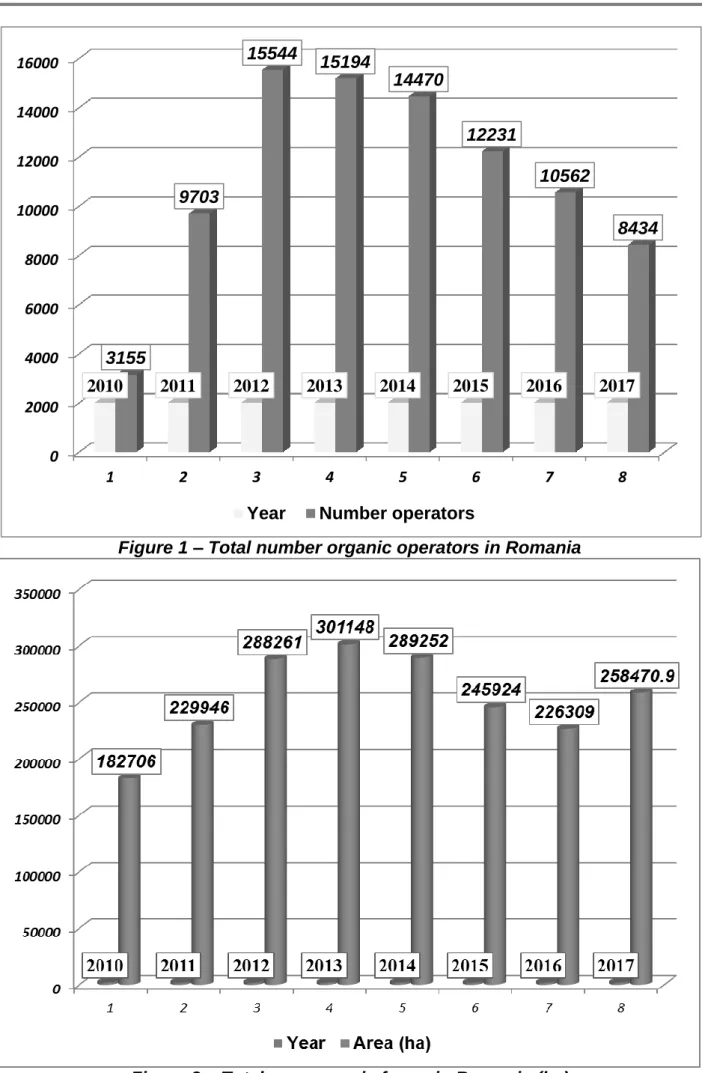
Results and discussions. As can be seen from Figure 1, the total number of operators involved in organic farming was maximum in 2012 (when Minister of Agriculture Order 181 was lanced and when subsidies for conversion and organic production were higher). This number has decreased over time until 2017, with competition between products being increasing and the compliance requirements with consolidated European Regulation 834/2007 consolidated and consolidated 889/2008 being increasingly complex.
Figure 2 shows the evolution of the areas cultivated in the organic farming system. It can be clearly seen that there has been a concentration of the ecologically worked areas in a smaller
number of operators and the largest ecologically cultivated area was recorded in 2013. For the past two years, there has been an increase in these areas. This growth continues - by expanding these areas to the edge of Protected Natural Areas, which will be influenced by the legislative changes in Romania in 2018 - regarding the custody of these territories, which are meant to protect biodiversity of flora and fauna in a certain danger of extinction (Savescu P., and coll, 2013)
152
roots was recorded in the years 2011-2012, years in which most of the operators who worked in the organic farming system - but who had only farm small areas.
The processing domain of these converting or even organic products was very poorly developed. Among the used species from which tubers and roots were potatoes, carrots, topinambur. Of these, topinambur (Helianthus tuberosus) was less used to construct of valuable food supplements or to inulin-concentrate separation (to replace sweeteners that were banned from eating people with diabetes or cardiovascular disease) (Savescu P. and coll, 2014).
The modern agriculture and
technological improvements have sharply increased yields from cultivation, but at the same time have caused widespread ecological damage and negative human
health effects (Bonciu E., 2012).
The topinambur (Jerusalem artichoke) was used mostly for animal feed, being an agricultural product that was less grown demanding and much more resistant to certain disease and pest attacks. In 2013, a Directive has been put in place in the European Union that promotes food wastage and promotes the cultivation of plants from the native flora, resistant to diseases and pests and from which more edible parts (tubers, leaves) are used as sources of very valuable bioactive compounds. These plants can also regulate the flow of micro- and macro-elements in the soil where they are growing, and through their high density and height they can be true protective barriers in the border areas of the Protected Natural Areas. All this helps to preserve and preserve the biodiversity of protected flora and fauna.
The feeding a growing world population is a major global challenge, which consists to increase agricultural productivity, guarantee access to food for all individuals, and at the same time
ensure food security for
consumers (Bonciu E., 2017).
A growing trend is also registered by the organic crops of technical plants (graph in Figure 4). This trend also includes organic hemp crops (Cannabis sativa) that are of particular interest to both growers and processors. For the development of special dietary supplements, one species of hemp seeds are used in Romania: Secuieni 1, Irene, Denise, Zenit, Diana, Dacia-Secuieni, Secuieni-Jubileu and Ratza - developed and cultivated in the Secuieni Agricultural Development Research Center, Neamt County, Romania. Here also developed a good ecological test - which is aimed at adaptability to the climatic conditions in the area of influence, the newest creations for autumn and spring cereals, legumes for beans and forage, textile plants, medicinal and aromatic plants and crops feed (http://www.scda.ro/testare-ecologica.html).
Very important in the development of very valuable and non-narcotic and hallucinogenic food supplements are Dacia-Secuieni varieties (with a fiber content of 31-33% and 0.013% THC content) and Jubilee Secuieni (with fiber content 20-24% and 0.002% THC content). On the food side, hemp seeds are much richer in protein, essential amino acids, Omega 3 and 6, compared to soybean, pumpkin or sesame seems. And in the pharmaceutical sector, hemp's intake is recognized even in cancer treatments. Also, hemp can extract the healthiest oil as well as environmentally friendly fuel.
The Romanian hemp has THC content (delta-9-tetrahydrocannabinol) far below 0.2%, the level required by the EU for industrial crops. On the other hand, compared to the other EU states, in our country, a law adopted in 2000, hemp is called generic "cannabis". There is no difference between THC-free cultivar varieties and THC-rich plant (V. Tabără, 2005)
153
from the Police, Health Minister and Agriculture Minister. Not only the cultivation of hemp is almost impossible in Romania, but also it’s processing for medicinal purposes. Thus, Order 244/2005 includes cannabis on the list of dangerous plants. In this Order of the Minister of Agriculture, no distinction is made between the plant with 50 thousand utilities and the one with the same ownership.
The hemp seed contains: 36% oil, 28% protein, 14-27% non-extractive extract, 17.8-26.3% cellulose and 2.5-6.8% ash. Thanks to this composition, hemp seeds can be used for extracting oil directly used in food and for margarine production. Unrefined oil is used to obtain varnishes, paints, linoleum, soap and waxed cloths.
In the group of hemp secreted substances, the most important are:
nacosone, cannabidiol,
tetrahydrocannabiol - constituents of the substance from hashish and marijuana. The hemp plant, especially the Indian one, has the biosynthetic ability to produce cannabiolicolic - cannabidiolic acid (DCBD), cannabidiol acid (CBD), tetrahydrocannabinolic acid (ATHC), cannabinol (CNB) and cannabinolic acid (ACNB).
ACBD and ATHC acids are predominant in plants until they are blossomed, then converted to CBD, CNB and THC (tetrahydrocannabinol). For this transformation to take place during the
flowering period, a daily average temperature of more than 32 ° C is required, which can be achieved only in the warmer climates of the globe and less in the conditions of Europe and Romania.
By the end of the vegetation period, by drying, some of the THC is converted to cannabinol (CNB), a pharmacologically inactive chemical compound. The transformation of THC into the CNB occurs also in the resin secreted by the bears on the inflorescence of the female plant, which greatly reduces its narcotic action.
Regarding to narcotic substances during the vegetation period, in the hemp plant has been produced two processes: transformation of ACBD into THC and transformation of THC into CNB - pharmacologically inactive. The first process is strongly dependent on light and high temperature. The second process takes place during plant transformations during maturation step.
The organic green crops have seen an increasing trend over the last 8 years (graph from the Figure 5), being highly demanded both in the development of food supplements - with a strong detoxifying and digestive role and as in the production of biomass.
154
Figure 1 – Total number organic operators in Romania
Figure 2 – Total area organic farms in Romania (ha) 0
2000 4000 6000 8000 10000 12000 14000 16000
1 2 3 4 5 6 7 8
2010 2011 2012 2013 2014 2015 2016 2017
3155
9703
15544 15194
14470
12231
10562
8434
155
Figure 3 – Organic plants grown for tubers and roots in Romania(ha)
156
Figure 5 – Organic green harvested plants in Romania (ha)
157
CONCLUSIONS
The Romania's ecological potential is insufficiently used and requires real awareness and support for all potential ecological operators.
In the framework of a Sustainable Development Strategy, the organic farming system should be promoted and disseminated to all stakeholders - because in Romania it can contribute to the simultaneous growth of the Natural Environment with the Social Environment and the Economic Environment.
The organic farming system can be an important source of raw materials for the design and development
of extremely valuable food supplements for certain categories of people
The Jerusalem artichoke (through the formed tubers and through the developed leaves) can be used with great success in the design of valuable nutraceuticals for patients with digestive disorders and diabetes.
The hemp residues resulting from the pressing of seeds in order to obtain very valuable oil can be used successfully in designing very high nutritional dietary supplements (rich in protein, riboflavin, amino acids).
BIBLIOGRAPHY
1. Belitz E., Grosch M., Schieberle P.,
2009- Food Chemistry,4-th Revised and Completed Edition, Springer Verlag, Berlin, p. 316-327, 701-703, 875-879;
2.Bonciu Elena, 2012. Cytological effects induced by Agil herbicide to onion. J. Hortie, Fores and Biotech, Vol. 16, no 1, pp. 68-72.
3.Bonciu Elena, 2017. Food processing, a necessity for the modern world in the context of food safety: A review. Annals of the University of Craiova-Agriculture, Montanology, Cadastre Series, Vol. 47, No 1, pp. 391-398.
4. Dobre Marian, 2015, - The Role of the Mulch Layer in the Success of No-Till Technology, ProEnvironment 8 , USAMV Cluj Napoca, p 216-221
5. Savescu P., Banta Cristina, 2005 - Promotion of the sustainable development programs –educational draft for a clean environment , Journal of Environmental Protection and Ecology (J.E.P.E.), Vol 6 (2), 288-294.
6. Savescu P., Vladu M.,, Environmental protection increasing according to the International Standards applied to food
factories. International Scientific GeoConferences SGEM, Albena BG, Vol I (2013), DOI: 10.5593/sgem2013, ISSN 409-416, pag. 1314-2704, ISI Proceedings,
http://sgem.org/sgemlib/spip.php?article3 306
7 Savescu P., Ana Maria Dodocioiu, Cristina Vladu, Boruz S.,, The development of Organic Farming in the EU and in Romania- big opportunity for reducing the risks and the hazards that occur in the foods production, Annals Of The University Of Craiova, Series Agriculture, Montanology, Cadastre, No1 (2014), Vol.44, pag. 243-247, ISSN 1841-83172066-950X (e), IDB,
http://anale.agro-craiova.ro/index.php/aamc/article/view/15 1/145
8. Tabara V., 2005, Fitotehnie, vol.II, Plante Tehnice tuberculifere și rădăcinoase, Editura Brumar