28
STUDY REGARDING INFLUENCE OF THE ORGANIC FERTILIZATION ON
THE MORPHOLOGICAL AND PRODUCTIVITY TRAITS TO THE
SOYBEAN (
GLYCINE MAX
)
BONCIU ELENA, IANCU PAULA
Keywords: soybean, Algafix, organic, fertilization, traits
ABSTRACT
In this paper, are presented the results concerning some elements of productivity under the influence of an ecological foliar fertilizer (compound of the green seaweed) namely Algafix applied to the soybean in 4 variants, along with untreated control. In comparison with untreated control, the variants fertilized with Algafix have recorded obvious increases in terms of plant height, number of branch pods/plant, number of pods/branch, number of pods/plant and the MMB. Also, the production showed significantly higher values to variants fertilized with Algafix compared with untreated control, the differences toward control being since insignificant positive (V3) until to significantly (V1) significantly distinct (V4) and very significantly (V2).
Results obtained suggest a positive significant effect induced by microbiologic fertilizer Algafix concerning the rapid and vigorous development with regeneration effect of soybean plants and, implicitly, with the higher production results compared to untreated control. We may think that seaweed can revolutionize the plant cellular activity, because it gives to plants everything it needs.
INTRODUCTION
Soybean (Glycine max) is one of the most important crop plants, with a variety of uses, such as food for humans and animals, and as feedstock for various industries. It is among the oldest cultivated plants, originating from China. A viable alternative to conventional farming is the organic farming system. Organic soybean is a basic food growing demand increasing natural protein in the European market, as, for example, tofu, soybean products greatly demanded by consumers of organic food.
The extreme weather conditions, the unfavorable soil properties, pathogens or pesticide residues accumulated in the soil, are factors that may affect the plant development. Stressors affecting young plants or crops during growth and development may affect safety of the crop. Without preventive aid, applied foliar or on the soil, the plant has no capacity for regeneration.Algafix is a special microbiological foliar fertilizer, who, uniquely, by means of the green seaweed and the substances obtained through photosynthesis assures for the host plant a good nutritional effect, thus achieving benefit for rapid and vigorous growth, with regeneration effect. Algafix application is recommended especially in cases where living conditions are sub-optimal for the plants growth. The microbiological formula to Algafix is "vitamin C of the plant" (4).
Seaweed can help remove toxins, heavy metals, lead and countless other chemicals which are linked to countless diseases so you can detoxify the body, fight infection and help regenerate the cells from the inside out. Seaweed actually binds to the heavy metal molecules and helps the body eliminate them (5).
29
applications. In a single treatment, the recommended dose is 2 liters/ha, in a 6-7 week growing season(4).
MATERIAL AND METHOD
The research in this paper was carried to study some morphological elements and productivity traits under the influence of the organic fertilizer (Algafix)based on green algae applied to soybean (Glycine max) in 4 variants experience, along with an untreated control, under organic farming system. The experiments were conducted in the experimental field of SD Banu-Maracine without irrigation. Soybean was being sown on April 15, 2014, at a density of 24 plants/m2. Organic fertilizer was provided by SC AgroBioforce SRL.
The dose of the fertilizer was 1 liter/ha, in two applications.First application of fertilizer Algafix was executed on June 6, 2014 (7 weeks from sowing) and the second application, on June 23, 2014 (at approx. 10 weeks after sowing).
Morphological characters studied were plant height and stem diameter, and productivity traits were:number of branch pods/plant, number of pods/branch, number of
pods/plant, number of grains/pods and MMB. Examinations and biometric measurements
were made both in the field and in the laboratory, in order to highlight any differences between the variants tested.
RESULTS AND DISCUSSIONS
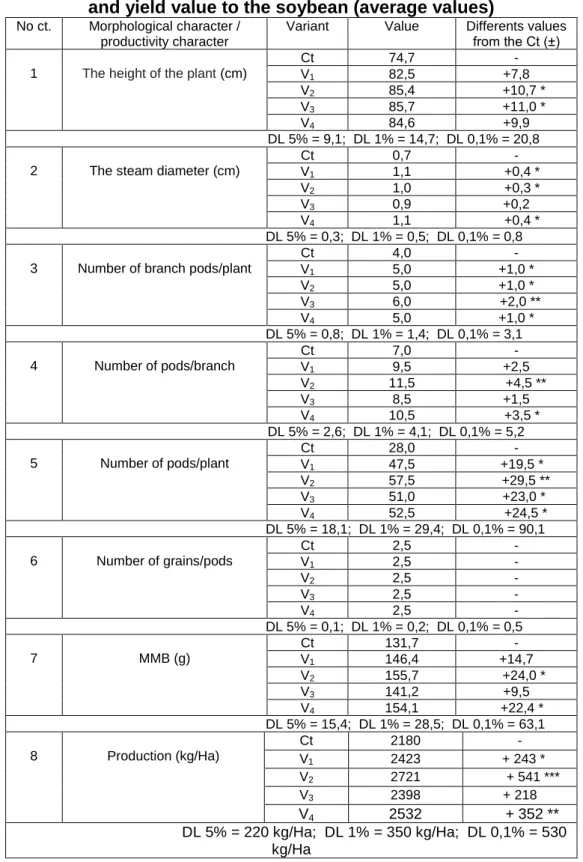
Experimental results on organic fertilization with Algafix on soybean are shown in Table 1.
Harvesting of soybean plants was made on September 11, 2014, when over 80 % of the pods were dry. In terms of plant height, the control without fertilization recorded an average of 74.7 cm, while all 4 variants fertilized with Algafix recorded averages values over the control values, with insignificant positive differences of 7.8 cm (V1) and 9.9 cm (V4) and significant positive of 10.7 cm (V2) and 11.0 cm (V3). Stem diameter recorded an average of 0.7 cm and all other variants recorded the higher values with positive differences between 0.2 cm (V3) and 0.4 cm (V1, V4).
In terms of productivity traits, the average of the number of branch pods/plant was 4 (the control variant), V3 variant recorded a value of 6 branch pods/plants, with a positive distinctly significant difference compared to the controlof 2 branch pods; to all other variants are all positive and significant differences.
Number of pods/branch had averages values between 7 pods (Mt) and 11.5 pods (V2), this variant registering a distinct significant positive difference of 4.5 pods/branch compared to the control.
Number of pods/plant recorded averages values from 28 (Mt) to 57.5 pods (V2); this variant it exceeds the control variant with a plus of 29.5 pods/plant, the difference is in this case distinct significantly positive.
The character of productivity number of grains/pods has not recorded different values from the control value, this character is genetically conditioned.
MMB values ranged between 131.7 g (Mt) and 155.7 g (V2), this variant recorded a significantly positive value, with 24 g compared to the control.
30
Table 1
Influence of the organic fertilization with Algafix on the morphological characters and yield value to the soybean (average values)
No ct. Morphological character / productivity character
Variant Value Differents values
from the Ct (±)
1 The height of the plant (cm)
Ct 74,7 -
V1 82,5 +7,8
V2 85,4 +10,7 *
V3 85,7 +11,0 *
V4 84,6 +9,9
DL 5% = 9,1; DL 1% = 14,7; DL 0,1% = 20,8
2 The steam diameter (cm)
Ct 0,7 -
V1 1,1 +0,4 *
V2 1,0 +0,3 *
V3 0,9 +0,2
V4 1,1 +0,4 *
DL 5% = 0,3; DL 1% = 0,5; DL 0,1% = 0,8
3 Number of branch pods/plant
Ct 4,0 -
V1 5,0 +1,0 *
V2 5,0 +1,0 *
V3 6,0 +2,0 **
V4 5,0 +1,0 *
DL 5% = 0,8; DL 1% = 1,4; DL 0,1% = 3,1
4 Number of pods/branch
Ct 7,0 -
V1 9,5 +2,5
V2 11,5 +4,5 **
V3 8,5 +1,5
V4 10,5 +3,5 *
DL 5% = 2,6; DL 1% = 4,1; DL 0,1% = 5,2
5 Number of pods/plant
Ct 28,0 -
V1 47,5 +19,5 *
V2 57,5 +29,5 **
V3 51,0 +23,0 *
V4 52,5 +24,5 *
DL 5% = 18,1; DL 1% = 29,4; DL 0,1% = 90,1
6 Number of grains/pods
Ct 2,5 -
V1 2,5 -
V2 2,5 -
V3 2,5 -
V4 2,5 -
DL 5% = 0,1; DL 1% = 0,2; DL 0,1% = 0,5
7 MMB (g)
Ct 131,7 -
V1 146,4 +14,7
V2 155,7 +24,0 *
V3 141,2 +9,5
V4 154,1 +22,4 *
DL 5% = 15,4; DL 1% = 28,5; DL 0,1% = 63,1
8 Production (kg/Ha)
Ct 2180 -
V1 2423 + 243 *
V2 2721 + 541 ***
V3 2398 + 218
V4 2532 + 352 ** DL 5% = 220 kg/Ha; DL 1% = 350 kg/Ha; DL 0,1% = 530
kg/Ha
31
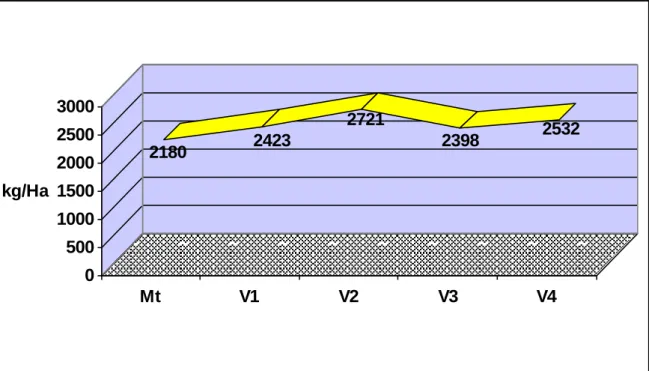
From the data obtained, one can see the significantly nutritiv effect of the organic fertilizer based of the seaweed Algafix and this effect is suggested by the higher production after treatment. Note that, two weeks after the fertilization with Algafix, the soybean culture has issued new shoots and flourished again. It seems that algae contained by Algafix have stimulated the plants regeneration and increased the resistance from the stress conditions.
Figure 1.The graphical representation of production values at the soybean variants fertilized with Algafix compared to the untreated control
Photo 1. Images of the experimental field
In the research of other authors, soybean has responded positively to treatment with biostimulators. For example, foliar application of the Bioalgeen-S90 has significantly
increased the nitrogen content in soybean aerial parts and stem (2).
2180 2423
2721
2398 2532
0 500 1000 1500 2000 2500 3000
kg/Ha
32
Also, the biostimulator Asahi SL applications in soybean cultivation significantly increased the height of plants and the first pod, formation the number of pods per plant, the number of seeds per plant and the yields of seed and straw (1).
The beneficial effects of some organic stimulators were confirmed by other authors to other plants species. Thus, into a Paulownia tomentosa (Thunb.) experience has been shown the positive effect of organic biostimulatorsAminosol, Bactofil and Biohumax. Among the treatments applied, Aminosol gave a significant advantage over the rest of the treatments in terms of seedlings vigor and Bactofil led to a good development of the root system (3).
CONCLUSIONS
The content of the seaweed from the Algafix formula has rapidly induced a strong regeneration effect, in that after two weeks of treatment, the soybean plants were given new shoots and blooming again.
Obviously the treatment influences the elements of the productivity.All tests carried out revealed the positive effect of treatment. Analysis by using biometrics demonstrates the stimulation processes of growth and development of soybean plants fertilized with Algafix, organic product based on the seaweed.
The treated variants were better developed in the height, had a greater stem diameter, several floors of pods per plant, more pods per plant and higher MMB values. In addition, variants treated have quickly entered in the flowering stage.
The average values of the production variants fertilized with Algafix have recorded significantly distinct positive values versus the untreated control, which suggests that the beneficial effect of the phytohormones, proteins and other nutritive substances content by the seaweed is great. Also, all elements play a key role in the metabolism of the plant and, consequently, in the results of soybean production.
We may think that seaweed can revolutionize the plant cellular activity, because it gives to plants everything it needs.
BIBLIOGRAPHY
1. Kozak, M. et al., 2008 – The effects of sowing rate and Asahi SL Biostimulator on soybean growt and yield.Journ. Biostimulators in modern agriculture, Field crops. Warsaw, Poland.
2. Redžepović, S. et al., 2008 –Effect of growth biostimulators and soybean seed
treatments with fungicides on symbiotic nitrogen fixation efficiency.Seed Science Journal, vol. 24, no. 3-4.
3. Soare Rodica, Păniţă, O., Bonciu Elena, Soare, M., 2014 – Research regarding the production of planting material for the decorative species Paulownia tomentosa Thumb. The 13th International Symposium “Prospects for the 3rd Millennium Agriculture”, U.S.A.M.V. Cluj-Napoca, p. 627.