117
PGA Scheduling with Cloud Computing
Rachhpal Singh, Harish Kumar Sharma
Sr. Asstt. Professor, P.G. Department of Computer Science & Applications, Khalsa College, Amritsar. Head, P.G. Department of Computer Science, RR Bawa D.A.V. College for girls, Batala.
Abstract
Execution of a large task and then further spliting the task into small multiple sub tasks that execute simultaneously and makes the exacution more fast is the concept of parallel computing. Faster output can be drawn with the capability of dividing the large task into modules. It is more beneficial and effective for large number of computation under some constraints like time, space, complexity constraints etc. Another crucial step in handling the parallel computing is the assignment of a set of tasks in the parallel system environment and makes the makespan set the execution in such a way that the total execution time is minimized. Cloud computing is the challanging job in the task scheduling. Efficient execution of the job schedule in parallel environment with cloud schedular that takes the structure of the application and the performance characteristics is proposed in this algorithm. There are number of algorithms in solving the task scheduling have been proposed. Such type of problem is heuristic NP-Hard problem. Research proposes Parallel Genetic Algorithm (PGA) to schedule tasks parallely on hetrogeneous parallel environment using genetic approach. It is a heuristic technique. In this paper the scheduling of jobs is a major problem. It includes - mapping of the task optimally, search of an optimal parallel system and to set sequence of job execution. The mechanism for the optimization of all the these components of scheduling techniques with the help of cloud schedular and genetic approach is experimanted and its performance is evaluated in comparison with some scheduling algorithms like First Come First Serve (FCFS), Round Robin (RR) and optimal scheduling and optimized result be evaluated.
Key words
Parallel Gentic Approach, DAG (Directed acyclic graph), Cloud computing, Task Scheduling.
I. INTRODUCTION
With the help of cloud computing task can be assigned and scheduling can be done as by assigning the tasks onto a set of processor called virtual machines and determining the sequence of execution of the task at each machine in the cloud environment [2]. The performance of the virtual machines in cloud computing plays a vital role for the execution of tasks in a sequence and compute the total finish time of the tasks. The execution of tasks using this scheduling criteria consists of four major elements [3]:
Evaluation of hetrogeneous virtual machines using a set of cloud, To enhance the performance of such system in the cloud environment, Scheduling of the tasks onto this virtual cloud environrmnt,
Mapping of and setting a sequence of these tasks on each processor ( having a virtual cloud machine).
All these major elements solve this optimization problem [4][5][10] and are highly dependent on each other and should not be optimized separately. Here a cloud scheduler (cloud user) generate an agreement with a cloud provider and utilizes the storage devices and server as a service and pays for the service. A cloud provider generates a computing system called cloud. Such type of cloud provider interconnects different virtual heterogeneous processors to process the different task for maximize and optimize purpose. So it makes a challenge for cloud computing to allocate the tasks efficiently to these virtual processors. It is an important issue in Cloud computing. Cloud computing satisfy the cloud users and it is the major achievement. It improves the efficiency of cloud providers [3]. Task scheduling in parallel environment with the help of cloud computing is being proposed by using the Genetic Algorithm (GA) approach. A GA approach [1][8] starts with a generation of individual. In this technique individuals are encoded as strings known as chromosome and a chromosome corresponds to a solution to solve the above said problem [2]. Each individual is evaluated by the fitness function. Three major opearions selection, crossover and mutation [15] are part of the GA based on some key parameters such as fitness function, crossover probability and mutation probability. All these parameters are used for the optimization of task scheduling.
This paper is categorized into five sections. Section I as previously discussed is the introduction about the concept and rest four are elaborated as follows: Section II tells an overview of the problem and methodology used. Detailed explanation about proposed parallel genetic algorithm in cloud computing environment is in section III. Section IV gives the experimental results with the performance analysis of the system. At last a conclusion was done in section V.
118
II. METHODOLOGY
Review of parallel algorithm classification is the basic requirement for the computation of the tasks scheduling. Different techniques based on their characteristics anlyize the scheduling critera. It depends upon the setting of the parallel environment and the availability of the information[6][7][9][11]. A huge task efficiently sub divided into a set of sub tasks having a particular format of appropriate grain size. This strategy is based on the idea of execution of these sub tasks on parallel computing system. Such type of an abstract model having the divided parts of sub tasks that can be represented by a natural and fast showing system called DAG. In other words it is called as Directed Acyclic Graph [12][13]. A precedence relationsip created among these sub tasks and can be scheduled in a particular format is the major achivement in this deterministic scheduling problem. A deterministic scheduling problem [14] is one in which all information about the tasks and the relation to each other such as execution time and precedence relation are known to the scheduling algorithm in advance and the processor environment is hetrogeneous[15][16]. The processors having different speed or and processing capabilities is the major achivemnt of heterogenity of processors. To compute and evaluate such type of system there be need of anlysis and to discuss the task scheduling problem in such type of environemnt. To determine the probabaility of occurance of a particular job in the heterogeneous parallel computing environemnet with the help of cloud computing is the basic need. To minimize the total task finish time (execution time + waiting time or idle time) i.e. minimize the makespan is the major goal in such type of system. Here a computing environment can takes place having the parallel multiprocessor with a set of x hetrogeneous machines and these are set under a cloud:
M = {mi: i =1, 2, 3…x}
There is a DAG showing the fully connected machines linked with each other via a network in the parallel computing environment under a cloud showing the occurance of taks scheduling be shown in the figure 1. Let Q = (t, e, w, c) be a DAG showing the scheduling application. Here t is the set of vertices and consist of s sub tasks. This whole is denoted in the generallized equation as:
t = {tj: j =1, 2, 3…s}
A set e is the directed edge consist of g edges and all are denoted with a super format as: e = {ek: g =1, 2, 3…r}
Figure 1. A fully connected having four parallel processor
There is a precedence relationships among tasks and can be represented with thier sub set mark. Suppose if there be a set of two tasks ti and ti+1 which are the part of a complete set t having a set of directed edges between these tasks is the ek , In
othere word edge from task ti to ti+1 is the interconnection between pre and post edge[17]. Here t also shows the working
and interconnection of the two adjasent tasks, i.e. ti+1 cannot be scheduled until ti has been processed completly and this
will continue till the whole system be processed [2]. This also makes the execution of the tasks in such type of environment fast and computation can be done easily. For advance compuation there be need of a communication cost and weight on these tasks, sub tasks and edges for the compuatation of the optimiaze result. Let take a set of weights of the vertices as in WT donted format with i and j interconnection of sub tasks on the e edges [18] and is represented in the
equation form as:
WT = {wi,j: i =1, 2, 3…a, j: 1, 2, 3,…b}
It represents the execution duration of the corresponding task and are varies from machine to machine in the parallel computing environment with cloud genetic operation. The elements set CC are the communation cost on thses machines during the processing of taks in a sequence and can be represented as:
CC = {ck: k =1, 2, 3…r}
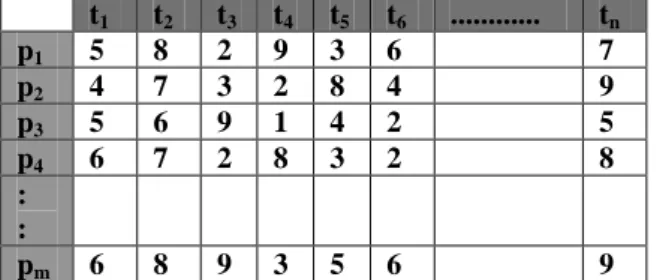
Communication cost between the two tasks for the evaluation of the data communication in such environment be represented by using this technique. In other words if jobs are scheduled to various machines and some problem occurs during communication, then how it can be scheduled is the major hinderence. Suppose if both tasks or sub tasks are scheduled to the same machine, then the weight associated to the edge becomes null [15]. A complete DAG having n jobs with communication costs and weight be as shown in the figure 3. How the different jobs works with the connection with edges be represented in the matrix format as shown in the table 1.
III. PRPOPOSAL OF PGA
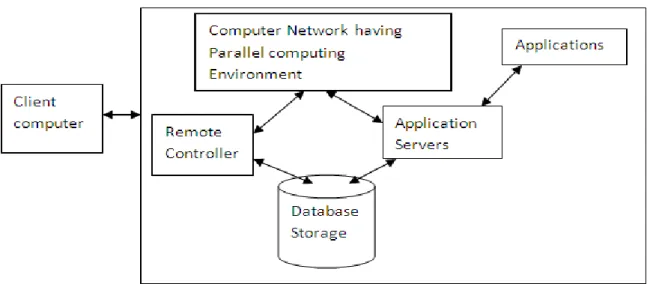
With the concept of cloud computing in parallel environment remote processors owned by another parallel environment can execute every task very easily via a network or internet. A complete view of cloud computing with parallel computer network is as shown in figure 2.
119
Gentic Approach has four major steps from the creation to optimaization. But when genetic approach occurs with the parallel algorithm, it makes it more evaluated. Here not take as quantititive, only consider it as qualitatitive. These are creation of string population, evaluation of strings from the population, selection of best string from the pool and again reproduction of another set of population .i.e. to create a new population. When the individuals are encoded in a particular fomat according to the cloud from the pool of string poulation is the concept of creation of chromosomes [1]. It is chromosome popualation and can be used according to the given set of data and initial indiviadual values. Fitness can be evaluated with the help of given set of chromosome. It works in a parallel environment set according to the given cloud. It also craete a cloud population. An apprpriate technique to compute the best cloud popualtion benefits the genetic opeartor for the compuatation of the best results. Each individual is having a fitness value to get the particular GA opeartion. It is also used for the creation of next generation for the good cloud parallel environemnt. To get it more accuarate, selection criteria be applied on the cloud set. Further if result set is going good then another operation like crossover and mutation are used for the compuation of best. A valid criteria must be taken so that appropriate operation can takes place. These operations are used in a particular cloud environment in such a way that the total execution time of the schedule should be minimum[10]. The various steps are as:
i). Cloud popualtion creation:Creation of the initial population is the first step in the GA. Some of the parameters like number of processors, number of tasks and population size are needed to generate initial population. The initial population is initialized with randomly generated individuals. The length of all individuals in an initial population is equal to the number of tasks in the DAG. Each task is randomly assigned to a processor[18]. Chromosome creation in the first generation with the help of cloud computing is necessary for further action.
ii). Fitness function computation: Proposed cloud GA uses the fitness function. It is based on the total completion time for the schedule. Execution time and communication delay time are also included in it. Task fitness and processor fitness are the two seprate parts for the comptation of the proper fitness value which creates a valid order or valid sequence of taks in the cloud. A valid order means that a precedence relations are satisfied [17].
120
As here all the tasks are executed on same processor, so the communication time is zero [11]. If communication time is zero, then it is idle and stop processing, but if it gives some execution values, then it is successful.
t1 t2 t3 t4 t5 t6 ... tn
p1 5 8 2 9 3 6 7
p2 4 7 3 2 8 4 9
p3 5 6 9 1 4 2 5
p4 6 7 2 8 3 2 8
: :
pm 6 8 9 3 5 6 9
Table 1: Shows a tasks execution matrix on different processors with task size = NxM.
So total finish time can be reduced by the proper fitness function.
iii. Cloud Selection:Selection operation is the direactly computation of the fitness value and find the best set of cloud chromosome for the enhancement of the results. Here select the superior and eliminate the inferior. Once fitness values have been evaluated for all cloud chromosomes, a good chromosomes set be selected using rotating roulette wheel strategy. [10].
iv. Cloud Crossover:Crossover operator randomly selects two parent chromosomes (chromosomes with higher values have more chance to be selected) and randomly chooses their crossover points, and mates them to produce two child (offspring) chromosomes [10].
v. Cloud Mutation: To reduce the idle time of a processor waiting for the data from other processors a mutation operation is designed. It works by randomly selecting two tasks and swapping them. Firstly, it randomly selects a processor, and then randomly selects a task [12] on that processor. This task is the first task of the pair to be swapped. Secondly, it randomly selects a second processor (it may be the same as the first), and randomly selects a task. If the two selected tasks are the same task the search continues on. If the two tasks are different then they are swapped over (provided that the precedence relations must satisfy).
The various phases of the cloud with Parallel Genetic Algorithm (PGA) are as follows:
1. Create a cloud with Parallel computer environment.
2. Create a DAG.
3. Create a task – processor execution matrix. In other word generate a node value.
4. Set the parameters values like cloud population size, cp-crossover probability, mp-mutation probability and mgen-maximum generation values.
5. At first generation g be zero value.
6. Initialize a list of randomly selected chromosome values from the cloud.
7. Fitness function or value be computed for each chromosome from the given set of cloud.
8. Cloud crossover swapping or operation on the chromosome from the given set of cloud be applied.
9. Perform the mutation operation or swap mutation process on chromosome from the selected cloud.
10. Cloud selected for the best set of chromosome be computed at end from the given set of cloud.
11. Test the result for final optimized solution and if achieved then stop the processing otherwise go to the step 4.
12. Get the optimized result from the final selected best set of chromosome from a given set of cloud.
IV. EXPERIMENTAL RESULTS AND PERFORMANCE ANALYSIS
Parellel Genetic Algorithm (PGA) in cloud computing environment be applied to the given DAG and get the best set of solution. The final result be computed on the MATLAB version 12a for the optimized results as shown in Figure 4.
0 50 100 150
10 20 30 40 50 60
Ti
m
e
Units
Number of Parallel Systems
Time Utilization
Optimal RR PGA
121
Figure 4. Time execution for the cloud computing schedule by PGA with some other scheduling criteria.
Speed up (Tsp): Speed up [12] is defined as the completion time on a uniprocessor divided by completion time on a
multiprocessor. In case of homogeneous system, it is denoted as: Tsp = p(1)/p(m). But in case of heterogeneous system, it
is denoted as Tsp= (min (p(1)) / p(m) i.e., the best uniprocessor completion time divided by the completion time on a
heterogeneous multiprocessor system. The speedup is measured with the execution of tasks on single processor and is as shown in Figure 5.
Figure 5. Speedup v/s number of parallel multiprocessor system in a cloud.
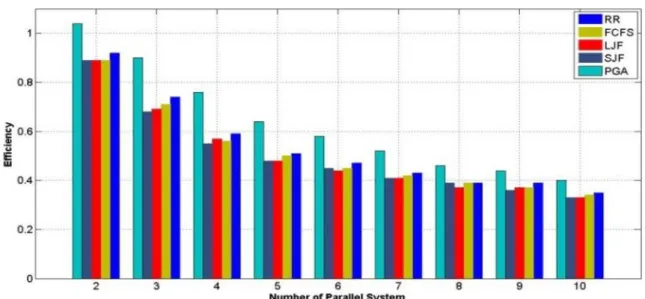
Efficiency (¢):(Tsp / m), where m is the number of processors.
Figure 6. Performance comparisons of the PGA with other scheduling critera in a cloud computing environment V. CONCLUSION
Parellel Genetic Algorithm (PGA) has been proposed in the cloud computing environment having various task scheduling criteria in heterogeneous parallel computing system to minimize the makespan and maximizing the throughput of such type of system. It is found a better solution for assigning the tasks to the heterogeneous parallel multiprocessor system in a cloud. After the discussion, experimental results and Parallel Genetic Algorithm are compared with other scheduling algorithms like FCFS, Round Robin (RR) etc. Finally the performance study is based on the best randomly generated schedule of the Parellel Genetic Algorithm having a particular cloud.
REFERENCES
[1] Anup Kumar, Sub Ramakrishnan, Chinar Deshpande, Larry Dunning, “ IEEE Conference on Parallel processing”, 1994, Page no.83-87.
[2] David E. Goldberg,”Genetic Algorithms in Search, Optimization and Machine Learning”, Published by Pearson Education, 2004, Page No.60-83.
0 1 2 3 4 5 6 7 8
10 20 30 40 50 60
Sp
e
e
d
u
p
Unit
Number of Parallel Systems
Speedup
Optimal RR PGA
122
[3] Sung-Ho Woo, Sung-Bong Yang, Shin-Dug Kim, and tack-Don Han ,” IEEE Trans on parallel System, 1997, Page 301-305.
[4] M.Salmani Jelodar, S.N.Fakhraie, S.M.fakharie, M.N. Ahmadabadi,” IEEE Proceeding”, 2006, Page No 340-347. [5] Man Lin and Laurence tianruo Yang,”IEEE Proceeding”, 1999, Page No 382-387
[6] Yajun Li, Yuhang yang, Maode Ma, Rongbo Zhu, “ IEEE Proceeding”, 2008.
[7] YI-Wen Zhong, Jian-Gang Yang, Heng-Nlan QI,” IEEE Proceeding”, August 2004, Page No. 2463-2468. [8] Imtiaz Ahmad, Muhammad K. Dhodhi and Arif Ghafoor,” IEEE Proceeding”, 1995, Page No. 49-53. [9] Ceyda Oguz and M.Fikret Ercan,” IEEE Proceeding”, 2004, Page No. 168-170
[10] Kai Hwang & Faye A. Briggs,”Computer Architecture and Parallel Processing”, Published by McGraw Hill ,1985.Page No. 445-47, 612.
[11] Andrei R. & Arjan J.C. van Gemund, “Fast and Effective Task Scheduling in Heterogeneous Systems”, IEEE Proceeding, 2000.
[12] Michael Bohler, Frank Moore, Yi Pan, “Improved Multiprocessor Task Scheduling Using Genetic Algorithms”, Proceedings of the Twelfth International FLAIRS Conference, 1999.
[13] Andrew J. page,” Adaptive Scheduling in Heterogeneous Distributed Computing System”, IEEE Proceeding, 2004.
[14] Jameela Al-Jaroodi, Nader Mohamed, Hong Jiang and David Swanson,” Modeling Parallel Applications Performance on Heterogeneous Systems”, Proceedings of the International Parallel and Distributed Processing Symposium (IPDPS’03)
[15] Yu-Kwong and Ishraq Ahmad, “Static Scheduling Algorithms for Allocating Directed Task Graphs to Multiprocessors”, ACM Computing Surveys, Vol. 31, No. 4, December 1999
[16] Wai-Yip Chan and Chi-Kwong Li, “Scheduling Tasks in DAG to Heterogeneous Processor System”, Proceeding IEEE 1998.
[17] Wojciech Cencek, “High-Performance Computing on Heterogeneous Systems”, Computational Methods in Science and Technology, 1999