MANAGING PROGRAM PROMOTION IN CABLE TV NETWORKS: A MODEL FRAMEWORK
Jagu P. Aiyer
Management Science Associates, 6565 Penn Avenue, Pittsburgh, PA 15232 Jayant Rajgopal*
2
Author Biographies
Jagu P. Aiyer is a software architect for cable TV products at Management Science Associates, Inc. in Pittsburgh. He also holds an adjunct appointment on the faculty of the Katz Graduate School of Business at the University of Pittsburgh. Prior to joining MSA, he was on the business faculty at Clarkson University and at Case Western Reserve University. He has a Ph.D. in Management Information Systems from Texas Tech University and his research interests are in the integration of quantitative modeling and information systems, especially as applied to the cable television industry.
Jayant Rajgopal is Associate Professor of Industrial Engineering at the University of Pittsburgh. He has a Ph.D. in Industrial and Management Engineering from the University of Iowa, and his research interests are in operations research and applied statistics and his work has been published in a number of different journals. He is a member of INFORMS, a senior member of the Institute of Industrial Engineers, and a licensed professional engineer in the state of Pennsylvania.
MANAGING PROGRAM PROMOTION IN CABLE TV NETWORKS: A MODEL FRAMEWORK
ABSTRACT
Advertising revenues are the primary source of income for cable television networks and the survival of a network strongly depends on the efficient management of its commercial inventory. Networks enter into advertising contracts that promise delivery of a certain number of impressions with specified demographic characteristics. However, the actual delivery of impressions is stochastic, and there is currently no systematic process to dynamically monitor and administer these contracts. This paper proposes a procedure to manage this process through the efficient use of program promotions. Starting with the notion of program elasticity, it develops a quantitative framework based upon a three-stage model for managing program promotions. The three-stages of the model are illustrated with data abstracted from an actual cable network.
INTRODUCTION
About 64 million households receive cable television today and about 95% of these receive at least 30 channels; these include broadcast and local channels as well as premium and non-premium cable channels. New cable channels are debuting by the day and it is expected that by the turn of the century the average household could receive several hundred channels. A cable network differentiates itself from its competition through programming that reflects its own unique image. This distinct identity allows the network to attract specialized audiences with specific demographic and psychographic characteristics. The driving force behind cable’s growth has been the effective marketing of niche services, and it is this feature that is expected to pave the way in the future for the dominant players in the industry (Littleton 1996). Advertisers find cable more attractive than traditional broadcast networks because it affords them the opportunity to target niche audiences with advertisement campaigns designed especially for them. Using cable, advertisers can design different campaigns for different demographics and use appropriate
2
With the proliferation of cable networks the audience is becoming increasingly fragmented. Consequently, competition for advertising dollars is becoming more intense, and the survival of a cable network depends on its ability to attract and retain viewers who are demographically attractive to advertisers. Typically, a cable network enters into a contract with an advertising customer to air a set of commercial spots within some collection of programs, to be broadcast by the network over some period of time. The contract usually guarantees the delivery of some total number of viewer impressions with specified demographic characteristics. This guaranteed delivery is based upon estimates of the audience for the network’s programs. However, the actual audience for a program could turn out to be quite different from such an estimate, and the actual delivery of impressions achieved as the programs air is stochastic in nature. Thus the actual delivery is often smaller than the number promised and when this happens, the network must run additional free spots for the customer to make up the deficiency. While this is obviously undesirable, the opposite case where the number is exceeded is also undesirable since the network is not compensated for any extra impressions delivered. Effective management of the available commercial inventory is thus critical.
A major marketing instrument used by a network to draw and retain audiences is program promotion. It should probably be mentioned at this point that we use the term "promotion" in a very narrow context here. To most people in traditional marketing, promotion generally refers to the large number of communication tools available to a marketer. In this paper the term is used to refer only to in-house network program advertising. The reason for retaining this terminology is that this limited interpretation is standard in the cable television industry and we wish to maintain the specific industry focus of this paper. The reader should thus bear in mind that the term promotion as used here refers to the advertising done by a network to promote viewership of its programs.
Effective promotion management is critical for a network to remain profitable and competitive. While a network cultivates its own distinct image over the long haul, promotions help to develop a loyal audience over the life cycle of a specific program by drawing extra viewers to it. This paper is based upon the fact that this ability to influence viewership levels provides an opportunity for a network to satisfy contractual agreements
made with its advertisers in a very cost-effective manner. Thus far, networks have never approached promotion management with this specific objective in mind and current practice is to promote all of their programs more or less across the board.
In order to manage the promotion of cable TV programs we propose a continuous and over-lapping cycle of three major steps: (1) planning and assessing promotional needs, (2) scheduling promotional spots, and (3) evaluating promotion effectiveness. The assess-ment process includes identifying the programs in need of promotion (known as the target programs) as well determining the extent to which these programs need to be promoted. Promotional inventory (the air-time available for promotional spots) is limited. The effective deployment of this inventory translates into allocating this limited inventory among different programs needing promotion in an optimal manner. The second step involves the scheduling of promotional spots within programs; such programs are called host programs. Finally, a promotion schedule must be evaluated after the promoted programs air in order to see if the desired results were achieved.
This paper focuses on the first two steps. Its objective is to develop a model-based framework for optimizing the promotion management process and maximizing revenues. It offers a step-by-step approach to each of the ingredients of promotion management. In the next section, we discuss the impact of promotion on revenues, followed by a brief review of the promotion management function. Following this we develop in detail the problem of promotion requirements assessment and suggest a modeling framework for determining these requirements. These requirements are then used in a model to analyze, develop and schedule promotions. Illustrations are provided for all of our models.
IMPACT OF PROMOTIONS ON REVENUE
Most cable networks are supported by advertisement revenue. Commercial inventory is imbedded in programs and is sold to advertisers with a guarantee of a certain amount and type of exposure, measured in impressions of a certain demographic. Such sales contracts are called deals in industry parlance. A deal consists of a set of programs, a set of spots within each program, time periods when they will air, a target demographic,
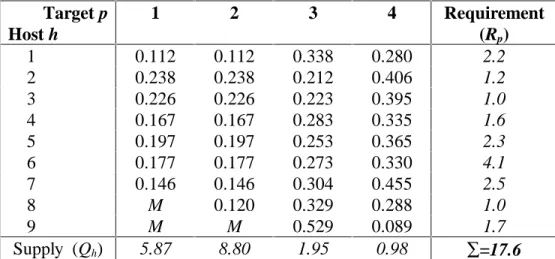
25 Target p
Host h
1 2 3 4 Requirement
(Rp)
1 0.112 0.112 0.338 0.280 2.2
2 0.238 0.238 0.212 0.406 1.2
3 0.226 0.226 0.223 0.395 1.0
4 0.167 0.167 0.283 0.335 1.6
5 0.197 0.197 0.253 0.365 2.3
6 0.177 0.177 0.273 0.330 4.1
7 0.146 0.146 0.304 0.455 2.5
8 M 0.120 0.329 0.288 1.0
9 M M 0.529 0.089 1.7
Supply (Qh) 5.87 8.80 1.95 0.98 ∑=17.6
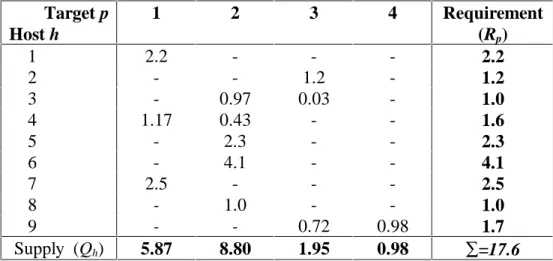
Target p Host h
1 2 3 4 Requirement
(Rp)
1 2.2 - - - 2.2
2 - - 1.2 - 1.2
3 - 0.97 0.03 - 1.0
4 1.17 0.43 - - 1.6
5 - 2.3 - - 2.3
6 - 4.1 - - 4.1
7 2.5 - - - 2.5
8 - 1.0 - - 1.0
9 - - 0.72 0.98 1.7
Supply (Qh) 5.87 8.80 1.95 0.98 ∑=17.6
27
Figure 1: Promotions Requirement Planning Process
Audience Spots and Deals Deficiencies
Deal Delivery
Analysis Program
Elasticities
Promotion Requirement Program Elasticity
Analysis Analysis
Target Programs Host Programs & &
Requirements Promotions Availability
Promotion Scheduling
Promotion Schedule
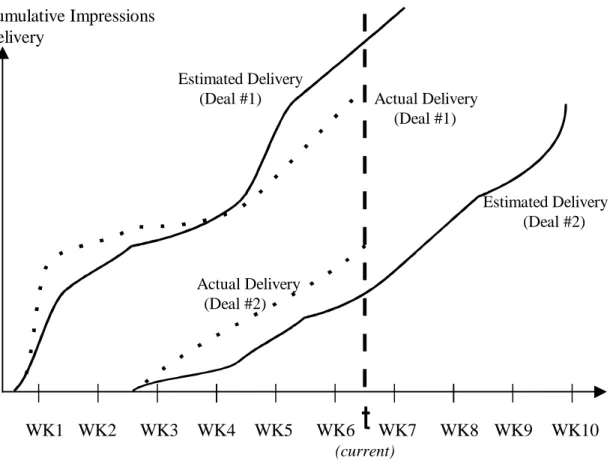
Figure 2:Deal Delivery Analysis Cumulative Impressions
Delivery
Estimated Delivery
(Deal #1) Actual Delivery
(Deal #1)
Estimated Delivery (Deal #2)
Actual Delivery (Deal #2)
WK1 WK2 WK3 WK4 WK5 WK6 WK7 WK8 WK9 WK10 (current)
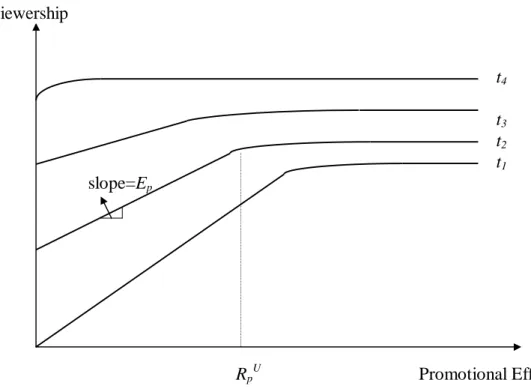
29 Viewership
t4
t3
t2
t1
slope=Ep
Rp U
Promotional Effort