Figure Credit: Kenny Gruchalla and Francois Usseglio-Viretta, NREL
Kandler Smith
Electrochemical Energy Storage - Computational Modeling Team Lead
National Renewable Energy Laboratory, Golden CO
[email protected]
Accelerating Electric Vehicle Adoption
& Battery Design
Outline
•
Transportation Electrification
•
Battery Cost
•
Lithium-based Chemistries – Today & Future
•
DOE & NREL Research & Development
–
Low/No Cobalt Cathodes
–
Recycling (RECELL)
–
Extreme Fast Charging (XCEL)
–
Behind the Meter Storage (BTMS)
Batteries and Electrification
•
New York International Auto Show: more than
40 electrified vehicles
•
EPRI: Utilities are proposing ~$3.7B in EV
charging infrastructure
•
CEO of Daimler Trucks North America: For
commercial vehicles “The beginning of the post
internal combustion engine era”
2020 Chevy
Bo
lt |
A
da
m
Je
ffe
ry
| CN
BC
https://www.cummins.com/news/2018/04/23/cummins-puts-electrification-progress-display
Energy Storage: Battery Cost Story – The Past
“
Rapidly falling costs of battery packs for electric vehicles
”, B. Nykvist and M. Nilsson;
Nature, Climate
Change;
March 2015, DOI: 10.1038/NCLIMATE2564
95% conf. interval, whole industry
95% conf. interval, market leaders
Publications, reports, and journals
News items with expert statements
Log fit of news, reports, and journals: 12 ÷
6% decline
Additional cost estimates without a clear method
Market leader, Nissan Motors (Leaf)
Market leader, Tesla Motors (Model S)
Other battery electric vehicles
Log fit of market leaders only: 8 ÷
8% decline
Log fit of all estimates: 14 ÷
6% decline
Future costs estimated in publications
2005
2010
2015
2020
2025
2030
2,000
1,600
1,800
1,400
1,200
1,000
800
600
400
200
2014 U
S$
/
kW
h
DOE cost target $100/kWh
w/ ultimate goal of $80/kWh
2012 DOE cost
target $600/kWh
2018 DOE cost
$197/kWh
2022 DOE cost target
$100/kWh
Conventional Li-ion Chemistries
Samu Kukkonen, VTT Technical Research Centre of Finland (2014)
Anode/Cathode Combinations
Decreasing Energy Density
Graphite/
LCO
Graphite/
NCA
Graphite/
NMC
Graphite/
LMO-Blend
Graphite/
LFP
LTO/NMC
Safety
Energy
Lifetime
Charge
Cost
Future Supply
LCO – Lithium Cobalt Oxide; NCA – Nickel Cobalt Aluminum; NMC – Nickel Manganese Cobalt
LMO – Lithium Manganese Oxide; LFP – Lithium Iron Phosphate; LTO – Lithium Titanate Oxide
Energy Storage: Battery Cost Story – The Future
Sy
st
em C
os
t (
$/
kW
h)
$200
$600
$500
$400
$300
$100
Year
2014
2020 2022 2024
2012
2016 2018
2026
$197/kWh
Graphite/High
Voltage NMC
Silicon/High
Voltage NMC
2028 2030
Lithium-Metal or
Lithium/Sulfur
$320/kWh (5x excess Li, 10%S)~$80/kWh
Graphite/High Voltage NMC
Silicon/High Voltage NMC
Lithium-Metal & Li/Sulfur
•
R&D Focus: Higher cathode
capacity (220+ mAh/g), low/no
cobalt, recycling, fast charge
•
R&D Focus: Higher anode
capacity (1000+ mAh/g),
cycle/calendar life, fast charge
•
R&D Focus: Solve cycle life/
catastrophic failure issues, reduce
excess lithium, reduce excess
electrolyte, reduce lithium metal
cost
Energy Storage: DOE R&D Portfolio
CHARTER: Develop battery technology that
will enable large market penetration of
electric drive vehicles
2022 GOAL: $150/kWh
(useable)
Critical materials-free with recycled materials and
capable of fast charge
Energy Storage R&D
Battery Testing,
Design, & Analysis
Battery
Development
Applied Battery
Research (ABR)
Battery Materials
Research (BMR)
Li-Based Chemistry Selection for Higher Energy Density
J.-M. Tarascon and M. Armand, Nature Vol. 414, p. 359 (2011)Cathodes
Anodes
Desire large
potential difference
between anode
and cathode…
Li-ion Cell Configurations
Photo Credit: NREL-Dirk Long Photo Credit: https://en.wikipedia.org/wiki/List_of_battery_sizes
Photo Credit: http://ewi.org/ultrasonic-metal-welding-for-lithium-ion-battery-cells/ Photo Credit:
http://sustainablemfr.com/energy-efficiency/lowering-costs-lithium-ion-batteries-ev-power-trains#lithium
• Cylindrical:
• Jellyroll
• Hard can
• Prismatic:
• Wound or stacked layers
• Soft pouch or hard can
Battery Packs in Some EVs
http://autogreenmag.com/tag/chevroletvolt/page/2/
Chevy Volt
Nissan Leaf
http://inhabitat.com/will-the-nissan-leaf-battery-deliver-all-it-promises/
http://www.caranddriver.com/news/car/10q4/2012_mitsubi
shi_i-miev_u.s.-spec_photos_and_info- auto_shows/gallery/mitsubishi_prototype_i_miev_lithium-ion_batteries_and_electric_drive_system_photo_19
i-MiEV
http://www.metaefficient.com/cars/ford-focus-electric-nissan-leaf.html
Ford Focus
Tesla Model S
https://hackadaycom.files.wordpress.com/2 014/09/tesla-batt.jpg?w=800
http://www.ibtimes.com/articles/79578/20101108/sb-limotive-samsung-sdi-chrysler-electric-car.htm
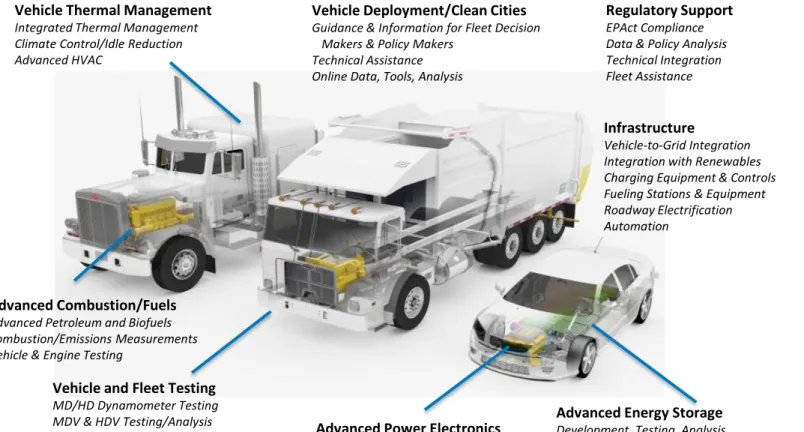
NREL Transportation RD&D Activities & Applications
Illustration by NREL
Advanced Energy Storage
Development, Testing, Analysis Thermal
Characterization/Management Life/Abuse Testing/Modeling Computer-Aided Engineering Electrode Material Development
Advanced Power Electronics
and Electric Motors
Thermal Management Thermal Stress and Reliability
Infrastructure
Vehicle-to-Grid Integration Integration with Renewables Charging Equipment & Controls Fueling Stations & Equipment Roadway Electrification Automation
Vehicle and Fleet Testing
MD/HD Dynamometer Testing MDV & HDV Testing/Analysis Drive Cycle Analysis/Field Evaluations Technology Performance
Comparisons
Data Collection, Storage, & Analysis Analysis & Optimization Tools
Regulatory Support
EPAct Compliance Data & Policy Analysis Technical Integration Fleet Assistance
Advanced Combustion/Fuels
Advanced Petroleum and Biofuels Combustion/Emissions Measurements Vehicle & Engine Testing
Vehicle Thermal Management
Integrated Thermal Management Climate Control/Idle Reduction Advanced HVAC
Vehicle Deployment/Clean Cities
Guidance & Information for Fleet Decision Makers & Policy Makers
Technical Assistance Online Data, Tools, Analysis
DUMMY
Lower cost of
batteries
Lower
environmental
impacts
Increase USA’s
energy security
Realizing
Next-Generation
Cathodes for
Li-Ion
Batteries:
Low-Cobalt
Cathodes
•
The objective of this
Argonne National Lab
(ANL) led project is to
realize capacity,
high-energy cathodes with
stabilized long-term
performance.
•
The project is developing
lithiated transition-metal
(TM) oxides, in concert
with strategies to
minimize/ eliminate cobalt
as well as particle
surface-engineering efforts to
mitigate the effects of
surface reactivity.
•
NREL is exploring Co-free
cathode materials and
advanced electrolytes to
stabilize nickel-rich
surfaces.
Developed Epitaxial High Nickel Cathodes Model Electrodes
Understand how surface chemistry affects electrochemical
reactivity at NMC surfaces using AFM/SECM
MISSION: Minimize the cost of recycling lithium ion batteries to ensure
future supply availability of critical materials and decrease energy usage
Direct recycling
minimizes steps
back to use
Decrease the cost of recycling
lithium-ion batteries to ensure
future supply of critical
materials and decrease energy
usage compared to raw
material production
Why is Extreme Fast Charging (XFC) Important?
•
DC Fast Charging Increases BEV
Utility
–
Yearly electric vehicle miles
(
eVMT
) traveled
increases with
use of 50 kW
fast charging
–
Nearly
25% more miles
driven
annually
when DCFC used
for 1-5%
of total charging events
Source: McCarthy, Michael. “California ZEV Policy Update.” SAE 2017 Government/Industry Meeting, Society of Automotive Engineers, 25 January 2017, Walter E. Washington Convention Center, Washington, DC. Conference Presentation.
Level 1 (110V, 1.4kW) Level 2 (220V, 7.2kW) DC Fast
Charger (480V,
50kW)
Tesla SuperCharger (480V, 140kW)
XFC (1000V, 400kW) Range Per Minute of Charge (miles)
0.082
0.42
2.92
8.17
23.3
Time to Charge for 200 Miles
(min)
2143
417
60
21.4
7.5
•
EV Service Equip (EVSE)
Comparison
–
XFC should be able to
charge
a BEV in less than
10 minutes
and provide approximately
200
additional
miles
of driving
range
Thick graphite electrodes increase energy density but decrease XFC
•
Greater EV driving range needs energy-dense electrodes
•
Slow transport of Li
+
ions in electrolyte + graphite limitations
Li plating side reaction
Increasing Li deposition on graphite electrodes as a function of capacity loading (electrode thickness)
•
Lithium may or may not removed during the following discharge cycle
•
Stranded lithium can be a safety issue
Advanced electrolytes, electrode architectures and elevated temperature all
can enable fast charging of 250 Wh/kg graphite-based Li-ion batteries
NREL | 20
Partnership with the U. S. Department of Energy Buildings
Technology Office and Solar Energy Technology Office
Behind-the-Meter Storage
Project
Goal:
To produce behind-the-meter storage
solutions to enable high-power electric-vehicle
charging coupled to a grid interactive efficient
building.
•
Focus on specific end user outcomes
•
Minimize cost of energy to user
•
Buildings are the largest electrical users.
•
EVs will be charged at buildings.
•
Demand charges need to be eliminated.
•
Grid impacts minimized.
•
Integration of PV is/will be common.
•
Both electrons and heat need to be stored.
•
New batteries are needed
NREL | 21
Physics of Li-Ion Battery Systems in
Different Length Scales
Li diffusion in solid phase Interface physics
Particle deformation & fatigue Structural stability
Charge balance and transport Electrical network in composite electrodes
Li transport in electrolyte phase
Electronic potential & current distribution Heat generation and transfer Electrolyte wetting Pressure distribution
Atomic Scale
Particle Scale
Electrode Scale
Cell Scale
System Scale
System operating conditions Environmental conditions Control strategy
Module Scale
Thermal/electrical inter-cell configuration Thermal management Safety control Thermodynamic properties Lattice stabilityMaterial-level kinetic barrier Transport properties
Many disparate
disciplines
involved in
battery R&D.
Computational
models
effectively
communicate
tradeoffs and
accelerate R&D
and design.
NREL | 22
c
e
c
s
MSMD
CAEBAT1
CAEBAT2-3
Parameter IDMechanical Abuse
3D Simulation Microstructure Tomography, Analysis, Stochastic Reconstruction
+XFC
*Computer-Aided Engineering of Batteries Program
+TARDEC
Bullet PenetrationComputer-Aided
Engineering for
Batteries: Tools
for Industry
DOE’s Vehicle Technologies
Office established
Computer-Aided
Engineering for Batteries
(CAEBAT) in 2010 to
develop experimentally
validated software design
tools to accelerate battery
product development time
and reduce cost.
Commercial CAEBAT
modeling tools are widely
used across industry.
www.nrel.gov
Thank You!
Questions?
This work was authored in part by the National Renewable Energy Laboratory, operated by Alliance for Sustainable Energy, LLC, for the U.S. Department of Energy (DOE) under Contract No. DE-AC36-08GO28308. Funding provided byU.S. Department of Energy Vehicle Technologies Office. The views expressed in the article do not necessarily represent the views of the DOE or the U.S. Government. The U.S. Government retains and the publisher, by accepting the article for publication, acknowledges that the U.S. Government retains a nonexclusive, paid-up, irrevocable, worldwide license to publish or reproduce the published form of this work, or allow others to do so, for U.S. Government purposes.