P R O T O C O L
Open Access
The effectiveness of interventions to
reduce peripheral blood culture
contamination in acute care: a systematic
review protocol
J. A. Hughes
1,2*, C. J. Cabilan
3, Julian Williams
2,4, Mercedes Ray
2and Fiona Coyer
1,5,6Abstract
Background:Blood cultures are an integral part of the diagnosis of bacteremia in unwell patients. The treatment of bacteremia involves the rapid and accurate identification of the causative agent grown from the blood cultures collected. Contamination of blood cultures with non-pathogenic microbes such as skin commensals causes false positive results and subsequent unnecessary and potentially harmful interventions. While guidelines for blood culture quality recommend no more than 2–3% contamination rate, rates up to 12% are reported in the literature. There have been a number of methods proposed to reduce the contamination of blood cultures, including educational interventions, changing of skin cleansing preparations and introduction of blood culture collection packs in acute care settings. This protocol outlines methods to identify and evaluate interventions to reduce blood culture contamination in the acute care setting.
Methods:The reviewers will conduct a systematic search of literature in CINHAL, PubMed, EMBASE and the CochraneCentralregister of controlled trials. Unpublished works will be identified in ProQuest Dissertations and Theses. Articles will be assessed for relevance based on their title and abstract. Remaining relevant citations will have their full text retrieved and assessed against eligibility criteria. All studies that meet the eligibility criteria will have their methodological quality appraised. Assessments for relevance and methodological quality will be conducted independently by two reviewers. If appropriate, data will be analysed using the Mantel-Haenszel method under a random effects model. Heterogeneity of the studies will be assessed using theI2and chi-squared statistic. Meta-analysis will be attempted if the data is suitable.
Discussion:This review will identify and summarise the interventions previously described in the literature aimed at reducing peripherally collected blood culture contamination rates in acute care. These findings have the potential to lead to multifaceted interventions based on previous evidence to reduce blood culture contamination in the acute setting. Reductions in the proportion of contaminated blood cultures have the potential to save money, unrequired treatment (particularly antimicrobials) and hospital bed days.
Systematic review registration:In accordance with guidelines outlined in the PRISMA-P methodology, this protocol was registered with the International Prospective Register of Systematic Reviews (PROSPERO) on December 8, 2017, and last updated on January 4, 2018 (registration number CRD42017081650).
Keywords:Systematic review, Blood culture, Contamination, Microbial contamination, Acute care, Peripheral blood collection
* Correspondence:[email protected] 1
School of Nursing, Queensland University of Technology, Brisbane, Australia
2Emergency and Trauma Centre, Royal Brisbane and Women’s Hospital,
Ground Floor, Dr James Mayne Building, Butterfield Street, Herston, Brisbane, Queensland 4029, Australia
Full list of author information is available at the end of the article
Background
A blood culture (BC) is a test designed to detect viable bacteria or fungi in the bloodstream. A sample of blood ob-tained using a sterile technique is placed in a culture media and incubated in a controlled environment, usually between 1 and 7 days [1,2]. Blood can be collected by a number of different methods, but is usually collected from a peripheral vein by direct venipuncture or drawn from an existing inva-sive device such as a peripheral cannula or central venous access device. Both methods have the opportunity to intro-duce microorganisms that are not present in the blood into the blood sample. Outside of intensive care and oncology treatment areas, blood for culture is most commonly collected from a peripheral vein, either via dedicated vene-puncture or through an existing peripheral intravenous catheter (PIVC) device. At the bedside, prescribed volumes of collected blood are immediately transferred to bottles containing aerobic and anaerobic culture media.
Blood cultures are an essential diagnostic tool for the identification and treatment of bacteremia. Bacteremia is a significant source of morbidity and mortality, with up to 37% mortality reported [3]. The treatment of bacteremia requires the rapid and accurate identification of the causative organism [4]. As for any test or proced-ure conducted in healthcare, the quality of the results from the analysis is directly attributable to the quality of the process in which the procedure was carried out. Blood cultures are not immune to variations in quality secondary to variations in collection techniques. Con-tamination of BC with organisms not originating from the blood of the patient is common. Current guidelines recommend that institutions should aim for a maximum of 2–3% contamination rate for BC collected [5–7]. Other guidelines recommend testing from at least two peripheral culture sites with at least 7 mls of blood in each culture bottle (both aerobic and anaerobic) [3].
Contamination rates in BC vary in the literature, with reported figures between 3 and 12% [7–13]. However, most baseline contamination rates reported are above the 3% recommendation in the current guideline [5]. Some of the variation in reported contamination rates may relate to differing criteria used to define contamin-ant organisms. The Clinical and Laboratory Standards Institute defines contamination as a“microorganism iso-lated from a blood culture during specimen collection or processing [and was] not pathogenic for the patient from whom the blood was collected” [2,p.2]. Some authors specify microorganisms that are considered contami-nants [8–10], while other authors refer decisions regard-ing contaminant status to contributregard-ing microbiologists [11]. Contamination rates provide an important metric on quality of care delivery and should be maintained at the lowest possible rate regardless of the differences in the definitions used.
Blood culture contamination is a significant problem be-cause it increases the incidence of false positive results. Contaminated or false positive BC may have detrimental effects to the patient, the organisation and to antimicrobial stewardship efforts. Contaminated BC may result in un-necessary treatment to the patient [3]. Patients who have a false positive BC have an extended stay in hospital com-pared to those patients who have a negative BC. In the North American setting, this has been quantified as an additional 4.5-day length of stay for patients with false positive BC compared to those patients with true negative results [3, 10,12]. In the UK, it has been shown that pa-tients with false positive BC results extend their hospital length of stay by 5.4 days [10]. Numerous studies have identified the financial burden of BC contamination, such as costs of cultures, increased length of stay, and pharmacy costs [3,7,10,12,13]; however, many of these estimates of cost are based on figures by Bates et al. work from 1991 and may not be relevant to current healthcare expenditure. Contemporary reports (from a district teaching hospital in Ireland) have reported costs $7500 per patient with a false positive blood culture [10]. The collection of contaminated BC also has the unwanted effect of prolonging broad-spectrum antibiotic therapy [3]. The increased use of antibiotics (especially broad—spectrum) for extended periods of time can lead to resistance in the microbes present. Antibiotic resistant bacteria are one of the greatest challenges in healthcare today. With increasing rates of resistance and fewer new antibiotics being manufactured, judicious use of currently available broad-spectrum antibi-otics is paramount [14].
Some interventions have been proposed to reduce the number of contaminated BC in the acute care environ-ment. These have included informational responses, such a regular emails outlining the current contamination rates [7,
9, 12,13, 15, 16], the introduction of chlorhexidine swabs at the point of collection [11,13,17] specialised collection packs [8, 12, 15, 18] and individual feedback on rates of contamination and procedural technique [7, 16, 19]. The grouped effectiveness of these interventions is unclear. There are three previous papers that provide aggregated results of interventions to reduce BC contamination. All three of these works have limitations that will be mitigated in this systematic review. One study provided a literature review with limited databases searched and no attempt at meta-analysis [20], another only reviewed skin antiseptic interventions [21] and the third reported on a limited num-ber of interventions [22]. This systematic review will look at all reported interventions aimed at reducing the amount of contaminated peripheral BC in the adult population.
for contamination that are not present in peripherally col-lected cultures. The main outcome of interest will be re-duction in contamination rates of peripherally collected blood cultures, while other outcome measures such as the reduction in antimicrobial usage, time spent in hospital and costs of providing care will be examined if the litera-ture allows.
Methods/design Objectives
The aims of this systematic review are to identify inter-ventions reported in the literature which aimed to re-duce contamination from peripherally collected BC and to evaluate the effectiveness of these interventions.
Inclusion criteria
Studies that meet the following criteria will be included in this systematic review.
Study designs
The review will include all studies that assess the effect-iveness of intervention/s against a control or usual care. The studies will include randomised controlled trials, quasi-experimental studies, pretest-posttest and time series designs. Studies that do not have a control or comparator group will not be considered for inclusion.
Participants
Studies on all groups of adult acute care patients will be included in this review. Interventions aimed specifically at populations under 16 years old or using paediatric blood culture collection bottles will be excluded. The use of paediatric blood culture bottles typically uses one and not two bottles; therefore, there is less chance of contamin-ation. Patients under the age of 16 years may have differ-ent contamination risk compared to adults and therefore should be studied separately. If sufficient evidence is found then subgroup analysis may be used to identify differences in settings (i.e. emergency department vs intensive care unit interventions or general wards).
Interventions
All interventions aimed at improving the quality of peripherally collected blood cultures described in the eli-gible studies will be included in this review. The quality of peripherally collected blood cultures is measured in terms of contamination, single sets of cultures and vol-ume of blood cultured. The interventions can include, but not be limited to changes in practice or procedure, education interventions, product or device interventions, or a combination of interventions.
Comparators
The comparator will be control, usual or standard care, or no intervention.
Outcomes
The primary outcome will be the percentage of blood culture sets (defined by paired aerobic and anaerobic culture bottles) in which a contaminant was isolated. The Clinical and Laboratory Standards Institute defines contamination as, “A micro-organism isolated from a blood culture that was introduced into the culture dur-ing specimen collection or processdur-ing that was not pathogenic for the patient from whom the blood was collected” [2]. However, for the purposes of this review, the definition of contaminant will necessarily vary be-tween included studies. Other outcomes will also be considered and may include length of stay, antibiotic therapy used in terms of type, frequency and dosage, and additional costs incurred in the delivery of care, such as increases in length of stay, antimicrobal therapy and associated costs.
Setting
Studies that were conducted in hospital settings will be included. The scope of the review is within acute care set-tings so studies that were conducted in general practice, commercial laboratory collection centres, residential aged care facilities or research facilities will be excluded.
Language
Due to unavailability of funding for language translation, the review will only include studies that are published in or have been previously translated into English.
Search strategy
(Australia and New Zealand Clinical Trials Register, International Clinical Trials Registery Platform Search Portal andClinicalTrials.gov). In addition to searches of the abovementioned databases, the reviewers will hand search the reference lists of relevant literature. The fol-lowing are examples of the search strategies used for PubMed and CINAHL databases:
Selection of studies
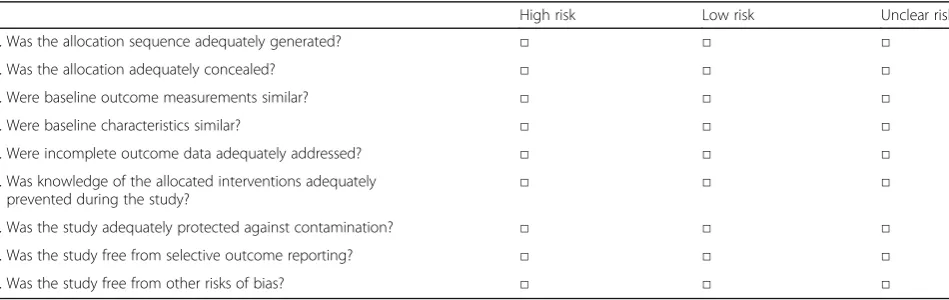
Selection will be conducted independently by two re-viewers (JH and CJC). Any disagreement will be resolved with referral to a third reviewer whose decision will be final (FC). All citations from the final search strategy will be imported into Endnote and subsequently screened for relevance using title and abstract. The full text of rele-vant citations will be retrieved and assessed for eligibility against the inclusion criteria set above. All eligible stud-ies will be appraised for methodological quality using the Effective Practice and Organisation of Care group risk of bias criteria (Tables2and3) [23].
Data extraction
Data extraction will be conducted independently by two reviewers (JH and CJC). It is anticipated that some publi-cations will have missing or incomplete data. In those in-stances, the corresponding authors will be contacted. If authors do not respond after being contacted three times and data are presented graphically, the WebPlotDigitizer [24] on-line application will be used to quantify data. Data
will be entered into Review Manager 5.3.5 software [25]. Meta-analysis will be conducted where possible, otherwise findings will be presented in a narrative form.
Events (e.g. contamination, antibiotic therapy) will be analysed using Mantel-Haenszel method under the ran-dom effects model and presented as risk ratio (RR) [26]. A RR of > 1 will be interpreted as increased likelihood of the event, while decreased chance of the event occurring will have corresponding value of < 1. A RR with a 95% confidence internal (CI) that does not include the value of 1 will be considered statistically significant [27]. Con-tinuous data such as cost, time, and length of stay will be presented as mean difference and will be analysed using random effects inverse variance. In addition to these data other information such as participant charc-teristics, details of the intervention, sustainability, fund-ing sources, and location of intervention will be captured and summarised. Grading of the quality of the evidence and the strength of any conclusion made from this analysis will be conducted using the Grading of Rec-ommendations Assessment, Development and Evalu-ation (GRADE) criteria [28].
Assessment of heterogeneity
Heterogeneity will be assessed statistically using the standardI2statistic, where (approximately) 1 to 25%, 26 to 75% and 76 to 100% will be interpreted as low, mod-erate, and high respectively [29]. Moreover, the chi-squared statistic will also be used to determine
Table 1Examples of search strings and results from PubMed and CINAHL via EbscoHost
Keyword search Date of search Search engine used Number of publications retrieved
((((contamination[Title/Abstract]) OR false-positive[Title/Abstract])) AND ((((Blood culture[MeSH Major Topic]) OR Hematologic tests[MeSH Major Topic]) OR blood culture*[Title/Abstract])
November 28, 2017 PubMed 1491
(Blood Culture OR Culture) AND (Contamination OR False Positive OR Microbial Contamination OR Bacterial Contamination OR False Negative).
November 29, 2017 CINAHL via Ebsco 2119
Table 2Effective Practice and Organisation of Care group risk of bias criteria for randomised controlled trials, quasi-experimental studies and pretest-posttest designs
High risk Low risk Unclear risk 1. Was the allocation sequence adequately generated? □ □ □ 2. Was the allocation adequately concealed? □ □ □ 3. Were baseline outcome measurements similar? □ □ □ 4. Were baseline characteristics similar? □ □ □ 5. Were incomplete outcome data adequately addressed? □ □ □ 6. Was knowledge of the allocated interventions adequately
prevented during the study?
□ □ □
heterogeneity, where apvalue of less than 0.1 will indi-cate significant heterogeneity. If present, heterogeneity will be explored in a sensitivity analysis accounting for population characteristics, setting, effect size, or sample size.
Discussion
Blood culture contamination is a source of error in healthcare. False positive BCs are associated with un-necessary and potentially harmful interventions. This is associated with increased costs of healthcare, and in-appropriate antibiotic usage. A number of interventions have previously been trialled to reduce the amount of BC contamination in acute care. This systematic review will identify the interventions reported in the literature that have previously been trialled in an attempt to re-duce the BC contamination rates and report on their success with, where possible, pooled results. The identi-fication of interventions that reduce BC contamination in the acute care setting has the potential to influence care. This study will be limited to the adult acute care population; therefore, interventions and influences on paediatric patients and patients in other settings will not be examined, and no inference to these populations should be made. There is the possibility that some evi-dence that is not reported in English may be missed. However, this represents a minimal amount of the total evidence. The results of this systematic review should be seen as a guideline for the interventions required in acute care to reduce the contamination rate of BC and ultimately improve care.
Abbreviations
BC:Blood culture; GRADE: Grading of Recommendations Assessment, Development and Evaluation; MeSH: Medical Subject Headings; PIVC: Peripheral intravenous catheter; RR: Risk ratio
Acknowledgements
The authors wish to acknowledge the assistance of Sarah Howard, Queensland University of Technology Librarian for her assistance with search strategies and database management.
Funding
JH undertakes this work as part of the Emergency Medicine Foundation Capacity Building Grant (EMCB-402R23-2015). This grant funds his
employment. The Emergency Medicine Foundation (EMF) supports Mr. Hughes’position to build research capacity in Emergency Care. The EMF had no involvement with the development of this protocol or the subsequent systematic review.
The Queensland University of Technology–Library has provided funding for the article processing charge for this publication.
Availability of data and materials
Data sharing is not applicable to this article as no datasets were generated or analysed during the current study.
Authors’contributions
JH is the guarantor and the principal investigator of this work. JH and CJC wrote the systematic review protocol with input from FC, JW and MR. JH and CJC developed the search strategy with input from a Health Services Librarian (Sarah Howard). JW and MR provided expert clinical opinion on the content and aims of the review within the clinical context. All authors are accountable for all aspects of the work, and all are entitled to be identified as authors of this work.
Ethics approval and consent to participate
Not applicable as this is a protocol only.
Consent for publication
There is no individual patient information contained within this protocol.
Competing interests
The authors declare that they have no competing interests.
Publisher’s Note
Springer Nature remains neutral with regard to jurisdictional claims in published maps and institutional affiliations.
Author details 1
School of Nursing, Queensland University of Technology, Brisbane, Australia.
2Emergency and Trauma Centre, Royal Brisbane and Women’s Hospital,
Ground Floor, Dr James Mayne Building, Butterfield Street, Herston, Brisbane, Queensland 4029, Australia.3Clinical Research Officer, Emergency
Department, Princess Alexandra Hospital, 199 Ipswich Road, Woolloongabba, Brisbane, Australia.4Faculty of Medicine, University of Queensland, Brisbane,
Australia.5Intensive Care Services, Critical Care and Clinical Support Services, Royal Brisbane and Women’s Hospital, Brisbane, Australia.6Institute for Skin
Integrity and Infection Prevention, University of Huddersfield, Huddersfield, UK.
Received: 4 January 2018 Accepted: 6 November 2018
References
1. Cockerill F III, Wilson J, Vetter E, Goodman K, Torgerson C, Harmsen W, Schleck C, Ilstrup D, Jn W, Wilson W. Optimal testing parameters for blood cultures. Clin Infect Dis. 2004;38(12):1724–30.
2. Wilson ML, Mitchell M, Morris A, Murray P, Reimer L, Reller L, Towns M, Weinstein M, Wellstood S, Dunne J. Principles and procedures for blood Table 3Effective Practice and Organisation of Care group risk of bias criteria for interrupted time series
High risk Low risk Unclear risk 1. Was the intervention independent of other changes? □ □ □ 2. Was the shape of the intervention effect pre-specified? □ □ □ 3. Was the intervention unlikely to affect data collection? □ □ □ 4. Was knowledge of the allocated interventions adequately
cultures; approved guideline.Wayne:CLSI document M47-A Clinical and Laboratory Standards Institute; 2007.
3. Long B, Koyfman A. Best clinical practice: blood culture utility in the emergency department. J Emerg Med. 2016;51(5):529–39.
4. Brown JD, Chapman S, Ferguson PE. Blood cultures and bacteraemia in an Australian emergency department: evaluating a predictive rule to guide collection and their clinical impact. Emerg Med Australas. 2017;29(1):56–62. 5. Ramos M. Reducing blood culture contaminations. J Emerg Nurs. 2017;43(1):7. 6. Nair A, Elliott SP, Al Mohajer M. Knowledge, attitude, and practice of blood
culture contamination: a multicenter study. Am J Infect Control. 2017;45(5):547–8. 7. Bowen CM, Coleman T, Cunningham D. Reducing blood culture contaminations in the emergency department: it takes a team. J Emerg Nurs. 2016;42(4):306–11. 8. Rupp ME, Cavalieri RJ, Marolf C, Lyden E. Reduction in blood culture
contamination through use of initial specimen diversion device. Clin Infect Dis. 2017;65(2):201–5.
9. Roth A, Wiklund AE, Palsson AS, Melander EZ, Wullt M, Cronqvist J, Walder M, Sturegard E. Reducing blood culture contamination by a simple informational intervention. J Clin Microbiol. 2010;48(12):4552–8. 10. Alahmadi YM, Aldeyab MA, McElnay JC, Scott MG, Darwish Elhajji FW,
Magee FA, Dowds M, Edwards C, Fullerton L, Tate A, et al. Clinical and economic impact of contaminated blood cultures within the hospital setting. J Hosp Infect. 2011;77(3):233–6.
11. Ryan C. Implementation of the theory of planned behavior to promote compliance with a chlorhexidine gluconate protocol. J Association Vascular Access. 2017;22(2):64–70.
12. Self WH, Mickanin J, Grijalva CG, Grant FH, Henderson MC, Corley G, Blaschke Ii DG, McNaughton CD, Barrett TW, Talbot TR, et al. Reducing blood culture contamination in community hospital emergency departments: a multicenter evaluation of a quality improvement intervention. Acad Emerg Med. 2014;21(3):274–82.
13. Denno J, Gannon M. Practical steps to lower blood culture contamination rates in the emergency department. J Emerg Nurs. 2013;39(5):459–64. 14. Fair RJ, Tor Y. Antibiotics and bacterial resistance in the 21st century.
Perspectives in Med Chem. 2014;6:25–64.
15. Marini MA, Truog AW. Reducing false-positive peripheral blood cultures in a pediatric emergency department. J Emerg Nurs. 2013;39(5):440–6. 16. Moeller D. Eliminating blood culture false positives: harnessing the power of
nursing shared governance. J Emerg Nurs. 2017;43(2):126–32.
17. Martínez J, Macías JH, Arreguín V, Álvarez JA, Macías AE, Mosqueda-Gómez JL. Isopropyl alcohol is as efficient as chlorhexidine to prevent
contamination of blood cultures. Am J Infect Control. 2017;45(4):350–3. 18. Hall RT, Domenico HJ, Self WH, Hain PD. Reducing the blood culture
contamination rate in a pediatric emergency department and subsequent cost savings. Pediatrics. 2013;131(1):e292–7.
19. Harding AD, Bollinger S. Reducing blood culture contamination rates in the emergency department. J Emerg Nurs. 2013;39(1):e1–6.
20. Dawson S. Blood culture contaminants. J Hosp Infect. 2014;87(1):1–10. 21. Caldeira D, David C, Sampaio C. Skin antiseptics in venous puncture-site
disinfection for prevention of blood culture contamination: systematic review with meta-analysis. J Hosp Infect. 2011;77(3):223–32.
22. Snyder SR, Favoretto AM, Baetz RA, Derzon JH, Madison BM, Mass D, Shaw CS, Layfield CD, Christenson RH, Liebow EB. Effectiveness of practices to reduce blood culture contamination: a laboratory medicine best practices systematic review and meta-analysis. Clin Biochem. 2012;45(13–14):999–1011. 23. Collaboration C. Suggested risk of bias criteria for EPOC reviews. Oxford:
Cochrane Collaboration; 2013.
24. Rohatgi A: WebPlotDigitizer. URLhttps://automeris.io/WebPlotDigitizer/2011. 25. Collaboration NCCTC. Review manager (RevMan)[computer program]
version 53. Copenhagen: The Nordic Cochrane Centre, The Cochrane Collaboration; 2014.
26. Deeks J, Higgins J, Altman D, Green S. Cochrane handbook for systematic reviews of interventions version 5.1. 0: The Cochrane Collaboration; 2011. 27. Scott I: Interpreting risks and ratios in therapy trials. Issues 2008:1. 28. Group GW. Grading quality of evidence and strength of recommendations.
BMJ. 2004;328(7454):1490.