Server services from IBM
Enabling the infrastructure for the onslaught of cloud,
mobile, social and analytic technologies
Contents
2 Introduction2 The infrastructure challenges facing today’s IT leaders 3 IBM Server Services portfolio
4 Design services 8 Deploy services 14 Managed services 15 Why IBM?
15 For more information
Introduction
In the last several years, against a worrisome economic backdrop, enterprises have taken an understandably cautious approach to IT. For the large majority, the focus has been on reducing costs and identifying opportunities for savings. Instead of investing in new technologies, most have turned their attention to capital preservation, with server consolidation and virtualization common directives. But while IT spending slowed, workplace technologies continued to penetrate more and more seamlessly into everyday life. The easy availability of mobile devices, social networking and cloud services—and the push to make sense of the enormous volume of information they generate—have heaped greater and greater demand on IT infrastructures. And they continue to do so. Digital interactions are skyrocketing,
and supporting server, storage and network infrastructures must be able to size themselves for any transaction load. They must be flexible enough to accommodate an ever-expanding array of personal devices and resilient enough to provide high levels of availability and increased performance.
The impact of these technological pressures along with a recovering economy are causing a shift in priorities. In the era defined by digital business and IT consumerization, cost reduction is important, but business agility, continuity and operational efficiency are taking precedence. Organizations are no longer virtualizing just to consolidate their physical footprint and cut costs. They are virtualizing to build a rock-solid infrastructure that can support their investments in technologies like cloud computing, enterprise mobility, social collaboration and analytics. They are finding that to achieve the greatest benefit from these technologies, they will need to invest in advanced infrastructure and virtualization management services and tools.
This paper provides an overview of the innovative IBM services that clients are using to design, build and manage high-performing server infrastructures with the requisite agility, resiliency and efficiency to capitalize on the strategic potential of emerging technologies.
The infrastructure challenges facing
today’s IT leaders
Cloud computing, enterprise mobility, social collaboration and analytics are shaking up traditional business models, emerging faster than many organizations can act on them.1 At
the same time, they are bringing business opportunities and differentiation to companies that have the infrastructure to effectively accommodate them.
All of these technologies depend on a scalable, flexible and reliable infrastructure to deliver their value. Without such an infrastructure, cloud cannot become a carrier ecosystem for information and services. Similarly, analytics cannot synthesize reams of data into meaningful insights without an infrastructure capable of delivering stable, real-time access to information. Social and mobile technologies cannot facilitate information exchange to anyone, anywhere, at any time without reliable uptime. The infrastructure is a critical enabler for all of these business functions. However, most infrastructures were not built to support these technologies. They do not have the required agility to deal with bigger and more unpredictable workloads, and support higher levels of availability and resiliency.
Enter virtualization, with its inherent ability to increase infrastructure agility and efficiency while lowering costs. While virtualization initiatives continue to escalate, implementing and managing a virtualized infrastructure can be difficult, especially as deployments increase in size and complexity. Virtualization creates a very dynamic environment that must be optimized continuously. With virtual workloads continually shifted between servers, monitoring utilization and performance becomes a lot more complicated. Traditional server management tools and practices are not designed to handle the scale or orchestration required by the virtualized environment. This has made automation, policy-based management, self-service portals, real-time monitoring and analytics essential ingredients in server operations. These capabilities not only simplify server management and support, alleviating the burden on resource-strained IT organizations, they optimize the infrastructure for the adoption of cloud, mobile, social and analytic technologies. As these technologies
advance, a tipping point will likely be reached when businesses must have them to succeed. When that time comes, the server infrastructure must be able to accommodate them.
IBM Server Services are helping organizations ready their server infrastructures. IBM views virtualization as a key element of a well-planned server optimization strategy aimed at enabling cloud computing, enterprise mobility, social collaboration and analytics. Our objective is to provide you with comprehensive solutions for developing that strategy and for designing, deploying and managing the virtualized and non-virtualized systems that make up your IT environment. In other words, we deliver server infrastructures that are ready today to handle the challenges and the opportunities you’ll face tomorrow. The sections that follow offer a high-level view of the services that comprise IBM’s Server Services portfolio.
IBM Server Services portfolio
IBM’s portfolio of server services provides end-to-end
capabilities to help organizations assess, design, implement and manage their server infrastructure. Our services are not limited to hardware or software, but instead include a wide array of systems, software and services for traditional and cloud-based platforms. Many of these offerings are pre-integrated to streamline deployment and simplify management. Together they enable IBM to deliver a broad set of server capabilities for your computing infrastructure.
Leverage IBM Server Services to:
• Design an efficient, optimized server or private cloud solution to meet your business objectives
• Deploy new cloud and traditional environments or virtualize existing servers
When IT skills are in short supply, IBM Server Services provide the hands-on expertise and support needed to fill the gap. Experienced IBM consultants, architects, technical support specialists and business partners work with clients to deliver selected services. In most cases, we can accelerate the time that is traditionally required to plan and implement new servers or optimize an existing server environment.
While many clients choose to turn over responsibility for server design, deployment and management, clients can also opt to retain these responsibilities. For those looking to build a traditional infrastructure themselves, we can supply IBM and non-IBM hardware components, software and tools to facilitate the process.
Clients looking to leverage the cost and operational efficiencies of the cloud for their data centers can deploy IBM’s private cloud solutions. IBM Private Modular Cloud is a platform as a service (PaaS) private cloud implemented at a client’s facility that leverages automation to speed provisioning and simplify cloud management. Another option is IBM SmartCloud®,
a suite of enterprise-level cloud technologies and managed services that enable clients to acquire infrastructure, platform and software as a service. IBM SmartCloud enables companies to customize an automated management solution for any private cloud infrastructure.
IBM design services summary
• Infrastructure strategy and planning services • Architecture and design consulting
• Infrastructure strategy and design services for cloud • Workload transformation analysis for cloud
Design services
As expectations increase for IT cost transparency and demonstrated business value, organizations need to have an effective strategy for simplifying the server infrastructure and reducing operational complexity. A well-designed strategy can help businesses achieve optimum performance and business value from their server investments. IBM server design services provide the consulting support to develop that strategy along with an actionable plan for execution. Our server design engagements accommodate accelerated time frames, varying scopes and both traditional and cloud-based server environments.
Infrastructure strategy and planning services
Using time-tested assessment methodologies and comparative analysis, IBM infrastructure strategy and planning services are designed to identify inefficiencies within your current server environment and recommend approaches for improvement. Three service options are offered to accommodate varying business needs and time frames:
• Diagnostic workshops (5–10 days) include an assessment of the server infrastructure and identify and prioritize IT improvement opportunities
• High-level strategy and planning engagements (8–12 weeks) add a high-level solution outline, transition roadmap and cost case for optimizing IT
• Full strategy and planning engagements (2–6 months) add a full implementation strategy, business case and cost-benefit analysis to help communicate recommendations
to stakeholders, plus an IT transformation and optimization strategy.
All of these services spell out opportunities to increase availability, efficiency and recoverability, based on your infrastructure requirements and business priorities. They
can help you develop a server strategy that facilitates the adoption of new technologies, speeds time to market for new applications and reduces energy consumption with more efficient server use. Past clients have been able to realize as much as 40 percent savings in IT costs through the implementation of a more secure, integrated and flexible infrastructure.2
NFL scores big savings with a more manageable infrastructure
With only 5 percent of its 600 servers virtualized, the National Football League (NFL) knew efficiency was lacking. The organization sought a new strategy—one that would facilitate IT services delivery and managed data growth.
IBM consultants redesigned the NFL’s existing data centers and created a shared IT service to increase infrastructure flexibility and recovery capability. Virtualization increased to 95 percent in 18 months, improving usage rates and simplifying capacity provisioning. Power and cooling capacity increased by 100 percent. The NFL reduced IT spending and simplified management.
Architecture and design consulting
Server architecture and design consulting picks up where our strategy and planning services leave off, turning server strategies into cost-effective infrastructure deployments and avoiding the costly project overruns and re-work that often occur during deployment.
IBM architects use a structured methodology to develop a server architecture aligned with your business objectives and service level requirements and designed to support the integration and optimization of your servers, storage, networks, operating systems, systems management and middleware. The architecture also specifies the optimal delivery models for your business, including cloud and sourcing models, and helps define a governance framework for tracking the progress of the implementation and managing the evolution of the architecture going forward. The architecture and design consulting engagement is completed in 10–16 weeks and produces a conceptual design document, an infrastructure specification document and an execution-ready transition plan.
* These server design services are for non-cloud environments only.
IBM server design services comparison*
Diagnostic workshop High-level strategy and planning
Full strategy and planning
Architecture and design consulting Your objective Assess the current
infrastructure for issues and opportunities
Develop an overall strategy for optimizing the server infrastructure
Develop a detailed, executable strategy for optimizing the server infrastructure
Design a cost-effective server architecture
Primary deliverables Prioritized list of IT improvements
Solution outline and basic roadmap, plus cost case for optimizing IT
Full implementation strategy and business case, plus detailed IT transformation and optimization strategy Conceptual design document, IT specification document, plus an actionable transition plan
Infrastructure strategy and design services for cloud
Once you’ve made the decision to implement cloud, designing an effective strategy can be a daunting task. You need to select the right cloud delivery model (private, public or hybrid) and ensure your existing infrastructure is sufficiently ready for cloud processing. Infrastructure strategy and design services for cloud simplifies those decisions using tools and analytics developed by IBM Research.
The strategy and design engagement is centered around a two-day workshop in which IBM cloud specialists work with you to understand your strategic intent for cloud in the context of your IT and business priorities. Specifically, they look at the type of services that you want delivered from the cloud (infrastructure, platform, software or business processes) and where they will be delivered (internally or externally). Your requirements are then mapped to our cloud computing adoption framework, which provides a standardardized reference for helping clients make the move to the cloud. This process helps us to begin to identify the most suitable cloud options for your environment. IBM specialists examine the options in detail and help you understand their implications to determine your ideal cloud opportunities.
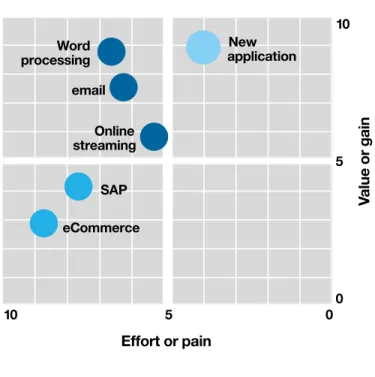
Next we use a high-level cloud workload analysis tool that qualitatively analyzes your workloads for various attributes (such as hardware maturity and virtualization) to assess each workload’s fit for a target cloud environment. It uses that information to calculate a score for each workload, comparing the relative value of migrating a workload to the cloud against the level of investment or effort required. The “pain versus gain” output for each workload is plotted to identify the most favorable workloads for cloud migration (Figure 1).
Effort or pain 10 5 0 0 5 10 Value or gain New application Word processing email Online streaming SAP eCommerce
Figure 1.Plotted output from the cloud workload analysis tool.
Workloads are plotted according to the “pain versus gain” scores they receive, assessing the relative value of cloud migration against the level of investment or effort required.
Then the IBM assessment and roadmap tool is used to determine your infrastructure readiness for cloud computing. This assessment of strengths and weaknesses yields an actionable and prioritized roadmap for any IT improvements deemed necessary. These improvements often center around governance, integration and service management capabilities, like metering and chargeback billing, that need to be in place for a private cloud. The tool’s rigorous strategy development
analytics, honed from IBM’s internal and client experiences, enable cloud strategies to be developed up to 90 percent faster than traditional methods of analysis.3 That helps speed
adoption and facilitate a smooth migration to cloud.
Workload transformation analysis for cloud
While the infrastructure strategy and design service helps identify potential workloads for cloud, IBM’s cloud workload transformation analysis uses automation and
analytics accompanied by our standardized workload analysis methodology to narrow the field and prioritize the most cost-effective workloads to migrate to your cloud environment. The service leverages a tool developed by IBM Research, in conjunction with client interviews, to assess current IT workloads for their affinity to cloud. The tool automates many of the manual tasks that are typically required in cloud workload analysis, reducing analysis time by up to 66 percent.4
Client data IBM- or client-defined
Servers Operating system distribution Location distribution Overall storage Nonfunctional requirements (NFRs) Application and workload data
Input/output, disk and utilization mapping
NFRs examination
Target cloud configurations Target cloud NFRs Historical data Target cloud cost
Operating system and software compatibility Migration difficulty
Other analytics
Workload Current cost Cloud target 1 Cloud target 2
Company A SAP application
US$6,000 per year Cost per year US$3,000, Difficulty 23 Cost per year US$3,000, Difficulty 10 Company A billing
distribution application
US$15,000 per year NO FIT Cost per year US$6,000, Difficulty 30 Company A expense
tracking application
US$2,000 per year Cost per year US$200, Difficulty 80 Cost per year US$1,000, Difficulty 3
Difficulty levels range from 1-100, with 1=easiest and 100=most difficult
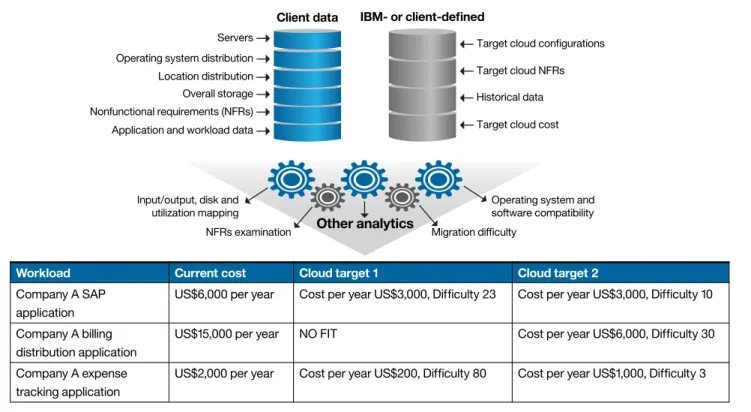
Figure 2.Components of IBM’s workload transformation analysis for cloud. Various client data, workloads and target clouds are assessed to determine
Our cloud workload transformation analysis tool and methodology help accelerate the adoption of your cloud strategy by providing quantifiable information to ease IT decision making. Workload transformation analysis employs a structured, granular technique to examine the fit and readiness of your workloads for deployment into your chosen cloud environment. Workloads are characterized and assessed against one or more target cloud environments based on agreed-to criteria that demonstrate the affinity of a given workload for a target cloud environment. The resulting output identifies each workload’s current cost per year in a non-cloud (traditional) environment and, if a workload is deemed a fit for one of the target clouds, the cost per year within that target cloud and the difficulty of migration. A sample cost analysis and migration impact are also included to provide business justification for the migration of a given workload to a cloud.
Figure 2 illustrates a sampling of the client data and types of workloads that are analyzed to determine a workload’s readiness for transition to cloud. The six cylindrical blocks stacked on the left side of the figure depict the client data that is analyzed. The four cylindrical blocks stacked on the right depict the IBM- or client-defined target criteria they are analyzed against. The five interconnected chain wheels below the cylinders depict the various analytics that are applied during IBM’s workload transformation analysis. The data presented in the table is representative of the results of the analysis, including the current assessed cost for each target cloud and the difficulty of migration on a scale of 1 to 100. Target clouds can include multiple public and private cloud options with different infrastructures and services.
IBM deploy services summary
• Server consolidation and virtualization services - Fit-for-purpose analytics
• Virtualization efficiency study • Private Modular Cloud
• Server implementation and migration services - Server product services
• Build services for private cloud • Implementation services for GDPS
Deploy services
Knowing how to exploit advanced technology takes time and, increasingly, it takes specialized expertise. A lack of in-house skills can complicate the implementation of new servers and reduce a company’s ability to realize the full potential of its server environment. IBM server deployment services help IT organizations compensate for the shortfall by providing access to highly skilled technical professionals who can help expand, upgrade or reconfigure the server environment.
Proven deployment methodologies refined in over 10,000 client engagements help reduce the chance of disruption and streamline your implementation. The offerings are designed to help you realize a faster return on your investment whether implementing or upgrading your server environment,
consolidating and virtualizing existing resources, or deploying tools to improve server management.
Server consolidation and virtualization services
The number of installed servers is growing at an exponential rate, yet average server utilization is less than 20 percent.5
With more than 80 percent of server capacity idle most of the time, it’s no wonder that consolidation and virtualization have become data center priorities in the push for greater efficiency. In fact, the IBM 2012 Global Data Center Study found that data centers that virtualized across all components of the physical infrastructure exhibited the highest levels of efficiency, with higher staff productivity, better application performance and fewer errors.6
IBM’s server consolidation and virtualization services are designed to increase utilization and resource availability and reduce equipment requirements. They can help you lower the cost and complexity associated with managing large numbers of servers and heterogeneous platforms. The services help you design and implement a more consolidated, virtualized sever environment that is more resilient and capable of responding dynamically to evolving business demands and workloads. We begin by assessing your current infrastructure to size your capacity needs and identify the best opportunities for consolidation and virtualization. We know that it’s not enough to simply consolidate resources in a virtualized environment, since virtualization radically increases the number of resources to be managed. So we use the data collected to design solutions that integrate the virtualized environment with your existing processes and systems to enable the virtual and physical infrastructures to be managed as one. This lowers the effort and skills that will be required to maintain the virtualized environment. More importantly, it enables automated management, and that will deliver the real savings.
The service includes assistance in building a business case to justify your virtualization investment. We quantify the potential savings and return of a smaller, more efficient infrastructure. The actual results have been dramatic. One recent client reduced server count by five times, saving millions in operating expenses.7
Fit-for-purpose analytics
Fit-for-purpose analysis is a complementary service designed to simplify the server consolidation and virtualization process by helping clients determine the best way to virtualize their infrastructure. By modeling workloads on different platforms and monitoring the outcomes, the analytics tool helps IBM identify the best-fit (hardware and software) platform for each workload. Clients can use that information to determine which servers to consolidate, which to retain and which to virtualize. It enables them to build a virtualization strategy and a plan for standardization and workload placement that increases workload-server efficiency and lowers costs.
The fit-for-purpose analysis grades each platform on more than 30 different workload variables and provides platform recommendations for each workload in the context of your business goals. The variables cover a broad range of client concerns besides cost, including performance, scalability, energy consumption, software licensing, risk, resiliency and service level agreements. An in-depth view of each platform’s benefits and drawbacks is provided, allowing you to feel more confident in the consolidation and virtualization decisions you make.
Fit-for-purpose yields a 90 percent smaller footprint
With hundreds of servers, a dozen different platforms and more than a hundred variations of models and versions, a financial firm understood the toll that its lack of standardization was taking on IT cost and efficiency. Using fit-for-purpose analysis, the firm assessed the viability of its servers and platforms and determined it would be possible to drastically reduce the size of the current infrastructure.
The resulting server strategy and workload placement model enabled the company to standardize its heterogeneous server environment while shrinking its physical footprint by 90 percent. The number of servers dropped from 813 to 81 and the number of platforms from 12 to 4. This resulted in a highly efficient operation and a 45 percent reduction in expenses.
Virtualization efficiency study
The IBM virtualization efficiency study (VES) helps you address the complex management and provisioning challenges presented by the virtualized infrastructure. VES uses predictive analytics to assess the virtual environment, modeling current and future demand on your server resources. The tool: • Gathers operational and utilization data from your
systems to determine how efficiently virtual resources are being used
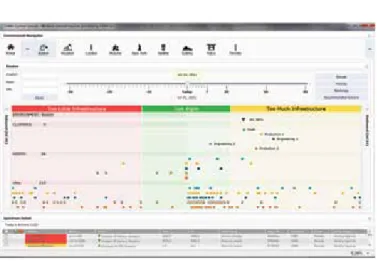
• Identifies virtual machines (VMs), hosts and clusters that are over- and under-provisioned, and the associated changes needed to reduce risk (Figure 3)
• Determines the optimal placement and resources for each workload, based on your operational policies, and your utilization and service level objectives
• Provides the management visibility to address issues proactively, providing actionable recommendations to resolve them.
VES’ comprehensive analytic modeling enables you to right-size and rebalance VM workloads to ensure changing requirements will be met. You can also model the impact of recommended corrective actions before taking them. The results can be dramatic, especially with existing utilization rates as low as 10 percent. In one case, VES’ recommended workload changes led to a four-fold increase in server utilization, with savings of US$4 million estimated the first year.8
Private Modular Cloud
IBM Private Modular Cloud enables you to deploy a highly automated, scalable, platform as a service (PaaS) private cloud with modular service options and analytic capabilities. It speeds private cloud implementation at your facility, reducing the typical time frame from months to weeks.
Figure 3.VES’ analytic results. VES identifies clusters, hosts and VMs that
have too much (yellow), too little (red) or optimal infrastructure (green) for the assigned workloads, based on a company’s utilization requirements and operational policies.
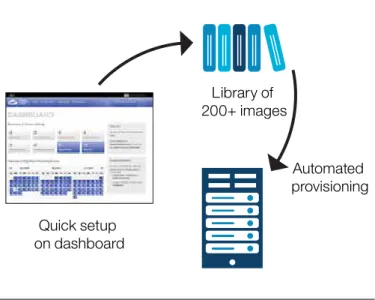
Most private clouds use an automated infrastructure, but middleware is still provisioned and managed manually. Private Modular Cloud automates across both infrastructure and middleware, accelerating and simplifying provisioning and management using a centralized dashboard. The customizable, self-service dashboard provides users with access to a pattern library of over 200 fully supported, reusable operating system (OS), middleware and database images, ready for automated deployment in the cloud (Figure 4). This dramatically streamlines provisioning, enabling hardware and software resources to be allocated in minutes. It allows users to deploy complex environments to the cloud with validated, high-quality and consistent results.
Site 3 Provisioning
Server
type 2 Servertype 3 Site 2 Server type 2 Site 1 Server type 3 Quick setup on dashboard Library of 200+ images Automated provisioning
With its standard architecture and modular design, Private Modular Cloud enables you to start small (with 100 VMs) and scale up to 10,000 quickly. Optional managed services for private cloud can be provided onsite or remotely, and they can be extended to cover the entire (traditional IT and cloud) infrastructure. Optional workload capacity controls and analytics provide the management visibility to optimize VM performance and efficiency and rebalance workloads across the virtualized infrastructure—a prerequisite for high-functioning hybrid cloud environments. Upgrades, patches and other middleware maintenance can be performed in minutes. (More detail on IBM’s management services is provided in the “Manage services” section below.)
Server implementation and migration services
Server implementation and migration services are designed to supplement your internal IT staff with highly skilled IBM resources, allowing you to deploy advanced server systems and capabilities quickly, with minimal disruption to users and business operation. The services are available for a variety of IBM and non-IBM systems (see box on page 12) and include: • Requirements assessment for space, layout, cabling, heating
and cooling, and 24x7 availability
• Planning, installation, migration, configuration, integration and testing of server hardware and associated software • Design, implementation, configuration and testing of
private cloud infrastructures, including on-demand provisioning and hypervisors
• Skills transfer to in-house staff • Project management and support.
Figure 4.Rapid setup and provisioning. With its self-service dashboard and
pattern library of reusable OS, middleware and database images, IBM Private Modular Cloud enables users to provision hardware and software resources in minutes.
Server implementation and migration services help you capitalize on your server investment sooner, speeding the adoption of new, multivendor technologies and optimizing their performance while allowing your in-house resources to remain focused on higher priority business initiatives. IBM’s own server migrations to IBM System x® and IBM
Power Systems® hardware were performed as much as 50
percent faster.9
IBM server implementation and migration services Supported systems
• IBM Power Systems™, including IBM i and
IBM p servers
• IBM System x® servers
• IBM System z® mainframes
• IBM Flex System™ and IBM PureFlex System™ servers
• IBM, Linux, Microsoft and VMware platforms • Non-IBM servers
• High-performance configurations • Simple to complex private clouds
IBM’s global delivery model ensures delivery consistency across your data centers, irrespective of their location. It enables all 1,500 of our server implementation and migration specialists to apply the same proven methods, tools and skills to deployments virtually anywhere in the world.
Server product services
Server product services are for organizations that have targeted specific server technologies for deployment. They know what they want to deploy, but they need help doing it. Server product services provide planning, implementation and migration services designed around specific server technologies. They help speed the return on your hardware investment by shortening the time required to get new server
technologies up and running. The services are available for a range of IBM and non-IBM products, including IBM Power Systems, PureFlex System, Flex System, System z and System x, as well as Linux and Microsoft server platforms, and open source software.
Product services leverage IBM’s global experience evaluating, designing, implementing and managing server platforms of all types. That depth of experience enables us to reduce the risk of outages and cost and time overruns that often accompany new technology deployments. IBM’s experience also plays a major role in the optimization component of product services. This includes helping to speed virtualization and private cloud deployment on the customizable Flex System infrastructure or helping you maximize the potential of your System z mainframe with IT process automation, autonomic capacity provisioning and server time protocol.
Product services also help you integrate new server technologies into your data center more effectively. IBM provides an objective evaluation of your existing environment and the integration potential of the new server technology. The aim is to reduce complexity and cost while improving system availability and security, no matter your server environment. We also customize the solution to your IT specifications and provide skills instruction for key personnel. This training is designed to help your IT technicians leverage the functions and capabilities of the server technology while effectively managing and supporting it in steady-state.
Build services for private cloud
IBM private cloud build services help organizations deploy an automated, security-rich, private cloud environment for their production and non-production workloads. Companies can select an IBM-supplied platform for their private cloud infrastructure or use their existing (IBM or non-IBM) hardware. IBM-supplied platforms include IBM Flex System
and IBM PureFlex System, Linux on IBM System z/VM®,
IBM Power Systems and x86. An IBM-supplied private cloud infrastructure can be extremely beneficial for organizations that are looking to replace aging systems or upgrade their operation with more powerful systems.
Private cloud build services include solution design, implementation plan development, installation and configuration of cloud management software, migration of virtualized workloads to the desired cloud platform, integration with existing systems and networks, solution testing, and training for administrators and end users.
Implementation services for GDPS
Keeping core business systems running and able to recover rapidly from an outage is vital. IBM implementation services for GDPS® (Geographically Dispersed Parallel Sysplex™) helps
organizations address the challenge with the deployment of an automated availability and recovery solution for IBM System z mainframes and distributed systems.
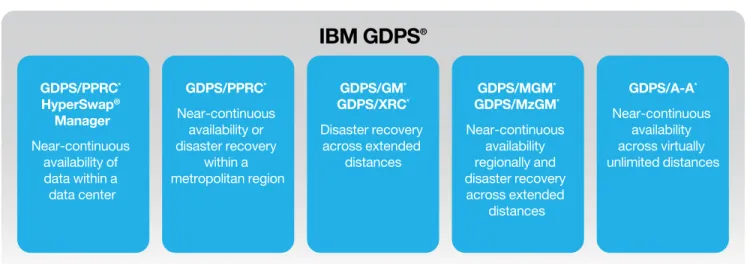
IBM GDPS solutions are designed to provide near continuous data and systems availability within a single site or across multiple sites. Automation accelerates recovery processing for planned and unplanned outages and reduces the overall complexity, support and operational skill required to manage data replication, server management and workload recovery tasks, based on client-established policies. Centralized management provides a single point of control for efficient event notification. This helps streamline outage resolution. Implementation services are provided for the full suite of GDPS solutions, which differ in the number of sites and distances they support and the level of availability and recovery capability they provide (Figure 5).
GDPS/PPRC* HyperSwap® Manager Near-continuous availability of data within a data center
IBM GDPS
® GDPS/PPRC* Near-continuous availability or disaster recovery within a metropolitan region GDPS/GM* GDPS/XRC* Disaster recovery across extended distances GDPS/MGM* GDPS/MzGM* Near-continuous availability regionally and disaster recovery across extended distances GDPS/A-A* Near-continuous availability across virtually unlimited distances*PPRC: Peer-to-peer remote copy; GM: Global mirror; XRC: Extended remote copy; MGM: Metro global mirror; MzGM: Metro z/OS® global mirror; A-A: Active-Active.
GDPS implementations begin with a technical consulting workshop to understand your application availability and disaster recovery objectives, current infrastructure, recovery processes and service requirements. IBM solution specialists document the findings, discussion points and recommendations, and lay out the high-level task list and plan for your GDPS implementation. The workshop helps identify the right GDPS solution for your environment and determine the level of customization needed to satisfy your specific recovery point and recovery time objectives in accordance with regulatory and audit requirements.
Our implementation services for GDPS include:
• Planning and solution design to determine configuration, implementation and testing plans
• Policy customization to enable automated monitoring and management
• Skills transfer for configuration and opera¬tions education • Onsite implementation assistance
• Project management and support.
Managed services
While most server management services are labor-based, relying on system administrators and technicians to monitor performance, IBM server management is largely program-driven, relying on automated tools and software developed by IBM Research and trusted third parties. Automation enables more cost-effective, proactive management, initiating action when established policy thresholds are exceeded and taking advantage of analytic modeling and outcomes to spot performance issues and potential failure patterns preemptively, before problems emerge.
Every organization’s server management needs are different, and IBM offers a continuum of services to address them. IBM managed server services bring IBM’s tools, processes
and automation into play to help clients transform their infrastructure operation and more fully capitalize on the promise of technologies like virtualization and cloud. Managed server services include a broad range of options that allow you to select just the monitoring and management services you need (see box). Available services include end-to-end monitoring, event management, problem and change management, and support for physical and virtual servers, storage and private cloud environments. You can also choose how your management services are delivered. Flexible sourcing options—including onsite or remote, cloud or traditional, selective out-tasking to enterprise outsourcing— enable you to retain the desired level of visibility and control over your systems.
IBM managed server services Service catalog
• Technical support and problem resolution
• End-to-end monitoring and event management for physical and virtual servers, storage and private cloud environments, along with groupware, middleware, database and neworking options • Operations and support
- Problem and change management - Performance and availability management - Systems management
- Configuration and capacity management - Policy-driven resource provisioning and workload placement
- Patch management and troubleshooting - Performance data and reporting services • Support for leading vendors’ high-availability IT optimization products
• Optional disk, archive and backup/restore management services
The results are tangible, producing meaningful operational and cost efficiencies. Analytic-based monitoring and management drive higher availability and utilitization while reducing the need for additional capital investments in hardware, software and physical facilities. Policy-driven automation increases service quality and lowers the labor costs associated with manual administration. Self-service portals improve employee productivity while lowering help desk costs and the strain on IT support staff. IBM clients leveraging our managed server services typically realize up to a 20 percent reduction in operational costs with payback in 12–18 months.10 This
reduction in IT spending frees funding for initiatives that can spur new revenue and business growth.
Why IBM?
The pressure is mounting to integrate technologies like cloud, social, mobile and analytics into the IT environment and leverage their capabilities. These initiatives will succeed only with a well-designed, optimized and virtualized server infrastructure. The infrastructure must be agile enough to facilitate the seamless adoption of these new technologies, resilient enough to maintain high availability levels and efficient enough to accommodate new demands without impacting performance or driving up complexity. IBM understands the competitive necessity of a capable infrastructure and the servers that are its strategic backbone. Leveraging established methodologies, tools and expertise, we can help you determine the optimal server strategy to support your changing business and the critical technologies that will propel it forward. Today over 8,000 IBM consultants and architects are building on decades of experience in the
design, implementation and management of multivendor server solutions and infrastructure optimization, using virtualization, automation and cloud technologies. They are helping organizations overcome the headaches and growing expenses associated with increased technological complexity, outdated IT infrastructures, unforeseen security threats and skills shortages.
IBM’s ability to deliver efficiencies across the IT infrastructure with a broad range of server services and cloud capabilities provides the foundation for a robust server environment—and a proven route to technology leadership. We work with you to maximize the effectiveness of your server environment and reduce your total cost of ownership so that you are better prepared for the inevitable business challenges and technology advances ahead.
For more information
To learn how IBM is helping organizations design, deploy and manage a more flexible, efficient and resilient server infrastructure, please contact your IBM representative or IBM Business Partner, or visit:
ibm.com/services/server
Additionally, IBM Global Financing can help you acquire IT solutions quickly and cost-effectively. We work with credit-qualified clients to customize IT financing solutions designed to preserve cash and mitigate financial risk. We are the world’s largest technology financier, supporting more than 125,000 clients and nearly 80 percent of the Fortune 100. For more information, visit:
1 IBM, “Fast track to the future: The 2012 IBM Tech Trends Report,” December
2012.
2 Based on specific IBM client engagements. Individual results may vary. 3 Based on a specific IBM client engagement. Individual results may vary. 4 Based on use in IBM’s IT transformation project. Individual results may
vary based on availability and extent of client data.
5 Based on specific IBM client engagements. Individual results may vary. 6 IBM, “Data center operational efficiency best practices,” Findings from the IBM
Global Data Center Study, April 2012.
7 Based on a specific IBM client engagement. Individual results may vary. 8 Based on specific IBM client engagements. Individual results may vary. 9 Based on specific IBM’s internal estimates for IBM System x and IBM
Power Systems. Individual results may vary.
10 Based on specific IBM client engagements. Individual results may vary.
IBM Global Services Route 100
Somers, NY 10589 U.S.A.
Produced in the United States of America September 2013
IBM, the IBM logo, Flex System, Geographically Dispersed Parallel Sysplex, GDPS, Power Systems, PureFlex, System x, System z, z/OS, z/VM, HyperSwap, IBM SmartCloud and ibm.com are trademarks of International Business Machines Corporation in the United States, other countries or both. If these and other IBM trademarked terms are marked on their first occurrence in this information with a trademark symbol (® or TM), these symbols indicate U.S. registered or common law trademarks owned by IBM at the time this information was published. Such trademarks may also be registered or common law trademarks in other countries. Other product, company or service names may be trademarks or service marks of others. A current list of IBM trademarks is available on the web at “Copyright and trademark information” at ibm.com/legal/copytrade.shtml.
Microsoft, Windows, Windows NT, and the Windows logo are trademarks of Microsoft Corporation in the United States, other countries, or both.
Linux is a registered trademark of Linus Torvalds in the United States, other countries, or both.
This document is current as of the initial date of publication and may be changed by IBM at any time. Not all offerings are available in every country in which IBM operates.
The client examples cited are presented for illustrative purposes only. Actual performance results may vary depending on specific configurations and operating conditions. It is the user’s responsibility to evaluate and verify the operation of any other products or programs with IBM products and programs.
THE INFORMATION IN THIS DOCUMENT IS PROVIDED “AS IS” WITHOUT ANY WARRANTY, EXPRESS OR IMPLIED, INCLUDING WITHOUT ANY WARRANTIES OF MERCHANTABILITY, FITNESS FOR A PARTICULAR PURPOSE AND ANY WARRANTY OR CONDITION OF NON-INFRINGEMENT. IBM products are warranted according to the terms and conditions of the agreements under which they are provided. Statements regarding IBM’s future direction and intent are subject to change or withdrawal without notice, and represent goals and objectives only. Actual available storage capacity may be reported for both uncompressed and compressed data and will vary and may be less than stated.
Please Recycle