experience
Abolfazl Hatami Varzaneh1, Masoumeh Esmaeily1, Kioumars
Farahbakhsh1, Ahmad Borjali2
Abstract
Divorce is an event affecting couples, children, families, and community. Little is known about the perception of Iranian couples who intended to get divorced with regard to the process of decision making on divorce. The purpose of this study was to build a theory about the process that leads the couples to get divorced. The grounded theory in qualitative paradigm was used. Ten couples were interviewed based on the theoretical saturation. Purposeful sampling and semi-structured in-depth method of interview were used. The interviews were analyzed by using the constant comparative method. The results indicated that a category named improper marriage formation included the causal condition of divorce, which consisted of lack of initial interest in spouse, improper reason for getting married, lack of marriage preparation, insufficient dating before marriage, forced marriage, and unawares spouse selection. Intervening condition was divided into three subcategories of intra personal factors (dysfunctional attitudes and characteristics); inter personal factors (dysfunctional marital, parental, and intergenerational systems), and Meta personal factors (financial issues). Contextual condition consisted of history of divorce and unhealthy family of origins. Couples and familial dysfunctional strategies were also explained. Consequences were identified as emotional, cognitive, and behavioral. We concluded that collapse of marriage occurs as a process not an onset event. Improper marriage formation, dysfunctional family of origin, lack of constructive boundaries, and dysfunctional strategies of family related to the eastern culture were explained in conclusion.
Keywords: Couples, Divorce, Grounded Theory, Qualitative Research
Journal of Research & Health
Social Development & Health Promotion Research Center
Vol. 6, No. 3, Jul & Aug 2016 Pages: 362- 372
DOI: 10.7508/jrh.2016.03.010
Original Article
1. Department of Counseling, School of Psychology and Educational Sciences, Allameh Tabataba’i University, Tehran, Iran
2. Department of Clinical Psychology, School of Psychology and Educational Sciences, Allameh Tabataba’i University, Tehran, Iran
Correspondence to: Masoumeh Esmaeily, Department of Counseling, School of Psychology and Educational Sciences, Allameh Tabataba’i University, Tehran, Iran
Email: [email protected]
Received: 30 Nov 2015 Accepted: 31 Jan 2016
How to cite this article: Hatami Varzaneh A, EsmaeilyM, Farahbakhsh K, Borjali A. A theoretical framework of divorcing couples experience. J Research & Health2016; 6(3): 362- 372.
Introduction
It is an old fairytale, two individuals fall in love with each other, and they get married and live happily after that. Of course, life is not a fairytale. The truth is that many marriages end in divorce. Divorce is an event that affects couples, children, family members, and the community. Healthy marriages are critical to
society and can benefit everyone involved, including the community at large [1].
companionship. More is required in marriage in terms of personal gratification. In addition, definition of family in the west includes gay and lesbians, single parenting, and mixed families [3].
In Iran, as an eastern Muslim country, marriage is different from the thing that is undergoing in western cultures. Therefore, the studies that have focused on marriage and divorce in the west cannot be easily generalized to Iran. Additionally, Iranian couples are experiencing an increase in divorce rate. The ratio of marriage to divorce, according to the National Organization for Civil Registrations of Iran, was 9.8 in 2004 which has been decreased to 4.4 in 2014 [4].
Most studies in Iran have tried to explore the factors leading to divorce and not trying to develop a theoretical framework according to the viewpoint of divorcing couples. These studies have found out that differences in education, occupation, unsatisfied expectations, and opinions along with interference of relevant others into the couple’s life [5]; harsh beginning, escalating, four horsemen of Gottman’s model(Criticism, Defensiveness, Stonewalling, Contempt), loving behaviors, compensative actions [6]; wrong reasons for marriage, forced marriage, conflict with family-in-laws, little time of husband spending at home, continuing singlehood friendship, gender role conflicts, domestic violence, infidelity, mistrust, financial issues [7]; wrong mate selection, dependency on parental families, not satisfied emotional needs and infertility [8]; behavioral disorders, modern institutions, values, institutional support, economic inadequacies, and cultural/ social class differences [9] were among the most important reasons of divorce among the couples. In addition, Bastani, Golzari and Rowshani explored the causal and intervening conditions of emotional divorce among Iranian couples. Unsatisfied emotional needs of women, communicational problems, improper mate selection, lack of empathy and companionship, violent behaviors, not spending enough time together, sexual dissatisfaction, lack of trust in each other, lack of responsibility, and
having psychological disorders were causal conditions found in the study, whereas intervening conditions were financial issues, increased involvement in work, not having enough time, occupational instability, absence of husband at home, addiction, family interference, family of origin differences, upbringing issues, and living with husband’s family [10].
Some studies explored the process of divorce and provided a theoretical framework for divorce in other cultures and concluded that divorce process consists of many cultural elements. Ford using grounded theory explored the divorce process among African-American couples. Infidelity, financial instability, methods used for conflict resolution, interference, immaturity, and not seeking outside professional help were emerged as his themes [11]. Akter and Begum [12] undertaking grounded theory methodology in Bangladesh culture explored the factors responsible for divorce process among women undergoing the divorce process. Themes emerged in this study were extramarital affairs, substance abuse, physical abuse, dowry-related problems, abandonment, interference from in-laws, polygamy, personality problems, criminal activity, and unemployment of husband [12]. Divorce can bring about huge difficulties for individuals, families, and the community. The rate of divorce is increasing in Iran while little is known about the reasons for Iranian couples reaching to the point of decision for divorce. Most studies exploring divorce process and developing theoretical frameworks have been carried out in other cultures that cannot be easily generalized to the Iranian culture. Thus, the main purpose of the study was to explore the process of reaching to the point of decision for divorce from the viewpoint of Iranian divorcing couples in order to build a theoretical framework.
Method
provides for the generation of emergent theory when there is little known about a particular phenomenon. The grounded theory was applied based on the Strauss and Corbin approach. The researcher used paradigm model to generate the theoretical framework. The paradigm model develops each category by examining its causal condition (factors that lead to the occurrence of the phenomenon), intervening condition (conditions that affect causal conditions on the phenomenon), contextual condition (specific sets of conditions or patterns of conditions that intersect dimensionally at this time and place to create a set of circumstances or problems to which persons respond through strategies), strategies (specific actions or interactions that result from the core phenomenon), and consequences (the outcome of the phenomena as they are engaged through strategies) [13]. Participants were recruited through a welfare organization. All couples who ask for divorce in Iran are required to attend family counseling of welfare organizations before being granted a divorce decree. Couples who came to the family counseling center of Zanjan (a city in Iran) and met the inclusion criteria were invited to participate in the interview voluntarily. Purposeful sampling was used to collect data. Participant selection, data collection, and data analysis continued until theoretical saturation reached. Data collection was ceased after the 18 interview, as it was clear that no new themes were emerged; but in order to make sure of the findings, two more interviews were performed. So, 10 divorcing couples who got married at least for two years and their main reason of requesting divorce was not any severe physical or psychological disorders included in the study. Couples were interviewed individually. The interview lasted about one hour and a half for each individual. Before starting the interview, the participants asked their questions about the research and were cleared about the aim of the study. They allowed the researcher to record their voice, while they were informed about the confidentiality of the study. In order to protect the participant’s identity, a number was allocated to each subject in the transcript. The
interviews were conducted in a private office. The participants were told that answering to the questions was voluntary and that they could terminate the interview at any point without consequences. Couples answered to the open-ended questions of the interviewer in a face to face semi-structured, in-depth interview. All interviews were audio recorded and transcribed verbatim. The answers were then coded.
trustworthiness of the data according to Creswell [15]: 1) member checking in which participants were asked to evaluate the results and confirm the accuracy, and 2) peer review in which three professionals of the relevant field coded transcripts and hold meetings to discuss about the study.
Results
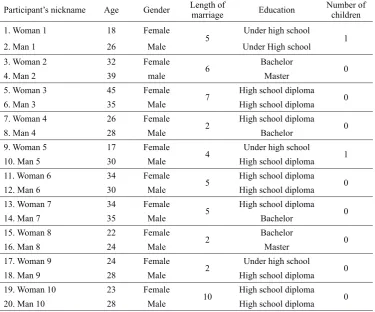
Demographics: 10 divorcing couples were interviewed in this study. The mean age of the participants was 27.5 years old for women and 30.3 for men. In eight marriages, men were older than women (m=5.25) and in two,
women were older than men (m=7 years). Two couples were dual careers while in eight marriages just husband worked out of the house. In terms of education, two men had master degree, two had bachelor degree, five had high school diploma, and one was educated under high school. Among women, two had bachelor degree, five had high school diploma, and three were educated under high school. The median length of marriage was 4.5 years. Eight couples did not have any children and two of them had only one child. The results on demographic characteristics are summarized in Table 1.
Table 1 Demographic characteristics of participants
Participant’s nickname Age Gender Length of marriage Education Number of children
1. Woman 1 18 Female
5 Under high school 1 2. Man 1 26 Male Under High school
3. Woman 2 32 Female
6 Bachelor 0
4. Man 2 39 male Master
5. Woman 3 45 Female
7 High school diploma 0 6. Man 3 35 Male High school diploma
7. Woman 4 26 Female
2 High school diploma 0
8. Man 4 28 Male Bachelor
9. Woman 5 17 Female
4 Under high school 1 10. Man 5 30 Male High school diploma
11. Woman 6 34 Female
5 High school diploma 0 12. Man 6 30 Male High school diploma
13. Woman 7 34 Female
5 High school diploma 0
14. Man 7 35 Male Bachelor
15. Woman 8 22 Female
2 Bachelor 0
16. Man 8 24 Male Master
17. Woman 9 24 Female
2 Under high school 0 18. Man 9 28 Male High school diploma
19. Woman 10 23 Female
10 High school diploma 0 20. Man 10 28 Male High school diploma
Overall, 11 themes were identified. The results indicated that improper marriage formation was the causal condition of marriage collapse, whereas intra-personal, interpersonal, and Meta personal factors constitute intervening condition. Contextual condition consisted of history of divorce and unhealthy family of origin. Couples and families used strategies against difficulties and conflicts that inversely led to worsening the situation. Finally, emotional,
cognitive, and behavioral consequences were recognized in this study. The process of the journey to collapse of marriage is visually represented in Figure 1.
Core Category: A journey to marriage collapse
Figure 1 Paradigm model for process of marriage collapse
preparation (Woman 1: “I was 13 and I didn’t know anything about marriage”), c) Insufficient dating (Woman 4: “we got engaged in only one week”), d) Forced marriage (Woman 1: “I was forced to marry this man by my father”), e) False reasons for marriage (Woman 3: ”I wanted to marry just to escape from parental house”), f) Unaware selection (Man 1: “I had no idea of marriage”).
Intervening condition consisted of three category of intrapersonal, interpersonal, and Meta personal factors. 2. Intrapersonal factors: Dysfunctional attitudes: Attitude about self: not viewing him/herself as valuable (Woman 1: “he doesn’t see me”); Attitudes about spouse: a) not believing in the spouse ability (Woman 3: “he is not a real men, he can’t afford life”), b) expectation more than the abilities of the spouse (Man 1: “she always asked me more than I had in my pocket”), c) others more important than spouse (Man 5: “when I asked her to go out she refused, but when her family wanted to, she was ready to go out with them”),
and constant enjoyment (Woman 6: “why should I tolerate hard time? I can’t anymore”), b) not having survival assumption (Woman 4: I always felt that this marriage wouldn't last); Attitude about children: a) children are the reason of staying in the marriage not my spouse (Man 5: ”I continued because of my child, I didn’t want this life”), b) children limit my freedom (Woman 2: ”because I got married, it doesn’t mean that I should have a child”); Attitudes about God: a) not having any belief (Woman 2: ”I don’t believe in any of them, I fast but I don’t believe in that”), b) Not having respect for the beliefs of the partner (Woman 6: “he never respects my beliefs, he insults my beliefs”), c) forcing spouse to obey the beliefs (Woman 2: “he forces me to say prayer and fast”).
Dysfunctional personality characteristics: Not being responsible (Woman 6: “he is not responsible, when we got married he didn’t give the rent of the house”); Self-centeredness (Woman 4: “my partner is self-centered, he believes he is right, even if all people disagree”); Low tolerance (Man 10: “my wife can’t tolerate and this increased our difficulties”).
3. Interpersonal factors: Dysfunctional marital system: Loving issues: a) verbal and nonverbal issues in love expressing (Woman 1: “he is very cold, I don’t see any love from him”), b) sexual problems (Woman 4: ”he had premature ejaculation”), c) issues with commitment (Woman 6: “he admitted that he had a girlfriend”); Boundary issues: a) letting others to interfere in the couple’s life (Woman 4: ”his parents used to say that they would divorce me”), b) dependence on the family of origin (Man 3: “my wife is so much dependent on her nephews”), c) letting the families know the issues (Man 5: ”whatever I tell her, she would say to her mother immediately”); Lack of mutual entertainment: a) not spending time together (Woman 9: ”he never spent time with me”), b) not having enough entertainment (Woman 4: “on the weakened, I told my husband to go out and he didn’t accept”); Roles issues: a) not helping each other in their roles (Woman 6: “he never helps me with chores”), b) not
doing the tasks (Man 10: “she is a housewife but she doesn’t cook lunch”); Communication issues: a) poor communication (Woman 4: “he is silent; he doesn’t say his stuffs to me”), b) destructive communication patterns like contempt, blaming, threatening, silence, defensiveness, and giving no attention (Man 3: “she calls me names”), c) not expressing expectations and demand to each other (Man 2: “my wife never talks to me, she doesn’t say her expectations to me”), d) superficial communication (Woman 4: “our life never was in deep, we didn’t discuss, talk, or love”), e) lying to each other (Woman 6: ”he lies a lot, I don’t believe him”); Not informing each other about what they do (Man 2: “she invited people to our place without informing me, went out without telling me”); Decision making issues: a) not consulting with each other (Woman 4: “he didn’t ask my opinions for anything, even when he decided to go to travel, I heard from my sister in-law”), b) decisions made out of marital system (Man 5: “from the day we got married, we didn’t decide by ourselves in anything, it was families who made the decisions”); Companionship issues: a) differences in opinions and interests (Woman 4: “I would like to enjoy my life and he just likes to work”), b) no being with partner in difficulties (Woman 6: “when he runs out of money, I go to my own family”), c) not enjoying being with each other (Woman 2: “I enjoy going out with my friends, but I don’t enjoy going out with him”), d) considering “me” and “I” instead of “we” and “us” (Man 10: ”my wife doesn’t care about us, she focus on her own needs”); Social interaction issues: (Woman 1: ”my husband let me down in front of people, he doesn’t see me”).
Dysfunctional family of origin system: Weakening marital system by intervening behaviors (Man 5: “my father in-law took my wife to his house without my permission”); Increasing tension (Man 5: “my mother in-law told me that my wife will stay in her house for dinner whether or not I permit, so we started fighting”); Limited marital system by sharing the same house and job (Woman 4: ”my husband works with his father; we live in one floor of their apartment”); Modeling negative behaviors of family of origin (Woman 1: ”his father is his model, his father believes that a man shouldn’t value his wife; he himself once hurt his wife with knife”)
4. Meta Personal Issues: Financial issues: a) severe financial issues (Woman 3: “actually we never have had anything for ourselves, we live on pennies”), b) Unemployment (Woman 3: ”he has been unemployed for seven years”), c) long hours of working: (Woman 4: “my husband works from morning to night, I see him few hours a day, even weekends he works”).
Contextual conditions consisted of history of divorce in family of origin and unhealthy family of origin which is explained below. 5. History of divorce in family of origin (Woman 1: “my Mom and Dad got divorced and remarried”); 6. Unhealthy family of origin (Woman 2: “I don’t like my family, nobody is good with each other”)
In the following, the strategies that couples and their family use for confronting struggles and conflicts are explained.
7. Couples dysfunctional strategies: Letting out the marital issues to people out of marital system like family of origin, relatives, and court (Man 5: “when we argued, she called her family and her father came and took her to their house”); Limiting the spouse (Woman 4: “when the relationship got worsened, he took my cell phone, took out the phone, and limited all my relationships, I couldn’t visit anybody even my parents”); Negative interactions: a) aggressive behavior like hitting, insulting (Woman 1: “he hits me and his mother, I am afraid of him”), b) silence-explosion (Woman 1: ”he didn’t say anything and suddenly started to hurt me”), c)
threatening for divorce (Woman 4: “whenever we argued, he threatened to divorce me”), c) bringing up the past (Woman 4: ”whenever we argued, he would start speaking about the past”).
8. Family of origin dysfunctional strategies: Dysfunctional advising (Woman 1: “my father told me that if you have a child, your problems will decrease, we did it and everything got worse”); Deciding instead of the couples (Man 5: “they didn’t let my wife to stay with me, they took her to their house”); Increasing the distance between the couples: a) taking the wife to their own house and not allowing to come back (Man 5: ”I quarreled with my mother in-law and she told me that she will take my wife to her house and won’t let her back”), b) putting illogical conditions for husband (Man 5: “they told me that you should give all your properties to our daughter if you want she comes back”), c) encouraging for divorce (Woman 4: “his father told him to divorce me, don’t worry; I will keep your twins(they were born dead”).
9. Emotional consequences: a) tiredness, b) loneliness, c) sadness, d) hopelessness, e) lack of enjoyment, f) dissatisfaction (Woman 4: “I don’t enjoy my life with him”). 10. Cognitive consequences: a) I am a loser (Woman 2:”I think I made a great mistake”), b) deciding to divorce (Woman 10: ”I think this life is not working anymore, we should get divorced”). 11. Behavioral consequences: a) doing the legal issues for divorce (Woman 1: “I really want to get divorced”), b) Fighting with each other about financial and legal, custody issues (Woman 3: “I will ask for my Mehr (In Islam “Mehr” is a mandatory payment, paid or promised to pay by the groom, or his father, to the bride at the time of marriage, that legally becomes her property)”).
Discussion
made during the time. Couples started their journey with lack of initial interest, improper reason for marriage, lack of preparation, insufficient dating before marriage, involved in a forced marriage, and unawares spouse selection criteria. Following the journey get started, the couple’s dysfunctional attitudes about self, spouse, families, life, children, and God and also some personal characteristics like, being irresponsible, not tolerant, and self-centeredness were emerged as other steps toward the journey of marriage collapse and increased the gap between the couples.
Marital system was unable to function correctly, so letting the couples more far away from each other. The consequences such as experienced lack of love, constructive boundaries, mutual entertainment, fulfilling the expected roles, communication, informing each other on decision making, and accompany in social interactions were found among the troubled couples.
They also experienced difficulties with families. One of the main problems of Iranian couples as eastern, collectivist culture was related to in-laws. Most of them believed that families increased their tension and worsened their relationship. Therefore, this system could not function properly. In addition, divorcing couples viewed the child as a source of conflict and worsening the gap between the couples. Financial issues also caused long hours working and increased dissatisfaction and tension.
Unhealthy family of origins and divorce in family set a condition that these passengers to not have a good model for choosing the best way and removing the stones from their path. Strategies that the couples used when facing trouble in their marital life made them very close to the end of the journey. They asked help from disqualified external people like family of origin, relatives, and court, which of course could not help them. In addition, negative interactions like aggressive behaviors and limiting the spouse increased the speed of the process of divorce. Strategies that family of origin used in collectivist cultures can make a great difference. Increasing the space between
the couples, deciding instead of the couples, and advising couples toward the wrong path resulted in the sophisticated problems. This study led to the emergence of a conceptual model that identifies the process of reaching to the point of marriage collapse in Iranian couples with strong negative emotional, cognitive, and behavioral consequences like sadness, dissatisfaction, lack of enjoy, and hopelessness, loss, deciding to get divorced, doing legal issues for divorce, fighting for financial, legal, and custody issues. Thus, it provides some insight into why some marriages collapse.
The definition of family differs greatly from group to group. The American (Anglo) definition focuses on the intact nuclear family [16], whereas families in many eastern cultures like Iran is completely different and may include the extended family and not tolerating different forms of families accepted in the western cultures like homosexual, cohabitation, and single parents. Collectivist families emphasize on connectedness and interdependence [17]. Thus, we can conclude that the results of the studies conducted on the western cultures cannot be easily generalized to the eastern cultures like Iran and each country needs to be explored according to its own culture.
Some of important intervening factors found in this study were related to the families. Most of the couples under the subject of study had negative attitude toward families, could not make healthy boundaries with families, and believed that their role was not supportive but destructive and also, some of them mentioned that they thought their role as spouse was not as important as the role of families. In addition, family’s roles were so much important that they reported many examples of the strategies that their families followed or suggested when the couples were not able to solve their issues. Unfortunately, these strategies did not have positive consequences and worsened the conditions and facilitated the process of collapse of marriage. Also, contextual conditions like unhealthy family of origins and history of divorce in family of origins made context ready for the core phenomena of this study. These findings were in the same line with those of some other studies in Iran that emphasized the role of family of origin in divorce of their children, which had great importance in Iranian culture [7,18-21]. The findings of Ford [11], Akter and Begum [12], and Bastani et al. [10] also emphasized the role of family; as all these investigated cultures (African American, Bangladeshi, and Iranian) are collectivists. In such cultures, connectedness, interdependence, and extended families are important. These findings when compared to the Gottman’s [22,23] model of divorce prediction, which is driven from the individualistic culture with emphasis on self and independence, will give us more insight toward more research on culture and its effect on marriage and divorce. The other effective factors found in this study like loving, roles, communication, anger issues [22-25], financial issues [26], personality problems, immatureness [27], and sexual issues [28] seemed to be found in all the marriages, no matter in what culture they are originated. These factors seem to be common factors in reaching to the decision of divorce.
Limitations
Participants were voluntarily recruited in this study, so the results might differ from
those who are not willing to participate. In addition, Iranian couples who are almost all Muslim were recruited in this study. Therefore, the results cannot be generalized to other religious and ethnic groups. It might be helpful to conduct this study in different ethnic, racial, and religious groups to get a better insight into how divorcing couples view their experiences.
Conclusion
The results of this study indicated that in the studies on topics like marriage and divorce, we should not ignore culture and try to find out more about marriage among Iranian families and its characteristics by qualitative and quantitative researches. Our findings, as explained in discussion, show that families of origin, connectedness, and interdependence are important factors in the whole process of marriage including dating, marriage, conflicts, child bearing, etc. This can guide us to the point that professionals cannot only focus on the nuclear family and should be aware of the important role of the extended family in Iranian marriages and help them use the support of family of origin and keep good boundaries with them. It can be concluded that the collapse of a marriage, that is the core category of this study, is not a sudden event, that happens in an onset moment, but it is a process during which the various components (Such as improper marriage formation, dysfunctional attitudes and characteristics, dysfunctional marital, parental, and intergenerational systems, financial issues, dysfunctional couples strategies and dysfunctional family of origin strategi\es) together lead to couples experience pointlessness , bitterness, and finally lead to the collapse of marriage. Thus in order to understand the process of divorce, we must consider all the factors involved in the separation of couples in a time period of before marriage is shaped until couples get divorce.
of how Iranian divorcing couples view their experience of reaching to the decision of divorce. Also the findings of this study can help authorities responsible for the prevention of divorce and improving marriage to consider the result of this study in their future plans, and perform efficient and culture based programs.
Acknowledgements
The authors greatly appreciate the cooperation and assistance of the couples who participated in this study.
Contribution
Study design: AHV, MS, KF, AB Data collection and analysis: AHV, MS Manuscript preparation: AHV
Conflict of Interest
"The authors declare that they have no competing interests."
Funding
The author (s) received no financial support for the research, authorship and/or publication of this article.
References
1- Waite L, Gallagher M. The case for marriage. New York: Broadway Books; 2000.
2- Cheung M. Cross-cultural comparison of gender factors contributing to long-term marital satisfaction: A narrative analysis. J Couple Relatsh Ther2005; 4(1): 51-78.
3- Dung Le TM. Vietnamese couples' perceptions of the factors that contribute to satisfaction in long-tTerm marriages [dissertation]. Canada: University of Manitoba 2008. 4- National organization of civil registration of Iran. Available atURL: https://www.sabteahval.ir/Default. aspx?tabid=4822; Retrieved on November 23, 2015. 5- Sadaghat K, Asadyan A. Sociological explanation of social factors effective on divorce (the case of Ghaemshahr City). Journal of Applied Sociology2014; 25(2): 97-116.
6- Aberooy F, Bahrami F, Fatehi Zadeh M, Shahmoradi S. Predictive factors of divorce according to Gottman Theory. Counseling Research & Developments2011; 11(44):107-26.
7- Mohsenzadeh F, Nazari AM, Arefi M. Qualitative
study on marital dissatisfaction factors. factors. Women’s Strategic Studies2011; 14(53): 7-42.
8- Barikani A, Ebrahim SM, Navid M. The Cause of divorce among men and women referred to marriage
and legal office in Qazvin, Iran. Glob J Health Sci2012;
4(5): 184-91.
9- Ghoreishi F, Shirmohammadi D, Barjvand A. Understanding causes of divorce from the Viewpoints of the divorced and divorcing couples (the case of Saghez City). Security and Social Order Strategic Studies Journal2014; 3(1):19-30.
10- Bastani S, Golzari M, Rowshani SH. Causes and intervening conditions of emotional divorce. Iranian Journals of Social Problem2012; 1(3): 1-20.
11- Ford GE. An investigation the processes that contribute to African Americans becoming divorced [dissertation]. United States: Capella University; 2012. 12- Akter M, Begum R. Factors for divorce of women undergoing divorce in Bangladesh. J Divorce Remarriage2012; 53 (8): 639–51.
13- Denzin NK, Lincoln YS. Handbook of qualitative research. Thousand Oaks, California: Sage publications; 1994.
14- Strauss A, Corbin J. Basics of qualitative research: grounded theory procedures and techniques. Newbury Park, California: Sage publications; 1990.
15- Creswell JW. Qualitative inquiry and research
design: Choosing among five approaches. Thousand
Oaks, California: Sage publications; 2007.
16- Mc Goldrick M, Joe G, Nydia GP. Ethnicity and family therapy. New York City: Guilford press; 2005. 17- Daneshpour M. Muslim families and family therapy. J Marital Fam Ther1998; 24: 355-68.
18- Ghotbi M, Holakoei Naeini K, Jazayeri A, Rahimi A. Evaluation of divorce and it's factors in divorced person lived in Dovlat Abad (Tehran). Social Welfare Quarterly2004; 3(12): 271-86.
19- Fakhraee S, Hekmat SH. Social factors affecting the intensity for divorce by women in Sardasht city. Journal of Woman & Study of Family2010; 2(7): 103-20. 20- Moshki M, Shahghasemi Z, Delshad Noghabi A, Moslem A. The survey of condition and related factors to divorce from divorced couples' viewpoint of Gonabad City in 1387-88. Quarterly of the Horizon of Medical Sciences2011; 17 (1):35-44.
21- Zargar F, Neshat Doost HT. Divorce incidence factors in falavarjan township. Journal of Family Research2008; 3(11): 737-49.
22- Gottman JM, Levenson RW. A two-factor model for predicting when a couple will divorce: exploratory analyses using 14-year longitudinal data. Fam Process2002; 41(1): 83-96.
23- Gottman JM, Levenson RW. Rebound from marital
conflict and divorce prediction. Fam Process1999;
38(3): 287-92.
marital dissolution in marriages after their 20th year? [dissertation]. United States: Northern Illinois University 2014.
25- Moore VL, Schwebel A. Factors contributing to divorce: A study of race differences. J Divorce Remarriage1993; 20(1/2): 123-35.
26- Andersen JD. Financial problems as predictors of divorce: a social exchange perspective [dissertation]. United States: Utah State University 2000.
27- Rogge RD. An examination of the predictors of discord and divorce in the early stages of marriage [dissertation]. United States: University of California 2002.
28- Amato PR, Previti D. People’s reasons for divorcing: gender, social class, the life course, and adjustment. J Fam Issues2003; 24(5): 602-26.