!∀#∃
%&∋∋()∋∗+,∋
ALGORITHMS FOR SENSOR VALIDATION AND MULTISENSOR FUSION
SEAN WELLINGTON
A thesis submitted in partial fulfilment of the requirements of The Nottingham Trent University
and Southampton Institute for the degree of Doctor of Philosophy
ABSTRACT
Doctor of Philosophy
ALGORITHMS FOR SENSOR VALIDATION AND MULTISENSOR FUSION
by Sean James Wellington
Existing techniques for sensor validation and sensor fusion are often based on analytical
sensor models. Such models can be arbitrarily complex and consequently Gaussian
distributions are often assumed, generally with a detrimental effect on overall system
performance. A holistic approach has therefore been adopted in order to develop two
novel and complementary approaches to sensor validation and fusion based on
empirical data. The first uses the Nadaraya-Watson kernel estimator to provide
competitive sensor fusion. The new algorithm is shown to reliably detect and
compensate for bias errors, spike errors, hardover faults, drift faults and erratic
operation, affecting up to three of the five sensors in the array. The inherent smoothing
action of the kernel estimator provides effective noise cancellation and the fused result
is more accurate than the single ‘best sensor’. A Genetic Algorithm has been used to
optimise the Nadaraya-Watson fuser design.
The second approach uses analytical redundancy to provide the on-line sensor
status output µH∈[0,1], where µH=1 indicates the sensor output is valid and µH=0 when
the sensor has failed. This fuzzy measure is derived from change detection parameters
based on spectral analysis of the sensor output signal. The validation scheme can
reliably detect a wide range of sensor fault conditions. An appropriate context
dependent fusion operator can then be used to perform competitive, cooperative or
complementary sensor fusion, with a status output from the fuser providing a useful
qualitative indication of the status of the sensors used to derive the fused result.
The operation of both schemes is illustrated using data obtained from an array of
thick film metal oxide pH sensor electrodes. An ideal pH electrode will sense only the
activity of hydrogen ions, however the selectivity of the metal oxide device is worse
than the conventional glass electrode. The use of sensor fusion can therefore reduce
measurement uncertainty by combining readings from multiple pH sensors having
complementary responses. The array can be conveniently fabricated by screen printing
Acknowledgements
I am very grateful to Professor Gurvinder Virk from the Department of Electrical and
Electronic Engineering, University of Portsmouth, for his support; without his
encouragement I probably would not have even started this research project. Thanks are
due also to Professor Graham King of Southampton Institute for his advice and Dr
Jonathan Vincent, also of Southampton Institute, for help with proof reading.
Many colleagues have been generous with their time. I am particularly grateful to Dr
John Atkinson of the Thick Film Unit, Department of Engineering Sciences, University
of Southampton and Dr Russ Sion of C-Cubed Limited. John has provided much useful
information about thick film sensors for chemical analytes.
The thick film sensor data used to illustrate the operation of the various sensor
validation and fusion schemes proposed in this thesis were originated as part of the EU
CRAFT project SpHINX – sensors for measuring pH in inks (BRST-CT98-5521), and
kindly supplied by Dr Russ Sion. Genetic Algorithms were implemented using a
software toolbox written by Dr Jonathan Vincent.
Finally, I am hugely grateful to my family, and in particular my wife, Nikki, for her
boundless patience, love and support.
Table of Contents
ABSTRACT ...ii
Acknowledgements ...iii
Table of Contents ... iv
List of Figures and Tables ...vii
List of Figures ...vii
List of Tables ...ix
1) Introduction... 10
1.1) Background and Motivation ... 10
1.2) Aims of the Research Programme ... 15
1.3) Structure of the Thesis... 16
1.4) Concluding Remarks ... 17
2) Multisensor Data Fusion ... 18
2.1) Definition of Multisensor Data Fusion ... 18
2.2) The Data Fusion Process ... 19
2.2.1) The Joint Directors of Laboratories (JDL) Model ... 25
2.3) Architectures for Multisensor Data Fusion ... 27
2.4) Tools and Techniques for Multisensor Data Fusion ... 29
2.4.1) Probabilistic Methods ... 29
2.4.2) Dempster-Shafer Theory... 35
2.4.3) Fuzzy Logic... 38
2.4.4) Artificial Neural Network ... 41
2.5) Multisensor Fusion in Engineering Systems... 43
2.6) Concluding Remarks ... 45
3) Plant and Sensor Validation ... 46
3.1) Introduction ... 46
3.3.1) Model-based Sensor Validation ... 53
3.3.2) Sensor Validation using Signal Analysis ... 55
3.4) Concluding Remarks ... 58
4) Fuser Design using Empirical Data... 59
4.1) pH Sensors ... 59
4.1.1) pH Measurement ... 59
4.1.2) Thick Film pH Sensors ... 61
4.1.3) Experimental Data... 63
4.2) Multisensor Fusion using the Nadaraya-Watson Kernel Estimator ... 64
4.3) Multisensor Fusion using a Feedforward Neural Network... 66
4.4) Results and Discussion... 67
4.4.1) Data in – Data out Fusion... 67
4.4.2) Data in – Decision out Fusion... 70
4.5) Design Optimisation using a Genetic Algorithm... 72
4.6) Concluding Remarks ... 78
5) Sensor Validation and Fusion using the Nadaraya-Watson Kernel Estimator .. 79
5.1) Experimental Method ... 83
5.2) Results and Discussion... 83
5.3) Concluding Remarks ... 85
6) Fuzzy Sensor Validation and Fusion ... 91
6.1) Local Sensor Validation... 91
6.2) A Fuzzy Sensor Status Output ... 93
6.3) Experimental Method ... 101
6.4) Results and Discussion... 104
6.4.1) Sensor Validation ... 104
6.4.2) Competitive Sensor Fusion ... 112
6.4.3) Complementary Sensor Fusion ... 119
7) Discussion... 121
7.1) Multisensor Fusion... 121
7.2) Sensor Validation ... 122
7.3) Multisensor Fusion using the Nadaraya-Watson Kernel Estimator ... 124
7.4) Multisensor Validation and Fusion using the Nadaraya-Watson Kernel Estimator... 128
7.5) Fuzzy Sensor Validation and Fusion using Analytical Redundancy... 131
7.6) Implementation ... 133
7.7) Suggestions for Further Work ... 134
7.7.1) Implement multi-criteria optimisation of the Nadaraya-Watson fuser design using a Genetic Algorithm... 134
7.7.2) Incorporate the algorithms in a rugged intelligent sensor... 134
8) Conclusions ... 135
References ... 137
Appendix 1 – Experimental Procedure ... 145
List of Figures and Tables
List of Figures
Fig. 1: Fusion of complementary sensor data 13
Fig. 2: Comparison of fusion system architectures 22
Fig. 3: A model of the fusion process 23
Fig. 4: A general taxonomy of the main components of a data fusion system 23
Fig. 5: The JDL Model of the Data Fusion Process 25
Fig. 6: Illustration of evidential intervals 37
Fig. 7: Model-based plant validation and fault diagnosis 47
Fig. 8: Summary of the data and quality parameters specified by the SEVA sensor model
51
Fig. 9: Innovation generation of a general sensor model 57
Fig. 10: The principle of potentiometric measurement 60
Fig. 11: Test results obtained from five thick film pH sensors 64
Fig. 12: Empirical design procedure for N-W fuser 65
Fig. 13: Architecture of the feedforward neural network employed to fuse five pH sensors
66
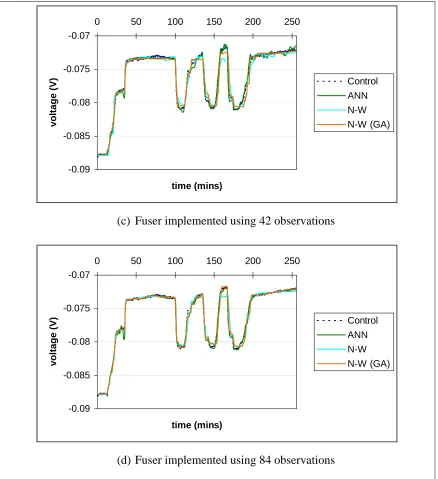
Fig. 14: Effect of altering the number of observations used to realise the fuser 68
Fig. 15: Effect of altering the bandwidth of the kernel estimator 69
Fig. 16: Genetic algorithm process 73
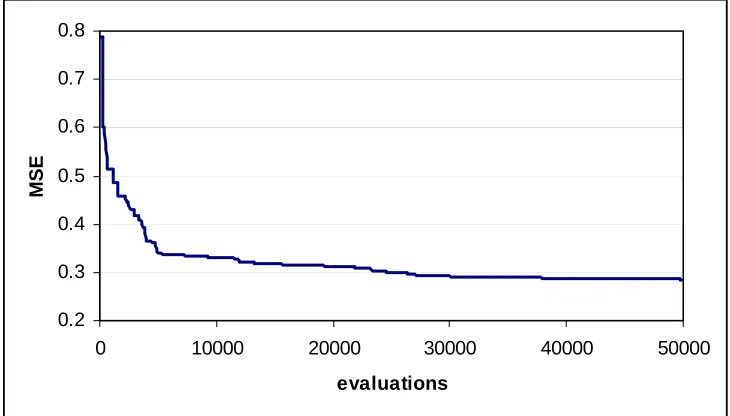
Fig. 17: Typical GA convergence plot 75
Fig. 18: Optimisation of the N-W fuser using a genetic algorithm 76
Fig. 19: Sensor validation using N-W with N=2 81
Fig. 20: Simplified representation of sensor fusion and validation scheme using the N-W estimator
82
Fig. 21: Sensor validation and fusion results using the N-W estimator 86
Fig. 22: Assumed probability density function of a change detection parameter for a healthy sensor
95
Fig. 24: Comparison of fusion operators 97
Fig. 25: Comparison of ‘context independent variable behaviour’ fusion operators 100
Fig. 26: Deriving change detection parameters by partitioning the frequency spectrum into four separate frequency bands
103
Fig. 27: Comparison of fusion operators for fuzzy change detection parameters 104
Fig. 28: Fuzzy sensor validation using the Fast Fourier Transform 106
Fig. 29: Using a filter-bank to obtain the change detection parameters 108
Fig. 30: Fourier transform of a 16-point Hanning window 109
Fig. 31: Comparison of 64-point Hanning window with 3rd order IIR digital filter 110
Fig. 32: Fuzzy sensor validation using a parallel filterbank 110
Fig. 33: Detecting a sensor stuck fault at t=120 mins. 112
Fig. 34: Fuzzy fusion architecture with sensor validation 114
Fig. 35: Fusion of three thick film pH sensors 115
Fig. 36: Fuzzy sensor validation and fusion with 3 sensors - Sensor 1 spike fault at t=75 mins, Sensor 2 hardover fault at t=150 mins.
116
Fig. 37: Fuzzy sensor validation and fusion with 3 sensors - Sensor 4 erratic from t=100 mins.
117
Fig. 38: Fuzzy sensor validation and fusion with 4 sensors - Sensor 4 erratic from t=100 mins.
118
Fig. 39: Sensor validation and fusion using the N-W kernel estimator 130
Fig. 40: Fuzzy sensor validation 131
List of Tables
Table 1: JDL Process Model 27
Table 2: Device status values and meanings 51
Table 3: Summary of typical sensor failure modes 52
Table 4: Mean square error of thick film pH sensors 67
Table 5: Effect of altering the number of observations used to realise the fuser 67
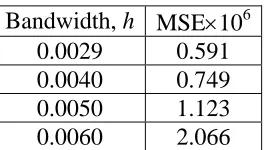
Table 6: Effect of altering the bandwidth of the kernel estimator 69
Table 7: Bias and random errors of thick film pH sensors 69
Table 8: Summary of sensor fusion results 69
Table 9: Number of misclassifications for the hypothesis Ho is True if the pH sensor output is greater than –0.075V
71
Table 10: Comparison of decision fusion results obtained using majority voting and a feedforward neural network
71
Table 11: Summary of fuser performance 75
Table 12: Performance of the N-W sensor validation and fusion scheme 84
Table 13: Sensitivity of change detection parameters to sensor faults 103
Table 14: Examples of mathematical tools used for data fusion 122
1) Introduction
1.1) Background
and
Motivation
In 1997 the UK Foresight Programme highlighted sensors as one of the key areas in
science, engineering and technology that “merit particularly urgent attention by
organisations in the public and private sectors.” Feedback from government, industry
and academia suggested that sensors should be more intelligent, robust, reliable,
integrated and smaller. The report highlighted the need to further develop links between
research into sensor systems and the processing of sensed information, including signal
gathering and processing from multisensor arrays. (Foresight Sensors Action Group,
1997). A separate report by the Defence and Aerospace Foresight Panel Technology
Working Party, also published in 1997, concluded that data fusion and data processing
techniques are vital enabling technologies for a wide range of defence and non-defence
applications (Defence and Aerospace Foresight Panel Technology Working Party,
1997).
Data fusion is not a new concept. A natural ability to fuse sensed information has
evolved in many animal species. Humans for example, routinely combine sight,
hearing, touch, smell and taste information (Murphy, 1996). Data fusion can be used to
calibrate, increase dimensionality, increase statistical significance or provide robustness
in order to cope with sensor uncertainty (Starr and Desforges, 1998). This may be
achieved by:
• Combining readings from several different types of sensor to give more accurate
information;
• Using readings from several independent sensors to make the system less
vulnerable to the failure of a single sensor;
• Combining several readings from the same sensor to reduce the effect of noise (Brooks and Iyengar, 1998).
Present applications of data fusion span a wide range of fields:
• Industrial engineering (Belloir et. al., 2000; Gros, 1997; Karlsson et. al., 1998;
• Robotics and intelligent vehicles (Agogino et. al., 1995; Bryanston-Cross et. al.,
1999; Dailey et. al., 1996; Durrant-Whyte, 1988; Murphy, 1998);
• Pattern recognition and radar tracking (Belloir and Billat, 2000; Pau and
Trailovic, 2000; Smith, 1998);
• Landmine detection and other military applications (Collins et. al., 2001; Cremer et. al., 1999; Maltese and Lucas, 1998);
• Remote sensing (Leduc et. al., 1999; Petrou and Stassopoulou, 1999);
• Aerospace systems (Doyle and Harris, 1996; Harris et. al., 1998);
• Law enforcement (Hua-Mei Chen and Varshney, 1999; Varshney, 1997a);
• Medicine (Rogova, 1999; Solaiman et. al., 1999; Winquist et. al., 1998).
Data fusion systems have been used extensively for defence applications, in particular
surveillance, target tracking and identification, and strategic decision-making. (Harris
et. al., 1998) report that over two-thirds of defence and aerospace products exported
from the UK during the period 1990-1994 utilise some form of multisensor fusion.
(Valet et. al., 2000) summarise the results of a statistical study of journal articles
published in the years 1997-1999. Defence applications accounted for 37% of the
articles published. Only 6% considered industrial engineering applications despite the
importance of sensors and feedback control systems in the process and manufacturing
industries, where the global market for sensors was estimated to reach £25 billion per
year in 2000 (Foresight Sensors Action Group, 1997).
The aim of multisensor fusion is to gain maximum value from existing sensor
technologies (Grossmann, 1998). Fusion techniques can be applied to multiple readings
from the same sensor or readings from multiple sensors. In many cases a single sensor
cannot provide sufficient information about the environment hence the use of multiple
sensors can provide more accurate and more complete information about the world.
(Brooks and Iyengar, 1998) define the following types of sensor networks:
• Complementary – Complementary fusion uses different sensors that each give
different phenomena. An example is the combination of wind speed and air
temperature measurements to determine wind chill factor (Tanner and Loh,
1992);
• Competitive – Independent measures of the same phenomenon, either a series of
readings from a single sensor or readings obtained from multiple sensors.
Competitive fusion is often used to reduce measurement uncertainty, although
the fusion of a series of measurements from the same sensor type cannot reduce
systematic (bias) errors it may reduce random (noise) errors;
• Cooperative – Combines data from independent sensors (i.e. the ‘left’ and ‘right’ images in a 3D vision system. Cooperative fusion is not widely considered in
the literature. Fusion may reduce uncertainty and incompleteness but the fusion
process will derive an estimate of some secondary parameter (i.e. depth
information in the 3D vision system) and thus may be viewed as a ‘virtual
sensor’ (Durrant-Whyte, 1988).
The fusion scheme adopted will depend on the application. It is therefore difficult to
generalise the fusion strategy and no universal fusion algorithm has been proposed.
Some attempts have been made to establish a generic framework for data fusion based
on best practice techniques (Hannah et. al., 2000), however the design and
implementation of data fusion systems remains very challenging with a number of
misconceptions and pitfalls. In particular sensor fusion can result in poor performance
if incorrect information about sensor performance is used (Hall and Garga, 1999). In
many applications an accurate mathematical model of the sensor is unavailable, too
complex, or the task of deriving the model is impractical (Rao 1999; Yung and Clarke,
1989). A common approach in data fusion is therefore to characterise the sensor in
some convenient way, typically using static, zero-mean Gaussian probability
distributions (Hall, 1992). ‘Real world’ sensors operating in a dynamic environment
and subject to non-Gaussian conditions are very unlikely to behave in this idealised
manner, and this can have a detrimental effect on the data fusion process (Hall and
Garga, 1999).
Fuser design is a critical issue. A poorly designed fusion scheme can render worse
possible to collect experimental data by sensing objects with known parameters. (Rao,
1999) demonstrates that experimental data from such observations may be used to
estimate the required fuser, implemented by means of a feedforward neural network or
the Nadaraya-Watson (N-W) estimator.
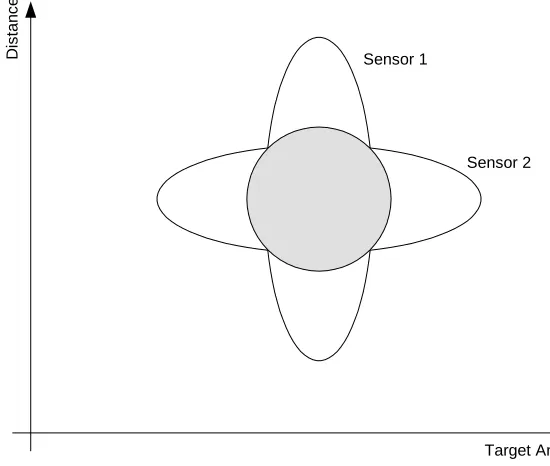
The goal of many fusion systems is uncertainty reduction and this is best achieved using
sensor complementarity (Grossmann, 1998). Fig. 1 illustrates the fusion of two sensors
used to measure distance and target angle in a mobile robot. Sensor 1 is fairly certain
about the target angle but uncertain about the range. Sensor 2 is relatively certain about
the distance but uncertain about the target range. In this case the reduction of the
measurement uncertainty is achieved by competitive fusion as both sensors measure the
same parameters.
Sensor 1
Target Angle
D
ista
n
ce
Sensor 2
Fig. 1: Fusion of complementary sensor data
A further example is the use of competitive sensor fusion for the detection of buried
(abandoned) anti-personnel landmines. No single sensor technology can reliably
achieve the detection rates demanded for humanitarian demining operations (Cremer et.
al., 1999). Consequently multisensor systems have been the subject of extensive
research and development. (Lohlein and Fritzsche, 1999) describe the fusion of a metal
detector and ground penetrating radar. The results indicate that the fusion process does
(compared with a detection probability of 63% for the metal detector and 60% for the
ground penetrating radar operated separately). Unfortunately the fused result is still
well below the UN standard of 99.6% for humanitarian demining.
Target tracking using a Kalman filter to fuse a series of measurements from a radar
system is another example of competitive fusion (Hall, 1992). In this case a single
sensor is employed, making the system vulnerable to a fault or external interference
such as jamming. Multiple sensors can be used to improve the reliability of a system
and physical redundancy has long been a feature of safety-critical systems (Napolitano
et. al., 1998b).
A great emphasis in the design of data fusion systems is that high quality data is
required from the sensors. Expressed succinctly by (Hall and Garga, 1999):
“There is no substitute for a good sensor. No amount of fusion of bad sensors will substitute for a single accurate sensor that measures the phenomenon that you want to observe.”
In many applications acting on faulty sensor data can have disastrous effects. For
example, the safe and reliable operation of complex process plant is dependent on the
reliable operation of sensors providing information about the process state (Keaton et.
al., 1998). Sensor validation is concerned with recognising when an observed value lies
outside the expected range. Two separate approaches to sensor validation have been
developed:
• Physical redundancy – Uses multiple parallel hardware sub-systems (Napolitano
et. al., 1998b);
• Analytical redundancy – Continuously monitors the sensor output signals in
order to provide fault detection. Many validation schemes use a model of the
plant or system. The model may be analytical or empirical. A sensor fault is
signalled when the measured value differs significantly from the value predicted
by the model (Patton et. al., 1995).
It is therefore apparent that important links exist between the fields of multisenor fusion
• The use of physical redundancy to provide sensor validation is a form of
competitive sensor fusion;
• Many sensor fusion and sensor validation schemes require models of sensor
performance;
• The performance of a multisensor fusion scheme is critically dependent on the performance of the individual sensors.
The central aim of this research programme is therefore to investigate the
complementary aspects of multisensor fusion and sensor validation in order to better
exploit the apparent synergy between these two activities.
1.2) Aims of the Research Programme
The aims of the research programme are:
1. To review existing schemes for multisensor fusion and sensor validation;
2. To investigate techniques used by sensor fusion and sensor validation schemes
to characterise sensor performance, in particular the use of empirical models of
sensor performance;
3. To propose new methods for the fusion of complementary sensors to provide
uncertainty reduction and improve system reliability, with particular emphasis
on the measurement of pH using thick film sensors;
4. To contribute to current knowledge by developing new schemes for sensor
validation and fusion suitable for both complementary and competitive fusion.
Such work is important because sensors play a vital role in a wide range of application
areas. The work has resulted in the following original contributions to knowledge in the
fields of multisensor fusion and sensor validation:
• The N-W estimator has been used to fuse an array of complementary thick film
robust, however they are generally manufactured in a batch process. Despite
careful control of the manufacturing process it is very difficult to achieve
reproducibility between batches. pH sensors are also susceptible to
environmental conditions and hence reliable analytical models of sensor
performance are difficult to obtain. The N-W fuser design is based on
experimental data and should be suitable for all sensors produced in a particular
batch. The N-W estimator has previously found only limited use as a fuser and
this is a new application of the technique. An empirical design procedure for the
N-W fuser has been formulated, although this manual design process can be
rather time-consuming. A Genetic Algorithm (GA) has therefore been used to
automate the fuser design process. This is a new approach to the design
optimisation of the N-W fuser.
• The N-W estimator has been used as the basis of a new sensor validation and
fault accommodation scheme. The technique makes use of sensor (physical)
redundancy. The operational characteristics of this novel approach have been
investigated and the algorithm validated using the full range of typical sensor
fault conditions.
• A fuzzy sensor validation scheme has been devised. The on-line sensor status
output is derived from change detection parameters based on spectral analysis of
the sensor output signal. This new method has been validated for all typical
sensor fault conditions and can be applied to a wide range of sensor types.
Portability is facilitated by the procedure that has been developed to
parameterise the fuzzy sets employed for fault detection using data obtained
from a healthy sensor.
1.3) Structure of the Thesis
The remaining material in this thesis is divided into the following major sections:
• Chapter 2 – Reviews the major taxonomies and architectures applicable to
multisensor fusion. Relates the main mathematical tools and techniques, giving
• Chapter 3 – Reviews the principles and applications of sensor validation
schemes based on physical and analytical redundancy;
• Chapter 4 – The N-W kernel estimator and the feedforward neural network are
employed to fuse an array of complementary thick film pH sensor electrodes.
An empirical design procedure for the N-W fuser is presented. A GA is also
employed to optimise the fuser design;
• Chapter 5 – Presents the design and evaluation of a novel sensor validation and
fusion scheme using the N-W kernel estimator;
• Chapter 6 – Proposes a sensor validation scheme using analytical redundancy to
provide on-line status information. The fuzzy status output, µH ∈[0,1] is potentially more useful than the simple binary status bit provided by many
sensor validation schemes;
• Chapter 7 – Discusses the model-free sensor validation and fusion schemes, and
the original contribution to knowledge, with suggestions for further work;
• Chapter 8 – Conclusions.
Extensive testing and evaluation of the various algorithms has been carried out,
principally using the MATLAB software. The results presented in the thesis have been
carefully selected to demonstrate the strengths and weaknesses of the various methods.
1.4) Concluding
Remarks
Sensors are used increasingly and in a divergent range of applications. Two separate
schemes have been developed to safeguard and enhance the quality of sensed data:
sensor fusion combines separate readings, while sensor validation confirms whether the
measured value is within acceptable limits. This research considers the complementary
aspects of these two activities and presents novel schemes that help to derive maximum
2) Multisensor Data Fusion
2.1) Definition of Multisensor Data Fusion
A useful definition of multisensor data fusion has been proposed by (Varshney, 1997a):
“Multisensor data fusion refers to the acquisition, processing, and synergistic combination of information gathered by various knowledge sources and sensors to provide a better understanding of the phenomenon under consideration.”
Another definition is due to (Wald, 1998):
“Data fusion is a formal framework in which are expressed means and tools for the alliance of data originating from different sources. It aims at obtaining information of greater quality; the exact definition of ‘greater quality’ will depend upon the application.”
This second definition emphasises the notion of combining information from various
sources to garner information of better quality than would otherwise be available using
the sources independently. The term ‘greater quality’ is used in a general sense to
indicate that the fused information should be in some way more useful to the user.
Much of the early work in the field of information fusion is related to military
applications; for example automated target tracking and recognition systems, remote
sensing, battlefield surveillance and automated threat recognition systems. A range of
non-military applications have also been developed, in particular condition monitoring
of industrial equipment, remote sensing, robotics and medical diagnosis (Waltz and
Llinas, 1990).
Data fusion draws upon a range of techniques and disciplines: digital signal processing,
statistical estimation, control theory, artificial intelligence and numerical methods. A
significant feature of the data fusion process is that information may be gathered from a
variety of sources: sensors, databases or humans. The potential advantages of a
multisensor system include (Varshney, 1997a):
• Improved reliability and robustness – there is an inherent redundancy due to the
• Extended coverage – use of multiple sensors may increase both spatial and
temporal coverage;
• Increased confidence – use of multiple sensors may help confirm inferences
from individual sensors;
• Shorter response time – because more data is collected by multiple sensors, a prescribed level of performance may be attained in a shorter time;
• Improved resolution – the overall resolution attained may be better than any
single sensor.
A practical problem is that combining accurate (good) data with inaccurate or biased
data, especially if the uncertainties or variances of the data are unknown, may actually
produce worse results than could be achieved by taking the most appropriate (best)
sensor in a suite (Hall and Llinas, 1997).
2.2) The Data Fusion Process
The following generic types of sensor fusion are defined by (Brooks and Iyengar,
1998):
• Complementary fusion – fusion of several disparate sensors that each give only
a partial view of the environment. This type of session resolves incompleteness
of sensor data;
• Competitive fusion – fusion of uncertain sensor data from several sources,
predominantly in order to reduce the uncertainty of the measurements. Fusion
can be performed on several measurements from different sensors, or on a series
of measurements from the same sensor;
• Cooperative fusion – fusion of independent sensors in order to derive an
estimate of some secondary parameter. An example given by (Durrant-Whyte,
1988) is the fusion of the ‘left’ and ‘right’ channels in a stereo vision system to
This taxonomy is very similar to the classes of sensor fusion proposed by (Tanner and
Loh, 1992):
• Uniquely determined dependent data fusion – there is precisely enough data to
determine the fused value. Tanner and Loh use the measurement of wind chill
factor from air temperature and wind speed as an example. This is
complementary fusion;
• Over determined dependent data fusion – occurs when there is more data
available than is actually required to determine the fused value. An example of
this is target tracking using data from multiple spatially dispersed radar systems.
The inherent sensor redundancy can be employed to detect erroneous sensor data
and provide reliable operation in the event of the failure of an individual radar,
due for example, to electronic counter measures. This is a competitive fusion
system.
• Under determined dependent sensor fusion – takes place when there are
insufficient sensory data to determine the desired value. This is really a process
of estimation or extrapolation. An example cited by Tanner and Loh is the
estimation of the velocity of an object from distance measurements. The
calculated velocity will only be correct if the object moves directly towards or
away from the range sensor.
A key issue is to decide where in the data flow to actually combine or fuse the data.
This fundamental design choice affects the quality of the fused product, the nature of
the algorithms or techniques employed, the complexity of the processing, and the
bandwidth of the communications required between the sensors and fusion centre (Hall
and Llinas, 1997). The choice of architecture depends on the nature of the sensors
involved, as well as the nature of the inferences sought (Hall, 1992). The main
architectures are illustrated in Fig. 2.
In Data Level Fusion (Fig. 2c) raw data from the sensors are combined. This approach
is centralised and yields the best overall results, however the sensor data are required to
be commensurate, that is observations of the same or similar physical properties, and
Feature Level Fusion (Fig. 2b) uses feature vectors extracted from sensor observations
and subsequently fused. Data communication requirements are reduced, however the
result is less accurate due to the information loss associated with generating the feature
vectors.
In Decision Level Fusion (Fig. 2a) a separate decision is produced for each sensor.
These decisions are then combined to yield the final result. The sensors need not be
commensurate and the communication bandwidth requirements are greatly reduced.
This is the least accurate of the three fusion options due to the information loss
associated with generating feature vectors and other processing.
The Data Fusion and Data Processing Technology Working Party of the Defence and
Aerospace Foresight Panel (Defence and Aerospace Foresight Technology Working
Party, 1997) also adopted a three level model of the fusion process (Fig. 3). Low level
fusion combines raw data from the sensors (data level fusion), while medium level
fusion combines features or patterns extracted from the sensed data (feature level
fusion) and high level fusion combines probabilistic information about states or
Feature Extraction Sensor A Sensor B Sensor N Identity Declaration Association I/DA I/DB Identity Declaration Identity
Declaration I/DN
Joint Identity Declaration Decision Level Fusion . . . . . .
Fig. 2a: Decision Level Fusion [Source: (Hall, 1992)]
Feature Extraction Sensor A Sensor B Sensor N Association Joint Identity Declaration Feature Level Fusion . . .
Fig. 2b: Feature Level Fusion [Source: (Hall, 1992)]
Association Sensor A Sensor B Sensor N Data Level Fusion Joint Identity Declaration Feature Extraction . . . Identity Declaration
Sensing Signal Processing Data Feature Extraction Pattern Processing Situation Assessment Decision Making Low Level Medium Level High Level Instruction Outside World Signal Processed Signal Pattern State Probability Option Costs
Fig. 3: A model of the fusion process [Source: (Defence and Aerospace Foresight Panel Technology Working Party, 1997; Harris et. al., 1998)]
The multisensor data fusion paradigm due to (Manyika and Durrant-Whyte, 1994),
illustrated in Fig. 4, models the data fusion process as a series of data/information flows
and processing elements. A three level model of the fusion proves is again adopted,
with data, feature and decision level fusion
Feature Extraction D a ta A sso ci a ti o n Env ir o nm en t Hypothesis/ Proposition Formulation Data Level Fusion Decision Level Fusion Feature Level Fusion Inference and Estimation Decision Strategy and
Feedback Control Sensor
Sensor
To Higher Level Functions (Situation
and Threat Assessment
Many authors model fusion as a three level process (Hall, 1992; Manyika and
Durrant-Whyte, 1994; Thomopoulos, 1989; Waltz and Llinas, 1990). An alternative
characterisation of the three level fusion model has been proposed by (Dasarathy, 1997)
and is based on the input-output modes of the fusion process:
• Data In – Data Out fusion: This is commonly referred to as data fusion. Fusion
takes place at the front end of the processing stream, typically using signal or
image processing techniques. The registration, both temporal and spatial, of the
data is critical as the raw information streams from the different sensors are
combined.
• Data In – Feature Out fusion: Data from different sensors are combined to derive some feature of the object or environment. An example is the fusion of
the information gathered from each of the two sensors in a stereo vision system.
In this case the fusion process will yield depth information.
• Feature In – Feature Out fusion: Referred to as feature fusion, derived features
are extracted from the raw sensor data and combined using qualitative or
quantitative techniques.
• Feature In – Decision Out fusion: Here the inputs are features from different sensors and the output of the fusion process is a decision. This is a widely used
fusion paradigm and is used in many pattern recognition systems.
• Decision In – Decision Out fusion: Typically referred to as decision fusion. The
fusion process integrates decisions made by single or multiple sensors at the
local level. The use of multiple sensors at the local level may imply the use of
one or more of the fusion modes described above.
The fusion architecture for a Data In – Decision Out system is generally regarded as
similar to Feature In – Decision Out fusion.
This initial taxonomy is presented as the building blocks of more complex fusion
systems. In general researchers believe that fusion of information at the lowest possible
or make decisions using the sensed information may result in information loss. The low
level information may, however, suffer the highest corruption due to noise.
2.2.1) The Joint Directors of Laboratories (JDL) Model
In an attempt to codify the terminology related to data fusion, the defence communities
in the USA established a Joint Directors of Laboratories (JDL) Data Fusion Working
Group in 1986. Although the group focussed on military applications, the Data Fusion
Lexicon and model (Fig. 5) for the data fusion process established by this group are
applicable to other application areas (Hall and Llinas, 1997).
Source Pre-processing
Level One Object Refinement
Level Two Situation Refinement
Level Three Threat Refinement
Sources
Database Management
System
Human Computer
Interface
Level Four Process Refinement
Data Fusion Domain
Fig. 5: The JDL Model of the Data Fusion Process [Source: (Hall and Llinas, 1997)]
Sources – These include sensors and other a-priori information available from humans
and databases.
Human Computer Interface (HCI) – This allows human input such as commands,
information requests and human assessments of inferences. In addition the HCI is used
to communicate results to the user.
Source Pre-processing – Provides a means of regulating the flow of information
entering the data fusion system. The fusion system may easily become overwhelmed by
data from multiple sensors. Preliminary signal processing may be used to sort and
prioritise data for subsequent processing.
Level One Processing (Object Refinement) – Fuses data in order to obtain the position,
velocity and identity of low-level entities or activities. Level One processing combines
positional and identity data from multiple sensors to establish a database of identified
four separate functions: (1) data alignment, (2) data association, (3) tracking, and (4)
identification.
Level Two Processing (Situation Refinement) – Seeks a higher level of inference about
Level One processing. Both formal and heuristic techniques are used to examine the
objects and events identified by Level One processing.
Level Three Processing (Threat Refinement) – Projects the current situation into the
future in order to draw inferences about threats and opportunities. Level Three
processing develops alternate hypotheses and evaluates these in the context of the
available information.
Level Four Processing (Process Refinement) – A meta-process, concerned with the
other processes, that undertakes three key functions: (1) monitors the data fusion
process to provide information about long term performance, (2) identifies what
information is needed to improve the fusion product, and (3) allocates and directs
sensors and other assets to collect the required information.
Database Management – An important ancillary function. The database management
system is required to provide data retrieval, storage, archiving, compression and
relational queries. This task is particularly difficult because of the large and varied data
managed. A summary of the JDL data fusion process components is shown in Table 1.
The JDL process model is widely used as a conceptual framework for the data fusion
process in military and non-military applications. The separation of processes into four
separate levels is rather artificial as a real data fusion system will interleave these
SOURCES The sources provide information in a variety of levels ranging from sensor data to a priori information from databases or human input. PROCESS ASSIGNMENT Source pre-processing enables the data fusion process to concentrate on
the data most pertinent to the current situation as well as reducing the data fusion processing load. This is accomplished via data pre-screening and allocating data to appropriate processes.
OBJECT REFINEMENT (Level 1)
Level 1 processing combines locational, parametric, and identity information to achieve representation of individual objects. Four key functions are:
• Transform data to a consistent reference frame and units;
• Estimate or predict object position, kinematics, or attributes;
• Assign data to objects to permit statistical estimation; and
• Refine estimates of the objects identity or classification. SITUATION
REFINEMENT (Level 2)
Level 2 processing attempts to develop a contextual description of the relationship between objects and observed events. This processing determines the meaning of a collection of entities and incorporates environmental information, a priori knowledge, and observations. THREAT REFINEMENT
(Level 3)
Level 3 processing projects the current situation into the future to draw inferences about enemy threats, friendly and enemy vulnerabilities, and opportunities for operations. Threat refinement is especially difficult because it deals not only with computing possible engagement outcomes, but also assessing an enemy’s intent based on knowledge about enemy intent, doctrine, level of training, political environment, and the current situation.
PROCESS REFINEMENT (Level 4)
Level 4 processing is a meta-process, i.e. a process concerned about other processes. The three key Level 4 functions are:
Monitor the real-time and long term data fusion process;
Identify information required to improve the multi-level data fusion product; and
Allocate and direct sensors and sources to achieve mission goals. DATABASE
MANAGEMENT SYSTEM
Database management is the most extensive ancillary function required to support data fusion due to the variety and amount of managed data, as well as the need for data retrieval, storage, archiving, compression, relational queries and data protection.
HUMAN-COMPUTER INTERACTION
In addition to providing a mechanism for human input and
communication of data fusion results to operators and users, the human-computer interaction (HCI) includes methods of directing human attention as well as augmenting cognition, e.g. overcoming the human difficulty in processing negative information.
Table 1: JDL Process Model [Source: (Hall and Llinas, 1997)]
2.3) Architectures for Multisensor Data Fusion
The development of distributed sensor networks was originally motivated by their use
in military surveillance applications. A typical system will combine data from local
sensors, for example sonar, radar and infrared (Viswanathan and Varshney, 1997). An
alternative approach (Agre and Clare, 2000) uses many low cost spatially dispersed
of low cost sensor nodes with embedded signal processing, wireless communications,
power sources and synchronisation. Sensor nodes may be required to operate
unattended for several weeks or months. Applications include area surveillance and
environmental monitoring, where sensor nodes may be hand-emplaced, air-dropped or
munition-deployed. The distributed sensor network approach can be used to build
robust networks capable of sensing a remote area, with sensors in close proximity to the
object of interest.
The following main fusion architectures are identified in the literature:
• Centralised - sensor data are sent unprocessed from sensors and processed
entirely within the central hub of the system. The communication system may
require a large bandwidth.
• Hierarchical – intermediate processing units situated between the sensors and central hub perform pre-processing tasks.
• Blackboard – sensor nodes are essentially autonomous but exchange information
through a blackboard system.
• Decentralised – uses autonomous sensor nodes with on-board processing and
communication facilities. The system consists of a network of nodes, either
fully connected, or connected to only local nodes. The decentralised data fusion
paradigm offers a number of advantages, including modularity, scalability and
fault tolerance (Durrant-Whyte et. al., 1998).
Some important general properties of the architecture of a multisensor fusion system are
identified by (Harris et. al., 1998) and include:
• Modularity – built up from discrete modules that may be interchanged as
needed.
• Parallelisation – the computational load may be high, hence multiple processing
elements can help achieve the necessary real-time operation.
• Scalability – the system may be applied to problems of increasing magnitude
• Robustness/survivability – graceful performance degradation in the event of a
system failure is particularly important in a safety critical or military application.
• Interoperability – allow integration of different technologies i.e. an open system
design philosophy.
The majority of operational multisensor fusion systems are limited in scope and often
employ just two sensors (Grossmann, 1998). Therefore, despite the many potential
advantages of the distributed architecture, the majority of existing multisensor fusion
systems employ a centralised approach (Valet et. al., 2000).
2.4) Tools and Techniques for Multisensor Data Fusion
2.4.1) Probabilistic Methods
Bayes’ Theorem
Probabilistic methods use statistical inference techniques to compute the probability of a
hypothesis. A number of methods of hypothesis testing are identified in the literature
and described by (Hall, 1992) and (Gros, 1997). Classical inference techniques may be
generalised to include data from multiple sensors, however only two hypotheses may be
assessed at a time. Probability theory also requires a priori information about
probability density functions that may not be readily available. Consider the use of
Bayes’ theorem, named after the eighteenth century British cleric the Rev. Thomas
Bayes (1702-1761). Bayes’ theorem is used to find the a posteriori probability of
hypothesis Hi being true given the evidence E. The theorem is expressed
mathematically in the form:
∑
= i i i i i i H P H E P H P H E P E H P ) ( ) | ( ) ( ) | ( ) |( (2.1)
where H0, H1,… Hj represent mutually exclusive and exhaustive hypotheses
P(Hi) is the a priori probability of Hi being true
Bayes’ theory provides a determination of the hypothesis being true. It is necessary to
enumerate all possible hypotheses in advance. Bayes’ theorem incorporates a priori
knowledge about the likelihood of a hypothesis being true, however when no a priori
information is available the ‘principle of indifference’ can be used where the P(Hi) are
assumed equal for all i.
Bayesian classification is employed by (White et. al., 1999) to assist with tracking of
targets in close proximity. Military systems fuse various combinations of radar, optical,
infra-red, acoustic, magnetic, radiometric and electronic surveillance data. Attributes
measured by these sensors include speed, range, altitude and radar cross-section. The
target attribute data are used to associate a target with some particular track and hence
assist the tracking algorithm. Target types are represented via a probability matrix:
P(i|j) is the probability that the sensor will declare a target of type j to have attribute i.
The Bayesian classification scheme is used to report the target belonging to the class
that has the highest probability. It is necessary to define all the target classes and
probabilities in advance. White et. al. report good results when the probability matrix is
initialised with the distributions used to generate the simulation data, however even
relatively small deviations from these exact values cause significant performance
degradation.
Kalman Filter
The Kalman filter is an algorithm for recursively estimating the state of nature given a
set of uncertain observations. The filter provides estimates of the state that are optimal
in the statistical sense (Manyika and Durrant-Whyte, 1994).
The algorithm basically consists of two steps and is often referred to as a
predictor-corrector filter. Consider the linear system described by the state equations:
) ( ) ( ) ( ) 1 ( ) 1 ( ) ( k k k k k k v Cx y w Ax x + = − + − = (2.2)
where w(k) is the process noise which is assumed to be Gaussian with zero-mean and
covariance Q(k), v(k) is the measurement noise which is assumed to be Gaussian with
zero-mean and covariance R(k), A is the state matrix of the system and C is the
Predictor equation
[
( ) ˆ( 1)]
) ( ) 1 ( ˆ ) 1 (
ˆ k+ k =Ax kk− +G k y k −Cx kk−
x (2.3a)
Predictor gain
[
]
1) ( )
1 ( )
1 ( )
(k =AP kk− C CP kk− C +R k −
G T T (2.3b)
Prediction mean-square error
[
( )]
( 1) ( )) 1
(k k A G k CP kk A Q k
P + = − − T + (2.3c)
The Kalman filter is frequently used to estimate the position, velocity and acceleration
of a target relative to some frame of reference by fusing sequential sensor readings. In a
system with multiple sensors it is possible to fuse the estimates produced by the
individual Kalman filters using a simple weighted sum approach (Harris et. al., 1998).
The use of Kalman filters to validate and fuse the readings from radar, sonar and optical
sensors for vehicle control on an automated highway is discussed by (Agogino et. al.,
1995) and (Goebel and Agogino, 1996). A model-based approach has been adopted. A
Kalman filter is used to estimate the measurand from the sensor readings and this value
is then compared with a model for the vehicle state. Readings are classified as faulty if
they are inconsistent with the model, although reliable validation is only possible when
the vehicle is in a state for which a model exists. Despite this, and the limitations of the
Kalman filtering algorithm, the authors report some good results based on simulation
and practical testing.
A model-based approach has also been adopted by (Julier and Durrant-Whyte, 1996)
who use a Kalman filter to temporally fuse a number of process models that describe the
behaviour of a system. The Kalman filter is used to fuse the predictions of each model
as if they were sensor information. The authors demonstrate that this approach is
theoretically sound when applied to linear systems.
The Kalman filter is perhaps the most widely used method of state estimation, however
the filter model assumes the process noise, w(k) and measurement noise, v(k) are
sequences of zero-mean Gaussian white noise with covariances R(k) and Q(k)
respectively. In many real applications the actual values of R(k) and Q(k) are not
large bound. Fuzzy control principles can be employed to adapt the behaviour of the
filter and so prevent divergence (Sasiadek and Hartana, 2000; Lho and Painter, 1993).
Other authors report good results using neurofuzzy techniques (Doyle and Harris,
1996). The reliance on stationary Gaussian models of process and measurement noise,
or alternatively a complex adaptive control scheme, is a major limitation.
Blind Source Separation
Blind Source Separation (BSS) has been used to recover the waveforms of unobserved
‘sources’ from observed measurements obtained from a Hall effect sensor array
(Paraschiv-Ionescu et. al., 1999). Expressed in matrix form:
) ( )
(t As t
x = (2.4)
where x is the vector of sensor output signals, A is the unknown ‘mixing matrix’ and s
is the vector of unknown source signals. The BSS algorithm consists of estimating a
‘separating’ matrix B either ‘on-line’ or by means of a batch algorithm:
) ( ) ( ) ( ) ( ) (
ˆ t B t x t B t As t
s = = (2.5)
This simple model can be extended in several ways:
• Unknown number of sources
• Noisy observations x(t)=As(t)+n(t)
• Non-linear mixture where is any unknown
inversible non-linear function.
⎟⎟ ⎠ ⎞ ⎜⎜ ⎝ ⎛ =
∑
= m j j ij ii t f a s t
x
1
) ( )
( fi
( )
⋅The technique is independent of sensor type and can be extended to non-linear sensor
behaviours. The optimisation procedure for estimating the separation matrix B may be
implemented using a neural network. At most one of the source signals is allowed to
have a Gaussian distribution. It is therefore impossible to separate two or more
Gaussian sources from each other. The performance of the algorithm may be improved
Nadaraya-Watson Estimator
A regression curve describes a general relationship between an explanatory variable Y
and a response variable X.
If n data points
{
have been collected, the regression relationship can bemodelled as:
}
n i i i YX , =1
( )
i i i mYX = +ε (2.6)
where m is the unknown regression function and εi are observation errors1. In most cases X denotes the (scalar) response variable and Y is a vector. The aim of regression
analysis is to produce a reasonable approximation to the unknown function. This can be
done essentially in two ways: parametric estimation and non-parametric estimation.
In parametric estimation the response function is approximated by some predefined
functional form, for example a polynomial regression equation. Non-parametric
estimation does not utilise a fixed parametric model.
The Nadaraya-Watson (N-W) kernel estimator is a non-parametric estimation technique
applicable to univariate and multivariate problems. Applications include engineering,
econometrics and mathematics (Blundell and Duncan, 1998; Hardle, 1990). Estimation
of the function at a particular point y is performed using the mean of observations Xi
that correspond to Yi in the region of y. In practice this estimate may be very poor if
observations are included that are distant to y since this will introduce bias. A kernel
function is therefore employed to weight the observations. As a result of the local
averaging procedure the regression estimator is often called a smoother.
1
Some sources (i.e. (Hardle, 1990)) define the regression relationship as Yi =m
( )
Xi +εi however theThe N-W estimator is given by:
(
)
(
)
∑
∑
= = − − = n i i h i n i i h n h Y y K X Y y K y f 1 1 , ( )ˆ (2.7)
where K is the kernel function and h is the bandwidth parameter. A number of kernel
functions are used in practice, for example the Gaussian function. The value of h
controls the weighting of the observations with respect to their distance to y. With a
fixed sample size the value of bandwidth h determines the degree of smoothing.
Choosing a small value of h will include only a few observations in the computation of
the estimate and may lead to a large variance. Conversely, a large value of h may
produce a significant approximation bias.
(Rao, 1997) demonstrates the use of the N-W estimator with Haar kernels to estimate a
fusion rule in a multisensor system. In a system with N sensors, the sensor Sj,
j=1,2,…N, outputs , according to an unknown probability density for the input .
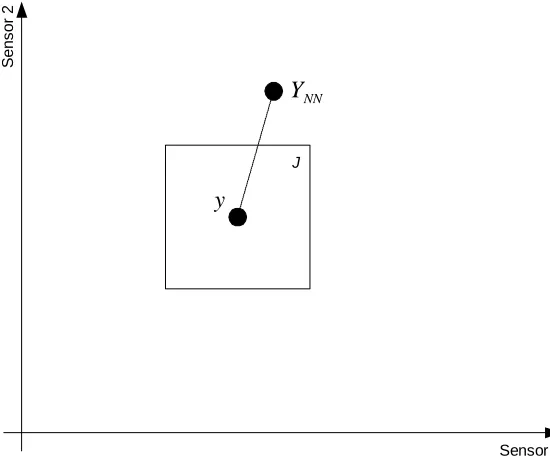
The Haar kernel function is an N-dimensional hypercube, J centred on y, and having
volume , where h is the bandwidth parameter.
j i
Y Xi
N
h
The N-W estimator based on Haar kernels is therefore:
∑
∑
∈ = ) ( 1 ) ( ˆ , i J J Y i n h Y X y f i (2.8)where denotes the indicator function 1J(Yi)
⎩ ⎨ ⎧ ∈ = otherwise J Y if
Yi i
J 0 1 ) ( 1
Computation of fˆh,n(y) at any given y involves obtaining the local sum of Xi’s in J and
this is the key to the efficient computation of the estimate. If no Yi’s lie in J then
is taken to be zero. In order to reduce the complexity of the estimator, and also
the time required to compute the estimate, it is desirable to minimise the number of
a-priori observations employed. Using few observations suggests that a large value of h )
( ˆ
, y
will be needed to ensure at least one Yi lies in J for all y and this will increase the
approximation bias.
The classical N-W estimator is shown to effectively perform data and decision-level
fusion (Rao, 1999). Data-level fusion is illustrated using the N-W estimator to fuse five
noisy estimates of an unknown function. The statistical estimator is shown to perform
better than a feedforward neural network using training sets of 100, 1000 and 10,000
input-output pairs. The N-W estimator is also shown to fuse an array of four ultrasonic
and four infrared sensors fitted to a mobile robot. The sensors are employed to measure
the width of a door or similar opening to check that the gap is large enough for the robot
to pass through. The infrared sensors are susceptible to surface texture and the colour of
the walls, while the ultrasonic sensors are susceptible to multiple reflections. It is very
difficult to derive accurate probabilistic models of the sensors, however experimental
data are relatively easy to obtain. The training data included 6 positive examples
(opening wide enough) and 12 negative examples (opening not wide enough). During
testing the N-W estimator correctly classified the width of an opening for all examples
of the test data, however Rao does not describe the design procedure that was adopted
for the estimator.
2.4.2) Dempster-Shafer Theory
Dempster and Shafer created a generalised form of the Bayesian inference model
(Shafer, 1976). This method seeks to assign measures of belief to combinations of
hypotheses.
Assume a set of mutually exclusive and exhaustive propositions:
{
0, 1, 2,... −1}
=
Θ X X X XN (2.9)
where Θ is called a ‘frame of discernment’ in Dempster-Shafer terminology.
It is possible to develop (2N-1) general propositions from Boolean combinations of the original set, i.e.
{
∨ ∨ Θ}
=
Θ ~
,... ,
,... ,
,
The concept of probability mass is employed to assign evidence to a proposition. Any
belief not assigned to a specific proposition is called a non-belief and is associated with
Θ~ .
The probability masses m(X0), m(X1), m(X0∨X1) etc. are assigned such that
and . Note that m(Θ) denotes a probability mass assigned either to an elementary proposition (i.e. m(X
] 1 , 0 [ ) (Θ →
m
∑
m(Θ)=10), m(X1), etc.) or to a general proposition in
the set 2Θ.
The support for a hypothesis X is defined by the belief function:
∑
⊆ = X X i i X m XBel( ) ( ) (2.11)
This is the sum of the probability masses assigned to the proposition. Thus if X is a
general proposition, Bel(X) is the sum of the probability masses contributing to all
elements of X, i.e. Bel(X0 ∨ X1)=m(X0)+m(X1)+m(X1∨ X2).
The plausibility of a hypothesis X is defined by:
∑
⊄ − = − = X X i i X m X Bel XPls( ) 1 ( ) 1 ( ) (2.12)
Thus the plausibility of a proposition is the sum of all the masses not assigned to its
negation.
The properties of the belief function include:
1 ) (Θ =
Bel as
∑
Θ ⊆
=
x
X m( ) 1
0 ) (Θ =
Bel if X ⊄Θ
Data association using Dempster-Shafer theory is performed using the Dempster rule of
c Y m X m Z
m X Y Z
− =
∑
∩ = 1 ) ( ) ( ) ( 2 1 (2.13)where
∑
and φ denotes the empty set.= ∩ = φ Y X Y m X m
c 1( ) 2( )
The normalisation factor, c is the sum of the products of masses assigned to conflicting
propositions.
The result of the Dempster rule of combination is a set of evidential intervals [Bel(Z),
Pls(Z)], where Bel(Z) is the belief assigned to the proposition Z and Pls(Z) is the
plausibility of Z. This is represented diagrammatically in Fig. 6.
Region of Uncertainty
0 1
Disbelief Belief
Plausibility
Fig. 6: Illustration of evidential intervals
Dempster-Shafer theory considers belief in sets of possibilities instead of considering
each possibility separately. This makes rules easier to write. The result is a range of
beliefs for each proposition. Dempster’s rules of combination are both commutative
and associative, and consequently parallel implementations are possible.
Critics of Dempster-Shafer theory note that the Dempster rule of combination may yield
counter-intuitive results in certain circumstances (Murphy, 1998; Zadeh, 1986).
Consider the case where one of three possible propositions, X0, X1 or X2 must be true
and Sensor 1 provides evidence: m(X0)=0.7, m(X2)=0.3, while Sensor 2 provides
contradictory evidence: m(X1)=0.8, m(X2)=0.2. Dempster’s rule of combination will
give the following results: Bel(X0)=0, Bel(X1)=0 and Bel(X2)=1. Thus indicating
complete support for hypothesis X2. The normalisation factor, c can therefore be
viewed as a measure of conflict between belief functions.
Dempster-Shafer theory is commonly used to provide decision level fusion. An
example of Dempster-Shafer fusion applied to a vision system is described by (Murphy,
1998). The evidence of a feature is based on how well the observed value of the feature
goodness-of-fit function that was adapted to assign belief to a particular proposition. The weight of
conflict metric, which quantifies discordance in a set of evidence, can be used to
indicate a possible sensor failure. In such cases heuristic domain knowledge may be
employed to enact some form of coping strategy.
(Cremer et. al., 1999) evaluate the use of Dempster-Shafer theory to fuse data from a
metal detector, infrared camera and ground-penetrating radar in order to detect the
presence of buried antipersonnel landmines. After acquisition, the data from the
individual sensors are processed and mapped to obtain decision-level data on a
reference grid. The confidence value on each cell expresses a confidence or belief in
the presence of a landmine at that position. The confidence value has a high correlation
with the associated probability but no statistical meaning. The individual sensors are
then fused using Dempster-Shafer theory. Experimental results demonstrate that the
fusion scheme performs better than the best single sensor. The use of decision-level
fusion in this case is necessary because it is not possible to directly fuse the disparate
raw data streams from the various sensors.
2.4.3) Fuzzy Logic
Fuzzy set theory was first introduced by (Zadeh, 1965) as an extension to the crisp set.
The crisp set A can be defined using the indicator function:
⎩ ⎨ ⎧
∉ ∈ =
A x if
A x if x
A
0 1 ) (
µ (2.14)
In contrast a fuzzy set is defined by a membership function µA(x) that takes values in the range [0,1]. Fuzzy systems provide a convenient mechanism for transforming a set
of linguistic rules into a non-linear mapping. The first fuzzy control application was
presented by (Mamdani and Assilian, 1975). The controller used four inputs: Pressure
error, Speed error, Change in pressure error and Change in speed error; and two outputs:
Heat change and Throttle change. The controller employed 24 rules and consistently
gave better results than a fixed digital controller when used to regulate a steam engine
and boiler combination. Fuzzy systems have since found their way into a variety of
engineering applications. In practice the rules are often ‘guessed’ by human experts or
rule base and membership functions is generally necessary in order to achieve the
desired performance (Kosko, 1997).
Fuzzy systems provide an effective model-free method of approximating a non-linear
function using IF-THEN rules. The rules may be derived from expert knowledge or
training data. Consequently fuzzy systems have been used in a wide range of data
fusion application areas, including robotics (Baglio et. al., 1996), manufacturing
(Karlsson et. al., 2000) and defence (Smith, 1998).
Fuzzy systems are universal approximators; that is they can approximate any non-linear
function. The fuzzy IF-THEN rules define fuzzy patches in the input-output space X×Y. The fuzzy system F: X→Y approximates a function f: X→Y by covering its graph with rule patches and averaging patches that overlap. Increasing the number of rule patches,
and hence reducing the size of the patches, has the effect of improving the accuracy of
the estimate. The rules grow exponentially in number as the dimensions of X and Y
increase. This rapid increase in the number of rules is known as “the curse of
dimensionality”. (Wang, 1997) identifies three separate situations where it may be
necessary to find an optimal fuzzy system that approximates some non-linear function,
f(x):
• The analytical formula of f(x) is known;
• The analytical formula of f(x) is unknown but for any x∈U we can determine the corresponding f(x);
• The analytical formula of f(x) is unknown but we are provided with a limited
number of input-output pairs
{
j( )
j}
njx f
x , =1 where xj cannot be arbitrarily chose
![Fig. 2a: Decision Level Fusion [Source: (Hall, 1992)]](https://thumb-us.123doks.com/thumbv2/123dok_us/90810.2010883/23.595.114.531.528.678/fig-a-decision-level-fusion-source-hall.webp)
![Fig. 4: A general taxonomy of the main components of a data fusion system [Adapted from (Manyika and Durrant-Whyte, 1994)]](https://thumb-us.123doks.com/thumbv2/123dok_us/90810.2010883/24.595.127.535.101.328/general-taxonomy-components-fusion-adapted-manyika-durrant-whyte.webp)
![Fig. 7: Model-based plant validation and fault diagnosis [Source: (Patton et. al., 1995)]](https://thumb-us.123doks.com/thumbv2/123dok_us/90810.2010883/48.595.201.458.115.412/model-based-plant-validation-fault-diagnosis-source-patton.webp)