VOLUME NO.3(2013),ISSUE NO.08(AUGUST) ISSN 2231-5756
A Monthly Double-Blind Peer Reviewed (Refereed/Juried) Open Access International e-Journal - Included in the International Serial Directories Indexed & Listed at:
Ulrich's Periodicals Directory ©, ProQuest, U.S.A., EBSCO Publishing, U.S.A., Cabell’s Directories of Publishing Opportunities, U.S.A., Open J-Gage, India [link of the same is duly available at Inflibnet of University Grants Commission (U.G.C.)],
Index Copernicus Publishers Panel, Polandwith IC Value of 5.09 &number of libraries all around the world.
Circulated all over the world & Google has verified that scholars of more than 2718 Cities in 161 countries/territories are visiting our journal on regular basis. Ground Floor, Building No. 1041-C-1, Devi Bhawan Bazar, JAGADHRI – 135 003, Yamunanagar, Haryana, INDIA
VOLUME NO.3(2013),ISSUE NO.08(AUGUST) ISSN 2231-5756
INTERNATIONAL JOURNAL OF RESEARCH IN COMMERCE, IT & MANAGEMENT
CONTENTS
CONTENTS
CONTENTS
CONTENTS
Sr.
No.
TITLE & NAME OF THE AUTHOR (S)
Page No.
1. A COMPARATIVE FINANCIAL ANALYSIS OF INDIAN BANKING SECTOR IN CONTEXT OF NPA MANAGEMENT
ALPESH GAJERA & DR. VIJAY PITHADIA
1
2. IMPACT OF INFORMATION COMMUNICATION TECHNOLOGY (ICT) ON EMPLOYEES PERFORMANCE: A STUDY OF MTN NIGERIA TELECOMMUNICATION LIMITED
DR. ADEWOYE, JONATHAN OYERINDE
5
3. KNOWLEDGE INCUBATION PRACTICES PREVALENT IN HIGHER EDUCATION SYSTEM: A REVIEW OF SELECT PRIVATE INSTITUTIONS IN BANGALORE
DR. A ELANGOVAN & VALARMATHI.B
10
4. A STUDY ON INTER-MANDAL AND INTER-DIVISIONAL VARIATIONS IN RURAL FEMALE WORK PARTICIPATION RATE IN CHITTOOR DISTRICT (ANDHRA PRADESH)
DR. E. LOKANADHA REDDY
13
5. IMPACT OF MICROFINANCE ON WOMEN’S LIVES: A STUDY OF LUDHIANA DISTRICT
DR. M. L. GUPTA & MUNISH KAPILA
17
6. IMPACT OF ANTECEDENTS OF BEHAVIOURAL INTENTION OF STUDENTS’ IN HIGHER EDUCATION
DR. M. KALPANA, DR. D SUDHARANI RAVINDRAN & DR. K.RAMYA
21
7. ENERGY USES IN INDIA: A CASE OF ELECTRICITY
M.ANANDAN & S.RAMASWAMY
27
8. THE EXAMINATION OF CONNECTION OF BOTH BALANCE SHEET FINANCING AND ACCEPTED COMPANIES PERFORMANCE IN TEHRAN STOCK EXCHANGE USING MARKET VALUE TO BOOK
DR. ABOLFAZL GHADIRI MOGHADAM, DR. MOHAMMAD HOSSEIN VADIEI NEUGHABI, DR. HADI JABARI NEUGHABI & YOUSSEF HAGHIGHI
34
9. TEAM BUILDING IN INFORMATION TECHNOLOGY (IT) INDUSTRIES
SIRISHA DAMARAJU, DR. P. SAI RANI & DR. T. NARAYANA REDDY
39
10. IMPROVED PARALLEL THINNING ALGORITHM FOR NUMERAL PATTERNS
GAURAV KUMAR & AASISH OBEROI
43
11. AWARENESS AND INDIVIDUAL DIFFERENCES ON ORGANIC FOOD PRODUCTS IN ERODE DISTRICT, TAMILNADU
M. GOMATHI & DR. S. KALYANI
48
12. THE IMPACT OF ONLINE MARKETING IN INDIA
KUSHINI PRASAD & KONDA SANTOSH KUMAR
52
13. A STUDY ON EMPLOYEE ENGAGEMENT ACTIVITIES AT EFD
KANIMOZHI.R
55
14. NATURE AND TRENDS OF PUBLIC EXPENDITURE IN MANIPUR (2000-2010)
HUIDROM IMOBI SINGH
59
15. CHALLENGES TO RETAIL SECTOR: A STUDY OF DISTRICT RAJOURI IN JAMMU AND KASHMIR STATE
AASIM MIR
68
16. BLENDING WITH THE BEST: EVALUATION OF SERVICE QUALITY OF HOTEL INDUSTRY
DR. LEENA NITIN FUKEY
75
17. A CRITICAL ASSESSMENT ON MEASURES OF EMOTIONAL INTELLIGENCE
MEETA MANDAVIYA
83
18. IMPACT OF INFLATION ACCOUNTING ON FINANCIAL STATEMENTS AND EARNING PER SHARE
MONIKA KHEMANI
88
19. A STUDY OF EFFECT OF PERFORMANCE APPRAISAL ON THE ORGANIZATION AND THE EMPLOYEE IN NIDHI TECHNOLOGIES
AVINASH GOYAL
94
20. A STUDY ON IMPACT OF GLOBAL RECESSION ON INDIAN ECONOMY WITH REFERENCE TO INDIA’S EXPORTS
DR. A.MUTHUSAMY
104
21. KNOWLEDGE, ATTITUDE, PRACTICE AND PREVENTION ABOUT HIV/AIDS AMONG MEN WHO HAVE SEX WITH MEN (MSM) IN KARNATAK: AN EMPIRICAL STUDY OF BELGAUM DISTRICT
UMESH T, SEEMA DEVADIGA & DHAVALESHWAR C U
112
22. RELATIONSHIP BETWEEN INFORMATION SECURITY AWARENESS AND INFORMATION SECURITY THREAT
WILLIAMS SOLOMON ADEDAYO & AKANMU SEMIU AYOBAMI
115
23. WHY MBA STUDENTS ARE NOT EMPLOYABLE? (WITH REFERENCE TO DAVANGERE MBA STUDENTS)
ASIFULLA A
120
24. AN EVALUATION OF AUDIT EXPECTATION GAP IN NIGERIA
OLOLA OLAYEYE ADUWO
124
25. ROLE OF FINANCIAL INCLUSION FOR INCLUSIVE GROWTH: AN INDIAN SCENARIO
BHARGAB KUMAR KALITA
131
26. PROBLEMS OF SELF HELP GROUPS WITH SPECIAL REFERENCE TO STATE MICRO FINANCE VISION 2011, ARUNACHAL PRADESH
AKEPI LINGGI EHILI
137
27. INDEBTEDNESS AND FARMERS SUICIDES IN RURAL PUNJAB
DR. GURMEET KAUR
141
28. PRESERVATION AND MAINTENANCE OF THE COLLECTION OF SRI VENKATESWARA ORIENTAL RESEARCH INSTITUTE LIBRARY, TIRUPATI: A USER SURVEY
B. DEENADHAYALU, A. SIVAKESAVULLU & M.BHANUMURTHY
147
29. USE OF INFORMATION AND COMMUNICATION TECHNOLOGY (ICT) PRODUCTS AND SERVICES IN UNIVERSITY LIBRARIES OF TIRUPATI (A. P.): AN ANALYTICAL STUDY
DR. D. KONAPPA
150
30. SATISFACTION ON FACILITIES AND SERVICES OF J. B. WOMEN’S ENGINEERING COLLEGE LIBRARY IN TIRUPATI: AN USER SURVEY
B. VEENA KUMARI
155
VOLUME NO.3(2013),ISSUE NO.08(AUGUST) ISSN 2231-5756
INTERNATIONAL JOURNAL OF RESEARCH IN COMMERCE, IT & MANAGEMENT
A Monthly Double-Blind Peer Reviewed (Refereed/Juried) Open Access International e-Journal - Included in the International Serial Directorieshttp://ijrcm.org.in/
iii
CHIEF PATRON
CHIEF PATRON
CHIEF PATRON
CHIEF PATRON
PROF. K. K. AGGARWAL
Chairman, Malaviya National Institute of Technology, Jaipur
(An institute of National Importance & fully funded by Ministry of Human Resource Development, Government of India)
Chancellor, K. R. Mangalam University, Gurgaon
Chancellor, Lingaya’s University, Faridabad
Founder Vice-Chancellor (1998-2008), Guru Gobind Singh Indraprastha University, Delhi
Ex. Pro Vice-Chancellor, Guru Jambheshwar University, Hisar
FOUNDER
FOUNDER
FOUNDER
FOUNDER PATRON
PATRON
PATRON
PATRON
LATE SH. RAM BHAJAN AGGARWAL
Former State Minister for Home & Tourism, Government of Haryana
Former Vice-President, Dadri Education Society, Charkhi Dadri
Former President, Chinar Syntex Ltd. (Textile Mills), Bhiwani
CO
CO
CO
CO----ORDINATOR
ORDINATOR
ORDINATOR
ORDINATOR
AMITA
Faculty, Government M. S., Mohali
ADVISORS
ADVISORS
ADVISORS
ADVISORS
DR. PRIYA RANJAN TRIVEDI
Chancellor, The Global Open University, Nagaland
PROF. M. S. SENAM RAJU
Director A. C. D., School of Management Studies, I.G.N.O.U., New Delhi
PROF. M. N. SHARMA
Chairman, M.B.A., Haryana College of Technology & Management, Kaithal
PROF. S. L. MAHANDRU
Principal (Retd.), Maharaja Agrasen College, Jagadhri
EDITOR
EDITOR
EDITOR
EDITOR
PROF. R. K. SHARMA
Professor, Bharti Vidyapeeth University Institute of Management & Research, New Delhi
CO
CO
CO
CO----EDITOR
EDITOR
EDITOR
EDITOR
DR. BHAVET
Faculty, Shree Ram Institute of Business & Management, Urjani
EDITORIAL ADVISORY BOARD
EDITORIAL ADVISORY BOARD
EDITORIAL ADVISORY BOARD
EDITORIAL ADVISORY BOARD
DR. RAJESH MODI
Faculty, Yanbu Industrial College, Kingdom of Saudi Arabia
PROF. SANJIV MITTAL
University School of Management Studies, Guru Gobind Singh I. P. University, Delhi
PROF. ANIL K. SAINI
VOLUME NO.3(2013),ISSUE NO.08(AUGUST) ISSN 2231-5756
INTERNATIONAL JOURNAL OF RESEARCH IN COMMERCE, IT & MANAGEMENT
DR. SAMBHAVNA
Faculty, I.I.T.M., Delhi
DR. MOHENDER KUMAR GUPTA
Associate Professor, P. J. L. N. Government College, Faridabad
DR. SHIVAKUMAR DEENE
Asst. Professor, Dept. of Commerce, School of Business Studies, Central University of Karnataka, Gulbarga
ASSOCIATE EDITORS
ASSOCIATE EDITORS
ASSOCIATE EDITORS
ASSOCIATE EDITORS
PROF. NAWAB ALI KHAN
Department of Commerce, Aligarh Muslim University, Aligarh, U.P.
PROF. ABHAY BANSAL
Head, Department of Information Technology, Amity School of Engineering & Technology, Amity
University, Noida
PROF. A. SURYANARAYANA
Department of Business Management, Osmania University, Hyderabad
DR. SAMBHAV GARG
Faculty, Shree Ram Institute of Business & Management, Urjani
PROF. V. SELVAM
SSL, VIT University, Vellore
DR. PARDEEP AHLAWAT
Associate Professor, Institute of Management Studies & Research, Maharshi Dayanand University, Rohtak
DR. S. TABASSUM SULTANA
Associate Professor, Department of Business Management, Matrusri Institute of P.G. Studies, Hyderabad
SURJEET SINGH
Asst. Professor, Department of Computer Science, G. M. N. (P.G.) College, Ambala Cantt.
TECHNICAL ADVISOR
TECHNICAL ADVISOR
TECHNICAL ADVISOR
TECHNICAL ADVISOR
AMITA
Faculty, Government M. S., Mohali
FINANCIAL ADVISORS
FINANCIAL ADVISORS
FINANCIAL ADVISORS
FINANCIAL ADVISORS
DICKIN GOYAL
Advocate & Tax Adviser, Panchkula
NEENA
Investment Consultant, Chambaghat, Solan, Himachal Pradesh
LEGAL ADVISORS
LEGAL ADVISORS
LEGAL ADVISORS
LEGAL ADVISORS
JITENDER S. CHAHAL
Advocate, Punjab & Haryana High Court, Chandigarh U.T.
CHANDER BHUSHAN SHARMA
Advocate & Consultant, District Courts, Yamunanagar at Jagadhri
SUPERINTENDENT
SUPERINTENDENT
SUPERINTENDENT
SUPERINTENDENT
VOLUME NO.3(2013),ISSUE NO.08(AUGUST) ISSN 2231-5756
INTERNATIONAL JOURNAL OF RESEARCH IN COMMERCE, IT & MANAGEMENT
A Monthly Double-Blind Peer Reviewed (Refereed/Juried) Open Access International e-Journal - Included in the International Serial Directorieshttp://ijrcm.org.in/
v
CALL FOR MANUSCRIPTS
CALL FOR MANUSCRIPTS
CALL FOR MANUSCRIPTS
CALL FOR MANUSCRIPTS
We invite unpublished novel, original, empirical and high quality research work pertaining to recent developments & practices in the areas of Computer Science & Applications; Commerce; Business; Finance; Marketing; Human Resource Management; General Management; Banking; Economics; Tourism Administration & Management; Education; Law; Library & Information Science; Defence & Strategic Studies; Electronic Science; Corporate Governance; Industrial Relations; and emerging paradigms in allied subjects like Accounting; Accounting Information Systems; Accounting Theory & Practice; Auditing; Behavioral Accounting; Behavioral Economics; Corporate Finance; Cost Accounting; Econometrics; Economic Development; Economic History; Financial Institutions & Markets; Financial Services; Fiscal Policy; Government & Non Profit Accounting; Industrial Organization; International Economics & Trade; International Finance; Macro Economics; Micro Economics; Rural Economics; Co-operation; Demography: Development Planning; Development Studies; Applied Economics; Development Economics; Business Economics; Monetary Policy; Public Policy Economics; Real Estate; Regional Economics; Political Science; Continuing Education; Labour Welfare; Philosophy; Psychology; Sociology; Tax Accounting; Advertising & Promotion Management; Management Information Systems (MIS); Business Law; Public Responsibility & Ethics; Communication; Direct Marketing; E-Commerce; Global Business; Health Care Administration; Labour Relations & Human Resource Management; Marketing Research; Marketing Theory & Applications; Non-Profit Organizations; Office Administration/Management; Operations Research/Statistics; Organizational Behavior & Theory; Organizational Development; Production/Operations; International Relations; Human Rights & Duties; Public Administration; Population Studies; Purchasing/Materials Management; Retailing; Sales/Selling; Services; Small Business Entrepreneurship; Strategic Management Policy; Technology/Innovation; Tourism & Hospitality; Transportation Distribution; Algorithms; Artificial Intelligence; Compilers & Translation; Computer Aided Design (CAD); Computer Aided Manufacturing; Computer Graphics; Computer Organization & Architecture; Database Structures & Systems; Discrete Structures; Internet; Management Information Systems; Modeling & Simulation; Neural Systems/Neural Networks; Numerical Analysis/Scientific Computing; Object Oriented Programming; Operating Systems; Programming Languages; Robotics; Symbolic & Formal Logic; Web Design and emerging paradigms in allied subjects.
Anybody can submit the soft copy of unpublished novel; original; empirical and high quality research work/manuscriptanytime in M.S. Word format
after preparing the same as per our GUIDELINES FOR SUBMISSION; at our email address i.e. [email protected] or online by clicking the link online submission as given on our website (FOR ONLINE SUBMISSION, CLICK HERE).
GUIDELINES FOR SUBMISSION OF MANUSCRIPT
GUIDELINES FOR SUBMISSION OF MANUSCRIPT
GUIDELINES FOR SUBMISSION OF MANUSCRIPT
GUIDELINES FOR SUBMISSION OF MANUSCRIPT
1. COVERING LETTER FOR SUBMISSION:
DATED: _____________ THE EDITOR
IJRCM
Subject: SUBMISSION OF MANUSCRIPT IN THE AREA OF.
(e.g. Finance/Marketing/HRM/General Management/Economics/Psychology/Law/Computer/IT/Engineering/Mathematics/other, please specify)
DEAR SIR/MADAM
Please find my submission of manuscript entitled ‘___________________________________________’ for possible publication in your journals.
I hereby affirm that the contents of this manuscript are original. Furthermore, it has neither been published elsewhere in any language fully or partly, nor is it under review for publication elsewhere.
I affirm that all the author (s) have seen and agreed to the submitted version of the manuscript and their inclusion of name (s) as co-author (s).
Also, if my/our manuscript is accepted, I/We agree to comply with the formalities as given on the website of the journal & you are free to publish our contribution in any of your journals.
NAME OF CORRESPONDING AUTHOR:
Designation:
Affiliation with full address, contact numbers & Pin Code: Residential address with Pin Code:
Mobile Number (s): Landline Number (s): E-mail Address: Alternate E-mail Address:
NOTES:
a) The whole manuscript is required to be in ONE MS WORD FILE only (pdf. version is liable to be rejected without any consideration), which will start from the covering letter, inside the manuscript.
b) The sender is required to mentionthe following in the SUBJECT COLUMN of the mail:
New Manuscript for Review in the area of (Finance/Marketing/HRM/General Management/Economics/Psychology/Law/Computer/IT/
Engineering/Mathematics/other, please specify)
c) There is no need to give any text in the body of mail, except the cases where the author wishes to give any specific message w.r.t. to the manuscript. d) The total size of the file containing the manuscript is required to be below 500 KB.
e) Abstract alone will not be considered for review, and the author is required to submit the complete manuscript in the first instance.
f) The journal gives acknowledgement w.r.t. the receipt of every email and in case of non-receipt of acknowledgment from the journal, w.r.t. the submission
of manuscript, within two days of submission, the corresponding author is required to demand for the same by sending separate mail to the journal.
2. MANUSCRIPT TITLE: The title of the paper should be in a 12 point Calibri Font. It should be bold typed, centered and fully capitalised.
3. AUTHOR NAME (S) & AFFILIATIONS: The author (s) full name, designation, affiliation (s), address, mobile/landline numbers, and email/alternate email address should be in italic & 11-point Calibri Font. It must be centered underneath the title.
4. ABSTRACT: Abstract should be in fully italicized text, not exceeding 250 words. The abstract must be informative and explain the background, aims, methods,
VOLUME NO.3(2013),ISSUE NO.08(AUGUST) ISSN 2231-5756
INTERNATIONAL JOURNAL OF RESEARCH IN COMMERCE, IT & MANAGEMENT
5. KEYWORDS: Abstract must be followed by a list of keywords, subject to the maximum of five. These should be arranged in alphabetic order separated bycommas and full stops at the end.
6. MANUSCRIPT: Manuscript must be in BRITISH ENGLISH prepared on a standard A4 size PORTRAIT SETTING PAPER. It must be prepared on a single space and
single column with 1” margin set for top, bottom, left and right. It should be typed in 8 point Calibri Font with page numbers at the bottom and centre of every page. It should be free from grammatical, spelling and punctuation errors and must be thoroughly edited.
7. HEADINGS: All the headings should be in a 10 point Calibri Font. These must be bold-faced, aligned left and fully capitalised. Leave a blank line before each
heading.
8. SUB-HEADINGS: All the sub-headings should be in a 8 point Calibri Font. These must be bold-faced, aligned left and fully capitalised.
9. MAIN TEXT: The main text should follow the following sequence:
INTRODUCTION
REVIEW OF LITERATURE
NEED/IMPORTANCE OF THE STUDY
STATEMENT OF THE PROBLEM
OBJECTIVES
HYPOTHESES
RESEARCH METHODOLOGY
RESULTS & DISCUSSION
FINDINGS
RECOMMENDATIONS/SUGGESTIONS
CONCLUSIONS
SCOPE FOR FURTHER RESEARCH
ACKNOWLEDGMENTS
REFERENCES
APPENDIX/ANNEXURE
It should be in a 8 point Calibri Font, single spaced and justified. The manuscript should preferably not exceed 5000 WORDS.
10. FIGURES &TABLES: These should be simple, crystal clear, centered, separately numbered & self explained, and titles must be above the table/figure. Sources of data should be mentioned below the table/figure. It should be ensured that the tables/figures are referred to from the main text.
11. EQUATIONS:These should be consecutively numbered in parentheses, horizontally centered with equation number placed at the right.
12. REFERENCES: The list of all references should be alphabetically arranged. The author (s) should mention only the actually utilised references in the preparation
of manuscript and they are supposed to follow Harvard Style of Referencing. The author (s) are supposed to follow the references as per the following:
•
All works cited in the text (including sources for tables and figures) should be listed alphabetically.•
Use (ed.) for one editor, and (ed.s) for multiple editors.•
When listing two or more works by one author, use --- (20xx), such as after Kohl (1997), use --- (2001), etc, in chronologically ascending order.•
Indicate (opening and closing) page numbers for articles in journals and for chapters in books.•
The title of books and journals should be in italics. Double quotation marks are used for titles of journal articles, book chapters, dissertations, reports, workingpapers, unpublished material, etc.
•
For titles in a language other than English, provide an English translation in parentheses.•
The location of endnotes within the text should be indicated by superscript numbers.PLEASE USE THE FOLLOWING FOR STYLE AND PUNCTUATION IN REFERENCES: BOOKS
•
Bowersox, Donald J., Closs, David J., (1996), "Logistical Management." Tata McGraw, Hill, New Delhi.•
Hunker, H.L. and A.J. Wright (1963), "Factors of Industrial Location in Ohio" Ohio State University, Nigeria. CONTRIBUTIONS TO BOOKS•
Sharma T., Kwatra, G. (2008) Effectiveness of Social Advertising: A Study of Selected Campaigns, Corporate Social Responsibility, Edited by David Crowther &Nicholas Capaldi, Ashgate Research Companion to Corporate Social Responsibility, Chapter 15, pp 287-303. JOURNAL AND OTHER ARTICLES
•
Schemenner, R.W., Huber, J.C. and Cook, R.L. (1987), "Geographic Differences and the Location of New Manufacturing Facilities," Journal of Urban Economics,Vol. 21, No. 1, pp. 83-104. CONFERENCE PAPERS
•
Garg, Sambhav (2011): "Business Ethics" Paper presented at the Annual International Conference for the All India Management Association, New Delhi, India,19–22 June.
UNPUBLISHED DISSERTATIONS AND THESES
•
Kumar S. (2011): "Customer Value: A Comparative Study of Rural and Urban Customers," Thesis, Kurukshetra University, Kurukshetra.ONLINE RESOURCES
•
Always indicate the date that the source was accessed, as online resources are frequently updated or removed.WEBSITES
VOLUME NO.3(2013),ISSUE NO.08(AUGUST)
INTERNATIONAL JOURNAL OF RESEARCH IN COMMERCE
A Monthly Double-Blind Peer Reviewed (RefereedIMPROVED PARALLEL TH
Thinning has been a part of morphological image processing for a wide variety of applications. Thinning algorithms have preprocessing phase of OCR systems.. Many algorithms for vectorization by thinning have been devised and applied to a great v for data compression, pattern recognition and raster-to
pixel-wide lines as input. But parallel thinning algorithms which generate one
or generate spurious branches. A few most common thinning algorithms have been implemented and evaluated on the basis of perf
KEYWORDS
Digital image, parallel thinning algorithm, structuring element elimination rule, connectivity, exe
1. INTRODUCTION TO THINNING
hinning is a morphological operation that is used to remove selected foreground pixels from
Thinning is normally only applied to binary images, and produces another binary image as output. The term ‘
a representation of a pattern by a collection of thin arcs and curves. Other nomenclatures have been used in different contex For example the term ‘medial axis’ is used to denote the locus of centers of maximal blocks Some authors al
representation of pattern. In recent years, it appears that
to refer to the result, regardless the shape of the original pattern or the method employed. Thus, “ pattern to just a single pixel. This concept is shown in figure 1.
Like other morphological operators, the behavior of the thi
determines under what situations a foreground pixel will be set to background, and hence it determin consider the structuring elements as shown in figure 2.
FIG. 1
T
)
INTERNATIONAL JOURNAL OF RESEARCH IN COMMERCE, IT
Refereed/Juried) Open Access International e-Journal - Included in the International Serial Directories
http://ijrcm.org.in/
IMPROVED PARALLEL THINNING ALGORITHM FOR NUMERAL PATTERNS
GAURAV KUMAR
STUDENT
M. M. UNIVERSITY
MULLANA
AASISH OBEROI
ASSOCIATE PROESSOR
M. M. UNIVERSITY
MULLANA
ABSTRACT
Thinning has been a part of morphological image processing for a wide variety of applications. Thinning algorithms have preprocessing phase of OCR systems.. Many algorithms for vectorization by thinning have been devised and applied to a great v
to-vector conversion. The vectorization algorithms often used in pattern recognition tasks also require one wide lines as input. But parallel thinning algorithms which generate one-pixel-wide skeletons can have difficulty in preserving the connectivity of an imag or generate spurious branches. A few most common thinning algorithms have been implemented and evaluated on the basis of perf
Digital image, parallel thinning algorithm, structuring element elimination rule, connectivity, execution time, spurious branches, character recognition.
hinning is a morphological operation that is used to remove selected foreground pixels from binary images and is particularly useful for Thinning is normally only applied to binary images, and produces another binary image as output. The term ‘skeleton
a representation of a pattern by a collection of thin arcs and curves. Other nomenclatures have been used in different contex ’ is used to denote the locus of centers of maximal blocks Some authors also refer to a ‘
representation of pattern. In recent years, it appears that thinning and skeletonization have become synonyms in the literature, and the term ‘
the original pattern or the method employed. Thus, “THINNING” is defined as process of reducing the width of pattern to just a single pixel. This concept is shown in figure 1.
Like other morphological operators, the behavior of the thinning operation is determined by a structuring element
determines under what situations a foreground pixel will be set to background, and hence it determines the application for the thinning operation. For example,
FIG. 1: A SET OF OBJECTS WITH SKELETONS SUPERIMPOSED
FIG. 2. STRUCTURING ELEMENT FOR THINNING
ISSN 2231-5756
, IT & MANAGEMENT
Included in the International Serial Directories43
NUMERAL PATTERNS
Thinning has been a part of morphological image processing for a wide variety of applications. Thinning algorithms have played an important role in the preprocessing phase of OCR systems.. Many algorithms for vectorization by thinning have been devised and applied to a great variety of pictures and drawings ersion. The vectorization algorithms often used in pattern recognition tasks also require
one-wide skeletons can have difficulty in preserving the connectivity of an image or generate spurious branches. A few most common thinning algorithms have been implemented and evaluated on the basis of performance parameters.
cution time, spurious branches, character recognition.
and is particularly useful for skeletonization.
skeleton’ has been used in general to denote a representation of a pattern by a collection of thin arcs and curves. Other nomenclatures have been used in different context.
so refer to a ‘thinned image’ as a line drawing have become synonyms in the literature, and the term ‘skeleton’ is used is defined as process of reducing the width of
VOLUME NO.3(2013),ISSUE NO.08(AUGUST) ISSN 2231-5756
INTERNATIONAL JOURNAL OF RESEARCH IN COMMERCE, IT & MANAGEMENT
FIGURE 3: SHOWS THE RESULT OF THIS THINNING OPERATION ON A SIMPLE BINARY IMAGE.
Fig. 3.Thinning of a simple binary shape, using the above structuring elements. Note that the resulting skeleton is connected.
1.1 Why thinning
In real world there is a need for thinning of images due to following reasons:
1. To reduce the amount of data required to be processed.
2. To reduce the time required to be processed.
3. Extraction of critical features such as end-points, junction-points, and connection among the components .
4. The vectorization algorithms often used in pattern recognition tasks also require one-pixel-wide lines as input.
5. Shape analysis can be more easily made on line like patterns.
1.2 Applications
• Handwritten and printed characters
• Fingerprint patterns
• Chromosomes & biological cell structures
• Circuit diagrams
• Engineering drawings.
2. SOME PRELIMINARY DEFINITIONS
Input image is represented by black pixels and white pixels. Black pixels and white pixels are denoted as 1's and 0's, respectively.
Definition 1: A pixel p has 4- neighbours denoted as X3, X5, X7 and X9 as shown in fig 4.
Definition 2: In addition to four neighbours described in definition 1, a pixel p has four diagonal neighbours denoted as X2, X4, X6 and X8 as shown in fig 4. These are collectively known as 8- neighbours of a pixel p.
Definition 3 : Two pixels p1 and p2 with a common value aresaid to be 8- connected(4-connected) if a sequenceof pixels a0(=p1), a1,
FIG. 4: NEIGHBOR PIXELS OF N (p)
….,an (=p2) exists such that each ai is 8-neighbour(4-neighbour) of ai-1 ( 1≤ i ≤ n) and all ai have the same values as p1 and p2.
Definition 4 : Connectivity has been defined by the following : two 1’s are connected if they are 8- connected, and two 0’s are connected if they are 4 connected.
Definition 5 : A pixel p is deletableif its removal does not change 8-connectivity of p, otherwise the pixel is said to be undeletable.
3. THINNING ALGORITHMS
According to the way we examine pixels, these algorithms can be classified as ‘Sequential’ and ‘Parallel’. In sequential algorithm, the pixels are examined for deletion in a fixed sequence in each iteration, and the deletion of p in the nth iteration depends on all the operations performed so far, i.e. on the results of (n-1)th iteration; as well as on the pixels already processed in (n)th iteration. In a parallel algorithm, the deletion of pixels in the nth iteration depends only on the result of nth iteration; therefore, all the pixels can be examined independently in the parallel manner in each iteration.
Many thinning algorithms (or modifications of existing ones) have been proposed in recent years. Here we discuss two parallel algorithms that can be applied to numerals.
3.1 Fast Parallel Algorithm For thinning digital patterns
A binary digitized picture is defined by a matrix IT where each pixel IT(i,j) is either 1 or 0. the pattern consists of those pixels that have value 1. Each stroke in the pattern is more than one element thick. Iterative transformation are applied to matrix IT point by point according to values of a smallset of neighbouring points. In parallel picture processing the new value given to a point at nth iteration depends on its own value as well as those of its 8 neighbours at the (n-1)th iteration, so that all picture points can be processed simultaneously. It is assumed that a 3X3 windiow is used, and that each element is connected with its 8-neighbouring elements. This algorithm requires
only simple calculations.The method for extracting the skelton of a picture consists of removing all the contour points of the picture except those points that belong to the skelton. In order to preserve the connectivity of skelton,each iteration is divided in to two sub-iterations.In the first sub iteration, the contour point p1 is deleted from the digital pattern. If it satisfies following conditions:
(a) 2≤B(p1)≤6
(b) A(p1) = 1
(c) p2 x p4 x p6 = 0
(d) p4 x p6 x p8 = 0
where A(p1) is the number of 01 patterns in the ordered of p2,p3,p4,…p8,p9 that are the eight neighbourss of p1 (fig. Below), and B(p1) is the non-zero neighbourss of p1, that is
B(p1) = p2+p3+…+p9.
FIG. 5: DESIGNATION OF 9 PIXELS IN 3X3 WINDOW:
P9 (i-1,j-1)
p2 (i-1,j)
p3 (i-1,j+1) P8
(i,j-1) p1 (i,j)
p4 (i,j+1) P7
(i+1,j-1) p6 (i+1,j)
p5 (i+1,j+1)
X
4
X
3
X
2
X
5
p
X
9
VOLUME NO.3(2013),ISSUE NO.08(AUGUST) ISSN 2231-5756
INTERNATIONAL JOURNAL OF RESEARCH IN COMMERCE, IT & MANAGEMENT
A Monthly Double-Blind Peer Reviewed (Refereed/Juried) Open Access International e-Journal - Included in the International Serial Directorieshttp://ijrcm.org.in/
45
If any condition is not satisfied then p1 is not deleted from the picture.In the seond subiteration, only condition (c) and (d) are changed as follows
(c’) p2 x p4 x p4 = 0
(d’) p2 x p6 x p8 = 0
and the rest remain the same.
By condition (c) and (d) of the first subiteration it will be shown that the first subiteration removes only the south- east boundry points and the north-west corner points which do not belong to an ideal skelton. By condition (a), the end-points of a skelton line are preserved. Also, condition (b), prevents the deletion of those points that lie between the end-point of skelton line.
The iterations continue until no more points can be removed.
3.2 PREPROCESSING THINNING ALGORITHM
This algorithm reduces the hand-written character into the unitary thin form. Each element is assigned the value ‘1’ if it is covered by part of the character, and the value ‘0’ otherwise. This algorithm involves two sub iterations [9]. In the first sub iteration the skeleton is scanned horizontally by the 3*4 pixels window. Any two points which are horizontally adjacent to each other and horizontally isolated from other points, are detected. With p1 and p4 representing terse two points, apply the following test whether one of them is redundant.
P1 is deleted if one of the following conditions is true:
1. SP1 and p6=1:
2. SP2 and p2=1:
3. [( P2 and P3) or ( P3 and P2 and P9)] and [(P5 and P6) or (P5 and P6 and P7)] Where SP1=P3 or P2 or P9.
SP2= P6 or P5 or P7.
‘and’ and ‘or’ are logical ‘AND’ and logical ‘OR’ respectively.
If p1 is not redundant then p4 must be deleted if the following condition is not true: (P3 and P10) or (P5 and P12).
FIG. 6: A 3×4 PIXEL WINDOW
P9 P2 P3 P10
P8 P1 P4 P11
P7 P6 P5 P12
In the second sub iteration the thin is scanned vertically by the 4*3 pixel window. Any two points which are vertically adjacent to each other and vertically isolated from other points are detected. With p1 and p6 representing these points, apply the following tests to locate the redundant point P1 is deleted if one of the following conditions is true:
1. SP11 and p4=1:
2. SP22 and p8=1:
3. [( P8 and P7) or (P7 and P8 and P9)] and [( P4 and P5) or ( P5 and P4 and P3)] Where SP11 =P9 or P8 or P7,
SP22= P3 or P4 or P5,
‘and’ and ‘or’ are logical ‘AND’ and logical ‘OR’ respectively.
If p1 is not redundant then p6 must be deleted if the following condition is not true: (P7 and P12) or (P5 and P10)
FIG 7: A 4×3 PIXEL WINDOW
P9 P2 P3
P8 P1 P4
P7 P6 P5
P12 P11 P10
4. PERFORMANCE EVALUATION PARAMETERS AND COMPARISON OF TWO THINNING ALGORITHMS
Due to the proliferation of these algorithms, the choice of algorithm for an application has become very difficult, and a researcher in this area is often faced with the question of which algorithm to use. For this reason, we propose to evaluate the performance of two thinning algorithms and to examine the effects based on real-life data. The algorithms are chosen for their significance and representation of different modes of operation in parallel thinning. The performance of these algorithms is evaluated on the basis of following parameters:
1. Convergences of the thinned image to a unit width skeleton.
2. connectivity.
3. spurious branches
4. Processing time.
We compare these algorithms are compared in terms of: 1. Convergences of the thinned image to a unit width skeleton 2. Connectivity of pixels in the thinned image.
3. Spurious branches that may be produced. 4. The time taken for execution.
The algorithms are chosen for their significance and representation of different modes of operation in parallel thinning. In order to conduct an experiment of considerable scope, the following procedure has been adopted:
1) Each algorithm is implemented using a suitable programming language with a verification of the results.
2) Each algorithm is used to thin the pattems of hand written regional language.
3) Results and observations are recorded from thinning these large sets of data. The main features of parallel algorithms are as described below:
4.1 Measures of convergence to unit width
A thinning algorithm is perfect if it can generates one-pixel-wide skeletons.It is obvios that if the converged skeleton SM does not contain any one of the pattern QK as shown in figure 8, then SM is one pixel wide. To measure the width of the resultant skelton , mt is defined as:
VOLUME NO.3(2013),ISSUE NO.08(AUGUST) ISSN 2231-5756
INTERNATIONAL JOURNAL OF RESEARCH IN COMMERCE, IT & MANAGEMENT
FIGURE 8
Fig. 8. Template QK (1≤k≤4) are used to examine the width of converge Where , Area [•] is the operation that counts the number of one-pixel that have the values true or ‘1’. This measure has a non- negative value less than or eqal to 1, with mt =1 , if
SM is aperfect unit width skelton.
4.2 Connectivity
Preserving connectivity of a connected component is essential for shape analysis.the topological features of an 8- connected pattern may change completely if it becomes disconnected. Therefore a connected component must have a corresponding connected skeleton.
4.3 Spurious branches
The spurious branches refers to the extraneous branches that may be generated as an output of thinning process. A good thinning algorithm should be capable of avoiding generation of spurious branches.
4.4 Execution time
The computational cost or the time required by a thinning algorithm for skeltonization of the original pateern is another important factor. This time is actually the amount of CPU time utilized by the thinning algorithm. Number of example images are considered for the purpose of measuring the computational cost. The factor mc i.e. the total CPU time used divided by the area of origanal image is considered as a facyor for comparison i.e.
CPU time mc =
Area [•]
Where Area [•] is the number of dark point or object pixel in the original image.
FIGURE 9: SHOWING HOW CONNECTIVITY IS PRESERVED USING PARALLEL TWO ALGORITHMS
Fig.9 (a) orginal image(b) algorithm2 (c) algorithm1
The discussion of various aspects such as convergence to unit width, connectivity, spurious branches and execution time can be taken together to conclude which of these two algorithms cosidered is better for regional language numerals for the purpose of thinning. The results obtained by applying the above discussed parallel thinning algorithms are shown in figure 9. this suggests that algorithm 2 preserves connectivity better than algorithm1. In future the information loss can be studied and skeleton and contour can be incorporated.
5 . IMPROVED PARALLEL THINNING ALGORITH FOR NUMERAL PATTERNS
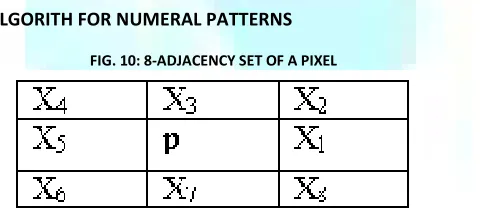
FIG. 10: 8-ADJACENCY SET OF A PIXEL
The first algorithm belongs to class of multi-pass iterative boundary removal thinning algorithms. Iterative boundary removal algorithms delete pixels onthe boundary of a pattern repeatedly until only unit pixel-width thinned image remains.When a contour pixel is examined, it is usually deleted or retained according to the configuration of N(p) shown in figure 10. To prevent sequentially eliminating an entire branch in one iteration, a sequentially algorithm usually marks(or flags) all the pixels to be deleted, and all the marked pixels area then removed at the end of an iteration. This generally ensures that only one layer of pixels would be removed in each cycle.
The method for extracting the skelton of a picture consists of removing all the contour points of the picture except those points that belong to the skelton. In order to preserve the connectivity of skelton, each iteration is divided in to two sub-iterations.The pattern is scanne left to right and from top to bottom , and pixels are marked for deletion under four additional conditions:
H1: At least one black neighbour of p must be unmarked.
H2: Xh(p) =1 at the beginning of the iteration.
H3: If x3 is marked, setting x3=0 does not change Xh(p).
H4: If x5 is marked, setting x5=0 does not change Xh(p).
Condition H1 was designed to prevent excessive erosion of small “circular” subsets, H2 to maintain connectivity, andH4 to preserve two- pixel wide lines.
6. RESULT AND DISSCUSSION
VOLUME NO.3(2013),ISSUE NO.08(AUGUST)
INTERNATIONAL JOURNAL OF RESEARCH IN COMMERCE
A Monthly Double-Blind Peer Reviewed (RefereedThe results shown in Fig. 11 shows that the proposed alternative parallel thinning algorithm provides better pixel connectivi width. Presently, the algorithm has been implemented and tesed for BMP format of numeral patterns. In future, the algorithm c commonly available image formats also. Further studied can be carried out to eliminate the spurious bra
proposed algorithm.
REFRENCES
1. A. Dutta and S. K. Parui, A robust parallel thinning algorithm for binary images, Pattern recognition,Vol, 27, No. 9, pp, 118
2. A. K. Jain, Fundamentals of Digital Image Processing, Prentice
3. Fingerprint minutiae extraction based on principal curves, Pattern Recognition Letters Volume 28, Issue 16, 1 December 2007,
4. M. Ahmad and R. Ward,” An Expert system for General Symbol Recognition,” Pattern Recognition, vol. 33, no. 12, pp. 1975
5. M. Ahmed, R. Ward, A Rotation Invariant Rule-Based Thinning Algorithm for Character Recognition December 2002 (Vol. 24, No.
6. R. Gonzalez and R. E. Woods, Digital Image Processing, Prentice Hall, 2002.
7. T.J., Zhang and C.Y. Suen, A fast parallel algorithm for thinning digital pattern, Comm. Of ACM 27 , 236 Fully Parallel Thinning Algorithm,” in Proc. IEEE Int.Conf.Document Analysis and Recognition, Vol. 1,pp.137
8. W. H. Abdulla, A.O.N. Saleh and A.H.Morad, A preprocessing algorithm for hand )
INTERNATIONAL JOURNAL OF RESEARCH IN COMMERCE, IT
Refereed/Juried) Open Access International e-Journal - Included in the International Serial Directories
http://ijrcm.org.in/
FIG.11: (A) ALGO1 (B) ALGO2 (C) ALGO3
The results shown in Fig. 11 shows that the proposed alternative parallel thinning algorithm provides better pixel connectivi width. Presently, the algorithm has been implemented and tesed for BMP format of numeral patterns. In future, the algorithm c
commonly available image formats also. Further studied can be carried out to eliminate the spurious branches and to improve the time complexity of the
A. Dutta and S. K. Parui, A robust parallel thinning algorithm for binary images, Pattern recognition,Vol, 27, No. 9, pp, 118 e Processing, Prentice-Hall, 1986.
Fingerprint minutiae extraction based on principal curves, Pattern Recognition Letters Volume 28, Issue 16, 1 December 2007, M. Ahmad and R. Ward,” An Expert system for General Symbol Recognition,” Pattern Recognition, vol. 33, no. 12, pp. 1975
Based Thinning Algorithm for Character Recognition December 2002 (Vol. 24, No. R. Gonzalez and R. E. Woods, Digital Image Processing, Prentice Hall, 2002.
T.J., Zhang and C.Y. Suen, A fast parallel algorithm for thinning digital pattern, Comm. Of ACM 27 , 236-239 N .H. Han, C. W.La, and P.K.Rhee, “An Efficient Fully Parallel Thinning Algorithm,” in Proc. IEEE Int.Conf.Document Analysis and Recognition, Vol. 1,pp.137-141(1997
W. H. Abdulla, A.O.N. Saleh and A.H.Morad, A preprocessing algorithm for hand-written character recognition, pattern recognition letter
ISSN 2231-5756
, IT & MANAGEMENT
Included in the International Serial Directories47
The results shown in Fig. 11 shows that the proposed alternative parallel thinning algorithm provides better pixel connectivity and convergence to unit pixel width. Presently, the algorithm has been implemented and tesed for BMP format of numeral patterns. In future, the algorithm can be generalized for other nches and to improve the time complexity of theA. Dutta and S. K. Parui, A robust parallel thinning algorithm for binary images, Pattern recognition,Vol, 27, No. 9, pp, 1181-1192,1994
Fingerprint minutiae extraction based on principal curves, Pattern Recognition Letters Volume 28, Issue 16, 1 December 2007, Pages 2184-2189 M. Ahmad and R. Ward,” An Expert system for General Symbol Recognition,” Pattern Recognition, vol. 33, no. 12, pp. 1975-1988,2000.
Based Thinning Algorithm for Character Recognition December 2002 (Vol. 24, No. 12) pp. 1672-1678
239 N .H. Han, C. W.La, and P.K.Rhee, “An Efficient 141(1997).
VOLUME NO.3(2013),ISSUE NO.08(AUGUST) ISSN 2231-5756
INTERNATIONAL JOURNAL OF RESEARCH IN COMMERCE, IT & MANAGEMENT
REQUEST FOR FEEDBACK
Dear Readers
At the very outset, International Journal of Research in Commerce, IT and Management (IJRCM)
acknowledges & appreciates your efforts in showing interest in our present issue under your kind perusal.
I would like to request you to supply your critical comments and suggestions about the material published
in this issue as well as on the journal as a whole, on our E-mail i.e.
for further
improvements in the interest of research.
If you have any queries please feel free to contact us on our E-mail
.
I am sure that your feedback and deliberations would make future issues better – a result of our joint
effort.
Looking forward an appropriate consideration.
With sincere regards
Thanking you profoundly
Academically yours
Sd/-
VOLUME NO.3(2013),ISSUE NO.08(AUGUST) ISSN 2231-5756
INTERNATIONAL JOURNAL OF RESEARCH IN COMMERCE, IT & MANAGEMENT
A Monthly Double-Blind Peer Reviewed (Refereed/Juried) Open Access International e-Journal - Included in the International Serial Directorieshttp://ijrcm.org.in/