R E S E A R C H A R T I C L E
Open Access
The importance of professional values from
nursing students
’
perspective
Batool Poorchangizi
1, Fariba Borhani
2, Abbas Abbaszadeh
3, Moghaddameh Mirzaee
4and Jamileh Farokhzadian
5*Abstract
Background:Professional values of nursing students may be changed considerably by curricula. This highlights the importance of the integration of professional values into nursing students’curricula. The present study aimed to investigate the importance of professional values from nursing students’perspective.
Methods:This cross-sectional study was conducted at the Kerman University of Medical Sciences, Iran. Data were gathered by using a two-section questionnaire consisting of demographic data and Nursing Professional Values Scale-Revised (NPVS-R). By using the stratified random sampling method, 100 nursing students were included in the study.
Results:Results showed that the mean score of the students’professional values was at high level of importance (101.79±12.42). The most important values identified by the students were“maintaining confidentiality of patients” and“safeguarding patients’right to privacy”. The values with less importance to the students were“participating in public policy decisions affecting distribution of resources”and“participating in peer review”. The professional value score had a statistically significant relationship with the students’grade point average (P< 0.05).
Conclusions:In light of the low importance of some values for nursing students, additional strategies may be necessary to comprehensively institutionalize professional values in nursing students.
Keywords:Nursing education, Professional values, Professional ethics, Nursing students
Introduction
Values are goals and beliefs that establish a behavior and provide a basis for decision making [1]. In a profession, values are standards for action that are preferred by ex-perts and professional groups and establish frameworks for evaluating behavior [2]. Nursing is a profession rooted in professional ethics and ethical values, and nursing performance is based on such values. Core values of nursing include altruism, autonomy, human dignity, integrity, honesty and social justice [3]. The core ethical values are generally shared within the global community, and they are a reflection of the human and spiritual approach to the nursing profession. However, the values in the care of patients are affected by cultural, social, economic, and religious conditions dominating the community, making it essential to identify such values in each country [4].
Professional values are demonstrated in ethical codes [5]. In fact, ethical codes clarify nursing profession prac-tices, the quality of professional care, and professional norms [2]. Advances in technology and expansion of nursing roles have provoked complex ethical dilemmas for nurses. Such dilemmas, if not dealt with properly, negatively affect the ability of novice nurses to make clinical decisions [6]. With the ever-increasing number and complexity of ethical dilemmas in care settings, pro-motion of professional values has become more crucial in nursing education. The acquisition and internalization of values are at the center of promoting the nursing pro-fession [2]. When values are internalized, they will be-come the standards in practice and guide behavior [7]. Values can be taught, modified and promoted directly or indirectly through education [8]. Each student enters the nursing school with a set of values that might be chan-ged during the socialization process [9]. Purposeful inte-gration of professional values in nursing education is essential to guaranteeing the future of nursing [10,11].
© The Author(s). 2019Open AccessThis article is distributed under the terms of the Creative Commons Attribution 4.0 International License (http://creativecommons.org/licenses/by/4.0/), which permits unrestricted use, distribution, and reproduction in any medium, provided you give appropriate credit to the original author(s) and the source, provide a link to the Creative Commons license, and indicate if changes were made. The Creative Commons Public Domain Dedication waiver (http://creativecommons.org/publicdomain/zero/1.0/) applies to the data made available in this article, unless otherwise stated.
* Correspondence:[email protected];[email protected]
5Nursing Research Center, Kerman University of Medical Sciences, PO Box:
7716913555, Kerman, Iran
One of the significant consequences of teaching ethics and professional values to students is increasing their capacity for autonomous ethical decision-making [12]. Nursing students acquire professional values initially through the teaching of their school educators and the socialization process. Professional socialization is the method of developing the values, beliefs, and behaviors of a profession [13]. In their study, Seda and Sleem re-ported a significant relationship between professional socialization of students and improvement of profes-sional values [9]. Through professional socialization, which results in the complete acquisition and internal-ization of values, nursing students should acquire neces-sary skills and knowledge in cognitive, emotional, and practical dimensions. Presently, however, less attention is paid to the emotional dimension in the formation of values compared to the other two [14]. In order to de-velop a value system, individuals should reach the fourth or fifth level of learning of Bloom’s affective domain, i.e. organization and internalization of values. At this level, stabilization of values requires passage of time [15].
Studies have shown that education causes differences in the formation of professional values, and that nursing educators have significant influence on the stimulation of professional values [8,14,16,17]. Wehrwein reported that education related to ethics was effective when stu-dents’ awareness of ethical issues increased along with the application of values in the workplace. In addition, the ability to make ethical decisions was reported to be stronger in students who had passed an ethics course compared to those who had not [18]. Therefore, nursing educators play a key role in determining the future way in which nurses grow professionally and are prepared to confront new, unavoidable challenges [9].
Professors and educators, both in clinical settings and at each stage of education, have the role of facilitator in developing students’ perception of the nursing profes-sion and the nurse’s role. Students may increase their commitment to professional values directly through role playing and indirectly through observing behaviors re-lated to professional values [14]. Nursing educators are effective role models because of their clinical skills, sense of responsibility, professional commitment, and personal characteristics such as kindness, flexibility, and honesty. Nursing educators enhance creative learning by encour-aging critical thinking and decision-making, establishing a supportive learning environment, having technical and ethical knowledge, and providing opportunities for fair evaluation and feedback. Nursing educators should teach nursing students effective strategies to confront ethical dilemmas [12].
Students’perspectives on professional values influence their approach to applying professional values in their future profession [14, 15, 19, 20]. Nursing educators
need additional awareness of nursing students’ perspec-tives on importance of professional values as a basis to use more effective methods for applying professional values. Therefore, nursing educators are able to educate graduates who are ready for decision-making and can ef-fectively deal with daily ethical challenges. Nursing edu-cators’ and students’ awareness of professional nursing values is important for preparing nurses to provide care of patients in an ethical and professional manner [6]. Re-searchers have found insufficient information about nursing students’ professional values in Iran. Because of the potential impact of cultures and clinical environ-ments on professional values, the present study aimed to examine the importance of professional values from nursing students’perspective.
Methods
Study design and setting
This cross-sectional study was performed from February to May 2016 at the Razi Nursing and Midwifery School affiliated with the Kerman University of Medical Sci-ences (KUMS), in Kerman, Iran. This study is a part of a larger study. The results of the first part was published in previous study [21].
Sample
The participants included all undergraduate nursing stu-dents who were studying at the time of data collection (n= 177). The sample size (n= 106) was determined based on the Cochran formula (d= 0.06,p= 0.05). Inclu-sion criteria were undergraduate nursing students in the fourth, sixth, and eighth semesters without official work experience in hospitals. Submitting an incomplete ques-tionnaire was considered an exclusion criterion. The participants were selected using a stratified random sam-pling based on the proportion of students in each semes-ter. Therefore, among the total of 50, 62, and 65 students in the three semesters, 30, 37, and 39 students were enrolled, respectively. Finally, of the remaining 106 students, 100 students completed the questionnaires, but six students did not return the questionnaires. Thus, the final sample consisted of 100 students (with the re-sponse rate of 94.34%).
Instrument
instrument for measuring professional nursing values. In developing the professional values scale, Weis and Schank used the ANA Code of Ethics as well as the studies on nursing values and their promotion among nurses [2].
We used the Persian version of the NPVS-R in this study. The validity of the translated questionnaire was confirmed using face and content validity as well as ex-pert opinion. Reliability of the NPVS-R was reported to be 0.91 using Cronbach’s alpha [22]. To establish reli-ability of the NPVS-R in Persian, a pilot study was con-ducted with 20 nursing students, which resulted in a Cronbach’s alpha coefficient of 0.90.
The NPVS-R includes 26 items with a Likert-scale for-mat in five dimensions: 1) trust: 5 items, 2) justice: 3 items, 3) professionalism: 4 items, 4) activism: 5 items, and 5) caring: 9 items. The trust dimension reflects the nurse’s duty (the value of veracity) to patients. The just-ice dimension deals with patients as noted in statements reflecting equality and diversity issues. The professional-ism dimension reflects the promotion of nursing compe-tence, self-evaluation and reflection, and seeking professional growth. The activism dimension reflects participation in professional activities and solutions to professional problems. The caring dimension reflects re-spect for patients and protection of patient rights.
The participants specified the importance of each item on a Likert 5-point scale ranging from 1 to 5 with 1 = not important, 2 = somewhat important, 3 = important, 4 = very important, and 5 = the most important. The possible range of scores is 26 to 130 [2]. In this study, the scores below 43, scores between 43 and 86, and those above 86 were considered low importance, moder-ate, and high importance, respectively. A higher score indicates that professional values are very important, and that nurses are more oriented toward stronger pro-fessional values.
Data collection
The first researcher distributed the questionnaires among the participants and explained the study objec-tives. The researcher also explained to the participants how to fill out the questionnaires and asked them to specify the importance of professional values. In order to eliminate any ambiguity regarding questionnaire items, necessary explanations were provided. The researcher collected the questionnaires while maintaining anonym-ity and confidentialanonym-ity of the data.
Statistical analysis
Descriptive statistics (frequency, percentage, mean and standard deviation) and inferential statistics (independ-ent samples, t- test, analysis of variance (ANOVA), Mann-Whitney, and Pearson’s correlation coefficient)
were used. SPSS software version 19 was used for data analysis and level of significance was consideredp≤0.05.
Ethical considerations
First, the study was approved by the ethics committee affiliated to the Kerman University of Medical Sciences (No code: 1394.238). Then, official permission for col-lecting data was obtained from the Razi Nursing and Midwifery School. Prior to distributing the question-naire, the researcher guaranteed the confidentiality and anonymity of the questionnaires. The students’informed consent was implied from returning completed questionnaires.
Results
The results showed that the students’ mean age was) 21.9 ± 1.26 (and GPA was at B level (16.20 ± 1.20). Most of the students were female (75%), single (67%), and Iranian (97%). Around 37% of the students were in the eighth se-mester, and around 37.6% of the students had participated in professional ethical training courses (Table1).
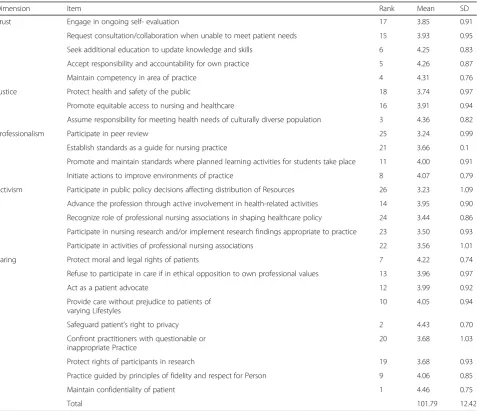
The high mean score of the professional values of the nursing students indicated high awareness and perception of the importance of professional values from the students’ perspective. The most important values as identified by higher mean scores were respectively as follows:“ maintain-ing confidentiality of patients”,“safeguarding patients’right to privacy”, “assuming responsibility for meeting health needs of the culturally diverse population”, and “ maintain-ing competency in area of practice”. The values with lower mean scores were “participating in public policy decisions affecting distribution of resources”, “participating in peer review”, “recognizing role of professional nursing associa-tions in shaping healthcare policy” and “participating in nursing research and/or implementing research findings appropriate to practice”, respectively (Table2).
The results of the Pearson’s correlation coefficient test indicated that there was no significant relationship be-tween professional values and age (r= 0.03, p= 0.47), while there was a significant relationship between profes-sional values and the GPA (r= 0.29, p= 0.003). This re-vealed that the students with higher GPA had higher scores in professional values. There was no significant dif-ference in the students’ professional values based on dif-ferent educational semesters (F= 0.29, p= 0.74). In addition, there were no significant differences in profes-sional values based on the other demographic variables such as gender, marital status, ethnicity, and participation in professional ethical training courses(p> 0.05) (Table1).
Discussion
Table 1Demographic data of the nursing students and its relationship with professional values
Variable N % Mean ± SD Test statistic p
Gender Female 75 75% 103.05 ± 1.26 t= 1.73 0.07
Male 25 25% 98 ± 1.21
Marital status Married 33 33% 103.39 ± 1.25 t= 0.90 0.37
Single 67 67% 101.66 ± 1.23
Ethnicity Persian 97 97% 101.6 ± 1.25 Z= 0.96 0.36
Non Persian 3 3% 108 ± 7.93
Semester Fourth 29 29% 100.25 ± 1.25 F= 0.29 0.74
Sixth 35 35% 102.49 ± 1.20
Eighth 37 37% 102.30 ± 1.28
Participation in Professional ethical Yes 156 62.4% 104.26 ± 1.18 t= 1.04 0.30
No 94 37.6% 99.77 ± 1.17
Table 2Importance of professional values from the nursing students’perspective
Dimension Item Rank Mean SD
Trust Engage in ongoing self- evaluation 17 3.85 0.91
Request consultation/collaboration when unable to meet patient needs 15 3.93 0.95
Seek additional education to update knowledge and skills 6 4.25 0.83
Accept responsibility and accountability for own practice 5 4.26 0.87
Maintain competency in area of practice 4 4.31 0.76
Justice Protect health and safety of the public 18 3.74 0.97
Promote equitable access to nursing and healthcare 16 3.91 0.94
Assume responsibility for meeting health needs of culturally diverse population 3 4.36 0.82
Professionalism Participate in peer review 25 3.24 0.99
Establish standards as a guide for nursing practice 21 3.66 0.1
Promote and maintain standards where planned learning activities for students take place 11 4.00 0.91
Initiate actions to improve environments of practice 8 4.07 0.79
Activism Participate in public policy decisions affecting distribution of Resources 26 3.23 1.09
Advance the profession through active involvement in health-related activities 14 3.95 0.90
Recognize role of professional nursing associations in shaping healthcare policy 24 3.44 0.86
Participate in nursing research and/or implement research findings appropriate to practice 23 3.50 0.93
Participate in activities of professional nursing associations 22 3.56 1.01
Caring Protect moral and legal rights of patients 7 4.22 0.74
Refuse to participate in care if in ethical opposition to own professional values 13 3.96 0.97
Act as a patient advocate 12 3.99 0.92
Provide care without prejudice to patients of varying Lifestyles
10 4.05 0.94
Safeguard patient’s right to privacy 2 4.43 0.70
Confront practitioners with questionable or inappropriate Practice
20 3.68 1.03
Protect rights of participants in research 19 3.68 0.93
Practice guided by principles of fidelity and respect for Person 9 4.06 0.85
Maintain confidentiality of patient 1 4.46 0.75
Total 101.79 12.42
regard to the importance of professional values. These findings are in agreement with the findings of the studies conducted in the United States [15, 23], Taiwan [24], Korea [25], and Iran [21]. Results of these studies highlighted that instructors and nursing trainers were seen as role models by students.
In this study, the most important nursing professional values were“maintaining confidentiality of patients”,“ safe-guarding patients’ right to privacy”, “responsibility for meeting health needs of the culturally diverse population”, and“maintaining competency in area of practice”. The re-sults of this study are in agreement with the rere-sults of the studies conducted by Lin et al. [19], Clark [15], Fisher [23], and Leners et al. [8], who identified these values as the most important values. One possible reason for the consistency between the results of this study and those of the other studies may be that these values are among the main values in the nursing profession and are closely asso-ciated with it. Leners et al. reported that maintaining com-petency in area of practice, accepting responsibility and accountability for own practice, and safeguarding patients’ right to privacy were values prioritized by students. Since these values are associated with the direct care of patients and given that students complete their clinical practices under supervision of nurses, students may learn the im-portance of these values through role modeling and appli-cation in clinical settings [8].
In this study, the least important values from the stu-dents’ perspective were “participating in public policy decisions affecting distribution of resources”,“ participat-ing in peer review”, “recognizing role of professional nursing associations in shaping healthcare policy”, and “participating in nursing research and/or implementing research findings appropriate to practice”. The results of this research are also in agreement with the results of the studies conducted by Lin et al. [19], Clark [15], Fisher [23], and Leners et al. [8]. A multitude of factors may have contributed to the lower importance placed on these values; some causes might be less information about the importance of these values in the development of the profession, low motivation, insufficient affirm-ation, and low encouragement by nursing educators.
The reason for the low importance placed on the values such as “participating in nursing research and/or implementing research findings appropriate to practice” might be the fact that nursing students do not acquire necessary skills (such as information literacy skills) to apply in evidence-based practices during their academic days [26, 27]. Another reason for the low importance of the above-mentioned values might be graduate educa-tion programs; undergraduate students focus on the rules of clinical practice because they are novices. As they become more competent and eventually experts, the ranking of the values is likely to change.
Concerning the lower importance of the “recognizing role of professional nursing associations in shaping healthcare policy”value, Esmaeili et al. reported the fol-lowing items as causes for reduction of participation in such associations: long working hours, lack of awareness about the associations’ objectives and activities, insuffi-ciency of time, and lack of support from hospitals to play active roles in associations. Moreover, the inactivity of members in such associations and the weak relationship among these associations were other barriers confronted by such associations in Iran [28]. In addition, one other reason might be that nursing educators themselves do not participate in professional nursing associations be-cause of high workloads and limited time. Professional nursing associations play major roles in promoting nurs-ing authority and professional identity. Consequently, understanding and valuing the importance of participa-tion in professional associaparticipa-tions may require emphasis as an important professional value.
Regarding the low importance of values such as “ par-ticipating in peer review” and “participating in public policy decisions affecting distribution of resources”, it can be mentioned that these activities are part of the manager’s duties, and that the nurses are not involved in peer evaluation and policy decisions.
In this study, a significant relationship was found be-tween the GPA and scores of professional values. Stu-dents with high GPA Probably have the necessary scientific competency in their professional performance, which may result in giving higher importance to profes-sional values as a significant index of profesprofes-sional com-petence. Lechner et al. emphasized that academic environments appear to elicit and reinforce values such as developing one’s capacities and pursuing one’s inter-ests [29].
professional values in a positive direction from entry into school until graduation [8,14,19]. In their study, Weis and Shank concluded that higher focus on curricula of junior and senior students could change some professional values, indicating that time spent in school was associated with change in values [30].
The study had three limitations. First, the assessment of the students’perspectives on professional values was lim-ited only in the school affiliated with the KUMS in south-ern Iran, which may limit generalization of these findings. The second limitation was the translation of the NPVS-R into Persian. Cultural and language differences may have affected the meaning of the terms literally and in the con-text of nursing education in Iran. Third, this study did not assess how the students learned professional values. Simi-larly, we did not know to what extent students had these values prior to entering nursing education and we did not collect information on these two items; thus, we did not highly emphasize the role of nurse educators in this study. It is suggested that further studies with more accurate in-struments are conducted in other nursing schools with different cultural and environmental conditions might lead to comprehensive strategies for internalizing profes-sional values of nursing students.
Implications for nursing
Nursing educators can primarily facilitate professional values by urging students to participate both in research studies on the topic and in nursing education. Periodic classes and seminars about professionalism should be presented by clinical tutors and school educators, who play important roles as behavioral models for their stu-dents. It is also recommended to conduct studies to in-vestigate the impact of educational environments and university educators as role models for students on ad-vancement of professional values in students.
Conclusions
The study showed high mean total of professional values from the nursing students’ perspective. However, some professional values such as participating in public policy decisions and participating in nursing researches were less important. This shows low awareness about these values or educators’ insufficient emphasis on them, time limita-tions to promote these values, and negative attitudes of students toward these values. As future nurses, nursing students should be able to apply professional values in making decisions when confronted with the emerging eth-ical challenges in the healthcare area. This preparation should be provided for students by educators and profes-sors during their professional socialization process in schools. The findings suggest that many of the values were similarly important in other countries, which can be a re-flection of the globalization process in the nursing
profession and the presence of professional values at the root of the discipline. However, strategies should be devel-oped to improve weaknesses of nursing students in the professional values adapted to cultural, social, and reli-gious conditions prevailing in the societies, faculties, schools, and hospitals.
Abbreviations
GPA:Grade point average; NPVS-R: Nursing Professional Values Scale-Revised
Acknowledgements
The researchers appreciate all nursing students who gave their time so generously in order to participate in the study.
Authors’contributions
BP, FB, AA, and JF contributed to conceiving and designing the research. The data were collected, analyzed, and interpreted by BP, MM, FB, and JF. BP, FB JF, AA, and MM contributed equally in writing the manuscript and approved the final manuscript.
Funding
This research received no specific grant from any funding agency in the public, commercial, or not-for-profit sectors.
Availability of data and materials
The datasets generated and analyzed during the current study are not publicly available because this study is part of a larger study. This datasets are available from the corresponding author on reasonable request.
Ethics approval and consent to participate
First, the study and consent procedure was approved by ethics committee affiliated to Kerman University of Medical Sciences (No: 1394.238). Then, verbal and written informed consent was obtained from the students prior to the data collection. The students were ensured about anonymity and confidentiality of the data as well as voluntary participation in the study. All participants provided written consent by filling in the written questionnaires.
Consent for publication
Not applicable.
Competing interests
The authors declare that they have no competing interests.
Author details
1ICU, Shahid Bahonar Hospital, Kerman University of Medical Sciences,
Kerman, Iran.2Department of Nursing Ethics, Medical Ethics and law
Research Center, Shahid Beheshti University of Medical Sciences, Tehran, Iran.
3Bam University of Medical Sciences, Bam, Iran.4Department of Biostatistics
and Epidemiology, School of Public Health, Kerman University of Medical Sciences, Kerman, Iran.5Nursing Research Center, Kerman University of
Medical Sciences, PO Box: 7716913555, Kerman, Iran.
Received: 28 August 2017 Accepted: 27 June 2019
References
1. Chitty KK, Black BP. Professional nursing: Concepts and challenges. 5rd ed. St. Louis, Mo: Saunders/Elsevier; 2007.
2. Weis D, Schank MJ. Development and psychometric evaluation of the nurses professional values scale-revised. J Nurs Meas. 2009;17(3):221–31. 3. The Essentials of Baccalaureate Education for Professional Nursing Practice.
2016.http://www.aacn.nche.edu/education-resources/BaccEssentials08.pdf. Accessed 20 Oct 2016.
4. Shahriari M, Mohammadi E, Abbaszadeh A, Bahrami M, Fooladi MM. Perceived ethical values by Iranian nurses. Nurs Ethics. 2012;19(1):30–44. 5. Guide to the code of ethics for nurses: Interpretation and application. 2016.
www.nursesbooks.org/ebooks/download/CodeofEthics.pdf. Accessed 20 Oct 2016.
7. Farag AA. Multigenerational Nursing Workforce Value Differences and Work Environment: Impact on RNs' Turnover Intentions. Thesis for the degree of Doctor of Philisophy. Case Western Reserve University. 2008.https://etd.ohiolink.edu/rws_ etd/document/get/case1196441618/inline. Accessed 20 May 2016.
8. Leners DW, Roehrs C, Piccone AV. Tracking the development of professional values in undergraduate nursing students. J Nurs Educ. 2006;45(12):504-11. 9. Seada A, Fathi Sleem W. Professional socialization process and acquisition
of professional nursing values among undergraduate nursing students. J Am Sci. 2012;8(4):678–83.
10. Astorino TA. A survey of professional values in graduating student nurses of traditional and accelerated baccalaureate nursing programs. Indiana University of Pennsylvania, ProQuest Dissertations Publishing. 2006.http:// search.proquest.com/docview/304950099/fulltextPDF/
E0631C817BC249E4PQ/1?accountid=34377. Accessed 20 May 2016. 11. Karami A, Farokhzadian J, Foroughameri G. Nurses’professional competency
and organizational commitment: Is it important for human resource management? PLoS One. 2017;12(11):e0187863.
12. Borhani F, Alhani F, Mohammadi E, Abbaszadeh A. Professional Ethical Competence in nursing: the role of nursing instructors. J Med Ethics Hist Med. 2010;3:3. 13. Blais KK, Hayes JS. Professional nursing practice: Concepts and perspectives.
7rd ed. Pearson; 2015.
14. Bang KS, Kang JH, Jun MH, Kim HS, Son HM, Yu SJ, et al. Professional values in Korean undergraduate nursing students. Nurse Educ Today. 2011;31(1):72–5. 15. Clark DK. Professional values: a study of education and experience in
nursing students and nurses. (Phd Thesis). Nursing Capella University, 2009. http://gradworks.proquest.com/3372808.pdf. Accessed 20 May 2016. 16. Rassin RM. Values grading among nursing students–Differences between
the ethnic groups. Nurse Educ Today. 2010;30(5):458–63.
17. Fahrenwald NL, Bassett SD, Tschetter L, Carson PP, White L, Winterboer VJ. Teaching core nursing values. J Prof Nurs. 2005;21(1):46–51.
18. Wehrwein TA. Moral reasoning and ethical decision making in beginning baccalaureate nursing students. 1rd ed.Wayne State University; 1990.
19. Lin Y-H, Wang LS, Yarbrough S, Alfred D, Martin P. Changes in Taiwanese nursing student values during the educational experience. Nurs Ethics. 2010; 17(5):646–54.
20. Lui MH, Lam LW, Lee IF, Chien WT, Chau JP, Ip WY. Professional nursing values among baccalaureate nursing students in Hong Kong. Nurse Educ Today. 2008;28(1):108–14.
21. Poorchangizi B, Farokhzadian J, Abbaszadeh A, Mirzaee M, Borhani F. The importanceof professional values from clinical nurses’perspective in hospitals of a medical university in Iran. BMC Med ethics. 2017;18(1):20. 22. Hoseini F, Parvan K, Zamanzadeh V. Professional values of the nursing
students’perspective in type 1 universities of medical sciences. Quarterly Journal of Nursing Vision. 2012;11(1):69–82.
23. Fisher M. A comparison of professional value development among pre-licensure nursing students in associate degree, diploma, and bachelor of science in nursing programs. Nurs Educ Perspect. 2014;35(1):37–42. 24. Lin Y-H, Wang LS. A Chinese version of the revised nurses professional
values scale: Reliability and validity assessment. Nurse Educ Today. 2010; 30(6):492–8.
25. Moon S, Kim DH, Kim EJ, Kim Y-J, Lee S: Evaluation of the validity and reliability of the Korean version of the Nursing Professional Values Scale-Revised. Nurse Educ Today. 2014;34(3):325–30.
26. Farokhzadian J, Khajouei R, Ahmadian L. Information seeking and retrieval skills of nurses: Nurses readiness for evidence based practice in hospitals of a medical university in Iran. Int J Med Inform. 2015;84(8):570–7.
27. Salsali M, Mehrdad N. Iranian nurses' constraint for research utilization. BMC Nurs. 2009;8(1):9.
28. Esmaeili M, Nayeri ND, Negarandeh R. A review of the opportunities and challenges facing the nursing associations in Iran. Int Nurs Rev. 2012; 59(2)168–74.
29. Lechner CM, Sortheix FM, Göllner R, Salmela-Aro K. The development of work values during the transition to adulthood: A two-country study. J Vocat Behav. 2017;99:52–65.
30. Weis D, Schank MJ. An instrument to measure professional nursing values. J Nurs Scholarsh. 2000;32(2):201–4.
Publisher’s Note