Topical issue on:
NICHE PRODUCTS AND CROP DIVERSIFICATION: IN SEARCH OF ADDED VALUE
PRODUITS DE NICHE ET CULTURES DE DIVERSIFICATION : À LA RECHERCHE DE VALEUR AJOUTÉE
RESEARCH
ARTICLE
Optimization of mango seed kernel oil extraction using
response surface methodology
Fajriyati Mas
’
ud
1,2,*, Meta Mahendradatta
3, Amran Laga
3and Zainal Zainal
31
Hasanuddin University, Makassar, 90245 South Sulawesi, Indonesia 2
Department of Chemical Engineering, State Polytechnic of Ujung Pandang, Makassar, 90245 South Sulawesi, Indonesia 3
Department of Agricultural Technology, Hasanuddin University, Makassar, 90245 South Sulawesi, Indonesia
Received 9 June 2017–Accepted 18 August 2017
Abstract – Response surface methodology (RSM) was applied to study the optimum condition of mango seed kernel oil (MSKO) extraction with n-hexane. In the present paper, for thefirst time, we provide an optimal condition of MSKO extraction to obtain the maximum of yield, total phenolic content (TPC) and vitamin E. The experiment was conducted using central composite design (CCD) consisted of twenty experimental points including six replicates of center points to study the effect of three independent variables: temperature, time and amount of n-hexane on dependent variables. Data were analyzed using Design-Expert 10 software. The result showed that the optimum condition of MSKO extraction were 54.19°C, 5.24 h and 224.23 mL of n-hexane. In this condition MSKO have yield of 7.03%, TPC of 67.77 mg GAE/g oil and vitamin E of 141.22 mg/L. These results suggest that MSKO has potential as raw materials of food products oil-based and as a natural antioxidant of functional food and for use in food processing.
Keywords:mango seed kernel oil / oil extraction / total phenolic content / vitamin E / response surface methodology
Résumé – Optimisation de l’extraction d’huile de noyau de mangue à l’aide de la méthodologie RSM.
La méthodologieResponse surface methodology(RSM) a été appliquée pour définir les conditions optimales d’extraction de l’huile de noyau de mangue avec du n-hexane. Dans le présent article, pour la première fois, est proposée une condition optimale d’extraction de l’huile de noyau de mangue afin d’optimiser le rendement, la teneur en phénols (total phenolic contentou TPC) et en vitamine E. L’expérience a été réalisée en utilisant plan d’expériences composite centré de vingt points expérimentaux avec six répétions de points centraux pour étudier l’effet de trois variables indépendantes : température, temps et quantité de n-hexane sur des variables dépendantes. Les données ont été analysées à l’aide du logiciel Design-Expert 10. Le résultat a montré que les conditions optimales d’extraction de l’huile de noyau de mangue étaient 54,19°C, 5,24 h et 224,23 ml de n-hexane. Dans ces conditions, le rendement est de 7,03 %, la teneur TPC de 67,77 mg GAE/g d’huile et la concentration en vitamine E de 141,22 mg/L. Ces résultats soulignent le potentiel de l’huile de noyau de mangue en tant que matière première de produits alimentaires à base d’huile et en tant qu’antioxydant naturel des aliments fonctionnels et pour la transformation des aliments.
Mots clés :huile de noyau de mangue / extraction d’huile / phénols / vitamine E / RSM
1 Introduction
Mango,Mangifera indica, belongs to the family Anacar-diaceae. It is a very popular fruit and often referred to as‘king of fruits’in the tropical world (Singhet al., 2002), but after consumed or used by the mango processing industry, mango seeds are generally only disposed of as waste (Puravankara
et al., 2000; Kittiphoom, 2012). On the other hand, enough scientific information is available regarding the nutritional importance of mango waste, mainly of feeding ever-increasing human population. The issue of food insecurity in Asia and Africa in the coming 35–50 years may lead to hunger and starvation (FAO, 2006). Mango seed account for 35%–55% of the fruit, depending on the variety (Bhalerao et al., 1989). MSKO may be defined as oil fraction extracted from stone of mango, it contains almost 15% of oil (Nzikou et al., 2010). Studies have disclosed that mango kernel is a potential source
Topical
Issue
*Correspondence:[email protected]
DOI:10.1051/ocl/2017041
of wide range of bioactive compounds and antioxidants (Jafari
et al., 2014). Cardio and hepatic protective effects, anti-carcinogenic, anti-ageing effects of phenolic compounds are scientifically proven (Mohdaly et al., 2011). MSKO can be utilized for the preservation of fats and oils, improved oxidative stability of sunflower oil and tallow (Abdallaet al.,
2007;Jafariet al., 2014).
Kittiphoom (2012)reported that MSKO consisted of about
44–48% saturated fatty acid, it was dominated by stearic acid and 52–56% of unsaturated fatty acid, that could be used as a source of potential functional food ingredients because it contained high quality of oil which contained antioxidants in high concentration. MSKO has potential application in human foods (Kittiphoom and Sutasinee, 2013), potentially be used in the formulations of food products such as chocolate and biscuits as a natural nutritional additive due to its fatty acid composition and antioxidant activities (Jafariet al., 2014), and has been used in the cosmetics industry as an ingredient in soaps, shampoos and lotions because it is a good source of phenolic compounds (Soong and Barlow, 2004). Unfortunate-ly, the massive nutritional and commercial potential of MSKO is not fully utilized. Toxicological assessment of MSKO was performed in multi generation breeding trials in weanling albino rats. Histopathology evaluation of organs did not reveal any abnormality. These results suggested that MSKO has no toxic effects (Rukmini and Vijayaraghavan, 1984;Agunbiade
and Olanlokun, 2006). Analysis of cholesterol content of
MSKO showed that it is free of cholesterol (Mostafa, 2013). On the other hand, the extraction technique used to obtain high aggregate value compound from natural products is crucial for product quality (Kittiphoom and Sutasinee, 2013). The solvent extraction may be affected by various factors such as temperature, time, and amount of solvent. When many factors and interactions may affect a desired response, the RSM is an effective tool to find the optimal conditions for process (Stroescu et al., 2013). RSM is very popular for optimization solid-liquid extraction in recent years (Liuet al.,
2009;Samaram et al., 2015). RSM is a statistical technique
used to design experiments to obtain relevant information in the shortest possible time at the lowest cost. Basic principle of RSM is to relate product properties to regression equations that describe inter-relations between input parameters and product properties (Giovanni, 1983;Montgomery, 1984). Its use leads to the rapid and efficient development of new and improved products and processes. As the extraction is generally a multi-parameter process, selection and optimization of the experi-mental conditions represents a critical step in the development of MSKO extraction methods. Previous studies showed that temperature, time and amount of solvent were the main parameters affecting the extraction yield from different sources (Liet al., 2012;Goula, 2013;Minjares-Fuenteset al., 2014). These parameters also had a significant influence on the endogenous bioactive compounds, such as certain from the TPC (Rodrigueset al., 2008;Ghafooret al., 2009;Wanget al.,
2013;Sahin and Samli, 2013;Chaniotiet al., 2016).
Related to edible oil, the most important contribution of vegetable oils is its tocopherols, which is commonly and collectively referred to as“vitamin E”. Vegetable oils contain high concentration of vitamin E (Bauernfeind and Desai, 1977) and could provide most daily dietary vitamin E requirement
(Desaiet al., 1980). The term of vitamin E is used to describe a
group of eight molecules of related structure in which, chemical and biological activities are mostly dominated by a-tocopherol (Brigelius-Flohé and Traber, 1999; Schneider, 2005). It occurs in the form of eight stereoisomers, four tocopherols (a, ß,g,d), and four tocotrienols (a, ß,g,d) (Pascual
et al., 2013). Vitamin E is a nutraceutical compound that have attracted researchers and food manufacturers due to its antioxidant and non-antioxidant biological activities (Mayer
et al., 2013;Yang and McClements, 2013). Tocols are able to reduce lipid peroxidation and lipid risk factors, in this case elevated LDL cholesterol levels and platelet aggregation display anti-inflammatory properties and show anti-carcinogenic and cardiovascular protective effects (Tiwari and Cummins, 2009). Based on reports of existing research results, in the present study, for thefirst time, RSM was employed to standardise the parameters (temperature, time and amount of n-hexane) for maximum yield, TPC and vitamin E of MSKO extraction. The aim of this study was to optimize the solvent extraction of MSKO with n-hexane in terms of yield, TPC and vitamin E applying the RSM technique and considering the extraction temperature, time and amount of n-hexane as variables.
2 Materials and methods
Arumanis mango, a local mango in Indonesia, as samples were obtained from South Sulawesi and harvested in September to November 2016. All chemical were from Merck, Germany. Standard of a-tocopherol from Sigma-Aldrich Co. Preparation of MSK according to Mahale and
Goswami-Giri (2011) with minor modification. The seeds
were washed, and the kernel enclosed in the hard cover was separated manually. The kernels were dried in the oven at 50°C for 12 h to a constant weight in order to reduce its moisture content. Separation of thin cover from the kernel was carried out using tray to blow away the cover in order to achieve very high yield. Stainless steel grinder was used to powdered form, sealed in a plastic container and stored in a freezer until extraction to prevention of its oxidation.
RSM was used to optimize the MSKO extraction process. At experimental unit, 50 g of MSK powder were weighed in the reactor 1.0 L four neckflasks, MSK was extracted with n-hexane using a heating mantle connected with the thermometer setting, agitator on the top, speed of 200 rpm, residue was separated by centrifugation (refrigerated AX-521 centrifuge) at a speed of 3500 rpm for 20 min. The liquid part accommodated in the flask evaporator, solvents removed on a rotary evaporator Buchi R-215 incorporates vacuum Pomp V-700. MSKO obtained was packaged in a dark glass bottle and stored in a freezer for analysis. The percentage oil yield was calculated as follows (Sani, 2014):
Oil yieldð%Þ ¼ weight of oil
weight of sample 100: ð1Þ
2.1 Determination of total phenolic content (TPC) and vitamin E analysis
The analysis method of TPC according toBrand-Williams
Folin Ciocalteau reagent and 1.6 mL of 7.5% Na2CO3and left
at room temperature for 30 min. The mixing solution was measured an absorbance at 750 nm by ultraviolet-visible spectrophotometer (UV 1800, Shimadzu, Japan) and calculat-ed as gallic acid equivalent. Analysis of vitamin E using standard a-tocopherol. Preparation of standard vitamin E: 0.05 g dissolved in methanol-chloroform (1:1) at 100 mL
flasks, and made respectively 100, 200, 300, 400, and 500 mg/ L in a 50 mLflask, homogenized by vortex, inserted in the vial GC-MS, the sample was injected automatically. Preparation of sample vitamin E: 0.012 g MSKO dissolved in 2 mL methanol-chloroform (1:1), homogenized by vortex and inserted into the vial bottle GC-MS. The sample was injected automatically. Quantification of vitamin E was analyzed using GC-MS ultra Shimadzu QP2010, instrument uses column Rxi SH-5Sil MS (length 30 m, diameter x thickness 0.25 mm ID 0:25 um df). Helium was used as a carrier gas at a pressure of 76.9 kps with a flow of 14.0 mL/min, split ratio of 1:10. The initial temperature of the oven starting at 110°C and hold for 2 min until the oven temperature to 200°C with an isothermal increase of 10°C/min, afinal temperature of 280°C, hold for 9 min with an isothermal increase of 5°C/min, the total analysis time of 40 min. Scan interval 45–450 m/z. Ion temperature 200°C, 280°C temperature interface.
2.2 Experimental design for optimization and statistical analysis
RSM was used to determine the optimum conditions for solvent extraction of MSKO. The variables used were extraction temperature (°C, X1), time (hour, X2) and amount of n-hexane
(mL, X3). The complete design consisted of fourteen
experi-ments and six replicates at the center point. Extraction yield, TPC and vitamin E of MSKO were selected as the responses for the combination of the independent variables. Statistic software (Design-Expert Version 10) was used for the regression analysis of the experimental data. The adequacy of each model was determined by evaluating the lack offit and the coefficient of determination (R2). The significance of each coefficient was determined by using the F-test obtained from the analysis of variance (ANOVA) that was generated. Regression coefficients were then used to generate response surfaces. 3D response surface graphs and profile for predicted values and desirability level for variables were plotted using the software. In order to verify the validity of the statistical models, additional verification experiments were subsequently performed. Verifi -cation of the optimum extraction condition was done by extraction of MSKO on a laboratory scale following the extraction condition suggested by the statistical models. For this verification, triplicate assenting experiments were carried out using the optimized parameters for yield, TPC and vitamin E of MSKO as response.
3 Results and discussion
The effects of X1, X2and X3on yield, TPC and vitamin E
of MSKO were studied during experimentation. The results showed that the yield, TPC and vitamin E of MSKO ranged from 5.16 to 7.08%, 31.81 to 67.52 mg GAE/g oil, and 100.25 to 140.27 mg/L, respectively. The maximum yield, TPC and
vitamin E of MSKO was found under the experimental conditions of X1= 54.19°C, X2= 5.24 h and X3= 224.23 mL,
respectively. Maximum yield, TPC and vitamin E of MSKO under these conditions were 7.03%, 67.77 mg GAE/g oil, and 141.22 mg/L, respectively.
3.1 Modelfitting
According to the result of ANOVA for yield, TPC and vitamin E of MSKO that the models are significant. The quality of the models developed was evaluated based on the correlation coefficient value. The R2values of extraction yield, TPC and vitamin E were 0.96, 0.98 and 0.97, respectively, indicating that the models adequately represented the real relationship between the parameters chosen. Significance of different terms of each coefficient was determined using the F-value and p-value. According toYolmehet al.(2014), a largeF-value and a smallp -value would imply a more significant effect on the corresponding response variable. The actual quadratic equation of the yield, TPC and vitamin E of MSKO response are given in equations (2), (3) and (4), respectively.
Yieldð%Þ ¼ ð17:13Þ þ0:26X1þ3:47X2þ0:07X3
3:27E003X120:34X22
1:18E004X32þ0:02X1X2
þ1:50E005X1X33:60E003X2X3; ð2Þ
TPCðmg GAE=g oilÞ ¼ ð397:58Þ þ5:91X1
þ73:15X2þ1:002X30:05X12
5:81X221:6E003X32
0:02X1X28:28E005X1X3
0:05X2X3; ð3Þ
Vitamin Eðmg=LÞ ¼ ð255:92Þ þ3:49X1þ77:15X2
þ0:65X30:03X128:47X22
2:07E003X320:10X1X2
3:1300E004X1X3þ0:09X2X3: ð4Þ
3.2 Interpretation of response surface model and contour plots
The result of a statistical analysis showed that thefit model to describe the effect of X1, X2, X3for the yield is a quadratic
model. The model F-value of 28.82 implies the model is significant. A positive value of coefficient X1, X2, X3in the
equation (2) implies that X1, X2, X3are effect on increasing the
yield. Values of Prob>F less than 0.0500 indicate model terms are significant (in this case X1, X2,X3, X12, X22, X32,
X1X2, X2X3). The variables with the largest effect on yield
were the linear terms of treatment (X1, X2 and X3), the
quadratic term of treatment (X12, X22and X32), followed by
interaction between X1and X2, and interaction between X2and
X3. Values greater than 0.1000 indicate the model terms are not
significant, so that interaction between X1and X3did not give
any significant contribution to the yield of MSKO. The lack of
fit F-value of 1.42 implies the lack of fit is not significant,
Topical
which indicates that the model is suitable to describe the effect of treatment for the yield, and that the developed model is adequate for predicting the response. According to Bas and
Boyaci (2007), the model will be considered appropriate if lack
offit value model is not significantly different at the level of specifica.
Thefit model to describe the effect of X1, X2and X3for the
TPC of MSKO is a quadratic model. A positive value of coefficient X1, X2, X3in the equation (3) implies that X1, X2
and X3are effect on increasing the TPC. The modelF-value of
45.08 and the low probability value (p<0.0001) implies that the model is significant. The variables with the largest effect on TPC were the linear terms of treatment (X1, X2, X3), the
quadratic term of treatment (X1 2
, X2 2
, X3 2
), followed by interaction between X2and X3. However, interaction term of
X1X2and X1X3was not significant. The lack offitp-value of
1.55 was non-significant, this indicates that the model is suitable to describe the effect of X1, X2and X3for the TPC, and
that the developed model is adequate for predicting the response. These values would give a goodfit to the mathematic model in equation (3).
Thefit model to describe the effect of X1, X2and X3for the
vitamin E of MSKO is a quadratic model. The modelF-value of 35.11 (p<0.0001) implies the model is significant. A positive value of coefficient X1, X2and X3in the equation (4)
implies that the treatment effects on increasing the vitamin E. The variables with the largest effect on vitamin E were X3and
X2 2
, followed by X1, X2, X1 2
, X3 2
, and X2X3. However, X1X2
and X1X3were not significant. The lack of Fitp-value of 2.93
was non-significant (p>0.05) which indicates that the model is suitable to describe the effect of X1, X2and for the vitamin E,
and that the developed model is adequate for predicting the response.
The sign "-" in front of all thefirst terms of the response equations (-17.13, -397.58 and -255.92) does not have a significant meaning to the RSM model prediction. The signs "-" on the intercept are constants that will be meaningful to the approximate X1, X2, and X3that are rational (X values are not
equal to zero). Intercept values do not always have to be interpreted, as often the range of X1, X2, and X3 does not
include zero as one of the observed values, so a negative intercepts does not matter as long as X1, X2, and X3are not
equal to zero (Dougherty, 2002;Mendenhall, 2011).
3.3 Interpretation of contour plots
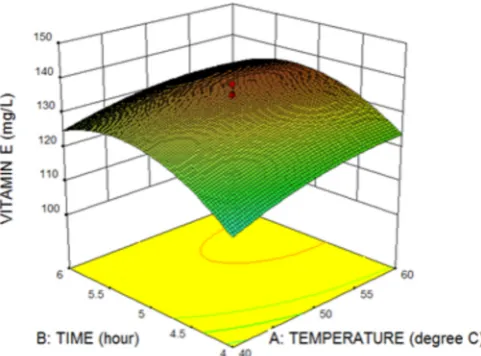
The relationship between dependent and independent variables are illustrated in 3D representation of the response surfaces generated by the model for extraction yield, TPC and vitamin E of MSKO (Figs. 1–3, respectively). These plots are obtained depicting two variables within experimental range and keeping the third variable at a constant level. In order to gain a better understanding of the results of the yield of MSKO, the predicted model is presented inFigure 1as the 3D plot. It can be seen the effect of X1and X2at afixed X3on the yield
MSKO. It is showed that the yield of MSKO had a maximum point. It appears that the results of the optimization conditions of MSKO extraction to obtain maximum yield indicate an increase. This means that the combination of X1, X2and X3are
Fig. 1.Response surface plots of yield MSKO.
effect on increasing the yield of MSKO. The effect of X3on
yield is stronger than the effect of both X1and X2. It is evident
in the coefficient estimated of the ANOVA, larger value of X3
(0.33) compared to value of X1 (0.23), while the estimated
coefficient of X2is smaller (0.18).
The 3D plot corresponding to the effects of X1and X2on
the TPC at afixed X3(200 mL) is shown in Figure 2. It is
showed that the TPC had a maximum point. The combination of X1, X2and X3are effect on increasing the TPC of MSKO. At
X3is constant (200 mL), the influence of X1is slightly stronger
than the effect of X2on increased of the TPC. It is evident in
the coefficient estimated of the ANOVA, coefficient estimated of X1(4.30) is slightly higher than the coefficient estimated of
X2(4.03). On the other hand, coefficient estimated of X3(5.43)
is higher than both coefficients estimated of X1and X2, this
means that the effect of X3is stronger than effect of both X1
and X2on TPC.
The 3D plot corresponding to the effect of X1and X2on the
vitamin E at afixed X3(200 mL) is shown inFigure 3. This
result showed that the vitamin E had a maximum point. The combination of X1, X2and X3were effect on increasing the
vitamin E. At X3is constant (200 mL), the effect of X1slightly
lower than the effect of X2on increasing the vitamin E. It is
evident in the coefficient estimated of the ANOVA, coefficient estimated of X1 (4.18) slightly lower than the coefficient
estimated of X2(4.73). On the other hand, coefficient estimated
of X3(11.71) is higher than both coefficient estimated of X1
and X2.
Based on the results of the optimum conditions that an increase of X1 from 40°C to 54.19°C and X2 from 5 h to
5.24 h (atfixed X3of 200 mL) promoted an increase in the
yield, TPC and vitamin E of MSKO. Further increase of X1up
to 54.19°C and addition of X2 up to 5.24 h promoted a
decrease in the yield, TPC and vitamin E of MSKO. An increase of X1 from 40 to 54.19°C and X3 from 150 to
224.23 mL (atfixed X2of 5 h) promoted an increase in the
yield, TPC and vitamin E. Further, increase of X1 up to
54.19°C and addition X3 up to 224.23 mL promoted a
decrease in the yield, TPC and vitamin E. The same phenomenon at an addition of X2of 4 h to 5.24 h and X3from
150 mL to 224.23 mL (atfixed X1of 54.19°C) promoted an
increase in the yield, TPC, and vitamin E. Further, addition of X2up to 5.24 h and addition X3up to 224.23 mL promoted a
decrease in the yield, TPC and vitamin E.
These results are in agreement with other oil studies.Abadi
et al.(2014), reported that the amount of salmon liver oil yield is increased by increasing temperature from 50°C to 68°C in each of considered times, denoting direct impact of tempera-ture increase on increasing percent of oil extraction, it is similar to effect of extraction time. Koleva and Simeonov
(2014)andStroescuet al.(2013)reported that temperature and
solid-liquid ratio had the greatest influence on the oil yield.
Maniet al.(2007)andMinjares-Fuenteset al.(2014)reported that by increasing the temperature of extraction, the yield of oil is maximized. The more time given to the seeds for contact with the solvent, the higher the extraction yield percentage
(Elkhaleefa and Shigidi, 2015).
The linear relationship of temperature and solvent ratio to solid on the extraction of phenolic compound has also been reported byCacace and Mazza, (2003).Rodrigueset al.(2008)
reported that the greatest effect on TPC of extracts was
promoted by the solid-liquid ratio and the temperature.Cacace
and Mazza (2003)andWanget al.(2013)reported that
solid-liquid ratio is the most significant parameter affecting of TPC. According toGhafooret al.(2009), the solubility of phenolic compounds increases with increasing of temperature and extraction time. Although the positive effect of higher temperature on the extraction yield, but the temperature cannot be increased indefinitely, because the stability of phenolic compounds and membrane denaturation can occur at temperature >50°C (Schwartzberg and Chao, 1982; Cacace
and Mazza, 2003).
Related to vitamin E,Pascualet al. (2013) reported the effect of temperature on vitamin E, in this case against tocol contents in rice parboiling and cooking. They are reported that parboiling affected mostly vitamin E, which presented an average loss of approximately 60% when compared to the initial level. Khatoon and Gopalakrishna (2004) already reported high losses of tocols after parboiling a single Indian commercial brown rice sample. Cooking caused a further loss of tocols and thefinal amounts were irrelevant in both cooked non-parboiled and parboiled rice. Kumar et al. (2006) have studied the effect of different cooking conditions (different rice-water ratios) on retention of tocols in rice bran and reported a variable retention of total tocols from 1 to 59% depending on the amount of water used.
Mango seed can be used as an alternative source of vitamin E which is also an antioxidant. Antioxidant vitamin has been reported to be able to reduce the oxidative processes that are important in the initiation of arthrosclerosis (Steinberget al., 1989). A natural tocopherol mixture is used as an antioxidant up to 500 ppm along with ascorbyl palmitate which enables to prolong antioxidant activity. At higher levels (>1000 ppm) a-tocopherol is thought to act as a pro-oxidant, the addition of 200 ± 800 ppm tocols in vegetable oils only exhibits limited effects.Hudson et al.(2000), who has study on rice bran oil reported that the isoforms of vitamin E and polyphenols in rice bran oils are bioactive components that are known to exhibit a variety of antioxidant activities that can be directly related to anticancer activity.
3.4 Verification of optimum extraction condition of MSKO
Triplicate experiments were carried out using the optimized parameters for each response for verification. It was aimed to prove that the optimum extraction condition solution suggested by the program provides yield, TPC and vitamin E of MSKO in accordance with the predicted values. The result showed that the average of yield, TPC and vitamin E were 7.22%, 70.67 mg GAE/g oil and 141.37 mg/L, respec-tively. The MSKO produced in the verification process showed that the average value of the yield, TPC and vitamin E were slightly higher than the predicted values. This indicates that the developed models were valid and adequate in their predictions and they can be used to optimize the extraction process of MSKO. These results suggest that the MSKO obtained from the verification process can be applied to extracting of MSKO, but it must be noted that succeeding higher MSKO yield at higher extraction temperature has limited industrial application because the bioactivity of MSKO might be imperiled.
Topical
4 Conclusions
MSKO, an important by-product of mango and a rich source of phenolic and vitamin E as a bioactive compound was confirmed, and RSM was applied to determine the optimal extraction conditions of temperature, time, and amount of n-hexane. The procedure was evaluated in terms of the oil extraction yield, TPC and vitamin E. The results of this study can be applied to obtain the optimum conditions of MSKO extraction, and can be applied in food industry. The results suggest that MSKO has potential as raw materials of food products oil-based and as a natural antioxidant of functional food and for use in food processing.
Acknowledgments. Thanks to the Directorate General of Higher Education of Indonesia for a doctoral grant that supports the funding of this study.
Conflicts of interest. The authors declare that they have no conflicts of interest in relation to this article.
References
Abadi FZK, Abolhasan A, Amir H. 2014. Evaluation and estimation of mass transfer parameters influencing salmon liver oil extraction.Indian J Nat Sci5(27): 2083–2089.
Abdalla EM, Darwish SM, Ayad EHE, EL-Hamahmy RM. 2007. Egyptian mango by-product. Antioxidant and antimicrobial activities of extract and oil from mango seed kernel.Food Chem 103: 1141–1152.
Agunbiade SO, Olanlokun JO. 2006. Studies on the nutritive values of the seed kernels of exotic and local mangoes.Biomed Biophys Res Asia3: 122–125.
Bas D, Boyaci IH. 2007. Modelling and optimization I: Usability of response surface methodology.J Food Eng78: 836–45. Bauernfeind JS, Desai ID. 1977. The tocopherol content of food and
influencing factors.Crit Rev Food Nutr8: 337–382.
Bhalerao SD, Mulmuley GV, Anathakrishna SM, Potty VH. 1989. Wash and waste water management in food industry. Fruit and vegetable processing.Indian Food Packer43(2): 5–11. Brand-Williams W, Cuvelier ME, Berset C. 1995. Use of free radical
method to evaluate antioxidant activity.LWT- Food Sci Technol 28: 25–30.
Brigelius-Flohé R, Traber MG. 1999. Vitamin E: function and metabolism,FASEB J13: 1145–1155.
Cacace JE, Mazza G. 2003. Optimization of extraction of anthocyanin from black currants with aqueous ethanol.J Food Sci68: 240– 248.
Chanioti S, Siamandoura P, Tzia C. 2016. Evaluation of extracts prepared from olive oil by-products using microwave-assisted enzymatic extraction: effect of encapsulation on the stability of final products. Waste and biomass valorization. DOI:10.1007/ s12649-475016-9533-1.
Desai ID, Swann MA, Garcia Tavares ML, Dutra de Oliveira BS, Duarte FAM, Dutra de Oliveira JE. 1980. Vitamin E status of agricultural migrant workers in Southern Brazil.Am J Clin Nutr 33: 2669–2673.
Dougherty C. 2002. Introduction to econometrics, 2nd ed. New York: Oxford University Press, pp. 13–14.
Elkhaleefa A, Shigidi I. 2015. Optimization of sesame oil extraction process conditions.Adv Chem Eng Sci5: 305–310.https://doi. org/10.4236/aces.2015.53031.
FAO. 2006. The state of food insecurity in the world.http://www.fao. org/docrep/009/a0750e/a0750e00.htm. Accessed at 2014/01/08. Ghafoor K, Choi YH, Jeon JY, Jo IH. 2009. Optimization of
ultrasound-assisted extraction of phenolic compounds, antiox-idants, and anthocyanins from grape (vitis vinifera) seeds.J Agric Food Chem57: 4988–4994.
Giovanni M. 1983. Response surface methodology and product optimization.Food Technol37(11): 41–45.
Goula A. 2013. Ultrasound-assisted extraction of pomegranate seed oil - Kinetic modeling.J Food Eng117: 492–498.
Hudson EA, Dinh PA, Kokubun T, Simmonds MSJ, Gescher A. 2000. Characterization of potentially chemopreventive phenols in extracts of brown rice that inhibit the growth of human breast and colon cancer cells.Cancer Epidemiol Biomark Prev9(11): 1163–1170.
Jafari M, Gharachorloo M, Hemmaci AH. 2014. The stabilizing effect of three varieties of crude mango seed kernel oil on tallow.J Food Biosci Technol4(1): 31–36.
Khatoon S, Gopalakrishna AG. 2004. Fat-soluble nutraceuticals and fatty acid composition of selected Indian rice varietas.J Am Oil Chem Soc81: 939–943.
Kittiphoom S. 2012. Utilization of mango seeds.Int Food Res J19 (4): 1325–1335.
Kittiphoom S, Sutasinee S. 2013. Mango seed kernel oil and its physicochemical properties.Int Food Res J20(3): 1145–1149. Koleva V, Simeonov E. 2014. Solid liquid extraction of phenolic and
flavonoid compounds from cotinus coggygria and concentration by nano-filtration.Chem Biochem Eng Q28(4): 545–551. DOI: 10.15255/CABEQ.2014.2006.
Kumar HGA, Khatoon S, Prabhakar DS, Krishna AGG. 2006. Effect of cooking of rice bran on the quality of extracted oil.J Food Lipids13: 341–353.
Li T, Qu X, Zhang Q, Wang Z. 2012. Ultrasound-assisted extraction and profile characteristics of seed oil from Isatis indigotica Fort. Ind Crop Prod35: 98–104.
Liu S, Yang F, Zhan C, Ji H, Hong P, Deng C. 2009. Optimization of process parameters for supercritical carbon dioxide extraction of Passiflora seed oil by response surface methodology.J Supercrit Fluids48: 9–14.
Mahale SM, Goswami-Giri AS. 2011. Composition and characteri-zation of refined oil compared with its crude oil from waste obtained from Mangifera indica. Asian J Res Chem4: 1415– 1419.
Mani S, Jaya S, Vadivambal R. 2007. Optimization of solvent extraction of Moringa (Moringa oleifera) seed kernel oil using response surface methodology.Food Bioprod Process85: 328– 335.
Mayer S, Weiss J, McClements DJ. 2013. Vitamin E-enriched nanoemulsions formed by emulsion phase inversion: factors influencing droplet size and stability.J Colloid Interface Sci402: 122–130. DOI:10.1016/j.jcis.2013.04.016.
Mendenhall W. 2011. A second course in statistics: regression analysis, 7th ed. Upper Saddle River, New Jersey: Prentice Hall. 99 p. Minjares-Fuentes R, Femeni A, Garau MC, Meza-Velázquez JA,
Simala S, Rosselló C. 2014. Ultrasound-assisted extraction of pectin from grape pomace using citric acid: a response surface methodology approach.Carbohydr Polym106: 179–189. Mohdaly AA, Smetanska AI, Ramadan MF, Sarhan MA, Mahmoud
A. 2011. Antioxidant potential of sesame (Sesamum indicum) cake extract in stabilization of sunflower and soybean oils.Ind Crop Prod34: 952–959.
Mostafa UE. 2013. Phenolic compounds and antioxidant potential of mango peels and kernels (Mangifera indicaL.) on the frying oil stability, lipid profile and activity of some antioxidant serum enzymes in rats.J Am Sci9(11): 371–378.
Nzikou JM, Kimbonguila A, Matos L,et al.2010. Extraction and characteristics of seed kernel oil from mango (Mangifera indica). RJ Environ Earth Sci2: 31–35.
Pascual CSCI, Isabel LM, Fabiana K, Rosa MCB, José AN, Ursula MLM. 2013. Effects of parboiling, storage and cooking on the levels of tocopherols, tocotrienols andg-oryzanol in brown rice (Oryza sativa L.)Food Res Int50: 676–681.
Puravankara D, Boghra V, Sharma RS. 2000. Effect of antioxidant principles isolated from mango (Mangifera indica L) seed kernels on oxidative stability of buffalo ghee (butter-fat),J Sci Food Agric 80(4): 522–526. DOI: 10.1002/(SICI)1097-0010(200003) 80:4.522:AID-JSFA560.3.0.CO;2-R.
Rodrigues S, Pinto G, Fernandes F. 2008. Optimization of ultrasound extraction of phenolic compounds from coconut (Cocos nucifera) shell powder by response surface methodology. Ultrason Sonochemistry15: 95–100.
Rukmini C, Vijayaraghavan M. 1984. Nutritional and toxicological evaluation of mango kernel oil.J Am Oil Chem Soc61: 780–792. Sahin S, Samli R. 2013. Optimization of olive leaf extract obtained by ultrasound-assisted extraction with response surface methodolo-gy.Ultrason Sonochemistry20: 595–602.
Samaram S, Mirhosseini H, Tan C, Ghazali H, Bordbar S, Serjouie A. 2015. Optimisation of ultrasound-assisted extraction of oil from papaya seed by response surface methodology: oil recovery, radical scavenging antioxidant activity and oxidation stability. Food Chem172: 7–17.
Sani I. 2014. Soxhlet extraction and physicochemical characterization ofMangifera indicaL. Seed kernel oil. Research and Reviews:J Food Dairy Tech2(1): 20–24.
Schneider C. 2005. Chemistry and biology of vitamin E.Mol Nutr Food Res49: 7–30. DOI:10.1002/mnfr.200400049.
Schwartzberg HG, Chao RY. 1982. Solute diffusivities in leaching processes.Food Technol2: 73–86.
Singh SK, Sharma HC, Singh SP. In vitro polyembryony in monoembryonic mango cultivars (Mangifera indica L.) In: Kapoor AC, ed. Sustainability of Hill Agriculture: emerging trends and possible solutions. New Delhi: Todays and Tomorrows Printers and Publishers, 2002. pp. 295–299.
Soong YY, Barlow PJ, Perera CO. 2004. A cocktail of phytonutrients: identification of polyphenols, phytosterol and tocopherols from mango seed kernel.IFTAnn meeting Lasvegas12–16.
Steinberg D, Parthasarathy S, Carew TE, Khoo JC, Witztum JL. 1989. Beyond cholestrol: modification of low density lipoprotein that increase its atherogenicity.N Engl J Med320: 915–924. Stroescu M, Stoica-Guzun A, Ghergu S, Chira N, Jipa I. 2013.
Optimization of fatty acids extraction from Portulaca oleracea seed using response surface methodology. Ind Crops Prod43: 405–411.
Tiwari U, Cummins E, 2009. Nutritional importance and effect of processing on tocols in cereals.Trends Food Sci Technol20: 511–520. Wang X, Wu Y, Chen G, Yue W, Liang Q, Wu Q. 2013. Optimisation of ultrasound assisted extraction of phenolic compounds from Sparganii rhizoma with response surface methodology.Ultrason Sonochemistry20: 846–854.
Yang Y, DJ McClements. 2013. Vitamin E bio accessibility: influence of carrier oil type on digestion and release of emulsified a-tocopherol acetate.Food Chem141: 473–481. DOI:10.1016/j. foodchem.2013.03.033.458.
Yolmeh M, Habibi NM, Farhoosh R. 2014. Optimization of ultrasound-assisted extraction of natural pigment from annatto seeds by response surface methodology (RSM).Food Chem155: 319–324.
Cite this article as: Mas’ud F, Mahendradatta M, Laga A, Zainal Z. 2017. Optimization of mango seed kernel oil extraction using response surface methodology.OCL24(5): D503.