ISSN 2319-7625 (Online) (An International Research Journal), www.chemistry-journal.org
Synthesis of Al doped ZnO Thin Film by Sol-gel Spin
Coating Method and Study of Gas Sensor for Detection
of Ethanol Gas Vapor
Shazia Umar and Mahendra Kumar
Department of Physics,
University of Lucknow, Lucknow 226007, INDIA. email:[email protected], [email protected].
(Received on: November 19, 2017)
ABSTRACT
Al doped ZnO thin film is sensitive to many gases like CO2, CO, H2S etc. Al
doped ZnO thin films can be synthesized by many methods like PVD, CVD, spin coating, Dip-coating spray pyrolysis etc. This paper discusses the synthesis of Al doped zinc oxide thin film by sol gel spin coating method. The structural properties, optical properties and gas sensing characteristic of the film have been studied. The XRD and SEM studies show the hexagonal wurtzite structure of ZnO. The sensor response was investigated for detection of ethanol vapor at various temperatures. The gas sensing results show that sensitivity for detecting 600ppm ethanol vapor was ~ 18 at operating temperature of 300oC.The high sensitivity and reliability suggest that
ZnO: Al film prepared by a spin coating method can be used for ethanol vapor gas sensing.
Keywords: ZnO; ZnO: Al; Thin film; spin-coating; Ethanol gas sensor; XRD; UV; SEM etc.
1. INTRODUCTION
Zinc oxide thin films have attracted more attention due to their broad range of applications, such as in solar cells, as sensors and flat panel displays. Thin films have dual
properties a good electrical conductivity and high optical transparency in visible range1, 2 and 3.
And there are various methods for deposition of thin film like CVD, spray paralysis, PVD;
spin coating etc.4. Here sol-gel spin coating technique is used because of its special properties:
Simple and easy procedure.
Cost effective.
Film quality can be controlled by controlling the doping concentration.
Detection and identification of gases and volatile organic compounds are critically important to human health and safety. Gas chromatography mass spectrometry (GCMS) is a reliable and established technology for analyzing gases. Gas monitoring devices are in demand for a rapidly growing range of applications. Metal oxide chemical based sensors have been used extensively for the detection of toxic pollutant gases, combustible gases and organic vapors. Ethanol is one of the commonly used and widespread alcohols and thus there is a need to develop sensors for its detection. The most common application of ethanol sensors in a breath analyzer, since the human breadth is said to correlated with the concentration in the
blood. Recently gas sensors based on semi-conducting metal oxides such as ZnO, SnO2 5,6
have been used to be very useful for O27 H2 8 and ethanol9.
2. EXPERIMENTAL PROCEDURE
Zinc acetate dehydrate, Isopropyl alcohol and MEA are respectively used as
precursor, solvent and stabilizer ,aluminum nitrate was used as a source of doping .ZnO sol
was obtained by dissolving zinc acetate 0.5M under stirring at 60OC in sol of Isopropyl
alcohol and MEA for 2 hours .Al doped ZnO was obtained by zinc acetate dihydrate and aluminum nitrate simultaneously to the solution of isopropyl alcohol and MEA . A spin coating apparatus was used for deposition of thin film on glass substrates at the rate of 3000
rpm for 30 seconds .After each deposition films are dried at 150oC for 50 minutes. The
operation was repeated to produce many layers. The samples were calcined at the temperature
of about 450oC. Two sets of samples with different layers (5 layers and 10 layers) are made
ready for characterization.
3. RESULTS AND DISCUSSION
3.1.X-ray diffraction studies
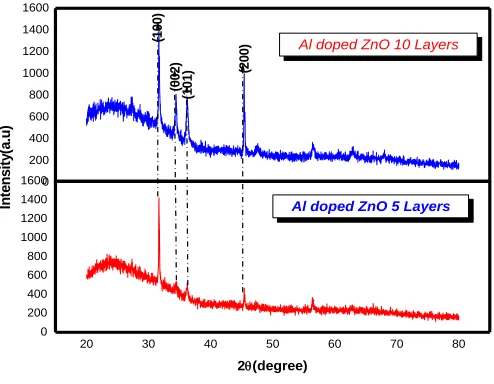
Figure 1: XRD pattern of Al doped ZnO thin films.
3.2. SEM (Scanning electron microscopy)
The surface morphology of thin films is very important tool for detecting the microstructure of the films. SEM micrographs for two samples (5 layers and 10 layers)of aluminum doped ZnO thin film is shown in figure 2 below. Graph clearly describes the hexagonal crystalline structure by showing hexagons all over the surface, but for various deposited layers the grain size increases on increasing the no of layers.
Figure 2(a) Al doped ZnO thin film 5 layers. Figure 2(b) Al doped ZnO thin film 10 layers. Figure 2: SEM micrograph of Al doped ZnO thin film.
3.3. Optical study (UV-vis spectroscopy)
The UV-vis spectra of undoped and aluminum doped ZnO thin films are shown in figure 3. The peaked absorbance for ZnO generally occurs at 305 nm which can be attributed
to the transition of electrons from the valence band to the conduction band of ZnO (O2p −−−
20 30 40 50 60 70 80
0 200 400 600 800 1000 1200 1400 16000 200 400 600 800 1000 1200 1400 1600
2(degree)
Al doped ZnO 5 Layers
(2 0 0 ) (1 0 1 ) (0 0 2 ) (1 0 0 ) In te n s it y (a .u )
→ Zn3d)10. The addition of aluminum ions shifted this peak to 353 nm for 5 layers and to
357nm for 10 layers. This red shift observed at the edge of the absorption spectrum is a clear indication of the aluminum incorporation into the ZnO matrix. The red shift may occur due to the strain caused by aluminum doping and the change in the band structure of ZnO.
Figure3: Absorption spectra of ZnO and aluminum doped ZnO thin film.
Gas sensing studies: Sensitivity of a Al doped ZnO thin film to 600ppm ethanol vapors
from 100 to 300oC is shown in figure 4(a), and it can be seen from graph that the sensitivity
increases with increasing operating temperature. The gas sensing result shows that the
sensitivity for detecting 400ppm. Ethanol vapor was 18 at 300oC. The high sensitivity suggest
that ZnO:Al film prepared by spin coating method can be used for ethanol vapor gas sensing.
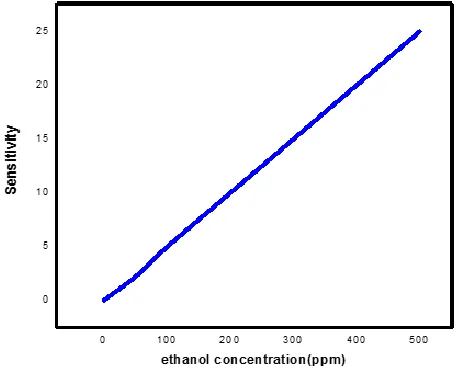
Figure 4(b): Sensitivity variation as a function of ethanol concentration for ZnO: Al thin film at 250oC.
The calibration curve shown in figure 4 (b) indicates that the relation between sensitivity and concentration is linear, which benefits as actuator by enabling it to detect different concentrations of combustible gases and organic vapors.
4. CONCLUSION
In this work, structural and optical properties of aluminum doped ZnO thin films prepared by sol-gel dip coating method have been investigated .Based on the research results of aluminum doped ZnO thin films reported by us ,the XRD analysis results of our experiments shows that all films have crystalline structure .SEM studies shows that for various deposited layers the grain size increases on increasing the no of layers .the high sensitivity shows that Al doped ZnO can be used for detection of ethanol vapor. Considering the structural and optical properties, the fabricated aluminum doped ZnO thin film prepared by cost effective method, spin coating can be used as a suitable material for optoelectronic applications.
ACKNOWLEDGEMENT
The authors would like to acknowledge the laboratory facilities provided by the Department of Physics, University of Lucknow for conducting the research reported in the paper.
REFERENCES
1. Dasgupta S., Hahn H., Mechau N., Nasr B., Kruk R., Wang D., K Journal of applied
2. Beyer W., Hupkes J., Stiebig H., Thin Solid Films. 516, 147 (2007).
3. Aida M., Attaf N., Chabane Sari S.M., Hakem I.F., Senoudi A.R., Zargou S., J. Mater.
Environmental Science, 7, 3134 (2016).
4. Bhat S., Kushavahb D., Naik K.G., Shrisha B.V., Mater. Today. Proc. 3, 1693 (2016).
5. Maekawa, T.; Matsushima, Tamaki, JS. Miura, N.; Yamazoe, N; Ethanol gas sensing
properties of Pd-La2O3-In2O3 thick film element. Chem. Lett., 3, 477-480 (1990).
6. Groppelli, Quaranta, F; S Sberveglieri, G.; Nelli, P.; Valentini, A.; Vasanelli, L. Oxygen
gas sensing characteristics for ZnO(Li) sputtered thin films. Sensors. Actuators B, 7,
747-751 (1992).
7. S.; Noma, T.; Suzuki, T.; Wada, Yamazaki, T, Gas-sensing properties of ultrathin zinc
oxide films. Sens. Actuators B, 14, 594-595 (1993).
8. Muller, J.; Weissenrieder, S. ZnO-Thin film chemical sensors. Fres. J. Anal. Chem., 349,
380-384 (1994).
9. Konstantinov, K.; Vassilev, Stambolova, I.; S.; Peshev, P.; Tsacheva, Ts. Lanthanum
doped SnO2 and ZnO thin films sensitive to ethanol and humidity. Materials Chemistry
and Physics, 63, 104–108 (2000)
10. K. Kaneko, S. Fujita, “Epitaxial growth of corundum-structured wide band gap III-oxide