• No results found

QSMSR Principal Model

N/A
N/A
Protected

Academic year: 2020

Share "QSMSR Principal Model"

Copied!
6
0
0

Loading.... (view fulltext now)

Full text

(1)

Online Publication Date: 19 March 2012

Publisher: Asian Economic and Social Society

QSMSR Principal Model

Shahbaz Nazeer

(Government College University Faisalabad,

Pakistan Gurunanak Pura, St# .9 p/501, Faisalabad)

Tahir Abdullah

(Government College University Faisalabad,

Pakistan)

Nadim Asif

(Government College University Faisalabad ,

Pakistan)

Beenish Yaseen

(Government College University Faisalabad,

Pakistan)

M. Mehran Arshad Khan

(Government College University

Faisalabad, Pakistan)

Afzaal hussain

(Government College University Faisalabad,

Pakistan)

(2)

Journal of Asian Scientific Research, Vol.2, No.3, pp.145-149

Author (s)

Shahbaz Nazeer

Government College University Faisalabad, Pakistan Gurunanak Pura, St# .9 p/501, Faisalabad.

Tel: +92-3337000154

E-mail: [email protected]

Tahir Abdullah

Government College University Faisalabad, Pakistan

E-mail: [email protected]

Nadim Asif

Government College University Faisalabad , Pakistan

Beenish Yaseen

Government College University Faisalabad, Pakistan

M. Mehran Arshad Khan,

Government College University Faisalabad, Pakistan.

Afzaal hussain

Government College University Faisalabad, Pakistan.

QSMSR Principal Model

Abstract

Software architecture design and requirement engineering are

core and independent areas of engineering. A lot of research,

education and practice are carried on Requirement elicitation

and doing refine it, but it is a major issue of engineering.

QSMSR model act as a bridge between requirement and design.

There is a huge gap between these two areas of software

architecture and requirement engineering. In this research

principal model defines how to take input the requirements and

to refine it in such a way that the gap is covered.

Keywords:

QSMSR (Qualitative Synergism of Multi-agent Software Architecture and

Requirement engineering), Software Architecture, Requirement Engineering.

Introduction

The relationship between architecture and

requirements of a system to be is neither clear

nor understandable, stakeholders may have

contradictory

goals

nor

expectations,

non-functional requirements are tough to be

mapped to an architectural entity, etc Chung

et.

al.

(2000)

[1].

Software architecture requirements engineering

are well-known fields of research, education

and practice in the software engineering society.

Because of the significant progress on these

two fronts, we still need the solid basis,

technique and tools to support the synergism

achievement of architectural objectives within

the

context

of

complex

stakeholder

associations.

(3)

QSMSR Principal Model

presented and analyzed Cavalcante. R, (2011)

[2].
These requirements are often vague, unfinished,

incompatible,

and

usually

expressed

unceremoniously. By contrast, requirement

activities focus on the totality, reliability and

confirmation of the requirements. Early stage

requirements

engineering

activities

have

objectives and suppositions that are different

from those of the later stage. Alencar

et al

,

(2001)

[3].

Figure-1

The QSMSR Framework

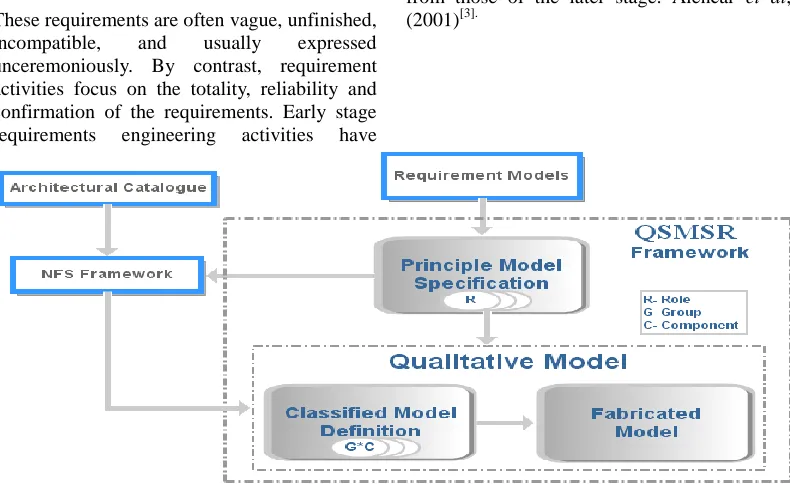
The QSMSR Framework emphasizes the

organizational environment and helps to

reduce the gap among Multi Agent Systems

(MAS) requirement models and architectural

models. To eliminate the gap between these

two fields its

follow

the i* format for doing this basically its gets

traditional and modified requirements and

then produce the design of that system.

(4)

Journal of Asian Scientific Research, Vol.2, No.3, pp.145-149

its consist of two models principal model and

qualitative. The principal model gets the

requirement and refines the raw requirements

into pure requirements. And provide the

architecture catalog for qualitative model. In

QSMSR model use different architectural

styles for the end results .there are some

famous architectural styles are structure-in-5

and joint venture style. Both are the famous

architectural style.

Principal Model

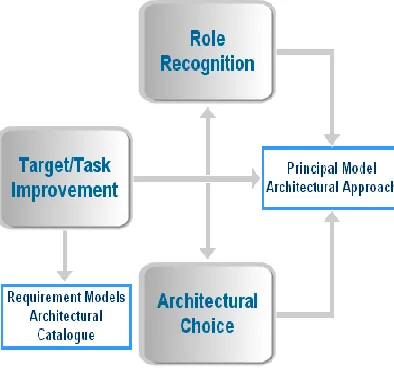
In QSMSR we are focusing on the principal

model.

The

principal

model

gets

the

requirements model as the input and than

produce architectural catalog. This catalog is

further use for much purpose but QSMSR use

it for purposing the architectural design of the

system. The principal divided into three sub

task

goal

task

refinement

and

role

identification and then at the last selection of

the architectural selection. These are three

main tasks of the principal model of QSMSR

model.

Figure-3

Principal Model

In the goal refinement firstly we analysis the

actors and their role after that we refine these

goals by their contribution of the system. In

this we check which actor involved which type

of role and how he interact with the system for

this purpose we use the OR Decomposition,

AND Decomposition and contribution.

As show in the below figure how a actor

contribute to the system. It show how

contribute it positively or negatively according

to that we select the contribution and refine it.

It is root of the sub system.

Figure-4

Role identification

In the role identification we define the role of

the actors of the system. In MAS the scenario

is totally different its too much complex to

having the role identification. For this there is

some specific tasks are followed by the role

identification. Tasks are group together and

show depends of these to each other’s and

similar task are group into one and different

task are group in different group. In this we

define the roles and define the relation

between the roles how roles are interact to

each other .in this we check the low level of

coupling of the roles. The groups are refining

her again as per role and iteration to each other

and these are the selected goals that are we

accomplish further. The process is processed

as further.

The architectural selection has two sub task

centrality

equivalence

and

similarity

equivalence.

Figure-5

Architectural selection

(5)

QSMSR Principal Model

is there any similar actor existed which doing

the same task in the system if exist than we

eliminate that actor.

Figure-6

The Principal Model Specification

The process of the QSMSR principal model is

defined in above figure in principal model

firstly we get the goal and task refinement

from the requirement model. For this the

QSMSR principal model define the clustering

and in other sense you can say define the sub

task of the system and than refine it. After the

refining process .The principal model gets it as

the input for this model. than model applied

correlation and clustered analysis on it for

this we use the perason correlation formula we

apply this formula to all sub task and take the

correlation of that sub task and in the same

time we have some architectural design or

architectural style where the our correlation

results are matched. Than we calculate the

correlation of the architectural style and match

this correlation to our problem than we convert

it in to the architectural style. Suppose we have

the example where we have the 7 actors but

our

correlation

matched

with

structure-in-5.and in it we have the 5 location.

Than we analysis the problem and check

which actors are doing more likely to same

work than we merge these actor .for example

we have two actor journal reviewer and review

handler for the example of journal publisher by

seeing these actors as their abstract view we

combine it into one and give the name review

controller that further have two sub actors

handler and reviewer.

Results and Discussion

In below figure we have input SR model and

shoe the results to refine the figures of our goal

we refine our goal and the refine goals are our

out put.

Figure-7

SR Model to Refinement of goal

In this figure the refinement of goal process by

the recursively and used as a input of the

system and the results are the roles of the

system.

Figure -8

Refinement of goal to roles

In below figure the roles used as the input and

the resultant is the role iteration graph.

Figure-9

Roles and SR model to Roles

interaction graph

(6)

Journal of Asian Scientific Research, Vol.2, No.3, pp.145-149

Figure-10

Architectural style and its role

interaction to role matrix

Conclusion

The QSMSR principal model gets the

requirement model as the input than convert

theses requirement in to sub tasks after that

applying correlation on these sub modules. It

provides the catalog architecture for the

QSMSR Qualitative Model.

References

Allen, J. H.; Barnum, S.; Ellison, R.

J.;McGraw, G.; & Mead, N. R

. Software

Security Engineering: A Guide for Project

Managers. Boston, MA: Addison-Wesley

Professional, 2008 (ISBN: 978-0321509178).

Alencar, F.M.R., Castro, J.F.B., Cysneiro,

G.A.A., Mylopoulos, J. (2001)

“Integrating

Organizational Requirements and Object

Oriented Modeling”. 5th IEEE International

Symposium on Requirements Engineering,

Toronto[3].

Bastos, L.R.D. and Castro, J.F.B. (2004)

“Systematic Integration between Requirements

and

Architecture”.

Third

International

Workshop on Software Engineering for

Large-Scale

Multi-Agent

Systems

SELMAS'04. Edinburgh, Scotland, May.

LNCS 3390: “Software Engineering for

Multi-Agent

Systems

III”,

pp.

85-103.R.Choren

et

all.

(Eds.),

Springer-Verlag, 2005.

Chung, L., Nixon, B. A., Yu, E. and

Mylopoulos,

J.

(2000)

“Non-Functional

Requirements in Software Engineering”.

Kluwer Publishing.[1]

Manuel, K. and John, M. (2007)

Software

Architectures as Organizational Structures

Department of Computer Science, University

of Toronto, Toronto M5S3G4, Canada.

Mead, N. R

. “Experiences in Eliciting Security

Requirements.” CrossTalk 19, 12 (December

2006): 14-19.

Mead, N. R. & Stehney, T (2005)

“Security

Quality Requirements Engineering (SQUARE)

Methodology.” Software

Engineering

for

Secure Systems (SESS05), ICSE 2005

International Workshop on Requirements for

High Assurance Systems, St. Louis, MO, May

15-16,.

http://homes.dico.unimi.it/%7Emonga/s

ess05.html

Michael, W, Nicholas, R. Jennings, David,K,

Autonomous Agents and Multi-Agent Systems,

3, 285.312, 2000

Rodolfo Carneiro Cavalcante

,

Ig Ibert

Bittencourt, Alan Pedro da Silva

,

Marlos

Silva

,

Evandro Costa ,Robério Santos 10

October 2011[2].

Scott A. DeLoach & Matthew Miller (2010)

“A

Goal Model for Adaptive Complex

Systems”

International

Journal

of

Computational

Intelligence:

Theory

and

Practice. Vol.5, No. 2,

Wooldridge, M., Jennings, N.R. and Kinny

D. (2000)

“The Gaia Methodology for

Agent-Oriented

Analysis

and

Design”.

Autonomous Agents and Multi-Agent System,

3, 285312. Kluwer Academic Publishers,

Netherlands.

Yu, E. (2001)

“Agent Orientation as a

Modeling Paradigm”. Wirtschaftsinformatik.

Vol.43, No, 2 pp.123-132.

Zambonelli, F., Jennings, N., Wooldridge, M.

(2001)

"Organisational Abstractions for the

Analysis and Design of Multi-Agent Systems".

In: Ciancarini P., Wooldridge, M. (eds.):

Agent-Oriented Software Engineering, LNCS

1957, Springer- Verlag, pp. 235 – 251.

Figure

Figure -2 The QSMSR Process Activities
Figure-6 The Principal Model Specification

References

Related documents

Rainbow trout ( Oncorhynchus mykiss ), Black Sea trout ( Salmo trutta labrax ; synonym, Salmo coruhensis ), turbot ( Psetta maxima ), and sea bass ( Dicentrarchus labrax ) were

Brady arguably answered this question by brokering a compromise: in exchange for imposing minor obligations on the prosecutor at trial, the Court signaled to the

In the first step of the suggested algorithm, the GA is applied to determine the optimum CHs number to increase the network performance compared with other methods,

The paper is discussed for various techniques for sensor localization and various interpolation methods for variety of prediction methods used by various applications

Default If Customer or any Customer fails to comply with any material provision of this Agreement, including, but not limited to failure to make payment as specified, then Cox, at

In Step 2 we will look more closely at the links between thoughts, feelings and behaviours, particularly when we feel Anxious, Depressed and Angry. We will also start to learn

Quan parlem de fitxes ens referim a fulls A4, que pots fer a mà o bé directament amb ordinador (amb Word o amb qualsevol altre processador de textos). Has d’obrir tantes fitxes

intubation tube), operation time (min), lowest arterial pressure (mmHg), total urine volume (ml) and intraopera- tive average urine flow rate (ml/kg/h), infusion volume (ml)