78
Int J Res Med. 2013; 2(1);78-82 e ISSN:2320-2742 p ISSN: 2320-2734AN OSSEOUS STUDY OF MORPHOLOGICAL ASPECT OF
ACETABULUM OF HIP BONE
Kintu Vyas
1*,Bhavesh Shroff
2,Kalpesh Zanzrukiya
31Assistant Professor, Department of Anatomy, Medical College, Baroda. 2
Assistant Professor, Department of PSM, Medical College, Baroda.
3 Resident. Department of Forensic Medicine. Government Medical College, Surat.
.
INTRODUCTION
Hip joint is one of the major weight bearing joints of the body. The acetabulum is located on the outside of the hip bone, at the junction of three primitive pieces (ilium, ischium and pubis), facing flow, front and side.3 The femoral head articulates with the cup-shaped acetabulum to form the hip joint. Femoroacetabular Impingement (FAI) is characterised by an early pathologic contact during hip joint motion between skeletal prominences of the acetabulum and the femur that limits the physiologic motion of hip.
*Corresponding Author
Dr. KintuKumar Vyas.
Address: 109, Vishwamitri Township, Opp. Gujarat Tractor,
Manjalpur, Baroda. 390011 Email: [email protected]
Two types of impingements are distinguished. Cam and Pincer. Pincer impingement is the acetabular cause of the femoroacetabular impingement and is characterised by focal or general overcoverage of the femoral head. Treatment requires surgical resection of impinging causes like trimming of acetabular rim or acetabular osteotomy4. Total hip replacement has become one of the most successful surgical operations. Largest hip failure occur from prosthetic loosening, either because the cemented inferface is not sufficiently strong to bear the loads, or because the interface was weak originally2. The geometric discrepancies between the natural acetabulum and implant can result in painful iliopsoas impingement attributable to prosthetic overlap at the anterior acetabular ridge over which the iliopsoas tendon extends to leave the pelvis1. Precise anatomical knowledge of acetabulum is important to understand mechanics of hip joint. The acetabulum is not always of the same shape, width or depth. Minor anatomical abnormalities in the acetabulum shape, joint congruences are frequent5. An incongruous joint more prone to develop degenerative changes than a joint having normal anatomy6. Authors have studied the anterior
ORIGINAL ARTICLE
ABSTRACT
BACKGROUND: The geometric discrepancies between the natural acetabulum and implant can result in painful iliopsoas impingement attributable to prosthetic overlap at the anterior acetabular ridge1. Largest hip failure occurs from prosthetic loosening may be because of weak interface originally2. Precise knowledge of acetabulum is required to understand mechanics of joint and planning for suitable prosthesis. The present study was taken to find the morphological variations of acetabulum. MATERIALS AND METHODS: All available 152 dry hip bone (74 belonged to right side and 78 to left side) of unknown age and sex were examined from the collection of the Anatomy department. Morphological variation of the shapes of anterior acetabular ridge was noted and transverse diameter and depth of acetabulum of hip bones were measured with the help of vernier callipers. RESULTS: Curved shaped anterior rim of acetabulum was found in 57 (37.5%) followed by straight shaped in 48(31.6%), irregular shaped in 28(18.4%) and angular shaped in 19(12.5%) specimens. Average maximum transverse diameter of acetabulum was measured 4.79 cm on right side and 4.83 cm on left side. Average depth of acetabulum was measured 2.71 cm on right side and 2.65 cm on left side. CONCLUSION: The present study will be helpful to orthopaedicians, radiologists and prosthetists for better understanding of pathophysiology of hip region and to design suitable size of prosthetics which are more functional to prevent common complications like dislocations and iliopsoas impingement.
79
Int J Res Med. 2013; 2(1);78-82 e ISSN:2320-2742 p ISSN: 2320-2734 acetabular ridge morphology and described it ascurved, angular, irregular or straight5,7,8. Different authors have measured different diameters of acetabulum also 9,10,11. With all these information keeping in mind present study was taken to find out variation in morphology of anterior ridge of acetabulum and to measure transverse diameter and depth of acetabulum which will be helpful to clinicians, radiologists, orthopaedics and prosthetists for better understanding of pathophysiology of hip joint and preparing suitable size of prosthesis which are more functional to prevent complications like prosthetic loosening or dislocation.
MATERIALS AND METHODS
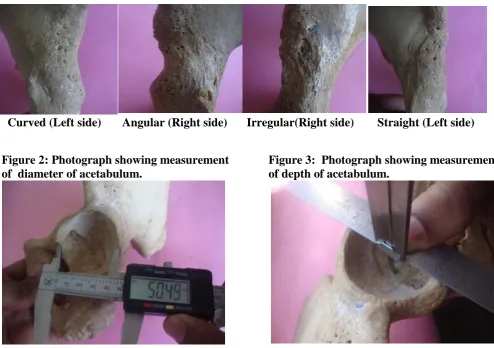
All available 152 dry hip bone (74 belonged to right side and 78 to left side) of unknown age and sex were examined from the collection of the Anatomy department The damaged specimens were excluded from the study. All measurements were manually performed with the aid of digital vernier callipers and were performed directly by placing the callipers on the acetabulum. All measurements were carried out by the same instrument throughout the study and in cms. The following parameters of the acetabulum were studied. a) Diameter of acetabulum: it is described as a maximum anteroposterior transverse distance between the margins of acetabular cavity9.b)Depth of the acetabulum: it is described as the maximum vertical distance from the brim of the acetabulum to the deepest point in the acetabular cavity. Thin metallic scale was placed across the brim of the acetabular cavity and then the distance from the metallic scale to the deepest point in the acetabulum was measured using a vernier callipers9. 2 Shape of the anterior ridge of the acetabulum. Shape of the anterior ridge of the acetabulum was evaluated and classified as curved, irregular, angular or straight8. Statistical methods :The data so obtained was checked for its completeness, quality and internal consistency. The data were then entered and analyzed using the Microsoft Excel 2007.
RESULTS
Morphological evaluation of shape of the anterior ridge of acetabulum was done on 152 dry hip bones, out of them 74 were belonged to right side and 78 to left side. The shape was classified as a curved, angular, irregular or straight. The Table number 1 shows that curved shaped anterior rim of acetabulum was found in 57 (37.5%) followed by straight shaped in 48(31.6%), irregular shaped in 28(18.4%) and angular shaped in 19(12.5%) specimens. Table:2 shows that maximum diameter
and depth of the acetabulum with mean, range and SD. Average maximum transverse diameter of acetabulum was measured 4.79 cm on right side with range of 4.08 -5.38 cm and 4.83 cm on left side with range of 4.01- 5.40 at 95% confidence limit .Average depth of acetabulum was measured 2.71 cm on right side with range of 1.96 – 3.10 cm and 2.65 cm on left side with range of 2.10 – 3. 22 cm at 95% confidence limit.
DISCUSSION
80
Int J Res Med. 2013; 2(1);78-82 e ISSN:2320-2742 p ISSN: 2320-2734Figure 1 : Photograph showing various shapes of anterior acetabular ridge.
Curved (Left side)
Angular (Right side)
Irregular(Right side)
Straight (Left side)
Figure 2: Photograph showing measurement
of diameter of acetabulum.
Figure 3: Photograph showing measurement
of depth of acetabulum.
Table 1: Comparison between the shape of right and left anterior acetabular ridge.
Shape of the anterior acetabular ridge
Number and incidence of shape. Right acetabulum
No. (%)
Left acetabulum No. (%)
Total No. (%)
X2 And P value Curved 26 (35.1) 31 (39.7) 57 (37.5) X2=0.34,p>0.05 Angular 08 (10.8) 11 (14.1) 19 (12.5) X2=0.38,p>0.05 Irregular 19 (25.7) 09 (11.5) 28 (18.4) X2=5.05,P<0.05 Straight 21 (28.4) 27 (34.6) 48 (31.6) X2=0.68,p>0.05
Total 74 (100.0) 78 (100.0) 152 (100.0)
Table 2: Comparison of measurements of right and left acetabular parameters.
Parameters Range Mean Standard Deviation Z
value
Right Left Right Left Right Left
Diameter of acetabulum(cm)
4.08-5.38 4.01-5.40 4.79 4.83 0.35 0.31 0.8
Depth of acetabulum(cm)
81
Int J Res Med. 2013; 2(1);78-82 e ISSN:2320-2742 p ISSN: 2320-2734 Table 3: Comparison of shapes of anterior acetabular ridge by various authors.Shape of the anterior acetabular ridge
Govsa et. al. Maruyama et al. AKSU et al. Present study.
No. (%) No. (%) No. (%) No. (%)
Curved 98 (43.3) 121(60.5) 71(46.1) 57(37.5) Angular 64(28.3) 51(25.5) 26(16.8) 19 (12.5) Irregular 37(16.3) 19(9.5) 21(13.6) 28 (18.4)
Straight 27(11.9) 9(4.5) 36(23.3) 48(31.6)
Total 226(100) 200(100) 154(100) 152 (100)
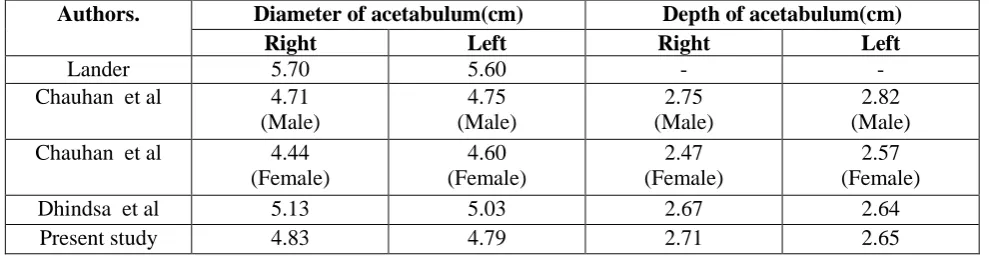
Table 4: Comparison of diameter and depth of acetabulum by various authors.
Authors. Diameter of acetabulum(cm) Depth of acetabulum(cm)
Right Left Right Left
Lander 5.70 5.60 - -
Chauhan et al 4.71 (Male)
4.75 (Male)
2.75 (Male)
2.82 (Male) Chauhan et al 4.44
(Female)
4.60 (Female)
2.47 (Female)
2.57 (Female)
Dhindsa et al 5.13 5.03 2.67 2.64
Present study 4.83 4.79 2.71 2.65
Moon measured average diameter of acetabulum which was 4.95 cm similar to the values of the present study and average depth of acetabulum which was 2.58 cm, slightly lesser than the values of the present study3.
CONCLUSION
The values of the present findings will be helpful for the clinicians, orthopaedicians, prosthetists and radiologists to better understand the pathophysiology of hip region and preparing suitable prosthesis which are more functional to prevent common complications like prosthetic loosening and dislocation. Since present study was performed on limited dry hip bones of unknown age and sex further cadaveric and radiological study of known age and sex is indicated.
ACKNOWLEDGEMENT
We are very much thankful to Dr. D.C.Master, Professor & Head, Anatomy Department, and Dr. A. T. Leuva, Dean, Medical College, Baroda for allowing us to work in the department. We also extend our sincere thanks to Dr. Kanchan Nagdev and other staff members for helping us in preparing the paper.
REFERENCES
1. Vandenbussche E, Saffarini M, Taillieu F, Mutschler C. The asymmetric profile of the acetabulum. Clin Orthop Relat Res. 2008;466(2):417-423.
2. Gray’s anatomy, The anatomical basis of medicine and surgery. 38th edition. Total hip replacement. 689-691.
3. Moon MP, V. Desnoyers JL, Charissoux, C. Mabit, Arnaud JP. Study of the human morfological acetabulum : Biometry. Rev. Chil. Anat. Temuco. 1998;16(1)
4. Tannast M., Klaus A. Siebenrock and Anderson S.E.. Femoroacetabular Impingement : Radiographic Diagnosis-What the Radiologist should know, AJR.2007.188(6) 1540-1552. 5. Govsa F, Ozer MA, Ozgur Z. Morphological
features of the acetabulum. Arch Orthop Trauma Surg.2005; 125(4): 453-461.
6. Murray RO. The aetiology of primary osteoarthritis of the hip. Br J Radiol.1965; 38(6): 810-24.
82
Int J Res Med. 2013; 2(1);78-82 e ISSN:2320-2742 p ISSN: 2320-2734 8. Aksu FT, Ceri NG , Arman C, Tetik S.Morphology and morphometry of the acetabulum. 20(3),2006 : 143-148.
9. Dhindsa G S. Journal of Evolution of Medical and Dental Sciences.(2013) available at: http//www.jemds.com/latest-articles.php?at-id=580. ( Accessed on 15-2-2013)
10. Chauhan R., Paul S, Dhaon, BK. Anatomical Parameters of North Indian Hip joints –
Cadaveric Study. Journal of Anatomical Society of India. 2002; 51(1): 39-42.