1
Frontiers in Heat and Mass Transfer
Available at www.ThermalFluidsCentral.org
DIFFUSION-THERMO AND THERMAL-DIFFUSION EFFECTS
ON RIVLIN-ERICKSEN ROTATORY CONVECTIVE FLOW
PAST A POROUS VERTICAL PLATE
M.S.Dada∗,S.A.Agunbiade,E.O.Titiloye
DepartmentofMathematics,FacultyofPhysicalSciences,UniversityofIlorin,Nigeria
ABSTRACT
Diffusion-thermo and thermal-diffusion effects on unsteady, incompressible Rivlin-Ericksen rotatory convective flow of a magnetic conducting electrical fluid with time dependent suction between two vertical plates of which one is permeable are investigated. The uniform angular velocity rotates about an axis normal to the plate. The equations governing the flow model are non-dimensionalised, perturbed for simplification and solved by Adomian decomposition method. Graphical illustrations of the fluid parameters on velocity, temperature, concentration are presented and discussed. The effect of skin-friction, Nusselt and Sherwood numbers are presented in tabular forms and it is discovered from the results that a rise in thermal-diffusion parameter speedup the skin-friction, while increasing diffusion-thermo parameter slowdown the skin-friction.
Keywords: Diffusion-thermo, Rivlin-Ericksen fluid, Rotatory, thermal-diffusion and Unsteady.
1. INTRODUCTION
Forced and free convection mechanisms contribute significantly to heat transfer. The phenomenon occurs in both industrial and technical prob-lems such as solar collectors, in cooling of electronic devices and nuclear reactors resulting in an emergency shutdown etc. The significance of these applications led some researchers to study natural, forced and mixed convective flows in the presence of heat and mass transfer. Deepthi and Prasada(2017) considered heat and mass transfer with mixed convective flow in the presence of radiation and Soret. In the investigation, rotatory and Dufour effects were considered insignificant. The result shown that a rise in Soret parameter decreased the heat and mass transfer rate on the walls. Soret effect on mixed convection viscoelastic fluid flow in the presence of heat and mass transfer was studied byDevasena and Ratmat
(2014). The effects of Dufour and thermal radiation were not considered.
Dada and Agunbiade(2016) examined the effects of chemical reaction and radiation on convective non-rotatory Rivlin-Ericksen fluid flow in a vertical porous plate. It was discovered that temperature and velocity decreased as radiation parameter increased. Arunaet al.(2015) inves-tigated the influence of both thermal-diffusion and diffusion-thermo of non-rotatory mixed convective hydromagnetic fluid flow through a verti-cal wavy porous plate. The finite difference method was used to obtain the solution.
However, the study of rotating medium is of great importance in fluid dynamics as a result of its relevance in many natural phenomena and its applications in technology relating to Coriolis force. Some of the applications of rotating flow, particularly in porous media in the field of engineering, to mention but a few are rotating machinery, food and
∗
Corresponding author. Email: [email protected]
chemical processing industries. The study of rotating flow has gained the interest of many researchers due to its importance.Sibanda and Makinde
(2010) examined steady MHD flow with heat transfer as a result of rotat-ing disk in a porous fluid in the presence of viscous dissipation. Mutua et al.(2013) considered MHD free convection flow of a Newtonian fluid with variable suction through porous plate and the result revealed that skin friction increased both alongxandyaxes due to a decrease in rota-tion parameter.
In addition, Singh(2013) studied thermal radiation effects on ro-tatory viscoelastic MHD flow via a vertical plate. It was reported that rotation parameter enhanced velocity profiles. Oldroyd-B Rotating MHD radiative fluid through a vertical porous channel was carried out byGarg et al.(2014b).Guria and Jana(2013) examined rotatory viscoelastic fluid past a porous plate under a uniform suction. It was discovered that the presence of viscoelastic parameter contributed to the increase in the plate heat transfer. Abdulmaleque(2017) investigated the effects of tempera-ture dependent suction/injection on non-Newtonian casson radiative fluid flow with viscous dissipation. Also,Garget al.(2014a) presented oscil-latory viscoelastic fluid flow through a porous rotating vertical channel with an assumption of an optically thin radiation and constant suction. The result showed that as the rotation parameter increased, the velocity decreased. Even though, the above investigations had contributed to the studies of fluid flow but the effects of chemical reaction was neglected in the studies and chemical reactions have tremendous impacts in changing the rate of mass diffusion.
po-tentials and the fluxes relation are significantly noticed. The energy flux that is generated due to concentration gradient is referred to as diffusion-thermo, while mass flux resulting from temperature gradients is thermal-diffusion. Mostly, the effects of diffusion-thermo and thermal-diffusion are often neglected in most studies on the bases that they are of low mag-nitude in relation to the rest chemical species. The effects of Dufour and Soret become significant phenomena in areas like petrology, hydrology, geosciences, etc. The effect of thermal-diffusion is relevant, for example, in the separation of isotope and mixture of gases that has light molecular weight. Therefore,Sarma and Govardhan(2016) reported on the effects of thermal-diffusion and diffusion-thermo on natural convection heat and mass transfer with thermal radiation in the presence of viscous dissipation in a porous medium. A Newtonian fluid was examined in the study and finite difference method was used in the computations of the results. It was reported that velocity profiles was accelerated by increase in viscous dissipation. The effects of thermal-diffusion and diffusion-thermo on free convection MHD flow of Rivlin-Ericksen fluid was examined byReddy et al.(2016). Rotatory and thermal radiation effects were considered to be insignificant, the result shown that an increase in diffusion-thermo and thermal-diffusion speedup the skin-friction. Gbadeyanet al.(2011) ex-amined the influence of Soret and Dufour with heat and mass transfer on mixed convective viscoelastic fluid flow past a porous medium. It was observed from the result that Soret enhanced both concentration and tem-perature profiles.
Furthermore,Dada and Salawu(2017) presented heat and mass trans-fer of pressudriven flow with inclined magnetic field. The result re-vealed that an increase in chemical reaction reduced both pressure and concentration profiles. Ibrahim and Suneetha(2015) studied effects of Soret and chemical reaction on MHD unsteady viscoelastic fluid past an infinite vertical plate. The study concluded that both concentration and velocity profiles increased as thermal-diffusion increased. Hayatet al.
(2017) investigated Dufour and Soret effects on MHD Jeffrey fluid of peristaltic transport in a curved channel. It was observed that Dufour and Soret have opposite behaviour for concentration and temperature. Babu et al.(2017) considered diffusion-thermo and thermal-diffusion effects on heat and mass transfer MHD Jeffery fluid flow in a stretching sheet. The result revealed that temperature profiles was reduced by an increase in ei-ther Prandtl number or Soret parameter. Influence of ei-thermal-diffusion on Kurshinshiki fluid in the presence of heat and mass transfer past a verti-cal porous plate was investigated byJimohet al.(2014). At the boundary layer, the result shown that increase in the heat sources parameter im-proved both velocity and temperature profiles. However, as impressive as the above studies were, rotatory Rivlin-Ericksen fluid flows have received no significant attention.
A careful examination of all the above studies on heat and mass transfer showed that combined effects of time dependence suction, pres-sure gradient and heat absorption in Rivlin-Ericksen convective fluid flow in a rotating medium with diffusion-thermo and thermal-diffusion have received little or no attention. Considering various phenomena, com-bined effects of all these parameters come into consideration in a prac-tical flows of fluid and are of pracprac-tical applications in the field of en-gineering, chemical processing industry, rotating machinery, paper and food processing industry, petroleum industry and other areas that involve viscoelastic fluid flow. Hence, this present study analyses the effects of diffusion-thermo, thermal-diffusion and radiation effects on convective Rivlin-Ericksen fluid in a rotating system with chemical reaction.
2. MATHEMATICAL ANALYSIS
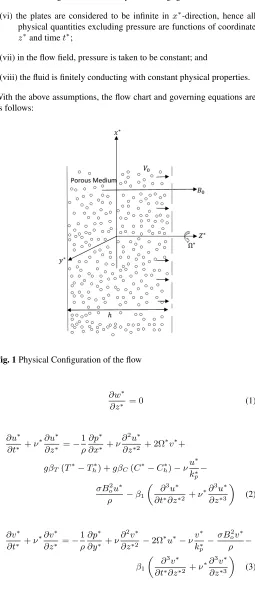
Consider a non-Newtonian, two-dimensional incompressible free convec-tive Rivlin-Ericksen flow of an electrically conducting fluid through a rotating vertical channel with a periodic suction. The following assump-tions are made in the formulation of this problem:
(i) an unsteady and laminar flow is considered;
(ii) induced magnetic field and Hall effects are ignored due to the fact that magnetic Reynolds number and transversely applied magnetic field is considered to be very small;
(iii) a magnetic field (B0) of uniform strength is perpendicularly applied
to the plates;
(iv) there is a rotation of the entire system through the perpendicular axis to the plates;
(v) thermal-diffusion and diffusion-thermo are assumed to be of sub-stantial magnitude, hence, they are not negligible;
(vi) the plates are considered to be infinite in x∗-direction, hence all physical quantities excluding pressure are functions of coordinate
z∗and timet∗;
(vii) in the flow field, pressure is taken to be constant; and
(viii) the fluid is finitely conducting with constant physical properties. With the above assumptions, the flow chart and governing equations are as follows:
Fig. 1Physical Configuration of the flow
∂w∗
∂z∗ = 0 (1)
∂u∗ ∂t∗ +ν
∗∂u∗
∂z∗ =−
1
ρ ∂p∗ ∂x∗ +ν
∂2u∗ ∂z∗2 + 2Ω
∗
v∗+
gβT(T∗−Th∗) +gβC(C∗−Ch∗)−ν
u∗ k∗
p
−
σB2
ou
∗
ρ −β1
∂3u∗
∂t∗∂z∗2 +ν
∗∂3u∗
∂z∗3
(2)
∂v∗ ∂t∗ +ν
∗∂v∗
∂z∗ =−
1
ρ ∂p∗ ∂y∗ +ν
∂2v∗ ∂z∗2 −2Ω
∗
u∗−νv
∗
k∗
p
−σB
2
ov∗
ρ −
β1
∂3v∗
∂t∗∂z∗2 +ν
∗∂3v∗
∂z∗3
∂T∗ ∂t∗ +ν
∗∂T∗
∂z∗ = α
∂2T∗
∂z∗2 −
φ0
ρcp
(T∗−Th∗)−
1
ρCp
∂qR
∂z∗ +
DkT∂2C∗
CpCs∂z∗2
(4)
∂C∗ ∂t∗ +ν
∗∂C∗
∂z∗ =D
∂2C∗ ∂z∗2 −K
∗
1(C
∗
−Ch∗) +
DKT
Tm
∂2T∗ ∂z∗2 (5)
The boundary conditions for the problem are:
z∗= 0;u∗=v∗= 0, T∗=T0∗+(T0∗−Th∗) cos$
∗
t∗, C∗=C0∗+(C
∗
0−C
∗
h) cosw
∗
t∗
z∗=h; u∗=Wo(1 +cos$∗t∗), v∗= 0,
T∗=Th∗, C
∗
=Ch∗
(6)
The time dependent suction velocity is expressed in exponential form as:
ν∗=−Wo
1 +Aei$∗t∗(Daset al.(2011)),andAis small
val-ues less than unity. qRis the radiative heat flux and is defined base on
Rosseland approximation (Brewster(1972)) as:
qR = − 4σ
3k1
∂T∗4
∂z∗ (7)
This present analysis is limited to optically thick fluid, hence Rosse-land approximation is used. Considering the temperature differences within the flow to be sufficiently small,T∗4 (quartic temperature
func-tion) can be expanded using Taylor series expansion and neglecting higher order terms gives;
T∗4≈ 4Th∗3T
∗
− 3Th∗4 (8)
This is substituted into radiative heat flux term that was used in Eq. (4). The pressure gradient for the fluid is considered in the form;
−1 ρ
∂P∗
∂y∗ = 0 and −
1
ρ ∂P∗
∂x∗ =Hcos$t (9)
where H is a constant and it oscillates only in x-axis direction.
The accompanying non-dimensional variables are utilized to reduce the governing equations to non-dimensional form.
ξ= u∗
Wo, v=
v∗
Wo, t=
t∗Wo2
ν , η=
Woz∗
ν =
z∗
h,
ϑ=T
∗− Th∗ T0∗−Th∗, $=
$∗ν
W2
o , Pr=
νρCp
kp =
ν
α, x=
Wox∗ ν
M= σB20ν
ρW2
o , Gh=
νgβT(T0∗−Th∗)
W3
o , SC=
ν
D, VR=
β1Wo2 ν2
Gm=
νgβc(C0∗−C∗h)
W3
o , y=
Woy∗
ν , P=
P∗
ρW2
o, ζ= C∗−C∗h
C∗
0−C∗h
E= k1kp
4σT∗3 h
,Ω =ΩW∗ν2 o, Kr=
K1ν
W2
o , φ= νφ0 ρCpW2
o
Sp=
DKT(T0∗−Th∗) νTm(C0∗−C∗h), Dp=
DKT(C0∗−C∗h) CsCpν(T0∗−Th∗), kp=
k∗pWo2 ν2 (10)
By applying non-dimensional variables (10), Eqs (2)-(5) become
∂ξ ∂t−
1 +Aei$t∂ξ
∂η =Hcos$t + ∂2ξ
∂η2 + 2Ωv+Ghϑ−
M+ 1
kp
ξ+Gmζ − VR
∂3ξ
∂t∂η2 −
1 +Aei$t∂
3ξ ∂η3 (11) ∂v ∂t −
1 +Aei$t∂v ∂η =
∂2v
∂η2 −2Ωξ−
M+ 1
kp
v
− VR
∂3v ∂t∂η2 −
1 +Aei$t∂
3 v ∂η3 (12) ∂ϑ ∂t −
1 +Aei$t∂ϑ ∂η =
1
Pr
+ 4
3EPr
∂2ϑ
∂η2
−φϑ+Dp
∂2ζ
∂η2 (13)
∂ζ ∂t −
1 + Aei$t∂ζ ∂η =
1
Sc
∂2ζ
∂η2 − Krζ+Sp
∂2ϑ
∂η2 (14)
The boundary conditions are:
ψ= 0, ϑ= 1 +
2 e
i$ t+ e−i$ t
, ζ= 1 + 2 ei$ t+ e−i$ t
at η= 0
ψ= 1 +
2 e
i$ t+ e−i$ t
, ϑ= 0, ζ= 0at η= 1
(15)
whereξ,ϑ,ζ,η,Ω,Rv,E,kr,M,P r,Sc,φ,VR,A,Dp,Sp,Gh,Gm
are velocity, temperature, concentration, plates distance apart, rotation parameter, resultant velocity, radiation parameter, chemical reaction pa-rameter, magnetic papa-rameter, Prandtl number, Schmidt number, heat ab-sorption coefficient, viscoelasticity parameter, suction velocity parame-ter, Dufour number, Thermal-diffusion parameparame-ter, Grashof number for heat and mass transfer, respectively.
Takingψ=ξ+ivthen, Eqs (11) and (12) combine to
∂ψ ∂t−
1 +Aei$t∂ψ
∂η =Hcos$t+ ∂2ψ
∂η2−(2iΩ +F)ψ+Ghϑ+
Gmζ−VR
∂3ψ ∂t∂η2 −
1 +Aei$t∂
3 ψ ∂η3 (16) where
F=M+ 1
kP
3. METHOD OF SOLUTION
3.1. Perturbation method
The partial differential Eqs. (13), (14) and (16) are reduced to ordi-nary differential equations by Perturbation technique. Due to the nature of the boundary conditions, the assumed solutions can be written as fol-lows.(Garget al.(2014b))
ψ(η, t) =ψ0(η) +2 ψ1(η)ei$t+ψ2(η)e−i$t
ϑ(η, t) =ϑ0(η) +2 ϑ1(η)ei$t+ϑ2(η)e−i$t
ζ(η, t) =ζ0(η) +2 ζ1(η)ei$t+ζ2(η)e−i$t
(17)
Substituting equation (17) into Eqs. (13), (14) and (16) gives:
VRψ0000 +ψ
00
0+ψ
0
0−(2iΩ +F)ψ0=−Ghϑ0 −Gmζ0 (18)
VRψ0001 + (1−VRi$)ψ001 +ψ
0
1−(i$+ 2iΩ +F)ψ1=−H− 2Aψ00−Ghϑ1−Gmζ1−2VRAψ0000 (19)
VRψ0002 + (1 +VRi$)ψ002 +ψ
0
2−(2iΩ +F−i$)ψ2=−H−
Ghϑ2−Gmζ2 (20)
Bϑ000+ϑ
0
0−φϑ0=−Dpζo00 (21)
Bϑ001+ϑ
0
1−(φ+i$)ϑ1=−2Aϑ00−Dpζ100 (22)
Bϑ002+ϑ
0
2−(φ−i$)ϑ2=−Dpζ200 (23)
ζ000+Scζ00 −ScKrζ0=−ScSpϑ000 (24)
ζ100+Scζ
0
1−Sc(Kr+i$)ζ1 =−2AScζ
0
0−ScSpϑ
00
1 (25)
ζ200+Scζ
0
2−Sc(Kr−i$)ζ2=−ScSpϑ
00
2 (26)
where
B= 1
Pr + 4
3EPr
The boundary conditions for the problem are:
ψ0=ψ1 =ψ2= 0, ϑ0=ϑ1=ϑ2= 1,
ζ0=ζ1=ζ2= 1at η= 0
ψ0=ψ1 =ψ2= 1, ϑ0=ϑ1=ϑ2= 0,
ζ0=ζ1=ζ2= 0at η= 1
Equations (18)-(20) are third order differential equations with only two boundary conditions. In order to obtain necessary and sufficient bound-ary conditions (Beard and Walters(1964)) and (Garget al.(2014b)), the solutions are expressed in the forms:
ψ0(η) =ψ01(η) +VRψ02(η) + 0(VR2)
ψ1(η) =ψ11(η) +VRψ12(η) + 0(VR2)
ψ2(η) =ψ21(η) +VRψ22(η) + 0(VR2)
ϑ0(η) =ϑ01(η) +VRϑ02(η) + 0(VR2)
ϑ1(η) =ϑ11(η) +VRϑ12(η) + 0(VR2)
ϑ2(η) =ϑ21(η) +VRϑ22(η) + 0(VR2)
ζ0(η) =ζ01(η) +VRζ02(η) + 0(VR2)
ζ1(η) =ζ11(η) +VRζ12(η) + 0(VR2)
ζ2(η) =ζ21(η) +VRζ22(η) + 0(VR2) (28)
Applying Eqs. (28) to Eqs. (18)-(26) gives:
ψ0100 +ψ
0
01−(2iΩ +F)ψ01=−Ghϑ01−Gmζ01 (29)
ψ0200 +ψ
0
02−(2iΩ +F)ψ02=−ψ01000−Ghϑ02−Gmζ02 (30)
ψ0011+ψ
0
11−(i$+ 2iΩ +F)ψ11=−H−2Aψ001
−Ghϑ11−Gmζ11 (31)
ψ0012+ψ
0
12−(i$+ 2iΩ +F)ψ12=i$ψ
00
11−ψ
000
11−2Aψ
0
02− 2Aψ00001−Ghϑ12−Gmζ12 (32)
ψ2100 +ψ
0
21−(2iΩ +F−i$)ψ21=−H−Ghϑ21−Gmζ21 (33)
ψ0022+ψ
0
22−(2iΩ +F−i$)ψ22=−ψ
000
21−i$ψ
00
21−
Ghϑ22−Gmζ22 (34)
Bϑ0001+ϑ
0
01−φϑ01=−Dpζ
00
01 (35)
Bϑ0002+ϑ
0
02−φϑ02=−Dpζ
00
02 (36)
Bϑ0011+ϑ
0
11−(φ+i$)ϑ11=−2Aϑ001−Dpζ1100 (37)
Bϑ0012+ϑ
0
12−(φ+i$)ϑ12=−2Aϑ002−Dpζ1200 (38)
Bϑ0021+ϑ
0
21−(φ−i$)ϑ21=−Dpζ2100 (39)
Bϑ0022+ϑ
0
22−(φ−i$)ϑ22=−Dpζ
00
22 (40)
ζ0100 +Scζ
0
01−ScKrζ01=−ScSpϑ
00
01 (41)
ζ0200 +Scζ
0
02−ScKrζ02=−ScSpϑ
00
02 (42)
ζ1100 +Scζ110 −Sc(Kr+i$)ζ11=−2AScζ010 −ScSpϑ0011 (43)
ζ1200 +Scζ120 −Sc(Kr+i$)ζ12=−2AScζ020 −ScSpϑ0012 (44)
ζ2100 +Scζ210 −Sc(Kr−i$)ζ21=−ScSpϑ0021 (45)
ζ2200 +Scζ220 −Sc(Kr−i$)ζ22=−ScSpϑ0022 (46)
subject to the following boundary conditions:
ψ01=ψ02=ψ11=ψ12=ψ21=ψ22= 0 at η= 0
ψ01=ψ11=ψ21= 1, ψ02=ψ12=ψ22= 0 at η= 1
ϑ01=ϑ11=ϑ21= 1, ϑ02=ϑ12=ϑ22= 0 at η= 0
ϑ01=ϑ11=ϑ21= 0, ϑ02=ϑ12=ϑ22= 0 at η= 1
ζ01=ζ11=ζ21= 1, ζ02=ζ12=ζ22= 0 at η= 0
ζ01=ζ11=ζ21= 0, ζ02=ζ12=ζ22= 0 at η= 1 (47)
3.2. Adomian Decomposition method
The ordinary differential Eqs. (29)-(46), though linear but are highly coupled, hence Adomian decomposition methods is applied in solving the problem. A differential equation can be written in a general form as;
F ψ(η) =b (48)
where F represents an operator of nonlinear ordinary differential equation containing both linear and nonlinear terms.Lψrepresents the linear term, and the invertible linear operator is L. Taking the highest-ordered deriva-tive as L,L−1is n-fold integration operator from 0 toηforL=dηdnn. For
the linear operator L, the remainder is R andN ψis the nonlinear term. Hence,
Lψ+Rψ+N ψ=b (49)
Lψ=b−Rψ−N ψ (50)
Since L is invertible, thus
L−1Lψ=L−1b−L−1Rψ−L−1N ψ (51) The highest-order in Equations (29)-(46) is two, therefore,
L−1Lψ = Z η
0 Z s
0
ψ00(η)dηds (52)
L−1Lψ = ψ − ψ(0) − ηψ0(0) (53) substituting forL−1Lψin Equation (51), the equation becomes;
ψ = ψ(0) + ηψ0(0) + L−1b−L−1Rψ−L−1N ψ (54) Hence,
ψ = ψ(0) + ηψ0(0) + bη
2 2 − Z η 0 Zs 0
(Rψ + N ψ)dηds (55)
ψcan be written in series form as:
ψ=
∞
X
n=0
ψn (56)
also, the nonlinear term as:
N ψ=
∞
X
n=0
An (57)
where
An= 1
n!
dn
dλn F n X
i=0
λiψi !!
λ=0
n= 0,1,2,3, ... (58)
Substituting Equations (56) and (57) into equation (55) gives;
∞
X
n=0
ψn = ψ(0) + ηψ 0
(0) + bη
2 2 − Z η 0 Z s 0 R ∞ X n=0
ψn +
∞ X n=0 An ! dηds (59)
The first three terms are identified asψ0which is the initial
approxima-tion, that is
ψ0 = ψ(0) + ηψ
0
(0) + bη
2
2 (60)
and
ψn+1 =− Z η 0 Z s 0 R ∞ X n=0
ψn +
is the recurrence relation. All the components can be determined sinceA0
depends onψ0only,A1depends onψ0 andψ1and so on. The solution
then is the n-term approximation or approximant toψ.
From Eqs. (60) and (61), the approximate solutions for Eqs (29 )-(46), which converges atn= 5, can be written as:
ζ01=P5a=0ζ01[a], ϑ01=P5a=0ϑ01[a];
ψ01=P5a=0ψ01[a], ζ02=P5a=0ζ02[a],
ϑ02=P5a=0ϑ02[a];ψ02=P5a=0ψ02[a],
ζ11=P5a=0ζ11[a], ϑ11=P5a=0ϑ11[a];
ψ11=P5a=0ψ11[a], ζ12=P5a=0ζ12[a],
ϑ12=P5a=0ϑ12[a];ψ12=P5a=0ψ12[a],
ζ21=P5a=0ζ21[a], ϑ21=P5a=0ϑ21[a];
ψ21=P5a=0ψ21[a], ζ22=P5a=0ζ22[a],
ϑ22=P5a=0ϑ22[a];ψ22=P5a=0ψ22[a] (62)
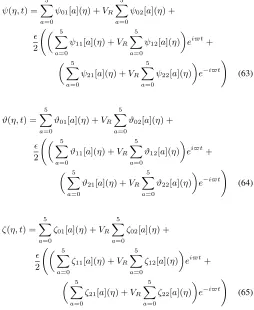
Series solutions (62) are substituted in Eqs. (17) and (28) to give the final solution for velocity, temperature and concentration distributions
ψ(η, t) = 5 X
a=0
ψ01[a](η) +VR
5 X
a=0
ψ02[a](η) +
2 5
X
a=0
ψ11[a](η) +VR
5 X
a=0
ψ12[a](η)
ei$t+
5 X
a=0
ψ21[a](η) +VR
5 X
a=0
ψ22[a](η)
e−i$t
!
(63)
ϑ(η, t) = 5 X
a=0
ϑ01[a](η) +VR
5 X
a=0
ϑ02[a](η) +
2 5
X
a=0
ϑ11[a](η) +VR
5 X
a=0
ϑ12[a](η)
ei$t+
5 X
a=0
ϑ21[a](η) +VR
5 X
a=0
ϑ22[a](η)
e−i$t
!
(64)
ζ(η, t) = 5 X
a=0
ζ01[a](η) +VR
5 X
a=0
ζ02[a](η) +
2 5
X
a=0
ζ11[a](η) +VR
5 X
a=0
ζ12[a](η)
ei$t+
5 X
a=0
ζ21[a](η) +VR
5 X
a=0
ζ22[a](η)
e−i$t
!
(65)
3.3. Skin-friction, Nusselt and Sherwood number in term of Amplitude
With reference to the boundary conditions, the amplitude is defined in terms of primary and secondary velocities for steady and unsteady flow. Therefore, total resultant velocity can be written as;
Rv= p
d2+f2 (66)
where velocity is defined as
ψ(η, t) = d +if (67)
The Skin-friction is given as;
τ(η) =
∂ψ ∂η
η=0,1
=τm+iτn (68)
β1= p
τ2
m+τn2 (69)
Nusselt number (Heat transfer coefficient) is defined as;
N u(η) = −
1 + 4
3E ∂ϑ ∂η
η=0,1
=βm+iβn (70)
β2= p
β2
m+βn2 (71)
Sherwood Number(Mass transfer coefficient) is expressed as:
Sh(η) =
∂ζ ∂η
η=0,1
=λm+iλn (72)
β3= p
λ2
m+λ2n (73)
4. DISCUSSION OF RESULTS
The solutions for the partial differential equations (13), (14) and (16) with the corresponding boundary conditions (15) are acquired by Ado-mian decomposition methods alongside with MATHEMATICA program-ming. The impacts of different parameters governing the flow field on velocity, temperature and species in the fliud are depicted in tabular and graphical forms. The parameters considered in this study include: di-mensionless viscoelasticity parameter of the Rivlin-Ericksen fluid (VR),
suction velocity parameter (A), rotation parameter (Ω), scalar constant (), chemical reaction parameter (Kr), thermal radiation parameter (E),
Prandtl number (Pr), Schmidt number (Sc), heat absorption coefficient
(φ), Mass transfer Grashof number (Gm), Heat transfer Grashof number
(Gh), permeability of the porous medium (kp), Dufour parameter (Dp),
Soret parameter (Sp) and magnetic parameter (M). Throughout the
com-putations, the following are taken as default values:t= 1, Gh=Gm=
M = 5, VR = 0.05, φ = 0.005,Pr = 0.71, E = 3, = 0.01,
A=kp= 0.5, Kr= 2,Ω = 10,Dp= 0.1,Sp= 2andSc= 1.002.
Figures2and3depict the effects of Suction velocity parameter (A) on concentration and resultant velocity (Rv). It is obvious that as
Suc-tion velocity parameter increases, resultant velocity and concentraSuc-tion in-crease.
Fig. 2Variation of dimensionless concentrationζwith suction velocity parameterA
Fig. 3Variation of resultant velocityRvwith suction velocity parameter
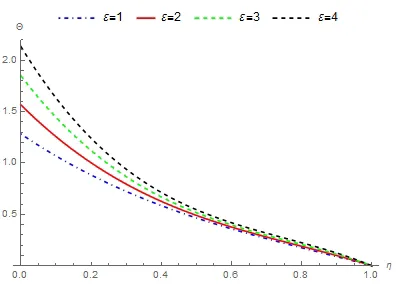
Variation of values of scalar constant () on resultant velocity, tem-perature and species distribution is shown in Figs.4-6. It is detected that increasingcauses a corresponding increment on resultant velocity, temperature and species profiles.
Fig. 4Variation of dimensionless concentrationζwith scalar constant
Fig. 5Variation of dimensionless temperatureϑwith scalar constant
Fig. 6Variation of resultant velocityRvwith scalar constant
The influence ofGm,Ghandkpon velocity is illustrated in Figs.7
-9. From these Figures, resultant velocity is enhanced by an increase in
Gm,Ghandkp.
Fig. 7Variation of resultant velocityRvwith mass transfer Grashof
num-berGm
Fig. 8Variation of resultant velocityRvwith heat transfer Grashof
num-berGh
Fig. 9Variation of resultant velocityRvwith permeability of the porous
mediumkp
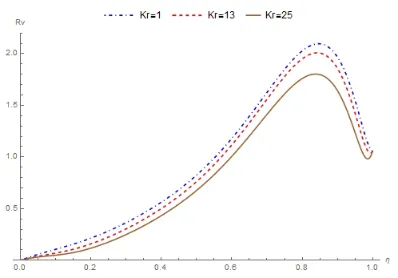
Figures10and11display the effect of the different values ofKron
species and velocity profiles. It is observed that the more the value ofKr,
Fig. 10Variation of dimensionless concentrationζwith chemical reaction parameterKr
Fig. 11Variation of resultant velocityRvwith chemical reaction
param-eterKr
Figure12reveals the influence ofM on the resultant velocity. It is clear from the figure that a higher value ofMdecreases the flow velocity throughout the domain of the fluid. A drag force identified as Lorentz force is produced in electrically conducting fluid where magnetic field is applied. There is a decrease in the velocity of the fluid as a result of the effect of this drag force since fluid transport is resisted in the presence of the magnetic field.
Fig. 12Variation of resultant velocityRvwith magnetic parameterM
The contribution of radiation parameter is represented in Figs.13
and14. From these figures, it is shown a rise inEslows temperature dis-tribution down. However, resultant velocity disdis-tribution is improved with a rise inE. This result revealed that higher values of radiation parameter are equivalent to increasing dominance conduction overE. Hence, there is reduction in buoyancy force and temperature in the thermal boundary
layer.
Fig. 13Variation of dimensionless temperatureϑwith thermal radiation parameterE
Fig. 14Variation of resultant velocityRvwith thermal radiation
parame-terE
The effect ofΩ on resultant velocity is seen in Fig.15. The re-sult revealed that, higher values of rotation parameter enhanced rere-sultant velocity profiles, which showed an overwhelming effect of rotation. A diminishing inRvdue to a decrease inΩis because of the presence of
gravitational and Lorentz force rotating at very low speeds. This indicates that a friction factor is noticed, henceRvdecreases. The same trend is
apparent in Figs.16and17, which represented velocity and temperature profiles for different values ofPr. Prandtl number can be defined as the
ratio of momentum diffusivity to thermal diffusivity. It is, therefore, ob-vious that a lower thermal conductivity material leads to high velocity and a different trend is seen for higher thermal conductivity. Hence, in Fig.17, it is seen that an increase in Prandtl number accelerates the re-sultant velocity profiles. Likewise, in Figs.16, an increase inPrreduces
the thermal boundary layer thickness and average temperature within the boundary. This implies that, an increase inPrmakes the thermal
Fig. 15Variation of resultant velocityRvwith rotation parameterΩ
Fig. 16Variation of dimensionless temperatureϑwith Prandtl number
P r
Fig. 17Variation of resultant velocityRvwith Prandtl numberP r
Furthermore, effect ofSc on concentration and resultant velocity
profiles is revealed in Figs.18and19. Here, it is observed that higherSc
leads to a decline in concentration profiles, while the resultant velocity is enhanced.
Fig. 18Variation of dimensionless concentrationζwith Schmidt number
Sc
Fig. 19Variation of resultant velocityRvwith Schmidt numberSc
Figure20depicts the variation of different values of heat absorption coefficient (φ). It is seen that with a rise inφ, the temperature diminishes. Thus, when heat is absorbed, the buoyancy force decreases the tempera-ture profile. Effect ofVRon resultant velocity is displayed in Fig.21. It
is evident in Fig.21that resultant velocity is accelerated by an increase inVR.
Fig. 21Variation of resultant velocityRvwith dimensionless
viscoelas-ticity parameter of the Rivlin-Ericksen fluidVR
Figures 22- 24 detect the effects of variation ofSpon resultant
velocity, temperature and species profiles. A careful study of these fig-ures shown that the presence ofSpenhances both resultant velocity and
concentration profiles, while a different trend is noticed in temperature profiles. Temperature profiles decline with a rise inSp.
Fig. 22Variation of resultant velocityRvwith Soret parameterSp
Fig. 23Variation of dimensionless temperatureϑwith Soret parameter
Sp
Fig. 24Variation of dimensionless concentrationζwith Soret parameter
Sp
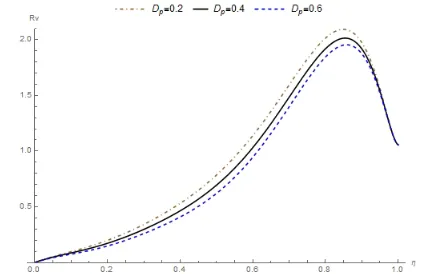
Effect ofDpon resultant velocity, temperature and concentration
profiles is presented in Figs.25-27. Resultant velocity profiles dimin-ishes asDpis increased, while temperature profiles increases. This is as
a result of the generation of energy flux that enhances the temperature. A rise inDpmakes concentration profiles to fall within0≤η≤0.7. and
within0.7≤η≤1, a rise in concentration profile is observed.
Fig. 25Variation of resultant velocityRvwith Dufour parameterDp
Fig. 26Variation of dimensionless temperatureϑwith Dufour parameter
Fig. 27Variation of dimensionless concentrationζwith Dufour parame-terDp
Tables1and2display the variation of fluid parameters (Kr,E,Ω,
Sp,DpandVR) on Skin-friction, Nusselt number and Sherwood
Num-ber atη = 0andη = 1. It is seen in Table1that the Skin-friction is diminished with the presence ofKr,Ω,DpandVR, while it is
strength-ened byE andSp. Nusselt number is reduced with an increase inKr,
N, andDp. On the other hand, increasing the values ofSpenhances
the Nusselt number. In like manner, Sherwood number increases with an increase in chemical reaction and Dufour parameter. The mass transfer coefficient value is reduced with an increase inEandSp. Consequently,
Table2shows that skin friction is quickened by an increase inKr,E, Ω,SpandVR, while higher values of Dufour parameter decreases the
Skin-friction. Nusselt number is risen with an increase inKrandDpbut
diminishes with increment in the values ofEandSp. IncreasingE,Sp
andDpmake Sherwood number to rise and it decelerates by increasing
the values ofKr.
Table 1Values of Skin-friction, Nusselt number and Sherwood Number for different parameters atη= 0
Kr E Ω Sp Dp VR τ N u Sh
1 3 15 2 0.1 0.05 1.26547 2.11822 1.51979 2 3 15 2 0.1 0.05 1.23144 2.05517 1.88701 3 3 15 2 0.1 0.05 1.20171 1.99740 2.21109 2 2 15 2 0.1 0.05 1.22856 2.24886 2.02036 2 3 15 2 0.1 0.05 1.23144 2.05517 1.88701 2 4 15 2 0.1 0.05 1.23326 1.95820 1.80325 2 3 10 2 0.1 0.05 2.30656 2.05517 1.88701 2 3 12 2 0.1 0.05 1.91408 2.05517 1.88701 2 3 14 2 0.1 0.05 1.47608 2.05517 1.88701 2 3 15 0.5 0.1 0.05 1.15877 1.96696 2.39242 2 3 15 1 0.1 0.05 1.18374 1.99150 2.23485 2 3 15 1.5 0.1 0.05 1.20808 2.02105 2.06581 2 3 15 2 0.2 0.05 1.23902 1.91244 2.24897 2 3 15 2 0.3 0.05 1.22160 1.68476 2.84090 2 3 15 2 0.4 0.05 1.17973 1.28395 3.77168 2 3 15 2 0.1 0.03 1.88677 2.05517 1.27000 2 3 15 2 0.1 0.04 1.24755 2.05517 1.88689 2 3 15 2 0.1 0.05 1.23144 2.05517 1.88701
Table 2Values of Skin-friction, Nusselt number and Sherwood Number for different parameters atη= 1
Kr E Ω Sp Dp VR τ N u Sh
1 3 15 2 0.1 0.05 31.07010 1.11707 1.01404 2 3 15 2 0.1 0.05 31.18150 1.15218 1.00215 3 3 15 2 0.1 0.05 31.30150 1.18574 0.99255 2 2 15 2 0.1 0.05 30.93190 1.39006 0.92341 2 3 15 2 0.1 0.05 31.18150 1.15218 1.00215 2 4 15 2 0.1 0.05 31.34460 1.03570 1.05271 2 3 10 2 0.1 0.05 10.07210 1.15218 1.00215 2 3 12 2 0.1 0.05 15.89760 1.15218 1.00215 2 3 14 2 0.1 0.05 31.18150 1.15218 1.00215 2 3 15 0.5 0.1 0.05 30.56020 1.17756 0.51807 2 3 15 1 0.1 0.05 30.73410 1.17484 0.66103 2 3 15 1.5 0.1 0.05 30.94190 1.16610 0.82349 2 3 15 2 0.2 0.05 30.65410 1.20466 1.20452 2 3 15 2 0.3 0.05 30.07210 1.25950 1.47638 2 3 15 2 0.4 0.05 29.37250 1.29107 1.92832 2 3 15 2 0.1 0.03 22.58470 1.15218 0.99932 2 3 15 2 0.1 0.04 26.85330 1.15218 1.00074 2 3 15 2 0.1 0.05 31.18150 1.15218 1.00215
5. CONCLUSION
An investigation of the join influence of the fluid parameters on con-vective Rivlin-Ericksen flow of an unsteady incompressible and elec-trically conducting fluid in vertical plates with a time dependence suc-tion is discussed. The governing equasuc-tions of the flow field were non-dimensionalised and the solutions are obtained using Adomian decom-position method. The effects of various parameters on velocity, tempera-ture, concentration, skin friction, Nusselt number and Sherwood number are presented in graphical and tabular forms.
The study reveals that;
1. Resultant velocity is strengthened by the presence ofΩ, E, VR,
andSpand weakened with the presence ofKrandDp.
2. An increase inDptends to accelerate temperature profiles, while
it is slowed down by higher values ofEandSp.
3. Concentration distribution is enhanced with increase inSp,
how-ever, the profile is reduced with an increase inKrandDp. Within 0.7≤η≤1, higher values ofDpimproved the profile.
4. Skin friction is enhanced with an increase in the values ofSpand
decelerated by increasingDpandΩatη= 0. The same effect is
noticed forSpandDpatη= 1. But,Ωtends to accelerate the skin
friction.
5. Atη= 0, it is observed that increasing in the Soret number strength-ens the heat transfer coefficient and weakstrength-ens mass transfer coeffi-cient. The reverse effect is noticed for Dufour number.
6. Both heat and mass transfer coefficients are improved by high val-ues ofDpatη= 1.
NOMENCLATURE
x∗ dimensional distance upward the plate (m)
y∗ dimensional distance normal to the plate (m)
z∗ dimensional distance perpendicular to the planes of the plates (m)
u∗, v∗, w∗ dimensional velocity components in thex∗, y∗, z∗directions respectively (ms−1)
Cp specific heat at constant pressure (Jkg−1K−1)
B0 magnetic induction (tesla)
T∗ dimensional temperature (K)
C∗ dimensional concentration (kmol/m3)
P∗ dimensional pressure (N/m2)
D chemical molecular diffusivity
g gravitational acceleration (m/s2)
Th∗ plate dimensional temperature (K)
Ch∗ plate dimensional concentration (kmol/m3)
kp non-dimensional permeability of the porous medium
k0 mean absorption coefficient
Wo scale of suction velocity contain non-zero positive constant
Tm mean fluid temperature
KT thermal diffusion ratio
Cs concentration susceptibility
K thermal conductivity (W/m·K)
T0 temperature at the left plate (K)
C0 concentration at the left plate (kmol/m3)
h distance of the plate (m)
Greek Symbols
ρ∗ fluid density (kgm−3)
ν∗ kinematic viscosity (m2s−1)
σ Stefan-Boltzman constant (W/m2·K4)
φo dimensional heat absorption coefficient (j/kg)
α thermal diffusivity
βT,βC thermal, concentration expansion coefficient
β1 kinematic viscoelasticity
scalar constant
REFERENCES
Abdulmaleque, K.L., 2017, “Temperature dependent suction/injection and variable properties on non-Newtonian Casson mixed convective MHD laminar fluid flow with viscous dissipation and thermal radiation,”
American Journal of Heat and Mass Transfer,4(2), 104–120.
http://dx.doi.org/10.7726/ajhmt.2017.1007.
Aruna, G., Varma, S.V., and Raju, R.S., 2015, “Combined influence of Soret and Dufour effects on unsteady hydromagnetic mixed convective flow in an accelerated vertical wavy plate through a porous medium,”Int J Adv Appl Math and Mech,3(1), 122–134.
Babu, H.D., Venkateswarlu, B., and Narayana, S.P.V., 2017, “Soret and Dufour effects on MHD radiative heat and mass transfer flow over a stretching sheet,”Frontiers in Heat and Mass Transfer(FHMT),8(5), 1– 9.
http://dx.doi.org/10.5098/hmt.8.5.
Beard, D.M., and Walters, K., 1964, Elastico-viscous boundary-layer flows-I: two-dimensional flow near the stagnation point, Proc. Cambr. Phil. Soc., London.
Brewster, M.Q., 1972,Thermal Radiation Transfer Properties, John Wi-ley and sons, London.
Dada, M.S., and Agunbiade, S.A., 2016, “Radiation and chemical re-action effects on convective Rivlin-Ericksen flow past a porous vertical plate,”Ife Journal of Science,18(3), 655–667.
Dada, M.S., and Salawu, S.O., 2017, “Analysis of Heat and Mass Transfer of an inclined magnetic field pressure-driven flow past a permeable plate,”
Applications and Applied Mathematics: An international Journal (AAM),
12(1), 189–200.
http://pvamu.edu/aam.
Das, S., Maity, M., and Das, J.K., 2011, “Effect of heat source and vari-able suction on unsteady viscous stratified flow past a vertical porous flat moving plate in the slip flow regime,”International Journal of Energy and Environment,2(2), 375–382.
Deepthi, J., and Prasada, D.R.V., 2017, “Mixed convective heat and mass transfer flow in a vertical channel with Soret effect and radiation,” Inter-national Journal of Emerging Trends in Engineering and Development,
2(7), 1–11.
http://www.rspublication.com/ijeted/ijeted index.htm.
Devasena, Y., and Ratmat, A.L., 2014, “Effect of thermo-Diffusion on mixed convective Heat and mass transfer flow of a Visco-Elastic fluid past a porous plate with Heat Generating Sources,”International Journal of Emerging Trends in Engineering and Development,2(4), 8–19.
http://www.rspublication.com/ijeted/ijetedindex.htm.
Garg, B.P., Singh, K.D., and Bansal, A.K., 2014a, “An oscillatory MHD convective flow of viscoelastic fluid through porous medium filled in a ro-tating vertical porous channel with heat radiation,”International Journal of Engineering and innovative Technlolgy,3(12), 273–281.
Garg, B.P., Singh, K.D., and Bansal, A.K., 2014b, “Rotating MHD con-vective flow of Oldroyd-B fluid through a porous medium in a vertical porous channel with thermal Radiation,”International Journal of Inno-vations in Engineering and Technology,4(1), 251–267.
Gbadeyan, J.A., Idowu, A.S., Ogunsola, A.W., Agbola, O.O., and Olare-waju, P..O., 2011, “Heat and mass transfer for Soret and Dufour’s effect on mixed convection boundary layer flow over a stretching vertical sur-face in a porous medium filled with a viscoelastic fluid in the presence of magnetic field,”Global Journal of Science Frontier Research,11(8), 96–115.
Guria, M., and Jana, R.N., 2013, “Flow of a viscoelastic fluid past a porous plate in a rotating system,”Int J of Applied Mechanics and En-gineering,18(1), 27–41.
http://dx.doi.org/10.2478/ijame-2013-0002.
Hayat, T., Zahir, H., Tanveer, A., and Alsaedi, A., 2017, “Soret and Du-four effects on MHD peristaltic transport of Jeffrey fluid in a curved chan-nel with convective boundary conditions,”PLoS ONE,12(2), 1–50.
http://dx.doi.org/10.1371/journal.pone.0164854.
Ibrahim, S.M., and Suneetha, K., 2015, “Chemical reaction and Soret effects on unsteady MHD flow of a viscoelastic fluid past an impulsively started infinite vertical plate with heat source/Sink,”International journal of Mathematics and conputational Science,1(1), 5–14.
http://www.publicscienceframework.org/journal/ijmcs.
Jimoh, A., Idowu, A.S., and Titiloye, E.O., 2014, “Influence of Soret on unsteady MHD of Kuvshinshiki fluid flow flow with heat and mass Transfer past a vertical porous plate with vertical suction,”International journal of Recent and Innovation Trends in computing and communica-tion,2(9), 2599–2611.
http://www.ijritcc.org.
Mutua, N.M., Musyoki, N.M., Kinyanjui, M.N., and Kwanza, J.K., 2013, “Magnetohydrodynamic free convection flow of a heat generating fluid past a semi-infinite vertical porous plate with variable suction,” Interna-tional Journal of Applied Mathematics Research,2(3), 356–371. Reddy, P.C., Raju, M.C., and Raju, G.S.S., 2016, “Soret and Dufour ef-fects on MHD free convective flow of Rivlin-Ericksen fluid past a semi-infinite vertical plate,” Advances and Applications in Fluid Mechanics,
19(2), 401–414.
Sarma, G.S., and Govardhan, K., 2016, “Thermo-diffusion and Diffusion-thermo effects on free convective heat and mass transfer from vertical surface in a porous medium with viscous dissipation in the presence of Thermal radiation,”Archives of Current Research International,3(1), 1– 11.
http://dx.doi.org/10.9734/ACRI/2016/21503.
Sibanda, P., and Makinde, O.D., 2010, “On steady MHD flow and heat transfer due to a rotating disk in a porous medium with ohmic heating and
viscous dissipation,”Int J Num Methods for Heat and Fluid Flow,20(3), 269–285.
Singh, K.D., 2013, “Visco-Elastic MHD convective periodic flow through porous medium in a rotating vertical channel with thermal radiation,”
Journal of Global Research in Mathematics Archives,1(4), 8–20.