International Journal of Advanced Research
in Science and Technology
journal homepage: www.ijarst.com
ISSN 2319 – 1783
Optimization of machining parameters in turning using Design of Experiments (DOE)
and Analysis of Variance (ANOVA)
Arun Kumar Parida, Tapas Kumar Moharana
Gandhi Institute Of Technology And Management (GITAM), Bhubaneswar, India.
*Corresponding Author’s Email: [email protected]
A R T I C L E I N F O A B S T R A C T
Article history:
Received 13 August 2012 Accepted 25 Sept. 2012 Available online 01 October 2012
Metal cutting process is one of the complex process which has numerous factors contributing towards the quality of the finished product. CNC turning is one among the metal cutting process in which quality of the finished product depends mainly upon the machining parameters such as feed, speed, depth of cut, type of coolant used, types of inserts used etc. Similarly the work piece material plays an important role in metal cutting process. While machining, optimized machining parameters results in good surface finish, low tool wear, etc. This study involves in identifying the optimized parameters in CNC turning. Based on the performance of test results of various sets of experiments performed for analyzing the influence of different machining parameters on the cutting force in the machining of mild steel using HSS cutting tool, Factorial 3k design of experiment (DOE), Analysis of variance (ANOVA), F-test values. The experimental results show that the cutting force and feed force are low at low feed and depth of cut and comparatively high at high feed and high depth of cut. The greater the feed and depth of cut , larger the cross sectional area of the uncut chip, the volume of the deformed metal and consequently the greater is the resistance of the material to chip formation and larger is the force Pz will be in turning operation.
© 2012 International Journal of Advanced Research in Science and Technology (IJARST). All rights reserved.
Keywords:
Turning Machining DOE ANOVA
Introduction:
Turning is one of the fundamental machining processes, especially for the finishing of machined parts. Usually, the selection of appropriate machining parameters is difficult and relies heavily on the operators’ experience and the machining parameters tables provided by the machine-tool builder for the target material. Hence, the optimization of operating parameters is of great importance where the economy and quality of a machined part play a key role
[1]. Proper selection of cutting tools, parameters, and conditions for
optimal surface quality (as well as tool life) requires a more methodical approach by using experimental methods and mathematical and statistical models. Not only does this require considerable knowledge and experience to design experiments and analyze data, but traditional design-of-experiment (DOE) techniques
require a large number of samples to be produced [2]. Davim [3]
conducted such a study using a steel workpiece, with control parameters of spindle speed, depth of cut, and feed rate, and the
response parameter being the surface roughness. Davim [4] also
conducted a more elaborate study using a composite work piece;
spindle speed, feed rate, and cutting time control variables; and tool wear, spindlepower, and surface roughness response variables.
Among the cutting parameters affecting machining variables for steel, speed has maximum effect & depth of cut has minimum effect. Tool tip temperature increases with increase in cutting speed. At high speeds, surface finish is least affected. Surface finish deteriorates at high feed rates; hence to obtain good surface finish, feed rate may be kept low. At low speeds cutting force are high & tendency of work material to form a built up edge is also stronger. At lower speeds, surface roughness increases with increasing feed but at higher speeds surface roughness is less dependent on feed [5].
Cakir et al. [6] studied the effects of cutting parameters on the
surface roughness through mathematical models developed using a series of turning experiments. Fifty-four experiments were conducted using chemical vapor deposition (CVD) and physical vapor deposition (PVD) coated tools, and the surface roughness parameter Ra on each workpiece was measured. Regression analysis using least squares method was used to develop linear,
second-order, and exponential models. Choudhury and El-Baradie [7] used
Int. J. Adv. Res. Sci. Technol. Volume 1, Issue1, Oct-2012, pp 30-34.
prediction equations. Each experiment was started with a new cutting tool and the surface roughness was measured using the
tactile roughness tester. Arbizu and Pérez [8] used factorial design
with regression techniques to develop firstorder linear and
second-order polynomial models to predict surface roughness. Arola and
Ramulu [9] presented a finite element model with a predefined fracture plane to predict cutting and thrust forces in the orthogonal cutting of composites. They also used a homogeneous material model, and the results of their work agreed very well with the experimental values; however, the thrust-force predictions did not comply with the experimental trend. Mkaddem et al. [10] established another finite element model to investigate the effect of fiber orientation, depth of cut, and tool rake angle on the cutting and thrust forces; and this study was only for fiber orientations less than 900.
Experimental set up description:
Turning is a widely used machining process in which a single point cutting tool removes material from the surface of a rotating cylindrical work piece. In Orthogonal cutting, the cutting is assumed as to be uniform along the cutting edge; therefore it is a two-dimensional plane strain deformation without side spreading of the material.
Basically, cutting force is strongly correlated with cutting parameters such as cutting speed, feed, and depth of cut. Proper selection of the cutting parameters can obtain minimum cutting force in turning. In order to achieve the objective of this experimental work, mild steel of diameter 40mm was used for experimentation. The cutting experiments were carried out on a lathe using HSS for the machining of above steel. The specification of cutting tool and photographs of experimental set up are shown below. The cutting force was measured by two-dimensional strain gauge type turning dynamometer. Cutting tests were carried on a 3-jaw chuck lathe machine under dry cutting environment. H.S.S cutting tools of shank size (1/2’’Х1/2’’) procured from dealer MIRINDA. Cutting tools have been used for Orthogonal cutting on Mild steel work piece. Cutting tools of nomenclature of 60 orthogonal rake angle, 80 clearance angle, 900principal cutting edge angle,0.4mm nose radius and 00 inclination angle used for orthogonal turning operation. Each w/p was first centre –drilled on one side .This was necessary in order to support the workpiece from both sides while turning on lathe and it reduces the vibration of the w/p material and minimizes any impact force on the cutting speed .The w/p was fixed to the lathe by means of chuck .A tailstock assembly was used to support the w/p centre drilled end .The mild steel work piece and the tool was attached to the lathe machine and was made ready by adjusting speed and depth of cut. The force readings were obtained from tool dynamometer. The force measuring system consists of two bridge circuits for cutting and feed force components with balancing for initial zero setting of the bridge settings. The turning tool dynamometers possessed two channel digital meters to read force in kg and ten turn helical potentiometers to balance two channels. 4 pin Amphenol sockets for connecting inputs to channels. The readings for temperature cutting force and feed force were recorded after output stabilization and have been presented for analysis.
The chips were collected each time after machining for different cutting speeds, feeds and depth of cut. The chips are first cleaned and polished before measurement. The average values of thickness of these chips were measured by means of digital caliper. Machining parameters and their levels
Table: 1
Results and discussion: The plan of tests as per 3k factorial design
of experiment was developed with the aim of relating the influence of the cutting speed (v), feed (f) and depth of cut (t) with the cutting and feed force and chip reduction coefficient. The statistical treatment of the data was made in two phases. The first phase was concerned with the ANOVA and the effect of the factors and interactions. The optimal parametric combination for achieving minimum cutting force has also been investigated.
Effect of cutting speed on cutting and feed force
Fig: 1 Fig: 2
Fig: 3 Fig: 4
Fig: 5
Parameters Level-1
(-1)
Level-2 ( 0 )
Level-3 (+1)
Cutting speed(v) in
m/min 25 35 45
Feed(f) in mm/rev 0.05 0.1 0.2
Depth of cut(t) in mm 0.4 0.6 0.8
0 2 4 6 8 10 12
0 50
P
z
&
P
x
i
n
K
g
Cutting speed in m/min Pz & Px vs cutting speed at f=0.05mm/rev & t=0.4mm
Pz
Px
0 2 4 6 8 10 12 14
0 50
P
z
&
P
x
i
n
K
g
Cutting speed in m/min
Pz Px
0 5 10 15 20
0 50
P
z
&
P
x
i
n
K
g
Cutting speed in m/min Pz & Px vs cutting speed at
f=0.05mm/rev & t=0.8mm
Pz Px
0 5 10 15 20
0 50
P
z
&
P
x
i
n
K
g
Cutting speed in m/min
Pz & Px vs cutting speed at f=0.1mm/rev & t=0.4mm
Pz Px
0 5 10 15 20 25 30
0 20 40 60
P
z
&
P
x
i
n
K
g
Cutting speed in m/min Pz & Px vs cutting speed at f=0.2mm/rev & t=0.4mm
Figure 1-5 shows the influence of cutting speed on the cutting and feed forces during orthogonal turning operation of mild steel work piece. The experimental results show that the cutting force and feed force are low at high cutting speed i.e at 45m/min an comparatively high at low cutting speed i.e at 25m/min. The reason for drop of Pz with increase of cutting speed is due to the decrease in chip thickness. That means at higher speed, thinner chips are produced. It has been suggested that the drop in thes
partly caused by decrease in contact area of flow region and partly by a drop in the shear strength in the flow zone. As cutting speed increases the chips are thinner and shear angle increases thus decreasing chip reduction coefficient and chip
the plastic deformation of metal takes place with less strain because of greater shear angle, the force and power consumption being low. As cutting velocity increases, the BUE disappears and in its place a flow one is observed, deeply bonded to the tool rake face called sticking zone or seizure zone. Under sticking condition, it can no longer be assumed that relative motion takes place at the interface because the force required overcoming the interlocking and bonding is normally higher than the required to shear the adjacent layer of the metal. In this shear stress developed no more relies on the normal stress rather assumes a constant value of shear stress at yield point. Hence coefficient of friction decreases and consequently Pz decreases.
Effect of feed and depth of cut on cutting and feed force
Fig: 6 Fig: 7
Fig: 8 Fig: 9
Fig: 10 0
10 20 30
0 0.2 0.4
P z & P x i n K g
Feed in mm/rev
Pz & Px vs feed at v=25m/min & t=0.4mm Pz Px 0 5 10 15 20 25 0 P z & P x i n K g
feed in mm/rev
Pz & Pxvs feed at v=35m/min &
Pz Px 0 5 10 15 20 25 30
0 0.1 0.2 0.3
P z & P x i n K g
Feed in mm/rev
Pz & Px vs feed at v=45m/min & t=0.4mm Pz Px 0 10 20 30 40 0 0.1 P z & P x i n K g
Feed in mm/rev
Pz & Px vs feed at v=25m/min & t=0.6mm Pz Px 0 10 20 30 40 50
0 0.1 0.2 0.3
P z & P x i n K g
Feed in mm/rev
Pz & Px vs feed at v=25m/min & t=0.8mm
Pz Px
5 shows the influence of cutting speed on the cutting and feed forces during orthogonal turning operation of mild steel work piece. The experimental results show that the cutting force and feed force are low at high cutting speed i.e at 45m/min and comparatively high at low cutting speed i.e at 25m/min. The reason for drop of Pz with increase of cutting speed is due to the decrease in chip thickness. That means at higher speed, thinner chips are produced. It has been suggested that the drop in these forces is partly caused by decrease in contact area of flow region and partly by a drop in the shear strength in the flow zone. As cutting speed increases the chips are thinner and shear angle increases thus decreasing chip reduction coefficient and chip strains. That means the plastic deformation of metal takes place with less strain because of greater shear angle, the force and power consumption being low. As cutting velocity increases, the BUE disappears and in its place a
bonded to the tool rake face called sticking zone or seizure zone. Under sticking condition, it can no longer be assumed that relative motion takes place at the interface because the force required overcoming the interlocking and bonding r than the required to shear the adjacent layer of the metal. In this shear stress developed no more relies on the normal stress rather assumes a constant value of shear stress at yield point. Hence coefficient of friction decreases and consequently Pz
Effect of feed and depth of cut on cutting and feed force
Figure6-10 shows the effect of feed on the cutting and feed forces during orthogonal turning operation of mild steel work piece. The experimental results show that the cutting force and feed force are low at low feed i,e at 0.05mm/rev and comparatively hig
feed at 0.2mm/rev.
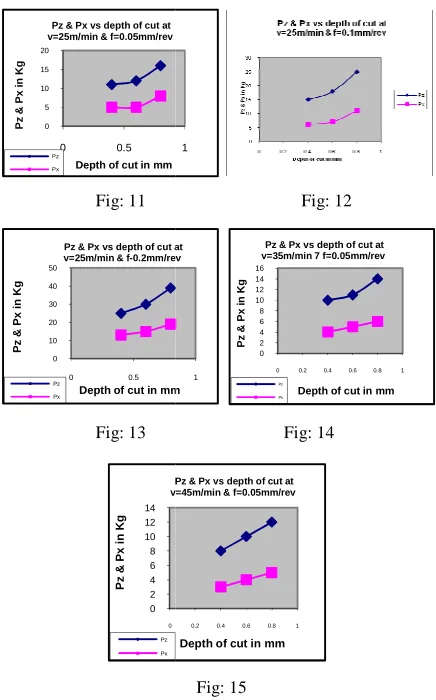
The effect of depth of cut on the cutting and feed force during machining is shown in fig 11
Fig: 11
Fig: 13
The experimental result reveals that cutting and feed force are low at low depth of cut i.e at 0.4mm and comparatively high at high depth of cut i.e at 0.8mm. The greater the feed and depth of cut , larger the cross sectional area of the uncut chip, the vo
deformed metal and consequently the greater is the resistance of the material to chip formation and larger is the force Pz will be in turning operation.
Effect of cutting speed on chip reduction coefficient
0.2 0.4
feed in mm/rev
Pz & Pxvs feed at v=35m/min & t=0.4mm
0.1 0.2 0.3
Feed in mm/rev
Pz & Px vs feed at v=25m/min & t=0.6mm 0 5 10 15 20 0 0.5 P z & P x i n K g
Depth of cut in mm
Pz & Px vs depth of cut at v=25m/min & f=0.05mm/rev
Pz Px 0 10 20 30 40 50 0 0.5 P z & P x i n K g
Depth of cut in mm
Pz & Px vs depth of cut at v=25m/min & f-0.2mm/rev
Pz Px 0 2 4 6 8 10 12 14 0 P z & P x i n K g
Pz & Px vs depth of cut at v=45m/min & f=0.05mm/rev
Pz Px 0 0.5 1 1.5 2 2.5 3 3.5 4
0 10 20
C h ip r e d u c ti o n c o e ff ic ie n ts
Cutting speed in m/min
Cutting speed vs chip reduction coefficient at
10 shows the effect of feed on the cutting and feed forces during orthogonal turning operation of mild steel work piece. The experimental results show that the cutting force and feed force are low at low feed i,e at 0.05mm/rev and comparatively high at high
The effect of depth of cut on the cutting and feed force during machining is shown in fig 11-15.
Fig: 12
Fig: 14
Fig: 15
The experimental result reveals that cutting and feed force are low at low depth of cut i.e at 0.4mm and comparatively high at high depth of cut i.e at 0.8mm. The greater the feed and depth of cut , larger the cross sectional area of the uncut chip, the volume of the deformed metal and consequently the greater is the resistance of the material to chip formation and larger is the force Pz will be in
Effect of cutting speed on chip reduction coefficient
Fig: 16 1
1 Depth of cut in mm
Pz & Px vs depth of cut at 0.2mm/rev 0 2 4 6 8 10 12 14 16
0 0.2 0.4 0.6 0.8 1
P z & P x i n K g
Depth of cut in mm
Pz & Px vs depth of cut at v=35m/min 7 f=0.05mm/rev
Pz Px
0.2 0.4 0.6 0.8 1 Depth of cut in mm
Pz & Px vs depth of cut at v=45m/min & f=0.05mm/rev
30 40 50
Cutting speed in m/min
Cutting speed vs chip reduction coefficient at different feeds
Int. J. Adv. Res. Sci. Technol. Volume 1, Issue1, Oct-2012, pp 30-34.
The chips obtained in the tests had a uniform thickness at high cutting speeds. For low cutting speeds, the chips had a non-uniform cross-sectional area. Chips of this category were sectioned and polished and the variation in their thickness was measured by digital caliper. The average value of chip thickness was noted. The chip reduction coefficient was plotted against cutting speed for different feed as shown in fig16. The chip reduction coefficient was found to decrease with increase in cutting speed as shown in fig16. Experiment results indicate that thinner chips are produced at all higher cutting speeds. Thinner chips indicate that the deformation during the process of chip formation with greater shear angle, the energy consumption being low and decreases the kinetic coefficient of friction. It can therefore concluded that higher cutting speeds produce larger shear angle and a larger cutting ratio or smaller chip reduction coefficient for which the cutting and feed forces are also low.
Analysis of variance for cutting force:
Table: 2. Results of ANOVA for Cutting Force
SV SS DF MS F F(95%) P(%)
v 84.518 2 42.259 35.128 3.15 5
f 1223.2 2 611.59 508.39 3.15 74.4
t 264.3 2 132.15 109.85 3.15 15.9
vf 12.815 4 3.203 2.662 2.53 0.4
vt 16.371 4 4.092 3.401 2.53 0.7
ft 29.037 4 7.259 6.034 2.53 1.4
Error 9.629 8 1.203 2.2
Total 1639.9 26 100
The purpose of the ANOVA is to investigate which of the process parameters significantly affect the performance characteristics. This analysis provides the relative contribution of machining parameters in controlling the response of machining performance criteria i.e cutting force during turning. The significance of a variable on the quality characteristic can be evaluated by using F-ratio. The F-ratio is the ratio of MS to the error. Generally, when F is greater than 3.37, it means that the change of experimental variables has a significant effect on the quality characteristics. The ANOVA table indicates that, with the exception of the vxf and vxt (very small value of F of 2.662 & 3.401) interaction in cutting force, all the cutting parameters and fxt interaction are significant (F calculated value is more than the table value 3.37 & 2.53) at 95% confidence level. Table shows that the feed (P = 74.4%) is the most significant variable affecting cutting force followed by depth of cut (P = 15.9%) and cutting speed (P = 5%). The interaction of feed and depth of cut is the next influencing factor on the cutting force and other interaction of vxf and vxt are neglected being very small value
of percentage of contribution which depicts the least significant effect on cutting force. Since the error refers to unknown or uncontrolled factors, the percent contribution due to error provides an estimate of the adequacy of the experiment. If the percent contribution due to error is 15% or less, then it can be assumed that no important factors have been omitted from the experiment. Percent contribution due to error in ANOVA table is less than 15%, it can be said that no important variables have been omitted from the experiment.
Investigation of optimal parametric combination for achieving minimum cutting force in machining:
Fig-17 Fig-18
Fig-19
To assist in the practical interpretation of this experiment, fig: 17-19 presents plots of the three main effects and the feed-depth of cut interaction. The main effect plots are just graphs of the marginal response averages at the levels of the three factors. It is noticed that all the three variables have positive main effects i.e increasing the variable feed and depth of cut moves average cutting force upwards and downward for increasing cutting speed. It is evident from main effect table 3 & that at low feed (level -1) and low depth of cut (level -1), the average cutting force value is small. But from main effect table 3, it is clear that the average cutting force value decreases as cutting speed increases i.e level +1 of cutting speed, cutting force value is small. The interaction between feed-depth of cut is fairly small, as shown by the similar shape of the two curves in fig 18-19.
It is observed from table that the combination of lowest feed i.e level -1 and the lowest depth of cut at level -1 seem most effective for minimum cutting force. As minimum cutting force is required for low power consumption in machining operation,
it can be concluded from main effects and interaction plot that cutting speed at level +1, feed at level -1 and depth of cut at level -1 gives minimum cutting force in orthogonal turning of mild steel workpiece. Thus the optimal parametric combination for minimum cutting force is as follows:
0 5 10 15 20 25
0 20 40 60
A
v
e
ra
g
e
c
u
tt
in
g
f
o
rc
e
i
n
K
g
Cutting speed in m/min Main effect for cutting speed
Pz
0 5 10 15 20 25 30
0 0.2 0.4
A
v
e
ra
g
e
c
u
tt
in
g
f
o
rc
e
i
n
K
g
Feed in mm/rev Main effect plot for feed
Pz
0 0.2 0.4 0.6 0.8 1 1.2
0 0.5 1 1.5
A
v
e
ra
g
e
c
u
tt
in
g
f
o
rc
e
i
n
K
g
Depth of cut in mm Main effect plot for depth of cut
1. Cutting speed at level +1 i.e 45m/min 2. Feed at level -1 i.e 0.05mm/rev 3. Depth of cut at level -1 i.e 0.4mm
Conclusions: Based on the performance of test results of various sets of experiments performed for analyzing the influence of different machining parameters on the cutting force in the machining of mild steel using HSS cutting tool, Factorial 3k design of experiment (DOE), Analysis of variance (ANOVA), F-test values, the following conclusions can be drawn for effective machining during turning:
1. The experimental results show that the cutting force and feed force are low at high cutting speed i,e at 45m/min and comparatively high at low cutting speed i,e at 25m/min. As cutting speed increases the chips are thinner and shear angle increases thus decreasing chip reduction coefficient and chip strains. That means the plastic deformation of metal takes place with less strain because of greater shear angle, the force and power consumption being low. At higher cutting speeds, BUE formation disappears and chip-tool contact length decreases resulting in the reduction of cutting force and improves the better surface finish of the work piece.
2. The experimental results show that the cutting force and feed force are low at low feed and depth of cut and comparatively high at high feed and high depth of cut. The greater the feed and depth of cut , larger the cross sectional area of the uncut chip, the volume of the deformed metal and consequently the greater is the resistance of the material to chip formation and larger is the force Pz will be in turning operation.
3. It can therefore concluded that higher cutting speeds produce larger shear angle and a larger cutting ratio or smaller chip reduction coefficient for which the cutting and feed forces are also low. 4. It is found that the factorial design of experiment provides a simple, systematic and efficient methodology for the ANOVA and optimization of the cutting parameters.
5. Feed (P = 74.4%) is the most significant variable affecting cutting force followed by depth of cut (P = 15.9%) and cutting speed (P = 5%). The interaction of feed and depth of cut is the next influencing factor on the cutting force and other interaction of vxf and vxt are neglected being very small value of percentage of contribution which depicts the least significant effect on cutting force.
6. Thus the optimal parametric combination for minimum cutting force is as follows: Cutting speed at level +1 i.e 45m/min, Feed at level -1 i.e 0.05mm/rev and depth of cut at level -1 i.e 0.4mm respectively.
References:
1. Saravanan R, Sankar RS, Asokan P, Vijayakumar K, Prabhaharan G
(2005) Optimization of cutting conditions during continuous finished profile machining using non-traditional techniques. Int J Adv Manuf Technol 26:30–40
2. Yang WH, Tarng YS (1998) Design optimization of cutting parameters
for turning operations based on the Taguchi method. J Mater Process Technol 84:122–129
3. Davim JP (2001) A note on the determination of optimal cutting
conditions on the surface finish obtained in turning using design experiments. J Mater Process Technol 116 (2/3):305–308
4. Davim JP (2003) Design of optimisation of cutting parameters for
turning metal matrix composites based on the orthogonal arrays. J Mater Process Technol 132:340–344
5. Dhiman S.Sehgal R.Sharma S.K.Sharma V.S.(2008) Machining
behavior of AISI 1018 steel during Turning journal of scientific and Indristrial Research. Vol-67pp.355-360
6. Cakir MC, Ensarioglu C, Demirayak I (2009) Mathematical modeling
of surface roughness for evaluating the effects of cutting parameters and coating material. J Mater Process Technol 209:102–109
7. Choudhury IA, El-Baradie MA (1997) Surface roughness prediction in
the turning of high-strength steel by factorial design of experiments. J Mater Process Technol 67:55–61
8. Arbizu IP, Pérez CJL (2003) Surface roughness prediction by factorial
design of experiments in turning processes. J Mater Process Technol 143–144:390–396
9. Mahdi M, Zhang L. A finite element model for the orthogonal cutting
of fiberreinforced composite materials. J Mater Process Technol 2001;113:373–7.
10. Zhang LC, Zhang HJ, Wang XM. A force prediction model for cutting
unidirectional fiber-reinforced plastics. Mach Sci Technol
2001;5(3):293–305. Table: 3 Main
effect for cutting speed
v Pz
25 21.22
35 19.11
45 16.88
Table: 4 Main effect for
feed
f Pz
0.05 11.55
0.1 17.77