University of Kentucky University of Kentucky
UKnowledge
UKnowledge
University of Kentucky Doctoral Dissertations Graduate School
2005
COMPETITIVE DYNAMICS IN ELECTRONIC NETWORKS -
COMPETITIVE DYNAMICS IN ELECTRONIC NETWORKS -
ACHIEVING COMPETITIVENESS THROUGH
ACHIEVING COMPETITIVENESS THROUGH
INTERORGANIZATIONAL SYSTEMS
INTERORGANIZATIONAL SYSTEMS
Lei Chi
University of Kentucky
Right click to open a feedback form in a new tab to let us know how this document benefits you. Right click to open a feedback form in a new tab to let us know how this document benefits you.
Recommended Citation Recommended Citation
Chi, Lei, "COMPETITIVE DYNAMICS IN ELECTRONIC NETWORKS - ACHIEVING COMPETITIVENESS THROUGH INTERORGANIZATIONAL SYSTEMS" (2005). University of Kentucky Doctoral Dissertations. 276.
https://uknowledge.uky.edu/gradschool_diss/276
ABSTRACT OF DISSERTATION
Lei Chi
College of Business and Economics
University of Kentucky
COMPETITIVE DYNAMICS IN ELECTRONIC NETWORKS
− ACHIEVING COMPETITIVENESS THROUGH
INTERORGANIZATIONAL SYSTEMS
ABSTRACT OF DISSERTATION
A dissertation submitted in partial fulfillment of the requirements for the degree of Doctor of Philosophy in the
College of Business and Economics at the University of Kentucky
By Lei Chi
Lexington, Kentucky
Director: Dr. Clyde Holsapple, Professor of Decision Science and Information Systems
Lexington, Kentucky
2005
ABSTRACT OF DISSERTATION
COMPETITIVE DYNAMICS IN ELECTRONIC NETWORKS
− ACHIEVING COMPETITIVENESS THROUGH
INTERORGANIZATIONAL SYSTEMS
Many dramatic and potentially powerful uses of information technology involve
interorganizational systems (IOS). These systems, defined as distributed computing systems that
support shared processes between firms, have become fundamental to business operations,
spanning multiple activities in value/supply chains. They have opened avenues to unprecedented
collaborative linkages between firms. As IOS-mediated relational networks are rapidly evolving,
roles of IOS have progressively changed beyond those of efficiency and power functions.
To fully appreciate modern roles of IOS in e-business, this dissertation addresses two key
research questions: (1) How do firms achieve competitiveness through IOS? (2) How do IOS
influence competitive behaviors of the competing firms in intertwined electronic networks? It
does so by integrating three research streams – social network analysis, interorganizational
systems, and competitive dynamics – into a model of competitive dynamics in electronic
networks. This study focuses on the paired relationships between the three constructs of network
structure, IOS use, and competitive action, and empirically investigates nine general hypotheses.
Data collection focuses on second-hand data in the automotive industry. A total of 805
involving nine major automakers are collected. Data sources include databases, major trade
publications, Web sites, and industry indices. Data analysis includes network analysis, ANOVA
test, and correlation.
Empirical results support the general contention that network structure and IOS use
co-evolve and influence competitive action. Building on these results, a framework characterizing
IOS’s roles in achieving firm competitiveness is concluded and advanced.
This dissertation broadens our view of IOS’s roles in e-business. It contributes to IS/IOS
theory, methodology, and practice. First, this study examines IOS-mediated networks in
multiple levels, including firm-level, pair-level, and network-level. It provides new theoretical
conceptualizations of IOS’s roles. Second, this study advances a new IT value measure
addressing limitations of the traditional measures. Third, it introduces a novel, useful
methodology for data collection. Fourth, results from this study can guide a firm’s e-business
initiatives for using IOS as powerful tools for achieving firm competitiveness.
KEYWORDS: Interorganizational Systems (IOS), Electronic Networks, Network Structure, IOS Use, Competitive Action
Lei Chi
COMPETITVE DYNAMICS IN ELECTRONIC NETWORKS – ACHIEVING COMPETITIVENESS THROUGH
INTERORGANIZATIONAL SYSTEMS
By
Lei Chi
Clyde Holsapple Director of Dissertation
Merl Hackbart
Director of Graduate Studies
RULES FOR THE USE OF DISSERTATIONS
Unpublished dissertations submitted for the Doctor’s degree and deposited in the University of Kentucky Library are as a rule open for inspection, but are to be used only with due regard to the rights of the authors. Bibliographical references may be noted, but quotations or summaries of parts may be published only with the permission of the author, and with the usual scholarly acknowledgements.
Extensive copying or publication of the dissertation in whole or in part also requires the consent of the Dean of the Graduate School of the University of Kentucky.
A library that borrows this dissertation for use by its patrons is expected to secure the signature of each user.
DISSERTATION
Lei Chi
College of Business and Economics
University of Kentucky
COMPETITIVE DYNAMICS IN ELECTRONIC NETWORKS
− ACHIEVING COMPETITIVENESS THROUGH
INTERORGANIZATIONAL SYSTEMS
DISSERTATION
A dissertation submitted in partial fulfillment of the requirements for the degree of Doctor of Philosophy in the
College of Business and Economics at the University of Kentucky
By Lei Chi
Lexington, Kentucky
Director: Dr. Clyde Holsapple, Professor of Decision Science and Information Systems
Lexington, Kentucky
2005
ACKNOWLEDGEMENTS
Many people helped me develop and carry out this research. At the University of
Kentucky, the members of my dissertation committee deserve special mention as friends and
mentors. Dr. Clyde Holsapple, my advisor, generously gave me hours of his time and pressed
me on issues of theory, method, data, and interpretation. His patient guidance and continuous
encouragement fostered many sparkles of new ideas and further turned them into interesting
frameworks. His care, effort, and support for this study guided me through difficult times in
doing this dissertation and made my journey such a joy and pleasure.
Dr. Wally Ferrier is an established researcher in competitive dynamics stream. He
pushed me to develop fully the concept and model of competitive dynamics in the context of
electronic networks. Wally patiently directed me to useful competitive dynamics literature, and
offered many insightful suggestions on developing the variable construct of competitive action.
He shared with me his critical thinking, knowledge and research ideas of competitive action.
Dr. Cid Srinivasan, a statistics professor at the University of Kentucky, helped me
develop variable measures and analyze data. In many of our discussions, he generated fresh
ideas at supercomputer speeds and stirred the free thinking spirit into me.
Dr. Chen Chung is an inspiring mentor. His always positive attitude about research
motivated me to forge ahead throughout these years of doing my dissertation.
Dr. Albert Lederer was rigorous about my research methodology. He was very
responsive to every question I posed. His critical comments helped improve this study.
Dr. Anita Lee-Post is a good mentor and is also like a friend. Her feedback was critical
but constructive and helpful to this study.
Persons outside my dissertation committee made this dissertation possible.
My parents, Shuyi and Peifang, were always there for me through thick and thin and
never lost faith in me.
My twin sister, Ping, qualifies for special thanks. During many of our heated debates, her
critical comments and constructive suggestions stimulated many interesting thoughts that helped
improve my research model. Her effort and support for me and for this study motivated me
Finally, I owe many thanks to my good friend, Peng Yuan, Ford engineer, Wei Hong,
Nissan engineer, Xiaoqing Xie, Toyota project general manager, Richard Alloo, and Toyota
TABLE OF CONTENTS
Acknowledgements... iii
List of Tables ... viii
List of Figures ... ix
Chapter 1 Introduction ... 1
1.1 Research Questions of This Dissertation ... 2
1.2 Research Methodology of This Dissertation... 3
1.3 Research Results of This Dissertation ... 3
1.4 Research Contributions of This Dissertation ... 4
1.5 Organization of This Dissertation... 6
Chapter 2 Interorganizational Systems: A Definition and A Classification ... 7
2.1 An IOS Definition... 7
2.2 A Collaboration-Oriented IOS Classification... 7
2.2.1 Types of Interdependencies and IOS Classes ... 9
2.2.2 IOS Candidate Technologies ... 13
Chapter 3 Prior IOS Research: IOS’s Roles in Achieving Firm Competitiveness ... 18
3.1 Four Research Perspectives on the Roles of IOS... 18
3.1.1 The Techno-Economic Perspective ... 20
3.1.2 The Socio-Political Perspective ... 20
3.1.3 The Trust Perspective ... 20
3.1.4 The Learning Perspective ... 21
3.2 Limitations of Prior IOS Research... 22
3.2.1 From A Static View to A Dynamic View... 24
3.2.2 From A Dyadic View to A Network View ... 24
3.2.3 From A Sporadic View to A Systematic View ... 25
3.3 Research Questions... 25
Chapter 4 Research Model: Competitive Dynamics in Electronic Networks... 27
4.1 Research Background ... 27
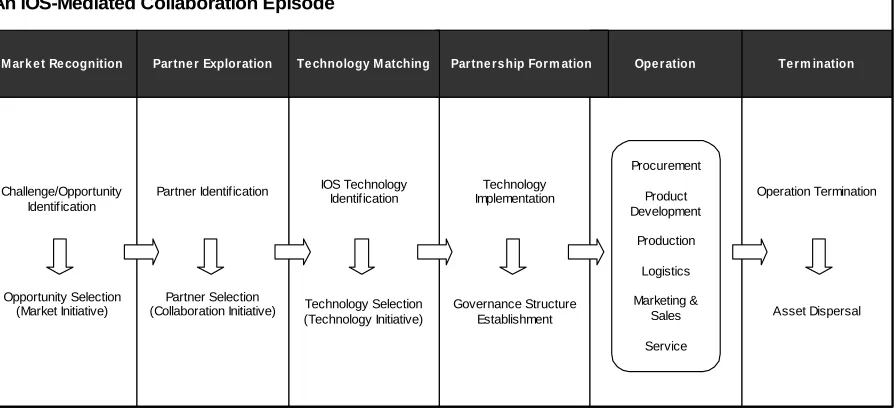
4.1.1 An IOS-Mediated Collaboration Episode... 27
4.1.2 Electronic Networks as Loci of Resources ... 28
4.1.3 Structural Embeddedness of Competitive Actions in Electronic Networks ... 30
4.1.4 Boundaries of the Research Model ... 31
4.2 Research Model and Hypotheses ... 31
4.2.1 Variable Constructs... 31
4.2.2 Hypotheses... 35
Chapter 5 Data Collection Methodology ... 43
5.1 Data Collection ... 43
5.2 Data ... 46
5.2.1 Collaborative Relationship Data ... 46
5.2.2 IOS Use Data ... 51
5.2.3 Competitive Action Data ... 51
5.3 Data Reliability ... 53
Chapter 6 Variable Operationalization and Measures ... 55
6.1 Variable Measures ... 55
6.1.1 Similarity Measure... 55
6.1.2 Diversity Measure... 56
6.2 Variable Operationalization ... 59
6.2.1 Network Structure... 59
6.2.2 IOS Use... 63
6.2.3 Competitive Action... 69
Chapter 7 Data Analysis Methods and Results... 78
7.1 Data Analysis Methodology ... 78
7.2 Data Analysis Results ... 80
Chapter 8 Data Analysis Results: An Overview... 86
8.1 The Automotive Industry: Evolving Electronic Networks as Loci of Resources... 86
8.2 Hypothesis Testing Results... 88
Chapter 9 The Relationship between Network Structure and IOS Use ... 90
9.1 Hypothesis Testing Results... 90
9.2 Discussions ... 93
9.3 Implications... 96
Chapter 10 The Relationship between Network Structure and Competitive Action ... 97
10.1 Hypothesis Testing Results... 97
10.2 Discussions ... 100
10.3 Implications... 103
Chapter 11 The Relationship between IOS Use and Competitive Action ... 104
11.1 Hypothesis Testing Results... 104
11.2 Discussions ... 107
Chapter 12 Conclusion... 118
12.1 A Framework of IOS’s Roles in Achieving Firm Competitiveness ... 118
12.2 A Roadmap for Identifying IOS Opportunities ... 120
12.3 Contributions... 123
12.3.1 Contribution to Theory ... 123
12.3.2 Contribution to Methodology ... 127
12.3.3 Contribution to Practice ... 128
12.4 Limitations ... 128
12.5 Future Research Directions... 130
References... 133
LIST OF TABLES
Table 2.1 Examples of IOS candidate technologies and applications ... 8
Table 2.2 Three-part IOS typology... 10
Table 2.3 Pooled knowledge resources IOS candidate technologies... 14
Table 2.4 Value/supply-chain IOS candidate technologies... 16
Table 2.5 Networked IOS candidate technologies ... 17
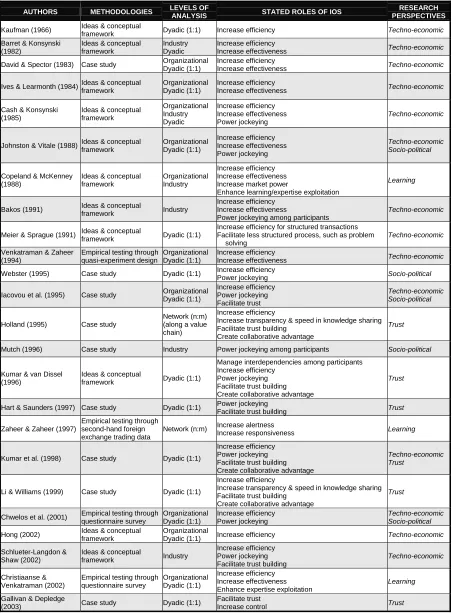
Table 3.1 A Summary of IOS literature: methodologies, levels of analysis, stated roles of IOS, and research perspectives... 23
Table 5.1 Data sources used in this study ... 45
Table 5.2 A coding example of collaborative relationship ... 46
Table 5.3 Action category... 52
Table 5.4 Action coding of the nine automakers in 2003 ... 53
Table 6.1 Structural similarity between the nine automakers in 2003... 60
Table 6.2 Degree centrality of the nine automakers in 2001-2003... 60
Table 6.3 Normalized betweenness centrality of the nine automakers in 2001-2003 ... 62
Table 6.4 A coding example of IOS reach... 63
Table 6.5 IOS reach of the nine automakers in 2002-2003 ... 63
Table 6.6 A coding example of IOS range ... 65
Table 6.7 IOS range of the nine automakers in 2002-2003 ... 66
Table 6.8 A coding example of diversity of IOS use... 66
Table 6.9 Diversity of IOS use at the nine automakers in 2003 ... 67
Table 6.10 Diversity differences of IOS use between the nine automakers in 2003 ... 69
Table 6.11 Action pattern similarity between the nine automakers in 2003 ... 70
Table 6.12 Action volume of the nine automakers in 2003... 71
Table 6.13 Complexity of action repertoire for the nine automakers in 2003... 72
Table 6.14 Differences of action complexity between the nine automakers in 2003 ... 73
Table 6.15 Partial monthly actions initiated at the nine automakers in 2003 ... 76
Table 6.16 Action heterogeneity of the nine automakers in 2003 ... 76
Table 6.17 A summary of the variable constructs and their measures ... 77
Table 7.1 Data descriptions... 80
Table 7.2 Correlations for H1 and H4: Pearson correlation ... 81
Table 7.3 Correlations for H1 and H4: non-parametric correlations ... 82
Table 7.4 Correlations for H2-H3, H5-H9: Pearson correlation... 83
Table 7.5 Correlations for H2-H3, H5-H9: Kendall's tau_b non-parametric correlation... 84
Table 7.6 Correlations for H2-H3, H5-H9: Spearman’s R non-parametric correlation... 85
Table 8.1 Collaboration between the nine automakers in 1985-2003 ... 87
Table 8.2 Hypothesis testing results: an overview... 89
Table 9.1 Hypothesis testing results regarding the relationship between network structure and IOS use... 91
Table 10.1 Hypothesis testing results regarding the relationship between network structure and action pattern... 98
Table 10.2 ANOVA Tukey's studentized range test for network structure ... 99
Table 10.3 ANOVA Tukey's studentized range test for competitive action... 99
Table 11.1 Hypothesis testing results regarding the relationship between IOS use and competitive action... 105
LIST OF FIGURES
Figure 2.1 Wal-Mart’s wireless supply chain system for order tracking and replenishment ... 12
Figure 3.1 Prior research regarding IOS’s roles in achieving firm competitiveness ... 19
Figure 3.2 The approach of this dissertation to address the research questions ... 26
Figure 4.1 An IOS-mediated collaboration episode ... 27
Figure 4.2 IOS as common infrastructure between firms ... 28
Figure 4.3 IOS reach, IOS range, and diversity of IOS use... 33
Figure 4.4 The links between network structure, IOS use, and competitive action ... 35
Figure 4.5 A model of competitive dynamics in electronic networks ... 42
Figure 5.1 Automakers’ network structures... 50
Figure 6.1 A network with p ’s falling on the shortest path between k p and i p ... 61 j Figure 6.2 A comparison of automakers’ action patterns in 2003... 71
Figure 6.3 A comparison of automakers’ action complexity in 2003... 74
Figure 9.1 IOS-induced structural changes in the automotive network... 93
Figure 12.1 A framework of IOS’s roles in achieving firm competitiveness... 119
Figure 12.2 A roadmap for identifying IOS opportunities ... 121
Figure 12.3 Contributions to the D&M IS success model ... 125
Figure 12.4 A semantic difference between network structures of Ford and Toyota... 130
Chapter 1
Introduction
In a 1966 HBR article, Felix Kaufman implored general managers to explore the
possibilities of “extra-corporate” systems for linking buyers and sellers or firms performing
similar functions. Today, nearly forty years after Kaufman’s visionary argument about computer
networking, information systems that transcend firm boundaries have highlighted the most
dramatic uses of information technology. These interorganizational systems have become
fundamental to business operations through their span of multiple activities in the value/supply
chain. They can produce far-reaching impacts on firm performance (Cash and Konsynski 1984;
Christiaanse and Venkatraman 2002), interfirm relations (Clemons and Row 1993; Konsynski
1993), and the structure of entire industries (Bakos 1991; Konsynski 1993).
Defined as distributed computing systems that support processes shared by two or more
firms, interorganizational systems (IOS) involve technologies such as the Internet, extranet,
electronic data interchange (EDI), customer relationship management (CRM), supply chain
management systems (SCM), and B2B exchanges. By providing a common infrastructure for
managing interdependencies between firms, IOS have opened avenues to collaboration on a wide
range of dimensions. They have enabled a new set of organizational design variables beyond the
conventional set, such as shared repositories, real-time integration of business processes,
electronic communities that foster learning and allow multiple relationships to occur
simultaneously, and virtual organizations that enable rapid assembly of external resources and
capabilities (Strader et al. 1998). IOS have also opened avenues to collaborative linkages among
competing firms, leading to a growing “co-opitition” (i.e., concurrent collaboration and
competition) in e-business.
Estimates suggest that in 2001, over 30,000 IOS were in use (Surbramani 2004), and
about one third of North American companies used extranets, Internet-based EDI and private
exchanges (Computerworld December 17, 2001). Today, B2B exchanges have proliferated for
almost every industry around the world. To name a few, these include e-Wood for lumber and
building materials exchange, Scana Online for online gas and electricity auctions, ChemConnect
for chemical exchange, and Orbitz for air travel exchange. Many large companies like Cisco, the
Big-Three automakers, and Dell have launched their e-business initiatives for improving
among its extended supply chain (including Tier 1 and Tier 2 suppliers). The Big-Three
automakers have joined forces on two fronts to fully reap the benefits of economies of scale and
scope afforded by IOS: one in establishing a B2B automotive procurement portal for linking the
three automakers, other automakers and their suppliers; the other in establishing a B2B repair
parts portal for linking the three automakers, other automakers, dealers, auto body shops,
insurance companies, as well as retailers. Dell has leveraged the Internet to extend its reach to
diverse customers and suppliers to enable agile moves in build-to-order, new product
introduction, competitive pricing, and marketing & sales.
1.1 Research Questions of This Dissertation
Traditionally, IOS’s roles have been oriented toward improving efficiency (Kaufman
1966; Barret and Konsysnski 1982; Cash and Konsyski 1985; Johnston and Vitale 1988;
Venkatraman and Zaheer 1994; Iacovou et al. 1995), or reinforcing power and control (Johnston
and Vitale 1988; Webster 1995; Mutch 1996; Chwelos et al. 2001). In recent years, rapid
technology advancement, especially the advent and explosive growth of e-business systems, has
enabled many IOS innovations. As more and more IOS links have been established, networks of
electronically interconnected relations are rapidly spanning across an increasing number of firms.
These electronic networks have become the loci of resources and have progressively changed the
roles of IOS beyond those of efficiency and power functions.
Key questions for fully appreciating modern roles of IOS are “How do firms achieve
competitiveness through IOS?” and “How do IOS influence competitive behaviors of the
competing firms in intertwined electronic networks?” Answers to these questions have
important implications. For researchers, they broaden and deepen the understanding of the
changing roles of IOS in e-business, highlighting new considerations to take into account in the
design of research studies. For practitioners, the answers can provide insights to guide a firm’s
e-business initiatives at improving firm performance via IOS.
When examining IOS’s roles in electronic networks, there is a pressing need to move
toward a dynamic, network, and systematic view of using IOS. Yet limited research has been
done in this regard (Straub et al. 2004). Prior IOS studies have largely focused on (a) a relatively
static view of using IOS (e.g., achieving efficiency through deploying the tangible assets of IOS),
jockeying or trust building), and (c) a sporadic view (based on case studies, anecdotes, or
personal experiences of IOS use).
In the interest of an expanded view of IOS usage, this dissertation introduces the use of
social network analysis and competitive dynamics research into the study of IOS. It examines
competitive dynamics in the context of electronic networks, referring to the dynamic market
process whereby firms act and react to achieve competitiveness via the use of IOS. Applying
social network analysis, electronic networks are viewed as IOS-mediated relational networks,
where participating firms may have direct and indirect partnerships. This dissertation
particularly focuses on the three paired relationships existing between the three concepts of
network structure, IOS use, and competitive behavior. It is contended that IOS use and network
structure co-evolve and influence firm performance (Chen and Hambrick 1995; Chen 1996).
1.2 Research Methodology of This Dissertation
Data collection focuses on the automotive industry and involves second-hand data about
nine major automakers. A total of 805 collaborative relationships, 106 IOS technologies and
applications, and 305 competitive actions are collected. Data sources include SDC database,
COMPUSTAT, F&S Predicast’s Index, thousands of articles from 19 major trade publications,
as well as miscellaneous Web sites. Data analysis includes network analysis, ANOVA test,
Pearson’s correlation, and non-parametric correlations.
1.3 Research Results of This Dissertation
Empirical results suggest important roles of IOS in influencing firm behavior and
network structure that have not been heretofore established. Building on the empirical results
from this study, a framework characterizing IOS’s roles in achieving firm competitiveness is
concluded. This framework is one of the two major frameworks developed in this dissertation.
It is advanced with an orientation to IS discipline. The other framework, which appears in
Chapter 4, is the research model investigated in this dissertation. The research model has an
orientation to a general audience. It is intended to be generalized to and used in other disciplines
1.4 Research Contributions of This Dissertation
This study empirically investigates the competitive dynamics in an automotive network
of electronically interconnected firms. This empirical investigation has broadened our view of
how IOS can be used to achieve firm competitiveness in e-business. It contributes to IS theory,
methodology, and practice.
Contribution to Theory
First, by introducing a social network perspective, this study examines IOS-intensive
networks in multiple levels, including firm-level, pair-level, and network-level. It contributes to
IS research by providing new theoretical conceptualizations of IOS’s roles.
Second, this study empirically validates and theoretically enriches the D&M IS Success
Model (DeLone and McLean 1992; 2003). The D&M IS Success Model, since proposed in
1992, has been widely used as a framework for conceptualizing and operationalizing information
system success or effectiveness. In the D&M IS Success Model, the use of information systems
is postulated as pivotal to IS success or effectiveness (DeLone and McLean 1992; 2003). Yet,
too frequently, simple usage variables (e.g., frequency of system use) are used in prior studies. It
is strongly desirable to recognize the multidimensionality of system usage so as to capture the
richness of this complex construct (DeLone and McLean 2003).
This study empirically investigates the uses of IOS and their impacts on firm
performance in e-business. The empirical results suggest strong associations between IOS use,
firm behavior, and network structure. These results further validate the D&M IS Success Model
by confirming that system use is a key variable in understanding IS success or effectiveness. In
addition, this study introduces three new measures to describe system use. These are IOS reach,
range, and diversity of use. These measures enrich the D&M IS Success Model by recognizing
multiple dimensions of system use.
Third, this study, by recognizing competitive actions as externally-oriented, specific
moves that are first observed after undertaking a firm’s IT initiatives in achieving
competitiveness, provides the promise of developing an IT value measure that supplements the
traditional measures by addressing the limitations of those measures.
Traditional IT value measures, such as IT productivity, IT profits, and consumer surplus,
provide a limited view of IT investment returns. Because these measures are aggregate-level
gains from an IT investment sometimes may be transformed into such soft gains as agility,
innovation, or market influence rather than less soft gains like profits, productivity, or consumer
surplus. So, using IT productivity, IT profits, and consumer surplus may not be able to capture a
complete view of IT value.
On the other hand, as firms increasingly digitize their business processes and rely on
IT-mediated interfirm relationships to develop and deploy capabilities, firm behavior becomes
increasingly inseparable from IT, either IT-induced or IT-enabled (Subramani 2004). Gains (soft
or hard) from an IT investment, more or less, can be transformed into and first observed as one
action or a series of patterned actions. In this regard, competitive action provides a different
view of IT investment returns that may not be captured by the traditional measures.
Furthermore, competitive action can be observed within any length of time windows. The length
of time windows can be taken as short as a month or half a year, and as long as five-year or
more. Thus, competitive action greatly increases the flexibility (in terms of time scale) of
measuring IT value.
As such, competitive action provides the promise of serving as an IT value measure.
Competitive action supplements IT productivity, IT profits, and consumer surplus, allowing for a
more complete view of IT value.
Contribution to Methodology
This study represents a first attempt in collecting actual, voluntary IOS use data from
second-hand data sources like news reports and trade articles. Prior IOS empirical research
largely collects self-reported data. Self-reported data are limited in that (1) they may induce
biases due to having the same respondents answer questions on their perceptions of system use
and effectiveness, known as common method variance (Devaraj and Kohli 2003); (2) some
studies have suggested that perceived system usage may not be congruent with actual usage
(Straub et al. 1995), and thus might not be an appropriate surrogate for actual usage (Szajna
1996); (3) second-hand data sources (like news reports and trade articles) allow data to be
collected in a relatively controlled manner, especially when collecting longitudinal data or
sensitive data (like collaborative relationships, competitive actions, and significant system
implementation and usage), which are generally difficult to obtain in a self-reported manner.
Therefore, second-hand data collection about actual, voluntary IOS use may represent a
Contribution to Practice
The framework of IOS use suggests to IOS users possible ways to disrupt the equilibrium
in the product-market space – by launching competitive moves through aggressive pursuit of
new opportunities for IOS innovation, exploration, and exploitation.
Building on the framework of IOS use, this dissertation also develops a roadmap for
identifying IOS opportunities. This roadmap can guide a firm’s systematic search for
opportunities of using IOS as powerful tools for achieving firm competitiveness.
Finally, the exploration of possibilities for using competitive action as an IT value
measure suggests an alternative direction for IOS users to pursue in evaluating their
organizations’ IOS use.
1.5 Organization of This Dissertation
This dissertation is organized as follows: Chapter 2 introduces the concept of IOS and
develops a collaboration-oriented IOS classification, which is important in developing measures
for testing hypotheses at later stage; Chapter 3 reviews prior studies on IOS, summarizes major
perspectives on IOS’s roles and their limitations, and poses research questions of this
dissertation; Chapter 4 introduces the research model and hypotheses; Chapter 5 discusses data
collection methodology; Chapter 6 operationalizes variable constructs and their measures;
Chapter 7 describes data analysis methods and presents results of these analyses; Chapters 8-11
discuss data results; Chapter 12 recommends a framework of IOS use and a roadmap for
identifying IOS opportunities, and concludes with research contributions, limitations, and future
research directions.
Chapter 2
Interorganizational Systems: A Definition and A
Classification
This chapter describes concepts of interorganizational systems (IOS). Based on Kumar
and van Dissel’s IOS typology, it develops a collaboration-oriented IOS classification. This IOS
classification is useful in identifying IOS candidate technologies and developing IOS use
measures for hypothesis testing in the subsequent study.
2.1 An IOS Definition
In 1966, Kaufman implored general managers to explore the possibilities of
extra-corporate systems for linking buyers and sellers or firms performing similar functions. Kaufman
convincingly argued that these extra-corporate systems could greatly enhance operational
efficiency and cooperation between firms. In 1982, Barrett and Konsynski described such
systems as “interorganizational information sharing systems.” In 1985, Cash and Konsynski
used the term “interorganizational systems” (IOS) and defined them as automated information
systems shared by firms.
IOS in this study are defined as distributed computing systems that support business
processes shared between firms. In a broad sense, any digital technology that allows an interfirm
application can be regarded as an IOS candidate technology, such as an EDI system and an
extranet. Some well-known examples of IOS technologies and applications are American
Airlines’ SABRE reservation system, the CFAR system between Wal-Mart and
Warner-Lambert, and Cisco’s eHub.
2.2 A Collaboration-Oriented IOS Classification
Kumar and van Dissel (1996) develop an IOS framework based on Thompson’s (1967)
typology of interorganizational interdependencies. By illustrating IOS’s roles in managing
interdependencies and enhancing trust for sustained collaboration between firms, Kumar and van
Dissel’s framework provides a good basis for a collaboration-oriented IOS classification. Based
on Kumar and van Dissel’s framework, this study further identifies and expands the list of IOS
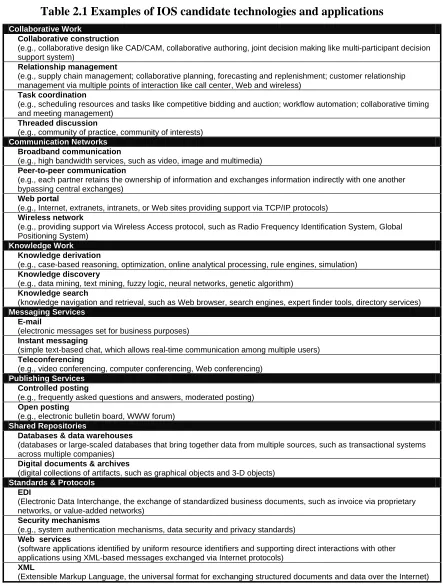
candidate technologies, as presented in Table 2.1. This extended IOS classification is important
Table 2.1 Examples of IOS candidate technologies and applications
Collaborative Work
Collaborative construction
(e.g., collaborative design like CAD/CAM, collaborative authoring, joint decision making like multi-participant decision support system)
Relationship management
(e.g., supply chain management; collaborative planning, forecasting and replenishment; customer relationship management via multiple points of interaction like call center, Web and wireless)
Task coordination
(e.g., scheduling resources and tasks like competitive bidding and auction; workflow automation; collaborative timing and meeting management)
Threaded discussion
(e.g., community of practice, community of interests)
Communication Networks
Broadband communication
(e.g., high bandwidth services, such as video, image and multimedia)
Peer-to-peer communication
(e.g., each partner retains the ownership of information and exchanges information indirectly with one another bypassing central exchanges)
Web portal
(e.g., Internet, extranets, intranets, or Web sites providing support via TCP/IP protocols)
Wireless network
(e.g., providing support via Wireless Access protocol, such as Radio Frequency Identification System, Global Positioning System)
Knowledge Work
Knowledge derivation
(e.g., case-based reasoning, optimization, online analytical processing, rule engines, simulation)
Knowledge discovery
(e.g., data mining, text mining, fuzzy logic, neural networks, genetic algorithm)
Knowledge search
(knowledge navigation and retrieval, such as Web browser, search engines, expert finder tools, directory services)
Messaging Services
(electronic messages set for business purposes)
Instant messaging
(simple text-based chat, which allows real-time communication among multiple users)
Teleconferencing
(e.g., video conferencing, computer conferencing, Web conferencing)
Publishing Services
Controlled posting
(e.g., frequently asked questions and answers, moderated posting)
Open posting
(e.g., electronic bulletin board, WWW forum)
Shared Repositories
Databases & data warehouses
(databases or large-scaled databases that bring together data from multiple sources, such as transactional systems across multiple companies)
Digital documents & archives
(digital collections of artifacts, such as graphical objects and 3-D objects)
Standards & Protocols
EDI
(Electronic Data Interchange, the exchange of standardized business documents, such as invoice via proprietary networks, or value-added networks)
Security mechanisms
(e.g., system authentication mechanisms, data security and privacy standards)
Web services
(software applications identified by uniform resource identifiers and supporting direct interactions with other applications using XML-based messages exchanged via Internet protocols)
XML
2.2.1 Types of Interdependencies and IOS Classes
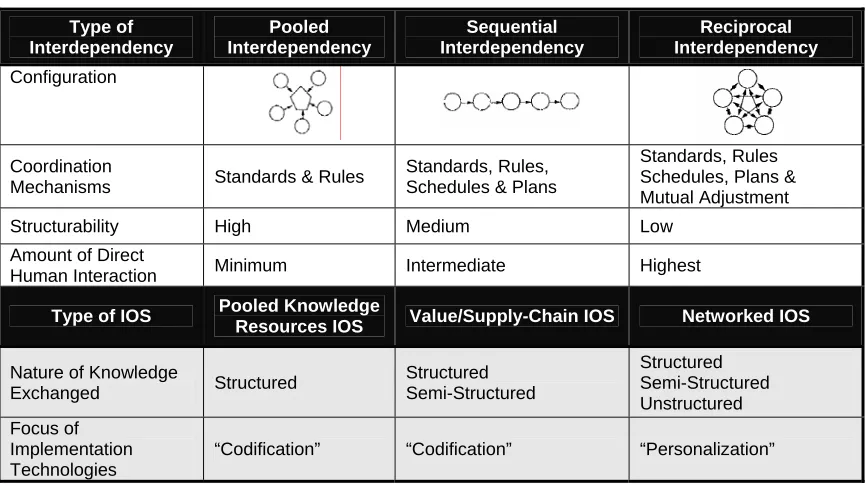
According to Thompson (1967, pp. 54-55), firms can be interrelated in three different
ways: pooled interdependency, sequential interdependency, and reciprocal interdependency. In
pooled interdependency, firms share and use common resources; “each renders a discrete
contribution to the whole and each is supported by the whole” (e.g., the use of a common data
processing center by a number of firms). Sequential interdependency refers to the situation
where companies are linked in a chain with direct directional and well-defined relations, where
the outputs from one firm become inputs to another (e.g., the customer-supplier relationship
along a supply chain). Reciprocal interdependency describes a relationship where each firm’s
outputs become inputs to the others (e.g., a concurrent engineering team consisting of customers,
suppliers, distribution centers, dealers, shippers, and forwarders).
Pooled interdependency involves minimal direct interaction among the units, and
coordination by standardization is appropriate. Sequential interdependency involves an
increasing degree of contingency because each position in the chain must be readjusted if an
upstream position fails to fulfill its expectation, and coordination by plan is appropriate.
Reciprocal interdependency involves the highest degree of interaction because actions of each
position in the set must be adjusted to the actions of many interacting positions, and coordination
by mutual adjustment is needed (Thompson 1967).
In correspondence with pooled interdependency, sequential interdependency, and
reciprocal interdependency, Kumar and van Dissel (1996) suggest a three-part typology for IOS:
pooled information resources IOS, value/supply-chain IOS, and networked IOS. They regard
IOS as technologies designed and implemented to operationalize the interfirm relationships.
They assume that the structure of the relationship influences the degree to which the relationship
can be programmed and embedded in the IOS. Adopting Kumar and van Dissel’s three-part
typology for IOS, this study further extends the notion of pooled information resources IOS to
pooled knowledge resources IOS to allow for an unstructured dimension of knowledge to be
Table 2.2 Three-part IOS typology
Type of Interdependency
Pooled Interdependency
Sequential Interdependency
Reciprocal Interdependency
Configuration
Coordination
Mechanisms Standards & Rules
Standards, Rules, Schedules & Plans
Standards, Rules Schedules, Plans & Mutual Adjustment
Structurability High Medium Low
Amount of Direct
Human Interaction Minimum Intermediate Highest
Type of IOS Pooled Knowledge
Resources IOS Value/Supply-Chain IOS Networked IOS
Nature of Knowledge
Exchanged Structured
Structured Semi-Structured
Structured Semi-Structured Unstructured Focus of
Implementation Technologies
“Codification” “Codification” “Personalization”
(Adapted from Kumar and van Dissel 1996; grey-shaded areas indicate extensions)
Pooled Knowledge Resources IOS
Pooled knowledge resources IOS involve interorganizational sharing of a technological
system, such as common repositories (e.g., databases, digital archives), common
communications networks (e.g., the Internet, extranet, broadband networks), common
communications protocols and standards (e.g., EDI, XML), and electronic markets which may
include some combinations of common repositories and common communications infrastructure.
In pooled knowledge resources IOS, the coordination structure in terms of the level of
roles, obligations, rights, procedures, knowledge flows, as well as analysis and computational
methods used, can be clearly specified and standardized (Kumar and van Dissel 1996). The
knowledge exchanged tends to be highly structured, such as product descriptions, customer
characterizations, and transaction status. As such, interfaces between firms can be mostly
designed as protocols, rules, and standards built in shared software, tools, and systems.
For instance, the Amico Library (www.amico.org) is an Internet-based archive with
digital copies of more than 100,000 paintings, sculptures, and photographs initiated and shared
by 39 museums from the Metropolitan Museum of Art to smaller institutions like the Newark
initiative to create a shared cosmic data warehouse using an Internet-based registry for
nationwide collaboration in astronomy (New York Times May 20, 2003).
Another example of pooled knowledge resources IOS is Cisco’s eHub. eHub is a private
electronic marketplace for parts procurement between Cisco and its suppliers. eHub involves an
extranet infrastructure that uses XML standards, and a central repository that pools together
supply chain information for planning and executing tasks (Grosvenor and Austin 2001).
Value/Supply-Chain IOS
Value/supply-chain IOS support structured and semi-structured customer-supplier
relationships, which are likely to be implemented through automation. Value/supply-chain IOS
institutionalize sequential interdependency between firms along the value/supply chain.
In value/supply-chain IOS, roles and mutual expectations between adjacent parties in a
value/supply chain can be structured. Structured interactions could range from tracking
EDI-based orders, to examining databases of adjacent partners in the chain for sales forecasting, to
transferring CAD-based specifications from customers to suppliers (Kumar and van Dissel
1996). The knowledge shared can range from structured data, such as ordering and customer
data, sales data, and production and inventory data, to semi-structured representations, such as
market research, category management, and cost-related descriptions (Simatupang and Sridharan
2001). As such, interfaces between participants in value/supply-chain IOS, like those in pooled
knowledge resources IOS, also can be designed as protocols, rules, and standards embedded in
the software, tools, and systems (e.g., automated workflow systems).
In recent years, rapid development in the Internet technology and wireless technology
have enabled many innovative value/supply-chain IOS. For example, in 1995, Wal-Mart and
Warner-Lambert (now part of Pfizer) initiated an Internet-based EDI, the CFAR (collaborative
forecasting and replenishment system) for joint forecasting (such as expected alterations of store
layout) and replenishing pharmaceuticals and healthcare products (Computerworld September
23, 1996).
Wal-Mart is also testing a wireless supply chain system with its suppliers, including
Pepsi, Bounty, and Gillette. Wal-Mart uses RFID (Radio Frequency Identification) to track
shipments of Pepsi soft drinks, Bounty paper towels, and Gillette razors, from manufacturer to
warehouse to store to checkout counter. This process is illustrated in Figure 2.1. Information
transaction database. Then suppliers can get a real-time view of what is happening at the store
shelf level (Shankar and O’Driscoll 2003).
Figure 2.1 Wal-Mart’s wireless supply chain system for order tracking and replenishment
(adapted from Shankar and O’Driscoll 2003)
Networked IOS
Networked IOS operationalize and implement reciprocal interdependencies between
firms. Networked IOS provide a shared virtual space where people collaborate for emerging
relationships and learning (Nonaka and Konno 1998). They focus on supporting informal
exchange of semi-structured or unstructured knowledge, which sometimes cannot be described
as a business process, such as posting a question on the electronic bulletin board, asking an
expert for a solution, or directly contacting customer to elicit needs or problems.
With networked IOS, the form, direction, and content of the relationships among
participants are much less structured than with the other two types of IOS (Kumar and van Dissel
1996). Reciprocal relationships can be viewed as consisting of exchange processes and
adaptation processes. Exchange processes represent “the operational, day-to-day exchanges of
an economic, technical, social, or informational nature occurring between firms;” “adaptation
involves the processes whereby firms adjust and maintain their relationships by modifying
routines and mutual expectations” (Kumar et al. 1998 pp. 215). A networked IOS thus involves
an increasing degree of human interaction and requires mechanisms (such as trust) to identify,
of the knowledge exchanged can range from structured (such as product data), to semi-structured
(such as reports about industry trends), to highly unstructured (such as expertise,
problem-solving skills, and new product ideas or conceptualization). As such, many parts of
interorganizational interfaces in networked IOS, unlike those in the other two types of IOS,
cannot be designed as built-in protocols, rules, and standards. Instead, human processors
positioned at organizational boundaries tend to interface with each other, with the aid of IOS.
ComputerLink is an example of the networked IOS. ComputerLink is a community
health information network built in Cleveland for Alzheimer’s caregivers. ComputerLink
involves using the Internet, an electronic bulletin board, a decision support system, as well as
e-mail and electronic encyclopedia facilities to provide clinical and financial services, and deliver
just-in-time knowledge among patients, physicians, hospitals, clinics, and home health agencies.
The e-mail facility allows individual users to communicate anonymously with a nurse-moderator
and other Alzheimer’s caregivers. The nurse-moderator serves as technical liaison by providing
systems and health support to ComputerLink users while maintaining all encyclopedia functions
related to Alzheimer and care giving. The decision support system guides users through a
myriad of scenarios allowing self-determined choices based on personal values. The bulletin
board enables users to communicate through an electronic support-group public forum (Payton
and Brennan 1999).
The three types of IOS form a Guttman-type scale (Thompson 1967). That is,
value/supply-chain IOS may possess the characteristics of pooled knowledge resources IOS; and
networked IOS may possess characteristics of both value/supply-chain IOS and pooled
knowledge resources IOS (Kumar and van Dissel 1996).
2.2.2 IOS Candidate Technologies
Based on the characteristics and roles of each IOS class, candidate technologies and
application systems are identified correspondingly.
Pooled Knowledge Resources IOS Candidate Technologies
Pooled knowledge resources IOS usually involve a large number of participants, highly
structured interactions among participants, and a relatively low degree of human contact. They
are used to reduce uncertainty and achieve economies of scale and scope by sharing knowledge
Implementation technologies require a focus on “codification” (i.e., “capturing existing
knowledge and placing this in repositories in a structured manner”) (Milton et al. 1999 pp. 619;
Tsui, 2003). Thus, communication technologies and standards & protocols can serve as good
application candidates. Table 2.3 illustrates some examples.
Table 2.3 Pooled knowledge resources IOS candidate technologies Communication Networks
Broadband communication
(e.g., high bandwidth services, such as video, image and multimedia)
Peer-to-peer communication
(e.g., each partner retains the ownership of information and exchanges information indirectly with one another bypassing central exchanges)
Web portal
(e.g., Internet, extranets, intranets, or Web sites providing support via TCP/IP protocols)
Wireless network
(e.g., providing support via Wireless Access protocol, such as Radio Frequency Identification System, Global Positioning System)
Shared Repositories
Databases & data warehouses
(databases or large-scaled databases that bring together data from multiple sources, such as transactional systems across multiple companies)
Digital documents & archives
(digital collections of artifacts, such as graphical objects and 3-D objects)
Standards & Protocols
EDI
(Electronic Data Interchange, the exchange of standardized business documents, such as invoice via proprietary networks, or value-added networks)
Security mechanisms
(e.g., system authentication mechanisms, data security and privacy standards)
Web services
(software applications identified by uniform resource identifiers and supporting direct interactions with other applications using XML-based messages exchanged via Internet protocols)
XML
(Extensible Markup Language, the universal format for exchanging structured documents and data over the Internet)
Value/Supply-Chain IOS Candidate Technologies
Value/supply-chain IOS involve relatively structured and linear relations between
adjacent chain members, whose interaction interfaces can be largely standardized. They are used
primarily for purposes of reducing uncertainty, facilitating coordination, and streamlining flows
of knowledge, services, and products. Implementation technologies also focus on “codification.”
It is worth noting that interdependencies between firms are different from the ways in which
tasks/activities are interrelated. For example, sequential dependency between firms along a
supply chain may involve many different tasks/activities relationships, such as “sharing,” “flow,”
“fit,” concurrent tasks, task-subtask (Malone and Crowston 1999 pp. 429; Holsapple and
resource. “Flow” relationships arise when one activity produces a resource that is used by
another activity, involving sequencing, transfer, and usability. “Fit” relationships occur when
multiple activities collectively produce one resource. Concurrent tasks arise when multiple
activities occur simultaneously. Task-subtask relationship arises when one activity involves
multiple subactivities.
Therefore, the coordination technologies that focus on supporting structured and
semi-structured tasks/activities along the value/supply chain may serve as good candidate technologies
for value/supply-chain IOS. These technologies may include scheduling resources and tasks
across companies (Malone and Crowston 1999; Holsapple and Whinston 2001 pp. 585),
managing customer-supplier relationships (Holsapple and Whinston 2001 pp. 585), and
interorganizational workflow automation (van der Aalst 2000). Scheduling techniques involve
managing the “sharing” relationships based on the mechanisms, such as “first come/first serve,”
priority order, budget, managerial decision, and competitive bidding, and also the “flow”
relationships, such as CPM and PERT for project management. Managing customer-supplier
relationships focuses on the “flow” relationships between activities along a value/supply chain.
Technologies may involve customer relationship management, supply chain management, EDI
systems, as well as collaborative planning, forecasting, and replenishment systems. Workflow
automation is used for structured business processes across firms with a predefined set of tasks
and routing constructs. Workflow automation involves managing concurrent tasks, task-subtask
relationships, and multi-participant tasks.
Candidate technologies for value/supply-chain IOS may also include technologies for
handling structured and semi-structured knowledge resources in a sequential manner (e.g.,
knowledge navigation and retrieval technologies like search engines, knowledge derivation
technologies like rule engines, case-based reasoning).
Table 2.4 Value/supply-chain IOS candidate technologies Collaborative Work
Relationship management
(e.g., supply chain management; collaborative planning, forecasting and replenishment; customer relationship management via multiple points of interaction like call center, Web and wireless)
Task coordination
(e.g., scheduling resources and tasks like competitive bidding and auction; workflow automation; collaborative timing and meeting management)
Knowledge Work
Knowledge search
(knowledge navigation and retrieval, such as Web browser, search engines, expert finder tools, directory services)
Knowledge derivation
(e.g., case-based reasoning, optimization, online analytical processing, rule engines, simulation)
Networked IOS Candidate Technologies
Networked IOS have a focus on people and their work styles, especially how they create
ideas and what knowledge resources they use. Networked IOS are particularly instrumental in
three aspects: agile problem solving by delivering just-in-time knowledge among individuals
across organizations, expertise co-development by supporting deeper and more tacit knowledge
sharing among professionals, and innovation by optimizing interactions with customers and
utilizing their knowledge (Nomura 2002). Each of these aspects highlights human ingenuity and
involves a tacit and less structured learning process. Thus, implementation technologies focus
on “personalization” (i.e., “locating and connecting people”) (Milton 1999; Tsui 2003 pp. 6).
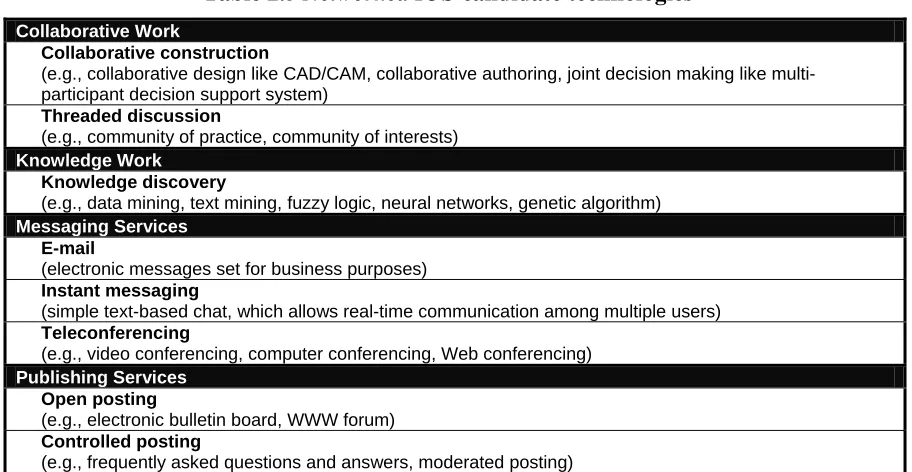
Groupware, e-mail, instant messaging, teleconferencing, threaded discussion, publishing services
(e.g., open posting, FAQs), and collaborative construction tools (e.g., design, authoring) may
serve as good candidates. Candidate technologies of networked IOS may also include
technologies for handling unstructured knowledge resources, such as data mining and fuzzy
Table 2.5 Networked IOS candidate technologies Collaborative Work
Collaborative construction
(e.g., collaborative design like CAD/CAM, collaborative authoring, joint decision making like multi-participant decision support system)
Threaded discussion
(e.g., community of practice, community of interests)
Knowledge Work
Knowledge discovery
(e.g., data mining, text mining, fuzzy logic, neural networks, genetic algorithm)
Messaging Services
(electronic messages set for business purposes)
Instant messaging
(simple text-based chat, which allows real-time communication among multiple users)
Teleconferencing
(e.g., video conferencing, computer conferencing, Web conferencing)
Publishing Services
Open posting
(e.g., electronic bulletin board, WWW forum)
Controlled posting
(e.g., frequently asked questions and answers, moderated posting)
Chapter 3
Prior IOS Research: IOS’s Roles in Achieving Firm
Competitiveness
This chapter reviews prior IOS research and summarizes major perspectives and their
limitations regarding IOS’s roles in achieving firm competitiveness. It poses research questions
and suggests ways to answer these questions that address the limitations of prior studies.
3.1 Four Research Perspectives on the Roles of IOS
Based on an extensive review of IOS literature, this study identifies four major
perspectives on the roles of IOS in achieving firm competitiveness: the techno-economic
perspective, the socio-political perspective, the trust perspective1, and the learning perspective.
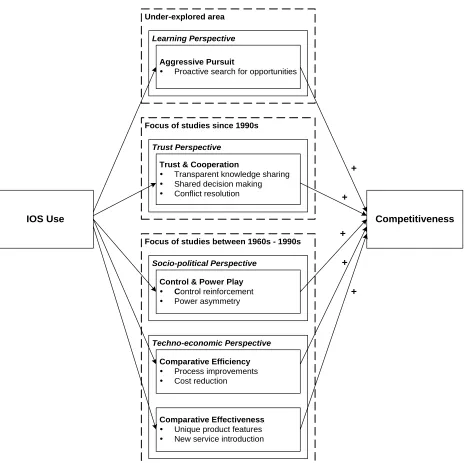
Figure 3.1 illustrates these four perspectives.
The techno-economic perspective views IOS as instruments for increasing organizational
efficiency and effectiveness. The socio-political perspective focuses on the roles of IOS as
competitive weapons for power controls between the IOS participants. The techno-economic
and socio-political perspectives represent the focus of IOS research in the 1960s - 1990s.
In the 1990s, the trust perspective was introduced. The trust perspective emphasizes the
elements of transparent knowledge sharing, shared decision making, and effective governance
for conflict resolution in the IOS use. This perspective advances the roles of IOS in enhancing
trust and cooperation for achieving collaborative advantage.
The learning perspective represents a fourth rationale for studying the roles of IOS. This
view focuses on the dynamic roles of IOS and suggests creating sustained competitiveness
through aggressive pursuit of new opportunities for joint performance improvements via IOS.
1
The techno-economic perspective, socio-political perspective, and trust perspective originally came from Kumar et al. (1998). The techno-economic perspective holds a similar notion to Kling’s (1980) system rationalism
perspective. The socio-political perspective holds a similar notion to Kling’s (1980) segmented institutionalism
Comparative Efficiency y Process improvements
y Cost reduction
Comparative Effectiveness y Unique product features
y New service introduction
Control & Power Play y Control reinforcement
y Power asymmetry
Trust & Cooperation
y Transparent knowledge sharing
y Shared decision making
y Conflict resolution
Aggressive Pursuit
y Proactive search for opportunities
Techno-economic Perspective Socio-political Perspective Trust Perspective
Learning Perspective
Focus of studies between 1960s - 1990s Focus of studies since 1990s
Under-explored area
Competitiveness +
+ + +
+ IOS Use
3.1.1 The Techno-Economic Perspective
The central concept of the techno-economic perspective is that all actors/stakeholders in
an interfirm relationship subscribe to the economic goal of maximizing their firms’ economic
efficiency and effectiveness through technology (Kling 1980; Kumar et al. 1998). It focuses on
the narrowly bounded world of computer use in which the computer user is a central actor and
emphasizes the beneficial or positive role that computerized technologies play in interfirm
relationships.
As such, studies holding the techno-economic perspective are likely to focus on the roles
of IOS as instruments for increasing organizational efficiency (e.g., easier data manipulation,
faster response, lower order costs) and effectiveness (e.g., unique product features, better
customer service). Representative studies include Kaufman (1966), Barret and Konsysnski
(1982), Cash and Konsyski (1985), Johnston and Vitale (1988), Venkatraman and Zaheer (1994),
Iacovou et al. (1995).
3.1.2 The Socio-Political Perspective
Unlike the techno-economic perspective, the socio-political perspective is not
techno-centric. It does not presume a technological imperative or economic rationality in human
behavior, but instead assumes that the interconnected environments within which firms operate
represent political or negotiated areas that are characterized by inequality, information
asymmetry, manipulation, coercion, or conflict (Kling 1980; Oliver 1990; Kumar et al. 1998).
This perspective views the use of IOS as being motivated by power and control. In the drive to
achieve competitive advantage, the objective of a firm is to minimize its dependence on other
firms and to maximize the dependence of other firms on itself (Reekers and Smithson 1995).
As such, studies adopting the socio-political perspective are likely to focus on the roles of
IOS as competitive weapons for control reinforcement and power plays (e.g., biasing information
display in an IOS to create information asymmetry, increasing switching costs and partner
dependence via customized systems). Representative studies include Johnston and Vitale
(1988), Webster (1995), Mutch (1996), Chwelos et al. (2001).
3.1.3 The Trust Perspective
Since the 1990s, as the potential for linking the information systems of separate firms has
and interfirm relationships. The development and implementation of IOS networks (e.g., EDI
networks) have radically altered many firms’ internal procedures in procuring supplies,
delivering goods and services, and carrying out financial transactions. Results include
performance improvements in just-in-time delivery and inventory management, and quick
response to customer demand. In order to respond more effectively to changing business
conditions, many firms have realized that more cooperative relationship and greater transparency
in information sharing are needed. This recognition has given an infrastructural impetus to use
IOS for enhancing trust and a shift in the focus of IOS studies from the techno-economic and
socio-political perspectives to a trust perspective.
The trust perspective goes beyond techno-centric and economic considerations. It
assumes that trust, mutual support, harmony, and cooperative relationships rather than coercion,
domination, conflict, and control are the predominant values underlying the socio-economic
behavior. This perspective recognizes that both the techno-economic perspective and the
socio-political perspective have an underlying focus on self-interest and opportunism, which is likely
to create a win-lose view of business transactions and relationships for achieving competitive
advantage. In contrast, the trust perspective, by recognizing the existence of cooperative
relationships, is likely to create win-win strategies in wielding IT for collaborative advantage
(Kumar and van Dissel 1996).
Studies using the trust perspective suggest that trust and cooperation, in addition to
efficiency and power, provide a third rationale for studying the roles of IOS (Kumar et al. 1998).
Representative studies include Holland (1995), Kumar and van Dissel (1996), Hart and Saunders
(1997), Kumar et al. (1998), Li and Williams (1999), and Gallivan and Depledge (2003).
3.1.4 The Learning Perspective
The learning perspective provides a fourth rationale, besides the other three perspectives,
for studying the roles of IOS.
Like the techno-economic perspective, the learning perspective also sees increases in
organizational efficiency and effectiveness through exploiting IOS capabilities. But unlike the
techno-economic perspective, the learning perspective implies that performance improvements
through merely deploying the tangible assets of IOS are relatively static. These improvements
cannot create sustainable advantage, because they are usually achieved spontaneously along with
changes (e.g., increasing use of IOS by competitors), these advantages (e.g., data entry efficiency
obtained via IOS) are likely to disappear quickly.
The learning perspective is also different from the socio-political and trust perspectives.
The latter two perspectives view IOS as instruments for managing relationships, while the
learning perspective emphasizes the dynamic roles of IOS in achieving sustained
competitiveness, through aggressive pursuit of opportunities for using IOS or IOS innovations.
Aggressive pursuit can lead to dynamic capabilities that are adaptable to environmental changes
and are not easily imitated by rivals, because firms that begin to ride a learning curve ahead of
their competitors realize a head start that will endure as long as new opportunities continue to be
revealed and exploited (Copeland and McKenney 1988).
The learning perspective is represented by three studies: Copeland and McKenney
(1988), Zaheer and Zaheer (1997), and Christiaanse and Venkatraman (2002).
3.2 Limitations of Prior IOS Research
The four perspectives have provided some insights into the roles of IOS in achieving firm
competitiveness, but they provide limited insights into the process of how sustained
competitiveness is created through IOS. The techno-economic perspective represents a relatively
static view of using IOS. The socio-political and trust perspectives largely focus on the roles of
IOS in managing dyadic relationships. The learning perspective emphasizes a more dynamic
dimension of using IOS, but it remains under-explored. Additionally, many IOS studies are
ideas and conceptual frameworks or case-based approaches. They are interpretative, subject to
sporadic anecdotes, personal opinions, and experiences rather than systematic research. With the
proliferation of IT-mediated interfirm collaboration, electronic networks are rapidly evolving and
spanning across an increasing number of firms, industries, and value/supply chains. The
emergence of these networks warrants a change in the focus of IOS’s roles– from a relatively
static view to a more dynamic view, from a dyadic dimension to a network dimension, from a