Research Journal
Volume 11, Issue 3, June 2017, pages 204–210
DOI: 10.12913/22998624/76450 Research Article
RESEARCH INTO MORPHOLOGY AND PROPERTIES OF TiO
2– NiAl
ATMOSPHERIC PLASMA SPRAYED COATING
Andrzej Maruszczyk1, Agata Dudek2, Mirosław Szala3
1 Institute of Materials Engineering, Częstochowa University of Technology, Armii Krajowej 19, 42-200
Częstochowa, Poland, e-mail: [email protected]
2 Institute of Materials Engineering, Częstochowa University of Technology, Armii Krajowej 19, 42-200
Częstochowa, Poland, e-mail: [email protected]
3 Department of Materials Engineering, Mechanical Engineering Faculty, Lublin University of Technology, 36
Nadbystrzycka St., 20-618 Lublin, Poland, email: [email protected]
ABSTRACT
Titania (TiO2) based coatings are ceramic products with unique properties that make them widely applicable (e.g. in automotive industry, optoelectronics, chemical pro-cessing or medicine). Atmospheric plasma spray process enables to deposit TiO2 with addition of NiAl feedstock material which has an influence on coating cohesion and adhesion to substrate. However, the literature and technical notes give little informa-tion about parameters of spraying of TiO2-10 wt.% NiAl feedstock powders enables producing coating without nonuniformities including cracks and delamination form substrate. The aim of the work was to verify the parameters of plasma spraying by evaluation of the morphology and properties of manufactured the TiO2-10 wt.% NiAl coatings. Titania based coatings were deposited by means of atmospheric plasma sprayed on steel substrate using TiO2-10 wt.% NiAl feedstock powders. Morphology and microstructure were examined using light optical microscope (LOM) and scan-ning electron microscope (SEM). Coating chemical composition were analysed by means of SEM-EDS method. Coating surface topography and Knoop microhardness were determined. Porosity and thickness were evaluated by using quantities image analysis programme. Plasma spraying parameters used in our research allow to obtain uniform coating without cracks and delamination at coating-substrate interface. It ac-knowledges that uniformity of coating technological properties as well manufactured coatings can be put to wear tests, such as high temperature oxidation, corrosion, ero-sion or cavitation eroero-sion resistance evaluation.
Keywords: microstructure, titania, TiO2–NiAl, atmospheric plasma spray, TiO2 coat-ing, lamellae, microhardness, porosity.
INTRODUCTION
Titania (TiO2) based coatings are
manufac-tured with different methods such as thermal spray processes (e.g plasma arc, electric arc, flame
or kinetic). Atmospheric plasma arc (APS) is one of the particularly used in industry applications of thermal spray process, and Fig. 1 illustrates idea of APS. In plasma sprayed coatings, the hot gas jet
created by a plasma arc expands, entrains powder particles, heats the particles, and accelerates them toward the substrate, where they impact, deform, and resolidify to form a coating. Plasma sprayed coating exhibits higher deposit densities and bond
strengths compared to most flame and electric
arc spray coatings. The low porosity of plasma sprayed coatings can equal that of high-velocity oxyfuel and detonation-gun-type coatings [5, 12,
13, 18]. Plasma spraying method enables to con-stitute resistant to wear coating [1, 4, 11÷13, 17, 19, 21, 22] with properties comparable to overlay padded coatings [5, 12, 23, 24]. APS process is a very perspective method enables producing metal, ceramic and composite coatings therefore APS coatings are considered as good candidates for
application on different substrates (e.g. iron, tita -nium, magnesium, cobalt, nickel and aluminium based alloys) [5, 7, 10, 12, 13, 18, 23, 25, 26].
Plasma sprayed coatings incorporate proper-ties such as the wear resistance, as a thermal bar-rier coatings (TBC) resistant to high temperature and oxidation hence are widely applicable for ele-ments of aero gas turbine, in energetics industry, combustion chamber and diesel engines e.g. TiO2 -Al2O3 [11]. Medical application of hydroxyapa-tite APS coating is systematically studied.
Hy-droxyapatites modified with zirconium are depos -ited on the surface of implants [6]. In optoelec-tronics and production of photovoltaics panels, as
well as in chemical processing to neutralize NOx
and SOx compounds, TiO2 coatings are imple-mented [5, 6, 12, 13, 27]. Moreover, TiO2 coat-ings with addition of NiAl can be sprayed on en-gine elements because of their resistance do high temperature oxidation and creep [3, 5, 12, 13]. However, microstructure and properties of TiO2 with addition of Al2O3 powders are discussed in particular, as stated in the literature [11, 16, 20]. In the specialised literature and technical notes, a little information about coatings deposited with TiO2-10 wt.% NiAl feedstock powder is given.
As a result of literature survey it can be stated that coating adhesion to substrate, sprayed coat-ing morphology and hardness are crucial features
which influence the operating properties of coated
machine parts and elements. The improvement of materials used in plasma sprayed coatings pro-cesses exact detailed study of the morphology of coating [2, 7, 14, 20]. Moreover, the influence of
plasma spraying process parameters on properties of coatings is systematically studied [4, 8, 15]. For industry applications coating adhesion to substrate is crucial. Manufacturing coatings without defects including such as coating cracks and delamination
in substrate-coating zone is a substantial issue.
The literature provides a little information about parameters of spraying of TiO2-10 wt.% NiAl feedstock which enables producing coating with demanded morphology and properties.
The aim of the work was to verify the pa-rameters of plasma spraying by evaluation of the morphology and properties of manufactured the TiO2-10 wt.% NiAl coatings.
MATERIAL AND METHODS
In the present study mixture of TiO2 with the 10 wt. % of NiAl powder was used as feedstock and deposited on low alloyed steel plates grade 40Cr4 (nominal hardness 208-252 HBW and chemical composition: 0,35-0,45% C, 0,-0,9% Mn, 0,1-035% Si, Ni 0-0,15%, Cr 0,9-1,2%, V 0,05%, Sn 0,02%, max. 0,35% S, Fe – rest [29]). Thickness of substrate equals 5 mm. Be-fore spraying steel surface was sandblasted and chemically cleaned. Coating was produced using atmospheric plasma spraying (APS) process by means of Plamotron PN-200 facility. The APS pa-rameters used to fabricate the TiO2-10 wt.% NiAl coatings are given in Table 1.
face and cross section specimen were studied. Me-tallographic specimens were prepared by grind-ing and polishgrind-ing. With the use of Light optical microscope (LOM) type Axiovert 25 (prod. Carl Zeiss) and scanning electron microscope (SEM) type JSM-6610LV (prod. JEOL) equipped with LaB6 electron gun and energy dispersive X-ray analyser (EDS), the coating structure was inves-tigated. The presence of coating cracks and coat-ing-substrate delamination was examined. Coat-ing porosity was determined by image processCoat-ing programme (prod. ImagePro) on the basis of LOM
microstructure. To recognize microstructure uni -formity of the coating, a chemical microanalysis was conducted, using SEM-EDS method. The
morphology of surface of coating with different magnifications was estimated by means of SEM
method. The topography was investigated us-ing a special scannus-ing electron microscope mode with surface roughness measurement programme. The plasma sprayed coatings, as well as substrate hardness, were measured using Knopp hard-ness tester. Microhardhard-ness tester FM-800 (Future Tech) was employed to achieve the microhardness indentation measurements. Parameters including load 0,025 kG, and dwelling time 10 s were used. Indentations in samples cross-section at random locations were made. To enable comparison, the results of Knopp (HK) hardness measurements ac-cording to ASTM E140 standard to Vickers (HV) and Brinell (HBW) parameters were converted.
RESULTS AND DISCUSSION
Manufactured TiO2-10 wt.% NiAl plasma
sprayed coating is shown in Fig. 2. The results
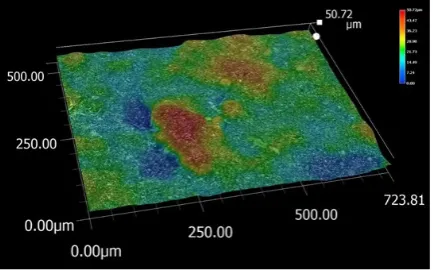
presented in Fig. 2 and Fig. 3 confirm that topog -raphy of coating surface was uniform. The report-ed range between pits and hills equals no more than 50 µm (Fig. 3). Uniform and repeatable
sur-faces stereometry parameters can have beneficial effect for prevention of friction wear.
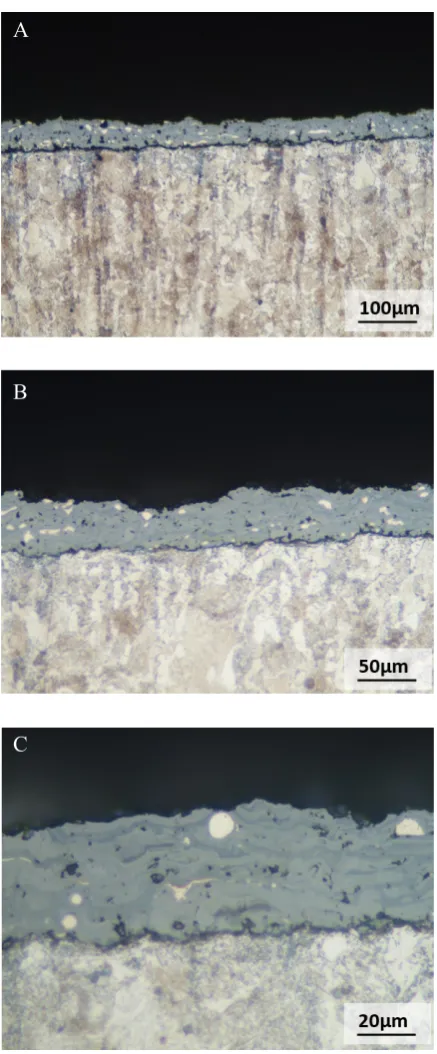
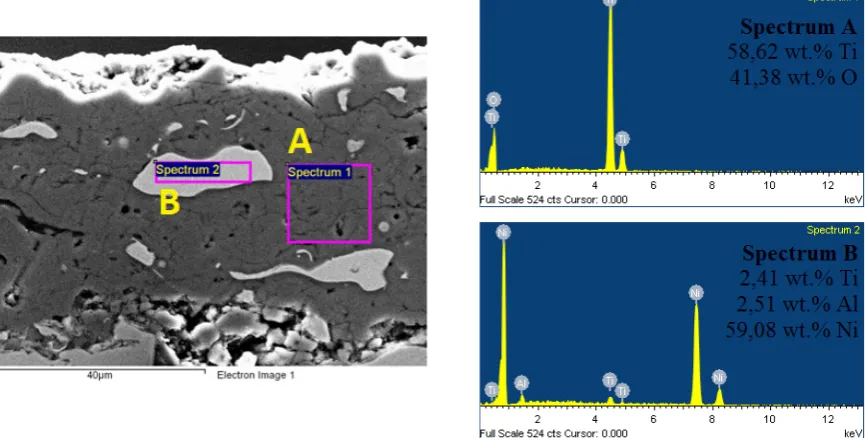
Fig. 4 and Fig. 5 present microstructure of
coatings obtained with various magnifications,
using LOM and SEM respectively. The results
of the chemical analysis in specific microstruc
-ture phases is presented in Fig. 6. The analysis of microscopic study revealed the structures typical for sprayed coatings, i.e. laminar particle shapes, porosity and presence of non-melted or partially-melted particles of the feedstock powders (vis-ible as brighter areas in Fig. 4). In the samples cross-section, the coating porosity (dark areas in Fig. 4) can be recognised. Based on quantitative image analysis, the coating porosity was deter-mined at 5%, and average coating thickness was determined as 50 µm. Lamellar microstructure is clearly visible in Fig. 4C, Fig. 5 and Fig. 6. Non-melted or partially-Non-melted particles correspond-ing to NiAl particles are the clearest areas in Fig. 5 and Fig. 6. Microstructural observations are in accordance with the chemical composition mea-surements. The chemical microanalysis reveals the presence of titanium and oxygen elements in the darkest lamellar coating areas (Fig. 6A), as well as mainly aluminium and nickel elements in clearest structure phases (Fig. 6B)
correspond-Table 1. APS spraying parameters for TiO2-NiAl coatings
Current intensity Arc voltage Distance of torch tip to substrate Plasma gases mixture
Type of gas Flow rate
350 A 50 V 100 mm argon 3 m3/h
hydrogen 0,5 m3/h
Fig. 2. TiO2-NiAl plasma sprayed coating manufac-tured on steel substrate (scale in mm)
ing to Titania lamellar matrix, and non-melted of partially-melted NiAl particles. Mixture of TiO2 with 10 wt.% NiAl is advantageous to increase the coating cohesion and the adherence of coating to
substrate. Salman and Cizmeciglu [21] present re -search done with and without NiAl bonding
coat-ing for different ceramic coatcoat-ings. They conclude
that the improvement of the NiAl bonding coating application was obtained due to the exothermic reaction that occurred during the coating process.
Manufactured coating does not demonstrate cracks or delamination; therefore the parameters of coatings plasma spraying were adequate. Uni-form morphology of coating was acknowledged. Interface coating – substrate demonstrates the presence of porosity and various depth of surface pores penetration by coating material. Kromer et al. claim [14] that pores near the interface would
be localized as zones for crack initiations and
propagations. In their work, the authors proposed to enhance adhesion bond strength for thermal spray process for small and large in-contact area proper volume particles and topography param-eters. The results of microscopic and hardness ex-amination indicate that TiO2-10 wt.% NiAl plas-ma sprayed feedstock forms uniform coating.
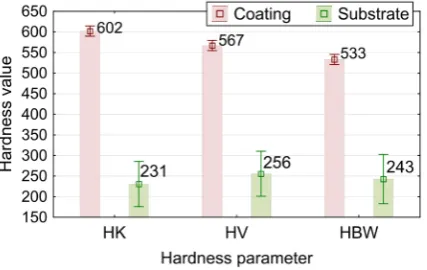
Coatings cross–section hardness measure-ments are presented in Fig. 7. Bertrand et al. [2] described that the hardness values published for the rutile TiO2 are between 580 and 700 HK and the values commonly measured for the anatase TiO2 are between 550 and 580 HK. The results obtained for coating microhardness measurements 602±5 HK are on the similar level as presented in [2] , however the lower level than hardness depicted for TiO2 [8, 9] and Al2O3-TiO2 [16, 19]
plasma sprayed coatings. It indicates the influence
of plasma spraying process on hardness results. Measured hardness of plasma sprayed coating was more than two times higher than steel sub-strate Fig. 7. Spread of Knopp hardness measure-ments of TiO2-NiAl coating equals 10 HK. Such restrained hardness values acknowledge about technological uniformity of coating properties.
CONCLUSIONS
In the work the parameters of plasma spraying
were positively verified by evaluating the morphol-ogy and properties of manufactured the TiO2-10 wt.% NiAl coatings. The results demonstrated that plasma sprayed parameters allow to obtain uni-form coating without cracks and delamination at
coating-substrate interface. Therefore, it acknowl-edged about uniformity of coating technological properties thus manufactured coatings can be put to wear tests, such as high temperature oxidation, corrosion and erosion resistance evaluation.
Titania (TiO2) based coatings are ceramic products with unique properties that make them widely applicable (e.g. in automotive or heavy industry, for engine elements or as biomaterial
Fig. 4. Cross-section of plasma sprayed TiO2-NiAl and substrate, LOM
A
B
Fig. 5. Morphology of specimen, surface view (a, b, c) and cross-section (d, e, f), SEM
coatings). NiAl addition positively influences on
coating cohesion and adhesion to substrate. Mor-phology and uniformity of technological param-eters are crucial in coating exploitation.
Measured thickness of manufactured TiO2-10 wt.% NiAl coating equals 50 µm, and the poros-ity was determined at 5% and Knoop hardness in range of 602±5 HK. The microscopic analysis (LOM, SEM-EDS) revealed the structures typi-cal of plasma sprayed coatings, i.e. laminar par-ticle shapes, porosity and presence of non-melt-ed or partially-meltnon-melt-ed particles of the fenon-melt-edstock powders (corresponding to NiAl). Topography and hardness measurements indicated that plas-ma sprayed TiO2-10 wt.% NiAl feedstock forms uniform coating.
REFERENCES
1. Berkowski L.: Influence of the state of the surface on properties of coats after metal spraying. Journal of Research and Applications in Agricultural Engi-neering. 50 (3), 2005, 11–14.
2. Bertrand G. et al.: Evaluation of metastable phase and microhardness on plasma sprayed titania coat-ings. Surface and Coatings Technology. 200 (16), 2006, 5013–5019.
3. Bordes M.C. et al.: Application of plasma-sprayed TiO2 coatings for industrial (tannery) wastewater treatment. Ceramics International. 41 (10), 2015, 14468–14474.
4. Bordes M.C. et al.: Preparation of feedstocks from nano/submicron-sized TiO2 particles to obtain photocatalytic coatings by atmospheric plasma spraying. Ceramics International. 40 (10), 2014, 16213–16225.
5. Davis J.R.: Handbook of Thermal Spray Technol-ogy. ASM International 2004.
6. Dudek A.: Kształtowanie własności użytkowych biomateriałów metalicznych i ceramicznych. Częstochowa 2010.
7. Dudek A., Adamczyk L.: Properties of hydroxyapa -tite layers used for implant coatings. Optica Appli-cata. 43 (1), 2013.
8. Forghani S.M. et al.: Effects of plasma spray pa -rameters on TiO2-coated mild steel using design of experiment (DoE) approach. Ceramics Interna-tional. 39 (3), 2013, 3121–3127.
9. Gardon M. et al.: Improved, high conductivity tita-nium sub-oxide coated electrodes obtained by At-mospheric Plasma Spray. Journal of Power Sourc-es. 238, 2013, 430–434.
10. Gontarz A., Dziubińska A.: A new method for pro -ducing magnesium alloy twin-rib aircraft brack-ets. Aircraft Eng & Aerospace Tech. 87 (2), 2015, 180–188.
11. Hejwowski T.: Comparative study of thermal bar-rier coatings for internal combustion engine. Vacu-um. 85 (5), 2010, 610–616.
12. Hejwowski T.: Nowoczesne powłoki nakładane cieplnie odporne na zużycie ścierne i erozyjne. Po -litechnika Lubelska, Lublin 2013.
13. Klimpel A.: Napawanie i natryskiwanie cieplne: technologie. WNT, Warszawa 2009.
14. Kromer R. et al.: Role of Powder Granulometry and Substrate Topography in Adhesion Strength of Thermal Spray Coatings. J Therm Spray Tech. 25 (5), 2016, 933–945.
15. Łatka L. et al.: Thermal diffusivity and conductiv -ity of yttria stabilized zirconia coatings obtained by suspension plasma spraying. Surface and Coatings Technology. 208, 2010, 87–91.
16. Luo H. et al.: Alternant phase distribution and wear mechanical properties of an Al2O3-40 wt%TiO2 composite coating. Ceramics International. 43 (9), 2017, 7295–7304.
17. Madej M., Ozimina D.: Właściwości powłok kompozytowych natryskiwanych naddźwiękowo metodą HP/HVOF. Inżynieria Maszyn. 16 (4), 2011, 75–84.
18. Morel S.: Powłoki natryskiwane cieplnie. Wydawnictwo Politechniki Częstochowskiej, Częstochowa 1997.
19. Morks M.F., Akimoto K.: The role of nozzle diam -eter on the microstructure and abrasion wear resist-ance of plasma sprayed composite coatings. Journal of Manufacturing Processes. 10 (1), 2008, 1–5 . 20. Palacio, C.C. et al.: Effect of the mechanical
properties on drilling resistance of Al2O3–TiO2 coatings manufactured by atmospheric plasma spraying. Surface and Coatings Technology. 220, 2013, 144–148.
21. Salman S., Cizmecioglu Z.: Studies of the correla
tion between wear behaviour and bonding strength in two types of ceramic coating. Journal of Materi-als Science. 33 (16), 1998, 4207–4212.
22. Szala M. et al.: Cavitation erosion resistance of Ni-Co based coatings. Advances in Science and Tech-nology Research Journal. 21 (8), 2014, 36–42. 23. Szala M.: Coatings for increasing cavitation
wear resistance of machine parts and elements - Thesis for doctore degree. Lublin University of Technology, Lublin 2016.
24. Szala M., Hejwowski T.: Improvement of cavita -tion erosion resistance of metal alloys by pad weld-ing of coatweld-ings. Przegląd Spawalnictwa - Weldweld-ing Technology Review. 87 (9), 2015, 56–60.
25. Szala M., Łukasik D.: Cavitation wear of pump im -pellers. Journal of Technology and Exploitation in
Mechanical Engineering. 2 (1), 2016, 40–44. 26. Thirumalaikumarasamy D. et al.: Effect of ex
-perimental parameters on the micro hardness of plasma sprayed alumina coatings on AZ31B mag-nesium alloy. Journal of Magmag-nesium and Alloys. 3 (3), 2015, 237–246.
27. Vismaya, S., Sunil, H.: Study on the factors attect-ing photocatalytic behavior ot titana coatattect-ings us-ing different plasma spray proces. Internacional Journal of Technical Research, and Applications. 3, 2015, 255–265.
28. Plasma Spraying - Plasma Spray Coating, http:// www.ep-coatings.co.uk/processes/plasma-spraying/.
![Fig. 1. Plasma spray process [28]](https://thumb-us.123doks.com/thumbv2/123dok_us/8807415.1775319/2.595.118.469.76.223/fig-plasma-spray-process.webp)