SHIV SHAKTI
International Journal in Multidisciplinary and
Academic Research (SSIJMAR)
Vol. 6, No. 5, October 2017 (ISSN 2278 – 5973)
Brain Tumor detection using RST-PSO
A survey on different techniques in Load balancing in Cloud Computing
Neelam
M.tech Scholar, IIET Kinana, Jind Sunaina
A.P., IIET Kinana, Jind
Abstract
The term Cloud is used for service provider who have all type of resources for storage, computing and service providing. For realizing full capacity in cloud computing, it needs to support different services such as security, uniform access, task scheduling, resource management, economic computation etc. To integrate essential services to real cloud environment and it is necessary to select suitable virtual machine or computing resources with objective of maximum resource utilization and scheduling tasks such that user meets its requirement in terms of overall processing time, processing cost and any other constraints observed by user.
Keywords: Cloud Computing, Load balancing
1. Introduction
The cloud computing relies on the thought of dynamic provisioning, that is applied to services, computing capability, storage, networking, and data technology infrastructure to fulfil user needs. The resources are created offered for the users through the web and offered on a pay-as-use basis from completely different Cloud computing vendors.
nature of the surroundings. every entity has specific needs and objectives that require to attain. Server consolidations are permitting the multiple servers running on one physical server at the same time to reduce the energy consumed in a very knowledge centre. Running the multiple servers on one physical server is completed through virtual machine thought. The task consolidation is additionally called server/workload consolidation downside. Task consolidation downside self-addressed during this thesis is to assign n task to a collection of r resources in cloud computing surroundings. This energy economical resource allocation maintains the employment of all computing resources and distributes virtual machines in a very manner that the energy consumption will minimize. The goal of those algorithms is to keep up accessibility to work out nodes whereas reducing the full energy consumed by the cloud infrastructure.
Cloud computing resources are managed through the centralized resource manager. The centralized resource manager assigned the tasks to the specified VMs. There sources of cloud knowledge centre are offered to the users/applications through Virtual Machines (VMs). Virtual Machines are accustomed meet the resource demand and run time support for the applications. specifically capital punishment AN application for needed resource may be created offered through 2 steps: making an instance of the virtual machine PRN by the applying (VMs provisioning) and programming the request to the physical resources otherwise called resource provisioning. The VM here is to explain the software package concept: a software system abstraction with the appearance of a pc system's hardware (real machine). A virtual machine is sufficiently almost like the underlying physical machine running existing software system unmodified. The VM technology has become in style in recent years in knowledge centres and cloud computing environments as a result of it's variety of advantages as well as server consolidation, live migration, and security isolation. Cloud computing relies on the thought of virtualization that encapsulates varied services that may meet the user demand in a very cloud computing surroundings. Virtual machines (VMs) are designed to run on a server to supply a multiple OS surroundings with the support of assorted applications. One or additional VM(s) may be placed or deployed on a physical machine that meets the need for the VM. The task may be scheduled dynamic load equalization between the host in cloud computing environments are achieved mistreatment mental image technology.
1.1 Cloud Computing Evolution
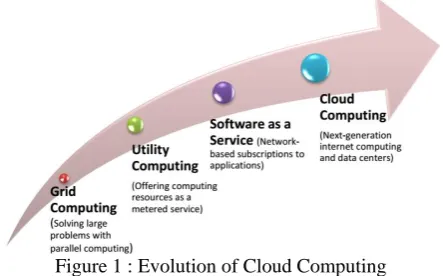
The term Cloud has been used traditionally as a trope for the web. Cloud computing has evolved through variety of phases that embody Grid and Utility computing, Application Service Provision (ASP), and software system as a Service (SaaS) as shown in Figure one.1 . The underlying thought of Cloud computing dates back to the Sixties, once John McCarthy opened that computation could sometime be organized as a public-service corporation.
Figure 1 : Evolution of Cloud Computing
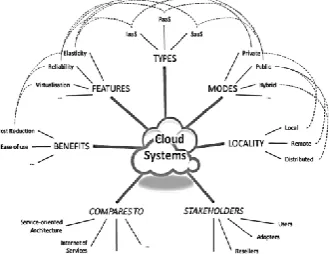
oversized size of information storage. the information still as process is somewhere on servers. So, the purchasers need to trust the supplier on the provision still as knowledge security. The SLA is that the solely legal agreement between the service supplier and shopper. ―The basics of Cloud computing is to distribute the computing tasks to several distributed computers, not native laptop or remote servers [2]. In 1999 salesforce.com place the concept of Cloud computing in associate degree application. They used an easy web site to deliver its enterprise applications to users. Then in 2002 amazon launched their Cloud based mostly net services. Cloud computing doesn't stop here it had been then utilized by Microsoft to push the Cloud computing services by Azure Services platform in Oct twenty seven, 2008. Google in 2009 came into market by victimization Cloud computing construct by delivering Google Apps. Cloud Computing offers service to end-users instead of a product, by sharing resources, software package and different info below a usage based mostly payment model. ―Cloud computing refers to each the applications delivered as services over the web and therefore the hardware and computer program within the knowledge centers that offer those services‖ [A15]. Figure 1.2 shows the most aspects of Cloud computing. There are several projected definitions of the Cloud computing thanks to its growing quality shaping its characteristics. a number of the definitions given by several well-known scientists and organizations are:
• Rajkumar Buyya defines the Cloud computing in terms of its utility to finish user as ―A Cloud may be a form of parallel and distributed system consisting of a group of interconnected and virtualized computers that ar dynamically provisioned and given together or a lot of unified computing resources supported service-level agreements established through negotiation between the service supplier and customers [3].
• National Institute of Standards and Technology (NIST) defines Cloud computing as follows: ―Cloud computing may be a model for enabling convenient, on-demand network access to a shared pool of configurable computing resources (e.g., networks, servers, storage, applications, and services) which will be quickly provisioned and free with negligible management effort or service supplier interaction. This Cloud model promotes availableness and consists of 5 essential characteristics, 3 service models, and 4 readying models [4].
Figure 2: Non-Exhaustive read on the most aspects forming a cloud system
2. Characteristics of Cloud Computing
The different characteristics of Cloud computing [5] are represented below:
• Reduced Cost: There are variety of reasons to attribute Cloud technology with lower prices. The asking model is pay as per usage; the infrastructure isn't purchased so lowering maintenance. Initial expense and revenant expenses are a lot of under ancient computing.
• Multiplied Storage: With the large Infrastructure that's offered by Cloud suppliers these days, storage & maintenance of huge volumes of information may be a reality. fulminant work spikes are managed effectively & expeditiously, since the Cloud will scale dynamically. • Flexibility: Cloud computing stresses on obtaining applications to plug terribly quickly, by victimization the foremost acceptable building blocks necessary for readying.
• Reliability: it's the aptitude to make sure constant operation of the system while not disruption, i.e. no loss of information, no code reset throughout execution etc. dependableness is usually achieved through redundant resource utilization.
• Location independence: It allows users to access systems employing a applications programme no matter their location or what device they're victimization.
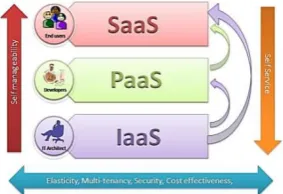
Cloud computing is usually divided into 3 levels of service offerings [5] as shown in Figure 3.
Figure 3: Services of cloud computing • Software package as a Service (SaaS)
A complete application is obtainable to the client, as a service on demand. one instance of the service runs on the Cloud & multiple finish users are maintained. On the client aspect, there's no want for direct investment in servers or software package licenses, whereas for the supplier, the prices are lowered , since solely one application has to be hosted & maintained. these days SaaS is obtainable by corporations akin to Google, Salesforce, Microsoft, Zoho, etc.
• Platform as a Service (PaaS)
PaaS is associate degree application development and readying platform delivered as a service to developers over the net. It facilitates development and readying of applications while not the price and quality of shopping for and managing the underlying infrastructure, providing all of the facilities needed to support the entire life cycle of building and delivering net applications and services entirely on the market from the web. This platform consists of infrastructure software package, and generally includes a info, middleware and development tools. PaaS suppliers provide a predefined combination of OS and application servers, akin to LAMP platform (Linux, Apache, MySql and PHP), Google Apps Engine may be a PaaS giving wherever developers write in Python or Java.
• Infrastructure as a service (IaaS)
Infrastructure as a Service is that the delivery of hardware (server, storage and network), and associated software package (operating systems virtualization technology, file system), as a service. it's associate degree evolution of ancient hosting that doesn't need any long run commitment and permits users to provision resources on demand. in contrast to PaaS services, the IaaS supplier will little management then again keep {the knowledge|the info|the information} centre operational and users should deploy and manage the software package services themselves – simply the manner they'd in their own data centre. Amazon net Services Elastic cypher Cloud (EC2) and Secure Storage Service (S3), GoGrid, three Pidlimdi ar the samples of IaaS offerings.
2.2 Readying Models of Cloud Computing
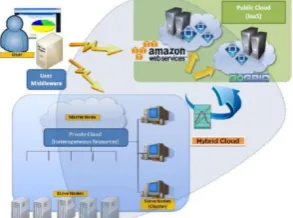
The different readying models of Cloud Computing [5] are shown in Figure 4.
• Public Cloud
Public Cloud is that the most typical readying model wherever services are on the market to anyone on web in a very pay-as-you-go manner. To support thousands of property right users, knowledge centres designed by public Cloud suppliers are quite giant comprising of thousands of servers with high speed network. a number of the celebrated public Clouds are Amazon net Services (AWS), Google App Engine, and Microsoft Azure. Amazon EC2 provides infrastructure as a service, Google AppEngine provides platform as a service, and Salesforce.com provides software package as a service. The characteristics of Public Clouds ar multi-tenancy and measurability.
Private Clouds are deployed among the premise of a corporation to supply IT services to its internal users. The personal Cloud services provide bigger management over the infrastructure, rising security and repair resilience as a result of its access is restricted to at least one or few organizations. Such personal readying poses associate degree inherent limitation to finish user applications i.e. inability to scale elastically on demand as will be done victimization bone Cloud services. a corporation can purchase a lot of machines consistent with increasing desires of its users, however this can't be done as quick and seamlessly like public Clouds.
Figure 4: Cloud Computing Models • Hybrid Cloud
Hybrid Clouds is that the readying that emerged thanks to diffusion of each public and personal Clouds blessings. during this model, organizations source non-critical info and process to the general public Cloud, whereas keeping crucial services and knowledge in their management. Therefore, organizations will utilize their existing IT infrastructure for maintaining sensitive info among the premises. With a Hybrid Cloud, service suppliers will utilize third party Cloud suppliers in a very full or partial manner so increasing the pliability of computing.
2.4Analysis Problems in Cloud Computing
The emergence of Cloud computing has created an incredible impact on the data Technology (IT) business over the past few years. presently IT business desires Cloud computing services to supply best opportunities to globe. Cloud computing is in initial stages, with several problems [11], [9], [10] still to be addressed.
• Machine-Controlled Service Provisioning
The objective of a service supplier during this case is to allot and de-allocate resources from the Cloud to satisfy its service level objectives (SLOs), whereas minimizing its operational value. These approaches generally involve: (i) Constructing associate degree application performance model that predicts the quantity of application instances needed to handle demand at every explicit level, so as to satisfy QoS necessities; (ii) sporadically predicting future demand and decisive resource necessities victimization the performance model; and (iii) mechanically allocating resources victimization the expected resource requirements. Application performance model will be created victimization varied techniques, together with Queuing theory, management theory and applied math Machine Learning. The proactive approach uses expected demand to sporadically allot resources before they're required. The reactive approach reacts to immediate demand fluctuations before periodic demand prediction is offered.
• Virtual Machine Migration
Virtualization will offer important edges in Cloud computing by enabling virtual machine migration to balance load across the information center. additionally, virtual machine migration allows sturdy and extremely responsive provisioning in knowledge centers. Authors have acknowledged that migrating a complete OS and every one of its applications together unit permits to avoid several of the difficulties long-faced by process-level migration approaches, and analyzed the advantages of live migration of VMs [12]. the key good thing about VM migration is to avoid hotspots. police investigation work hotspots and initiating a migration lacks the lightness to retort to fulminant work changes.
• Server Consolidation
in order that the remaining servers will be set to associate degree energy-saving state. Downside the matter of optimally consolidating servers in a very knowledge center is usually developed as a variant of the vector bin-packing problem, that is associate degree NP-hard optimization drawback. varied heuristics are projected for this drawback. Server consolidation activities shouldn't hurt application performance. For server resources that are shared among VMs, akin to information measure, buffer store and disk I/O, maximally consolidating a server might lead to re-source congestion once a VM changes its footprint on the server. Hence, it's typically necessary to look at the fluctuations of VM footprints and use this info for effective server consolidation. Finally, the system should quickly react to resource congestions as and once they occur.
• Energy Management
Rising energy potency is another major issue in Cloud computing. it's been calculable that the price of powering and cooling accounts for fifty three of the overall operational expenditure of information centers [13]. In 2006, knowledge centers within the North American nation consumed over one.5% of the overall energy generated therein year, and therefore the share is projected to grow eighteen annually [14]. thence infrastructure suppliers are below monumental pressure to cut back energy consumption. The goal isn't solely to chop down energy value in knowledge centers, however conjointly to satisfy government rules and environmental standards. coming up with energy efficient knowledge centers has recently received sizable attention. This drawback will be approached from many directions. As an example, energy-efficient hardware design that allows swiftness down computer hardware speeds and turning off partial hardware parts has become commonplace. Energy-aware job planning and server consolidation are 2 different ways in which to cut back power consumption by turning off unused machines. A key challenge all told the on top of ways is to realize a decent trade-off between energy savings and application performance. • Knowledge Security
Knowledge security is another necessary analysis topic in Cloud computing. Since service suppliers generally don't have access to the physical security system of information centers, they need to trust the infrastructure supplier to realize full knowledge security. Even for a virtual personal Cloud, the service supplier will solely specify the safety setting remotely, with-out knowing whether or not it's totally enforced. it's crucial to create trust mechanisms at each discipline layer of the Cloud. Firstly, the hardware layer should be trustworthy victimisation hardware trustworthy platform module. Secondly, the virtualization platform should be trustworthy victimisation secure virtual machine monitors. VM migration ought to solely be allowed if each supply and destination servers are trustworthy.
2
Literature survey
[1].
This paper, projected a secure energy-aware provisioning of cloud computing resources on consolidated and virtualized platforms. Energy potency is achieved through just-right dynamic Round-Robin provisioning mechanism and therefore the ability to power down sub-systems of a bunch system that don't seem to be needed by VMs mapped to that. any solutions square measure projected to security challenges two-faced throughout VM live migration.[2]. During this paper we have a tendency to conduct a survey of analysis in energy-efficient computing and propose: discipline principles for efficient management of Clouds; energy-efficient resource allocation policies and programming algorithms considering QoS expectations and power usage characteristics of the devices. it's valid by conducting a performance analysis study victimisation CloudSim toolkit.Green Cloud Computing aims at a process infrastructure that mixes flexibility, quality of services, and reduced energy utilization. so as to attain this objective, the management answer should regulate the interior settings to deal with the pressing issue of information center over-provisioning regarding the requirement to match the height demand. during this context, propose associate degree integrated answer for resource management supported VMs placement and VMs allocation policies. This work introduces the system management model, analyzes the system‟s behavior, describes the operation principles, and presents a use case situation.
that our approach has huge potential as itoffers important improvement within the aspects of time interval and makespan, demonstrates high potential for theimprovement in energy potency of the information center, and may effectively meet the service level agreementrequested by the users. This paper proposes associate degree improved organism choice algorithmic rule supported time value and energy consumption models in cloud computing surroundings. we've got analyzed the performance of our approach victimisation the CloudSim toolkit. The experimental results show that our approach has huge potential because it offers important improvement within the aspects of time interval and makespan, demonstrates high potential for the advance in energy potency of the information center, and may effectively meet the service level agreement requested by the users. [4]. During this paper, IARA technique is introduced to sense and predicts the behavior of the adhocsystem for allocating the resources. The IARA technique includes of a distributed design ofresource allocation model developed with special hardware support for localization in resource strained surroundings. this system enhances the resource programming method in cloud computing surroundings and attempt to devise a multitasking primarily based resource hardware to assign theresources with the best energy and information measure consumption in cloud surroundings. IARA techniqueschedules the resources effectively to attain the sub optimisation for the cloud computing drawback. This programming technique achieves each the allocation of resources and therefore the utilization of systemresource. IARA assign the resources supported the effective process capability and consumes the network information measure on the idea of method efficaciousness. Simulation is conducted with set of experiments in terms of resource potency, analysis time and energy utilization rate. The simulation results showsthat the IARA approach is worked expeditiously in resource allocation method and achieved the most effective result compared to the present congestion management and dynamic resource allocation ways. IARA technique is just about ten -25 yuletide lesser utilization of energy compared with the dynamic resource allocation methodology victimisation the localization of the hardware within the individual clouds.
[5]. During this paper the authors analyze the assorted biological process and swarm-based algorithms that are used for task programming on resources in cloud computing environments.Scheduling is a crucial activity in multi-tasking systems to expeditiously manage resources, minimize idle time and increase performance of systems. therefore there's extreme would like of correct programming in cloud computing systems also, as a result of period of time execution and better turnout square measure essential necessities for multiple users.
[6].Author proposes, the virtual machine allocation algorithmic rule with multiple resources supported PSO that effectively improves energy potency. In cloud knowledge center, the allocation of virtual machines with multiple resources plays a crucial role in up theenergy potency and performance of cloud computing. it'll scale back the energy consumption of the cloud knowledge center. however the ways mentioned here solely thought of the central processing unit and disk resources not the opposite resources akin to network and memory.
[7].During this paper, author investigates the requirement of power consumption and energy potency in cloud computing model. it's been shown that there square measure few major parts of cloud design that square measure to blame for high quantity of power dissipation in cloud. The potential ways in which to satisfy every sector for planning associate degree energy potency model has conjointly been studied. Finally author shows the long run analysis direction and therefore the continuity of this work for next level implementation.
[8]. During this paper, author proposes associate degree optimisation technique referred to as microorganism forage that employed in order to unceasingly optimize the allocation of resources thereby up the energy potency of the information center. The results obtained once simulating a cloud computing surroundings and implementing the projected algorithmic rule create it clearly evident that cloud computing has nice potential and offers important performance gains also as value savings even below dynamic work conditions.
feasible to fine tune the trade-off between power consumption and execution time. The projected algorithmic rule shows quadratic complexness dependency on with the relevancy the amount of tasks tobe allotted.
[10]. During this paper author presentsthe style, implementation, associate degreed analysis of an economical resource management system for cloud computing services. Author uses Cloud Booster algorithmic rule for locating the node‟s capabilities & joballocation and accommodative Genetic algorithmic rule for VM migration. during this system VM allocation is predicated on node weight [a price indicates capability of every node]. supported these weights a VM resource allocation mechanism has projected, that is considering each Node weight and future prediction. to provide an improved approach for finding the matter of VM resource migration in an exceedingly cloud computing surroundings, this project demonstrates accommodative Genetic algorithmic rule primarily based VM resource migration strategy that focuses on system load equalization.
[11].This text introduces an influence economical resource allocation algorithmic rule for tasks in cloud computing knowledge centres. The developed approach is predicated on genetic algorithms that guarantee performance and measurability to countless tasks. Resource allocation is performed taking into consideration process and networking necessities of tasks and optimizes task completion time and knowledge center power consumption. The analysis results, obtained employing a dedicated open supply genetic multi-objective framework referred to as jMetal show that the developed approach is ready to perform the static allocation of an oversized range of freelance tasks on homogeneous single-core servers at intervals a similar knowledge centre with a quadratic time complexness.
[12].The projected multi-resource allocation mechanism, called DRFH, equalizes the worldwide dominant share allotted to every user, and therefore generalizes the DRF allocation from one server to multiple heterogeneous servers. we have a tendency to analyze DRFH and show that it retains the majority fascinating properties that DRF provides within the single-server situation. Notably, DRFH is envy-free, economist best, and cluster strategy proof. It conjointly offers the sharing incentive in an exceedingly weak sense.
[13].This paper has projected a hybrid particle swarm optimisation (HPSO) algorithmic rule that finds a near-optimal task assignment with affordable time. The process expertise manifests that the HPSO reports actual best solutions verified by a billboard applied math package for varietyof faucet instances. for big scale faucets, within which case the industrial package fails to derive actual best answer s, the performance of the HPSO is assessed by competing with a genetic algorithmic rule (GA). The experimental result shows that the HPSO trounce s the GA associate degree d the value distinction between the 2 approaches is statistically important. Also, the convergence and therefore the worst- case analyses of the HPSO are by trial and error conducted. [14].It projected associate degree economical resource management policy for virtualizedCloud knowledge centres. the target is to unceasingly consolidate VMs investing live migration and turn out idle nodes to attenuate power consumption, whereas providing needed Quality of Service. It conferred analysis results showing that dynamic reallocation of VMs brings substantial energy savings, so justifying any development of the projected policy.
[16].During this paper, we've got introduced a Markoff process model and projected an impression algorithmic rule for the matter of host overload detection as a locality of dynamic VM consolidation. The model permits a supervisor to expressly set a QoS goal in terms of the OTF parameter, that may be a work freelance QoS metric. For a noted stationary work and a given state configuration, the management policyobtained from the Markoff model optimally solves the host overload detection drawback within the on-line setting by increasing the mean intermigration time, whereas meeting the QoS goal. victimisation the Multisize window work estimation approach, we've got heuristically custom-made the model to handle unknown nonstationary workloads. we've got conjointly projected associate degree prefer the matter of hostoverload detection to guage the potency of the MHOD algorithmic rule.
[17].This study outlined and developed the multi-tenant VM allocation drawback in cloud knowledge centres, considering the VM necessities of various tenants, and introducing the allocation goal of minimizing the total of the VMs‟ network diameters of all tenants. Then, it projected a superimposed Progressive resource allocation algorithmic rule for multi-tenant cloud knowledge centres supported the Multiple haversack drawback (LP- MKP). The LP-MKP algorithmic rule uses a multi-stage superimposed progressive methodology for multi-tenant VM allocation and expeditiously handles unprocessed tenants at every stage. This reduces resource fragmentation in cloud knowledge centres, decreases the variations within the QoS among tenants, and improves tenants‟ overall QoS in cloud knowledge centres. It performed experiments to guage the LP-MKP algorithmic rule and demonstrate that it will give important gains over different allocation algorithms.
[18].This paper investigates the opportunities for inexperienced Cloud Computing (GCC) to get a additional comprehensive prospect towards achieving energy economical Cloud Computing, associate degreed presents associate degree energy economical network resources management approach in an Infrastructure as a Service (IaaS) Cloud model. This paper specialize in developing associate degree energy economical algorithmic rule by proposing a sensible multi-level Cloud Resource-Network Management (CRNM) algorithmic rule, that is enforced in an exceedingly virtual Cloud surroundings victimisation Snooze framework because the Cloud energy potency manager. The optimisation focuses on the employment of network information measure as main resource below take a look at, whereas conjointly taking into consideration the opposite resources, akin to central processing unit and memory, to urge the required performance.
[19].This paper conferred a particle swarm optimisation (PSO) primarily based heuristic to schedule applications to cloud resources that takes into consideration each computation value and knowledge transmission value. It experimented with a advancement application by variable its computation and communication prices. The comparison is finished on the idea of value savings once victimisation PSO and existing „Best Resource Selection‟ (BRS) algorithmic rule. the results show that PSO will achieve: a) the maximum amount as three times value savings as compared to BRS, and b) sensible distribution of work onto resources.
[20].This paper concisely reviewed the basics of firefly algorithmic rule beside a range of recent publications. Then, it mentioned the optimality related to equalization exploration and exploitation, that is important for all metaheuristic algorithms. By comparison with intermittent search strategy, it's been terminated that metaheuristics akin to firefly algorithmic rule square measure higher than the best intermittent search strategy and conjointly analysed algorithms and their implications for higher-dimensional optimisation issues.
A comparison table is made to show various works in this field.
Table 1. Comparison table of work carried in load balancing in Cloud computing Reference paper S.no. Work carried out in BAN field
[1] Secure energy-aware provisioning of cloud computing resources using dynamic Round-Robin provisioning mechanism
[2] Study victimization CloudSim toolkit
[3] Associate degree improved organism choice algorithmic rule supported time-cost and energy consumption models in cloud computing surroundings
system for allocating the resources
[5] Swarm-based algorithms that are used for task programming on resources in cloud computing
[6] Virtual machine allocation algorithmic rule with multiple resources supported by PSO that effectively improves energy potency
[7] Investigates the requirement of power consumption and energy potency in cloud computing model
[8] Associate degree optimisation technique referred to as microorganism forage that employed in order to unceasingly optimize the allocation of resources thereby up the energy potency of the information center
[9] Influence economical resource allocation algorithm for cloud computing knowledge centers that is predicated on genetic heuristics
[10] Cloud Booster algorithmic rule for locating the node‟s capabilities, job allocation and accommodative Genetic algorithmic rule for VM migration
[11] Dedicated open supply genetic multi-objective framework is used
[12] Multi-resource allocation mechanism, called DRFH, equalizes the worldwide dominant share allotted to every user
[13] Hybrid particle swarm optimisation (HPSO) algorithmic rule that finds a near-optimal task assignment with affordable time
[14] Study associate degree economical resource management policy for virtualized Cloud knowledge centres.
[15] Presents vision, challenges, and disciplined components for energy-efficient management of Cloud computing environments
[16] The model permits a supervisor to expressly set a QoS goal in terms of the OTF parameter, that may be a work freelance QoS metric
[17] It performed experiments to gauge the LP-MKP algorithmic rule and demonstrate that it will give important gains over different allocation algorithms.
[18] Sensible multi-level Cloud Resource-Network Management (CRNM) algorithmic rule
[19] Particle swarm optimisation (PSO) primarily based heuristic to schedule applications to cloud resources
[20] Firefly optimization algorithm primarily based heuristic to schedule applications to cloud resources
5
.Conclusion
It is concluded by this survey that load balancing in cloud computing is very much required and a lot of work is done in this field using various methodologies. Also few heuristic algorithm are utilized for load balancing such as GA, PSO and firefly. These optimization algorithm also gave good results in large network environment.
References
[1].SaurabhBilgaiyan, SantwanaSagnika, Madhabananda Das, “An Analysis of Task Scheduling in Cloud Computing using Evolutionary and Swarm-based Algorithms”, International Journal of Computer Applications (0975 – 8887) Volume 89 – No.2, March 2014.
[3].Manasa H.B, AnirbanBasu , “Energy Aware Resource Allocation in Cloud Datacenter”, International Journal of Engineering and Advanced Technology (IJEAT) ISSN: 2249 – 8958, Volume-2, Issue-5, June 2013 277.
[4].WannengShu, Wei Wang and Yunji Wang, “A novel energy-efficient resource allocation algorithm based on immune clonal optimization for green cloud computing” ,EURASIP Journal on Wireless Communications and Networking 2014, 2014.
[5].N.R.RamMohan, E.Baburaj, “Resource Allocation Using Interference Aware Technique in Cloud Computing Environment”, International Journal of Digital Content Technology and its Applications(JDCTA) Volume8, Number1, February 2014.
[6].An-ping Xiong and Chun-xiangXu, “Energy Efficient Multiresource Allocation of Virtual Machine Based on PSO in Cloud Data Center” , Hindawi Publishing Corporation Mathematical Problems in Engineering Volume 2014.
[7].Arindam Banerjee, Prateek Agrawal and N. Ch. S. N. Iyengar, “Energy Efficiency Model for Cloud Computing” , International Journal of Energy, Information and Communications Vol.4, Issue 6 (2013), pp.29-42. ISSN: 2093-9655 IJEIC.
[8].Akshat Dhingra and Sanchita Paul, “Green Cloud: Heuristic based BFO Technique to Optimize Resource Allocation”, Indian Journal of Science and Technology, Vol 7(5), 685–691, May 2014.
[9].Giuseppe Portaluri, Stefano Giordano, Dzmitry Kliazovich and Bernab´e Dorronsoro, “A Power Efficient Genetic Algorithm for Resource Allocation in Cloud Computing Data Centers” , 2014 IEEE 3rd
International Conference on cloud Networking (Cloud Net). [10].SaurabhBilgaiyan, SantwanaSagnika, Madhabananda Das, “ An Analysis of Task
Scheduling in Cloud Computing using Evolutionary and Swarm-based Algorithms”, International Journal of Computer Applications (0975 – 8887) Volume 89 – No.2, March 2014.
[11].Korir Sammy, RenShengbing, Cheruiyot Wilson, “Energy Efficient Security Preserving VM Live Migration In Data Centers For Cloud Computing” , IJCSI International Journal of Computer Science Issues, Vol. 9, Issue 2, No 3, March 2012. ISSN (Online):
1694-0814.
[12].Manasa H.B, AnirbanBasu , “Energy Aware Resource Allocation in Cloud Datacenter”, International Journal of Engineering and Advanced Technology (IJEAT) ISSN: 2249 – 8958, Volume-2, Issue-5, June 2013 277 .
[13].WannengShu, Wei Wang and Yunji Wang, “A novel energy-efficient resource allocation algorithm based on immune clonal optimization for green cloud computing” ,EURASIP Journal on Wireless Communications and Networking 2014.
[14].N.R.RamMohan, E.Baburaj, “Resource Allocation Using Interference Aware Technique in Cloud Computing Environment”, International Journal of Digital Content Technology and its Applications(JDCTA) Volume8, Number1, February 2014.
[16].Akshat Dhingra and Sanchita Paul, “Green Cloud: Heuristic based BFO Technique to Optimize Resource Allocation”, Indian Journal of Science and Technology, Vol 7(5), 685–691, May 2014.
[17].Giuseppe Portaluri, Stefano Giordano, DzmitryKliazovich and Bernab´eDorronsoro, “A Power Efficient Genetic Algorithm for Resource Allocation in Cloud Computing Data Centers” , 2014 IEEE 3rd
International Conference on cloud Networking (Cloud Net). [18].S.R.Suraj, R.Natchadalingam, “Adaptive Genetic Algorithm for Efficient Resource
Management in Cloud Computing” , International Journal of Emerging Technology and Advanced Engineering (ISSN 2250-2459, ISO 9001:2008 Certified Journal, Volume 4, Issue 2, February 2014).
[19].G. Portaluri, S. Giordano, D. Kliazovich and B. Dorronsoro, "A power efficient genetic algorithm for resource allocation in cloud computing data centers," Cloud Networking (CloudNet), 2014 IEEE 3rd International Conference on, Luxembourg, 2014, pp. 58-63. [20].W. Wang, B. Liang and B. Li, "Multi-Resource Fair Allocation in Heterogeneous Cloud