International Journal of Current Research in
Biosciences and Plant Biology
ISSN: 2349-8080 (Online)
●Volume 3
●Number 5 (May-2016)
Journal homepage: www.ijcrbp.comOriginal Research Article doi: http://dx.doi.org/10.20546/ijcrbp.2016.305.024
Correlation of Microbial Population and Phosphatases Activity during
Vermicomposting of Organic Substrates with
Perionyx ceylanensis
J. Devi1 and M. Prakash2*
1Research & Development Centre, Bharathiar University, Coimbatore-641 046, Tamil Nadu, India
2Department of Microbiology, Kanchi Shri Krishna College of Arts and Science, Kilambi, Kancheepuram-631 551, Tamil Nadu,
India
*Corresponding author.
A b s t r a c t A r t i c l e I n f o
Total microbial population (bacteria, fungi and actinomycetes) and phosphatases (acid and alkaline phosphatase) activity have been studied during the vermicomposting of pre-decomposed (21 days) teak leaf litter, paper mill sludge and pressmud in
combination with cowdung (1:1) using the earthworm, Perionyx ceylanensis for a period
of 60 days. The vermibed samples were collected on 0, 15, 30, 45 and 60th day of
vermicomposting and subjected to the analysis of total microbial population and phosphatases activity using standard procedures. The results showed that the acid phosphatase activity range was found to be 0.095 to 0.154 m moles of phenol liberated / l. Alkaline phosphatase which ranged from 0.38 to 0.98 m moles of phenol liberated/l, also showed similar trend of statistically significant increase. The total bacterial, fungal
and actinomycetes in the vermibed substrates from 0th day to 60th day showed gradual
increase. The correlation of total bacterial population with acid phosphatase in teak leaf
litter + cowdung vermibed combination was y = 12.32x + 6.529 (R2 = 0.890; p=0.01), in
paper mill sludge + cowdung vermibed combination was y = 15.20x + 6.547 (R2 =
0.703, p=0.05), and in pressmud + cowdung vermibed combination was y = 8.407x +
7.218 (R2 = 0.672, p=0.05). The increase of total microbial population is positively
correlated with the increase of phosphatases.
Accepted: 09 April 2016 Available Online: 06 May 2016
K e y w o r d s
Earthworms Enzyme activity Microbial population Perionyx ceylanensis Vermicomposting
Introduction
Vermiculture has been receiving considerable attention in recent years internationally for its potential role in organic farming and sustainable development (Kale, 1993). Species identified as potentially useful to break down organic wastes were Eisenia fetida, Dendrobaena
veneta and Lumbricus rubellus from temperate areas and
Eudrilus eugeniae and Perionyx excavatus from the
tropics (Edwards, 1998). The survival, growth, mortality and reproduction of these species have been studied thoroughly in the laboratory, using a wide range of organic wastes (Edwards, 1998). It is altogether a natural
system in which the earthworms play their major roles in degrading the organic portion of the waste. The use of earthworm in sludge management is called as vermicomposting or vermistablization.
the gut, cellulose and manganese were not detected in the cultured tissues, which indicated that these two enzymes were produced by microorganisms ingested with the soil (Zhang et al., 1993). Aira et al. (2007) studied the relationships between earthworm activity, microbial biomass and the activation and dynamics of several enzyme activities. The presence of earthworms in young layers stimulated microbial growth which decreased once earthworms left the slurry and the layers aged. This increase was related to the initial activation of the microbial enzymes studied as correlations between microbial biomass and enzymes showed, which indicated an increase of intracellular enzyme activity. In the present study, total microbial population (bacteria, fungi and actinomycetes) and phosphatases (acid and alkaline phosphatase) activity have been studied during the vermicomposting of pre-decomposed (21 days) teak leaf litter, paper mill sludge and pressmud in combination with cowdung (1:1) using the earthworm, Perionyx
ceylanensis for a period of 60 days.
Materials and methods
Teak leaf litter (TLL) was collected from an agroform near KSK College, Kanchipuram. The paper mill sludge (PMS) was procured from a private mill near Kanchipuram. The filter mud or pressmud (PM) was collected from Cheyyar Co-operative Sugar Mills Ltd., located in Thenthandalam, Anakkayur, Thiruvannamalai District, Tamil Nadu. The cowdung was collected from nearby cattle sheds in fresh form and allowed to stabilize for one week and used for the study. The organic substrates, TLL, PMS and PM were subjected to initial decomposition in rectangular draining cement tanks of 75cm×60cm×45cm size by sprinkling water, regular mixing and turning of the substrates for 20 days. The earthworm, Perionyx ceylanensis Mich. was mass multiplied in cow dung and used for vermicomposting studies. Based on the earlier studies Karmegam and Daniel (2009) and Prakash and Karmegam (2010), the ratio of organic substrate mix, i.e., 1:1 (50:50) proportion on dry weight basis was used in the present study. Accordingly, the pre-decomposed organic substrates were mixed with cowdung in 1:1 ratio on dry weight basis, transferred to vermibeds and moistened to hold 60-70% moisture content. The vermicomposting studies were carried out for 60 days using P. ceylanensis in three replicates twice under controlled conditions. On 0, 15, 30, 45 and 60th day, the phosphatase enzymes viz., alkaline phosphatase and acid phosphatase were estimated from the vermicompost filtrates using the method of Lowry et al. (1954). The microbial population
count, i.e., bacteria, fungi and actinomycetes and the characteristics of vermicomposts were analysed as described in Prakash and Karmegam (2010). The results were subjected to correlation analysis using SPSS computer software (Version 20.0).
Results and discussion
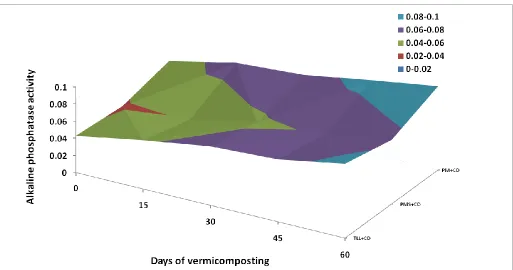
The range of activities of acid phosphatase and alkaline phosphatase enzymes are given in Fig. 1 and Fig. 2 respectively. At the time of start of the experiment (0 day), the acid phosphatase activity was 0.095, 0.083 and 0.101 m moles of phenol liberated / l respectively in teak leaf litter + cowdung, paper mill sludge + cowdung and pressmud + cowdung which showed gradual increase and on the 60th day it was 0.148, 0.126 and 0.154 m moles of phenol liberated / l respectively. The acid phosphatase activity range was found to be 0.095 - 0.154 m moles of phenol liberated / l. Alkaline phosphatase which ranged from 0.38 to 0.98 m moles of phenol liberated / l, also showed similar trend of statistically significant increase.
The total bacterial, fungal and actinomycetes in the vermibed substrates from 0th day to 60th day showed gradual increase. The total bacterial population ranged from 7.63 – 8.46 cfu x log10/g. TLL+CD vermibed combination showed 7.63, 7.85, 8.16, 8.23 and 8.25 cfu x log10/g in 0, 15, 30, 45 and 60th day of vermicomposting respectively. In PMS+CD vermibed combination the total fungal population was 4.90, 5.21, 5.29, 5.27 and 5.34 cfu x log10/g on 0, 15, 30, 45 and 60th day of vermicomposting respectively. Similarly total actinomyctes population also showed increase towards the progression of vermicomposting.
Fig. 1: 3-D area chart showing the range of activities of acid phosphatase activity during the vermicomposting of three different combinations of substrates (TLL – teak leaf litter; PMS – paper mill sludge; PM – pressmud. Alkaline phosphatase activity: m moles of phenol liberated / l).
Table 1. Correlation of microbial population with acid phosphatase during vermicomposting of different vermibed substrates using
Perionyx ceylanensis.
Vermibed substrates Regression equation R2 value Significance level
Bacterial population
Teak leaf litter + cowdung y = 12.32x + 6.529 0.890 p=0.01
Paper mill sludge + cowdung y = 15.20x + 6.547 0.703 p=0.05
Pressmud + cowdung y = 8.407x + 7.218 0.672 p=0.05
Fungal population
Teak leaf litter + cowdung y = 9.228x + 4.094 0.779 p=0.01
Paper mill sludge + cowdung y = 9.614x + 4.202 0.768 p=0.01
Pressmud + cowdung y = 10.85x + 4.908 0.556 p=0.05
Actinomycetes population
Teak leaf litter + cowdung y = 7.700x + 4.909 0.796 p=0.01
Paper mill sludge + cowdung y = 10.33x + 4.030 0.616 p=0.05
Pressmud + cowdung y = 5.924x + 5.287 0.410 p=0.05
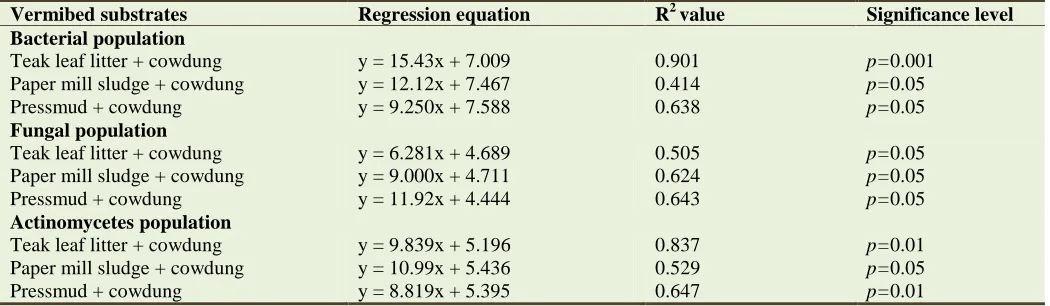
The correction of microbial population and alkaline phosphatase activity was found to be significant as both increased from 0 day to 60 days of vermicomposting (Table 2). The correlation of total bacterial population with alkaline phosphatase in teak leaf litter + cowdung vermibed combination was y = 15.43x+7.009 (R2 = 0.901; p=0.001), in paper mill sludge + cowdung vermibed combination was y = 12.12x + 7.467 (R2 = 0.414, p=0.05), and in pressmud + cowdung vermibed combination was y = 9.250x + 7.588
(R2 = 0.638, p=0.05). The correlation of total fungal population with acid phosphatase in teak leaf litter + cowdung vermibed combination was y = 6.281x + 4.689 (R2=0.505; p=0.05), in paper mill sludge + cowdung vermibed combination was y = 9.000x + 4.711 (R2=0.624; p=0.05), and in pressmud + cowdung was y = 11.92x + 4.444 (R2=0.643; p=0.05). Similar significant correlation was observed for total actinomyctes population also (Table 2).
Table 2. Correlation of microbial population with alkaline phosphatase during vermicomposting of different vermibed substrates
using Perionyx ceylanensis.
Vermibed substrates Regression equation R2 value Significance level
Bacterial population
Teak leaf litter + cowdung y = 15.43x + 7.009 0.901 p=0.001
Paper mill sludge + cowdung y = 12.12x + 7.467 0.414 p=0.05
Pressmud + cowdung y = 9.250x + 7.588 0.638 p=0.05
Fungal population
Teak leaf litter + cowdung y = 6.281x + 4.689 0.505 p=0.05
Paper mill sludge + cowdung y = 9.000x + 4.711 0.624 p=0.05
Pressmud + cowdung y = 11.92x + 4.444 0.643 p=0.05
Actinomycetes population
Teak leaf litter + cowdung y = 9.839x + 5.196 0.837 p=0.01
Paper mill sludge + cowdung y = 10.99x + 5.436 0.529 p=0.05
Pressmud + cowdung y = 8.819x + 5.395 0.647 p=0.01
Vermicomposting is an aerobic, bio-oxidation and stabilization, non-thermophilic process of organic waste decomposition that depends upon earthworms to fragment, mix and promote microbial activity (Gunadi et al., 2002). It has been shown to have high levels of total and available nitrogen, phosphorous, potassium (NPK) and micro nutrients, microbial and enzyme activities and growth regulators (Parthasarathi and Ranganathan, 1999; Chaoui et al., 2003; Karmegam and Daniel, 2008; Prakash et al., 2008). The process of vermicomposting results in the increase of microbial diversity and activity dramatically and the vermicompost produced could be a
definitive source of plant growth regulators produced by interactions between microorganisms and earthworms, which could contribute significantly to increased plant growth, flowering and yields (Arancon and Edwards, 2009).
may derive benefit from microorganisms when they have to survive on materials rich in cellulose or hemi cellulose. So there exists mutualistic relation between earthworms and microorganisms. In the present study, the earthworm activity in vermibeds favoured the growth of microbial population thereby resulting in increased enzyme activities. The correlation between the microbial population and phosphatase enzymes was found to be significant with variation between different vermibed substrates.
Conflict of interest statement
Authors declare that they have no conflict of interest.
References
Aira, M., Monroy, F., Domínguez, J., 2007. Earthworms strongly modify microbial biomass and activity triggering
enzymatic activities during vermicomposting
independently of the application rates of pig slurry. Sci. Tot. Environ. 385, 252-261.
Arancon, N. Q., Edwards, C. A., 2009. The utilization of vermicomposts in horticulture and agriculture. In: Proceedings of Indo-US Workshop on Vermitechnology in Human Welfare (Eds.: Edwards, C. A., Jayaraaj, R., Jayraaj, I. A.). Rohini Achagam, Coimbatore. pp.98-108. Chaoui, H. I., Zibilske, L. M., Ohno, T., 2003. Effects of
earthworms casts and compost on soil microbial activity and plant nutrient availability. Soil Biol. Biochem. 35(2), 295-302.
Edwards, C.A., 1998. The use of earthworms in the breakdown and management of organic waste. In: Earthworm Ecology (Ed.: Edwards, C.A.). St. Lucie Press, Boca
Raton. pp.327-354.
Gunadi, B., Blount, C., Edward, C.A., 2002. The growth and
fecundity of Eisenia foetida (Savigny) in cattle solids
pre-composted for different periods. Pedobiol. 46, 15-23.
Kale, R.D., 1993. Know-how of Earthworm. Earthworm Resources and Vermiculture. Zoological Survey of India, Calcutta. pp.43-49.
Karmegam, N., Daniel, T., 2009. Investigating efficiency of
Lampito mauritii (Kinberg) and Perionyx ceylanensis
Michaelsen for vermicomposting of different types of organic substrates. Environmentalist. 29, 287-300.
Karmegam, N., Daniel, T., 2008. Effect of vermicompost and chemical fertilizer on growth and yield of hyacinth bean,
Lablab purpureus (L.) Sweet. Dyn. Soil Dyn. Plant. 2,
77-81.
Lavelle, P., 1983. The structure of earthworm communities. In: Earthworm Ecology (Ed.: Satchell, J. E.). Chapman and Hall, London. pp.449-466.
Lowry, O.H., Roberts, N.R., Mei-Ring, W. U., Hixon, W.S., Crawford, E.J., 1954. Phosphatase studies—Acid and alkaline phosphatase. J. Biol. Chem. 207, l9-37.
Parthasarathi, K., Ranganathan, L. S., 1999. Longevity of microbial and enzyme activities and their influence on NPK content in pressmud vermicasts. Eur. J. Soil Biol. 35, 107-113.
Prakash, M., Karmegam, N., 2010. Vermistabilization of
pressmud using Perionyx ceylanensis Mich. Bioresour.
Technol. 101, 8464-8468.
Prakash, M., Jayakumar, M., Karmegam, N., 2008. Physico-chemical characteristics and fungal flora in the casts of the
earthworm, Perionyx ceylanensis Mich. reared in
Polyalthia longifolia leaf litter. J. Appl. Sci. Res. 4, 53-57. Zhang, B., Rouland, G, C., Lattaud, C., Lavelle, P., 1993. Activity and origin of digestive enzymes in gut of the tropical earthworm. Eur. J. Soil. Biol. 29(1), 7-11.
How to cite this article:
Devi, J., Prakash, M., 2016. Correlation of microbial population and phosphatases activity during
vermicomposting of organic substrates with Perionyx ceylanensis. Int. J. Curr. Res. Biosci. Plant