Smoothing Multivariate Performance Measures
Xinhua Zhang∗ [email protected]
Department of Computing Science University of Alberta
Alberta Innovates Center for Machine Learning Edmonton, Alberta T6G 2E8, Canada
Ankan Saha [email protected]
Department of Computer Science University of Chicago
Chicago, IL 60637, USA
S.V.N. Vishwanathan [email protected]
Departments of Statistics and Computer Science Purdue University
West Lafayette, IN 47907-2066, USA
Editor:Sathiya Keerthi
Abstract
Optimizing multivariate performance measure is an important task in Machine Learning. Joachims (2005) introduced a Support Vector Method whose underlying optimization problem is commonly
solved by cutting plane methods (CPMs) such asSVM-PerfandBMRM. It can be shown thatCPMs
converge to anεaccurate solution inO λε1iterations, whereλis the trade-off parameter between
the regularizer and the loss function. Motivated by the impressive convergence rate ofCPMon
a number of practical problems, it was conjectured that these rates can be further improved. We disprove this conjecture in this paper by constructing counter examples. However, surprisingly, we further discover that these problems are not inherently hard, and we develop a novel smoothing
strategy, which in conjunction with Nesterov’s accelerated gradient method, can find anε
accu-rate solution inO∗minn1ε,√1
λε o
iterations. Computationally, our smoothing technique is also particularly advantageous for optimizing multivariate performance scores such as precision/recall
break-even point andROCArea; the cost per iteration remains the same as that ofCPMs.
Empiri-cal evaluation on some of the largest publicly available data sets shows that our method converges
significantly faster thanCPMs without sacrificing generalization ability.
Keywords: non-smooth optimization, max-margin methods, multivariate performance measures, Support Vector Machines, smoothing
1. Introduction
Recently there has been an explosion of interest in applying machine learning techniques to a num-ber of application domains, much of which has been fueled by the phenomenal success of binary Support Vector Machines (SVMs). At the heart of SVMs is the following regularized risk
mization problem:
min
w J(w) =
λ
2kwk 2
+Remp(w). (1)
HereRemp is the so-called empirical risk (see below), 12kwk2 is the regularizer, λ>0 is a scalar which trades off the importance of the empirical risk and the regularizer. Given a training set with
nexamples
X
:={(xi,yi)}ni=1wherexi∈Rpandyi∈ {±1}, the empirical riskRempminimized by SVMs is the average of the hinge loss:Remp(w):= 1
n n
∑
i=1
max(0,1−yihw,xii), (2)
whereh·,·idenotes the Euclidean dot product.
Binary SVMs optimize classification accuracy, while many application areas such as Natural Language Processing (NLP) frequently use more involved multivariate performance measures such as precision/recall break-even point (PRBEP) and area under the Receiver Operating Characteristic
curve (ROCArea). Joachims (2005) proposed an elegant SVM based formulation for directly
op-timizing these performance metrics. In his formulation, the empirical riskRempin (1) is replaced by
Remp(w):= max z∈{−1,1}n
"
∆(z,y) +1 n
n
∑
i=1
hw,xii(zi−yi) #
. (3)
Here, ∆(z,y) is the multivariate discrepancy between the correct labels y:= (y1, . . . ,yn)⊤ and a candidate labelingz:= (z1, . . . ,zn)⊤∈ {±1}n. In order to compute the multivariate discrepancy for
PRBEPwe need the false negative and false positive rates, which are defined as
b=
∑
i∈Pδ(zi=−1) and c=
∑
j∈Nδ(zj=1), respectively.
Hereδ(x) =1 ifxis true and 0 otherwise, while
P
andN
denote the set of indices with positive (yi= +1) and negative (yi=−1) labels respectively. Furthermore, letn+=|P
|,n−=
N
. With this notation in place,∆(zzz,yyy)forPRBEPis defined as∆(zzz,yyy) = (
b/n+ ifb=c
−∞ otherwise. (4)
ROCArea, on the other hand, measures how many pairs of examples are mis-ordered. Denote
m=n+n−. Joachims (2005) proposed using the following empirical risk,Remp, to directly optimize
theROCArea:1
Remp(w) = 1
mz∈{max0,1}m
"
∑
i∈P j
∑
∈Nzi j h
1−w⊤(xi−xj) i#
. (5)
We will call the regularized risk minimization problem with thePRBEPloss (3) as thePRBEP
-problem and with the ROCArea loss (5) as the ROCArea-problem respectively. As is obvious,
both these problems entail minimizing a non-smooth objective function which isnotadditive over the data points. Fortunately, cutting plane methods (CPMs) such as SVM-Perf (Joachims, 2006)
and BMRM(Teo et al., 2010) can be used for this task. At each iteration these algorithms only
require a sub-gradient ofRemp, which can be efficiently computed by aseparationalgorithm with
O(nlogn)effort for both (3) and (5) (Joachims, 2005). In this paper, we will work withBMRMas
our prototypicalCPM, which, as Teo et al. (2010) point out, includesSVM-Perfas a special case. CPMs are popular in Machine Learning because they come with strong convergence guarantees.
The tightest upper bound on the convergence speed ofBMRM, which we are aware of, is due to Teo
et al. (2010). Theorem 5 of Teo et al. (2010) asserts thatBMRMcan find anε-accurate solution of
the regularized risk minimization problem (1) with non-smooth empirical risk functions such as (3) and (5) after computingO(λε1)subgradients. This upper bound is built upon the following standard assumption:
Assumption 1 (A1) The subgradient of Remp is bounded, that is, at any point w, there exists a
subgradient ggg∈∂Remp(w)such thatkgggk ≤G<∞.
In practice the observed rate of convergence ofBMRMis significantly faster than predicted by
the-ory. Therefore, it was conjectured that perhaps a more refined analysis might yield a tighter upper bound (Teo et al., 2010). Our first contribution in this paper is to disprove this conjecture under assumptionA1. We carefully constructPRBEPandROCAreaproblems on whichBMRMrequires
at least Ω(1/ε) iterations to converge for a fixed λ. It is worthwhile emphasizing here that due to the specialized form of the objective function in (1), lower bounds forgeneralconvex function classes such as those studied by Nesterov (2003) and Nemirovski and Yudin (1983) do not apply. In addition, our examples stick to binary classification and are substantially different from the one in Joachims et al. (2009) which requires an increasing number of classes.
This result leads to the following natural question: do the lower bounds hold because thePRBEP
andROCAreaproblems are fundamentally hard, or is it an inherent limitation of CPM? In other
words, does there exist a solver which solves thePRBEPandROCAreaproblems by invoking the
separation algorithm for fewer than O(λε1) times?2 We provide partial answers. To understand our results one needs to understand another standard assumption that is often made when proving convergence rates:
Assumption 2 (A2) Eachxilies inside an L2(Euclidean) ball of radius R, that is,kxik ≤R.
Clearly assumption A2is more restrictive than A1, because kxxxik ≤Rimplies that for all www, any
subgradient of RemphasL2 norm at most 2R in both (3) and (5). Our second contribution in this paper is to show that theO(λε1)barrier can be broken under assumptionA2, while making a similar claim just under assumptionA1remains an open problem. In a nutshell, our algorithm approximates (1) by a smooth function, which in turn can be efficiently minimized by using either accelerated gradient descent (Nesterov, 1983, 2005, 2007) or a quasi-Newton method (Nocedal and Wright, 2006). This technique for non-smooth optimization was pioneered by Nesterov (2005). However, applying it to multivariate performance measures requires special care. We now describe some relevant details and point out technical difficulties that one encounters along the way.
1.1 Nesterov’s Formulation
LetAbe a linear transform and assume that we can find a smooth functiong⋆µ(A⊤w)with a Lipschitz continuous gradient such thatRemp(w)−g⋆µ(A⊤w)
≤µfor allw. It is easy to see that
Jµ(w):=λ
2kwk 2
+g⋆µ(A⊤w) (6)
satisfies Jµ(w)−J(w)
≤µ for all w. In particular, if we set µ=ε/2 and find a w′ such that
Jµ(w′)≤minwJµ(w) +ε/2, then it follows thatJ(w′)≤minwJ(w) +ε. In other words, w′ is anε
accurate solution for (1).
By applying Nesterov’s accelerated gradient method toJµ(w)one can find anε-accurate solution
of the original nonsmooth problem (1) after querying the gradient ofg⋆µ(A⊤w)at most
O∗ √
DkAkmin
1
ε,
1 √
λε
(7)
number of times (Nesterov, 1983, 2005).3 Here kAk is the matrix norm of A, which is defined askAk=maxuuu,vvv:kuuuk=kvvvk=1uuu⊤Avvv=
p
λmax(A⊤A), withλmax denoting the maximum eigenvalue of
A, when the norm considered is the Euclidean norm. Furthermore, Dis a geometric constant that depends solely ongµand is independent ofε,λ, orA. Compared with theO(λε1)rates ofCPMs, the
1
√
λε part in (7) is already superior. Furthermore, many applications requireλ≪εand in this case the 1ε part of the rate is even better. Note thatCPMs rely on λ
2kwk
2to stabilize each update, and it has been empirically observed that they converge slowly whenλis small (see, e.g., Do et al., 2009). Although the above scheme is conceptually simple, the smoothing of the objective function in (1) has to be performed very carefully in order to avoid dependence onn, the size of the training set. The main difficulties are two-fold. First, one needs to obtain a smooth approximationg⋆µ(A⊤w)to
Remp(w)such that √
DkAkis small (ideally a constant). Second, we need to show that computing the gradient ofg⋆µ(A⊤w) is no harder than computing a subgradient ofRemp(w). In the sequel we will demonstrate how both the above difficulties can be overcome. Before describing our scheme in detail we would like to place our work in context by discussing some relevant related work.
1.2 Related Work
Training large SV models by using variants of stochastic gradient descent has recently become increasingly popular (Bottou, 2008; Shalev-Shwartz et al., 2007). While the dependence onεandλ
is stillΩ(1
λε)or worse (Agarwal et al., 2009), one gets bounds on the computational cost independent ofn. However, stochastic gradient descent can only be applied when the empirical risk isadditively decomposable, that is, it can be written as the average loss over individual data points like in (2). Since the non-linear multivariate scores such as the ones that we consider in this paper are not additively decomposable, this rules out the application of online algorithms to these problems.
Traditionally, batch optimizers such as the popular Sequential Minimal Optimization (SMO) worked in the dual (Platt, 1998). However, as List and Simon (2009) show, for the empirical risk (2) based on hinge loss, if the matrix which contains the dot products of all training instances
(also known as the kernel matrix) is not strictly positive definite, then SMO requiresO(n/ε) iter-ations with each iteration costingO(np)effort. However, when the kernel matrix is strictly posi-tive definite, then one can obtain anO(n2log(1/ε))bound on the number of iterations, which has better dependence on ε, but is prohibitively expensive for large n. Even better dependence onε
can be achieved by using interior point methods (Ferris and Munson, 2002) which require only
O(log(log(1/ε))iterations, but the time complexity per iteration isO(min{n2p,p2n}).
Recently, there has been significant research interest in optimizers which directly optimize (1) because there are some distinct advantages (Teo et al., 2010). Chapelle (2007) observed that to find awwhich generalizes well, one only needs to solve the primal problem to very low accuracy (e.g., ε≈0.001). In fact, to the best of our knowledge, Chapelle (2007) introduced the idea of smoothing the objective function to the Machine Learning community. Specifically, he proposed to approximate the binary hinge loss by a smooth Huber’s loss and used the Newton’s method to solve this smoothed problem. This approach yielded the best overall performance in the Wild Competition Track of Sonnenburg et al. (2008) for training binary linear SVMs on large data sets. A similar smoothing approach is proposed by Zhou et al. (2010), but it is also only for hinge loss.
However, the smoothing proposed by Chapelle (2007) for the binary hinge loss is rather ad-hoc, and does not easily generalize to (3) and (5). Moreover, a function can be smoothed in many different ways and Chapelle (2007) did not explicitly relate the influence of smoothing on the rates of convergence of the solver. In contrast, we propose principled approaches to overcome these problems.
Of course, other smoothing techniques have also been explored in the literature. A popular approach is to replace the nonsmooth max term by a smooth log-sum-exp approximation (Boyd and Vandenberghe, 2004). In the case of binary classification this approximation is closely related to logistic regression (Bartlett et al., 2006; Zhang, 2004), and is equivalent to using an entropy regularizer in the dual. However, as we discuss in Section 3.1.2 this technique yields exorbitantly large√DkAkin the bound (7) when applied to optimize multivariate performance measures.
1.3 Notation And Paper Outline
We assume a standard setup as in Nesterov (2005). Lower bold case letters (e.g., w, µµµ) denote vectors,wi denotes thei-th component ofw,0 refers to the vector with all zero components,eeei is
thei-th coordinate vector (all 0’s except 1 at thei-th coordinate) and∆krefers to thekdimensional
simplex. Unless specified otherwise,k·krefers to the Euclidean normkwk:=phwww,wwwi. We denote
R:=R∪ {∞}, and[t]:={1, . . . ,t}.g⋆stands for the Fenchel dual of a functiong, and∂g(www)is the subdifferential ofgatwww(the set of all subgradients ofgatwww).
In Section 2, we first establish the lower bounds on the rates of convergence of CPMs when
used to optimize the regularized risk of PRBEP and ROCArea. To break this lower bound, our
1.4 Improvement On Earlier Versions Of This Paper
This paper is based on two prior publications of the same authors: Zhang et al. (2011a) at NIPS 2010 and Zhang et al. (2011b) at UAI 2011, together with a technical report (Zhang et al., 2010). Major improvements have been made on them, which include:
• New lower bounds forPRBEPandROCArealosses (see Sections 2.2 and 2.3 respectively).
• Significantly simplified algorithms for computing the gradient of smoothed objectives for
bothPRBEPandROCArealosses (See Sections 4.1 and 4.2 respectively).
• Empirical evaluation on some of the largest publicly available data sets including those from the Pascal Large Scale Learning Workshop in Section 5 (Sonnenburg et al., 2008)
• Open source code based on PETSc (Balay et al., 2011) and TAO (Benson et al., 2010) pack-ages made available for download from Zhang et al. (2012).
2. Lower Bounds For Cutting Plane Methods
BMRM(Teo et al., 2010) is a state-of-the-art cutting plane method for optimizing multivariate
per-formance scores which directly minimizes the non-smooth objective functionJ(www). At every itera-tion,BMRMreplacesRempby a piecewise linear lower boundRcp
k and obtains the next iteratewk by
optimizing
wk:=argmin w w w
Jk(w):= λ
2kwk 2+Rcp
k (w), where R
cp
k (w):=max
i∈[k]hw,aii+bi. (8)
Here ai∈∂Remp(wi−1) denotes an arbitrarysubgradient ofRemp at wi−1 andbi =Remp(wi−1)− hwi−1,aii. The piecewise linear lower bound is successively tightened until the gap
εk:= min
0≤t≤kJ(wt)−Jk(wk) (9)
falls below a predefined toleranceε.
SinceJkin (8) is a convex objective function, the optimalwwwkcan be obtained by solving its dual
problem, which is a quadratic programming problem with simplex constraints. We refer the reader to Teo et al. (2010) for more details. The overall procedure ofBMRMis summarized in Algorithm
1. Under AssumptionA1, Teo et al. (2010) showed thatBMRMconverges atO(1
λε)rates:
Theorem 3 Suppose Assumption 1 holds. Then for anyε<4G2/λ,BMRMconverges to anε
accu-rate solution of (1)as measured by(9)after at most the following number of steps:
log2λJ(0)
G2 + 8G2
λε −1.
2.1 Lower Bound Preliminaries
Algorithm 1:BMRM.
Input: A tolerance level of function valueε.
1 Initialize:www0to arbitrary value, for example,0. Letk=1.
2 while TRUE do
3 Pick arbitrary subgradient ofRempatwk−1:ak∈∂Remp(wk−1). 4 Letbk=Remp(wk−1)− hwk−1,aki.
5 Solvewk=argminwJk(w) =argminw
n λ 2kwk
2+max
i∈[k]{hw,aii+bi} o
.
6 ifmin0≤t≤kJ(wt)−Jk(wk)<εthen returnwwwk. elsek=k+1.
minimizing the objective functionJ(w)defined in (1), if we minimize a scaled versioncJ(w)this scales the approximation gap (9) byc. AssumptionA1fixes this degree of freedom by bounding the scale of the objective function.
Given a function f∈
F
and an optimization algorithmA, suppose{wk}are the iterates producedby some algorithmAwhen minimizing some function f. DefineT(ε;f,A)as the first step indexk
whenwk becomes anεaccurate solution:4
T(ε;f,A) =min{k: f(wk)−minwwwf(www)≤ε}.
Upper and lower bounds are both properties for a pair of
F
andA. A functionκ(ε) is called anupper bound of(
F
,A)if for all functions f ∈F
and allε>0, it takesat mostorderκ(ε)steps forAto reduce the gap to less thanε, that is,
(UB) ∀ε>0,∀ f ∈
F
,T(ε;f,A)≤κ(ε).On the other hand, we define lower bounds as follows. κ(ε)is calledalower bound of(
F
,A)if for anyε>0, there exists a function fε∈F
depending onε, such that it takesat leastκ(ε)steps forA to find anεaccurate solution of fε:(LB) ∀ε>0,∃ fε∈
F
,s.t. T(ε;fε,A)≥κ(ε).Clearly, this lower bound is sufficient to refute upper bounds or to establish their tightness. The size of the function class
F
affects the upper and lower bounds in opposite ways. SupposeF
′⊂F
. Proving upper (resp. lower) bounds on (F
′,A)is usually easier (resp. harder) than proving upper(resp. lower) bounds for(
F
,A). Since the lower bounds studied by Nesterov (2003) and Nemirovski and Yudin (1983) are constructed by usinggeneralconvex functions, they do not apply here to our specialized regularized risk objectives.We are interested in bounding theprimal gapof the iterateswk:J(wk)−minwwwJ(www). Data sets
will be constructed explicitly whose resulting objectiveJ(w)will be shown to satisfy Assumption
A1and attain the lower bound ofBMRM. We will focus on theRempfor both thePRBEPloss in (3)
and theROCArealoss in (5).
4. The initial point also matters, as in the best case one can just start from the optimal solution. Thus the quantity of interest is actuallyT(ε;f,A):=maxw0min{k:f(wk)−minwwwf(www)≤ε, starting point beingw0}. However, without
2.2 Construction Of Lower Bound ForPRBEPProblem
Given ε>0, let n=⌈1/ε⌉+1 and construct a data set {(xxxi,yi)}ni=1 as follows. Setc=
√
2 4 , and let eeei denote the i-th coordinate vector in Rn+2 (p=n+2). Let the first example be the only
positive example: y1= +1 andxxx1=cneee2. The restn−1 examples are all negative: yi=−1 and xxxi=−cneee3−cneeei+2fori∈[2,n]. This data set concretizes theRempin (3) as follows:
Remp(www) = max
zzz∈{−1,1}n
"
∆(zzz,yyy) +1
nhwww,xxx1i(z1−1) +
1
n n
∑
i=2
hwww,xxxii(zi+1)
| {z }
:=ϒ(zzz)
#
.
Setting λ=1, we obtain the overall objective J(www)in (1). Now we have the following lower bound on the rates of convergence ofBMRM.
Theorem 4 Let www0=eee1+2ceee2+2ceee3. Suppose runningBMRMon the above constructed objective
J(www)produces iteratesw1, . . . ,wk, . . .. Then it takesBMRMat least 1
5ε
steps to find anεaccurate solution. Formally,
min
i∈[k]J(wi)−minwww J(www)≥
1 4
1
k−
1
n−1
for allk∈[n−1],
hence min
i∈[k]J(wi)−minwww J(www)>εfor allk<
1 5ε.
Proof The crux of our proof is to show
wwwk=2ceee2+2ceee3+ 2c
k k+3
∑
i=4
eeei, for allk∈[n−1]. (10)
We prove it by induction. Initially atk=1, we note
1
nhwww0,xxx1i=2c
2=1 4, and
1
nhwww0,xxxii=−2c
2=
−14, ∀i∈[2,n]. (11)
Since there is only one positive example,zzzcan only have two cases. Ifzzz=yyy(i.e., correct labeling withb=0), thenϒ(zzz) =ϒ(yyy) =0. Ifzzzmisclassifies the only positive example into negative (i.e.,
b=1), then∆(zzz,yyy) =nb+ =1. SincePRBEPforcesc=b=1, there must be one negative example
misclassified into positive by zzz. By (11), all i∈[2,n]play the same role in ϒ(zzz). Without loss of generality, assume the misclassified negative example isi=2, that is, zzz= (−1,1,−1,−1, . . .). It is easy to check thatϒ(zzz) =1+2
n[−hwww0,xxx1i+hwww0,xxx2i] =0=ϒ(yyy), which means suchzzzis a
maximizer ofϒ(zzz). Using thiszzz, we can derive a subgradient ofRemp(www0):
a aa1=
2
n(−xxx1+xxx2) =−2ceee2−2ceee3−2ceee4andb1=0− haaa1,www0i=4c
2+4c2=1,
www1=argmin
www
1 2kwwwk
2+
haaa1,wwwi+b1
=2ceee2+2ceee3+2ceee4.
Next assume (10) holds for steps 1, . . . ,k(k∈[n−2]). Then at stepk+1 we have
1
nhwwwk,xxx1i=2c
2= 1 4, and
1
nhwwwk,xxxii= (
−2c2−2kc2 =−1 4−
1
Again consider two cases ofzzz. If zzz=yyythenϒ(zzz) =ϒ(yyy) =0. Ifzzzmisclassifies the only positive example into negative, then∆(zzz,yyy) =1. Ifzzz misclassifies any ofi∈[2,k+1]into positive, then
ϒ(zzz) =1+2
n[−hwwwk,xxx1i+hwwwk,xxxii] =−
1
2k <ϒ(yyy). So suchzzzcannot be a maximizer ofϒ(zzz). But
ifzzzmisclassifies any ofi≥k+2 into positive, thenϒ(zzz) =1+2
n[−hwwwk,xxx1i+hwwwk,xxxii] =0=ϒ(yyy).
So suchzzzis a maximizer. Picki=k+2 and we can derive from thiszzza subgradient ofRemp(wwwk):
a a ak+1=
2
n(−xxx1+xxxk+2) =−2ceee2−2ceee3−2ceeek+4, bk+1=0− haaak+1,wwwki=4c
2+4c2=1,
w
wwk+1=argmin
w w w
Jk+1(www) =argmin
w w w
1 2kwwwk
2
+max
i∈[k+1]{haaai,wwwi+bi}
=2ceee2+2ceee3+ 2c k+1
k+4
∑
i=4
eeei.
To verify the last step, notehaaai,wwwk+1i+bi=2(k+−11)for alli∈[k+1], and so∂Jk+1(wwwk+1) ={wwwk+1+
∑k+i=11αiaaai:ααα∈∆k+1} ∋0(just set allαi=k+11). So (10) holds for stepk+1. (End of induction.)
All that remains is to observeJ(wwwk) =14(2+1k)while minwwwJ(www)≤J(wwwn−1) =14(2+n−11), from which it follows thatJ(wwwk)−minwwwJ(www)≥14(1k−n−11).
Note in the above run ofBMRM, all subgradientsaaak have norm
q
3
2 which satisfies Assumption 1.
2.3 Construction Of Lower Bound ForROCAreaProblem
Next we consider the case ofROCArea. Givenε>0, define n=⌊1/ε⌋and construct a data set
{(xxxi,yi)}n+i=11withn+1 examples as follows. Leteeeibe thei-th coordinate vector inRn+2(p=n+2).
The first example is the only positive example withy1= +1 andxxx1=√neee2. The restnexamples are all negative, withyi=−1 andxxxi=−neeei+1fori∈[2,n+1]. Then the corresponding empirical risk forROCArealoss is
Remp(www) = 1
n n+1
∑
i=2
max{0,1− hwww,xxx1−xxxii}=
1
n n+1
∑
i=2
max{0,1− hwww,√neee2+neeei+1
| {z }
:=uuui
i}.
By further setting λ=1, we obtain the overall objective J(www) in (1). It is easy to see that
the minimizer ofJ(www) isw∗= 12√1neee2+1n∑n+i=32eeei
andJ(w∗) = 41n. In fact, simply check that hw∗,uuuii=1 for alli, so∂J(w∗) =
n
w∗−∑ni=1αi
1
√neee2+eeei+2
:αi∈[0,1] o
, and setting allαi=21n
yields the subgradient0. Then we have the following lower bound on the rates of convergence for
BMRM.
Theorem 5 Letw0=eee1+√1neee2. Suppose runningBMRMon the above constructed objective J(www)
produces iterates w1, . . . ,wk, . . .. Then it takes BMRM at least 2
3ε
steps to find an ε accurate solution. Formally,
min
i∈[k]J(wi)−J(w ∗) = 1
2k+
1
4n for allk∈[n],hence mini∈[k]J(wi)−J(w
∗)>εfor allk< 2
3ε.
Proof The crux of the proof is to show that
w w wk=
1 √
neee2+
1
k k+2
∑
i=3
We prove (12) by induction. Initially atk=1, we note thathwww0,uuuii=1 for alli∈[2,n+1]. Hence
we can derive a subgradient andwww1:
a aa1=−
1
nuuu2=−
1 √
neee2−eee3, b1=−haaa1,www0i=
1
n,
w
ww1=argmin
w ww
1 2kwwwk
2
+haaa1,wwwi+b1
=−aaa1= 1 √
neee2+eee3.
So (12) holds fork=1. Now suppose it hold for steps 1, . . . ,k(k∈[n−1]). Then for stepk+1 we note
hwwwk,uuuii= (
1+nk ifi≤k
1 ifi≥k+1.
Therefore we can derive a subgradient and computewwwk+1:
a
aak+1=− 1
nuuuk+2=−
1 √
neee2−eeek+3, bk+1=−haaak+1,wwwki=
1
n,
wwwk+1=argmin
w ww
n1
2kwwwk
2+ max
i∈[k+1]{haaai,wwwi+bi}
| {z }
:=Jk+1(www)
o
=− 1 k+1
k+1
∑
i=1
a aai=
1 √neee2+
1
k+1
k+3
∑
i=3
eeei.
This minimizer can be verified by noting that hwwwk+1,aaaii+bi=−k+11 for all i∈[k+1], and so ∂Jk+1(wwwk+1) ={wwwk+1+∑k+i=11αiaaai:ααα∈∆k+1} ∋0 (just set allαi= k+11). So (12) holds for step k+1. (End of induction.)
All that remains is to observeJ(wwwk) =21(1n+1k).
As before, in the above run of BMRM, all subgradients aaak have norm (1+1
n)
1/2 which satisfies Assumption 1.
3. Reformulating The Empirical Risk
In order to bypass the lower bound of CPMs and show that the multivariate score problems can
be optimized at faster rates, we propose a smoothing strategy as described in Section 1.1. In this section, we will focus on the design of smooth surrogate functions, with emphasis on the consequent rates of convergence when optimized by Nesterov’s accelerated gradient methods (Nesterov, 2005). The computational issues will be tackled in Section 4.
In order to approximate Remp by g⋆µ we will start by writing Remp(w) asg∗(A⊤w) for an ap-propriate linear transformAand convex functiong. Let the domain ofgbeQandd be a strongly convex function with modulus 1 defined onQ. Furthermore, assume minααα∈Qd(ααα) =0 and denote D=maxααα∈Qd(ααα). In optimization parlancedis called aprox-function. Set
g⋆µ= (g+µd)⋆.
Then by the analysis in Appendix A, we can conclude that g⋆µ(A⊤w) has a Lipschitz continuous gradient with constant at most 1µkAk2. In addition,
g⋆µ(A⊤w)−Remp(w)
Choosingµ=ε/D, we can guarantee the approximation is uniformly upper bounded byε.
There are indeed many different ways of expressing Remp(w) as g⋆(A⊤w), but the next two sections will demonstrate the advantage of our design.
3.1 Contingency Table Based Loss
Letting
S
kdenote thekdimensional probability simplex, we can rewrite (3) as:Remp(w) = max
zzz∈{−1,1}n "
∆(zzz,yyy) +1 n
n
∑
i=1
hw,xxxii(zi−yi) #
(14)
= max α
αα∈S2n
∑
zzz∈{−1,1}nαzzz ∆(zzz,yyy) +
1
n n
∑
i=1
hw,xxxii(zi−yi) !
(15)
= max α
αα∈S2n
∑
zzz∈{−1,1}n
αzzz∆(zzz,yyy)−
2
n n
∑
i=1
yihw,xxxii
∑
zzz:zi=−yiαzzz !
.
Note from (14) to (15), we defined 0·(−∞) =0 since ∆(zzz,yyy) can be −∞as in (4). Introduce
βi=∑zzz:zi=−yiαzzz. Thenβi∈[0,1]and one can rewrite the above equation in terms ofβββ:
Remp(w) = max β β β∈[0,1]n
( −2
n n
∑
i=1
yihw,xxxiiβi−g(βββ) )
(16)
where g(βββ):=− max α α
α∈A(βββ)zzz
∑
∈{−1,1}nαzzz∆(zzz,yyy). (17)
Here
A
(βββ) is a subset ofS
2ndefined via
A
(βββ) =αααs.t. ∑zzz:zi=−yiαzzz=βi for alli . Indeed, this rewriting only requires that the mapping fromααα∈S
2n toβββ∈Q:= [0,1]nis surjective. This is clearbecause for anyβββ∈[0,1]n, a pre-imageαααcan be constructed by setting:
αzzz= n
∏
i=1
γi, where γi= (
βi ifzi=−yi
1−βi ifzi=yi .
Proposition 6 g(βββ)defined by(17)is convex onβββ∈[0,1]n.
Proof Clearly
A
(βββ)is closed for anyβββ∈Q. So without loss of generality assume that for anyβββandβββ′in[0,1]n, the maximum in (17) is attained atαααandααα′ respectively. So∑
zzz:zi=−yiαzzz=βiand
∑zzz:zi=−yiα′zzz=β′i. For anyρ∈[0,1], considerβββ ρ
:=ρβββ+ (1−ρ)βββ′. Defineαααρ:=ρααα+ (1−ρ)ααα′. Then clearlyαααρsatisfies
∑
zzz:zi=−yi
αρzzz =ρβi+ (1−ρ)β′i=β ρ i.
Thereforeαααρis admissible in the definition ofg(βββρ)(17), and
g(βββρ)≤ −
∑
zzzαρzzz∆(zzz,yyy) =−ρ
∑
zzzαzzz∆(zzz,yyy)−(1−ρ)
∑
zzzα′zzz∆(zzz,yyy)
=ρg(βββ) + (1−ρ)g(βββ′).
which establishes the convexity ofg.
3.1.1 √DkAkFOROURDESIGN
Let us choose the prox-function d(βββ) as 12kβββk2. Then D=maxβββ∈[0,1]nd(βββ) = n2. Define A=
−2
n (y1xxx1, . . . ,ynxxxn)andMbe an-by-nmatrix withMi j=yiyj
xxxi,xxxj
. Clearly,A⊤A=n42M. Because we assumed thatkxxxik ≤R, it follows that |Mi j| ≤R2. The norm of Acan be upper bounded as
follows:
kAk2=λmax(A⊤A) = 4
n2λmax(M)≤ 4
n2tr(M)≤ 4
n2·nR 2=4R2
n . (18)
Hence
√
DkAk ≤ r
n
2 2R
√
n =
√ 2R.
This constant upper bound is highly desirable because it implies that the rate of convergence in (7) is independent of the size of the data set (norp). However, the cost per iteration still depends onn
andp.
3.1.2 ALTERNATIVES
It is illuminating to see how naive choices for smoothingRempcan lead to excessively large values of√DkAk. For instance, using (14),Remp(w)can be rewritten as
Remp(w) = max
zzz∈{−1,1}n 1
n "
n∆(zzz,yyy) + n
∑
i=1
hw,xxxii(zi−yi) #
=max α α
α∈Q
∑
zzz∈{−1,1}nαzzz n∆(zzz,yyy) + n
∑
i=1
hw,xxxii(zi−yi) !
.
whereQrefers to the 2ndimensional simplex scaled by 1
n:Q=
ααα:αz∈[0,n−1]and∑zzzαzzz= 1n .
DefiningAas a p-by-2nmatrix whosezzz-th column is given by∑ni=1xxxi(zi−yi)and writing h(ααα) =
(
−n∑zzz∈{−1,1}n∆(zzz,yyy)αzzz ifααα∈Q
+∞ otherwise ,
we can expressRempas
Remp(w) =max α α α∈Q
hD
A⊤w,αααE−h(ααα)i=h⋆(A⊤w). (19)
Now let us investigate the value of√DkAk. AsQ is a scaled simplex, a natural choice of prox-function is
d(ααα) =
∑
zzzαzzzlogαzzz+
1
nlogn+log 2.
Clearly,d(ααα)is a strongly convex function inQwith modulus of strong convexity 1 under theL1 norm (see, e.g., Beck and Teboulle, 2003, Proposition 5.1). In addition,d(ααα)is minimized whenααα
is uniform, that is,αzzz=n12n for allzzz, and so min
α α
α∈Qd(ααα) =2 n 1
n2nlog
1
n2n+
1
Therefore d(ααα) satisfies all the prerequisites of being a prox-function. Furthermore, d(ααα) is maximized on the corner of the scaled simplex, for example,αyyy=1n andαzzz=0 for allzzz6=yyy. So
D=max α α
α∈Qd(ααα) =
1
nlog
1
n+
1
nlogn+log 2=log 2. (20)
Finally, denoting thez-th column ofAasA:zzz, we can computekAkas kAk= max
u:kuk=1,v:∑zzz|vzzz|=1
u⊤Av= max
v:∑zzz|vzzz|=1
kAvk=max z kA:zk
=max z
n
∑
i=1
xxxi(zi−yi) ≤
2
n
∑
i=1
kxxxik ≤2nR. (21)
Note this bound is tight becausekAk=2nRcan be attained by settingxxxi=Reee1 for alli, in which case the maximizingzzzis simply−yyy. Eventually combining (20) and (21), we arrive at
√
DkAk ≤2nRplog 2.
Thus if we re-expressRempby using this alternative form as in (19), √
DkAkwill scale asΘ(nR)
which grows linearly withn, the number of training examples.
3.2 ROCAreaLoss
We rewriteRemp(w)from (5) as: 1
mzi jmax∈{0,1}i
∑
∈P j∑
∈Nzi j[1−w⊤(xi−xj)] =
1
mβββ∈max[0,1]m
∑
i∈Pj
∑
∈Nβi j h
1−www⊤(xxxi−xxxj) i
. (22)
The above empirical risk can be identified withg⋆(A⊤w)by setting
g(βββ) = (
−1
m∑i,jβi j ifβββ∈[0,1]m +∞ elsewhere ,
and lettingAbe a p-by-mmatrix whose(i j)-th column is−m1(xxxi−xxxj). Thisgis a linear function
defined over a convex domain, and hence clearly convex.
3.2.1 √DkAkFOROURDESIGN
Choose prox-functiond(βββ) = 1
2∑i,jβ2i j. By a simple calculation,D=maxβββd(βββ) = m2. As before, defineAto be a matrix such that its(i j)-th columnAi j =−m1(xxxi−xxxj)andMbe am-by-mmatrix
withM(i j)(i′j′)=xxxi−xxxj,xxxi′−xxxj′. Clearly, A⊤A= 1
m2M. Because we assumed thatkxxxik ≤R, it
follows that|Mi j| ≤4R2. The norm ofAcan be upper bounded as follows: kAk2=λmax(A⊤A) =
1
m2λmax(M)≤ 1
m2tr(M)≤ 1
m2·4mR 2=4R2
m .
Therefore
√
DkAk ≤ r
m
2 · 2R
√
m=
√
2R. (23)
3.2.2 ALTERNATIVES
The advantage of our above design of g⋆(A⊤www) can be seen by comparing it with an alternative design. In (22), let us introduce
γi=
∑
j∈Nβi j,i∈
P
, and γj=∑
i∈Pβi j, j∈
N
.Then clearly γγγ∈
B
:={γi∈[0,n−],γj ∈[0,n+]}. However this map fromβββ∈[0,1]m toγγγ∈B
isobviouslynotsurjective, because the imageγγγshould at least satisfy∑i∈Pγi=∑j∈N γj.5 So let us
denote the real range of the mapping as
A
andA
⊆B
. Now rewrite (22) in terms ofγγγ:Remp(www) = 1
mmaxγγγ∈A
(
∑
i∈P
γiwww⊤(−xxxi) +
∑
j∈Nγjwww⊤xxxj+
∑
i∈Pγi+
∑
j∈Nγj )
=g⋆(A⊤www), where g(γγγ) = (
−1
m∑i∈Pγi+m1∑j∈N γj ifγγγ∈
A
+∞ elsewhere,andAis ap-by-nmatrix whosei-th column is−m1xxxi(i∈
P
) and j-th column is m1xxxj (j∈N
).Choose a prox-function d(γγγ) = 12kγγγk2. Then we can boundkAkby mR√nsimilar to (18) and boundDby
D=max
γγγ∈A d(γγγ)≤maxγγγ∈Bd(γγγ) =
1 2 n
2
+n−+n+n2−.
Note that the≤here is actually an equality because they have a common maximizer: γi=n−
for alli∈
P
andγj=n+for all j∈N
(which is mapped from allβi j=1). Now we have√
DkAk ≤√1
2
q n2
+n−+n+n2− R m
√
n=√R
2
s
(n++n−)2 n+n−
.
This bound depends on the ratio between positive and negative examples. If the class is balanced and there exist constantsc+,c− ∈(0,1)such thatn+≥c+nandn−≥c−n, then we easily derive √
DkAk ≤ √ R
2c+c− which is a constant. However, if we fixn−=1 andn+=n−1, then √
DkAkwill scale asΘ(√n). In contrast, the bound in (23) is always a constant.
4. Efficient Evaluation Of The Smoothed Objective And Its Gradient
The last building block required to make our smoothing scheme work is an efficient algorithm to compute the smoothed empirical riskg⋆µ(A⊤w) and its gradient. By the chain rule and Corollary X.1.4.4 of Hiriart-Urruty and Lemar´echal (1996), we have
∂ ∂wg
⋆
µ(A⊤w) =Aβββˆ where βββˆ =argmax β ββ∈Q
D βββ,A⊤w
E
−g(βββ)−µd(βββ). (24)
Sincegis convex anddis strongly convex, the optimal ˆβββmust be unique. Two major difficulties arise in computing the above gradient: the optimal ˆβββ can be hard to solve (e.g., in the case of contingency table based loss), and the matrix vector product in (24) can be costly (e.g., O(n2p)
forROCArea). Below we show how these difficulties can be overcome to compute the gradient in
O(nlogn)time.
4.1 Contingency Table Based Loss
SinceAis a p×ndimensional matrix and ˆβββis andimensional vector, the matrix vector product in (24) can be computed inO(np)time. Below we focus on solving ˆβββin (24).
To take into account the constraints in the definition ofg(βββ), we introduce Lagrangian multipli-ersθiand the optimization in (24) becomes
g⋆µ(A⊤w) = max βββ∈[0,1]n
( −2
n n
∑
i=1
yihw,xxxiiβi− µ
2
n
∑
i=1
β2i (25)
+max α α α∈S2n
"
∑
zzz
αzzz∆(zzz,yyy) +min θ θθ∈Rn
n
∑
i=1
θi
∑
zzz:zi=−yiαzzz−βi !#)
⇔ min θθθ∈Rn
(
max α α α∈S2n
∑
zzz αzzz
"
∆(zzz,yyy) +
∑
iθiδ(zi=−yi) #
+ max βββ∈[0,1]n
n
∑
i=1
−µ
2 β 2
i −
2
nyihw,xxxii+θi
βi )
⇔ min θθθ∈Rn
(
max
zzz "
∆(zzz,yyy) +
∑
iθiδ(zi=−yi) #
| {z }
:=q(zzz,θθθ)
+ n
∑
i=1 max βi∈[0,1]
−µ
2 β 2
i −
2
nyihw,xxxii+θi
βi
| {z }
:=hi(θi)
)
. (26)
The last step is because allβiare decoupled and can be optimized independently. Let
D(θθθ):=max
zzz q(zzz,θθθ) + n
∑
i=1
hi(θi),
and ˆθθθbe a minimizer ofD(θθθ): ˆθθθ∈argminθθθD(θθθ). Given ˆθθθand denoting
ai=−
2
n yihw,xxxii, (27)
we can recover the optimalβ(θˆi)from the definition ofhi(θˆi)as follows:
ˆ
βi=βi(θˆi) =
0 if ˆθi≥ai
1 if ˆθi≤ai−µ
1
µ(ai−θˆi) if ˆθi∈[ai−µ,ai] .
So, the main challenge that remains is to compute ˆθθθ. Towards this end, first note that:
∇θihi(θi) =−βi(θi) and ∂θθθq(zzz,θθθ) =co
δzzz:zzz∈argmax zzz
q(zzz,θθθ)
.
Hereδzzz:= (δ(z1=−y1), . . . ,δ(zn=−yn))⊤and co(·)denotes the convex hull of a set. By the first
order optimality conditions0∈∂D(θθθˆ), which implies that
ˆ
βββ∈co
δzzz:zzz∈argmax zzz
q(zzz,θθθ)
We will henceforth restrict our attention toPRBEPas a special case of contingency table based
loss∆. A major contribution of this paper is a characterization of the optimal solution of (26), based on which we propose anO(nlogn)complexity algorithm for finding ˆθθθexactly. To state the result, our notation needs to be refined. We will always useito index positive examples (i∈
P
) and jto index negative examples (j∈N
). Let the positive examples be associated withxxx+i ,y+i (=1), a+i ,ˆ
θ+i , ˆβ+i , andh+i (·), and the negative examples be associated withxxx−j, y−j(=−1), a−j, ˆθ−j , ˆβ−j, and
h−j(·). Given two arbitrary scalarsθ+andθ−, let us defineθθθ=θθθ(θ+,θ−)by settingθ+
i =θ+for all i∈
P
andθ−j =θ−for all j∈N
. Finally define f :R7→Ras followsf(θ) =
∑
i∈Ph+i (θ) +
∑
j∈Nh−j
−1
n+ − θ
.
Then f is differentiable and convex inθ. Now our result can be stated as
Theorem 7 The problem(26)must have an optimal solution which takes the formθθθ(θ+,θ−)with
θ++θ−= −n1
+. Conversely, supposeθ
++θ−=−1
n+, thenθθθ(θ
+,θ−) is an optimal solution if, and
only if,∇f(θ+) =0.
Remark 8 Although the optimalθθθto the problem (26) may be not unique, the optimal βββ to the
problem(25)must be unique as we commented below(24).
4.1.1 PROOFOFTHEOREM7
We start with the first sentence of Theorem 7. Our idea is as follows: given any optimal solution ˆθθθ, we will constructθ+andθ−which satisfyθ++θ−=−1
n+ andD(θθθ(θ
+,θ−))≤D(θθθˆ).
First ˆθθθmust be inRnbecauseD(θθθ)tends to∞when any component ofθθθapproaches∞or−∞. Without loss of generality, assumen+≤n−, ˆθ1+≥θˆ+2 ≥. . ., and ˆθ−1 ≥θˆ−2 ≥. . .. Define ˆθ+0 =θˆ−0 =0, and consider the phase transition point
k:=max
0≤i≤n+: ˆθ+i +θˆ−i +
1
n+ >0
,
based on which we have three cases:k=0, 1≤k≤n+−1, andk=n+.
Case 1: 1≤k≤n+−1. Then there must existθ+∈[θˆ+k+1,θˆ+k]andθ− ∈[θˆ−k+1,θˆ−k]such that θ++θ−=−1
n+. Denoteθθθ
′:=θθθ(θ+,θ−)and it suffices to showD(θθθ′)≤D(θθθˆ). Sinceθ++θ−=−1
n+,
it is easy to see maxzzzq(zzz,θθθ′) =0, and so
D(θθθ′) =
∑
i∈Ph+i (θ+) +
∑
j∈Nh−j(θ−).
To get a lower bound ofD(θθθˆ), consider a specificzzzwherez+i =−1 for 1≤i≤k,z+i =1 fori>k,
z−j =1 for 1≤j≤k, andz−j =−1 for j>k. Then we have
D(θθθˆ)≥ k n+
+ k
∑
i=1
θ+i + k
∑
j=1
θ−j +
∑
i∈Ph+i (θ+i ) +
∑
j∈NUsingθ++θ−=−1
n+, we can compare:
D(θθθˆ)−D(θθθ′)≥ k
∑
i=1
h+i (θ+i )−h+i (θ+) +θ+i −θ++ k
∑
j=1
h
h−j (θ−j)−h−j(θ−) +θ−j −θ−i
+ n+
∑
i=k+1
h+i (θ+i )−h+i (θ+)+ n−
∑
j=k+1
h
h−j(θ−j)−h−j(θ−)i. (29)
It is not hard to show all terms in the square bracket are non-negative. For i≤k and j≤k, by definition ofθ+ andθ−, we haveθ+
i ≥θ+ andθ−j ≥θ−. Since the gradient ofh+i andh−j lies in [−1,0], so by Rolle’s mean value theorem we have
h+i (θ+i )−h+i (θ+) +θ+i −θ+≥(−1)(θ+i −θ+) +θ+i −θ+=0,
h−j(θ−j )−h−j (θ−) +θ−j −θ−≥(−1)(θ−j −θ−) +θ−j −θ−=0.
For i≥k and j≥k, by definition we haveθ+i ≤θ+ andθ−j ≤θ−, and soh+i (θ+i )≥h+i (θ+)and
h−j(θ−j)≥h−j (θ−). By (29) we concludeD(θθθˆ)≥D(θθθ′).
Case 2: k=n+. Then defineθ−=θ−n+ andθ +=−1
n+ −θ
−. Sincek=n
+soθ+<θ+n+. The rest
of the proof forD(θθθˆ)≥D(θθθ(θ+,θ−))is exactly the same as Case 1.
Case 3: k=0. This meansθ+i +θ−i + 1
n+ ≤0 for all 1≤i≤n+. Then defineθ +=θ+
1 and
θ−= −1
n+ −θ
+. Clearly,θ−≥θ−
1. The rest of the proof forD(θθθˆ)≥D(θθθ(θ+,θ−))is exactly the same as Case 1 withkset to 0.
Next we prove the second sentence of Theorem 7. We first show necessity. Denote θθθ′ := θ
θθ(θ+,θ−), and
Y
:=argmaxzzzq(zzz,θθθ′). By the definition ofPRBEP, anyzzz∈
Y
must satisfy∑
i∈P
δ(z+i =−1) =
∑
j∈Nδ(z−j =1). (30)
Sinceθθθ′is an optimizer ofD(θθθ), so0∈∂D(θθθ′). Hence by (28), there must exist a distribution
α(zzz)overzzz∈
Y
such that∇h+i (θ+) =−
∑
zzz∈Y:z+i =−1α(zzz), ∀i∈
P
and ∇h−j (θ−) =−∑
zzz∈Y:z−j=1α(zzz),∀j∈
N
.Therefore
∑
i∈P
∇h+i (θ+) =−
∑
i∈Pzzz∈Y
∑
:z+i =−1α(zzz) =−
∑
zzz∈Yα(zzz)
∑
i∈Pδ(z+i =−1)
by (30)
= −
∑
zzz∈Y
α(zzz)
∑
j∈Nδ(z−j =1) =−
∑
j∈Nzzz∈Y
∑
:z−j=1α(zzz) =
∑
j∈N∇h−j(θ−).
Finally, we prove sufficiency. By the necessity, we know there is an optimal solution ˆθθθ= θ
θθ(θ+,θ−) which satisfiesθ++θ−= −1
n+ and∇f(θ
+) =0. Now suppose there is another pairη+
andη− which also satisfyη++η−= −1
n+ and∇f(η
+) =0. Lettingθθθ′ =θθθ(η+,η−), it suffices to
show thatD(θθθ′) =D(θθθˆ). Sinceθ++θ−=η++η−=−1
n+, so
max
zzz q(zzz,
ˆ
θ
θθ) =max
zzz q(zzz,θθθ
′) =0. (31)
4.1.2 ANO(nlogn)COMPLEXITYALGORITHMFORSOLVING(26)UNDERPRBEP
We now design anO(nlogn)complexity algorithm which, given{ai}from (27), finds an optimal
solution ˆθθθexactly. By Theorem 7, it suffices to find a root of the gradient of f:
∇f(θ) =g+(θ)−g−
−1
n+ − θ
where g+(θ):=
∑
i∈P∇h+i (θ) and g−(θ):=
∑
j∈N∇h−j(θ).
Clearly,g+andg− are piecewise linear.g+only has 2n+kink points:{a+i ,a+i −µ:i∈
P
}andwe assume they are sorted decreasingly asτ+1 ≥. . .≥τ+2n
−. Similarly,g
−only has 2n
−kink points: {a−j,a−j −µ: j∈
N
}and we assume they are sorted decreasingly asτ−1 ≥. . .≥τ−2n−. Further define
τ+0 =τ−0 =∞andτ+2n++1=τ−2n
−+1=−∞.
Our main idea is to finda+,b+,a−,b−which satisfy i)g+is linear in[a+,b+]andg−is linear in
[a−,b−]; and ii) there existsθ+∈[a+,b+]andθ−∈[a−,b−]such thatθ++θ−=−1
n+ andg
+(θ+) =
g−(θ−). Once this is done, we can findθ+andθ− by solving a linear system
θ++θ−= −1 n+ ,
g+(a+) +g
+(a+)−g+(b+)
a+−b+ (θ +
−a+) =g−(a−) +g−(a−)−g−(b−)
a−−b− (θ−−a−). (32)
The idea of findinga+,b+,a−,b− is to detect the sign switch of “some” function. Our frame-work can be divided into two stages:
• First, we find a sign switching interval[τ+i ,τ+i−1]such that ∇f(τ+i )≤0 and ∇f(τ+i−1)≥0. Formally, since f(τ+2n++1) =limθ→−∞∇f(θ) =−n+and f(τ+0) =limθ→∞∇f(θ) =n−, there must be a cross pointi∈ {1, . . . ,1+2n+} such that∇f(τ+i )≤0 and∇f(τ+i−1)≥0. We set
a+=τ+i andb+=τ+i−1.
• Second, within [a+,b+]where c:= −1
n+ −τ +
i−1 andd := −n+1−τ +
i , we find a sign switching
interval[τ−j,τ−j−1]such that ∇f(−1
n+ −τ −
j)≥0 and ∇f(−n+1−τ −
j−1)≤0. Formally, suppose
τ−
p ≥. . .≥τ−q are in [c,d]. Define a decreasing array by χ−0 =d, χ−1 =τ−q, . . . , χ−m =τ−r, χ−m+1=c. Since∇f(−1
n+ −χ −
0) =∇f(τ+i )≤0 and∇f(−n+1−χ −
m+1) =∇f(τ+i−1)≥0, there must be a cross point j∈ {1, . . . ,m+1}such that∇f(−1
n+−χ −
j)≥0 and∇f(−n+1−χ −
j−1)≤0. We seta−=χ−j andb−=χ−j−1.
Thena+,b+,a−,b−are guaranteed to have the desired property. We formalize the idea in Algorithm 2. Since∇f(τ+0) =n−, it simply finds the smallesti≥1 such that ∇f(τ+i )≤0. Similarly, since
∇f(−n+1−χ−0)≤0, it just finds the smallest j≥1 such that∇f(−n+1−χ−j)≥0.
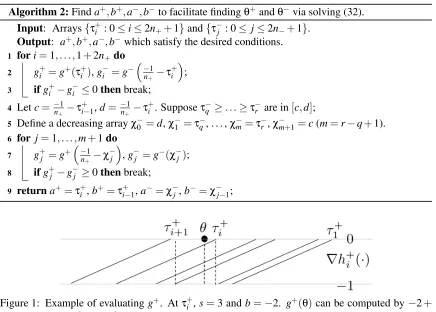
Algorithm 2 requires an efficient way to evaluateg+andg−. To this end, we design Algorithm 3 for computingg+, while the case forg− can be handled in sheer analogy. One key observation made from Algorithm 2 is that the location whereg+ is evaluated grows monotonically in the first and second stage. Therefore, our algorithm only needs to ensure that thetotalcost of evaluatingg+
in both stages isO(n+).
Algorithm 2:Finda+,b+,a−,b−to facilitate findingθ+andθ−via solving (32).
Input: Arrays{τ+i : 0≤i≤2n++1}and{τ−j : 0≤j≤2n−+1}.
Output: a+,b+,a−,b−which satisfy the desired conditions. 1 fori=1, . . . ,1+2n+do
2 g+i =g+(τ+i ),g−i =g−
−1
n+−τ + i
;
3 ifg+i −g−i ≤0thenbreak;
4 Letc=−n1
+ −τ +
i−1,d=− 1
n+ −τ +
i . Supposeτ−q ≥. . .≥τ−r are in[c,d];
5 Define a decreasing arrayχ−0 =d,χ−1 =τ−q, . . . ,χ−m=τ−r,χ−m+1=c(m=r−q+1). 6 for j=1, . . . ,m+1do
7 g+j =g+
−1
n+ −χ − j
,g−j =g−(χ−j);
8 ifg+j −g−j ≥0thenbreak;
9 returna+=τ+i ,b+=τ+i−1,a−=χ−j,b−=χ−j−1;
Figure 1: Example of evaluatingg+. Atτ+i ,s=3 andb=−2. g+(θ)can be computed by−2+
3(θ−τ+i ). Atτ+i+1,s=2 andb=−3.
to the largest possible value such thatθ∈(τ+i+1,τ+i ]and computeg+(θ)byb+s(θ−τ+i ). In other words, whenθ>τ+i , we need to decrementi; and whenθ≤τ+i+1 we incrementi. An example is given in Figure 1.
The key operation here is how to update s and b when sliding i. We say iis a head if τ+i
corresponds to somea+k (rather thana+k −µ). Otherwise we sayiis a tail. We initialize by setting
i=1,s=1 andb=0. Then the update rule falls in four cases:
• Incrementiandi′=i+1 is a head: update bys′=s+1, andb′=b+s·1µ(τ+i′ −τ+i ). • Incrementiandi′=i+1 is a tail: update bys′=s−1 andb′=b+s·1µ(τ+i′ −τ+i ). • Decrementitoi′=i−1, andiis a head: update bys′=s−1 andb′=b−s′·1µ(τ+i −τ+i′). • Decrementitoi′=i−1, andiis a tail: update bys′=s+1 andb′=b−s′·1µ(τ+i −τ+i′). Since the query point grows monotonically, the anchor pointionly needs to slide monotonically too. Hence the total computational cost in each stage isO(n+). It is also not hard to see thatican be
initialized toi=2n+, withs=0 andb=−n+. Finally, suppose we store{a+i ,a+i −µ}by an array
Algorithm 3:Computeg+(θ).
Input: A query pointθ.
Output: g+(θ).
1 Initialize:i=1,s=1,b=0. Given{ai}, do this only once at the first call of this function.
Other initializations are also fine, for example,i=2n+, withs=0 andb=−n+.
2 while TRUE do
3 ifτ+i ≥θthen
4 ifτ+i+1<θthen returnb+s·1µ(θ−τ+i );
5 else
6 b=b+s·1µ(τi++1−τ+i ),i=i+1;
7 ifiis a headthens=s+1;elses=s−1;
8 else
9 ifi==1then return0;
10 ifiis a headthens=s−1;elses=s+1;
11 i=i−1,b=b−s·1µ(τ+i+1−τ+i );
4.2 ROCAreaLoss
For theROCArealoss, given the optimal ˆβββin (24) one can compute
∂ ∂wg
⋆
µ(A⊤w) =
1
m
∑
i,jˆ
βi j(xxxj−xxxi) =−
1
m "
∑
i∈P
xxxi
∑
j∈Nˆ
βi j !
| {z }
:=γi
−
∑
j∈N
xxxj
∑
i∈Pˆ
βi j !
| {z }
:=γj
#
.
If we can efficiently compute allγi andγj, then the gradient can be computed in O(np) time.
Given ˆβi j, a brute-force approach to computeγi andγj takes O(m)time. We exploit the structure
of the problem to reduce this cost to O(nlogn), thus matching the complexity of the separation algorithm in Joachims (2005). Towards this end, we specialize (24) toROCAreaand write
g⋆µ(A⊤w) =max β ββ
1
m
∑
i,jβi jw ⊤(xxxj−xxxi) +
1
m
∑
i,jβi j− µ2
∑
i,jβ 2i j !
. (33)
Since allβi jare decoupled, their optimal value can be easily found:
ˆ
βi j=median(1,aj−ai,0)
where ai=
1
µm
w⊤xxxi−
1 2
,andaj=
1
µm
w⊤xxxj+
1 2
. (34)
Below we give a high level description of how γi fori∈
P
can be computed; the scheme forcomputingγjfor j∈
N
is identical. We omit the details for brevity.For a giveni, suppose we can divide
N
into three setsM
i+,M
i, andM
i−such thatAlgorithm 4:Computeγi,si,tifor alli∈
P
.Input: Two arrays{ai:i∈
P
}andaj: j∈
N
sorted increasingly:ai≤ai+1andaj≤aj+1.
Output: {γi,si,ti:i∈
P
}.1 Initialize:s=t=0,k= j=0 2 foriin 1 ton+do
3 while j<n− ANDaj+1<aido
4 j= j+1;s=s−aj;t=t−a2j
5 whilek<n−ANDak+1≤ai+1do
6 k=k+1;s=s+ak;t=t+a2k
7 si=s,ti=t,γi= (n−−1−k)−(k−j)ai+s
• j∈
M
i =⇒ aj−ai∈[0,1], hence ˆβi j=aj−ai.• j∈
M
i− =⇒ aj−ai<0, hence ˆβi j=0.Letsi=∑j∈Miaj. Then, clearly
γi=
∑
j∈Nˆ
βi j=|
M
i+|+∑
j∈Miaj− |
M
i|ai=|M
i+|+si− |M
i|ai.Plugging the optimal ˆβi j into (33) and using (34), we can computeg⋆µ(A⊤w)as
g⋆µ(A⊤w) =µ
∑
i jˆ
βi j(aj−ai)− µ
2
∑
i j ˆβ2
i j=µ
∑
j∈Najγj−
∑
i∈Paiγi !
−µ2
∑
i j
ˆ
β2
i j.
If we defineti:=∑j∈Mia 2
j, then∑i jβˆ2i j can be efficiently computed via
∑
j
ˆ
β2i j=
M
i++∑
j∈Mi(aj−ai)2=
M
i++M
iai2−2aisi+ti, ∀i∈P
.In order to identify the sets
M
i+,M
i,M
i−, and computesiandti, we first sort both{ai:i∈P
}andaj: j∈
N
. We then walk down the sorted lists to identify for eachithe first and last indices j such that aj−ai ∈[0,1]. This is very similar to the algorithm used to merge two sorted lists,and takesO(n−+n+) =O(n)time and space. The rest of the operations for computingγi can be
performed inO(1)time with some straightforward book-keeping. The whole algorithm is presented in Algorithm 4 and its overall complexity is dominated by the complexity of sorting the two lists, which isO(nlogn).
5. Empirical Evaluation
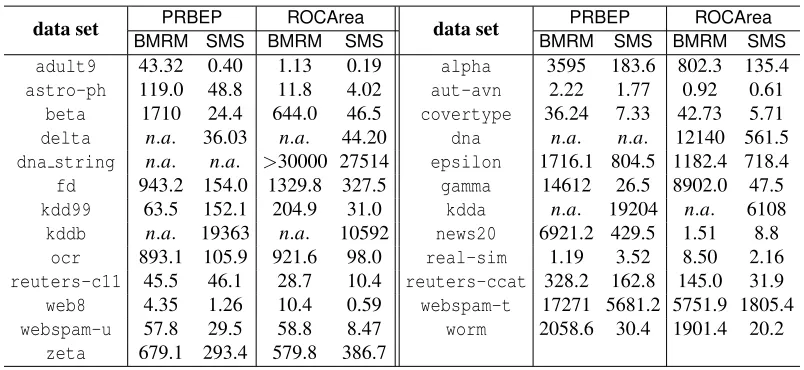
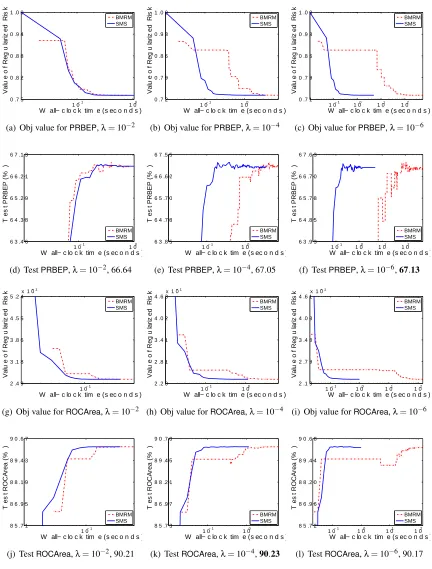
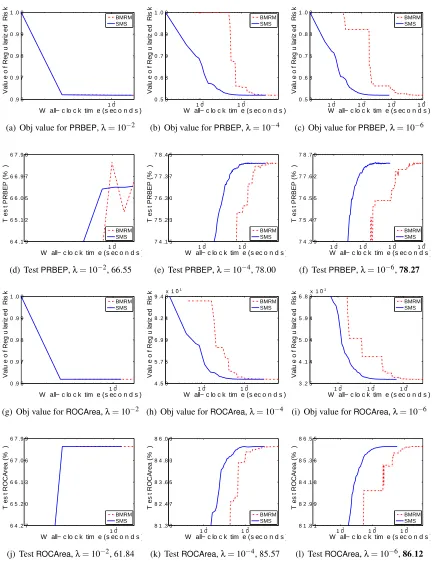
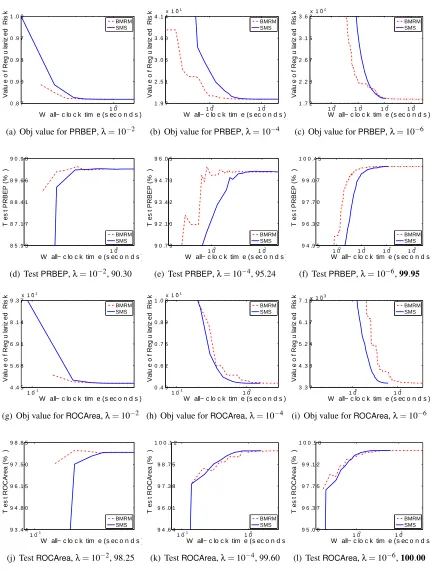
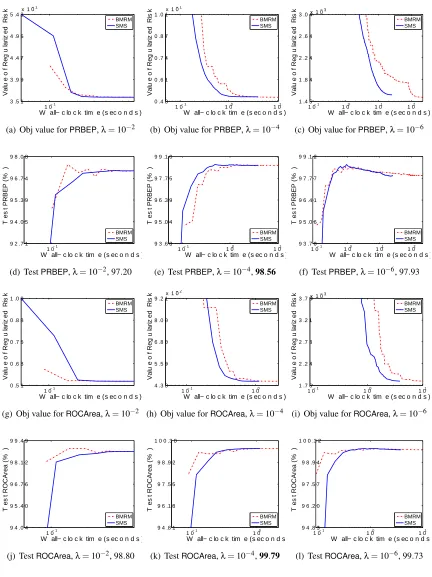
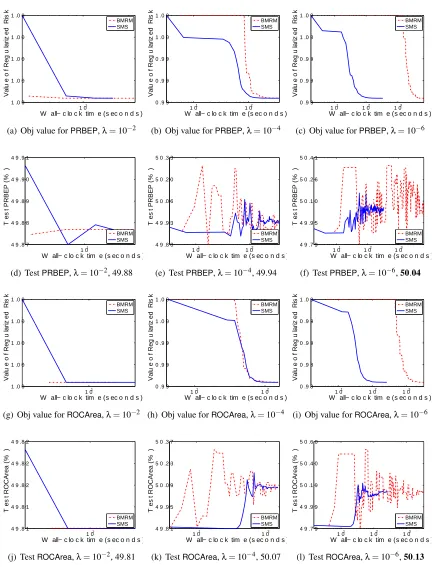
Therefore, what we are specifically interested in is the rate at which the objective function and generalization performance decreases. We will refer to our algorithm as SMS, for Smoothing
for MultivariateScores. As our comparator we use BMRM. We downloadedBMRM fromhttp:
//users.rsise.anu.edu.au/˜chteo/BMRM.html, and used the default settings in all our experi-ments.
5.1 Data Sets
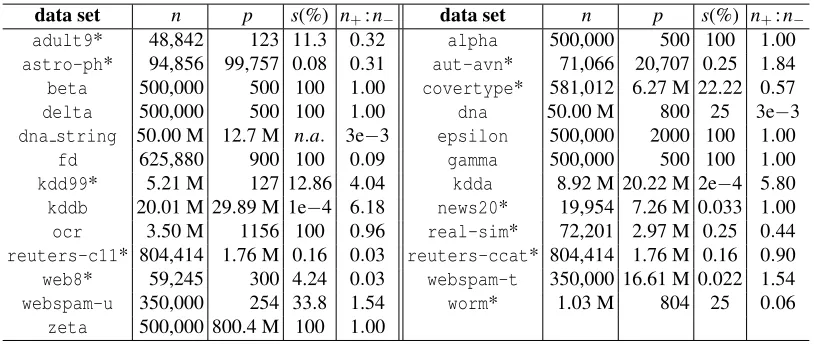
Table 1 summarizes the data sets used in our experiments.adult9,astro-ph,news20,real-sim,
reuters-c11,reuters-ccatare from the same source as in Hsieh et al. (2008). aut-avnis from Andrew McCallum’s home page,6 covertype is from the UCI repository (Frank and Asuncion, 2010), wormis from Franc and Sonnenburg (2008),kdd99is from KDD Cup 1999,7 while web8,
webspam-u, webspam-t,8 as well as the kdda and kddb9 are from the LibSVM binary data col-lection.10 The alpha, beta, delta, dna, epsilon, fd,gamma, ocr, and zeta data sets were all obtained from the Pascal Large Scale Learning Workshop website (Sonnenburg et al., 2008). Since the features ofdnaare suboptimal compared with the string kernels used by Sonnenburg and Franc (2010), we downloaded their original DNA sequence (dna string).11 In particular, we used a weighted degree kernel and two weighted spectrum kernels (one at position 1-59 and one at 62-141, corresponding to the left and right of the splice site respectively), all with degree 8. Following Son-nenburg and Franc (2010), we used the dense explicit feature representations of the kernels, which amounted to 12,670,100 features.
For dna stringand the data sets which were also used by Teo et al. (2010) (indicated by an asterisk in Table 1), we used the training test split provided by them. For the remaining data sets we used 80% of the labeled data for training and the remaining 20% for testing. In all cases, we added a constant feature as a bias.
5.2 Optimization Algorithms
Optimizing the smooth objective functionJµ(w) using the optimization scheme described in
Nes-terov (2005) requires estimating the Lipschitz constant of the gradient of theg⋆µ(A⊤w). Although it can be automatically tuned by, for example, Beck and Teboulle (2009), extra cost is incurred which slows down the optimization empirically. Therefore, we chose to optimize our smooth ob-jective function using L-BFGS, a widely used quasi-Newton solver (Nocedal and Wright, 1999). We implemented our smoothed loss using PETSc12 and TAO,13 which allow theefficient use of large-scale parallel linear algebra. We used the Limited Memory Variable Metric (lmvm) variant of
6. The data set can be found athttp://www.cs.umass.edu/˜mccallum/data/sraa.tar.gz. 7. The data set can be found athttp://kdd.ics.uci.edu/databases/kddcup99/kddcup99.html.
8.webspam-uis the webspam-unigram andwebspam-tis the webspam-trigram data set. Original data set can be found
athttp://www.cc.gatech.edu/projects/doi/WebbSpamCorpus.html.
9. These data sets were derived from KDD CUP 2010. kddais the first problem algebra 2008 2009 andkddbis the second problem bridge to algebra 2008 2009.
10. The data set can be found athttp://www.csie.ntu.edu.tw/˜cjlin/libsvmtools/datasets/binary.html. 11. The data set can be found athttp://sonnenburgs.de/soeren/projects/coffin/splice_data.tar.xz. 12. The software can be found at http://www.mcs.anl.gov/petsc/petsc-2/index.html. We compiled an
opti-mized version of PETSc (--with-debugging=0) and enabled 64-bit index to run for large data sets such asdnaand
ocr.
data set n p s(%) n+:n− data set n p s(%) n+:n−
adult9* 48,842 123 11.3 0.32 alpha 500,000 500 100 1.00
astro-ph* 94,856 99,757 0.08 0.31 aut-avn* 71,066 20,707 0.25 1.84
beta 500,000 500 100 1.00 covertype* 581,012 6.27 M 22.22 0.57
delta 500,000 500 100 1.00 dna 50.00 M 800 25 3e−3
dna string 50.00 M 12.7 M n.a. 3e−3 epsilon 500,000 2000 100 1.00
fd 625,880 900 100 0.09 gamma 500,000 500 100 1.00
kdd99* 5.21 M 127 12.86 4.04 kdda 8.92 M 20.22 M 2e−4 5.80
kddb 20.01 M 29.89 M 1e−4 6.18 news20* 19,954 7.26 M 0.033 1.00
ocr 3.50 M 1156 100 0.96 real-sim* 72,201 2.97 M 0.25 0.44
reuters-c11* 804,414 1.76 M 0.16 0.03 reuters-ccat* 804,414 1.76 M 0.16 0.90
web8* 59,245 300 4.24 0.03 webspam-t 350,000 16.61 M 0.022 1.54
webspam-u 350,000 254 33.8 1.54 worm* 1.03 M 804 25 0.06
zeta 500,000 800.4 M 100 1.00
Table 1: Summary of the data sets used in our experiments. nis the total number of examples, p
is the number of features,s is the feature density (% of features that are non-zero), and
n+:n−is the ratio of the number of positive vs negative examples. M denotes a million. A
data set is marked with an asterisk if it is also used by Teo et al. (2010).
L-BFGS which is implemented in TAO. Open-source code, as well as all the scripts used to run our experiments are available for download from Zhang et al. (2012).
5.3 Implementation And Hardware
BothBMRMandSMSare implemented in C++. Sincednaandocrrequire more memory than was
available on a single machine, we ran bothBMRMandSMSwith 16 cores spread across 16 machines
for these two data sets. Asdna stringemploys a large number of dense features, it would cost a prohibitively large amount of memory. So following Sonnenburg and Franc (2010), we (repeatedly) computed the explicit features whenever it is multiplied with the weight vector www. This entails demanding cost in computation, and therefore we used 32 cores. The other data sets were trained with a single core. All experiments were conducted on theRossmanncomputing cluster at Purdue University,14where each node has two 2.1 GHz 12-core AMD 6172 processors with 48 GB physical memory per node.
5.4 Experimental Setup
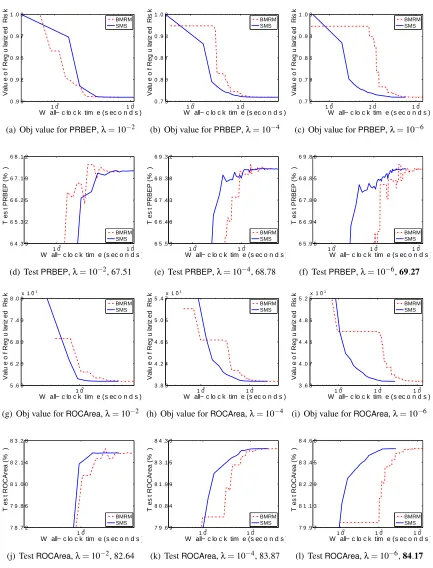
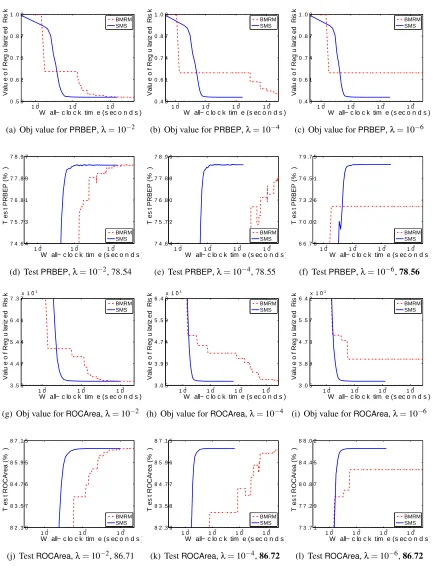
We usedλ∈10−2,10−4,10−6 to test the performance of BMRMandSMS under a reasonably
wide range ofλ. In line with Chapelle (2007), we observed that solutions with higher accuracy do not improve the generalization performance, and setting ε=0.001 was often sufficient. Accord-ingly, we could setµ=ε/Das suggested by the uniform deviation bound (13). However, this esti-mate is very conservative because in (13) we usedDas an upper bound on the prox-function, while in practice the quality of the approximation depends on the value of the prox-functionaround the optimum. On the other hand, a larger value ofµproffers more strong convexity ingµ, which makes