This is an open access journal, and articles are distributed under the terms of the Creative Commons Attribution-Non Commercial-ShareAlike 4.0 License, which allows others to remix, tweak, and build upon the work non-commercially, as long as appropriate credit is given and the new creations are licensed under the identical terms.
© 2018 Journal of Advanced Pharmacy Education & Research | Published by SPER Publication
15
Balance master versus Treadmill training on dynamic balance in
Hemiparetic Cerebral Palsied children
Ragaee Saeed Mahmoud
1, Emam Hassan El-negmy
1, Hebatallah Mohamed Kamal
1, Mohamed
El-sayed Alawady
2, Reham Saeed Alsakhawi
1,31The Department of Physical Therapy for Pediatrics, Faculty of Physical Therapy, Cairo University, Egypt, 2The Department of Neurology, Faculty of Medicine, Cairo
University, Egypt, 3Rehabilitation Sciences Department, College of Health and Rehabilitation Sciences, Princess Nourah bint Abdulrahman University, Riyadh, Saudi Arabia. Correspondence: The Department of Physical Therapy for Pediatrics, Faculty of Physical Therapy, Cairo University, Egypt
E-mail: [email protected]
ABSTRACT
Purpose: The present research was conducted to study the differences between the effect of balance master system versus treadmill training on the dynamic balance in hemiparetic cerebral palsied children. Subjects and Methods: Thirty hemiparetic cerebral palsied children were included in the current research. The participated children in this study were children ranged from eight to twelve years. The children in this study were assigned randomly into two equal number groups (A and B). Group (A) received a traditional physical therapy program, in addition to Balance Master System training, while group (B) received the same traditional physical therapy program as the group (A), in addition to treadmill training. Balance Master System was applied to investigate the dynamic balance of all the children in both groups before and after twelve successive weeks of the treatment program. Results: The obtained results indicated significant differences in all the measured variables pre and post-treatment in both groups (A and B), while there were significant differences in post-treatment’s mean values in favor of group (B). Conclusion: The Balance Master System can be used as therapeutic intervention to improve dynamic balance in hemiparetic cerebral palsied children. Moreover, the balance master system and treadmill training can be added to the physical therapy program, and treadmill training has been better than Balance Master System training in order to improve dynamic balance in hemiparetic cerebral palsied children.
Keywords:
Balance Master System, Dynamic balance, Hemiparetic cerebral palsied children, Treadmill.
Introduction
Hemiplegic cerebral palsy is the most common form of cerebral palsy, affecting up to one person per thousands of live births. Cerebral palsy (CP) could be characterized by a non-progressive disturbance in the developing fetal or infant brain resulting in posture and movement disabilities. A decline in walking is one of
the abnormal motor changes in adolescents and adults with CP, and it could be affected by the neurological disturbances associated with CP as secondary musculoskeletal impairments, pain, and physical fatigues [1].
Balance control is a complex process that requires the integration of multiple body systems (cognitive, sensorimotor,
and musculoskeletal systems) [2]. The ability of the person to
maintain postural stability and orientation of the body with Center of Gravity (COG) over Base of Support (BOS) while parts of the body are in motion is called the dynamic balance. Thus, an individual can weight shift or rock back and forth or side to side in posture (e.g., in sitting or standing) without losing control. The other evidence of dynamic postural control is the ability to shift weight onto one direction and free a limb for
nonweight bearing dynamic activity [3].
Various problems can result in balance difficulties in hemiparetic children in the physiological systems involved in Access this article online
Website: www.japer.in E-ISSN: 2249-3379
How to cite this article:Ragaee Saeed Mahmoud, Emam Hassan El-negmy, Hebatallah Mohamed Kamal, Mohamed El-sayed Alawady, Reham Saeed Alsakhawi. Balance master versus Treadmill training on dynamic balance in Hemiparetic Cerebral Palsied children. J Adv Pharm Edu Res 2018;8(4):15-20.
16 Journal of Advanced Pharmacy Education & Research | Oct-Dec 2018 | Vol 8 | Issue4
postural control, namely, sensory afferents, movement strategies, biomechanical constraints, cognitive processing and
perception of verticality [4]. At the time of walking, children
with spastic hemiplegia do not have strong motor coordination, which causes short strides, a length increased stride frequency to keep speed, an increased swing, and poor stability. Hemiplegia also influences the performance of balancing tasks
while walking in children [5]. The poor dynamic balance control
is one of the contributing factors to hemiplegic children problems with gait and reaching movement because of the
abnormal stability through the movements [6].
One of the dynamic system approaches that is used for the attainment of locomotor skills in children with CP is the treadmill training. Treadmill training based on the current theories on motor learning, provides a therapeutic intervention at one of the most important milestones in a child’s
development, i.e., the activity level of walking [7]. The actual
practice of walking is necessary if a person wants to learn to walk. The mechanics of treadmill training in children with CP have been affected by different factors including: neuroplasticity after brain injury, physical effects of therapy, and task-specific practices [8].
The Balance Master System (BMS) or dynamic posturography system is a validated instrument for measuring balance, and one of the therapeutic modalities to improve balance. It is a validated instrument for assessment of the sensory and motor components of the postural stability quantitatively, determining the impairments and the effectiveness of strategies for treating patients with balance abnormalities, also, it can be used as a therapeutic intervention to improve the static and dynamic
balance of patients with neurological disorders [9].
The primary objective of this study was to investigate the effectiveness of using Balance master system as one of the physical therapy modalities to improve dynamic balance in hemiparetic CP children. The secondary objectives were to make comparisons between the performance of the Balance Master system to more treadmill training; the effects of both programs after twelve cessation weeks were considered. It was hypothesized that there would be no significant difference between the effect of dynamic balance training using treadmill, and balance master system in hemiparetic cerebral palsied children.
Materials and Methods
Study design:
The current research was a randomized control trial to differentiate between the effect of balance master system and treadmill training on dynamic balance in hemiparetic cerebral palsied children.
Subjects
Thirty hemiparetic cerebral palsied children of both sexes were selected from the outpatient clinic of Faculty of Physical Therapy, Cairo University, Department of hearing and balance
of Faculty of Medicine, Cairo University, the out-patient clinic of Faculty of Medicine, Minia University, the outpatient clinic of Faculty of Physical Therapy, Deraya University, and Center of hearing and balance, New Minia, Egypt.
The participated children in this study were selected according to the following criteria; their ages ranged from eight to twelve years, they had spasticity ranged from grade 1 to grade 1+
according to Modified Ashworth Scale [10], they were able to
understand and follow the instructions, were able to walk independently, and were clinically and medically stable. Any child who had visual and/or auditory defects, the impairment of sensation or other neurological or psychological problems, the tightness and/or fixed deformity of lower limbs, the advanced radiographic changes such as bone destruction, bony ankylosis,
knee joint subluxation or epiphysial fracture, congenital or
acquired lower limb deformities in the lower limbs or cardiopulmonary dysfunction were excluded.
The selection of the age of the participated children in this study
coincided with the findings of Westcott et al. [11] who revealed
that, at seven to ten years of age, children are able to resolve a sensory conflict (mismatched information coming from somatosensory and visual receptors) and appropriately utilize the vestibular system as a reference.
Research Ethics Committee of the Faculty of Physical Therapy at Cairo University approved this study. A consent form was given to parents of potential participants describing the procedures and purpose of the study in detail. Researchers administered a brief structured interview to screen participants according to the research criteria, and gather their demographic information. After rapport-building, the instruments were administered to the participants, and the parents of the participants were assured of the confidentiality of the data related to their children.
Measures:
Balance master system (BMS):
Thetest-retestreliabilityofthe data was foundusingtheBMSas
the most significantfor the tests ofbalance, andthatdynamic
and static balance measures have been valid values of the
functionalbalance performance P
[12]
P
. The BMS consisted of two force platforms, a screen, and the main body of the computer. Children in this study took off their shoes and stood with both legs on the center of two plates, then gaze at the front monitor with folded arms. Before starting the test, a preliminary trial was
conducted to practice the test posture P
[13]
P
.
Journal of Advanced Pharmacy Education & Research | Oct-Dec 2018 | Vol 8 | Issue4 17 The participated children in this study were randomly assigned
into two groups of equal number (A and B) using a sealed envelope; odd numbers for the group (A) while even numbers for the group (B). The time length of this study was from March 2017 to July 2018. Children in both groups received as the following: Group (A) received traditional physical therapy program, in addition to the balance master system training, while group (B) received the same traditional physical therapy program as the group (A), in addition to treadmill training. The tools used for the traditional physical therapy exercises were: special tools which were used for the traditional physical therapy exercises including vestibular board, rolls of different sizes, blocks and wedges of different heights, and stepper and balance board. Group (A): The treatment session was conducted for 60 minutes (BMS training for 25 min, and traditional physical therapy exercise for 35 min), three times per week for twelve successive weeks. BMS was used as a treatment intervention in the same processing of evaluation with repetition. Children of this group received the following physical therapy program: exercises to facilitate balance, stretching exercises for tightening muscles, and strengthening exercises.
Group (B): The treatment session was conducted for 60 minutes (treadmill training for 25 min and they received the same selected physical therapy program as Group A), three times per week for successive twelve weeks. The treadmill is the unit formed from the belt and two cylinders, and an axle along its width has been adjusted for uphill walking (maximum 16 degrees). The parallel bars have been attached on the vertical beams at each side of the apparatus. The bars are independent of the slop mechanics, and thus remain at the same height and level when the slop is altered. Before starting walking on the treadmill, each child participated in this study were explained the procedure and goals of the exercise. The children grasped the front bar of the treadmill firmly by both hands, they were instructed to look forward and not to look down on their feet during walking as this might cause falling.
Statistical analysis
By using Minitab program version 16, the data were collected and analyzed through two types of statistics. All data in this study were analyzed using descriptive statistics (mean and standard deviation). The paired t-test was used to analyze the differences between the pre and postreatment measurements. Unpaired t-test wasused to compare the mean values of each parameter between the two groups before and after twelve weeks of the treatment program. The level of significance for all tests was set at (0.05).
Results
The collected data included:
1) Walk Across (WA): Step width (cm) Step length (cm) and
Speed (cm/sec).
2) Step/Quick Turn (SQT) (RT and LT sides): Turn time
(sec), Turn sway (deg/sec).
3) Tandem Walk (TW): Step width (cm), Speed (cm/sec)
and End sway (deg/sec).
1.
Walk across (WA):
Step length (cm):Comparing the two groups (A and B), a significant difference was revealed between the pre and post- mean values in the two groups (Table 1).
Table 1: Comparing the mean values of step length (cm) pre and post- treatment in the two groups. Step length (cm) Pre Group (A) Group (B)
Treatment treatment Post Treatment Pre TreatmentPost Mean
± SD ± 1.73 32.23 ± 1.65 33.95 ± 2.17 32.3 ± 1.3335.35
MD 1.73 3.05
% of improvement 5.36 % 9.44 %
t-value 3.47 3.94
p-value 0.004 0.001
Level of Significance S S Pre: Before treatment Post: After twelve weeks of treatment. SD: Standard Deviation. MD: Mean Difference. % of improvement: Percentage of improvement.
t-value: Paired and Un-paired t- test value. p-value: Probability value. S: Significant.
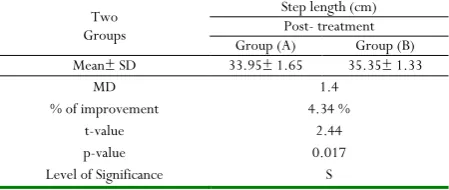
There was a significant difference when comparing between post- mean values of the groups (A and B) in favor of group (B) (table 2).
Table 2: Comparing between post- treatment mean values of step length (cm) between the two groups (A and B).
Two Groups
Step length (cm) Post- treatment Group (A) Group (B) Mean± SD 33.95± 1.65 35.35± 1.33
MD 1.4
% of improvement 4.34 %
t-value 2.44
p-value 0.017
Level of Significance S Pre: Before treatment Post: After twelve weeks of treatment. SD: Standard Deviation. MD: Mean Difference. % of improvement: Percentage of improvement.
t-value: Paired and Un-paired t- test value. p-value: Probability value. S: Significant.
2. Step/quick turn (SQT) among the groups (A
and B): (RT side) Turn time (sec):
Comparing the two groups (A and B), a significant difference was revealed between the pre and post- mean values in the two groups (table 3).
Table 3: Comparing the mean values of turn time (sec) pre and post- treatment in the two groups.
Turn time (sec) Pre Group (A) Group (B) Treatment treatment Post Treatment Pre TreatmentPost Mean± SD ± 0.09 1.77 ± 0.1 1.75 ± 0.1 1.74 ± 0.091.64
MD 0.02 0.1
% of improvement 1.12 % 5.74 %
t-value 3.29 3.39
p-value 0.005 0.004
Level of Significance S S Pre: Before treatment Post: After twelve weeks of treatment. SD: Standard Deviation. MD: Mean Difference. % of improvement: Percentage of improvement.
18 Journal of Advanced Pharmacy Education & Research | Oct-Dec 2018 | Vol 8 | Issue4
There was a significant difference when comparing post- mean values of groups (A and B) in favor of group (B) (table 4).
Table 4: Comparing the post- treatment mean values of turn time (sec) in the two groups (A and B).
Two Groups
Turn time (sec) Post- treatment Group (A) Group (B) Mean± SD 1.75± 0.1 1.64± 0.09
MD 0.11
% of improvement 6.28 %
t-value 3.16
p-value 0.004
Level of Significance S Pre: Before treatment Post: After twelve weeks of treatment. SD: Standard Deviation. MD: Mean Difference. % of improvement: Percentage of improvement.
t-value: Paired and Un-paired t- test value. p-value: Probability value. S: Significant.
3. Step/quick turn (SQT) among groups (A and
B): (LT side) Turn time (sec):
Comparing the two groups (A and B), a significant difference was revealed between the pre and post- mean values in the two groups (table 5).
Table 5: Comparing the mean values of turn time (sec) pre and post- treatment in the two groups.
Turn time (sec) Pre Group (A) Group (B) Treatment treatment Post Treatment Pre TreatmentPost Mean± SD ± 0.13 1.81 ± 0.11 1.78 ± 0.12 1.79 ± 0.131.68
MD 0.03 0.11
% of improvement 1.65 % 6.14 %
t-value 3.45 4.19
p-value 0.004 0.001 Level of
Significance S S
Pre: Before treatment Post: After twelve weeks of treatment. SD: Standard Deviation. MD: Mean Difference. % of improvement: Percentage of improvement.
t-value: Paired and Un-paired t- test value. p-value: Probability value. S: Significant.
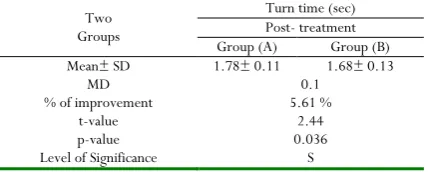
There was a significant difference when comparing the post- mean values of groups (A and B) in favor of group (B) (table 6).
Table 6: Comparing between post- treatment mean values of turn time (sec) in the two groups (A and B).
Two Groups
Turn time (sec) Post- treatment Group (A) Group (B) Mean± SD 1.78± 0.11 1.68± 0.13
MD 0.1
% of improvement 5.61 %
t-value 2.44
p-value 0.036
Level of Significance S Pre: Before treatment Post: After twelve weeks of treatment. SD: Standard Deviation. MD: Mean Difference.
% of improvement: Percentage of improvement.
t-value: Paired and Un-paired t- test value. p-value: Probability value. S: Significant.
4. Tandem walk (TW) among groups (A and B):
Speed (cm/sec):
Comparing the two groups (A and B), a significant difference was revealed between the pre and post- mean values in the two groups (table 7).
Table 7: Comparing the mean values of speed (cm/sec) pre and post- treatment in the two groups.
Speed (cm/sec) Pre Group (A) Group (B) Treatment treatment Post Treatment Pre TreatmentPost Mean± SD ± 2.11 24.17 ± 1.82 26.13 ± 2.89 24.59 ± 1.7927.69
MD 1.96 3.1
% of improvement 8.1 % 12.6 %
t-value 3.85 7.14
p-value 0.002 0.001 Level of Significance S S Pre: Before treatment Post: After twelve weeks of treatment. SD: Standard Deviation. MD: Mean Difference. % of improvement: Percentage of improvement.
t-value: Paired and Un-paired t- test value. p-value: Probability value. S: Significant.
There was a significant difference between post- mean values of groups (A and B) in favor of group (B) (table 8).
Table 8: Comparing the post- treatment mean values of speed (cm/sec) in the two groups (A and B).
Two Groups
Speed (cm/sec) Post- treatment Group (A) Group (B) Mean± SD ± 1.82 26.13 ± 1.7927.69
MD 1.56
% of improvement 5.97 %
t-value 4.84
p-value 0.026
Level of Significance S Pre: Before treatment Post: After twelve weeks of treatment. SD: Standard Deviation. MD: Mean Difference. % of improvement: Percentage of improvement.
t-value: Paired and Un-paired t- test value. p-value: Probability value. S: Significant.
Discussion
The present research was planned to investigate the effect of BMS versus treadmill training on dynamic balance in hemiparetic cerebral palsied children. The outcomes of this research showed significant differences between the effect of Balance master system and treadmill training in hemiparetic cerebral palsied children. This study was applied due to the complaints of hemiparetic cerebral palsied children who can walk independently with the balance problem. Thus, the impaired balance in a functional context has been an essential issue in the rehabilitation of these children as has been the focus
of therapeutic interventions [14].
The selection of the hemiparetic children in the present study was
Journal of Advanced Pharmacy Education & Research | Oct-Dec 2018 | Vol 8 | Issue4 19 gait disturbances and frequent falls have been common problems
in hemiparetic cerebral palsied children. The CP was found to demonstrate the deficit in the postural control system that may provide a partial explanation for balance problems that have been common in these subjects.
Comparing the pre and post-treatment results, in WA test of children of the two groups (A and B), the decreased step width, the improvement of the step length and speed were revealed. These can be explained firstly by the improvement in neuromotor control; secondly, the balance control and strength;
and thirdly the sensory integration [16]. These outcomes were in
agreement with Karimi et al. [17] who mentioned that an
appropriate motor response for the postural balance control requires an intact neuromuscular system and sufficient muscle strength to return to the center of mass within the BOS when the
balance is disturbed. Feland [18] stated that declines in strength,
the range of motion and reaction time have also been hypothesized to affect the balance control.
Also, these significant improvements could be attributed to the effect of treadmill training on improving the dynamic balance of hemiparetic cerebral palsied children, and reinforced the effectiveness of treadmill training on improving balance by adopting the suitable program of treadmill walking. These results
were also supported by Haven [19] who indicated that such
synaptic reorganization happens throughout a person’s lifetime of adapting to changing motion environments. By repeating, it would become easier for motor impulses from the brain stem to go through new nerve pathway, and this process has been defined as facilitation. And, the child would be able maintain balance during any activity.
A significant difference was recorded when comparing the pre and post-treatment results in SQT test of children of the two groups which showed significant decrease in the timing and swaying of the turn. The previous descriptions were supported
by Sanger and Kukke [20] who explained that somatosensory
problems could disrupt the postural control by the ability of the child to adapt sensory inputs to changes in task and environmental demands, and the development of the accurate internal models of the body for postural control was prevented.
The previous came in agreement with Rozzi et al. [21] who
declared that high stability indices demonstrated greater platform motion during the stance than the low stability indices; therefore, indicating less stability. The findings obtained for the post-treatment in group (B) demonstrated the efficiency of the treadmill training in balance improving by following a suitable program of treadmill walking.
Comparing the pre and post-treatment results, in TW test of children of the two groups, the decreased step width and end sway, and the improvement of speed were revealed. These results could be attributed to the effect of BMS and treadmill training on improving the dynamic balance of hemiparetic cerebral palsied children. The decreased scores of the step width in CP children indicated that they had a good dynamic balance control if the BOS was very narrow.
The previous results could be accepted by Comerford and
Mottram [22] who stated that muscles played a critical role in the
static control of the posture; the alignment of joints; the dynamic control; and the production of movement; and provide essential proprioception input into the control nervous system. The concept of the muscle balance is that muscles provide stability and movement, but there is a balance between different muscle groups which ensures the correct joint loadings and alignment. Incorrect loadings of tissues and alignment may lead to the development of tissue pathology. The responses of the muscles to the dysfunction may be either becoming overactive and tight,
orbecoming inhibited and weak.
The results were coincided with Grecco et al. [14] who proved
that treadmill training allows a specific gait training in a rhythmic fashion. Motor tasks require a specific muscle control between agonist and antagonist muscles as well as the activation of anti-gravity muscles. Children with CP exhibit an increase in co-contractions of the proximal and distal muscles, with no coordinated proximal-distal pattern.
This came in agreement with Guskiewicz [23] who reported that
the maintenance of postural balance includes a sensory process involving articular mechanoreceptors, the vestibular system, and the visual system. Sensorimotor information is then processed in the central nervous system. Finally, there is a motor response involving various muscle groups, including those around the ankle, thigh, trunk, and neck. A child with hemiparetic CP may experience impaired balance at both the sensory and motor levels.
One of the limitations of the current research was the limited number of participants (only thirty children) which might impact the generalization of the results. The second limitation was that the effect of interventions was measured immediately after the period of treatment which was twelve weeks, so it was not possible to anticipate whether the improvement would be sustainable or not. Also, there have been no enough research studies on the effect of BMS as one of the treatment intervention on the dynamic balance in hemiparetic cerebral palsied children. In addition, some children feared of balance master or treadmill, and school attendance of some participated children got them tired and exhausted during the treatment sessions.
Conclusion
The null hypothesis in the present study was rejected which stated that there would be no effect of BMS and treadmill training on dynamic balance in hemiparetic cerebral palsied children; and treadmill training had more effect on improving the dynamic balance than BMS. So, the BMS and treadmill training can be added as therapeutic modalities to improve the dynamic balance of hemiparetic CP children.
References
1. Robert J., Steven E., Peter L., and Beth T. Probability of
20 Journal of Advanced Pharmacy Education & Research | Oct-Dec 2018 | Vol 8 | Issue4
2. Tang P. and Woollacott M. Balance Control in Older
Adults. In: Bronstein A., Brandt T., Woollacott M. and Nutt J. Clinical Disability of Balance, Posture and Gait. Spr. Sci. and Bus. Med. 2014. 385 –90.
3. Choi Y. C., Park S. J. and Lee M. Y. The effects of trunk
muscle strengthening exercises on balance performance of sitting posture and upper extremity function of children with spastic diplegic cerebral palsy. J. Kor. Soc. Phys. Med. 2013. 8: 117 –25.
4. De Oliveira C. B., De Medeiros I. R., Frota N. A., Greters
M. E. and Conforto A. B. Balance control in hemiparetic stroke patients: main tools for evaluation. J. Rehab. Res. Develop. 2008. 45 (8): 1215 –26.
5. Nashner L., Shumway-Cook A. and Marin O. Stance
posture control in select groups of children with cerebral palsy: deficits in sensory organization and muscular coordination. Exp. brain. Res. 2013. 49: 393 – 409.
6. Ahmed K. S., El-negamy E. H., Salem A. H. and Ibrahim
M. B. Effect of Vestibular Stimulation on Balance in Children with Hemiparetic Cerebral Palsy. Med. J. Cairo Univ. 2017. 85 (4): 1417 – 1423.
7. Cherng R. J., Liu C. F., Lau T. W. and Hong R. B. Effect
of treadmill training with body weight support on gait and gross motor function in children with spastic cerebral palsy. Am. J. Phys. Med. Rehabil. 2007. 86: 548 –55.
8. Mutlu A., Krosschell K. and Spira D. Treadmill training
with partial body-weight support in children with cerebral palsy: a systematic review. Devel. Med. & Child Neurol. 2009. 51: 268 – 275.
9. Slattery E., Sinks B. and Goebel J. Vestibular tests for
rehabilitation: applications and interpretation. Neuro Rehabil. 2011. 29 (2): 143 –51.
10. Bohannon R. W. and Smith M. B. Interrater reliability of a
modified Ashworth scale of muscle spasticity. Phys Ther. 1987. 67(2), 206-07.
11. Westcott S., Lowes L. and Richardson P. Evaluation of
postural stability in children: current theories and assessment tools. Phys. Ther. 2007. 77 (6): 629–45.
12. Liston, R. A. L., & Brouwer, B. J. Reliability and Validity
of Measures Obtained from Stroke Patients Using the Balance Master. Arch Phys Med Rehabil. 1996. 77: 425– 30.
13. Kang J., Park R., Lee S., Kim J., Yoon S. and Jung K. The
Effect of the Forward Head Posture on Postural Balance in Long Time Computer Based Worker. Ann. Rehabil. Med. 2012. 36: 98 – 104.
14. Grecco L. A., Tomita S. M., Christovão T. C., Pasini H.
C., Sampaio L. M. and Oliveira C. S. Effect of treadmill gait training on static and functional balance in children with cerebral palsy: A randomized controlled trial. Braz. J. Phys. Ther. 2013. 17 (1): 17 – 23.
15. Harvey A., Robin J., Morris M., Graham H. and Baker R.
Systematic review of measures of activity limitation for children with hemiparetic cerebral palsy. Dev. Med. & Child Neurol. 2008. 50: 190 –98.
16. Abdel Mohsen H. and Emara A. Effect of a new physical
therapy concept on dynamic balance in children with spastic diplegic cerebral palsy. Egyp. J. of Med. Hum. Genet. 2015. 16: 77 – 83.
17. Karimi N., Ebrahimi I., Kahrizi S. and Torkaman G.
Evaluation of postural balance using the biodex balance system in subjects with and without low back pain. Pak. J. Med. Sci. 2008. 6: 45 – 52.
18. Feland J., Hager R. and Merrill R. Sit to stand transfer:
performance in rising power, transfer time and sway by age and sex in senior athletes. Brit. J. of Spo. Med. 2015. 39: 285 –86.
19. Haven L. The Human Balance System - A Complex
Coordination of Central and Peripheral Systems. Quar. Newsletter of the Vest. Disor. Assoc. 2008. 25 (4): 837 – 42.
20. Sanger T. and Kukke S. Abnormalities of Tactile Sensory
Function in Children with Dystonic and Diplegic Cerebral Palsy. J. of Child Neurol. 2007. 22 (3): 289 –93.
21. Rozzi S., Lephart S., Sterner R. and Kuligowski L. Balance
training for persons with functionally unstable ankles. JOSPT. 2009. 29 (8): 478 –86.
22. Comerford M. and Mottram S. Function stability
retraining: principles and strategies for managing mechanical dysfunction Man. Ther. 2012. 6: 1 – 9.
23. Guskiewicz K. Impaired postural stability: regaining