© 2015 S. Siswandi et al. This is an open access article distributed under the terms of the Creative Commons Attribution License -NonCommercial-ShareAlike Unported License (http://creativecommons.org/licenses/by-nc-sa/3.0/).
Journal of Applied Pharmaceutical Science Vol. 5 (06), pp. 078-082, June, 2015 Available online at http://www.japsonline.com
DOI: 10.7324/JAPS.2015.50613 ISSN 2231-3354
Virtual screening of co-formers for ketoprofen co-crystallization and
the molecular properties of the co-crystal
S. Siswandi
1,2, Taofik Rusdiana
1, Jutti Levita
3*1
Department of Pharmaceutics and Formulation Technology Faculty of Pharmacy, Universitas Padjadjaran Jl. Raya Bandung-Sumedang km.21 Jatinangor Sumedang, Indonesia. 2Indonesian Airforce Pharmaceutical Institution Jl.Abdurachman Saleh, Lanud Husein Sastranegara, Bandung, Indonesia.
3
Department of Pharmaceutical Analysis and Medicinal Chemistry Faculty of Pharmacy, Universitas Padjadjaran Jl. Raya Bandung-Sumedang km.21 Jatinangor Sumedang, Indonesia.
ARTICLE INFO ABSTRACT
Article history: Received on: 02/02/2015 Revised on: 23/02/2015 Accepted on: 17/03/2015 Available online: 27/06/2015
Ketoprofen or [2-(3-benzoylphenyl)propionic acid] is a nonsteroidal antiinflammatory and analgesic agent. The positive qualities of ketoprofen are based on optimal physicochemical and structural characteristics, its ability to penetrate into and accumulate in the inflammation centers and compatibility with other classes of drugs. This compound is practically insoluble in water, therefore as most of NSAID drugs, it is categorized as Biopharmaceutics Classification System (BCS) class II. A widely used to enhance the solubility of poorly water soluble drugs is co-crystallization. A co-crystal is a multi-component crystal which involves non-covalent interactions between API and its co-formers. In this work, we developed virtual screening of co-formers for ketoprofen by employing molecular docking method. AutoDock was used for docking. Parameters observed were type and energy (Ei) of interaction. The work was continued by co-crystallization process and solubility assay of the mixtures according to Higuchi and Connor method using UV spectrophotometer. Based on molecular docking, the best co-former is saccharin (Ei = -3.14 kcal/mol). The docking result fits the solubility assay of the ketoprofen-saccharin co-crystal (300.62 μg/mL in water or 256.54% increasing of solubility compared to ketoprofen). Ketoprofen co-crystal shows better curve (90.15 % in 60 minutes) than ketoprofen (78.87 % in 60 minutes). Co-crystallization of ketoprofen with saccharin increases the dissolution profile of ketoprofen. Key words:
Anti-inflammatory agent; co-crystal; co-former;
ketoprofen; molecular docking; saccharin.
INTRODUCTION
Ketoprofen (Fig.1) or [2-(3-benzoylphenyl)propionic acid] is a nonsteroidal antiinflammatory and analgesic agent. The positive qualities of ketoprofen are based on optimal physicochemical and structural characteristics, its ability to penetrate into and accumulate in the inflammation centers and compatibility with other classes of drugs (Khormosh, 2009). Ketoprofen is soluble in ethanol, chloroform, and ether. It is practically insoluble in water, therefore as most of NSAID drugs,
this compound is categorized as Biopharmaceutics Classification
System (BCS) class II, i.e. drugs with low solubility and high permeability character (Hussain, 2002). Various techniques have
* Corresponding Author
Jutti Levita, e-mail: [email protected] Mobile: +628156043663, Office: +62227796200
been widely used to enhance the solubility of poorly water soluble drugs; co-crystallization is one amongst them.
C O
CH C
O
O H
CH3
Fig.1 2D structure of ketoprofen ID 3693
O O O HOOC CH2 C O H
H2C COOH
H
HOOC
Both API and co-former should contain hydrogen bond donors (HBDs) or acceptors (HBAs), e.g. ether, thioether, alcohol, ketone, thioketone, ester, thioester, carboxylic acid, amide, primary and secondary amines, etc (Vinesha, 2013). Other interactions involved in the formation of co-crystals are Van der
Waals force, pi-pi (π-π) interaction, aromatic stacking, and
halogen bonding (He, 2008).
MATERIALS AND METHODS Hardware and programs
Personal computer Intel®Celeron® CPU 1007U @
1.50GHz (2 CPUs), ~1.5GHz, 2048MB RAM, BIOS: InsydeH2O
Version 03.72.23V2.17, 200 GB, was employed in this work.
Programs used were ChemOffice 2004 (trial version),
Portable_Hyperchem_8.0.7, AutoDock 4.2.3, OpenBabelGUI 2.2.3.
Molecular modelling
2D structures of ketoprofen (ChemSpider ID: 3693) and
its co-formers in .mol format were downloaded from
www.chemspider.com. All molecules were geometry optimized using molecular mechanics method in Portable_Hyperchem_8.0. and calculated their QSAR properties using the same program.
Molecular docking
All .mol files of the molecules were converted into .pdb
files by employing OpenBabelGUI 2.2.3. The files then were
opened in AutoDock 4.2.3 and converted into .pdbq files by
adding polar hydrogen and Kollman charges. The .pdbq files were
converted into .pdbqt by calculating their torsion angles and were
ready to be used for docking. The dimension of grid box was set to
40x40x40 Å3 and other parameters were set to default. Docking
was repeated 10 times for each co-former. Parameters observed were type and energy (Ei) of interactions.
Solubility assay
Instruments used were mechanical agitator (Kotterman 4010), Shimadzu UV 1700 spectrophotometer, and chemical glasswares. Solubility assay was carried out according to Higuchi and Connor method on ketoprofen and all co-crystals formed. An accurately weighed 100 mg of ketoprofen was dissolved to saturation in water and was shaken vigorously using mechanical agitator for 24h 120 rpm. The mixture was filtered and passed through milipore membrane ø 25 µm. Filtrate was measured at 250-260 nm.
Dissolution test
The best co-former according to virtual screening and solubility assay is equimol mixed and ground with ketoprofen, and 5 mL of methanol is added drop wise to the mixture.
The crystal formed is kept at room temperature (27oC)
for 24 h. Dissolution test is performed to both ketoprofen and ketoprofen co-crystal at 10 minutes interval for 1 h.
RESULTS AND DISCUSSION
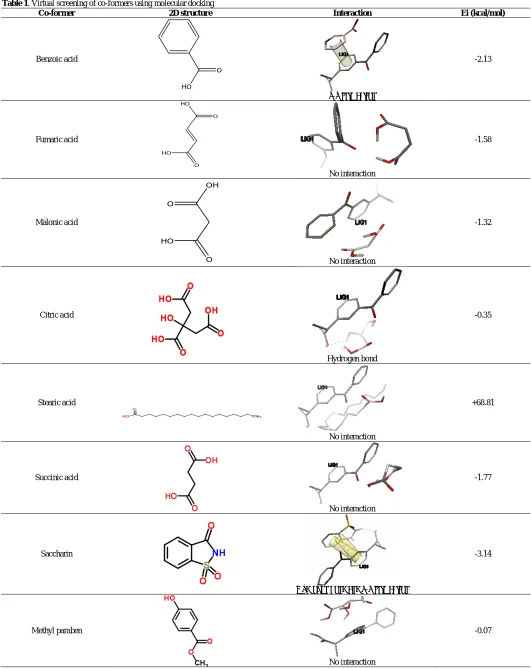
The molecule of ketoprofen contains two aromatic rings as well as 1 HBD (hydrogen atom of the carboxylate) and 3 HBAs (oxygen atoms of the carbonyl and carboxylate), hence it is possible to form co-crystals with certain co-formers. Co-formers chosen in this work were benzoic acid, fumaric acid, malonic acid, citric acid, stearic acid, succinic acid, saccharin, and methyl paraben. The result of virtual screening of co-formers using molecular docking is showed in Table 1.
Table 1 shows that benzoic acid, citric acid, and saccharin are the only co-formers able to form non-covalent interactions with ketoprofen. Benzoic acid (Ei = -2.13 kcal/mol)
interacts with ketoprofen via π-π interaction (or aromatic stacking)
(Fig.2b), while citric acid (-0.35 kcal/mol) forms one hydrogen bond with ketoprofen (Fig.2a). The best interaction is showed by saccharin (Ei = -3.14 kcal/mol) which forms two aromatic stackings and one hydrogen bond (hydrogen atom of saccharin’s nitrogen at thiazole ring is a HBD to oxygen atom of ketoprofen’s carbonyl) (Fig. 2c).
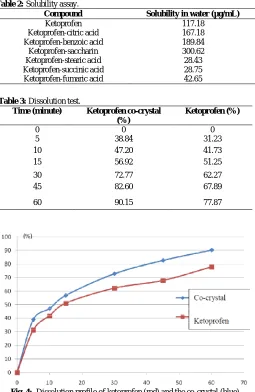
Mixtures of ketoprofen with the co-formers were tested for their solubilities and compared with ketoprofen itself. Results could be seen in Table 2.
Based on solubility assay carried out using Higuchi and Connor method, ketoprofen is slightly soluble in water (117.18
μg/mL). By mixing it with citric acid, the solubility increases
142.67% (167.18 μg/mL), whereas with benzoic acid and saccharin the increasing of solubility are 162.00% (189.84 μg/mL) and 256.54% (300.62 μg/mL), respectively. The interactions of ketoprofen with citric acid, benzoic acid, and saccharin could be proposed and seen in Fig.2.
A C O CH C O O H CH3 C O H B C O CH C O O H CH3 S O O O N H C
Fig. 2: Proposed interactions of ketoprofen-citric acid (a), ketoprofen-benzoic
Table 1. Virtual screening of co-formers using molecular docking
Co-former 2D structure Interaction Ei (kcal/mol)
Benzoic acid
HO O
-2.13
π-π interaction
Fumaric acid
HO
O O HO
-1.58
No interaction
Malonic acid
HO
O OH
O
No interaction
-1.32
Citric acid
Hydrogen bond
-0.35
Stearic acid
No interaction
+68.81
Succinic acid
No interaction
-1.77
Saccharin
Hydrogen bond and π-π interaction
-3.14
Methyl paraben
No interaction
Table 2: Solubility assay.
Compound Solubility in water (µg/mL)
Ketoprofen Ketoprofen-citric acid Ketoprofen-benzoic acid
Ketoprofen-saccharin Ketoprofen-stearic acid Ketoprofen-succinic acid Ketoprofen-fumaric acid
117.18 167.18 189.84 300.62 28.43 28.75 42.65
Table 3: Dissolution test.
Time (minute) Ketoprofen co-crystal
(%)
Ketoprofen (%)
0 0 0
5 38.84 31.23
10 47.20 41.73
15 56.92 51.25
30 72.77 62.27
45 82.60 67.89
60 90.15 77.87
Fig. 4: Dissolution profile of ketoprofen (red) and the co-crystal (blue).
The best co-former according to virtual screening and solubility assay, that is saccharine, was further tested for its dissolution profile in water. Fig.3 shows the ultraviolet spectrum of ketoprofen. The maxima of ketoprofen is observed at 259 nm,
which fits Woodward-Fieser rules for aromatic compounds containing carbonyl attached to the ring (base value for parent chromophore is 246 nm).
Other ring attached to the carbonyl in ketoprofen molecule (Fig.1) adds increments, thus shifts the maxima to longer wavelength.
Dissolution profile is showed in Table 3 and Fig.4. Ketoprofen co-crystal shows better curve (90.15 % in 60 minutes) than ketoprofen (78.87 % in 60 minutes).
Co-crystallization of ketoprofen with saccharin increases its solubility and dissolution profile due to aromatic stacking and hydrogen bond interaction of both molecules.
CONCLUSION
The best co-former is saccharin (Ei = -3.14 kcal/mol). It forms two aromatic stackings and one hydrogen bond with ketoprofen. The docking result fits the solubility assay of
ketoprofen-saccharin co-crystal (300.62 μg/mL in water or
256.54% increasing of solubility compared to ketoprofen). Co-crystallization of ketoprofen with saccharin increases the dissolution profile of ketoprofen.
REFERENCES
Hussain, A. 2002. Biopharmaceutics Classification System (BCS): A Regulatory Risk Management Tool, FDA.
He, G.W., Jacob, C., Guo, L.F., Chow, P.S., Tan, R.B.H. Screening for co-crystallization tendency: the role of intermolecular interactions, J Phys Chem B, 2008; 112: 9890-9895
Kormosh, Z., Hunkaa, I., Basel, Y. Spectrophotometric Determination of Ketoprofen and Its Application in Pharmaceutical Analysis, Acta Poloniae Pharmaceutica ñ Drug Research, 2009; 66(1): 3-9
Patel, A.R., Carlton, R.A., Needham, T.E., Chichester, C.O., Vogt, F.G., 2012, Preparation, structural analysis, and properties of tenoxicam cocrystals, International Journal of Pharmaceutics, 436: 685–706
Shan, N., Zaworotko, M.J., 2008, The role of cocrystals in pharmaceutical science, Drug Discovery Today, 13: 440-446
Vinesha, V., Sevukarajan, M., Rajalakhsmi, R., Chowdari, G.T., et al. Enhancement of Solubility of Taladafil by Cocrystal
Approach, International Research Journal of Pharmacy, 2013; 4(4): 218-223
How to cite this article: