Copyright © 2018 IJECCE, All right reserved
Functional Reliability of Cognitive Control Systems for
Manufacturing Processes
Eike Permin
*, Karl Lossie and Robert Schmitt
Date of publication (dd/mm/yyyy): 23/04/2018
Abstract –Industrial automation has led to a significant gain in reliability and stability in manufacturing processes through the introduction of numeric control and sensors, thus enabling control loops. This development has been identified as the third industrial revolution, which has been researched extensively over the last decades and led to an almost complete makeover of the industrial sector.
Control loops typically feature a fixed goal value as well as control parameters, thus limiting the abilities of the machine in case deviations from the originally specified environment and application occur. As products are being more and more customized and their lifecycles have been shortened dramatically, classical control loops for manufacturing processes need to be enhanced with more flexibility and finally autonomy to meet these challenges. Self-optimization or the enhancement of control loops with cognitive capabilities have been identified as one way to achieve this flexibility: these systems are able to identify their own current status as well as the environment conditions and can deduct control strategies accordingly. Typically, they are enhanced with the ability to learn to enable working in yet unknown future conditions. On the other hand, such systems will only be successful if safety and security as basic requirements of smart factories can be ensured. Safety features many different aspects, with functional reliability being one of its most prominent.
This contribution thus researches the functional reliability of cognitive control systems for manufacturing processes. For that an exemplary reliability model is developed using fault tree analysis. The model is evaluated by applying it to a validation case for force control in a turning application. It is shown that this modeling approach can be used to evaluate functional reliability in cognitive control systems.
Keywords – Artificial Intelligence, Cognitive Systems, Process Control, Reliability, Self-Optimization.
I.
I
NTRODUCTION“Cognition enhanced” or “Self-Optimizing” have been used synonymously for control systems in the recent literature. Their basic principle has been introduced by Skogestad in 2000 for the application of chemical processes [1]. Later on, the idea has been put into application in [2] as part of the Cluster of Excellence 128 “Integrative Production Technology for High-Wage Countries” for the area of manufacturing as well as in [3] within the Collaborative Research Center 614 “Self-Optimizing Concepts and Structures in Mechanical Engineering” for the area of mechatronic systems: A classic control loop is enhanced with a system that is able to change the control parameters and strategy as well as the set value. Through sensors, it determines the current status of the controlled systems, the overall goals as well as boundary and environmental conditions and deducts the new control
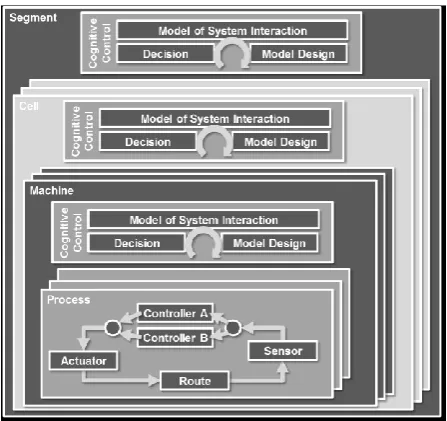
strategy. As control loops can be found on different levels, from singular drives to machines or even complete process chains, they need to be designed in a self-similar structure to enable cross-layer interaction. A schematic diagram based on [4] is provided in Fig. 1.
In the area of production, the principle of cognition-enhanced control has been applied to manufacturing processes [5], complete values chains [6] and industrial assembly [7]. An overview of all applications can be found in [8]. As can be seen in Fig. 1, the cognitive control system consists of two major parts – a decision module and a process and system model. Both the model and the decision module have been designed as learning systems. Cognitive control systems in manufacturing can thus be described as control loops enhanced with aspects of artificial intelligence.
As for all concepts and developments in the area of smart manufacturing, safety, security and reliability are major requirements for a successful application in real life industries [9]. Especially for learning systems, uncertainty with respect to process results need to be coped with [10]. Reliability and failure safe behavior are the two major aspects of safety [11]. Reliability again can be separated into functional reliability, maintainability and availability [12]. Thus, functional reliability depicts a major requirement for cognitive control systems in the smart factory of the future. The next chapter therefor provides an overview of the current state of the art in reliability research for artificial intelligent manufacturing control systems and its application to cognition-enhanced control.
Copyright © 2018 IJECCE, All right reserved
II. S
TATE OF THE ARTSkogestand introduced the concept of a self-optimizing control system for chemical plants in 2000 [1]. He merely points out that process reliability could be enhanced by their application, while no further investigation was made into the reliability of these systems [13].
In the course of the Collaborative Research Center 614 “Self-Optimizing Concepts and Structures in Mechanical Engineering”, reliability as part of the dependability through cognition-enhanced control systems was researched [14]. Design procedures and instruction have been deducted to enable their provision. Again, the dependability of the entire mechatronic system was put into focus, e.g. by providing control strategies for mechanical redundancy. The reliability of the learning or decision module representing the artificially intelligent part of the complete system was not in focus. The same is true for the works of Zaeh [15] and Bannat [16] in the course of the Cluster of Excellence 142 “Cognition for Technical Systems (CoTeSys)”. While some production processes have been improved using cognition-enhanced controllers, the reliability of the controller itself was taken as a boundary condition [17].
Cognition-enhancement or Self-optimization can be understood as part of Self-X-properties of manufacturing systems, which have been researched extensively by Pritschow [18] as well as Frei [19] and Leitao [20], looking at self-organization and reconfiguration abilities of these systems. Again, reliability was not focus of the research but instead seen as goal to be reached through Self-X properties [21].
When looking at the self-similar structure of connected cognitive control systems, the similarity to agent based production control becomes apparent. Dumke [22] as well as Wille [23] pointed out that in the context of agent based production control, reliability has been researched only in the area of multi agent systems (MAS). Both presented reliability research for MAS, but focused keenly on trustworthiness and efficiency with respect to solution finding. Pham as well as Katoh conducted similar research, adding performance criteria such as percentaged requirement fulfillment [24] and average waiting time for an answer within the network [25].
It can thus be deducted that the functional reliability for cognitive control systems in manufacturing has not been researched in the past. As functional reliability depicts a major content of safety and security in a smart factory, a new approach and methodology for its assessment will be presented in this paper.
III.
R
ELIABILITYA
SSESSMENTA
PPROACHIn general, reliability can be determined in two ways: in retrospect using field data and statistics, or as predictions based on system models [26]. As cognitive control systems in manufacturing are only at the brink of being introduced, few field data sets are available. On the other hand, a deterministic system model provides the opportunity to
change and fine-tune system design in order to increase its reliability. Thus, a modeling approach will be pursuit in the course of this paper.
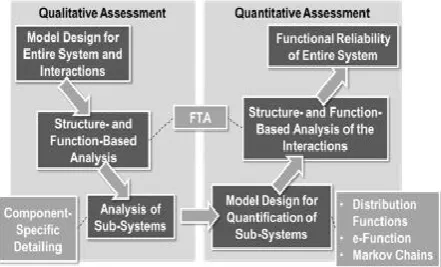
Different aspects have to be considered when looking at the functional reliability of cognitive production control systems in manufacturing. Software reliability assessment as e.g. depicted in [27, 28] or [29] plays a major part as most of the control systems will be implemented as such. On the other hand, some modules need a different modeling approach: The behavior of learning systems such as e.g. artificial neural networks cannot be modeled with such methods as their reliability heavily depends on training cycles, data etc. On the other hand, this training behavior can be approximated using e functions and statistics.
Finally, decision modules such as rule-based systems will make statistically distributed decisions, which can be modeled using Markov Chains [26]. The complete approach suggested by us is thus depicted in Fig. 2.
To model sub-systems and their interdependences, a functional system model is needed. Its reliability is defined as the inverse of its major failure cause probabilities. These again can be modeled using a fault tree analysis (FTA). Once the system interactions have been modeled properly, the failure causes and probabilities for the single system entities need to be determined. Thus, the step from a qualitative to a quantitative model is made. Based on proper models of the functional reliability of the sub-systems, the FTA and its top failure cause can be determined. To model the different sub-systems of a cognitive control system, basic statistics, Markov Chains and e functions can be applied.
IV.
E
XEMPLARYR
ELIABILITYM
ODELD
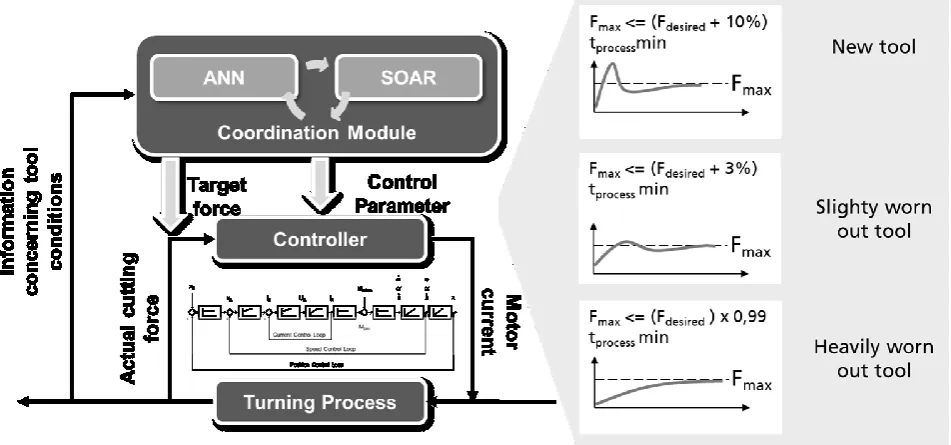
EVELOPMENTSeveral specific designs for cognitive control systems in manufacturing have been developed in the past. When looking at the level of manufacturing processes, a model based self-optimization has been pursuit by most researchers. Wagels and Isermann introduced a reduced design for the cognition enhancement of classical control loops (Fig. 3.), which has e.g. been presented and discussed in [30]. This model will be used to apply the approach presented in the previous chapter.
Copyright © 2018 IJECCE, All right reserved Fig. 3. Cognition enhanced control loop
The control loop is enhanced by a cognitive layer. A coordination module receives data characterizing the current status of the system as well as boundary conditions. Based on these inputs, the optimization module suggests the best-fitting control parameters as well as the set value. Before sending this information back to the control loop, the expected system behavior is predicted by the modeling module. Based on a preference function, the resulting process output is evaluated. Should the outcome be desirable, the parameters are handed over. If not (e.g. destabilizing the control loop), feedback is provided to the optimization module [31].
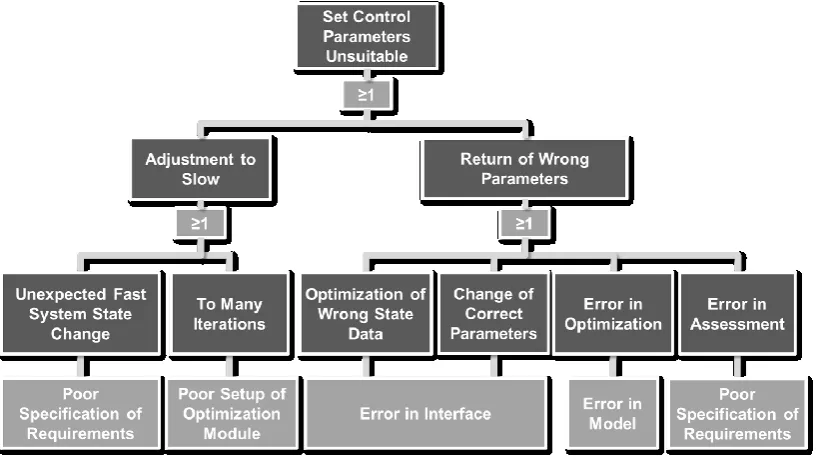
Finally, the feedback of the real process is compared to the model prediction. Should the deviation between these two exceed a certain level (e.g. five per cent), the model needs to be re-trained before the next decision cycle [30]. Based on this model of system interaction, top failure modes for the cognitive control system have been derived in expert discussions and simulation runs. The resulting FTA is depicted in Fig. 4.
Different detail designs have been used for the cognitive layer in the past, depending on the application and its designers.
Fig. 5. Markov Chain for assessing failure probability
In many cases as e.g. [30], [32] or [33], the modeling module has been implemented as an artificial neural network to allow for a quick reaction time in real time (or near real time) applications. The accuracy of the modeling module for predicting system conditions can be modeled using a normal distribution. Its learning behavior is directly depending on the quality of the data input as well as the training cycles applied.
Thus, its training behavior can be modeled using an e function.
Comparable behavior has been observed e.g. by [34], [32] or [33] in the context of manufacturing processes. In the same cases, the optimization module could basically be characterized as an expert system translating external inputs such as deviations or goals into answers of the cognitive layer and thus set values for the control layer.
Its learning process can be modeled using an e function, similar to the process model module. Such behavior has been observed e.g. by [35], [36] or [37]. Once a certain expertise level is reached, answers to system inputs are provided stochastically, thus giving the opportunity to use Markov Chains for failure probability, as shown in Fig. 5.
These modules are surrounded by a coordination layer providing interfaces and sending and receiving data. Its reliability again can be modeled assuming stochastically distributed failures, e.g. as percentage of lines of software code [27]. Putting these sub-models together, the expected reliability of the cognitive control system can be quantified.
Fig. 4. Fault tree analysis for cognition enhanced control systems
Copyright © 2018 IJECCE, All right reserved [26]:
𝑝𝑡𝑜𝑡 = 1 − [(1 − 𝑝(𝑡𝑜𝑜 𝑠𝑙𝑜𝑤)) ∗ (1 − 𝑝(𝑤𝑟𝑜𝑛𝑔 𝑝𝑎𝑟𝑎𝑚.))](1)
Setting aside a poor requirements management for the control system in the first place, three different modes can lead to the top system failure of “unsuitable control parameters”: Too many iterations of the optimization module causing a real time error, a prediction error in the process model leading to a gap between expected and real system feedback or an error in the interface.
The probability of a failure caused by too many iterations of the optimization module leading to a run-time error. The probability to find a suitable set of control parameters within a certain number of iterations n can be described as (see Fig. 5 for abbreviations):
1 − [1 − (𝑝𝐿𝐺) ∗ (1 − 𝑝𝑍)]𝑛 (2)
At the same time, a certain maximum time will be the limiting factor in the optimization, thus leading to a maximum number of iterations (nmax). In this case, the response time for the prediction model (tmodel), the response time for the interfaces (tinterfaces) and the response time for the optimization module to come up with a suggestions (topt) need to be taken into account:
𝑡𝑚𝑎𝑥
𝑡𝑂𝑝𝑡+ 𝑡𝑀𝑜𝑑𝑒𝑙𝑙+ 𝑡𝐾𝑜𝑜𝑟𝑑 < 𝑛𝑚𝑎𝑥 (3)
To validate the reliability modeling of the subcomponents of the cognitive control systems and its
underlying assumptions, the force control for turning operations will be introduced and discussed as an application case in the next chapter.
V.
V
ALIDATIONC
ASE:
F
ORCEC
ONTROL FORT
URNINGO
PERATIONSFor high volume cutting operations in turning, the cutting force is used as control parameter to avoid tool breakage and damaging of the part. The set parameter is typically a maximum force not to be exceeded, the manipulated variable is typically the motor current of the axis to influence the feed rate [38].
Based on the tool lifetime and status (e.g. measured through vibration emissions coming from the machine tool), the set parameter for the control loop are manipulated through the cognitive layer: For a brand new cutting tool, slight overshooting of the maximum cutting force can be allowed, enabling a higher cutting velocity. For a slightly used tool, this overshooting should be reduced. For a used cutting tool, the maximum cutting force should never be exceeded but instead be tuned tangentially, which will result in an overall longer cutting time but avoid tool breakage (Fig. 6).
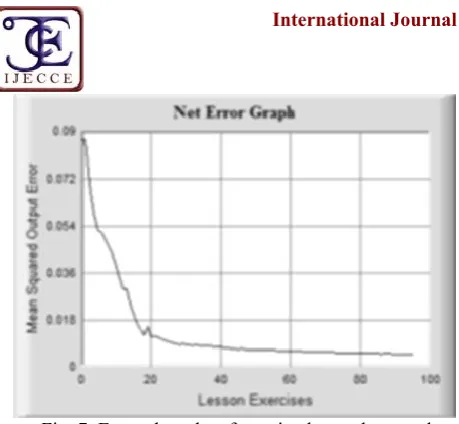
Based on existing process data, an artificial neural net was trained to mimic the behavior of the real cutting process using Membrain, a freely available software [39]. As could be expected, a normal learning curve could be observed. The remaining model failure was tested against sampling data and found to be mostly stochastically distributed. Exemplary data can be found in Fig. 7.
Copyright © 2018 IJECCE, All right reserved Fig. 7. Exemplary data for trained neural network
As can be seen, using e functions to model the learning behavior and applying statistics with a normal distribution to quantify the remaining error appears to be a good enough approximation model of the real behavior.
The optimization module was built in the language SOAR [40] as well as C++. Based on training data, it was trained to suggest control parameters for the force control of the cutting process based on the tool status. For such a system, reinforcement learning with rewards is used. As depicted in Fig. 8, the average reward achieved for parameter suggestions could be modelled using an e function with a very high level of significance.
Fig. 8. Reward achieved by the force control system after certain learning cycles
Putting all the inputs into the FTA from the previous chapter and using formulas (1) to (3), the functional reliability of the cognitive control system in this specific case was determined to be 99.6%. It was calculated as the inverse of the probability of the top failure cause of the FTA from Fig. 4, which was determined to be 0.39%. Based on the failure probabilities of the single sub-systems, design improvements were deducted: Better and more training data is always the first option to improve system performance. To overcome the failures inherited in the process model, a deterministic (white box) model should be used in addition to the ANN to identify system conditions with unclear data. The coordination module and the optimization should be enhanced with a watchdog system to recognize decisions
impasses or system freezes and allow for a safe shut down (fail safe).
VI.
C
ONCLUSIONIn this paper, an approach to model the functional reliability of cognitive control systems for manufacturing processes was introduced. Based on the established fault tree analysis, the top failure cause for such a system can be determined. E functions, normal distributions and Markov chains are necessary inputs to model sub-system behavior for cognitive control systems and thus quantify the overall failure probability. The approach was validated using a simplified example from force control in high speed turning. Such a modeling approach could contribute to ensure the safety and security of artificially intelligent control systems in smart factories. On the other hand, the added value of such systems with respect to efficiency gains or loss minimization by reduced failures rates has yet to be shown. On a lab scale, cognitive control systems have demonstrated advantages. On an industrial scale, proving their reliability is only one of many steps still to take.
A
CKNOWLEDGMENTSThe authors would like to thank the German Research Foundation DFG for the kind support within the Cluster of Excellence "Integrative Production Technology for High-Wage Countries".
R
EFERENCES[1] S. Skogestad, “Plantwide control: the search for the self-optimizing control structure,” Journal of Process Control, vol. 10, no. 5, pp. 487–507, 2000.
[2] C. Brecher, ed., Integrative Production Technology for High-Wage Countries, Springer Berlin Heidelberg, Berlin, Heidelberg, 2012.
[3] J. Gausemeier, U. Frank, A. Schmidt et al., “Towards a Design Methodology for Self-optimizing Systems,” in Advances in Design, H. A. ElMaraghy and W. H. ElMaraghy, Eds., pp. 61–71, Springer London, London, 2006.
[4] M. Mayer, C. Schlick, S. Müller et al., “Systemmodell für Selbstoptimierende Produktionssysteme,” 2013.
[5] U. Thombansen, J. Schuttler, T. Auerbach et al., “Model-based self-optimization for manufacturing systems,” in 17th International Conference on Concurrent Enterprising, Aachen, 2011.
[6] G. Schuh, M. Behr, C. Brecher et al., “Individualised Production,” in Integrative Production Technology for High-Wage Countries,
C. Brecher, Ed., pp. 77–239, Springer Berlin Heidelberg, Berlin, Heidelberg, 2012.
[7] E. Permin, M. Hoffmann, F. Bertelsmeier et al., “Cognitive Self-Optimization in Industrial Assembly,” Applied Mechanics and Materials, vol. 794, pp. 35–42, 2015.
[8] E. Permin, F. Bertelsmeier, M. Blum et al., “Self-optimizing Production Systems,” Procedia CIRP, vol. 41, pp. 417–422, 2016. [9] acatech - National Academy of Science and Engineering, 2011,
Cyber-Physical Systems: Driving force for innovation in mobility, health, energy and production, Springer, Berlin, Heidelberg, 2011.
[10] H. Kagermann, W. Wahlster, and J. Helbig, “Recommendations for implementing the strategic initiative INDUSTRIE 4.0: Final report of the Industrie 4.0 Working Group,” 2013.
Copyright © 2018 IJECCE, All right reserved [12] Verein Deutscher Ingenieure VDI, “Reliability management,”
03.2007, VDI 4003:2007-03.
[13] S. Skogestad, “Near-optimal operation by self-optimizing control: from process control to marathon running and business systems,”
Computers & Chemical Engineering, vol. 29, no. 1, pp. 127–137, 2004.
[14] J. Gausemeier, F. J. Rammig, W. Schäfer et al., Dependability of Self-Optimizing Mechatronic Systems, Springer, Dordrecht, 2014. [15] M. F. Zaeh, G. Reinhart, M. Ostgathe et al., “A holistic approach for the cognitive control of production systems,” Advanced Engineering Informatics, vol. 24, no. 3, pp. 300–307, 2010. [16] A. Bannat, T. Bautze, M. Beetz et al., “Artificial Cognition in
Production Systems,” IEEE Transactions on Automation Science and Engineering, vol. 8, no. 1, pp. 148–174, 2011.
[17] M. F. Zaeh, M. Ostgathe, F. Geiger et al., “Adaptive Job Control in the Cognitive Factory,” in Enabling Manufacturing Competitiveness and Economic Sustainability, H. A. ElMaraghy, Ed., pp. 10–17, Springer Berlin Heidelberg, Berlin, Heidelberg, 2012.
[18] G. Pritschow, K.-H. Wurst, C. Kircher et al., “Control of Reconfigurable Machine Tools,” in Changeable and Reconfigurable Manufacturing Systems, H. A. ElMaraghy, Ed., pp. 71–100, Springer London, London, 2009.
[19] R. Frei, Self-organisation in evolvable assembly systems, Universidade Nova de Lisboa, Portugal, 2010.
[20] P. Leitão and F. Restivo, “ADACOR: A holonic architecture for agile and adaptive manufacturing control,” Computers in Industry, vol. 57, no. 2, pp. 121–130, 2006.
[21] R. Frei and G. M. Di Serugendo, “Self-Organizing Assembly Systems,” IEEE Transactions on Systems, Man, and Cybernetics, Part C (Applications and Reviews), vol. 41, no. 6, pp. 885–897, 2011.
[22] R. Dumke, S. Mencke, and C. Wille, Quality assurance of agent-based and self-managed systems, CRC Press, Boca Raton, Fla., 2010.
[23] C. Wille, Software agent measurement framework, Shaker, Aachen, 2005.
[24] H. H. Pham, “Software Agents for Internet-Based Systems and Their Design,” in Intelligent Agents and Their Applications, J. Kacprzyk, L. C. Jain, Z. Chen et al., Eds., vol. 98, pp. 101–147, Physica-Verlag HD, Heidelberg, 2002.
[25] T. Katoh, T. Kinoshita, and N. Shiratori, “Dynamic Properties of Multiagents Based on a Mechanism of Loose Coalition,” in
Design and Applications of Intelligent Agents, G. Goos, J. Hartmanis, J. van Leeuwen et al., Eds., vol. 1881, pp. 16–30, Springer Berlin Heidelberg, Berlin, Heidelberg, 2000.
[26] B. S. Dhillon, Applied Reliability and Quality: Fundamentals, Methods and Procedures, Springer-Verlag London Limited, London, 2007.
[27] H. Pham, System software reliability, Springer, London, 2010. [28] X. Zhang and H. Pham, “An analysis of factors affecting software
reliability,” Journal of Systems and Software, vol. 50, no. 1, pp. 43–56, 2000.
[29] S. S. Gokhale, “Architecture-Based Software Reliability Analysis: Overview and Limitations,” IEEE Transactions on Dependable and Secure Computing, vol. 4, no. 1, pp. 32–40, 2007. [30] C. Wagels and R. Schmitt, “Benchmarking of Methods and Instruments for Self-Optimization in Future Production Systems,”
Procedia CIRP, vol. 3, pp. 161–166, 2012.
[31] C. Brecher, A. Kampker, F. Klocke et al., “Integrative Business and Technology Cases,” in Integrative Production Technology for High-Wage Countries, C. Brecher, Ed., pp. 987–1075, Springer Berlin Heidelberg, Berlin, Heidelberg, 2012.
[32] J. C. Chen and J. C. Chen, “An artificial-neural-networks-based in-process tool wear prediction system in milling operations,” The International Journal of Advanced Manufacturing Technology, vol. 25, no. 5, pp. 427–434, 2005.
[33] D. Karayel, “Prediction and control of surface roughness in CNC lathe using artificial neural network,” Journal of Materials Processing Technology, vol. 209, no. 7, pp. 3125–3137, 2009. [34] P.G. Benardos and G.C. Vosniakos, “Prediction of surface
roughness in CNC face milling using neural networks and Taguchi's design of experiments,” Robotics and Computer-Integrated Manufacturing, vol. 18, 5-6, pp. 343–354, 2002.
[35] A. M. Nuxoll and J. E. Laird, “Enhancing intelligent agents with episodic memory,” Cognitive Systems Research, 17-18, pp. 34– 48, 2012.
[36] Y. Wang, Hierarchical Functional Category Learning for Efficient Value Function Approximation in Object-Based Environments, ProQuest Dissertations Publishing, 2011. [37] N. Derbinsky and G. Essl, “Exploring Reinforcement Learning for
Mobile Percussive Collaboration,” in Proceedings of the 12th International Conference on New Interfaces for Musical Expression (NIME), Ann Arbor, Michigan, 2012.
[38] Y. Altintas, Manufacturing Automation: Metal Cutting Mechanics, Machine Tool Vibrations, and CNC Design, Cambridge University Press, 2012.
[39] “MemBrain,” 2/19/2018, https://membrain-nn.de/. [40] J. Laird, the Soar Cognitive Architecture, MIT Press, 2012.
A
UTHORS’
P
ROFILESEike Permin, born in 1986, earned a PhD in production
engineering, a diploma in mechanical engineering and a B.Sc. in business engineering at the RWTH Aachen university. He is currently working as the head of a research department with focus on production quality at the Fraunhofer-Institute for Production Technology IPT in Aachen, Germany. In addition, he is a lecturer for quality management at the RWTH Aachen university. His major research interests are digitalization of the shopfloor, data analytics for production processes and artificial intelligence for production control.
Karl Lossie, born in 1992, earned a diploma in
mechanical engineering with major in production engineering at TU Dresden, Germany. Currently, he is working in a research department with focus on production quality at the Fraunhofer Institute for Production Engineering IPT in Aachen, Germany. His main research topic are worker assistance and human-in- the-loop concepts in automated production environments through smart expert solutions based on smart devices.
Robert H. Schmitt, born in 1961, completed his studies