http: // www.ijrtsm.com© International Journal of Recent Technology Science & Management 6
ISSN : 2455-9679
[Mrinal et al. , 3(3), Mar 2018] Impact Factor : 2.015
IJRTSM
INTERNATIONAL JOURNAL OF RECENT TECHNOLOGY SCIENCE & MANAGEMENT
“
DESIGN AND OPTIMIZATION OF PORTABLE HYDRAULIC SCISSOR LIFT BY
USING FEA METHOD”
Mrinal Singh
1,
Ashish Kr Shrivastava
2, Arun Patel
3 1,PG, Scholar, Dept. of Mechanical Engineering, NIIST, Bhopal, MP, India 2Assistant Professor, Dept. of Mechanical Engineering, NIIST, Bhopal, MP India 3Assistant Professor, Dept. of Mechanical Engineering, NIIST, Bhopal, MP IndiaEmail: [email protected]
Email: [email protected]
Email: [email protected]
ABSTRACT
This project is mainly focused on the design as well as analysis of hydraulic scissor lift when it is extended and contracted. A hydraulic scissor lift is used for lifting and holding heavy weight components at required height. Material selection plays a major role in designing a machine and also influence on several factor such as durability, reliability, strength, resistance, maintenance which increases the life of scissor lift. The design is performed by considering hydraulic scissor lift as a portable, compact and much suitable for medium type of load application. Drafting & drawing of hydraulic system scissor lift is done on solid works with suitable modeling and imported to Ansys work bench for meshing and analysis. Hence, the static analysis of the scissor lift includes Total deformation load, Equivalent stress, Weight was done in Ansys and all responsible parameters were analyzed in order to check the compatibility of the design value. The computational values of three different materials such as Epoxy E glass fiber, Structure steel and stainless steel are compared for best results.
KEYWORD: Aerial Hydraulic scissor lift, solid works, Ansys work bench, Total deformation load, Equivalent stress,
static analysis
I. INTRODUCTION
http: // www.ijrtsm.com© International Journal of Recent Technology Science & Management 7
ISSN : 2455-9679
[Mrinal et al. , 3(3), Mar 2018] Impact Factor : 2.015
direction similar to a pantograph. The upward motion is achieved by the application of pressure to the outside of the lowest set of supports, elongating the crossing pattern, and propelling the work platform vertically upwards. The platform may also have an extending 'bridge' to allow closer access to the work area.
1.1 Types of Scissor lift
The scissor lifts can be classified as follows: Hydraulic lifts
Pneumatic lifts Mechanical lifts
II.METHODOLOGY
Deflection in scissors lifts can be defined as the change in elevation of all parts to the original size of entire assembly i.e from the floor to the top of platform deck, whenever loads are applied to or removed from the lift. Each component within the scissors lift has the potential to store or release energy when loaded and unloaded. Deflection takes place in all parts of scissor lift i.e Scissors Legs, Platform Structure, Base Frame, Pinned Joints. To reduce stresses and deflection in scissor lift the load should transfer equally between the two scissors arm pair. Base frames should be attached to the surface on which they are mounted.
2.1 Material Selection
Material selection plays a very important role in machine design. Three metals are considered for the analysis of scissor lift is epoxy e glass fiber structural steel and stainless steel.
2.2 Structure Steel Mechanical properties
Table- 1
Material Field Variable Value Units
Density 7850 Kg/m3
Young’s modulus 2E+05 Mpa
Poisson Ratio 0.30
Shear modulus 76923 Mpa
Bulk Modulus 1.6667E+0 5
Mpa
Tensile Yield Strength 250 Mpa
Compressive Yield Strength 250 Mpa
Tensile Ultimate Strength 460 Mpa
http: // www.ijrtsm.com© International Journal of Recent Technology Science & Management 8
ISSN : 2455-9679
[Mrinal et al. , 3(3), Mar 2018] Impact Factor : 2.015
2.3 Stainless Steel Mechanical properties
Table- 2
Material Field Variable
Value Units
Density 7750 Kg/m3 Young’s modulus 1.93E+05 Mpa Poisson Ratio 0.31
Shear modulus 76664 Mpa Bulk Modulus 1.6937E+05 Mpa Tensile Yield
Strength
207 Mpa
Compressive Yield Strength
207 Mpa
Tensile Ultimate Strength
586 Mpa
Compressive Ultimate Strength
0 Mpa
2.4 Epoxy E Glass Fiber Mechanical properties
Table- 3
Material Field Variable
Value Units
Density 2.6e-6 Kg/m3
Young’s modulus 85000 Mpa
Poisson Ratio 0.23
Shear modulus 36000 Mpa
Bulk Modulus 50000 Mpa
Tensile Strength 2050 Mpa
Compressive Strength
5000 Mpa
III.FINITEELEMENTMETHOD
http: // www.ijrtsm.com© International Journal of Recent Technology Science & Management 9
ISSN : 2455-9679
[Mrinal et al. , 3(3), Mar 2018] Impact Factor : 2.015
IV.MODELING
Fig.1
http: // www.ijrtsm.com© International Journal of Recent Technology Science & Management 10
ISSN : 2455-9679
[Mrinal et al. , 3(3), Mar 2018] Impact Factor : 2.015
4.1 Scissor lift Specification
Table.4
S.No. Particulars Dimensions
1 Scissor lift
closing height
780mm
2 Scissor lift
open height
9750mm
3 Loading
capacity of scissor lift
680kg
4.2 Simulation
Fig.3
http: // www.ijrtsm.com© International Journal of Recent Technology Science & Management 11
ISSN : 2455-9679
[Mrinal et al. , 3(3), Mar 2018] Impact Factor : 2.015
Fig.5
http: // www.ijrtsm.com© International Journal of Recent Technology Science & Management 12
ISSN : 2455-9679
[Mrinal et al. , 3(3), Mar 2018] Impact Factor : 2.015
Fig.7
http: // www.ijrtsm.com© International Journal of Recent Technology Science & Management 13
ISSN : 2455-9679
[Mrinal et al. , 3(3), Mar 2018] Impact Factor : 2.015
Fig.9
http: // www.ijrtsm.com© International Journal of Recent Technology Science & Management 14
ISSN : 2455-9679
[Mrinal et al. , 3(3), Mar 2018] Impact Factor : 2.015
Fig.11
IV.RESULT&DISCUSSION
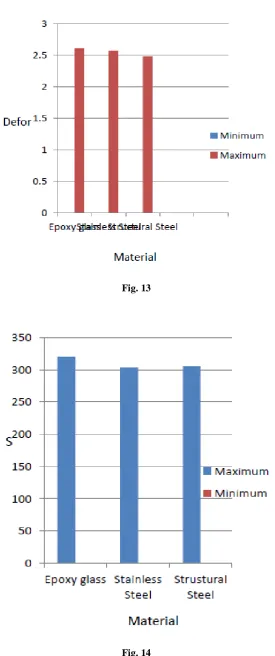
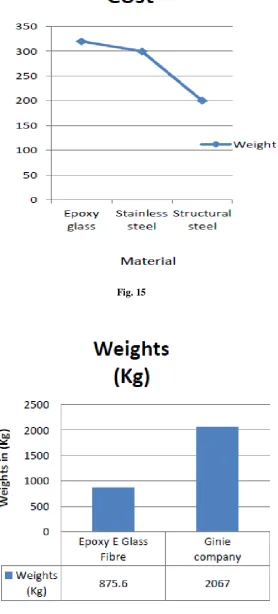
The maximum deformations induced in epoxy E glass fiber hydraulic lift is 2.60mm, which is in safe limits (1% of total span). Hence based on rigidity the design is safe, but if we compare deformations induced in Stainless Steel 2.57 mm. If we compare corresponding deformations in structure steel it is 2.48 mm which has less than other two materials. The equivalent stress induced for three materials is 320.05Mpa, 303.33 Mpa, 304.92 Mpa epoxy e glass fiber, stainless steel and structural steel respectively which is less than the allowable stress. Hence the design is safe based on strength. On optimization it is clear that Structure steel lift shows good results as compared to other two lift, hence Structure steel lift is suggested for manufacturing to said industry.
http: // www.ijrtsm.com© International Journal of Recent Technology Science & Management 15
ISSN : 2455-9679
[Mrinal et al. , 3(3), Mar 2018] Impact Factor : 2.015
Fig. 13
http: // www.ijrtsm.com© International Journal of Recent Technology Science & Management 16
ISSN : 2455-9679
[Mrinal et al. , 3(3), Mar 2018] Impact Factor : 2.015
Fig. 15
http: // www.ijrtsm.com© International Journal of Recent Technology Science & Management 17
ISSN : 2455-9679
[Mrinal et al. , 3(3), Mar 2018] Impact Factor : 2.015
V.CONCLUSION
The design and fabrication of a portable work platform elevated by a hydraulic cylinder was carried out meeting the required design standards. The portable work platform is operated by hydraulic cylinder which is operated by a motor. The scissor lift can be design for high load also if a suitable high capacity hydraulic cylinder is used. The hydraulic scissor lift is simple in use and does not required routine maintenance. It can also lift heavier loads. The main constraint of this device is its high initial cost, but has a low operating cost. The shearing tool should be heat treated to have high strength. Savings resulting from the use of this device will make it pay for itself with in short period of time and it can be a great companion in any engineering industry dealing with rusted and unused metals.
VI.FUTURESCOPE
This device affords plenty of scope for modifications for further improvements and operational efficiency, which should make it commercially available and attractive. Hence, its wide application in industries, hydraulic pressure system, for lifting of vehicle in garages, maintenance of huge machines, and for staking purpose. Thus, it is recommended for the engineering industry and for commercial production.
REFERENCES
1. “Design, Manufacturing & Analysis of Hydraulic Scissor Lift”, Gaffar G Momin, et al, International Journal Of Engineering Research And General Science Volume 3, Issue 2, Part 2,March-April,2015,ISSN 2091-2730
2. Design, Analysis and Development of Multiutility home equipment using Scissor Lift Mechanism”, Divyesh Prafulla Ubale, et al, International Journal of scientific research and management (IJSRM), Volume-3, Issue-3, Pages- 2405-2408, 2015
3. Design and Analysis of Hydraulic Pallet System in Chain Conveyor”, Setu Dabhi, et al, IJRET: International Journal of Research in Engineering and Technology eISSN: 2319-1163 ISSN: 2321-7308
4. Finite Element analysis of Frame of Hydraulically Operated Beam Lifting Machine” S. B. Naik, et al, International Journal For Technological Research In Engineering Volume 2, Issue 8, April-2015 ISSN (Online): 2347 – 4718
5. Design and analysis of an aerial scissor Lift, M. Abhinay, P.Sampath Rao,), SSRG International Journal of Mechanical Engineering (SSRG-IJME) – volume1 issue 5 September2014 Mechanical Dept, VREC, Nizamabad- 503003
6. Design & Analysis of Hydraulic Scissor Lift” M. Kiran Kumar1, J. Chandrasheker2, Mahipal Manda3 , D.Vijay Kumar4, International Research Journal of Engineering and Technology (IRJET) e-ISSN: 2395 -0056 Volume: 03 Issue: 06 June-2016 www.irjet.net p-ISSN: 2395-0072
7. Design, Analysis and Development of Hydraulic Scissor Lift Material loading and unloading, Suraj B. Dhanawade , Shubham S. Bhujbal , Rohan R. Dhane, Prof. Rahul R. Narkar , Prof.Sangram S. Bhosale International Journal of Advance Engineering and Research Development Volume 4, Issue 3, March -2017
8. Optimisation in Design of Mechanical Scissor Lift ,Deepak Rote, Kaustubh Kolhe, Vinit mangaonkar, Vinay shinde, Mr. Syed Zulfequar Ali International Engineering Research Journal (IERJ) Special Issue 3 Page 35-39, 2016, ISSN 2395-1621
http: // www.ijrtsm.com© International Journal of Recent Technology Science & Management 18
ISSN : 2455-9679
[Mrinal et al. , 3(3), Mar 2018] Impact Factor : 2.015
10. Material Handling Industry of America (MHIA), Safety Requirements for Industrial Scissors Lifts. 1994, Charlotte: ANSI.
11. Policy on Code Compliance - Scissors Lifts 2003,http://www.southworthproducts.com/stuff/contentmgr /files/145d616e3acdac9b637c374e5a8365fd/misc/tech_cs_policy_code_compliance_scissors_lifts.pdf, Accessed on August 27, 2009.
12. McCann, M. (2003). Deaths in construction related to personnel lifts, 1992–1999. Journal of Safety Research, 34, 507-514.
13. Christopher S. Pan, A.H., Michael McCann, Mei-Li Lin, Kevin Fearn, Paul Keane (2007). Aerial lift fall injuries: A surveillance and evaluation approach for targeting prevention activities. Journal of Safety Research.
14. Selected occupational fatalities related to vehicle-mounted elevating and rotating work platforms as found in reports of OSHA fatality/catastrophe investigations. 1991
15. Riley, W.F., Sturges, L.D and Morris, D.H (1999). Mechanics of Materials, 5th Edition, John Wiley & Sons, Inc., United States of America.
16. Brochure attachment from Autoquip Corp., 1058 W. Industrial Ave., Printed on 29 August 2009.