http://dx.doi.org/10.4236/jqis.2013.34018
Quantum Walk of Two Quantum Particles on
One Dimensional System
Yongmei Zhang*, Junjie Xiao, Dongsheng Hu
Department of Applied Physics, Nanjing University of Aeronautics and Astronautics, Nanjing, China Email: *[email protected]
Received January 30, 2013; revised October 19, 2013; accepted November 12,2013
Copyright © 2013 Yongmei Zhang et al. This is an open access article distributed under the Creative Commons Attribution License, which permits unrestricted use, distribution, and reproduction in any medium, provided the original work is properly cited.
ABSTRACT
We study two particle quantum walks on one dimensional chain. Probability distribution of two particle quantum walks is dependent on the initial state, and symmetric quantum walk or asymmetric quantum walk is analogous to that of one particle quantum walk. The quantum correlation probability is much different from classical coincidence probability. The difference reflects quantum interference between two particles.
Keywords: Quantum Walk; Hadamard Operation; Probability Distribution; Correlation Probability
1. Introduction
Random walk is relevant to many aspects of our lives, providing insight into diverse fields. It forms the basis of algorithms [1] and describes diffusion processes in phy- sics or biology, such as Brownian motion [2]. It has also been used as a model for stock market prices [3]. Quan- tum walk is the quantum counterpart of classical random walk. It is immediately noticed that quantum walks behave quite differently from classical random walk [4]. Quantum walk is expected to have implications for va- rious fields, for instance, as a primitive for universal quantum computing [5], systematic quantum algorithm engineering [6], or for deepening our understanding of the efficient energy transfer in biomolecules for photo- synthesis [7]. Quantum walk has attracted a great deal of attention in the scientific community in recent years. There have been several suggestions for practical imple- ments of quantum random walks, such as trapped ions [8, 9], optical lattices [10,11] and QED cavity[12].
In this paper, we aim to numerically simulate quantum walks of one or two quantum particles on a chain. The quantum correlation probability is much different from classical coincidence probability. The difference reflects quantum interference between two particles. Quantum interference is matter wave interference based on wave- particle dualism of quantum mechanics.
The paper is organized as following. In Section 2, the
quantum walk operations are introduced. In Section 3, distribution probability of two particles is displayed. The comparison between two particle quantum walks with one particle quantum walk is stated in Section 4. Brief conclusions are given in Section 5.
2. Quantum Walk in One-Dimensional
Systems
Quantum walk on a line is a simple example which shows many properties of quantum walks. It is often used as a tool in the analysis of quantum walks on more complicated graphs [4].
In a classical random walk on the line, a particle is in a certain location at start. At each time step, the particle moves left or right randomly with probability 1/2. This is realized by throwing a coin. If the coin is upward, the particle moves left. Otherwise the particle moves right. After many time steps, the random walk yields a bino- mial probability distribution.
Quantum walk is realized on a line or a circle by a quantum coin. Let H be the Hilbert space spanned by the positions of the particle. The basis states of the space are
n :nZ
, where n corresponds to a particle localized in position . However, quantum walker has been assigned an additional quantum degree of freedom which could be spin or other chirality [13]. The walker goes left or right depending on the spin degree of freedom. Thus the position space is augmented by coinn
space HX spanned by two basis states
,
. Statesof the total system are in the space of Н=НCНP n [14].
Suppose the particle is initially localized on site . The initial state of the particle is
0 a n n, 0 b n
n,1 (1) where are complex amplitudes of the state. According to normalization, we have
and
a n b n
2
2 1a n b n . If the initial state is asymmetric, then a n
1, 0 and b n
0, 0 . The symmetric state corresponds to
1 , 02
a n
and
10, 2 b n
[15]. In each time step, there are two
operations, coin flip operation and shift operation. The coin flip operation generates a superposition state
, 0 , 0 ,1
,1 , 0 ,1
C n a n b n C n c n d n
(2)
A frequently used balanced unitary coin is the so called Hadamard coin H
1 1 1
1 1 2
H
.
In the shift operation, spin-up state moves left while spin-down state moves right.
, 0 1, 0 ,1 1,1
S n n
S n n
(3)
Running N time steps of quantum walk, the probability distribution is very different from the classical normal distribution.
What is quantum walk mechanics of two particles on a chain? Suppose initially one particle is on site and the other on site . Since each particle has spin states, the initial state of the system is expressed as following.
m n
mn mn m n mn m n
mn m n mn m n
a b
c d
(4)
where mn, mn, mn and mn are complex ampli- tudes of the state. Because of normalization,
a b c d
2 2 2 2
1
mn mn mn mn
a b c d .
The quantum coin in two particle case is Hˆ H Hˆm ˆn.
where Hˆm is quantum flip operation on the mth
particle and Hˆn is quantum flip on the . Thus the
Hadamard coin is
nth
1 1 1 1
1 1
ˆ
1 1 1 1
2 m 2 n
H
(5)
First, the Hadamard coin operates on the initial state. The coin flip operation generates new superposition state.
ˆ
mn mn mn m n mn m
mn m n mn m n
H a b
c d
n
(6)
In which
1 2 1 2 1 2 1 2mn mn mn mn mn
mn mn mn mn mn
mn mn mn mn mn
mn mn mn mn mn
a a b c d
b a b c d
c a b c d
d a b c d
(7)
Second, the particle states moves along the chain according to their spin states. Spin-up state moves left while spin-down state moves right. We have the fol- lowing recursion relations.
1, 1 1, 1 1, 1 1, 1 1 2 1 2 1 2 1 2m n mn mn mn mn
m n mn mn mn mn
m n mn mn mn mn
m n mn mn mn mn
a a b c
b a b c
c a b c
d a b c
d d d d (8)
One step of quantum walk is accomplished in this way.
2 2 2
mn mn mn mn mn
p a b c d 2 is called correlation probability. That is probability of one particle on site and the other on site after steps quantum walk. If
and are same, that is probability of two particles coincide on one site.
m
n T
m n
3. Quantum Walk Probability Distribution
of Different Initial States
Suppose two particles are indistinguishable. There are three types of initial spin conditions: both spin up, both spin down, one spin up and the other spin down. The initial states are
1 2 , 1 2 : both spin up, one on site and the other on site ;
1 2 , 1 2 : one on site with spin up, the other on site with spin down 1 2 , 1 2 : both spin down, one on site and the other
mn nm
mn nm
mn nm
a a m n
b c m n
d d m
;
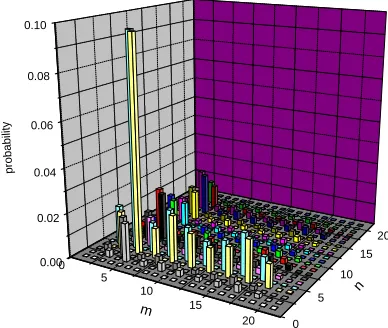
We simulate ten step quantum walk on a chain of length 21 and calculate the correlation probability. Figure 1 and Figure 2 both correspond to the first initial state in which two spin up particles locate on two different sites in the middle of the chain. After 10 steps of quantum walks, maximum probability appears on site 4 and 6. It reflects that spin up particles move left with bigger probability. Similar result happens to the third initial state. But the moving direction of spin down particles is right.
The correlation probability after ten steps quantum walk with initial state of one spin up and the other spin down is displayed in Figures 3 and 4. The maximum correlation probability is at (18,4) or (4,18). This indicates big probability of one particle moves to site 4
0 5
10 15
20 0.00
0.02 0.04 0.06 0.08 0.10
0 5
10 15
20
p
ro
b
a
b
ili
ty
n
[image:3.595.322.521.356.533.2]m
Figure 1. Correlation probability of two particles quantum walk on a chain of length 21 after 10 steps. Two spin up particles initially locate on site 10 and 12 respectively. The two particles mainly move left on the chain.
0 5
10 15
20 0.00
0.02 0.04 0.06 0.08 0.10
0 5
10 15
20
p
ro
b
a
b
ili
ty
[image:3.595.74.268.513.677.2]n m
Figure 2. Correlation probability of two particles quantum walk on a chain of length 21 after 10 steps. Two spin up particles initially locate on site 10 and 11 separately. The
0 5
10 15
20 0.00
0.01 0.02 0.03 0.04 0.05 0.06 0.07
two particles mainly move left on the chain. The probability is more concentrated in this case.
0.08
0 5
10 15
20
Pm
n
n
m
Figure 3. Correlation probability after 10 steps of quantum walk on a chain with 21 site. The two particles are initially at site 10 with spin up and site 12 with spin down. The probability of moving to opposite directions is big. The probability of returning to the starting point is small. But there is certain probability that they move to the same di-rection.
0 5
10 15
20 0.00
0.02 0.04 0.06 0.08 0.10
0 5
10 15
20
Pm
n
n
m
Figure 4. Correlation probability after 10 steps of quantum walk on a chain with 21 site. The two particles are initially
turning to their original locations is small. This result is at site 10 with spin up and site 11 with spin down. The probability of moving to opposite directions is big, but the probability of moving to the same direction is small. The probability of returning to the starting point is small, too. and the other moves to site 18. But the probability of re
Figure 3 than that in Figure 4. If the two particles are initially one site interval, each of them move right or left and overlap on some sites. When two particles are initially located nearby, they often stagger each other. There is little chance to reinforce.
4. Comparison with One Particle Quantum
Walk
o stu e results are displayed in Figures 5 and 6. Two particle quantum walk on a long chain is als
died. Th
Suppose the two particles are at site 200 and 201 at beginning. When they both spin up, they tends to move left after some steps. If one is spin up and one spin is down, the probability distribution is symmetrical. These
0.16
0 100 200 300 400
0.00 0.04 0.08 0.12
PR
O
BA
BILITY
D
IST
RIBUT
ION
SITE
[image:4.595.57.286.505.673.2]80 180
Figure 5. Probability distribution of two particle quantum walk on a chain of N = 400. Two spin up particles are ini-tially at site 200 and 201.Time steps are 80 and 180 respec-tively. The particles move to the left. The result is similar to one particle quantum walk.
0 100 200 300 400
0.00 0.02 0.04 0.06 0.08 0.10
prob
abilit
y
site
80 180
Figure 6. Probability distribution of two particle quantum walk on a chain of N = 400. One is spin up while the other is spin down initially at site 200 and 201. Time steps are 80 and 180 respectively. The quantum walk is symmetric. It is similar to one particle quantum walk.
results are similar to one particle quantum walk on a chain [14].
In classical statistics, the coincidence probability of two events is equal to the multiply of probabilities of single events. That is PAB PAPB [17]. In quantum random walks, one particle at site m is treated as an event. The probability of this event is Pm . The probability of the other particle on site n is Pn. The probability of one particle at site m and the other particle at site n is Pmn. In this work of two particle quantum walk, it is found that correlation probability is not equal to multiply of single event probabilities. Figure 7 is the difference between Pmn and PmPn where
60
m and n68. There is no difference in the first 20 steps because the particles have not arrives at site 60 or 68. When the particles arrive at the specific sites, quantum correlation probability is bigger than coinci- dence probability. During 20 and 50 steps, the difference changes severely. After 50 steps, the difference is very small because the particles have passed the objective sites. This manifests that correlation probability is distinct with coincidence probability in quantum random walk.
5. Conclusion
rticle quantum walks on one dimen- We study two pa
sional chain. Probability distribution of two particle quantum walks is dependent on the initial state, such as location and spin. The properties of symmetric quantum walk and asymmetric quantum walk are analogous to that of one particle quantum walk. When the two particles are one site apart initially, diffusion is faster and probability distribution is even on the chain. The quantum corre- lation probability is much different from classical coin-
0.012
0 20 40 60 80
-0.006 -0.004 -0.002 0.000 0.002 0.004 0.006 0.008 0.010
Pmn
-P
m
*P
n
time step
[image:4.595.308.536.521.683.2]m=60,n=68
[1] M. Barber, “R alks: Theor
Applications,” w York, 1970.
cidence probability. This difference reflects quantum in- terference between two particles.
REFERENCES
andom and Restricted W Gordon and Breach, Ney and
[2] H. C. Berg, “Random Walk in Biology,” Princeton, 1993.
[3] E. F. Fama, Financ. Anal., J, 51, 75(1995). http://dx.doi.org/10.2469/faj.v51.n1.1861
[4] A. Ambainis, “Quantum Walks and Thei Application,” 2004. arXiv: quantu-ph/0403
r Algorithmic 120v3
[5] A. M. Childs, “Universal Computation by Quantum Walk,”
Physical Review Letters, Vol. 102, No. 18, 2009, Article ID: 180501.
http://dx.doi.org/10.1103/PhysRevLett.102.180501
[6] W. Dur, R. Raussendorf, V. M. Kendon and H. Brieg “Quantum Walks in Optical Lattices,” Physical Revi
et, ,
ew A
Vol. 66, No. 5, 2002, Article ID: 052319. http://dx.doi.org/10.1103/PhysRevA.66.052319
[7] R. J. Sension, “Biophysics: Quantum Path to Photos thesis,” Nature, Vol. 446, 2007, pp. 740-741.
yn-
http://dx.doi.org/10.1038/446740a
[8] F. Zahringer, et al., “Realization of a Quantum W One and Two Trapped Ions,” Ph
alk with
ysical Review Letters, Vol. 104, No. 10, 2010, Article ID: 100503.
http://dx.doi.org/10.1103/PhysRevLett.104.100503 [9] P. Xue, B. C. Sanders and D. Leibfried, “Quantum on a Line for a Trapped Ion,” Physical Review Le
Walk
tters, Vol. 103, No. 18, 2009, Article ID: 183602.
http://dx.doi.org/10.1103/PhysRevLett.103.183602
[10] H. B. Perets, Y. Lahini, F. Pozzi, et al., “Realization of
evLett.100.170506 Quantum Walks with Negligible Decoherence in Wave- guide Lattices,” Physical Review Letters, Vol. 100, No. 17, 2008, Article ID: 170506.
http://dx.doi.org/10.1103/PhysR
al., [11] H. S. Eisenberg, Y. Silberberg, R. Morandotti, et
“Discrete Spatial Optical Solitons in Waveguide Arrays,”
Physical Review Letters, Vol. 81, No. 16, 1998, pp. 3383- 3386. http://dx.doi.org/10.1103/PhysRevLett.81.3383
[12] R. Rangel, N. Zagury and E. Massoni, “Dynamics of a
03/PhysRevA.69.023805
Single Trapped Ion inside a Nonideal QED Cavity at Zero Temperature,” Physical Review A, Vol. 69, No. 2, 2004, Article ID: 023805.
http://dx.doi.org/10.11
om Walk
m Walks: An Introductory
n One-Di-
-00267-2 [13] P. K. Pathak and G. S. Agarwal, “Quantum Rand
of Two Photons in Separable and Entangled State,” 2006. arXiv: quant-ph/0604138v3
[14] J. Kempe, “Quantum Rando
Overview,” 2003. arXiv: quant-ph/0303081v1
[15] X. P. Xu, “Discrete-Time Quantum Walks o
mensional Lattices,” The European Physical Journal B, Vol. 77, No. 4, 2010, pp. 479-488.
http://dx.doi.org/10.1140/epjb/e2010
l., “Quan-
ce.1193515 [16] A. Peruzzo, M. Lobino, J. C. F. Matthews, et a
tum Walks of Correlated Photons,” Science, Vol. 329, No. 5998, 2010, pp. 1500-1503.
http://dx.doi.org/10.1126/scien
al., “Quantum
oi.org/10.1103/PhysRevLett.102.253904 [17] Y. Bromberg, Y. Lahini, R. Morandotti, et
and Classical Correlations in Waveguide Lattices,” Phy- sical Review Letters, Vol. 102, No. 25, 2009, Article ID: 253904.