The exotic invasive plant
Vincetoxicum rossicum
is a
strong competitor even outside its current realized
climatic temperature range
Laura A. Sanderson1, Pedro M. Antunes1,2
1 Invasive Species Research Institute, Algoma University, Sault Ste. Marie, ON, Canada, P6A2G4 2 Department of Biology, Algoma University, Sault Ste. Marie, ON, Canada, P6A2G4s
Corresponding author:Pedro M. Antunes ([email protected])
Academic editor:M. van Kleunen | Received 20 September 2012 | Accepted 12 December 2012 | Published 12 February 2013 Citation: Sanderson LA, Antunes PM (2013) The exotic invasive plant Vincetoxicum rossicum is a strong competitor even outside its current realized climatic temperature range. NeoBiota 16: 1–16. doi: 10.3897/neobiota.16.4012
Abstract
Dog-strangling vine (Vincetoxicum rossicum) is an exotic plant originating from Central and Eastern
Eu-rope that is becoming increasingly invasive in southern Ontario, Canada. Once established, it successfully displaces local native plant species but mechanisms behind this plant’s high competitive ability are not
fully understood. It is unknown whether cooler temperatures will limit the range expansion of V. rossicum,
which has demonstrated high tolerance for other environmental variables such as light and soil moisture.
Furthermore, if V. rossicum can establish outside its current climatic limit it is unknown whether
com-petition with native species can significantly contribute to reduce fitness and slow down invasion. We
conducted an experiment to test the potential of V. rossicum to spread into northern areas of Ontario using
a set of growth chambers to simulate southern and northern Ontario climatic temperature regimes. We
also tested plant-plant competition by growing V. rossicum in pots with a highly abundant native species,
Solidagocanadensis, and comparing growth responses to plants grown alone. We found that the fitness of
V. rossicum was not affected by the cooler climate despite a delay in reproductive phenology. Growing V. rossicum with S. canadensis caused a significant reduction in seedpod biomass of V. rossicum. However, we
did not detect a temperature x competition interaction in spite of evidence for adaptation of S. canadensis
to cooler temperature conditions. We conclude that the spread of V. rossicum north within the tested range
is unlikely to be limited by climatic temperature but competition with an abundant native species may contribute to slow it down.
Keywords
Dog-Strangling Vine, Vincetoxicum rossicum, invasive species, invasion ecology, competition, phenotypic
plasticity, climatic temperature range, spread, reproductive phenology
introduction
Dog-strangling vine (Vincetoxicum rossicum (Kleopow) Barbar.; syn. Cynanchum rossi-cum (Kleopow) Borhidi) is an alien invasive plant species from the Ukraine and south-western Russia that has established in the north-eastern United States and southern Ontario. Vincetoxicum rossicum was first found in Toronto in 1889 (Smith et al. 2006). It is a perennial self-pollinating vine that produces pods filled with comose seeds that are wind-dispersed. Vincetoxicum rossicum effectively competes for light by forming large and dense stands that climb over other plants. This life-strategy results in suppres-sion of native plant productivity and diversity (DiTommaso et al. 2005). Vincetoxicum rossicum has been found growing successfully in both disturbed and undisturbed areas, in open fields, forest edges and understories, parks, road edges and railway embank-ments. The species produces a dense and fibrous root system and demonstrates wide environmental tolerance to variations in light intensity and soil moisture (DiTommaso et al. 2005; Douglass et al. 2009).
Currently, the distribution range of V. rossicum in North America has temperature and precipitation limits similar to those found in its native range (Kricsfalusy and Mill-er 2010). This climatic distribution pattMill-ern is consistent with what occurs for many exotic invasive terrestrial plants. A recent study on Holarctic invasive plants indicates that their new invaded range matches their native realized climatic niche, and that most species do not tend to invade beyond that range (Petitpierre et al. 2012). How-ever, given the high degree of environmental tolerance shown by V. rossicum, which factor(s) may be preventing its northern range expansion? Is it possible that nothing is limiting its expansion (i.e., propagules have simply not reached the north) or spe-cific factors (e.g., climatic, edaphic, environmental disturbance, biotic interactions) are preventing establishment? Considering the large number of seeds produced and their anemochory, it is unlikely that expansion is being limited by low propagule pressure.
It is unknown the extent to which climate serves as a barrier for further spread in the introduced range. Areas of central/northern Ontario that have, on average, slightly cool-er tempcool-eratures than those in the vine’s current range might be at risk of invasion by this plant. As such, determining the phenology and fitness of V. rossicum under those condi-tions is required for risk assessment and to potentially adjust management practices.
Plant phenology can be influenced by abiotic and biotic factors (Pau et al. 2011) and provides invasive plants with a competitive advantage over native plants. For in-stance, accurate timing of budburst can allow invasive plants to outcompete native species for light and successfully timed reproductive phenology ensures higher levels of fitness (Wolkovich and Cleland 2011; Godoy et al. 2008). Analyses of long-term phe-nological responses of native and exotic plant species to climate change have indicated that exotic invasive species are better able than natives at adjusting their flowering time (Willis et al. 2010).
its chances of establishing a successful population may be drastically reduced. Therefore, environmental tolerance, phenotypic plasticity and/or adaptive evolution may be crucial factors for invader success. Since invasion by V. rossicum is currently restricted to areas of North America with a climate similar to that found in its native range, its potential to spread throughout the introduced range is unknown. Nevertheless, flowering is found to occur later in Ontario than in populations from the United States, indicating a poten-tial climate-influenced phenological gradient (Douglass et al. 2009; DiTommaso et al. 2005). Species-distribution models have indicated that the northern limits of a plant’s range may be strongly influenced by its inability to set mature seeds (Morin et al. 2007). Therefore, V. rossicum may be limited in its capacity to spread into northern climates simply because it may not be able to complete its life-cycle.
On the biotic side, interspecific competition may be a limiting factor in species distribution (Keddy et al. 1998). Therefore, understanding competitive interactions between invasive and native species is important in risk assessment and can result in novel or improved management and restoration approaches (Firn et al. 2010). In its current North American range, V. rossicum is able to form what are essentially monocultures (DiTommaso et al. 2005), which would suggest that it is an excellent competitor against native species. Competitive ability has been tested in regard to V. rossicum polyembryony (Blanchard et al. 2010) and potential allelopathy (Douglass et al. 2011); both studies incorporated native species that co-occur with V. rossicum and ran from periods ranging 2–15 weeks in length under static growing conditions. How-ever, there are no data on whether V. rossicum responds negatively to a highly abundant native species outside its current climatic range.
Materials and methods
Dog-strangling vine (Vincetoxicum rossicum (Kleopow) Barbar.) root crowns were col-lected in Rouge Park, Toronto, ON (43.80526°N, 79.13594°W) in early May, 2011, before the onset of the growing season. The substrate used in the experiment consisted of soil collected from an un-invaded site adjacent to one invaded by V. rossicum. Root crowns were planted in one side of 10 L pots that were divided in half by a nylon mesh (30 μm opening) (Sefar Nitex 03-30/18, Heiden, Switzerland), which allows water and microbes, including fungal hyphae, to cross but prevents roots. The use of this nylon mesh still allows plants to compete for water and nutrients through diffusion, mass flow and mycorrhizal networks while preventing the roots from intertwining. The pots were filled with a 13 cm layer of a 2:1 mixture of Turface (a montmorillonite clay, Turface Athletics MVP, Profile Products LLC, Buffalo Grove, IL, USA) and non-calcareous granitic sand (Hutcheson Sand and Mixes, Huntsville, ON) followed by a 10 cm layer of 1.2 kg of field soil, and an additional 3 cm of the Turface:sand mixture.
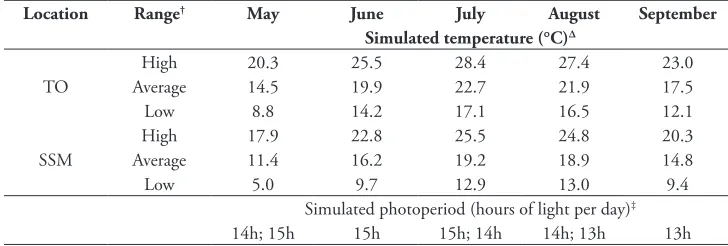
The experiment consisted of a completely randomized block design with two crossed factors; ‘plant competition’ and ‘temperature’. Specifically, for ‘plant competi-tion’ V.rossicum plants were either planted alone (control) or with a Canada Golden-rod (Solidago canadensis L. var. Canadensis; seeds were collected in the north east-ern United States by Ontario Seed Company, Waterloo, ON, Canada) seedling in the other half of the pot (competition group). Solidago canadensis seedlings were also planted alone (S. canadensis control). Each of these treatments comprised a total of 24 pots, which were divided evenly among six reach-in controlled environment units (Conviron, Winnipeg, MN, Canada), each representing a block; three chambers were set to Toronto (TO) growing season temperatures and three chambers set to Sault Ste. Marie (SSM) growing season temperatures for an overall total of 72 pots. To minimize any potential variability among controlled environment units all respective pots were rotated among units and re-randomized within each block every 25 days. Toronto temperatures are on average approximately 3° C warmer than SSM. We used weather records collected by Environment Canada from 1980–2010 to simulate the monthly temperature conditions throughout the growing season (Table 1). We also used these data to simulate photoperiod throughout the growing season. Since photoperiod was similar between the two locations and the main goal was to test temperature effects, it was kept the same across treatments (Table 1).
slow-release 18-6-8, 70-day fertilizer (meaning that after 70 days, 80% of the nutri-ents would have been released into the soil; 0.72 ppm N per pot) (Nutricote, Plant Products Co., Brampton, ON, Canada) after the fourth month of growth. The use of low fertilizer concentrations and of a slow release fertilizer ensured that plants had sufficient nutrients to survive but that soil fertility was such that they had to compete for nutrients. In the final month of the experiment, plants experienced an outbreak of thrips in all chambers, and were sprayed with Nemasys nematode spray (50 million count, Becker Underwood, SK, Canada).
The commercial seed stock of S. canadensis was contaminated with other species of goldenrod and asters. This resulted in twelve pots (three alone and six in competition under TO temperatures and three in competition under SSM temperatures) contain-ing the “wrong” plant species, which could not be differentiated until two months into the experiment. These pots have been removed from the competition data analysis, but have been kept for the V. rossicum phenology analysis.
At the end of the experimental period (as determined by simulated ‘first frost date’ for SSM), all plants were harvested. Roots and shoots were placed in separate bags, dried for three days at 60°C and weighed. Competitive response was calculated for both plant species according to methodology by Goldberg et al. (1999). Specifically, we calculated relative yield by dividing the total biomass of an individual plant grown with a competitor by the average total biomass for that same plant species grown alone. Competitive response was calculated by the ln of the relative yield; a negative number indicates a negative response to competition whereas a positive number indicates a positive response to competition.
Table 1. Temperature regimes used to simulate Toronto (TO) and Sault Ste. Marie (SSM) growing sea-sons in the controlled environment units.
Location Range† May June July August September
Simulated temperature (°C)∆
TO
High 20.3 25.5 28.4 27.4 23.0
Average 14.5 19.9 22.7 21.9 17.5
Low 8.8 14.2 17.1 16.5 12.1
SSM
High 17.9 22.8 25.5 24.8 20.3
Average 11.4 16.2 19.2 18.9 14.8
Low 5.0 9.7 12.9 13.0 9.4
Simulated photoperiod (hours of light per day)‡
14h; 15h 15h 15h; 14h 14h; 13h 13h
† Simulated temperatures were 1.4 °C warmer than the calculated average to meet the minimum range
allowed by the spell out controlled environment units (i.e., 5.0°C).
∆ Maximum and minimum temperatures were each maintained for 6 hours, with the remaining 12 hours
set at average temperatures.
‡ Average light intensity ranged between 350–400 μmol m-2 s-1. When two values are given, this indicates
Statistical analysis
We analysed plant responses to temperature on phenological data (i.e., flower bud-ding, open flowering and Seedpod formation), total plant biomass, root : shoot ratio, and competitive response. Since pots were rotated and re-arranged randomly among controlled environment units as blocks to minimize the potential for cham-ber effects, block effects were tested first within each temperature group using one-way ANOVAs. If a block effect was not detected, factorial ANOVAs were carried out. When testing phenology, total biomass, and root : shoot ratio each plant spe-cies was tested individually with the factor ‘plant competition’ being comprised of two levels (i.e., either S. canadensis or V. rossicum alone or the response of that species in presence of the competitor). To test for competitive response the model included ‘plant competition’ and ‘temperature’ as factors. Data were Box-Cox trans-formed to meet the test’s assumptions. All statistical analyses were carried out using Statsoft Inc. (2010).
Results
There were no significant differences in the reproductive phenology (i.e., presence of first flower bud, first flower opening and seedpod production) of V. rossicum grown either alone or with a competitor. In addition, we did not find a significant interaction between competition and temperature for any of these response variables. Tempera-ture, however, had a significant effect on the reproductive phenology of V. rossicum (Fig. 1). Plants grown under SSM temperatures took significantly longer to produce flower buds (F1,44 = 9.270, p = 0.00392), open flowers (F1,44 = 11.040, p = 0.00180), and seedpod (F1,44 = 19.778, p = 0.00006). These traits were delayed by an average
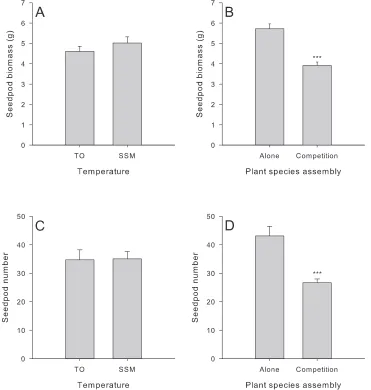
of 8, 9 and 11 days, respectively, under the cooler SSM temperatures. By the end of the experimental growing season, however, all V. rossicum plants had produced the same biomass and number of seedpods containing mature seeds regardless of tempera-ture treatment (Fig. 2A and C). Conversely, growing V. rossicum with a competitor caused significant reductions in the seedpod biomass of V. rossicum (F1,36= 42.812, p
= 0.000001) and in the number of seedpods produced (F1,36= 30.73, p = 0.000003) (Fig. 2B and D). We did not detect a significant interaction between temperature and competition for seedpod biomass or number.
Table 2. Total biomass (g) and root : shoot ratio of V. rossicum and S. canadensis grown under Toronto (TO) and Sault Ste. Marie (SSM) temperature regimes and either alone or in competition with each other.
Total biomass (g) Root : shoot ratio
V. rossicum S. canadensis V. rossicum S. canadensis
TO 23.56 ± 1.50 54.92 ± 4.90 2.05 ± 0.17 1.91 ± 0.18
SSM 22.75 ± 1.39 80.27 ± 8.99* 1.93 ± 0.19 2.97 ± 0.37
Alone 25.27 ± 1.39 82.46 ± 8.55 1.72 ± 0.14 2.42 ± 0.29
Competition 19.68 ± 0.86** 51.86 ± 5.23** 2.41 ± 0.20* 2.68 ± 0.42
For each species, statistically significant differences for each appropriate treatment factor are represented
by * (p<0.05) and ** (p<0.001). Data are presented as mean ± standard error of the mean. (V. rossicum,
temperature: n = 18 (TO), n = 21 (SSM); V. rossicum, plant species assembly: n = 24 (alone), n = 15
(com-petition); S. canadensis, temperature: n = 15 (TO), n = 21 (SSM); S. canadensis, plant species assembly: n
= 21 (alone), n = 15 (competition)).
Figure 1. Number of days necessary for the production of buds, flowers and seedpods under TO (black bars) and SSM (grey bars) temperatures. Significant differences between temperature regimes for each phenological trait are indicated by * (p<0.05) ** (p<0.01) and *** (p<0.0001). Error bars represent the standard error of the mean (n = 24).
Figure 2. Effect of climatic temperature (i.e., Toronto (TO) and Sault Ste. Marie (SSM) and
plant-plant competition (i.e., V. rossicum grown either alone or with S. canadensis (competition)) on seedpod
biomass (A and B) and number (C and D) of V. rossicum at the end of the experiment. Significant
dif-ferences between treatments are represented by *** (p<0.00001). Error bars represent the standard error of the mean (n = 24).
those grown in the warmer temperature (F1,32 = 6.1587, p = 0.018). There was no
significant temperature x competition interaction.
Discussion
Temperature significantly affected the reproductive phenology of V. rossicum. Gener-ally, phenological reproductive events took longer to occur under the cooler growing temperature conditions. This was expected as many plant species are known to accel-erate their reproductive phenology when subjected to warming (Sherry et al. 2007), especially those with flowering times that occur before the peak of summer, as is the case of V. rossicum. Indeed, we found that a slight reduction from the current grow-ing temperature conditions of V. rossicum was sufficient to produce a significant delay in budding, flowering, and the formation of seedpods. Along with photoperiod and moisture, temperature is considered a key environmental cue for flowering (Ratchke and Lacey 1985). Since we controlled for photoperiod and moisture, changes in the phenology of V. rossicum were likely solely influenced by temperature in our experi-ment. This is consistent with data indicating that some plants require the cumulative heatsum (i.e., a sum of daily heat inputs) to reach a certain threshold before flowering occurs (Reader 1983; Vasek and Sauer 1971; Ratchke and Lacey 1985). As such, we anticipate that V. rossicum will take longer to reach that threshold if it can indeed es-tablish and overwinter in field soils from northern Ontario.
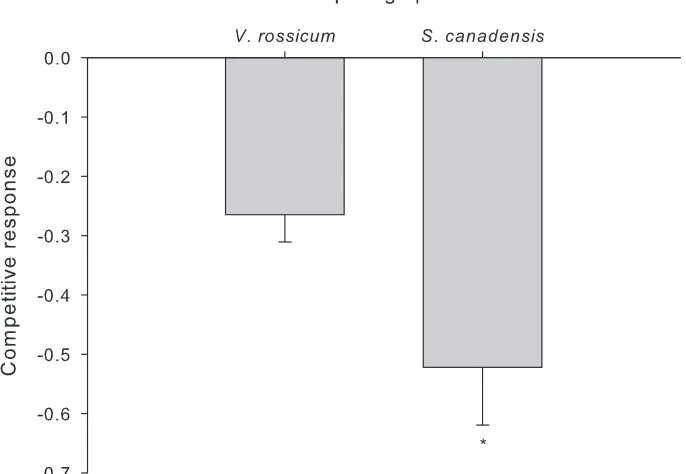
Figure 3. Competitive response (i.e., calculated by the ln of the relative yield, calculated by dividing the total biomass of an individual plant grown with a competitor by the average total biomass for that
same plant species grown alone) of V. rossicum and S. canadensis relative to the presence of the competing
species. Significant differences between species are indicated by an * (p<0.05). Error bars represent the
A plant’s northern range is determined by its capacity to overwinter and then pro-duce viable seeds (Morin et al. 2007; Chiune 2010). In this experiment the growing season temperature limit of V. rossicum was not reached, as all plants planted as root crowns produced mature seeds by the end of the growing season, which was simulated to coincide with the first frost in the SSM climatic region. This suggests that, despite experiencing a delay in reproductive phenology, V. rossicum can successfully produce as many propagules in the northern climate simulated in this experiment as in its current climate. Plants in their northern distribution ranges shorten their phenological timing to compensate for the shorter growing season, which can be done through phenotypic plasticity (Chuine 2010). It has been suggested that rapid seed maturation may be an adaptation to a later flowering time (Vasek and Sauer 1971). Vincetoxicum rossicum grown at lower temperatures produced mature seeds at the same time as those grown in warmer temperatures, suggesting an increase in seed maturation rate. As such, we conclude that phenotypic plasticity may enable this species to complete its life-cycle under the cooler climate of northern Ontario. However, our study focused on the growing season and V. rossicum started from root crowns. Future research should con-sider this species’ potential to rapidly evolve, including its capacity to overwinter and grow under different (a)biotic conditions, upon establishment from seeds.
The native forb S. canadensis is highly abundant in disturbed areas in its native range and is an exotic invader in Europe and Asia (Abhilasha et al. 2008). The species is well adapted to cold climates; the center of the distribution range of S. canadensis var. canadensis is northern Ontario (USDA NRCS, National Plant Data Team). In-deed, we did find evidence for adaptation to the colder temperature conditions of our experiment as plants grown under the cooler SSM conditions were 1.5 fold larger than those grown in the warmer temperature. These features made it a suitable candidate to potentially reduce the spread of V. rossicum either intentionally through seed augmen-tation or naturally, particularly under northern Ontario temperature conditions. There has been some discussion as to whether some native species can be considered invasive within their native range and whether they should be treated differently than exotic invasive species (Davis et al. 2011). From that perspective, using a native species that is highly abundant in disturbed areas as a means of V. rossicum control could be prob-lematic. However, various factors contribute to increase the risk of invasion by exotic relative to native species (see Simberloff et al. 2012) and considering that, overall, the most problematic biological invasions are caused by exotic species, we propose that investigating interactions between abundant native competitors and invasive exotic species should be considered both as a management option and in risk assessment.
significantly reduced in response to competition. However, even though S. canadensis ultimately produced more total biomass than V. rossicum, it was more negatively influ-enced by competition. This may result in V. rossicum populations out-competing those of S. canadensis over time, even though we did not determine the fitness (i.e., seed pro-duction) response of S. canadensis to competition.Therefore, the method of seeding S. canadensis in areas invaded by V. rossicum as a control option to reduce its fitness and spread may be an inefficient approach in the long-term. Even more so if we consider that feedback with soil biota is likely to lead to greater pathogen accumulations and growth reductions in native compared to exotic plants (Klironomos 2002).
Several factors were likely to have contributed to the competitive advantage of V. rossicum relative to S. canadensis in relation to total plant biomass. Plants were not limited by water, light or space aboveground, which suggests that most competi-tion would occur belowground for limited nutrient resources, which were supplied in low concentrations throughout the course of the experiment. Vincetoxicum ros-sicum increased its root : shoot ratio when in competition with S. canadensis whereas S. canadensis showed no response. This response of V. rossicum is consistent with competitively-driven adaptive plasticity, which can be explained by the balanced resource hypothesis; plants allocate nutrients and energy for growth to the areas re-sponsible for the acquisition of limiting resources (Brouwer 1962). Competitively-driven adaptive plasticity has been shown in other plant species especially under limited nutrient regimes (Berendse and Möller 2009). The observed differential between the two species in their capacity to shift resource allocation towards roots when in competition suggests that this may be an important factor in the success of V. rossicum as an invader.
Goldberg (1990) proposed that if both competitors start as seedlings, the species that is better able to acquire resources has the competitive advantage. However, if one species has an initial size advantage, which was the case in our study (S. canadensis seedling competing with a V. rossicum plant started from a mature root crown), the species that is better able to tolerate resource limitation has a competitive advantage. Our data indicate that V. rossicum can both tolerate and scavenge for the limiting re-sources present. Although the size asymmetry may have led to some initial competition bias towards V. rossicum, our goal was to test whether S. canadensis could alleviate the invasion of already established V. rossicum. Nevertheless, future studies on competi-tion between these two species could start equally from seeds. Future work should also investigate whether using a greater density of S. canadensis may be a more effective approach to help control V. rossicum. However, as discussed earlier competition and possible feedbacks with biota may favour V. rossicum in the long-term.
canadensis, which is typical of more mycorrhizal plants (Oliver et al. 1983). The mesh utilized in our competition pots was designed to keep plant roots separate be-tween species while allowing AM fungal hyphae to pass bebe-tween the divided cham-bers. Therefore, we hypothesize that V. rossicum’s association with AM fungi may have facilitated access to the other half of the competition pot. Future work should focus on the role of soil biota as potential modulators of competitive interactions be-tween native and exotic invasive species, which has not been consistently determined (Colautti et al. 2004; Levine et al. 2003).
Another possible reason for S. canadensis being a weaker competitor than V. ros-sicum could be that its timing for nutrient acquisition occurred later than that of V. ros-sicum’s. The two perennial species demonstrate different strategies; V. rossicum grows quickly early in the season whereas S. canadensis grows steadily over a longer period of time. A grassland study on invasion potential and resistance to invasion suggested that such resistance requires species that can establish and proliferate well, but also overlap the timing of their resource acquisition to that of the invading species (Young et al. 2008). It has also been suggested that the most accurate information about an invasive plant’s competitive ability against native species comes from pairing the invasive plant with a functionally similar native species (Firn et al. 2010). Testing other competitor species that are more functionally similar to V. rossicum might provide further insight into the competitive ability of this invasive vine and its invasion potential when S. canadensis is not present.
Conclusion
In spite of a delay in reproductive phenology, the fitness of V. rossicum does not appear to be limited by cooler growing season temperature regimes found outside its immedi-ate current distribution range in North America. Competition resulted in reductions in the fitness and total biomass of V. rossicum regardless of climatic temperature. How-ever, the relative reductions in total biomass were greater for the competing native species S. canadensis.
Acknowledgements
References
Abhilasha D, Quintana N, Vivanco J, Joshi J (2008) Do allelopathic compounds in invasive
Solidago canadensis s.l. restrain native European flora? Journal of Ecology 96: 993–1001.
doi: 10.1111/j.1365-2745.2008.01413.x
Averill KM, DiTommaso A, Morris SH (2008) Response of pale swallow-wort (Vincetoxicum
rossicum) to triclopyr application and clipping. Invasive Plant Science and Management 1:
196–206. doi: 10.1614/IPSM-07-036.1
Berendse F, Möller F (2009) Effects of competition on root-shoot allocation in Plantago
lanceo-lata L.: adaptive plasticity or ontogenetic drift? Plant Ecology 201: 567–573. doi: 10.1007/
s11258-008-9485-z
Blanchard ML, Barney JN, Averill KM, Mohler CL, DiTommaso A (2010) Does polyembry-ony confer a competitive advantage to the invasive perennial vine Vincetoxicum rossicum (Apocynaceae)? American Journal of Botany 97: 251–260. doi: 10.3732/ajb.0900232 Brouwer R (1962) Nutritive influences on the distribution of dry matter in the plant.
Nether-lands Journal of Agricultural Science 10: 399–408.
Cappuccino N (2004) Allee effect in an invasive alien plant, pale swallow-wort Vincetoxicum
rossicum (Asclepiadaceae). Oikos 106: 3–8. doi: 10.1111/j.0030-1299.2004.12863.x
Chiune I (2010) Why does phenology drive species distribution? Philosophical Transactions of the Royal Society B 365: 3149–3160. doi: 10.1098/rstb.2010.0142
Colautti RI, Ricciardi A, Grigorovich IA, MacIsaac HJ (2004) Is invasion success explained by the enemy release hypothesis? Ecology Letters 7: 721–733. doi: 10.1111/j.1461-0248.2004.00616.x
Davis MA, Chew MK, Hobbs RJ, Lugo AE, Ewel JJ, Vermeij GJ, Brown JH, Rosenzweig ML, Gardener MR, Carroll SP, Thompson K, Pickett STA, Stromberg JC, Tredici PD, Suding KN, Ehrenfeld JG, Philip Grime J, Mascaro J, Briggs JC (2011) Don’t judge species on their origins. Nature 474: 153–154. doi: 10.1038/474153a
Dhillion SS, Friese CF (1994) The occurrence of mycorrhizas in prairies: application to eco-logical restoration. In: Wicklett RG, Lewis PD, Woodcliffe A, Pratt P (Eds) The Proceed-ings of the 13th North American Prairie Conference, The University of Windsor (Canada) 1994. University of Windsor Press (Windsor, Canada): 103–114.
DiTommaso A, Lawlor FM, Darbyshire, SJ (2005) The biology of invasive alien plants in Canada. 2. Cynanchum rossicum (Kleopow) Borhidi [= Vincetoxicum rossicum (Kleopow) Barbar.] and Cynanchum louiseae (L.) Kartesz & Gandhi [= Vincetoxicum nigrum (L.) Mo-ench]. Canadian Journal of Plant Science 85: 243–263. doi: 10.4141/P03-056
Douglass CH, Weston LA, Wolfe D (2011) Phytotoxicity and potential allelopathy in pale
(Cynanchum rossicum) and black swallowwort (C. nigrum). Invasive Plant Science and
Management 4: 133–141. doi: 10.1614/IPSM-D-10-00021.1
Douglass CH, Weston LA, DiTommaso, A (2009) Black and pale swallowwort (Vincetoxicum
nigrum and Vincetoxicum rossicum): The biology and ecology of two perennial, exotic and
Firn J, MacDougall AS, Schmidt S, Buckley YM (2010) Early emergence and resource avail-ability can competitively favour natives over a functionally similar invader. Oecologia 163: 775–784. doi: 10.1007/s00442-010-1583-7
Fitter AH, Fitter RSR, Harris ITB, Williamson MH (1995) Relationships between first flower-ing date and temperature in the flora of a locality in central England. Functional Ecology 9: 55–60. doi: 10.2307/2390090
Godoy O, Richardson DM, Valladares F, Castro-Díez P (2008) Flowering phenology of in-vasive alien plant species compared with native species in three Mediterranean-type eco-systems. Annals of Botany 103: 485–494. doi: 10.1093/aob/mcn232
Goldberg DE (1990) Components of resource competition in plant communities. In: Grace JB, Tilman D (Eds) Perspectives on plant competition. Academic Press, Inc. (San Diego): 27–49. Goldberg DE, Rajaniemi T, Gurevitch J, Stewart-Oaten A (1999) Empirical approaches to
quantifying interaction intensity: Competition and facilitation along productivity gradients. Ecology 80: 1118–1131. doi: 10.1890/0012-9658(1999)080[1118:EATQII]2.0.CO;2 Greipsson S, DiTommaso A (2006) Invasive non-native plants alter the occurrence of arbuscular
mycorrhizal fungi and benefit from this association. Ecological Restoration 24: 236–241. doi: 10.3368/er.24.4.236
Gurevitch J, Wilson P, Stone JL, Teese P, Stoutenburgh RJ (1990) Competition among old-field perennials at different levels of soil fertility and available space. Journal of Ecology 78: 727–744. doi: 10.2307/2260895
Keddy P, Fraser LH, Wisheu IC (1998) A comparative approach to examine competitive response of 48 wetland plant species. Journal of Vegetation Science 9: 777–786. doi: 10.2307/3237043
Klironomos JN (2002) Feedback with soil biota contributes to plant rarity and invasiveness in communities. Nature 417: 67–70. doi: 10.1038/417067a
Kricsfalusy VV, Milller GC (2010) Community ecology and invasion of natural vegetation by
Cynanchum rossicum (Asclepiadacae) in the Toronto region, Canada. Thasizia Journal of
Botany 20: 53–70.
Levine JM, Vilà M, Antonio C, Dukes JS, Grigulis K, Lavorel S (2003) Mechanisms underly-ing the impacts of exotic plant invasions. Proceedunderly-ings of the Royal Society Series B: Bio-logical Sciences 270: 775–781. doi: 10.1098/rspb.2003.2327
Morin X, Augspurger C, Chuine I (2007) Process-based modeling of species’ distributions: What limits temperate tree species’ range boundaries? Ecology 88: 2280–2291. doi: 10.1890/06-1591.1
Oliver AJ, Smith SE, Nicholas DJD, Wallace W, Smith FA (1983). Activity of nitrate reduct-ase in Trifolium subterraneum: effects of mycorrhizal infection and phosphate nutrition. New Phytologist 162: 459–469.
Pau S, Wolkovich EM, Cook BI, Davies TJ, Kraft NJB, Bolmgren K, Betancourt JL, Cleland EE (2011) Predicting phenology by integrating ecology, evolution and climate science. Global Change Biology 17: 3633–3643:
Ratchke B, Lacey EP (1975) Phenological patterns of terrestrial plants. Annual Review of Ecol-ogy and Systematics 16: 179–214.
Reader RJ (1983) Using heatsum models to account for geographic variation in the floral phenol-ogy of two ericaceous shrubs. Journal of Biogeography 10: 47–64. doi: 10.2307/2844582 Sherry RA, Zhou X, Gu A, Arnone III JA, Schlmel DS, Verburg PS, Wallace LL, Luo Y (2007)
Divergence of reproductive phenology under climate warming. Proceedings of the Na-tional Academy of Sciences 104: 198–202. doi: 10.1073/pnas.0605642104
Simberloff D, Martin J-L, Genovesi P, Maris V, Wardle DA, Aronson J, Courchamp F, Galil B, García-Berthou E, Pascal M, Pyšek P, Sousa R, Tabacchi E, Vilà M (2012). Impacts of biological invasions: what’s what and the way forward. Trends in Ecology and Evolution. doi: 10.1016/j.tree.2012.07.013
Smith LL, DiTommaso A, Lehmann J, Greipsson S (2006) Growth and reproductive potential of the invasive exotic vine Vincetoxicum rossicum in northern New York State. Canadian Journal of Botany 84: 1771–1780. doi: 10.1139/b06-132
Smith LL, DiTommaso A, Lehmann J, Greipsson S (2008) Effects of arbuscular mycorrhizal fungi on the exotic invasive vine pale swallow-wort (Vincetoxicum rossicum). Invasive Plant Science and Management 1: 142–152. doi: 10.1614/IPSM-07-010.1
StatSoft Inc. (2010) STATISTICA (data analysis software system), version 9. http://www. statsoft.com.
Vasek FC, Sauer RH (1971) Seasonal progression of flowering in Clarkia. Ecology 52: 1038– 1045. doi: 10.2307/1933810
Weiner J (1988) The influence of competition on plant reproduction. In: Lovett Doust J, Lovett Doust L (Eds) Plant Reproductive Ecology: Patterns and Strategies. Oxford Uni-versity Press (New York): 228–245.
Wolkovich EM, Cleland EE (2011) The phenology of plant invasions: a community ecology perspective. Frontiers in Ecology and the Environment 9: 287–294. doi: 10.1890/100033 Werner PA, Bradbury IK, Gross RS (1980) The biology of Canadian weeds. 45. Solidago
can-adensis L. Canadian Journal of Plant Science 60: 1393–1409. doi: 10.4141/cjps80-194
Willis CG, Ruhfel BR, Primack RB, Miller-Rushing AJ, Losos JB, Davis C (2010) Favorable climate change response explains non-native species’ success in Thoreau’s Woods. PLoS ONE 5(1): e8878. doi: 10.1371/journal.pone.0008878