R E S E A R C H
Open Access
Massive open online nutrition and cooking
course for improved eating behaviors and
meal composition
Maya Adam
1*, Kelly C. Young-Wolff
2, Ellen Konar
3and Marilyn Winkleby
2Abstract
Background:Behavioral shifts in eating, favoring the increased consumption of highly processed foods over healthier, home-cooked alternatives, have led to widespread health problems. This study reports on the effectiveness of a massive open online course (MOOC), offering integrated nutrition and cooking instruction, for improving eating behaviors and meal composition among course participants.
Methods:The course, consisting of 47 short (4–6 min.) videos, was offered through Coursera, an open, online learning platform, available to individuals worldwide who have access to the Internet. Beginning in January 2014, participants viewed course videos, completed quizzes and participated in optional cooking assignments, over a 5-week period. Participants were invited to complete optional pre- and post-course surveys assessing their eating behaviors, typical meal composition and perceived barriers to home cooking. McNemar-Bowker tests of symmetry and within subject
t-tests were conducted to evaluate pre-post survey changes in the primary variables measured.
Results:7,422 participants from more than 80 countries completed both pre- and post-course surveys, while 19,374 participants completed the pre-survey only. Class participants were primarily women in the child-rearing ages (20–49 years of age). There were significant positive changes in eating behaviors and meal composition over time, including an increase in the percentage of participants who reported cooking dinner at home using mostly fresh ingredients 5–7 times in the previous week (63.4 % to 71.4 %), and who felt that yesterday’s dinner was very/extremely healthy (39.3 % to 56.4 %) and enjoyable (55.2 % to 66.7 %) (allpvalues < .0001).
Conclusions:Integrated nutrition and cooking courses, delivered via open online learning platforms, offer a free and flexible venue for reaching adults worldwide and have the potential to catalyze powerful behavioral shifts that align well with efforts to improve eating behaviors and meal composition.
Keywords:Nutrition, Cooking, Online education, Eating behaviors, Meal composition
Background
The harmful effects of over-consumption of highly proc-essed food have been well-documented [1–3]. Access to traditional, didactic nutrition education has been shown to elicit positive changes in eating behaviors among adults, particularly when nutrition education is explicitly linked to disease prevention [4–6]. The protective influ-ence of healthful home cooking and the family meal on child and adolescent health outcomes, including obesity
prevention, are also well documented [7–11]. This has led to calls for culinary skills education for school children, parents and healthcare providers [9, 11, 12]. Prior research testing the hypothesis that “the inclusion of ‘culinary education’(e.g., cooking demonstrations and hands-on cooking) as adjuncts to traditional didactic, nutrition presentations would result in measurable positive changes in both personal and professional nutrition-related behaviors” has yielded encouraging results among adults [12]. Similarly, in adolescents, both cooking education and family meals have been found to increase fruit and vege-table intake [13–15] among other positive changes in eating behavior and meal composition.
* Correspondence:[email protected] 1
Department of Pediatrics, Stanford School of Medicine, Stanford University, Building 20, Main Quad, Stanford, CA 94305, USA
Full list of author information is available at the end of the article
Parents have been identified as key players in establishing and modeling long-term eating behaviors for their children [6], but many parents model sub-optimal eating behaviors themselves [16] and identify barriers to both home cooking and the acquisition of nutrition education. Especially in the US, increasing the average intake of fruits and vegetables has been identified as a priority for health promotion and disease prevention efforts [17–20]. In addition, avoidance of highly processed foods, eating family meals and cooking at home have all been identified as health-promoting behaviors [2, 8, 13, 21] that lead to improved dietary intake in various populations. Major barriers to home cooking that have been identified, include perceived inconvenience [9], time constraints, lack of child care, transportation and low motivation to attending traditional nutrition education classes [6].
Online courses present an opportunity to overcome many logistical barriers to access for both traditional didac-tic nutrition education classes and culinary skills classes. While past, fee-based, online nutrition courses, have been found to enhance knowledge, student satisfaction has been mixed and the need to address emerging technologies has been identified [5]. The emergence of free, online learning platforms presents an opportunity to meet the needs of a diverse, worldwide audience. Since both lower socioeco-nomic status and level of education are known risk factors for poor dietary intake [22], minimizing barriers for these groups is particularly important.
Despite the need for healthful eating behaviors among adults and children, and the growing accessibility of massive open online learning [23], there are limited free online nutrition courses produced by medical and nutri-tion science professionals for the primary purpose of improving family eating behaviors and meal compos-ition. Additionally, no prior massive open online courses (MOOCs) have integrated basic online cooking educa-tion and online didactic nutrieduca-tion educaeduca-tion. To address this important gap, a medical and nutrition science team at the Stanford School of Medicine created and evalu-ated a MOOC aimed at promoting widespread access to cooking education and integrated didactic nutrition education. The objective of this pilot study was to assess the effectiveness of open, online nutrition and cooking instruction in improving the eating behaviors of course participants.
Methods
Course development and curriculum
A pilot version of the Stanford Child Nutrition and Cook-ing MOOC was offered on Coursera in May 2013. The course was primarily intended to reach participants with children, but individuals without children could partici-pate as well. As with all Coursera courses, participants could choose to watch videos multiple times and the
number of views per video was tracked by Coursera. More than 20,000 students enrolled in the 5-week introductory-level course and 60 % of enrollees engaged with course material beyond enrollment. More than half of these active participants provided feedback on the course, via discussion forums and/or course surveys. Feedback from the pilot course was used to generate a list of the partici-pants’most frequently cited“topics of interest”. Guided by the Social Cognitive Theory [24, 25] of behavior change, the course developers used this list to develop the Stanford Child Nutrition and Cooking 2.0 MOOC, of-fered from early January to mid-February 2014. This 5-week course was offered in English and consisted of 47 short (4–6 min.), easy-to-understand, instructional videos. Integrated instructional cooking videos aimed to provide participants with the tools to increase their skills and self-efficacy for healthful cooking by providing consistent on-screen modeling. In line with the Social Cog-nitive Theory of behavior change, course instructors, a medical doctor, a nutrition scientist and a chef, modeled healthful cooking, family mealtimes and involving children in the cooking process. The consistent integration of explanation, demonstration and modeling was intended to facilitate observational learning among course participants, while improving self-efficacy. Furthermore, the course employed a solution-oriented approach [26] by focusing largely on the potential benefits of healthful home cooking, rather than the risks associated with poor food choices, with the goal of demonstrating more immediate relevance to course participants.
Eligibility
The Stanford Child Nutrition and Cooking 2.0 MOOC was a free, open-access course available to individuals worldwide who had access to the internet. Both the pilot version and the final version of the course were advertised to Coursera’s existing student population and through promotional materials released by Stanford’s Vice Provost for Online Learning. According to Coursera’s Terms of Use, individuals under the age of 13 are excluded from en-rollment. Participants were expected to spend 2–4 h per week engaging with the course content and assignments.
Course content
The course content videos comprised three categories:
Category 1:“Basic Concept”videos covered paradigm-level concepts supporting healthy eating behaviors, including sensible grocery shopping, moderation in the diet, (including, for example, moderating intake of red meat), benefits of the family meal and how to encourage children to try unfamiliar foods.
macronutrients, micronutrients, US nutrition guidelines, the physiology of taste and other related concepts.
Category 3:“How To”videos consisted of short cooking demonstrations, interspersed with nutrition information about the foods being prepared. These videos delivered basic culinary skills education with an emphasis on preparing healthy meals economically, in a time-efficient manner.
Across all three categories of content, five health mes-sages, each identified as priorities in past nutrition re-search, were emphasized throughout the course: 1) health benefits of cooking at home, using mostly fresh ingredi-ents, including adequate fresh fruits and vegetables [27], 2) health and psychosocial benefits of eating family meals [21], 3) health benefits of reducing processed food con-sumption [28, 29], 4) health and environmental benefits of eating sustainably grown foods [30, 31], and 5) health benefits of practicing dietary moderation [32, 33].
The course content was then organized into a self-paced, 5-week curriculum, with a 10–15 question quiz at the end of each week. Participants were allowed to repeat quizzes, in line with literature suggesting that formative testing of this nature reduces student anxiety and solidifies learning [34]. In addition, participants were given the opportunity to communicate with each other and with teaching staff via online discussion forums and social media platforms. Coursera granted a Statement of Accomplishment to all participants who achieved a final grade of 60 % or higher and “distinction” was granted to all participants who achieved a grade of 80 % or higher on the weekly course quizzes. Optional weekly cooking assignments were not included in the calculation of the final grade, but partici-pants were encouraged to share photographs and recipes for their home cooked meals with members of the class community. During the course, feedback was obtained in-formally via the discussion forums that contributed to ongoing adjustments in the logistics of course delivery. Before and after the course, participants were asked to complete a confidential online survey that assessed their socio-demographic background, cooking and eating behav-iors, and perceived barriers to home cooking.
The Stanford IRB granted a Human Subjects waiver as this project was defined as a program evaluation rather than a systematic investigation.
Measures
Demographic variables
Demographic information was assessed in the pre-survey and included gender, age, education, race/ethnicity, country of residence, living situation (live alone, with family, with friends/other, with child younger than 18) and baseline perceived weight status.
Eating behaviors and meal composition
Eating behaviors and meal composition were assessed at both pre-and post-surveys for both the past week and for the previous day’s dinner. Participants indicated the number of days over thepast weekthat: 1) they ate dinner at home (all food types), 2) their oldest child under the age of 18 ate dinner at home with a family member, and 3) they cooked at home using mostly fresh foods; responses were categorized as follows: 0 days = 0, 1–4 days = 1, 5–7 days =2. Participants also reported on the previous day’s dinner, including whether it was cooked at home using mostly fresh foods (no = 0, yes = 1), whether it included fresh vegetables, fresh fruit, poultry, fish, red meat, vegetable protein, dairy, starch, and baked goods/sweets (no = 0, yes = 1, for each food type), as well as their levels of enjoyment and perceived healthfulness of the previous night’s dinner rated on five-point Likert scales and categorized as follows: not enjoyable or somewhat enjoyable (coded 0), moderately enjoyable (coded 1), and very or extremely enjoyable (coded 2); not healthy or some-what healthy (coded 0), moderately healthy (coded 1) and very or extremely healthy (coded 2).
Perceived ease of making healthy food choices and home cooked meals
Perceived ease or difficulty of making healthy food choices and preparing home cooked meals, a measure of self-efficacy, was assessed using eight questions, including how easy or difficult is it to avoid processed foods, get fresh foods to cook healthy meals, decide what to cook, cook using fresh foods, eat the right amount of food, get time to cook a meal at home, cook a meal that you enjoy, and eat healthy. Responses were gathered using a five-point Likert scale and categorized difficult or very difficult (coded 0), neutral (coded 1), and easy or very easy (coded 2); Cron-bach’s alpha = 0.80. An overall index score was also created using the summed total scores from these eight items.
Analysis
consumption of fresh fruits at yesterday’s dinner, and total perceived ease of healthy cooking) by key demo-graphic characteristics, including gender, age, education, baseline perceived weight, and US residence vs. non-US residence, to see whether changes would only occur for certain demographic groups. Stratified McNemar-Bowker tests of symmetry were used to test pre- to post-survey changes in consumption of fresh vegetables and fruits (categorical variables) and pairedt-test analyses were used to test pre- to post-survey changes in total perceived ease of healthy cooking (continuous variable).
Results
In line with published data on other MOOCs, a large discrepancy between number of enrolled students and number of course participants was seen [35]. Of the 35,521 students enrolled in the Stanford Child Nutrition and Cooking course, 22,023 were course participants who engaged with any course material beyond enroll-ment. The pre-course survey was completed by 19,374 (88.0 % of participants), over a 7-day period preceding the release of the first course videos. Both pre- and post-course surveys were completed by 7,422 (33.7 % of participants). All participants who completed both the pre- and post-surveys were included in the current study. Attrition analyses showed that participants who completed both the pre- and post-surveys were generally similar to those who only completed the pre-survey with respect to demographic characteristics, including educa-tion and perceived weight, although they were somewhat younger (79 % vs. 72.6 % under age 40) and more likely to be male (15 % vs. 13 %). Further, there were no differ-ences between those who completed both the pre- and post-surveys and those who only completed the pre-survey on average perceived ease of healthy cooking at baseline (27.3, SD = 5.7 vs. 26.4, SD = 5.9), although they were somewhat more likely to report consuming fresh fruit (28.4 % vs. 25.3 %) and fresh vegetables (71.4 % vs 66.3 %) at yesterday’s dinner at baseline. The overall completion rate for the course, defined as the percentage of enrolled students who received a Statement of Accomplishment (SOA) from Coursera, was 30 % of en-rolled students.
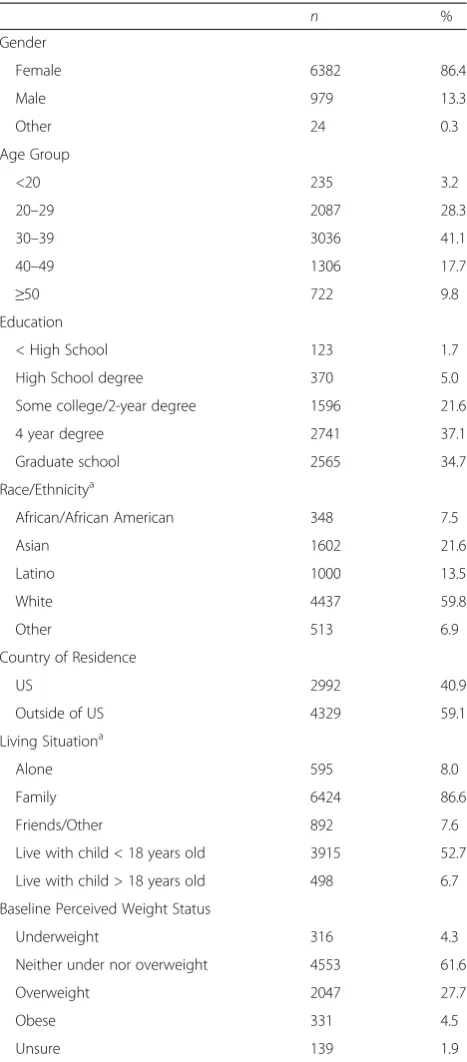
The majority of the 7,422 participants were female (86.4 %), white (59.8 %), in their bearing and child-rearing years (87.1 % aged 20–49), living with family (86.6 %), including at least one child under age 18 (52.7 %), with at least a 4 year college degree (71.8 %) (Table 1). The course reached participants from more than 80 countries and more than half of the class partici-pants (59.1 %) lived outside of the US. Among those who lived outside of the US, the 5 most common coun-tries of residence were Canada (12 %), India (6 %), the United Kingdom (6 %), Australia (5 %), and Spain (5 %).
Approximately 1/3 of participants perceived themselves to be overweight or obese (32.8 %).
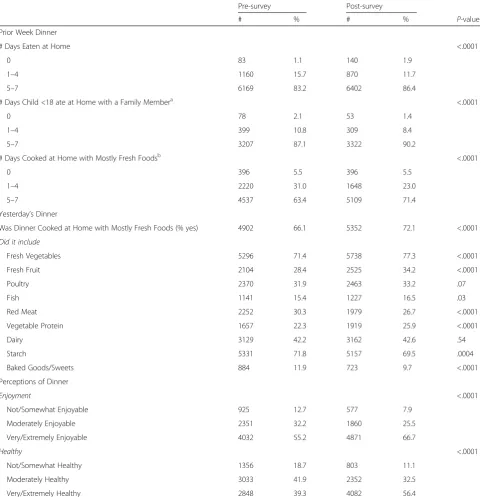
Eating behaviors and meal composition are described in Table 2. Almost all pre/post survey comparisons showed significant changes in the desired direction, mir-roring the messaging of the course. Most consistent with
Table 1Demographic variables (N= 7,422)
n %
Gender
Female 6382 86.4
Male 979 13.3
Other 24 0.3
Age Group
<20 235 3.2
20–29 2087 28.3
30–39 3036 41.1
40–49 1306 17.7
≥50 722 9.8
Education
< High School 123 1.7
High School degree 370 5.0
Some college/2-year degree 1596 21.6
4 year degree 2741 37.1
Graduate school 2565 34.7
Race/Ethnicitya
African/African American 348 7.5
Asian 1602 21.6
Latino 1000 13.5
White 4437 59.8
Other 513 6.9
Country of Residence
US 2992 40.9
Outside of US 4329 59.1
Living Situationa
Alone 595 8.0
Family 6424 86.6
Friends/Other 892 7.6
Live with child < 18 years old 3915 52.7
Live with child > 18 years old 498 6.7
Baseline Perceived Weight Status
Underweight 316 4.3
Neither under nor overweight 4553 61.6
Overweight 2047 27.7
Obese 331 4.5
Unsure 139 1.9
Note. Ns do not always add up to 7,422 due to missing responses
a
the central theme of the course, the percentage of partic-ipants who reported cooking at home with mostly fresh foods 5–7 times in the prior week, increased from 63.4 % to 71.4 % (p< .0001). Similarly, when describing yes-terday’s dinner, participants’ food choices reflected sig-nificant improvements that were aligned with the
longitudinal health messaging in the course, including a significant increase in consumption of fresh vegetables (71.4 % to 77.3 %) and fresh fruits (28.4 % to 34.2 %) (ps < .0001). Comparatively little change was seen from pre-to post-course survey with regard pre-to the consumption of foods that had neither been promoted nor discouraged
Table 2Pre- to post-survey changes in self-reported eating behaviors and meal composition (N= 7,422) Pre-survey Post-survey
# % # % P-value
Prior Week Dinner
# Days Eaten at Home <.0001
0 83 1.1 140 1.9
1–4 1160 15.7 870 11.7
5–7 6169 83.2 6402 86.4
# Days Child <18 ate at Home with a Family Membera <.0001
0 78 2.1 53 1.4
1–4 399 10.8 309 8.4
5–7 3207 87.1 3322 90.2
# Days Cooked at Home with Mostly Fresh Foodsb <.0001
0 396 5.5 396 5.5
1–4 2220 31.0 1648 23.0
5–7 4537 63.4 5109 71.4
Yesterday’s Dinner
Was Dinner Cooked at Home with Mostly Fresh Foods (% yes) 4902 66.1 5352 72.1 <.0001
Did it include
Fresh Vegetables 5296 71.4 5738 77.3 <.0001
Fresh Fruit 2104 28.4 2525 34.2 <.0001
Poultry 2370 31.9 2463 33.2 .07
Fish 1141 15.4 1227 16.5 .03
Red Meat 2252 30.3 1979 26.7 <.0001
Vegetable Protein 1657 22.3 1919 25.9 <.0001
Dairy 3129 42.2 3162 42.6 .54
Starch 5331 71.8 5157 69.5 .0004
Baked Goods/Sweets 884 11.9 723 9.7 <.0001
Perceptions of Dinner
Enjoyment <.0001
Not/Somewhat Enjoyable 925 12.7 577 7.9
Moderately Enjoyable 2351 32.2 1860 25.5
Very/Extremely Enjoyable 4032 55.2 4871 66.7
Healthy <.0001
Not/Somewhat Healthy 1356 18.7 803 11.1
Moderately Healthy 3033 41.9 2352 32.5
Very/Extremely Healthy 2848 39.3 4082 56.4
Note. Ns do not always add up to 7,422 due to missing responses.a
Includes only participants with a child < 18 years old (N= 3,915).b
in course videos (e.g., dairy).
Finally, there was a significant increase in the percent-age of participants who found yesterday’s dinner to be very or extremely enjoyable (55.2 % to 66.7 %;p< .0001)
and those who felt that yesterday’s dinner was very or extremely healthy (39.3 % to 56.4 %;p< .0001).
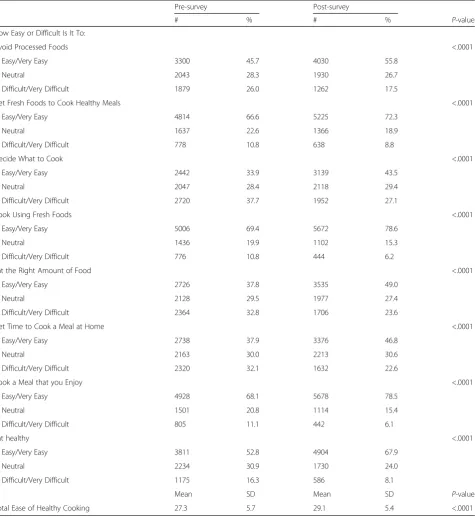
Table 3 presents the changes in perceived ease or diffi-culty of making healthy food choices and preparing home cooked meals. All pre-post changes were in the
Table 3Pre- to post-survey changes in perceived ease or difficulty of making healthy food choices and preparing home cooked meals (N= 7,422)
Pre-survey Post-survey
# % # % P-value
How Easy or Difficult Is It To:
Avoid Processed Foods <.0001
Easy/Very Easy 3300 45.7 4030 55.8
Neutral 2043 28.3 1930 26.7
Difficult/Very Difficult 1879 26.0 1262 17.5
Get Fresh Foods to Cook Healthy Meals <.0001
Easy/Very Easy 4814 66.6 5225 72.3
Neutral 1637 22.6 1366 18.9
Difficult/Very Difficult 778 10.8 638 8.8
Decide What to Cook <.0001
Easy/Very Easy 2442 33.9 3139 43.5
Neutral 2047 28.4 2118 29.4
Difficult/Very Difficult 2720 37.7 1952 27.1
Cook Using Fresh Foods <.0001
Easy/Very Easy 5006 69.4 5672 78.6
Neutral 1436 19.9 1102 15.3
Difficult/Very Difficult 776 10.8 444 6.2
Eat the Right Amount of Food <.0001
Easy/Very Easy 2726 37.8 3535 49.0
Neutral 2128 29.5 1977 27.4
Difficult/Very Difficult 2364 32.8 1706 23.6
Get Time to Cook a Meal at Home <.0001
Easy/Very Easy 2738 37.9 3376 46.8
Neutral 2163 30.0 2213 30.6
Difficult/Very Difficult 2320 32.1 1632 22.6
Cook a Meal that you Enjoy <.0001
Easy/Very Easy 4928 68.1 5678 78.5
Neutral 1501 20.8 1114 15.4
Difficult/Very Difficult 805 11.1 442 6.1
Eat healthy <.0001
Easy/Very Easy 3811 52.8 4904 67.9
Neutral 2234 30.9 1730 24.0
Difficult/Very Difficult 1175 16.3 586 8.1
Mean SD Mean SD P-value
Total Ease of Healthy Cooking 27.3 5.7 29.1 5.4 <.0001
hypothesized direction. For example, the percentage of participants who reported that it was easy or very easy to make healthy choices increased significantly across surveys, ranging from an increase of 5.7 % (get fresh foods to cook healthy meals) to 15.1 % (eat healthy) across surveys (ps < .0001). Mean overall perceived ease of making healthy food choices and preparing home cooked meals also increased significantly over time from 27.3 (SD = 5.7) to 29.1 (SD = 5.4) (p< .0001).
Results from stratified analyses that tested for changes in key variables (i.e., consumption of vegetables at din-ner, consumption of fruits at dindin-ner, total perceived ease of healthy cooking) by demographic subgroups from the pre- to post-survey (data can be assessed by contacting author) indicated that while males, younger adults, those with less education, US residents, and those who per-ceived themselves to be overweight or obese, tended to consume fewer fruits and vegetables and had lower per-ceived ease of healthy cooking at baseline, each demo-graphic subgroup reported significant improvements in their consumption of vegetables, consumption of fruits, and total perceived ease of cooking healthy foods (p’s < .05).
Discussion
The current study reports on the first cooking and nutri-tion MOOC created for an internanutri-tional audience as a public health intervention to improve eating behaviors and meal composition of the participants. Course partic-ipants reported significant positive changes in eating be-haviors and meal composition over time, including an increase in the reported frequency of cooking dinner at home, using mostly fresh ingredients, as well as signifi-cant increases in the perceived health and enjoyment of home-cooked meals.
Composed of short, easy to understand videos aimed at conveying basic nutrition education and basic cooking skills, this MOOC was primarily intended to be a public health education resource for a large, international audi-ence. The pilot intervention topics (e.g., teaching cooking skills, promoting home cooking) were designed to be broadly generalizable to the adults from over 80 countries who participated in the course. Among the 7,422 partici-pants who completed both pre and post course surveys, significant positive changes were seen in most behaviors related to the key health messages emphasized throughout the course, including cooking at home, using mostly fresh ingredients, eating family meals; and practicing dietary moderation. Of particular interest were the findings that younger adults, those with less education, US residents, and those who perceived themselves to be overweight or obese, tended to consume fewer fruits and vegetables at the outset of the course and had lower perceived ease of healthy cooking. However, each of these subgroups experienced
significant improvements in their consumption of vege-tables and fruits, and total perceived ease of cooking healthy foods, suggesting that these higher risk individ-uals may have benefitted from the course. Future stud-ies that are able to tailor their messaging for specific sub-populations (e.g., country of origin) may have an even larger impact.
Past literature has shown that both face-to-face and online nutrition education can engage students and in-crease nutrition knowledge. Ha and Caine-Bish [4] deliv-ered an interactive introductory nutrition course to college students, combining didactic nutrition education with ac-tivities such as diet and exercise self-tracking. Whole grain intake increased significantly among the 80 students who participated in the study. A registered dietitian at Vanderbilt University offered a nutrition MOOC without an instruc-tional cooking component [36]. Feedback shared through discussion forums was overwhelmingly positive, although dietary changes pre-post course were not published. These studies underscore the potential for disseminated nutrition education to result in improved knowledge and eating behaviors, yet few studies have evaluated the efficacy of de-livering cooking skills instruction and nutrition education via MOOCs.
Strengths and future directions
The relatively large sample size in this study as well as the broad, international composition of the participant body, add to the potential impact of this analysis. Since 2014, the Stanford Child Nutrition and Cooking MOOC has been offered as an“on-demand”course on Coursera, allowing participants to enroll at any time and complete the course at their own pace. By October 2015, course enrollment for this MOOC had reached 228,635. Matenance and course direction require a minimal time in-vestment on the part of the instructor and the online platform staff once course content has been created, so the potential for sustainability of this educational re-source is high.
Limitations
“less than 10 %” of enrolled students completing the course [38] or “generally between 10 and 20 %” [39]. The completion rate for the MOOC described here was higher than the reported averages, with 30 % of students enrolled earning a Statement of Accomplishment, but it has been suggested that completion rates do not accurately represent student engagement [37] as many students view video lectures without completing assessments. Assessing engagement has been identified as a major challenge in de-termining the effectiveness of MOOCs as public health education tools [37]. We also faced this challenge in our efforts to accurately assess engagement.
Second, participants’eating behaviors were self-reported and the social desirability of positive changes may have in-fluenced responses; however, the variability in changes seen across variables lends credibility. Similarly, partici-pants who completed both surveys may have been more motivated and thus, more likely to improve eating behav-iors, than those who failed to complete the course. Third, individual-level data on dose of exposure to course mate-rials is not available and thus we cannot determine the depth of engagement for individual participants and how this related to changes in eating behaviors. Fourth, the majority of participants in this study were women, 20–49 years of age, who lived with a family and had at least some post-secondary education. Fewer participants were men, older adults, and those who live alone, suggesting oppor-tunities for targeted outreach to these groups. Fifth, The Stanford Child Nutrition and Cooking MOOC was offered only in English. Subsequently, the course was translated into several world languages and is now being offered with the option of turning on subtitles in Korean, Spanish, Russian, Ukrainian, Dutch, Bulgarian and Croatian. Sixth, all survey measures were designed for this study by the team of medical and nutrition science experts in the Stanford School of Medicine for program evaluation. Demographic questions were adapted from U.S. national surveys (i.e., BRFSS, NHANES). Self-efficacy scales were adapted from previously evaluated nutrition interventions [40] and tailored to our intervention. Additional research is needed to validate these questions.
Finally, computer access and literacy is likely to be an ongoing barrier to participation in online courses, as evi-denced by the clustering of higher education levels among the majority of course participants.
Conclusions
The progressive substitution of highly processed foods with healthy home-cooked alternatives is a potentially powerful behavioral shift that aligns well with existing efforts to im-prove eating behaviors and meal composition. Based on the findings of this study, a valuable approach to support-ing this shift, may be found in the creation of accessible, in-tegrated nutrition education and cooking instruction. The
use of the MOOC format for delivering public health education of this kind allows participants to overcome logistical barriers to more traditional forms of education. With further evaluation, MOOCs have the potential to sur-pass traditional didactics as effective and far-reaching pub-lic health tools. More research is needed to determine how MOOC content can be tailored to maximize accessibility and positively impact the behaviors of people who may not otherwise have access to basic health education.
Endnote
1
Note: The data analysis for this paper was generated using SAS software. Copyright, SAS Inc. SAS and all other SAS Institute product or service names are registered trademarks of SAS institute Inc., Cary, NC, USA.
Abbreviation
MOOC:Massive open online course.
Competing interests
None. The authors have no financial disclosures or conflicts to report.
Authors’contributions
MA led the team who conceptualized and delivered the Stanford Child Nutrition and Cooking Course as well as writing the first drafts of the Abstract, Background, Methods and Discussion portions of this research paper. KYW analyzed the data collected from pre and post course surveys and wrote the Results sections. EK devised the surveys and led the data collection process for this study. MW supervised, edited and advised all authors during the process of data collection, analysis and presentation. All authors read, edited and approved the final manuscript.
Acknowledgments
Special thanks to Charles Prober MD, Senior Associate Dean, Medical Education, Stanford School of Medicine for his contributions to the review process for this manuscript, to Christopher Gardner PhD, Professor of Medicine at the Stanford Prevention Research Center for his contributions and feedback on course content and to Chris Stave, Librarian, Stanford School of Medicine, for his assistance with the literature review process.
Funding/Support
This work was funded by grants from the Stanford Vice Provost for Online Learning and support from the Stanford School of Medicine and the Program in Human Biology. This work was also supported by the Stanford Clinical and Translational Science Award (CTSA) to Spectrum (UL1 TR001085). The CTSA program is led by the National Center for Advancing Translational Sciences (NCATS) at the National Institutes of Health (NIH). The content is solely the responsibility of the authors and does not necessarily represent the official views of the NIH.
Financial disclosure
The authors have no financial disclosures or conflicts to report.
Human participant protection
The Stanford IRB granted a Human Subjects waiver as this project was defined as a program evaluation rather than a systematic investigation.
Author details
1Department of Pediatrics, Stanford School of Medicine, Stanford University, Building 20, Main Quad, Stanford, CA 94305, USA.2Department of Medicine, Stanford Prevention Research Center, Stanford, CA, USA.3Stanford Center for Advanced Studies in the Behavioral Sciences, Stanford, CA, USA.
References
1. Moodie R, Stuckler D, Monteiro C, Sheron N, Neal B, Thaksaphon T, et al. Profits and pandemics: prevention of harmful effects of tobacco, alcohol, and ultra-processed food and drink industries. Lancet. 2013;381(9867):670–9. 2. Monteiro CA, Levy RB, Claro RM, de Castro IRR, Cannon G. Increasing
consumption of ultra-processed foods and likely impact on human health: evidence from Brazil. Public Health Nutr. 2011;14(01):5–13.
3. Nestle M. Food politics: How the food industry influences nutrition and health. Vol 3. Berkeley, CA: Univ of California Press; 2013.
4. Ha EJ, Caine-Bish N. Interactive introductory nutrition course focusing on disease prevention increased whole-grain consumption by college students. J Nutr Educ Behav. 2011;43(4):263–7.
5. Cohen NL, Carbone ET, Beffa-Negrini PA. The design, implementation, and evaluation of online credit nutrition courses: a systematic review. J Nutr Educ Behav. 2011;43(2):76–86.
6. Pierce MB, Hudson KA, Lora KR, Havens EK, Ferris AM. The husky byte program: delivering nutrition education one sound byte at a time. J Nutr Educ Behav. 2011;43(2):135–6.
7. Larson NI, Nelson MC, Neumark-Sztainer D, Story M, Hannan PJ. Making time for meals: meal structure and associations with dietary intake in young adults. J Am Diet Assoc. 2009;109(1):72–9.
8. Fiese BH, Hammons A, Grigsby-Toussaint D. Family mealtimes: a contextual approach to understanding childhood obesity. Econ Hum Biol. 2012;10(4): 365–74.
9. Nelson SA, Corbin MA, Nickols-Richardson SM. A call for culinary skills education in childhood obesity-prevention interventions: current status and peer influences. J Acad Nutr Diet. 2013;113(8):1031–6.
10. Condrasky MD, Williams JE, Catalano PM, Griffin SF. Development of psychosocial scales for evaluating the impact of a culinary nutrition education program on cooking and healthful eating. J Nutr Educ Behav. 2011;43(6):511–6.
11. Lichtenstein AH, Ludwig DS. Bring back home economics education. JAMA. 2010;303(18):1857–8.
12. Eisenberg DM, Myrdal Miller A, McManus K, Burgess J, Bernstein AM. Enhancing medical education to address obesity:“See one. Taste one. Cook one. Teach one.”. JAMA Intern Med. 2013;173(6):470–2.
13. Larson NI, Story M, Eisenberg ME, Neumark-Sztainer D. Food preparation and purchasing roles among adolescents: associations with
sociodemographic characteristics and diet quality. J Am Diet Assoc. 2006; 106(2):211–8.
14. Thomas HM, Irwin JD. Cook It Up! A community-based cooking program for at-risk youth: overview of a food literacy intervention. BMC research notes. 2011;4:495.
15. Neumark-Sztainer D, Hannan PJ, Story M, Croll J, Perry C. Family meal patterns: associations with sociodemographic characteristics and improved dietary intake among adolescents. J Am Diet Assoc. 2003;103(3):317–22. 16. Patrick H, Nicklas TA. A review of family and social determinants of
children’s eating patterns and diet quality. J Am Coll Nutr. 2005;24(2):83–92. 17. Kimmons J, Gillespie C, Seymour J, Serdula M, Blanck HM. Fruit and
vegetable intake among adolescents and adults in the United States: percentage meeting individualized recommendations. Medscape J Med. 2009;11(1):26.
18. Liu RH. Health benefits of fruit and vegetables are from additive and synergistic combinations of phytochemicals. Am J Clin Nutr. 2003;78(3): 517S–20.
19. Ness AR, Powles JW. Fruit and vegetables, and cardiovascular disease: a review. Int J Epidemiol. 1997;26(1):1–13.
20. Boeing H, Bechthold A, Bub A, Ellinger S, Haller D, Kroke A, et al. Critical review: vegetables and fruit in the prevention of chronic diseases. Eur J Nutr. 2012;51(6):637–63.
21. Eisenberg ME, Olson RE, Neumark-Sztainer D, Story M, Bearinger LH. Correlations between family meals and psychosocial well-being among adolescents. Arch Pediatr Adolesc Med. 2004;158(8):792–6.
22. Hiza HA, Casavale KO, Guenther PM, Davis CA. Diet quality of Americans differs by age, sex, race/ethnicity, income, and education level. J Acad Nutr Diet. 2013;113(2):297–306.
23. Cronin MJ. Stanford Spins Out a Higher Education Tsunami. 2014:61–72. 24. Bandura A. Self-efficacy: The exercise of control. Macmillan, New York, 1997. 25. Bandura A. Social cognitive theory: An agentic perspective. Annu Rev
Psychol. 2001;52(1):1–26.
26. Robinson TN, Sirard JR. Preventing childhood obesity: a solution-oriented research paradigm. Am J Prev Med. 2005;28(2 Suppl 2):194–201. 27. Van Duyn MAS, Pivonka E. Overview of the health benefits of fruit and
vegetable consumption for the dietetics professional: selected literature. J Am Diet Assoc. 2000;100(12):1511–21.
28. Moubarac J-C, Martins APB, Claro RM, Levy RB, Cannon G, Monteiro CA. Consumption of ultra-processed foods and likely impact on human health. Evidence from Canada. Public Health Nutr. 2013;16(12):2240–8.
29. Wang MC, Cubbin C, Ahn D, Winkleby MA. Changes in neighbourhood food store environment, food behaviour and body mass index, 1981–1990. Public Health Nutr. 2008;11(09):963–70.
30. Horrigan L, Lawrence RS, Walker P. How sustainable agriculture can address the environmental and human health harms of industrial agriculture. Environ Health Perspect. 2002;110(5):445.
31. Hekler EB, Gardner CD, Robinson TN. Effects of a college course about food and society on students’eating behaviors. Am J Prev Med. 2010;38(5):543–7. 32. Willett WC, Sacks F, Trichopoulou A, Drescher G, Ferro-Luzzi A, Helsing E, et
al. Mediterranean diet pyramid: a cultural model for healthy eating. Am J Clin Nutr. 1995;61(6):1402S–6.
33. Young LR, Nestle M. The contribution of expanding portion sizes to the US obesity epidemic. Am J Public Health. 2002;92(2):246–9.
34. Cassady JC, Gridley BE. The effects of online formative and summative assessment on test anxiety and performance. J Technol Learn Assessment. 2005;4(1):n1.
35. Clow D. MOOCs and the funnel of participation. Paper presented at: Proceedings of the Third International Conference on Learning Analytics and Knowledge 2013.
36. Stark CM, Pope J. Massive open online courses: how registered dietitians use MOOCs for nutrition education. J Acad Nutr Diet. 2014;114(8):1147–55. 37. Gooding I, Klaas B, Yager JD, Kanchanaraksa S. Massive open online courses
in public health. Front Public Health. 2013;1:59.
38. Hill P. Four Barriers that MOOCs must overcome to build a sustainable model. e-Literate, http://mfeldstein.com/four-barriers-that-moocs-must-overcome-to-become-sustainable-model/ (Accessed 20/4/13). 2012. 39. Kolowich S. How will MOOCs make money. Inside Higher Ed. Washington,
DC, 2012.
40. Howard-Pitney B, Winkleby MA, Albright CL, Bruce B, Fortmann SP. The Stanford nutrition action program: a dietary fat intervention for low-literacy adults. Am J Public Health. 1997;87(12):1971–6.
Submit your next manuscript to BioMed Central and take full advantage of:
• Convenient online submission
• Thorough peer review
• No space constraints or color figure charges
• Immediate publication on acceptance
• Inclusion in PubMed, CAS, Scopus and Google Scholar
• Research which is freely available for redistribution