*Corresponding author
E-mail address: [email protected] Received October 26, 2017
J. Math. Comput. Sci. 8 (2018), No. 1, 130-152 https://doi.org/10.28919/jmcs/3550
ISSN: 1927-5307
A NEW ALGORITHM FOR SIGNED BINARY REPRESENTATION AND APPLICATION IN MOBILE PHONES
N. M. G. AL-SAIDI*, M. A. MAGAMISS, S. F. IBRAHEEM AND A. KH. FARAJ
Department of Applied Sciences, University of Technology, Baghdad, Iraq
Copyright © 2018 Al-Saidi, Magamiss, Ibraheem and Faraj. This is an open access article distributed under the Creative Commons Attribution License, which permits unrestricted use, distribution, and reproduction in any medium, provided the original work is properly cited.
Abstract: Cryptographic protocols become a requirement for many software applications and communication. Therefore, understanding of such protocols is more essential in order to improve them mathematically and in software implementations. Elliptic curve cryptography is one of these protocol, which are highly used nowadays especially in mobile devices due to its small key size and good security level. Despite of these advantages, it is considered as slower than other cryptosystems with the same key size and this revert to the most important operation the scalar multiplication. In this work, we aimed to reduce the computation of this operation by proposing an algorithm considered as faster in comparing to other efficient methods. This algorithm is implemented in mobile device to prove its efficiency.
Keywords: elliptic curve scalar multiplication (ECSM); binary method; signed binary representation. 2010 AMS Subject Classification: 68Q25.
1. Introduction
For the computational environment with limited memory such as, mobile devices, wireless
communication Elliptic curve cryptography was proved to be more secure than many other
cryptosystems such as, RSA AlGamal, when they used the same key size. The most important
operation in elliptic curve is the scalar multiplication, it is the operation to compute ,
where are points on the elliptic curve and r is any positive integer. The use of binary
expansion to represent r such that r= is considered as the most common way. Here, rs is
an element of a finite digit set Dk. In literature, several methods are proposed to achieve a perfect
representation that helps to enhance the performance of ECC and speeding up the scalar
multiplication operation. Some of them are based on reducing of the Hamming weight, such as,
the recording method []. Some other are based on window representation, which are considered
as a generalization of the recoding methods, for example, nonadjacent form (NAF) and Window
NAF [9–11], mutual opposite form (MOF) and Window MOF [12], and Window fractional
methods [13,14].
The complexity of the scalar multiplication operation is also improved by introducing fast
composite methods [2,15] as well as, using of coordinates systems instead of affine coordinates
[16,17]. It also speeds up through precomputations techniques [18–22]. Some other different
approach was through utilizing of customized hardware [23–25]. The representation of r is not
only limited to binary expansion, it was also represented in large radix. Another method for
representing r is known as double base number system (DBNS) [], it is used to improve the
performance of scalar multiplication. Combining software together is also helps to improve the
scalar operation of EC, this was obvious from the efficiency of EC single scalar multiplication
when combining of the optimal methods to solve EC problems. The operations on EC are two
EC operation type Operation name Math representation Denoted by Basic composite Point addition Doubling
Double and add
Tripling
Triple and add
Quadrupling
Quadruple and add Q+P 2P 2P+Q 3P 3P+Q 4P 4P+Q ADD DBL
DBL and ADD
TRP
TADD
QPL
QADD
In this paper, we aimed to enhance the EC scalar multiplication by proposing of an efficient
algorithm for this purpose, and compare it with other binary representation methods to prove its
efficiency.
2. Preliminaries
This section presents an overview of the material used in this work, for more details and some
background in cryptography; we refer the reader to see [22-24].
Definition 2.1: Let F be any field. Based on Weierstras’s equation, the elliptic curve E over F
is defined by:
( 1 ) x+ + + = y xy+ +
Where, the coefficients F and the discriminant of E is 0.
The discriminant of E given in (1) is defined by;
( 2 ) +9 27 8 -= where,
= 2 +
= + 4
= +4 - + -
Let L be an arbitrary extension of F, the set of all points on E is given by:
E (L) = {(x, y) L× L: + xy+ y - - - x- =0} { }.
where, is called the point at infinity.
The expression of the Weierstrass equation given in (1) for elliptic curve over the prime field
can besimplified as follows:
( 3 )
R and = 4 [19].
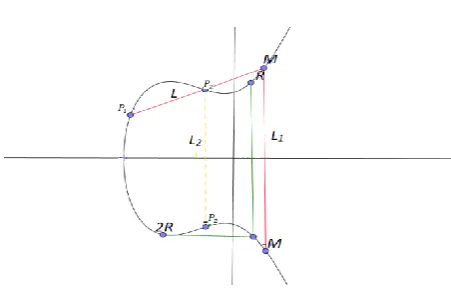
Figure 1: Elliptic Curve Addition
2.2 Addition of two points over EC algebraically
If we have two different points E( ). Then its addition
operation defined as = ( ) = E( ) is computed as
( 4 ) where, ( 5 ) − − = ( 6 ) − − ( λ =
and λ is the slope of the line L that connecting the points
such that: ( 7 ) mod = λ
If we have two similar points then its addition operation with
itself is defined as = ( ) = 2 E ). It is computed as
follows: ( 8 ) -= ( 9 ) -) -( λ = where ( 10 ) . =
The inverse of the point ) is defined as ).
Definition 2.3: The hamming weight of the scalar k is the number of non-zero bits in the signed
Definition 2.3: A signed binary representation of a scalar k with the base b is denoted by
such that k= with < b for =0, 1, 2, … and k= .
Definition 2.4: The length of a singed binary representation is denoted by which
represents the number of bits in this representation.
3. The Previous work
The binary representation length of the scalar k and its number of 1’s are controlling the
efficiency and the cost of the ECSM. There has been extensive research toward achieving of an
efficient representation for k. From literature, some of the existing well-known methods are
presenting in this section.
3.1Binary method:
The simplest method to represent an integer in (0, 1) bits is called the binary representation. It is
defined as ( where (0, 1), =0, 1, 2 … . Thus any integer can
be expressed as k = . Let be a point on an elliptic curve E, then the scalar
multiplication defined as k = = , where is another point on EC. The
computation of the scalar multiplication for binary method is showing in Algorithm 1:
Algorithm 1: Binary Method for Elliptic Curve Scalar Multiplication
Input: =( , )
=
1.
2. for 1 down to 0 do
2.1.
2.2. = 2
3. Return
The bits of k can be scans either from left to right or right to left in this method. The number of
operations for execution this algorithm is determined the running time. The elliptic curve adding
(ECADD) and doubling (ECDBL) operations are performed if , otherwise, only elliptic
curve doubling (ECDBL) operation is performed. The average of getting the number of ones in the
binary expansion of the scalar k is 1.
3.2Mutual Opposite Form (MOF)
In 2004, Mutual opposite form (MOF) proposed by Okeya et al. [20], is introduced to reduce the
hamming weight by converting the scalar to signed binary representation. The integer with
length of the binary representation by MOF is at most of the length and has a unique
representation. MOF satisfies the following properties:
a- The signs are different for every two adjacent non zero bits
b- The values 1and -1 are the first and the last non-zero bit in MOF representation,
respectively.
d- Sliding window method with width w can be executed in MOF, but in other methods such
as binary complementary, it cannot be executed with the sliding.
To represent the integer k in MOF we follow:
2k = … …
ϴk = … …
MOF(k)
-…
- …
-
-Where, ϴ refers to bitwise subtraction. This calculation can be computed in two directions; left
to right (L2R) or right to left (R2L), as presented in algorithm 2 and 3 respectively.
The L2R MOF representation is presented in Algorithm 2:
Algorithm 2: L2R MOF to find ECSM
Input: k )
Output: =
1. Set =0
2. For 1 down to 0 do
3. = 2
4.
5. if
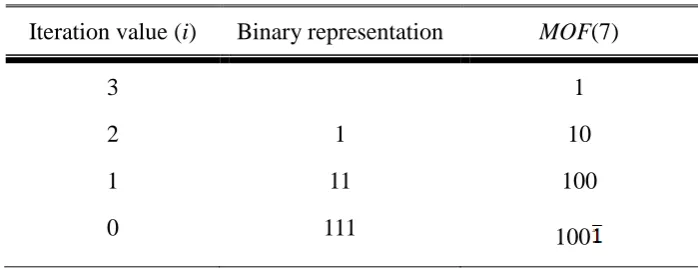
Example 1: Let k=7, Table 2 presents the steps for converting the scalar k into L2R MOF
representation.
Table 2: Binary representation and MOF for k=7
3.3 Complementary Recoding Method (CRM)
Firstly, we find the binary representation of a scalar k= ( . Utilizing
complementary method [45], to change the binary string into a signed binary string, the procedure
is given in the following:
k = = - -1 (4)
where = and = 1 when = 0 for i=0, 1, 2… i -1.
Algorithm 3: Complementary Recoding Method (CRM)
Input:
Output: k
1. v=
2. r=
3. CRM (k)= v-r-1
4. Return
Iteration value (i) Binary representation MOF(7)
3 1
2 1 10
1 11 100
Example 2: Let us take an integer k = = is the binary
representation with 13 bits.
The complement of the binary representation = .
Thus, using equation (4) to get the signed binary representation for a scalar k =
- -1
= (100000-1-1-10000-1) = - - - - .
The binary representation has 10 hamming weights and the complementary recoding has 5
hamming weights which saves 5 point addition operation in scalar multiplication.
3.4 Non Adjacent Form (NAF)
A non-adjacent form (NAF) proposed in 1951, by Booth [17]. NAF has an optimal traditional a
signed binary representation according to the minimum hamming weight as compared as other
traditional representations. A scalar k can be expressed a NAF representation as k= ,
where {0, 1, -1}, for every =0, 1, 2 … . A NAF representation has an important
property which is not existing two non-zero bits are adjacent respectively. Furthermore, it is at
most greater than binary representation by one digit. Every integer has a unique NAF
representation and exist proved by Gordon [47]. Algorithm 3 is used to express the integer k as
Algorithm 3: NAF representation of the scalar
Input: Appositive integer
Output:
1. Set
2. While
=2−(cmod 4)
Else
End if
= ;
End while
3. Return
The average number of hamming weight (non-zero bits) in this representation is equal to its
length divided by three ( ).
Table 3: The result of NAF (31)
I s(i) S
1 31
32
2 16 0 0
3 8 0 00
4
5
6
4
2
1
0
0
000
0000
100000
The previous table shows the result for NAF (31) = (10000 ). Now, computing the binary
representation for 31 = , so the hamming weight in the binary representation are 5
reduced to 2 in a signed binary representation NAF.
Remarks
1. A signed binary representation NAF (k) for a scalar k has the least hamming weight of
any other signed binary representation of k, except if the binary representation of k
already has. For examples
a. 42 =
=
b. 43 =
2. The scalar k is < k < if l (NAF (k)) = l.
3.5 Direct Recoding Method (DRM)
A new procedure is called Direct Recoding Method [20] for converting the scalar k into a signed
binary representation with lowest time compared with traditional methods proposed by Pathak
and Sanghi in 2010. In this procedure the output is same as a traditional signed binary
representation complementary recoding and NAF, MOF. The procedure is below:
< < (3.1)
= (3.2)
Bitwise-subtraction used in computation of procedure (3.2) by converting the scalar into a signed
binary representation. This method may cause increase by the hamming weight in many numbers
as in the following example3.4:
= = = so the hamming weight
in this example are 4 but in binary are 2.
4. The Proposed Algorithm
In this section, a new signed binary representation of integers going to present. We introduce the
following special algorithm of signed binary representation in order to achieve a unique
representation. After implementing this algorithm for every integer, we found that, its output
Algorithm 4: Assigned binary representation of a scalar k
Input: A scalar is appositive integer.
Output: k .
1. Set i=1, b1=0;
2. While (c>0);
t=c/2
b2=c - 2*t
a (i)=b1-b2
b1=b2
c=t
i=i+1;
End
a (i)=b1
3. Return .
Example 4.1: Initializing the above algorithm for computation the integer k=127 to generate the
assigned binary representation k= (1 0 0 0 0 0 0 -1). The expression of this integer k=127 in binary
representation is k= (1 1 1 1 1 1 1). The number of the hamming weight that generating by the
proposed algorithm is reduced to 2, compared with the binary representation that has 7 hamming
weight.
4.1 Complexity of the Proposed Algorithm
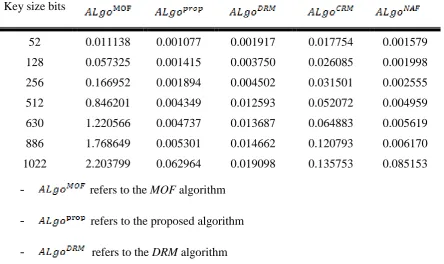
All traditional algorithms, such as MOF, CRM, DRM and NAF are compared with our proposed
algorithm according to the run time for generating the assigned binary representation. Using
Table 4: The comparison of run time of NAF, MOF, CRM and DRM.
Key size bits
52 0.011138 0.001077 0.001917 0.017754 0.001579
128 0.057325 0.001415 0.003750 0.026085 0.001998
256 0.166952 0.001894 0.004502 0.031501 0.002555
512 0.846201 0.004349 0.012593 0.052072 0.004959
630 886 1022 1.220566 1.768649 2.203799 0.004737 0.005301 0.062964 0.013687 0.014662 0.019098 0.064883 0.120793 0.135753 0.005619 0.006170 0.085153
-
refers to the MOF algorithm-
refers to the proposed algorithm-
refers to the DRM algorithm-
refers to the CRM algorithm-
refers to the NAF algorithmBased on our analysis which is shown in the previous Table 4, the running time computation in
the proposed algorithm to generate the assigned binary representation is the least in comparison
with the others methods as shown in Figure 3.
Figure 2: Time ratio of the second proposed algorithm with other algorithms
4.1 Implementation of the Proposed ECC in Mobile Phones with Android OS
The ECC is an efficient cryptosystem with a simple mathematical conclusion and small key size
in comparison to other public key cryptosystem. These facilities granted it advantages to be used
for securing data in small devices like mobile phones. The proposed ECC that implemented in
the previous section is applied on mobile phone with Android Operating System and using Java
language programming.
4.2 Implementation and Analysis
In this section, the screenshots of the results obtained from the program are depicted. This program
implemented by visual basic.net 2013. Due to successful run of the program, the data can be
securely transmitted from one device to another in a wireless transfer, such as Bluetooth, Wi-Fi etc.
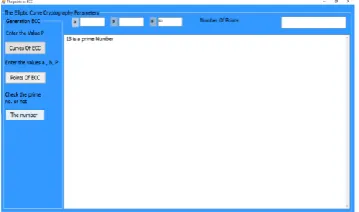
The program is run on windows platform. This interface is designed to check the number whether
it is a prime or not.
Figure 3: Primary Check.
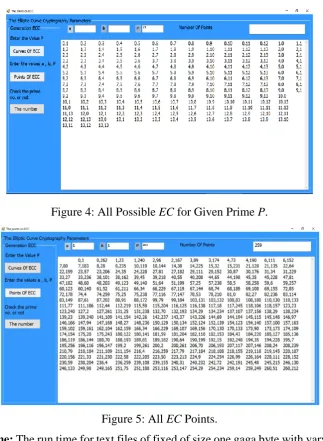
The second interface is designed to compute all elliptic curves over by given the value of the
prime number, which is obtained from first menu as sown in Figure 4. Each output consists of
two values (a, b) which are the coefficients of the equation of the elliptic curve. The first value
Figure 4: All Possible EC for Given Prime P.
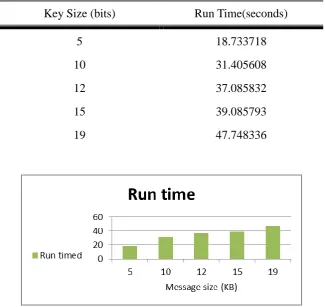
Figure 5: All EC Points.
Encryption time: The run time for text files of fixed of size one gaga byte with varying secret key sizes to perform the encryption process based on ElGamal Algorithm 4, as shown in Table 5:
Table 5: The Run Time for Encryption
Key Size (bits) Run Time(seconds)
5 5.320121
10 7.371525
12 8.721148
15 10.630149
Figure 6: Encryption Time.
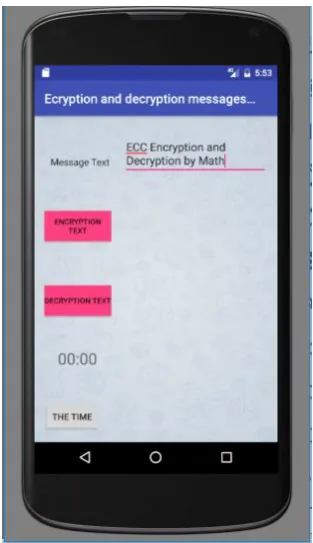
Decryption time: The run time for one gaga byte text files with varying secret key sizes to perform the decryption process depending on ElGamal Algorithm 4 as shown in Table 6 and
Figure 7:
Table 6: The Run Time for Decryption
Key Size (bits) Run Time(seconds)
5 18.733718
10 31.405608
12 37.085832
15 39.085793
19 47.748336
4.3 MOH-ECC Application
A new application is designed using Java code through Android studio which is a programming
language used to build application working in mobile devices. We called this application
MOH-ECC, it can be installed on any mobile device working under Android operating system.
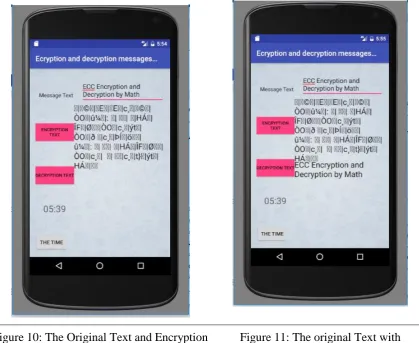
Figure 8 shows screen shoots for the main window of the proposed Android application that used
to encrypt and decrypt text message in English language. It has an easy to use interface that
shows how to encrypt an input text message and shows the encrypt text, it also contains another
button for the decryption process. Also, there is a button used to calculate the processing time for
each operation.
Figure 10: The Original Text and Encryption
Text.
Figure 11: The original Text with
Encryption and Decryption Text
Conclusions
In ECC, the scalar multiplication is the most important operation, while, it is the most expansive
operation due to the consuming of time implementation. The speed improvement is a challenge
that many researcher try to reach it. The performance of the scalar multiplication is mainly based
on the representation of the scalar. In our work, we design and implement a new efficient
algorithm called the nested algorithm, which is combined the elliptic curve scalar multiplication
and a signed binary representation MOF algorithm. The running time of the nested algorithm has
been reduced compared with ECSM based on MOF representation according to the result.
According to the experiment, it is obvious that, the computational time is reduced in comparison
to build new EC cryptosystem of this system is efficient and can be used in any mobile device
working under Android system. It is easy to install and support both common language in our
country (Arabic and English). Using large key sizes, we notice that, the computational time for
the proposed cryptosystem is acceptable.
Conflict of Interests
The authors declare that there is no conflict of interests.
REFERENCES:
[1] V.S. Miller, Use of Elliptic Curves in Cryptography, Advances in Cryptology, Proceedings of CRYPTO. 85, pp. 417-426, 1986.
[2] N. Koblitz, Elliptic Curve Cryptosystem, Math. Comput. 48 (1987), 203- 209.
[3] L. Ronald Rivest, Adi Shamir, and Len Adleman. A Method for Obtaining Digital Signatures and Public-Key Cryptosystems. Communications of the ACM, 21(2)( 1978), 120–126.
[4] G. Locke and P. Gallagher. Digital Signature Standard (DSS). Federal information processing standards publication. National Institute of Standards and Technology, 2009.
[5] T. ElGamal. A Public Key Cryptosystem and a Signature Scheme based on Discrete Logarithms. IEEE Trans. Inf. Theory, 31(4)(1985), 469–472.
[6] M. Anagreh, A. Samsudin and M.A Omar. Parallel Method for Computing Elliptic Curve Scalar Multiplication Based on MOF.Int. Arab J. Inf. Technol. 11(6 )(2014), 521-525.
[7] Y. Dan, X. Zou, Z. Liu, Y. Han, and L. Yi. High-Performance Hardware Architecture of Elliptic Curve Cryptography Processor over GF (2163). J. Zhejiang Univ. Sci. A, 10(2)(2009), 301-310.
[8] A. Osmani. Design and Evaluation of New Intelligent Sensor Placement Algorithm to Improve Converge Problem in Wireless Sensor Networks, J. Basic. Appl. Sci. Res., 2(2)(2012), 1431-1440.
[9] I. Blake, G. Seroussi, and N. Smart. Elliptic Curves in Cryptography. Cambridge University Press, UK, 1999. [10]E. Al-Daoud. An Improved Implementation of Elliptic Curve Digital Signature by using Sparse Elements.
[11]T. Al-Somani and M.Ibrahim. Generic-Point Parallel Scalar Multiplication without Precomputation, IEICE Electronics Express, 6(24)(2009), 1732-1736.
[12] B. Ansari and H. Wu, Parallel Scalar Multiplication for Elliptic Curve Cryptosystems, in Proceedings of International Conference on Communications, Circuits and Systems, Ontario, Canada, vol. 1, pp. 71-73, 2005.
[13]P. Balasubramaniam and E. Karthikeyan. Fast Simultaneous Scalar Multiplication, Appl. Math. Comput. 192(2)(2007), 399-404.
[14]X. Huang, P. Shah, and D. Sharma, Minimizing Hamming Weight Based on l’s Complement of Binary Numbers over GF(2m), in Proceedings of the 12th International Conference on Advanced Communication
Technology, Piscataway, USA, pp. 1226-1230, 2010.
[15]P. Balasubramaniam, and E. Karthikeyan. Elliptic Curve Scalar Multiplication Algorithm using Complementary Recoding, Appl. Math. Comput., 190(1)(2007), 51-56.
[16]D. A. Booth. A Signed Binary Multiplication Technique. Q. J. Mech. Appl. Math. 4(2)(1951), 236–240. [17]J.A. Solinas. Efficient arithmetic on Koblitz curves. Designs, Codes Cryptogr. 19(2–3)(2000), 195-249. [18]K. Koyama, Y. Tsuruoka. Speeding up Elliptic Cryptosystems by using a Signed Binary Window Method.
In Proceedings of the 12th Annual International Cryptology Conference on Advances in Cryptology. Springer-Verlag: California, USA, pp.357–345; 1993
[19]I.F. Blake, G. Seroussi, NP. Smart. Elliptic Curves in Cryptography. Cambridge University Press: Cambridge, UK, 1999.
[20]K. Okeya, K. Samoa, C. Spahn, and T. Takagi. Signed Binary Representations Revisited, in Proceeding of Annual International Cryptology Conference Advances in Cryptology Crypto, Santa Barbara, USA, pp. 123-139, 2004.
[21]H. K. Pathak and Manju Sanghi. Speeding up Computation of Scalar Multiplication in Elliptic Curve Cryptosystem. Int. J. Comput. Sci. Eng. 2(4)(2010), 1024–1028.
[23]H. Darrel, JM. Alfred, V. Scott. Guide to Elliptic Curve Cryptography, Vol. 332. Springer-Verlag: New York, 2003.