Ibrahim et al. World Journal of Pharmaceutical and Life Sciences
COORDINATION COMPOUNDS AS RADIOPHARMACEUTICALS
*1Ibrahim Waziri, 2Usman Umaru and 3Ibrahim Mohammed
1Department of Chemistry, University of Maiduguri, Maiduguri, Nigeria.
2Department of Chemistry, School of Secondary Education (Science Programmes), Federal College of Education,
Kontagora, Niger State, Nigeria.
3Department of Biology, School of Secondary Education, (Science Programmes), Federal College of Education, P.M.B.
39, Kontogora, Niger State, Nigeria.
Article Received on 03/02/2019 Article Revised on 24/02/2019 Article Accepted on 14/03/2019
INTRODUCTION
The discovery of radioactivity from the middle to late 1930s saw the utilization of radioisotopes of inorganic components to atomic medicine with specific interest in both diagnostic and therapeutic radiopharmaceuticals. With 32P, 131I, and 89Sr and the main human examination for leukaemia, thyroid and bone therapy, respectively, were started. The advancement of the 99Mo/99mTc generator in the late 1950s prompted the power of 99mTc in diagnostic nuclear medicine and was the section into the field of radiometal based imaging and therapeutic radiopharmaceuticals.[1] Radiopharmaceuticals are radioactive agents that could be used in the procedure for diagnostic or therapeutic process and consist of drug and radioactive component. Radionuclides substances varies in number of protons and neutrons as compared to stable elements.[2] Ionic form of radionuclides such as iodine – 131 (131I) is used in the treatment of cancer or strontium – 89(89Sr) for bone pain palliation which are commonly
represented by pharmaceutical targeting agents to which the radioisotope is synthetically attached. Radiopharmaceuticals targeting agents are also administered by oral, intra – arterial, intravenous,
intratumoral, intra – portal and intracavity routes.[3] Biological mechanisms for which carrier molecule are developed will determine the accumulation of the administered radiopharmaceuticals, as the carrier molecule, targets tissue of interest, the radionuclide that is attached to radiopharmaceuticals will provide radiation component (radioactivity).[3] Following systemic administration of a therapeutic dose of ionizing radiation to tissue, radiopharmaceutical will be localized within the body as a result of the biological and molecular properties of the carrier agent.. Radiation which is the driving force been produce by radioactive molecular imaging agents can easily be detected outside the body with minimal interference from surrounding tissue. This could be achieved by using positron emission tomography (PET) or position emitting radioisotopes.[4]
Radiopharmaceuticals are mostly small organic or inorganic compounds with clearly defined composition, they can also be macromolecules such as monodonal antibodies and antibody fragments that are not stoichiometrically labelled with radionuclide.[5] However, metal complexes with an organic chelate, metal – essential molecular agents for target – specific
World Journal of Pharmaceutical and Life Sciences
WJPLS
www.wjpls.org
SJIF Impact Factor: 5.088*Corresponding Author: Ibrahim Waziri
Department of Chemistry, University of Maiduguri, Maiduguri, Nigeria.
ABSTRACT
The interest in radiopharmaceutical as a positron – emitting radionuclide has grown considerably over the last decade, due to the fact that some radioisotopes have a standardized production and suitable half – life, favourable decay characteristics for single photon emission computed tomography or positron emission tomography (SPECT/PET) and successful use in a different diagnostic and therapeutic applications. There are a few radiopharmaceuticals dependent on monoclonal antibodies, peptides and particulate labelled with suitably used isotopes of radiometals for the treatment of some cancer and arthritis. However, to be utilised effectively in SPECT/PET applications, it must be stably bond to a targeting ligand. This review focuses on the coordination compounds as radiopharmaceuticals, six out of many radiometals were considered and the most successful used isotopes of the already discussed radiometals are; 99Tc, 186Re, 64Cu, 90Yt, 89Zr and 199Au chelators due to stability of their atomic properties such as half – life and favourable decay properties.The advancement of new radiometal ligands for SPECT/PET is a functional area of research. The review also dwells on the design principles and mechanism of radiopharmaceutical among the coordination compounds.
radiopharmaceuticals and radionuclides with physical (or nuclear) properties suitable for use in either a diagnostic or therapeutic radiopharmaceuticalsare mostly metals.[6,7] That makes coordination chemistry an essential part of radiopharmaceuticals.
Depending on their medical applications, radiopharmaceuticals can be classified into two essential classes: diagnostic and therapeutic. Their bio distribution (physical and chemical properties) and ultimate distribution (receptor binding or biological interaction) can also be used to determine their classification. The last class is appropriated by blood stream, but their tissue up – take retention rely on explicit communication of the radiopharmaceutical in biochemical procedure called target – specific radiopharmaceuticals.[2,5] Metals offer numerous ways for designing radiopharmaceuticals by changing the nature around the metal and permitting the specific in vivo on to be merged or incorporated into the molecule. It can either be metal essential or metal tagged, which may be determine by its biological distribution or properties of a carrier molecule. Stability and biological framework in which they will be utilised also determine the use and design of radiopharmaceuticals (vivo or thermodynamic stability).[2] Structural design or therapy in a customised treatment requires an interdisciplinary methodology covering synthetic and coordination chemistry, radiochemistry, labelling and bio conjugation techniques, pharmacokinetics and therapeutic.[4]
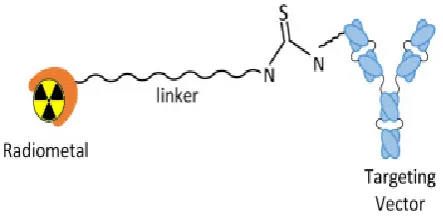
The basic interest to limit excessive radiation exposure by the body prompted the current radiopharmaceutical research to create site specific agents, so that the radionuclide can be specifically conveyed to the tissue of interest with negligible harm or damage to the surrounding cell. Bifunctional chelator (BFC) is a very good example of site – specific agents which has a dual function of binding the radiometal and forming through a linker. Such as proteins, peptides, nanoparticles which exhibit strong affinity to an overexpressed tumor surface biomarker as shown in (Fig. 1).[4]
Fig. 1: Bifunctional chelator approach.
Coordination chemistry and radiopharmaceuticals
Generally, the use of metal complexes as radiopharmaceutical for medicinal imaging and radiotherapy is moderately new area. Metallic radionuclide are specifically of particular interest for the
Fig. 2: Radiopharmaceutical Chemist’s table.
Radiopharmaceuticals Design and Coordination Compounds
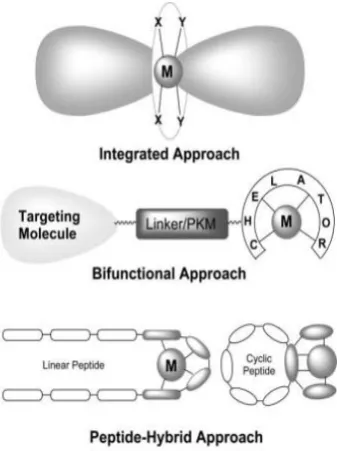
Inspite of the fact that the focal point of radiopharmaceutical research has moved towards organic or biological characterisation of radiolabelled receptor ligands over the most recent several years, while coordination chemistry still assumes a critical role in the design and improvement of the new target – explicit radiopharmaceuticals. Fig 3: Show the three different methods in radiopharmaceutical structure.[5]
Fig. 3: Showing three different approaches to radiopharmaceutical design.
In all the three radiopharmaceutical design inorganic chemistry is the ―centrepiece‖. The radiometal serves as the radiation source and distinguishes
radiopharmaceuticals from traditional therapeutic pharmaceuticals.[5]
Integrated approach
Integrated method design include substitution of part of a known high affinity receptor ligand with an ―unnatural‖ metal chelate so that there are negligible changes in size conformation, and receptor binding affinity. Substitution of the C – C or C – hetero atom bonds with M –N or M – S bonds has a great effect on the size and compliance of the receptor ligand, which are basic for the receptor binding. Introduction of the metal centre can likewise change the liphophilicity of the receptor ligand.[5]
Bifunctional approach
This is the more prominent approach for the advancement of target – specific radiopharmaceuticals, to a limited extents, because of the probability of holding the receptor binding affinity with a careful selection of BFC for radiolabelling. The fundamental advantage of this approach is that the receptor binding affinity could be retained by careful design and attachment of the radioactive chelate, and also uses a high affinity receptor ligand as the targeting biomolecule.[5]
Hybrid approach
In this approach, the tripeptide arrangement can be part of either a long straight polypeptide or a cyclic peptide backbone. The radiometal can also be incorporated as a major aspect of macrocyclic peptide structure. The hybrid approach radiometal (99mTc or 188Re) is chelated by a peptide sequence (e.gGly – Gly – Gly, Cys – Gly – Gly, or Cys – Gly – Cys) entering an N4, N3S or N2S2
Target specific radiopharmaceutical
Target – specific radiopharmaceutical is the recent aspect of radiopharmaceutical which is based on the receptor binding of a radiolabelled receptor ligand in the desired tissue, these effort depends heavily on identification and the use of receptor ligands as ―carriers‖ for radionuclide to localize at the disease tissues. For both imaging and therapy, radiolabelled receptor ligands offers advantage over simple radiometal complex radiopharmaceuticals
because of their high specificity and selectivity, but they also suffer disadvantage over traditional simple 99mTc complexes radiopharmaceuticals. For instance, if the agent is too specific it will not cover substantial population of patients, only those with similar physical and biological properties of the drug in question. Both commercial and medical application will be unsuccessful if the drug cannot serve the medical needs of large population.[5]
Table 1: Some target – specific diagnostic and therapeutic radiopharmaceuticals.[5]
Sr. No. Radiopharmaceuticals Trade name primary uses
1 Indium – 111 Capromab Prostascint® Imaging of prostate cancer pendetide 2 Indium – 111 Pentetreotide Octreoscan® Imaging of neuroendocrine tumor
3 I – 131 Tositumomab Bexxar® Treatment of non – Hodgkin’s lymphoma 4 Y – 90 Ibitumomabtiuxetan Zevalin® Treatment of non – Hodgkin’s lymphoma
5 Tc – 99m Depreotide Neotect® Somatostatin receptor- Bearing Pulmonary masses
Application of radiopharmaceuticals
Radiopharmaceuticals are applied in two major areas; diagnostic and therapeutic. The largest percentages of radiopharmaceutical products available have application
in cardiology (e.g myocardial perfusion), oncology (e.gtumor imaging and localization) and neurology (e.g cerebral perfusion).[2]
Table 2: Shows some examples of diagnostic and therapeutic radionuclide and Radiopharmaceutical agents used
in nuclear medicine application.[3]
Sr. No. Diagnostic radiopharmaceuticals
1 Radionuclide Agents Chemical Application Form 2 18F / 18F(FDG) Vector Imaging cell proliferation 3 123I /123I – MIBG Vector link Imaging medullary carcinoma 4 99mTcNa / 99mTcO4 Ionic Thyroid scanning
5 99mTc – hynic-Toc Vector – CA Imaging neuroendocrine tumors 6 99mTc – MDP CA Bone imaging
Sr. No. Therapeutic radiopharmaceutical
1 131INa131IIonic Thyroid scanning, treatmentof hyperthyroidism andthyroid cancer 2 131I / 131I – MBG Treatment of medullary carcinoma
3 177Lu 177I – DOTATATE Vetor – CA Treatment of neuro endocrinetumors 4 89Sr / 89SrCl Ionic Bone pain palliation
5 90Y Vector – CA Treatment of non –Hodgkin’slymphoma
Diagnostic radiopharmaceuticals
Nuclear medicine plays important role in the use of radiopharmaceuticals for infection imaging and nephrology. Radiopharmaceuticals utilized in diagnostic nuclear medicine techniques generally emit either gamma radiation or positrons, and half – lives of radionuclides for imaging applications for the most part length from minutes to a few hours.[2,3] However, low concentration in the range of 10-6 to 10-8M are mostly used in diagnostic radiation pharmaceutical and are not intended to have any pharmacological impact. Detailed description of the morphologic structure of organ or tissues as well as testing of their physiological function through accumulation of the radiotracer are the main aims of diagnostic application. It also provide non – intrusive for assessing and checking the impact of treatment.[5]
Therapeutic radiopharmaceuticals
line storing the radiation energy in a little volume of cells to store encompassing non-target tissues.
Fig. 3: show DNA strand break mediated by ionising radiation.[3]
Advantages of radiopharmaceuticals over traditional drugs
An essential distinction among the radiopharmaceuticals and traditional drugs is absence of pharmacologic activity with respect to radiopharmaceuticals. Radiopharmaceuticals have been used as tracers of physiologic process, radioactivity of radiopharmaceuticals permit non-invasive external monitoring with very little effects on biological processes in the body. In reality, radiopharmaceuticals have an incredible safety record, and their rate of antagonistic impact is very low.[2]
Coordination chemistry and pharmacokinetics
Generally, pharmacokinetics can best be described as movement, absorption, distribution, metabolism and elimination of drugs in the body. While, in the context of radiopharmaceuticals, it can be seen as the elimination and distribution of radionuclide following the administration of radiopharmaceuticals. Coordination chemistry therefor, contributes to pharmacokinetics of the target – specific radiopharmaceuticals by introducing various hydrophilic group such as poly aspartic acid which chelate metal particles and provide consumption hindrance. Synthetic charge of the metal chelate can be achieved by utilizing BFCs within various charge and hydrophilicity. For metal chelate containing at least two ligands, the choice of coligands may also be used for modification and enhancement of pharmacokinetics of the radiopharmaceuticals.[5] Pharmacokinetic information are fundamental for interpreting pharmaceutical agents from bench to clinic. Therefore, radiopharmaceuticals pharmacokinetic information are likewise basic for dosimetry to predict radiation doses to turmors and healthy tissues.[8]
Biological interaction
The interaction between biochemical and chemical agents in the body are important in radiopharmaceutical process. Administration of M-BFC – BM (M = radionuclide, M`= metal ion in the blood stream, BFC = bifunctional chelator, BM = biomolecule, L = completing chelator) in to the body system will results in the following biological interactions; receptor binding, protein and chemical reactions between radiopharmaceutical and metal ions in blood circulation as shown in fig. 4.[5,9]
Fig. 4: showing biological interactions of
radiopharmaceuticals in blood circulation.
As shown in fig. 4 above, the in vivo chemical reaction are the main source of radiation especially in the production of free 99Y by the reaction between 99Y chelate with other biological metal ions, such as Ca+ and F3+ will localise in the bone and cause bone marrow toxicity. Early release of 99Y from the 90Y – labelled BFC – BM conjugate may be triggered by competition between the BFC and the native chelator, such as amino acids and transferring.[5]
Radiometals for diagnostic and therapeutic
radiopharmaceuticals
all through the blood volume.[1] Below are some radiometals considered the most helpful site coordinated radiopharmaceuticals.
Technetium (Tc)
Technetium is largely used in diagnostic nuclear medicine because of its promising nuclear properties (6.02h, Eɤ 140keV), its availability from 99MoTc
generator and it’s relatively low cost, which are ideal for SPECT imaging. The mentioned properties has made
99
Tc the workhorse of the nuclear imaging community. Technetium is situated amidst the d – block transition elements in group 7 between manganese and rhenium, and their position gives the metals in this set one of the extensive scope of accessible oxidation states. Oxidation states of compound Tc ranges from +7 to – 1, with Tc(v), Tc(III) and TC(I) most commonly utilised in nuclear medicine application. It also has favourable gamma emission of 140KeV (89%), short half – live which is sufficiently long enough to do the essential chemistry to set up the different radiopharmaceutical for suitable imaging and can limit the radiation dose to the patient.[1,10]
As for now there are various clinically affirmed radiopharmaceuticals dependent on 99mTc that are basically small molecules and not based on the biofunctional chelate approach, for instance technetium (V) is the most accessible oxidation state from technetium (III) as confirmed by many approved technetium (V) radiopharmaceuticals such as Neurolite®, Ceretec®, Myoview® and MAG3®, which are recommended for cerebral blood flow imaging, cerebral blood flow imaging and white blood cell labelling, myocardial perfusion and renal filtration imaging respectively.[1] Brain imaging has turned into a main objective of 99mTc coordination chemistry, both for perfusion imaging and for labelling of so called central nervous system (CNS) receptor ligand. These ligands target receptors in brain and are important because of their implication in a wide range of mental disorders, such as Alzheimer’s and Parkinson’s disease or Schizophrenia.[11]
Lack of stable isotope of Tc, every form of technetium is radioactive, may published papers have reported the preparation and structural characterization of Tc complexes with wide variety of ligand or the use of
99mTc as a radio emitter in nuclear medicine.
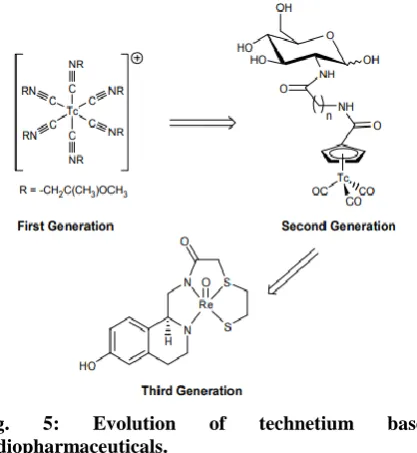
Specifications have reported in bone scanning, selective imaging of heart, brain, kidney, liver, lungs and other organs as well as radiolabelling agents for tumor tissue.[10,11] Similarly, radiopharmaceuticals have developed from simple metal compounds (first generation) with basic or simple ligands, to higher complex ligand or biomolecule ligand emulating lipophilic and structural properties to increase biocompatibility, bio distribution and tissue recognition specificity. Fig. 5 below show the evolution of technetium based radiopharmaceuticals with the last
generations have reached clinical applications, though chemically are harder targets to achieve.[10]
Fig. 5: Evolution of technetium based
radiopharmaceuticals.
Technetium isotope 94mTc is a cyclotron – produced radionuclide, with half – life of 52min. and a β+ energy of 2.47MeV (72%). It can be obtained from various production methods such as 94Mo(p, n)/94mTc (13.5 – 11MeV), natNb(3He, 2n)/94mTc (18 – 10MeV), 92Mo(α, pn)/94mTc(26 – 18MeV). Access to this isotope makes it conceivable to utilise PET to take care of issues with assessing the take – up of 99mTc radiopharmaceuticals.
94m
Tc isotope in the pertechnetate shape permit the utilization of the equivalent commercially available kit for 99mTc radiopharmaceuticals (such as 99mTc – sestamibi, 99mTc – tetrafosmin, and 99mTc – p829) to prepare the corresponding 94mTc analogues. On the whole, imaging quality of diseased tissue may better be achieved with the use of dual isotopes 99mTc/94mTc (SPECT/PET).[5]
Rhenium (Re)
the capacity to utilise the low spin d6 tricarbonyl Re(I) centre has gotten a great deal of consideration.[1]
Rhenium has two isotopes (186Re and 188Re). 186Re has a half – life of 3.68 days, β- emission (Emax = 1.07MeV, 91% abundance) and gamma – photon (E = 137KeV, 9% abundance). And then,188Re has half – life of 16.98h with high energy β – emission (Emax = 2.12MeV, 85%
abundance) and 155KeV gamma photons (5% abundance). However, the characteristics features of
186
Re most importantly its half – life and beta energy makes it more suitable for imaging and radiotherapeutic applications than isotope 188Re. Besides that, there was a specific movement of 185Re with neutrons (185Re(n,ɤ)
186Re) from low to medium isotope, but is not a carrier
free product, making 186Re still the most suitable and carrier free with high specific activity, interestingly can also be prepared from 188W – 186Re generator.[1,5] Consequently, due to its reasonable and promptly accessible186Re has great advantage and would make it suitable in the therapeutic and diagnostic radiopharmaceuticals.
Copper (Cu)
Improvement of copper radiopharmaceutical has gotten much consideration due to the accessibility of different isotopes with radiopharmaceutical significance. Copper isotopes of most interest include 64Cu (imaging and therapy), 62Cu (imaging) and 67Cu (therapy). Besides that, copper compounds show huge swath of biological activities such as anti – proliferative, anti – inflammatory and biocidal. From the three realised oxidation states, +1 and +3 are mostly unstable in organic framework, but on +2 oxidation state, Cu forms stable complexes with coordination number of 4, 5 and 6. Therefore, Cu (II) oxidation state is favoured for radiopharmaceutical use as it is more kinetically inert than the more typical, yet labile Cu (I) oxidation state. Similarly, administration of copper ions or radionuclides to diseased tissues or modify pharmacokinetics of ligands can be done effectively in a form of organometallic complexes as the biological system of organisms can manage the metal ions liberated from copper as opposed to other transition metal whose spilling from their compound can prompt aggregation and lethal impact. However, copper (II) complex tend to be Jahn – Teller distorted or misshaped compound and its lability remain an issue.[12]
Early work in the advancement of a chelate framework for Cu (II) concentrated on DOTA and 1,4,8,11 – tetraazacyclotetradecane – 1,4,8,11 – tetra acetic acid, TETA. Anyway, these complexes have exhibited constrained in vivo stability. Sarcophagine cage, cross – bridged derivatives of DOTA and TETA, CB – DO2A and CB – TE2A have demonstrated increasingly valuable for chelation of Cu(II) for in vivo applications. Moreover, based on their biological interaction, their synthesis and modification prove to be very difficult, making researchers want to utilise the industrially
accessible DOTA analogs despite the fact that they are not adequately stable under in vivo conditions.[1,12]
Brechbiel and associates have depicted a functionalised CB – TE2A analogy with a detailed 13% yield from cross – bridged cyclam, which was along these lines conjugated to RDG peptide analogs and labelled with
64Cu appearing in vivo dependently and has some unique
qualities that makes it a multipurpose radionuclide with numerous potential applications,[1,12] Atomic properties of 64Cu such as low β+ emission rate (18%) with β+ energy of 0.66MeV and half – life of 12.7h makes it suitable for the radiolabelling of small molecules. In the same vein, 64Cu is produced by photon irradiation of
natNi or improved 68Zn, however, the two techniques
experience the ill effects of low yield and co – production of 64Cu and 67Cu radioimpurities.[1,5,13] On the other hand61Cu can be produced from several nuclear reactions such as [59Co(α, 2n) 61Cu] (50MeV), [natNi(α,p)61Cu] (21MeV), and [61Ni(p,n)61Cu] with the following atomic properties; high β+ emission rate of (61%), maximum β+ energy of 1.2MeV and half – life of 3.4h, two gamma rays with Eɤ = 283(13%) and 656keV (11%). Despite the fact that the physical properties are alluring for PET imaging 61Cu has not been utilised to indistinguishable degree from 64Cu due to its low half-life.[5] In view of the above therefore, 64Cu has a great advantage over the remaining isotopes for PET imaging because of its stability in vivo.
Yttrium (Y)
Radioactive yttrium isotopes can’t be found in nature. However, in excess of thirty radioisotopes of yttrium with mass number running from 76 to 108 have been accounted for, the majority of which are created or produced during nuclear fission process. Out of these radioisotopes, 86Y and 90Y have radioactive decay properties suitable for use in clinical PET examinations and therapeutic applications respectively. 90Y therefore, is a receptor based therapeutic radiopharmaceuticals, because of its high activity with pure β+ particles emission. In addition, 90Y is generator – created radionuclide, as a result of 90Sr decay from the release of high β+ emission to form 90Zr.90Y has a suitable half –
life of 2.7days, which is short enough to accomplish a basic portion rate and in the meantime is sufficiently long to enable the radiopharmaceuticals to be produced and conveyed for clinical use. Also, the 90Sr/90Y generator is a perfect hotspot for the long – term availability of no carrier added 90Y which is reasonable for the planning of radiopharmaceuticals for radionuclide therapy. There are few entrenched radiopharmaceuticals dependent on monoclonal antibodies, peptides, and particulates marked with 90Y, that are in ordinary use for the treatment of a few types of essential cancer and arthritis.[5,14]
Zirconium (Zr)
Zr(III) and Zr(IV), which is the favoured oxidation state. At present, experimental proof demonstrates that because of its high charge and small radius, hydrated Zr(IV) exist as numerous monomeric and polynuclear µ - oxy – and µ - hydroxyl – bridge species in solution at low pH. Among the few isotopes ofZr, 89Zr has gotten the most consideration for radiopharmaceutical improvement in light of its nuclear decay properties that makes it helpful in the labelling of antibodies for immune – PET applications. An ongoing report demonstrated that 89Zr – desferrioxamine B –J591 can be utilized to effectively analysed a specific prostate membrane antigen positive prostate in tumors in vivo. In spite of the fact that the accessibility of a more extended lived positron producer (3.26 days for 89Zr) would be helpful by permitting delayed PET imaging, the 100% abundance emission of a 909keV gamma isn’t attractive perhaps a critical impediment. [1,15]
Gold (Au)
198Au and 199Au are the most important radioisotopes of
interest for radiotherapeutic applications and both are reactor based. However, 199Au has progressively appropriate beta and gamma emissions for atomic or nuclear drug application and is accessible in high explicit action from an improved Pt target, which makes it more suitable for radioactive imaging and is favourable for in vivo application. As against 198Au with high abundance and higher energy gamma of (412keV) making it less favourable for in vivo applications yet it is all the more promptly accessible for improvement. Chemistry of Au(III) isn’t straight forward and both hydrolysis and reduction to Au(0) are issues that should be survived. [1]
CONCLUSION
It is clear from the previous segments that coordination chemistry assumes an imperative role in the development of radiopharmaceutical. There are colossal effort in the improvement of target – specific radiopharmaceuticals for both early identifications of diseases and radiotherapy of cancers. Furthermore, radiometal assumes an essential role in diagnostic and therapeutic radiopharmaceuticals. Localization of small molecule radiopharmaceuticals involves the use of biochemistry, either explicit receptor interactions or metabolism are the eventual fate of nuclear medicine. Ultimately, radiopharmaceutical chemistry is particularly a multidisciplinary exertion and requires the cooperation of researchers from different fields including organic, inorganic, biochemistry and nuclear medicine in order to develop molecules that shows the ideal biochemistry activity. Despite the fact that kit preparation and arrangements for the imaging of practically all fundamental organs and organ framework exist and there is some involvement in the labelling of biomolecules, yet a requirement for new methodologies and new labelling procedures is needed. Meanwhile, huge number of the standard strategies apply the equivalent or related chelator frameworks and oxidation conditions of the transition metals. This unequivocally limit the chances to influence specific properties of the
metal biomolecule conjugates, hence remain a challenge for synthetic chemistry.
REFERENCES
1. Carroll, V., et al.; Radiochimica Acta., 2012; 100(8-9): 653-667.
2. https://www.pharmamirror.com/,
Radiopharmaceuticals. (Dictionary Online), 2013.
3. Dash, F.F.R.K.A. (Springer New Delhi Heidelberg New York Dordrecht London), 2016.
4. Donnelly, S; Advances in Inorganic Chemistry., 2016; 68: 223-251.
5. Liu, S., Chemical Society Reviews., 2014.
6. Jurisson, S., Wei Jia, D.B. and Dangshe, MA.;
Chem. Rev., 1993; 93: 1137-1156.
7. Larkina, E.P., Bragina, O., Stasyuk, E., Yusubov, M., Chernov, V., Zelchan, R., Skuridin, V. and Belousov ASD.; AIP Conference Proceedings., 2017; 1882: 020043.
8. Igor, S. and Ekaterina, D., journal of nuclear medicine., 2015;56: 10.
9. Hage, D.S., Clinical Chemistry., 2017; 63(6): 083-1093.
10. O.V.K., et al., Applications molecules., 2014; 19: 10755-10802.
11. Ulrich Abram, R.A., Journal of . Braz. Chem. Soc., 2006;17(8): 1486-1500.
12. Ferdani, C.J.A.R., Cancer Biotherapy & Radiopharmaceuticals, 2009; 24(4): 379-93.
13. Agency, I.A.E., Radioisotopes and Radiopharmaceuticals series, 2015; 5.
14. Rubel Chakravarty, A.D., and Pillai, M.R.A.; cancer biotherapy and radiopharmaceuticals, 2012; 27(10). 15. Nikunj B. B., Molecules — Open Access Journal,

![Fig. 3: show DNA strand break mediated by ionising radiation.[3]](https://thumb-us.123doks.com/thumbv2/123dok_us/9786741.1964231/5.595.61.275.107.292/fig-dna-strand-break-mediated-ionising-radiation.webp)