303 Copyright © 2011-15. Vandana Publications. All Rights Reserved.
Volume-5, Issue-1, February-2015
International Journal of Engineering and Management Research
Page Number: 303-307
Improving Wear Resistance of Grey Cast Iron using Detonation Gun
Sprayed Coatings: A Review
Gobind1, Jawala Parshad2, Dr. Neel Kanth Grover3 1,2,3
Department of Mechanical Engineering, S.B.S.S.T.C, Ferozepur, Punjab, INDIA
ABSTRACT
Materials are precious resources. Different methods and techniques are employed to protect the materials from degradation. As the wear is a surface phenomenon and occurs mostly at outer surfaces. Failure of mechanical components due to wear is the most common and unavoidable problem in automobiles, power generation units (hydro power plants), construction equipments, marine sector, gas and fuel pipelines and other mechanical processing industries. It not only affects the life of a component but also reduces its performances. Therefore due to heavy economic losses associated with wear, this problem has attracted the attention of the researchers worldwide. To overcome this problem of wear, wear resistant alloys or suitable wear resistant coatings deposited by various advanced techniques are generally used. Now a day’s Detonation gun spray coatings are gaining popularity due to exceptional hardness, wear resistance and cost effectiveness. A detonation gun spray coating is a type of thermal spray coating technique. In this paper, principle of detonation gun sprayed methods is discussed and the results of various previous researches done by various authors on detonation gun sprayed coatings have been reviewed.
Keywords--- thermal spraying, detonation gun, grey cast
iron.
I.
INTRODUCTION
“Thermal spraying is a coating process in which a coating material is heated quickly in a hot gaseous medium to become molten or semi-molten and at the same time projected at high velocity onto a substrate surface to develop a desired coating. (Hasan 2009). Thermal spraying techniques are (or heated) materials are sprayed onto a surface. The "feedstock" (coating precursor) is heated by electrical (plasma or arc) or chemical means (combustion flame) [1].
Thermal spraying, a group of coating processes in which
finely divided metallic or nonmetallic materials are deposited in a molten or semi molten condition to form a coating. The coating material may be in the form of powder, ceramic-rod, wire, or molten materials [2].
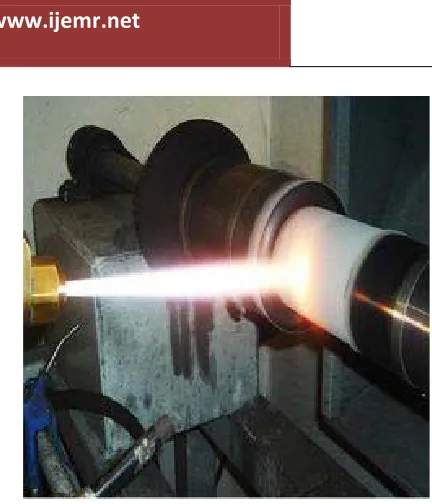
As shown in figure 1, Thermal spraying can provide thick coatings (approx. thickness range is 20 micrometers to several mm, depending on the process and feedstock), over a large area at high deposition rate as compared to
other coating processes such as
Coating materials available for thermal spraying include metals, alloys, ceramics, plastics and composites. They are fed in powder or wire form, heated to a molten or semi molten state and accelerated towards substrates in the form of micrometer-size particles. Combustion or electrical arc discharge is usually used as the source of energy for thermal spraying. Resulting coatings are made by the accumulation of numerous sprayed particles. The surface may not heat up significantly, allowing the coating of flammable substances [3].
Selection of the appropriate thermal spray method typically is determined by:
• Desired coating material
• Coating performance requirements • Economics
• Part size and portability
II.
METHODOLOGY
304 Copyright © 2011-15. Vandana Publications. All Rights Reserved.
Figure 1- Thermal spray processes
Thermal spray processes that have been considered to deposit the coatings are enlisted below
(1) Flame spraying with a powder or wire, (2) Electric
arc wire spraying, (3) Plasma spraying, (4) Spray and fuse, (5) High Velocity Oxy-fuel (HVOF) spraying, (6) Detonation Gun.
Among the commercially available thermal spray thermal spray coating techniques detonation gun sprayed coatings process is popularized because it gives an extremely good adhesive strength, low porosity and coating surface with compressive residual stresses [4].
III.
DETONATION GUN SPRAYING
PROCESS
In detonation Gun spraying Process, as shown in figure 2, A mixture of spray material, acetylene and oxygen is injected into the detonation chamber. A precisely measured quantity of the combustion mixture consisting of oxygen and acetylene is fed through a tubular barrel closed at one end. In order to prevent the possible back firing a blanket of nitrogen gas is allowed to cover the gas inlets. Simultaneously, a predetermined quantity of the coating powder is fed into the combustion chamber. The gas mixture inside the chamber is ignited by a simple spark plug. The combustion of the gas mixture generates high pressure shock waves detonation wave), which then propagate through the gas stream. Depending upon the ratio of the combustion gases, the temperature of the hot gas stream can go up to 4000 deg C and the velocity of the shock wave can reach 3500m/sec. The hot gases generated in the detonation chamber travel down the barrel at a high velocity and in the process heat the particles to a plasticizing stage (only skin melting of particle) and also
accelerate the particles to a velocity of 1200m/sec. These particles then come out of the barrel and impact the component held by the manipulator to form a coating. The high kinetic energy of the hot powder particles on impact with the substrate result in a buildup of a very dense and strong coating. The coating thickness developed on the work piece per shot depends on the ratio of combustion gases, powder particle, size carrier gas flow rate, frequency and distance between the barrel end and the substrate Depending on the required coating thickness and the type of coating material the detonation spraying cycle can be repeated at the rate of 1-10 shots per second. The chamber is finally flushed with nitrogen again to remove all the remaining “hot” powder particles from the chamber as these can otherwise detonate the explosive mixture in an irregular fashion and render the whole process uncontrollable. With this, one detonation cycle is completed above procedure is repeated at a particular frequency until the required thickness of coating is deposited.
Figure.2 Detonation Gun process
The chamber is finally flushed with nitrogen again to remove all the remaining “hot” powder particles from the chamber as these can otherwise detonate the explosive mixture in an irregular fashion and render the whole process uncontrollable. With this, one detonation cycle is completed above procedure is repeated at a particular frequency until the required thickness of coating is deposited [5].
IV.
STUDIES RELATED TO
DETONATION GUN SPRAYED COATINGS
305 Copyright © 2011-15. Vandana Publications. All Rights Reserved.
multifunctional multi material protective coatings using cold spraying (CS) and computer controlled detonation spraying (CCDS).As far as CS was concerned, the separate injection of each powder into different zones of the carrier
gas stream was applied. Cu–Al, Cu–SiC, Al–Al2O3,Cu–
Al2O3 ,Al-Ti and Ti-SiC coatings were successfully
sprayed. As to CCDS, powders were sprayed with a recently developed apparatus that was characterized by a high-precision gas supply system and a fine dosed twin powder feeding system. Computer control provided a flexible programmed readjustment of the detonation gases energy impact on powder thus allowing selecting the optimal for each component spraying parameters to form composite and multilayered coatings. Several powders were sprayed to obtain composite coatings, specifically, among others, WC– Several powders were sprayed to obtain composite coatings, specifically, among others, WC– Co– Cr + Al2O3, Cu +Al2O3, and Al2O3 + ZrO2
Sundararajan et al. [8] evaluated the tribological performance of 200 µm thick TiMo(CN)–28Co and TiMo(CN)–36NiCo coatings obtained by using the detonation spray coating system. Towards the above purpose, the detonation spray coating conditions were optimized to obtain the best coating properties (low porosity, high wear resistance) by varying two of the important coating process variables, i.e., oxygen to fuel ratio and gas volume. In both the coatings it was observed that the best tribological performance and also the lowest
porosity were obtained. However, the coatings with the highest hardness did not exhibit the best tribological performance. A comparison of the tribological performance of the optimized TiMo(CN) type coatings with that of optimized WC–Co coatings revealed that the abrasion resistance of TiMo (CN) type coatings is comparable to that of WC–Co coatings. However, the erosion and sliding wear resistance of TiMo (CN) type coatings were considerably lower than that of WC–Co coatings.
Kamal et al. [9] investigated the microstructure and mechanical properties of detonation gun sprayed NiCrAlY+CeO
.
Estimation of residual stress and its effects on the mechanical properties of detonation gun sprayed WC–Co coatings was done by Wang et al. [7]. Thick coatings seriously affect coatings performance during their service. Authors gave importance to understand the mechanisms by which the stresses arise, to predict and control the stresses for improving coating properties. Because the Stoney formula is commonly used to relate stress to curvature for thin coatings, a new calculation formula was developed to estimate the residual stresses of thick coatings that represent a comprehensive stress state of the coated specimen. Based on the deduced formula and accurate curvature measurements, the residual stresses of detonation gun (D-Gun) sprayed WC–Co coatings with different thickness were obtained. With increasing the coating thickness, the residual stress changed gradually from the tensile nature to a compressive nature. Meanwhile, the coating was in an approximately stress- free state at the thickness of around 365 µm. The analysis results emphasized the significance of penning stress in controlling the final stress state of the coated specimen, due to the high spraying velocity and kinetic energy during the D-Gun spraying process. Finally, the effects of residual stress on the mechanical properties of the coating were understood, namely, the compressive stress could significantly improve the coating properties, whereas the tensile stress impaired the coating properties.
2 alloy coatings deposited on superalloys.
The morphologies of the coatings were characterized by using the techniques such as optical microscopy, X-ray diffraction and field emission scanning electron microscopy/energy-dispersive analysis. The coating depicted the formation of dendritic structure and the micro structural refinement in the coating was due to ceria. Average porosity on three substrates was less than 0.58% and surface roughness of the coatings was in the range of 6.17–6.94 µm. Average bond strength and micro hardness of the coatings were found to be 58 MPa and 697–920Hv, respectively.
Microstructure characterization of D-gun sprayed Fe–Al intermetallic coatings was done by Senderowsk et al. [10] Intermetallic Fe–Al type coatings about 100 µm thick were deposited on a plain carbon steel substrate by D-gun spraying technique. The 40–75 µm size fraction of the feedstock powder was obtained by self-propagating high-temperature synthesis and sieved prior to D-gun spraying. This powder contained a mixture of Fe–Al type
intermetallic phases conventionally appointed FexAly.The
Fe–Al coatings were analyzed by transmission electron microscopy, selected area electron diffraction, and semi-quantitative energy-dispersive X-ray analysis in micro-areas. Particular attention was paid to the substructure of the individual grains in the coating zone abutting the steel substrate. The Fe–Al coatings have a multi-layer composite structure. The results explain the formation mechanism of the coating microstructure. The powder particles, which were heterogeneous in chemical composition and structure, were heated, highly softened or even partially melted and oxidized while flying from the gun barrel to the substrate. After impacting the substrate or previously deposited material and being shot peened by the following powder particles, they were rapidly cooled and plastically deformed, creating overlapping splats. In the zone adjacent to the substrate, alternating FeAl and Fe2Al5 intermetallic phases for med columnar crystals. The columnar crystal areas were separated by elongated amorphous oxide layers.
Areas of mixed equiaxed sub grains of FeAl and Fe3
Wang et al. [11] designed the separation device
306 Copyright © 2011-15. Vandana Publications. All Rights Reserved.
for detonation gun spraying system and studied its effects on the performance of WC–Co coatings. The WC–Co coatings were synthesized by the D-gun spraying system with and without using a separation device, respectively. The results showed that the use of the separation device resulted in better properties of the D-gun sprayed WC–Co coatings, e.g., lower the surface roughness, lower the porosity, higher the micro hardness, higher the elastic modulus, and higher the interfacial adhesive strength. Also, the tribological performance of the WC–Co coatings was improved. The relationship of surface roughness, micro hardness, elastic modulus, adhesive strength, and wear resistance of the WC– Co coatings with porosity was discussed. At the same time, there is an inevitable disadvantage for using the separation device, i.e., the relatively lower effective utility rate of the feedstock powder. Therefore, the separation device is suitable to be applied in occasions of high-performance requirements where increased costs are acceptable.
Formation and corrosion behavior of Fe-based amorphous metallic coatings prepared by detonation gun
spraying was studied by ZHOU Et al [12]. Amorphous
metallic coatings with a composition of Fe48Cr15MO14C15B6Y2
Detonation sprayed coatings can play important role in
protecting materials and alloys from wear and corrosion phenomena.
were prepared by detonation gun spraying process. Microstructural studies show that the coatings present a densely layered structure typical of thermally sprayed deposits with the porosity below 2%. Both crystallization and oxidation occurred obviously during spraying process, so that the amorphous fraction of the coatings decreased to 54% compared with fully amorphous alloy ribbons of the same component. Corrosion behavior of the amorphous coatings was investigated by electrochemical measurement. The results show that the coatings exhibit extremely wide passive region and low passive current density in 3.5% NaCl(mass fraction) and 1 mol/L HCl solutions, which illustrates excellent ability to resist localized corrosion.
Jia et al.[13] A research on detonation gun coating with Fe-SiC composite powders mechanically activated was done. The Fe–SiC composite powder prepared by the mechanical activation process has been used for coating on materials with the detonation gun (D-gun) machine in order to develop a new way for coating. Authors found that the coating layer has fine, homogeneous, dense structure and good wear resistance. The results of SEM and X-ray diffraction (XRD) show that some reactions happened between Fe and SiC during the D-gun coating, the Fe–Si compounds formed and SiC strength the coating layer. It was proved that the technology combined mechanical alloying with D-gun coating is a new method for surface modification.
V.
CONCLUSION
Work has been done by various researchers to investigate the performance of detonation sprayed coatings. However more research is needed to evaluate the performance of detonation sprayed coatings in actual environment. Process parameters of Detonation spraying influence the microstructure, mechanical and other properties of the coatings. Research is needed in optimization of the process parameters of detonation spraying process. Detonation gun separation device designed by researchers resulted in good performance of the detonation gun spraying in high performance requirement. More improvement can be done in the design of detonation gun spraying device. Little work is done in field of using nano structured powder with detonation spraying. More work is needed in using of nanostructured powder for coating by detonation spraying for wear and corrosion resistance.
REFERENCES
[1] D. Dawson, History of Tribology (2nd edition) (1998) (Professional Engineering Publishing Ltd., London. [2] Frank J. Hermanek, Thermal Spray Terminology and
Company Origins, First Printing, 2001, ASM
International,Materials Park, OH.
[3] Longo L. F., Thermal Spray Coatings, ASM, USA: 1985.
[4] Rajasekaran B., Sundara Raman Ganesh S., Joshi S.V., Sundararajan G.; “Influence of detonation gun sprayed alumina coating on AA 6063 samples under cyclic loading with and without fretting”, Tribology International, Volume 41, (2008), 315–322.
[5] Goyal Rakesh, Sidhu Buta Singh, Grewal J.S.; “Surface Engineering and Detonation Gun Spray Coating”, International Journal of Engineering Studies, Volume 2, Number 3 (2010), 351-357.
[6] Sova, Pervushin D., Smurov I.; “Development of multimaterial coatings by cold spray and gas detonation spr aying”, Surface and coatings technology, Volume 205, Number 4, (2010), 1108-1114.
[7] Wang Tie-Gang, Zhao Sheng-Sheng, Hua Wei-Gang, Li Jia-Bao, Gon g Jun, Sun Chao; “Estimation of residual stress and its effects on the mechanical properties of detonation gun sprayed WC-Co coatings”, Materials Science and Engineering: A, Volume 527, Number 3, 454-461.
[8] Sundarajan G., Sivakumar G., Sen D., Rao Srinivasa D., Ravichandra G.; “The tribological behaviour of detonation sprayed TiMo(CN) based cermet coatings”, International journal of refractory metals and hard materials, Volume 28, Number 1, (2010), 71-81.
[9] Kamal Subash, Jayaganthan R., Prakash Satya; “ Mechanical and microstructural characteristics of
307 Copyright © 2011-15. Vandana Publications. All Rights Reserved.
on superalloys”, Materials chemistry and physics, Volume 122, Number 1, (2010), 262-268.
[10] Senderowski C., Bojar Z., Wolczynski W., Pawlowski A.; “Microctructure characterization of D- gun sprayed Fe-Al intermetallic coatings”, Intermetallics, Volume 18, Number 7, 1405-1409.
[11] Wang Tie-Gang, Zhao Sheng-Sheng, Hua Wei-Gang, Gong Jun, Sun Chao; “ Design of separation device used in detonation gun spraying system and its effects on the performance of WC-Co coatings”, Surface and Coatings Technology, Volume 203, Number 12, (2009), 1637-1644. [12] ZHOU Zheng, WANG Lu, WANG Fu-chi, LIU Yan-bo; “Formation and corrosion behavior of Fe-based amorphous metallic coatings prepared by detonation gun spraying”, Transactions of nonferrous metals society of china, Volume 19, Number 3, (2009), 634-638.