them in full extent, which would be easier but not as representative as we would wish. Besides, this last solution could pose some problems regarding copyrights. So we took neither of these two ends, but a solution
halfway of both: we took 5/85 of the items at random,
and 5/85 of the words from each of them.
The sample that is taken from each of the items is not continuous. In order to get as much linguistic variety as
possible, we were interested in taking different bits of the documents. So the sample to be taken is divided in 300 word chunks, spread out equally at random through the document.
The general scheme of the annotation process is shown in Fig. 1.
Fig 1.- General scheme
2.2. Raw Corpus
For obtaining the raw corpus, we got in contact with Basque publishers. We told them about the corpus and signed an agreement with each of them. So the publishers sent us the texts selected for the balanced part and, if they wanted to, the ones that did not get chosen too, preferably in electronic format. The texts for the balanced part of the corpus that could not be obtained in electronic format were scanned, OCRed and reviewed. For the unbalanced part, only texts in electronic format were accepted.
For the annotation of the ZT Corpus, we chose TEI P4 (Ide et al., 2004) (TEI, 2005). To convert the documents from their original formats to TEI, we developed a HTML-TEI converter and a Doc-TEI converter. Conversion from other formats (Quark, PDF...) is done via external programs that convert from these to HTML first.
When we say balanced corpus and unbalanced corpus, we are not talking about two different corpora. There is only one collection of documents, and the paragraphs that are sampled for the balanced part are marked with an
'orekatua' (for balanced) attribute.
2.3. Structural Annotation
The structural annotation is done in two steps: a first automatic one, which is done to all documents during the conversion, and a second manual deeper one, which is done only to the documents in the balanced part.
The automatic structural mark-up includes information about the document, information about text structure and typography. The information about the
document is put under the <teiHeader> section. Text
structure (titles, sections, subsections, paragraphs, lists, tables, footnotes...) is marked using the following tags:
<body>, <div>, <head>, <p>, <table>, <row>, <cell>, <list>, <item> and <note>. Typography is marked using the tag <hi> combined with the attribute 'rend'.
In the balanced part deeper structural information is annotated. The typographical information is converted manually to more detailed tags: <foreign>, <emph>,
<distinct>, <q>, <soCalled>, <term>, <gloss>, <mentioned>, <name>, <head> and <note>. The lang
attribute is used for chunks in other languages.
tags. Statistics of these manual revisions are kept and afterwards used to improve the aforementioned NLP tools.
2.4. Linguistic Annotation
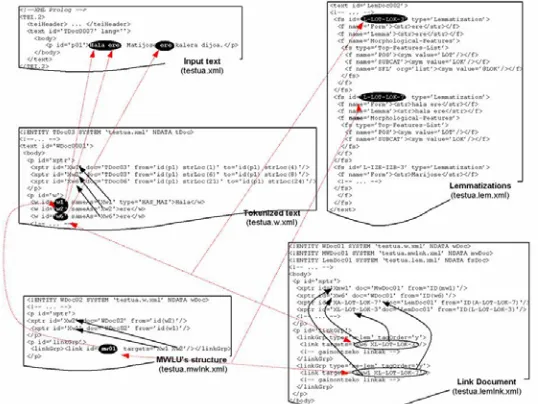
The linguistic annotation is based on TEI-P4 conformant typed features which are managed using EULIA (Artola et al., 2004), a web interface for creating, browsing and editing these structures. The annotation scheme is stand-off, so the information for each document will be divided in several files and it can be seem as a
composition of XML documents (annotation web).
The steps which are carried out are the following (Fig. 2):
Fig 2.- Steps in linguistic tagging
• a tokenizer that identifies tokens and sentences
• a morphological segmentizer which splits up a
word into its constituents morphemes
• a morphosyntactic analyzer whose goal is to group
the morphosyntactic information associated to a word.
• the treatment of multiword lexical units (MWLU)
as dates, numbers, named entities, ...
• disambiguation and lemmatization: Based on the
previous steps a combined tagger obtains an unique analysis for each lexical unit; so, lemma, part of speech and other morphosyntactic features are assigned.
This automatic process includes some errors. In the balanced corpus the results corresponding to lemma and part of speech are examined by linguists using EULIA.
Additional information about syntactic functions and semantic role will be included in a small part of the corpus. This information is obtained using NLP tools and revised and corrected in the balanced part.
The use of a stand-off linguistic annotation is very interesting because:
• partial results and ambiguities can be easily
represented
• information can be organized at different levels
• the representation of MWLUs is clear
• the level of disambiguation (automatic/manual)
can be expressed
• there are not different mechanisms to indicate the
same type of information
In this architecture three elements are distinguished in different documents:
• text anchors: text elements found in the input
• linguistic information: feature structures obtained
from the analyses
• links between anchors and their corresponding
analyses
In Fig. 3 we can see in a graphical mode the links between documents.
Fig 5.- Interface for manual revision of <reg>
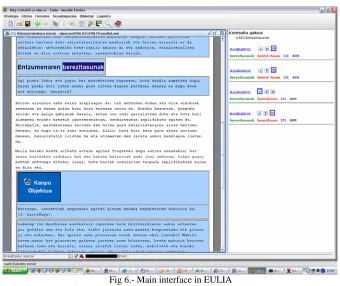
Fig 6.- Main interface in EULIA
After the automatic processing which generate the XML documents a module for manual linguistic annotation can be used. This module integrates the results of the automatic processes and gives to the linguistics a friendly interface for the annotation, hiding the complexity of the multiple files are being managed. The main interface is shown in Fig. 6.
As it can be observed there are two main windows: the
text window on left and the analysis window on right.
In the text window the linguist can click a token and a set of actions are offered to be performed.
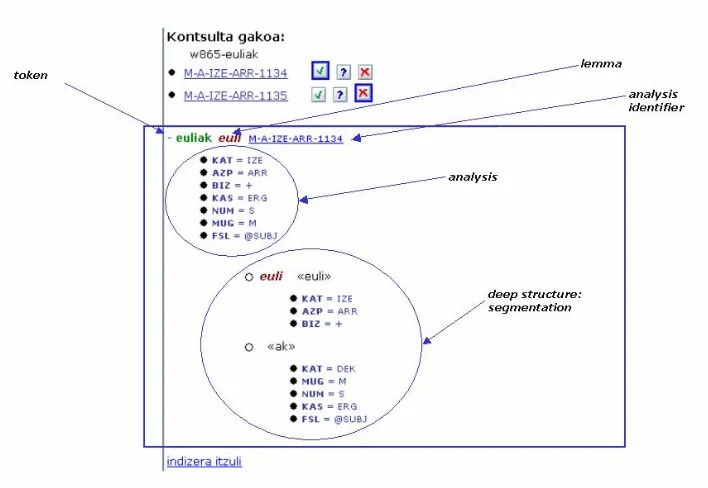
Fig 7.- Analysis window
In Fig. 7 we can see the top of this window for an
example. Information for whole word euliak (flies) and
for the two morphemes, euli (fly) and ak (nominative
plural) are given.
4.
Conclusions
Just as any other language, Basque needs corpora. Linguists, terminology specialists, language technology researchers, people that work in language standardization and normalization… Many people need corpora, nowadays an essential tool for the analysis of language. The Basque ZT corpus wants to be a useful and powerful tool for researching on specialized texts in Basque.
But Basque being a small language in terms of speakers and, therefore, resources dedicated to it, we not only need corpora. We also need the technology to build them easily; we need tools that will assist in the process of creating and managing corpora and that will reduce the usually expensive costs of building them. We have made such a tool, Corpusgile. This tool provides a flexible and extensible infrastructure for creating, visualizing and managing corpora and for consulting, visualizing and modifying annotations generated by linguistic tools. The interface has been designed to be informative, easy-to-use and intuitive. And due to its being based on the TEI standards, XML and stand-off annotation; it can be adapted by other builders of corpora using other tag sets, tools and languages.
Besides, in the making of Corpusgile we have defined and applied a methodology for building corpora more easily in the future.
These three things, a resource (the ZT Corpus), a methodology and a tool (Corpusgile) are the contributions
we have done to this field we are so in need of, the field of corpora. And we are convinced that in the future they will prove to be very valuable contributions indeed.
5.
Acknowledgements
This work was partially funded by the Basque Government (EJ-ETORTEK-2002/HIZKING21) and the University of the Basque Country (EHU/GIU05/52).
6.
References
Aduriz I., Aldezabal I., Alegria I., Artola Zubillaga X., Ezeiza N., Urizar R. 1996. "EUSLEM: A Lemmatiser / Tagger for Basque." Proc. EURALEX'96, Part 1, 17-26.
Göteborg.
Artola X., Díaz de Ilarraza A., Ezeiza N., Gojenola K., Sologaistoa A., Soroa A. 2004. "EULIA: a graphical web interface for creating, browsing and editing
linguistically annotated corpora." LREC 2004.
Workshop on Workshop on XML-based richly annotated corpora. Lisbon.
Biber D., Conrad, S. eta Reppen, R. 2000. Corpus
Linguistics. Investigating Language Structure and Use..
Cambridge: Cambridge University Press.
Bowkeron L, Pearson J. 2002. Working with Specialized
Language. A practical guide to using corpora. New
York: Routledge
Ide N., Romary L., Clergerie E. "International standard for
a linguistic annotation framework." Natural Language
Engineering, 2004