341
Copyright © 2011-15. Vandana Publications. All Rights Reserved.
Volume-5, Issue-1, February-2015
International Journal of Engineering and Management Research
Page Number: 341-345
Effectiveness of Advertising and Sales Promotion Techniques in
Marketing
of Housing Projects in Bangalore
Dr. K. Nagendra Babu1, Lakshmana Y.G.2 1
Chairman & Associate Professor, Department of Commerce, University of Mysore, Mysore, INDIA 2
Assistant Professor, BNM Degree College, Bangalore & PhD Research Scholar, Department of Commerce, University of Mysore, Mysore, INDIA
Abstract
The real estate sector has become highly competitive in the past few years with new projects coming up throughout India. Developers and builders have to constantly endeavor to create unique, innovative marketing and sales strategies in order to create visibility for their projects. At Housing companies, the onus of driving the project and taking it to the next level is primarily the responsibility of the marketing team. Along with the entire team of brand, media and communication managers, companies needs to focus immensely on distinctive planning and execution of innovative projects with unique features. Aspirants of housing in India are more receptive towards the advertisements they witness on various ad platforms. Specifically, outdoor /billboard advertisements act as a follow up medium and create top of the mind recall for patrons which effectively lead towards building further awareness and sale of the brand. This study is based on survey method. To collect the data, the research instrument was used by structured questionnaire, to analyze data the statistical techniques have been used. The study result in advertising and sales promotional techniques they have more effect on the housing brands.
Keywords--- Advertisements, Sales promotion, Housing projects.
I.
INTRODUCTION
One of the basic needs of human being is shelter which means the housing provision. Land is the pre-requisite for the construction of pavements till the mansions and therefore the mother of all activities to begin on earth to precisely say the land.
Even for agriculture activities primarily land is the source and the same land after it is annihilated from
revenue status, it will be allowed to use for housing. Housing is a building or structures that individuals and their family lives in. Housing comes in large variety of configuration from a free standing to apartments. There are many contradicting scenario in the housing sector in India. On one side huge population do not have affordable housing and many in urban and rural areas are found living in huts and slums, even the middle class have problem with housing in urban centers and they stay in rented houses where as on the other hand only a neglected percentage of persons may have the ownership of multiple houses and commercial establishments. There is a lot of emphasis need to be given by government for housing as it is one of the basic needs of the civilized animal, the human being. The point to be observed here is the housing provided by private companies, housing cooperatives and public - private joint initiatives contributions to the existing housing stock are also notable along with the government bodies meant for it.
II.
MEASUREMENT OF MARKETING
COMMUNICATION
EFFECTIVENESS
342
Copyright © 2011-15. Vandana Publications. All Rights Reserved.
The audience exposure can be measured by looking at the percentage of people who have seen the marketing message, read the message, understood the message and purchased.
III.
REVIEW OF LITERATURE
Jaehyuk Lee, Haeseong Je & Dong Woo Shin (2004) in their collective study titled, “Marketing strategy of Housing Construction Firms and Consumer’s Residential Consciousness: Evidence from Apartment Residents in Korea” aims to evaluate residential satisfaction based on the marketing factors of well-being apartments, as it is a high quality housing where residents are satisfied with the physical environment for their happiness & health. The marketing strategy of Korea’s housing construction firms is classified as green, well-being and ubiquitous.
Sharon Yam Lee Hong, Maziah Ismail & Tan Soo Yin (2004) in their research article titled, “ Corporate Social Responsibility in Housing Development – The Developers Perspective “ stated that businesses not only need to fulfill their economic obligations, but also have to be socially responsible to stay competitive. The authors studied the relevance of CSR from the housing developers’ perspective, particularly how they believe it would benefit project marketability. As the awareness of CSR is gaining its ground in market economy, the societal marketing concept is being widely used by socially responsible corporations.
Urmi Sengupta (2005) in her research titled “ Government intervention and public private partnerships in housing delivery in Kolkata” seeks to reflect on the emerging concept of public private partnership in developing countries as an offshoot of enabling strategies for housing delivery. It is the most prominent urban housing policy that has emerged in the last decade in India. Housing reforms in Kolkata under the flagship of PPP has taken the city in to a different league after decades of ineffective housing policy. Although housing production under the PPP model has been impressive in terms of costs & quality, there are major roadblocks identified include, antiquated legislation and the high levels of municipal taxes, stamp duties & sanction fees.
A Report of the Working Group on CSIR (Oct.2006) reveals that the Structural Engineering Research Centre (SERC), Central Building Research Institute (CBRI) and Central Road Research Institute (CRRI) jointly took major initiatives to bring improvement in quality and performance of building materials including high performance materials for construction & repair of pavements, materials for special road application.
IV.
STATEMENT OF THE PROBLEM
Aspirants of housing in India are more receptive towards the advertisements and sales promotion techniques
they witness on various ad platforms. Specifically, outdoor /billboard, T.V, Radio, Hoardings advertisements and promotions like, Financial deals, festival offers, EMI, Lottery act as a follow up medium and create top of the mind recall for patrons which effectively lead towards building further awareness and sale of the brand.
The purpose of the study is to identify and analyze the effectiveness of marketing communication strategies (Advertising and Sales promotion) of three major private housing enterprises i.e., Brigade, Mantri, Sobha developers in Bangalore city.
V.
OBJECTIVES OF THE STUDY
1. To study the advertising and sales promotion tools used by housing project companies
2. To compare the effectiveness of advertising and sales promotion tools of different housing project companies
VI.
HYPOTHESIS OF THE STUDY
H0: There is no significant difference in effectiveness of advertising and sales promotion tools used by housing projects companies.
H1: There is a significant difference in effectiveness of advertising and sales promotion tools used by housing projects companies.
VII.
SCOPE OF THE STUDY
The study covers the marketing communication strategies (Advertising and Sales promotion) of three major private housing enterprises i.e., Brigade, Mantri, Sobha developers in Bangalore city. The study comparatively analyses the marketing communication strategies of Brigade, Mantri, Sobha developers. In addition to this, the study looks forward to develop new varieties of different methods of marketing communication strategies in marketing housing projects. The study covers the housing projects in the geographical jurisdiction of Bangalore city.
VIII.
RESEARCH METHODOLOGY
Sources of Data collection
The study is primarily relying on the primary data which is collected by administering a structured questionnaire. Wherever feasible and available, secondary data will be employed for the purposes of comparisons and inferences.
Sampling Size
343
Copyright © 2011-15. Vandana Publications. All Rights Reserved.
IX.
TOOLS AND TECHNIQUES USED
FOR DATA ANALYSIS
Data is interpreted through statistical tools by using simple techniques such as independent sample t-test. Hypotheses are tested with the help of SPSS software.
Data analysis and interpretation
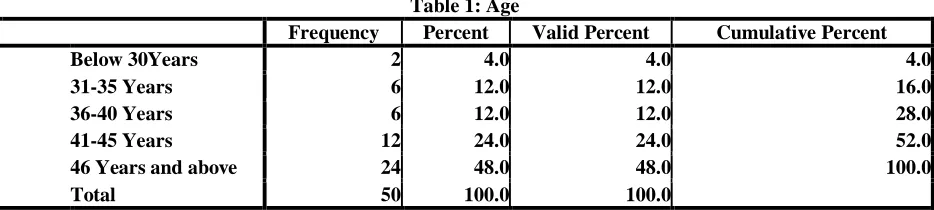
Table 1: Age
Frequency Percent Valid Percent Cumulative Percent
Below 30Years 2 4.0 4.0 4.0
31-35 Years 6 12.0 12.0 16.0
36-40 Years 6 12.0 12.0 28.0
41-45 Years 12 24.0 24.0 52.0
46 Years and above 24 48.0 48.0 100.0
Total 50 100.0 100.0
Source: Field survey
The above table shows that 48 percent of the respondents are in the age of 46 and above years, 24 percent of the respondents in the age of 41-45 years, remaining 30 percent of the respondents are in the age of below 40 years.
Table 2: Gender
Frequency Percent Valid Percent Cumulative Percent
Male 69 69.0 69.0 69.0
Female 31 31.0 31.0 100.0
Total 100 100.0 100.0
Source: Field survey
The above table shows that 69 percent of the respondents are male remaining 31 percent of the respondents are female.
Table 3: Profession of the respondents
Frequency Percent Valid
Percent
Cumulative Percent Salaried
Professional Self employment House Wife Retired Others Total
10 12 8 5 12 3 50
20.0 24.0 16.0 10.0 24.0 06.0 100.0
20.0 24.0 16.0 10.0 24.0 06.0 100.0
20.0 44.0 60.0 70.0 94.0 100.0
Source: Field survey
344
Copyright © 2011-15. Vandana Publications. All Rights Reserved.
Table 3: Effectiveness of advertising and sales promotion tools of different housing project companies
Advertising Tools N Brigade Groups Mantri Housing Projects Sobha Developers
Mean S.D Mean S.D Mean S.D
News Paper 50 2.80 1.40 2.93 1.38 2.65 1.25
T.V 50 2.55 1.85 2.65 1.53 2.59 1.75
Radio (FM) 50 2.45 1.90 2.68 1.82 2.78 1.96
Hoardings 50 2.90 1.40 2.91 1.31 2.85 1.45
Sales Promotion tools
Financial Deals 50 1.80 2.30 1.95 2.12 2.34 1.69
Festival offers 50 1.96 2.16 2.10 1.86 2.65 1.25
Lottery 50 .879 3.16 1.01 2.98 .982 3.21
EMI (Holidays) 50 2.1 1.89 2.36 1.56 2.39 1.74
Source: Field survey
The mean of advertising tools and sales promotion tools of Brigade groups, Mantri housing projects and sobha developers are found to be, the Hoardings and EMI (Holiday) is the very effective advertising and sales promotion tools of brigade groups with the mean value of 2.90 and 2.1and its followed by news paper 2.80 and festival offers 1.96.
The News paper, Hoardings and EMI (Holiday) is the very effective advertising and sales promotion tools of Mantri housing projects with the mean value of 2.93, 2.91 and 2.36 respectively and its followed by Radio FM 2.68 and festival offers 2.10. TV and Radio FM advertisements are also effective with the mean value of 2.65 and 2.68 respectively. Hoardings, Radio FM and EMI, Festival offers is the very effective advertising and sales promotion tools of sobha developers with the mean value of 2.85, 2.78 and 2.65, 2.39 respectively and its followed by News paper 2.65 and financial deals 2.34.
All the advertising tools of housing developers are very effective mode of marketing communication its clears in the above table and the EMI, Festival offers and Financial deals are the best sales promotional tools used by developers.
Hypothesis testing
H0: There is no significant difference in effectiveness of advertising and sales promotion tools used by housing projects companies.
H1: There is a significant difference in effectiveness of advertising and sales promotion tools used by housing projects companies
The above analysis clears that the different housing companies are using different advertising and sales promotion tools, but the effectiveness of each tools are different by one another by the company and respondents view, therefore the alternative hypothesis “There is a significant difference in effectiveness of advertising and sales promotion tools used by housing projects companies” is accepted and null hypothesis is rejected.
X.
FINDINGS
1. The majority 70 percent of the respondents are in the age of above 41 years, they are the major consumers of housing projects in Bangalore city. 2. The majority 68 percent of the participants in the
housing projects are the salaried, professionals and retired persons.
3. Hoardings are the best and effective mode of marketing communication tool for housing products it is evidenced by the above analysis. Its attractive in more public places.
4. EMI (Holiday) is the effective sales promotional tool of housing projects. Its entertain more salaried and self employment peoples.
5. Lottery method is not much effective compared to other sales promotional techniques.
6. The news paper and radio (FM) is also the effective mode of housing advertisement in Bangalore city.
7. The financial deals and Festival offers having seasonal demand and attractive tools for marketing of housing projects and it attracts the professionals, retired. house wife’s and middle class peoples.
8. Housing developers are more focus on salaried, professionals and retired persons only it means that they concentrate only regular income people.
XI.
SUGGESTIONS
1. The developers also need to focus more on middle class and poor peoples lived in Bangalore city i.e., create special offers to them.
2. The developers also need to follow the
government rules and regulations.
345
Copyright © 2011-15. Vandana Publications. All Rights Reserved.
4. Developers need to create awareness about their brands with self employment people, housewives and other neglected community of the society. 5. There is a huge competition in the marketing of
housing products developers are need to introducing of new marketing tools.
XII.
CONCLUSION
There is a huge demand for housing projects in Bangalore city. The news papers, TV, Radio, Hoardings carryout large advertisements of various housing projects. The most of the all housing project companies offered number of financial deals, festival offers and EMI Holidays. There is a huge competition in marketing of housing projects in Bangalore city. The study covers only three major enterprises engaged in housing projects i.e., Brigade, Mantri and sobha developers. The results shows that advertising and sales promotion have more effect on the housing brands and their sales. However the synergy is created by a few promotional tools only.
REFERENCES
[1] Vandna singh & Komal: Prospects & problems of real estate in India. ISSN 1450-2887 Issue 24 (2009).
[2] Report of the working group on CSIR (oct.2006) Eleventh Five Year Plan 2007-2012, Govt. of India.
[3] International Energy Agency’s Solar Heating & Cooling Program: SHC Task 28/ECBCS Annex 38: Sustainable solar Housing.
[4] Sandeep Goel: Shareholders Wealth Maximization in Realty Sector in India. JIMS 8M Jan-March, 2011
[5] Urmi Sengupta: Government intervention and public– private partnerships in housing delivery in Kolkata. doi:10.1016/j.habitatint.2004.12.002/2005
[6] Government of Karnataka: Karnataka Housing and habitat policy- 2009 (draft) Housing department, Bangalore.
[7] Jaehyuk Lee, Haeseong Je, Dong Woo Shin: Marketing Strategy of Housing Construction Firms and Consumer’s Residential Consciousness: Evidence from Apartment Residents in Korea,2004
[8] Majd Homoud, Salem Oun, Ayat Smadi, & Al-Mutasem Al- Hindawi: Exploring sales advertising in the housing market in Jordan, international Journal of Housing Markets and Analysis, Vol 2, No.1, pp39-56, 2009. [9] Dr Sharon Yam Lee Hong, Prof. Maziah Ismail & Dr Tan Soo Yin: Corporate social responsibility in housing development – The developers’ perspective, 2004.
Websites:-
1. www.planningcommission.nic.in
2. www.nibmindia.org
3.