78
Copyright © 2011-15. Vandana Publications. All Rights Reserved.Volume-5, Issue-1, February-2015
International Journal of Engineering and Management Research
Page Number: 78-86
Measurement and Modeling of Respiration Rate of Tomato (Cultivar
Roma) for Modified Atmosphere Storage
Palani Kandasamy1, Ranabir Moitra2, Souti Mukherjee3 1
Assistant Professor (Agril. Engg.), Institute of Agriculture, Visva-Bharati University, Santiniketan, West Bengal, INDIA 2
Associate Professor (Agril. Engg.), Institute of Agriculture, Visva-Bharati University, Santiniketan, West Bengal, INDIA 3
Professor and Head, Department of Postharvest Engineering, Faculty of Agricultural Engineering, Bidhan Chandra Krishi Visvavidhyalaya, Mohanpur, West Bengal, INDIA
ABSTRACT
Experiments were conducted to determine the respiration rate of tomato at 10, 20 and 30°C using closed respiration system. Oxygen depletion and carbon dioxide accumulation in the system containing tomato was monitored. Respiration rate was found to decrease with increasing CO2
and decreasing O2 concentration. Michaelis-Menten type
model based on enzyme kinetics was evaluated using experimental data generated for predicting the respiration rate. The model parameters that obtained from the respiration rate at different O2 and CO2 concentration levels
were used to fit the model against the storage temperatures. The fitting was fair (R2 = 0.923 to 0.970) when the respiration rate was expressed as O2 concentation. Since inhibition
constant for CO2 concentration tended towards negetive, the
model was modified as a function of O2 concentration only.
The modified model was fitted to the experimental data and showed good agreement (R2
Tomato (Lycopersicon esculentum Mill) is a wonderful vegetable drawing attention of millions of vegetable lovers worldwide for its incredible health promoting properties such as vitamins, minerals, carbohydrates, carotenoids, fiber, fat, protein, energy, etc. Dietary intake of tomato and its products containing lycopene has been shown to be associated with a decreased risk of chronic diseases, such as cancer and cardiovascular disease including breast cancer and prostate cancer [1]. Tomato is a climacteric and perishable vegetable, having
respiratory peak during its ripening process and short life span [2]. Since tomato is highly perishable it encounters several problems in its transportation, storage and marketing. It has been reported that there is a loss of 20-50% between harvesting and consumption of fresh tomato in tropical countries [3]. Therefore, an increase in postharvest life is really desirable to reduce losses during supply chain. Major physiological activity in the post harvest life of a produce is respiration. Respiration is considered to be a key process which brings physiological disorders such as ripening, senescence, decay, degradation of chlorophyll and subsequently deterioration in the normal course of time. Respiration involving the consumption of oxygen (O
= 0.998) with experimentally estimated respiration rate.
Keywords: Tomato, temperature, oxygen, carbon dioxide, respiration, modeling.
I.
INTRODUCTION
2) for oxidative break-down of organic components into simple molecules such as carbon dioxide (CO2
Due to these metabolic processes, respiration continues even after harvest, thus the shelf life of the produce is reduced. However, the rates of these metabolic processes are generally directly proportional to the storage temperature. Thus, shelf life can be increased to a certain level at lower temperatures. Respiration removes oxygen from the storage environment, which if depleted to hypoxic levels (<1%). This may lead to an anaerobic respiration. This process gives off-flavour and off alcoholic odor to the product [5]. The physiological disorders can be minimized to a certain period by controlling the respiration rate that can be achieved by properly controlling temperature and modification of natural atmospheric condition. The modification process
79
Copyright © 2011-15. Vandana Publications. All Rights Reserved.often tries to reduce the level of O2 and increase the level of CO2 initially and it may change dynamically depending on the produce and permeability of the storage materials. It is known as modified atmosphere [6].
Modified atmosphere storage of fresh produce relies on modification of the atmosphere inside the storage. This is achieved by the natural interplay between respiration rates of the produce and transfer of gases through the
storage that lead to an atmosphere richer in CO2 and
poorer in O2. This atmosphere can potentially reduce the
rate of respiration process [7, 8]. To establish a modified or controlled atmosphere storage system, respiration process of the produce has to be well understood. Respiration rate is a guide in determining a suitable storage system, ventilation requirements of the storage, duration for the desired gas composition to beachieved in a storage, heat produced by the stored produce, etc. Since measurement of respiration rate of a fresh produce is a time consuming process, it is essential to find a rapid and precise method for predicting it under any given storage condition without extensive experimentation. However, accurate measurement of respiration rate and its modeling is an important aspect to the success of design and operational features of modified atmosphere storage [4].
Mass of the stored produce and its maturity level, storage temperature, O2 and CO2 concentration are known to influence the respiration in storage. Respiration rate can be measured by observing the concentration of O2 consumptions or CO2 evolution per unit time per unit weight of the produce at a specific temperature [7].
Several attempts have been made by researchers to model the dynamics of the respiration rate for fresh commodity under various storage conditions. Models based on Michaelis-Menten type equations for describing enzyme kinetics have been developed to predict respiration rate of fresh produce as a function of O2 and CO2 concentrations. [9] Studied the influence of O2 and CO2 concentrations and storage time on the respiration rates of tomato. The effect of temperature on respiration rate was not considered in their models. The models adequately predicted the respiration rate of tomatoes stored in a controlled atmosphere. [10] Used an empirical approach to measure the respiration rate of tomato as a function of O2 concentration by observing the rate of O2 depletion in a closed system. [11] Suggested an enzyme kinetics theory for modeling of respiration rate of fresh produce. [12] Developed a non-linear empirical model for predicting the respiration rate of strawberry as a function of temperature, O2 and CO2 concentration. [13] Described respiration rate of blueberry cultivars using enzyme kinetics respiration model based on noncompetitive inhibition of CO2
[14] Developed enzyme kinetics based model to predict the respiration rate of fresh produce by steady and unsteady state method of the permeable system. [15] Evaluated five models based on enzyme kinetics equations for respiration rate of cherry tomato at different
temperatures for modified atmosphere packaging applications. [16] Used enzyme kinetics, chemical kinetics and artificial neural network for modeling the respiration rate of guava fruit under different storage temperatures. [17] Assessed three types of models based on enzyme kinetics to predict the respiration rate of banana fruit at 21°C. [18, 19] Tested the suitability of the models based on enzyme kinetics to predict the respiration rates of litchi and guava respectively at different temperatures. In this context, the present work was undertaken to determine the respiration rate of tomato cultivar ‘Roma’ at different temperatures and to develop a model based on the principle of enzyme kinetics to predict the respiration rate at different conditions.
II.
MATERIALS AND METHODS
A. Sample Preparation
Fresh mature tomato of local popular variety ‘Roma’
in breaker stage of ripeness free from cracks and bruises were obtained from the local field at Santiniketan, West Bengal (India). Breaker stage is a definite break in color from green to tannish-yellow, green with orange locular tissue and pink on not more than 10% of the surface [20]. The harvested tomatoes were graded manually and washed in chlorinated water concentration of 100 ppm to remove adhering dirt on their surface. Firmness, color, total soluble solids (TSS), pH, titratable acidity, total sugars, ascorbic acid and lycopene were determined in the laboratory prior to the respiration study to specify the maturity level and basic quality. The color of the tomato samples were measured using Minolta Colorimeter (Minolta Co. Ltd., Japan) in terms of ‘L’ (lightness), ‘a’ (redness and greenness), and ‘b’ (yellowness and blueness) [21].
The penetrometer (Model FT 327) fitted with a cylindrical plunger probe of 11 mm diameter made of stainless steel was used for measurement of fruit firmness and determined in terms of force (Newton) required to penetrate the tomato through its pericarp. Average of two forces at two diametrically opposite positions on the circumference of each tomato was taken [22]. TSS in degree Brix was directly measured using Abbe hand refractometer (Model NI; ATAGO, Japan) by placing a drop of supernatant on the prism of refractometer. The digital pH meter was used to measure the pH of the tomato samples. Total sugars, titratable acidity, ascorbic acid and lycopene were determined as per the methods described by [23]. All the quality characteristics were determined for five representative samples in triplicate and the average values were determined.
B. Closed System Respiration Experiment
.
80
Copyright © 2011-15. Vandana Publications. All Rights Reserved.less complex setup than the continuous flow system [24]. Closed system can provide a convenient way of characterizing respiration of fresh produce in a single set of experiment. In this method, the changes in O2 and CO2 concentrations resulting from respiration within a sealed container could be measured directly. This method has been broadly used by many researchers [13, 15, 16, 17, 18, 19, 25] for measuring the respiration of fresh produces.
Air-tight containers of 2 litres capacity made up of Polyethylene terephthalate (PET) were used for the respiration study. Each container was fitted with two silicon septa on the lid for headspace gas sampling and manometer. Known weight of tomatoes were placed in the container from the topside and closed with the lid and made airtight using rubber gasket and Teflon tape after tomato completely reached their respective experimental temperature. Respiration chambers were kept in cold rooms separately at temperatures of 10, 20 and 30°C. Three replicate containers were used for each temperature. Weight of tomato taken during the experiment and its corresponding free volume of container is presented in Table 1. Free volume of the container (Vf) was measured using the method of water displacement [16]. The free volume of container was calculated by difference in volume of the container and volume of tomato occupied in it.
Changes in the gas composition (O2 and CO2) in the respiration containers were measured at regular intervals. Headspace gas sample of 1 mL was taken periodically through silicon septa sticking on the container lid using an air-tight syringe. The gas sample was analyzed for O2 and CO2 concentration using gas chromatograph (SRI 8610A model, SRI Instruments, US) equipped with thermal conductivity detector and operating at an oven temperature of 45°C and detector temperature of 100°C using helium as the carrier gas. Calculations of concentration of the gases were made with the Peak Simple software. The software facilitated computation and processing of data pertaining to chromatograph. For determining the amount of
components in gas sample, standard gas mixture was analyzed and calibration curves were developed. The standard gas mixture was obtained from Span Gas Equipments Ltd, Mumbai. The standards of known mixtures were analyzed under the test conditions. The peaks were identified and compared with peaks of the unknown samples. The gas concentrations (O2 and CO2) were determined in per cent. Three replications were taken every time for the gas analysis and the average gas composition were recorded. Equivalent volume of gas (Nitrogen gas of 99.9% purity) was re-infused into the container to balance the in-pack gas pressure after sampling. Manometer was used to maintain container pressure equivalent to 1 atmosphere. Since the models are not valid for anaerobic respiration [11, 24], gas sampling was stopped when O2 concentration reached 2-4%.
D. Determination of Experimental Respiration Rate
Respiration rate of a produce in closed system depends on the temperature, gas concentration, mass of the produce, etc. and it can be measured by observing the concentration of O2 consumption or CO2 evolution per unit time per unit weight of the produce [7, 11, 24]. The experimental respiration rate was calculated periodically using the data such as difference in gas concentration per time, weight of the stored produce and free volume of the container. The mass concentration of O2 and CO2 inside the closed experimental container were determined and plotted as a function of time. Curve fitting was done using second-order polynomial regression equation [26]. The fitted polynomial was differentiated to determine the change of rate of gas concentrations. The first derivative of the regression functions were used to obtain the experimental respiration rates as a function of O2 consumption (RO2) and CO2 evolution (RCO2) [13]. The negative sign in Equation (1) signifies that the O2 concentration in the closed container decreases with time.
E. Modeling Process for Respiration Rate
81
Copyright © 2011-15. Vandana Publications. All Rights Reserved.Based on Equation (3), they developed a model for predicting the respiration rate of fresh produce in the absence of CO2. This model is valid only under aerobic conditions where sufficient O2 is available for the respiration. The dependence of respiration on O2 concentration is expressed as follows:
Considering that CO2 acts as a respiration inhibitor, the effect of CO2 on the product respiration can be described by the uncompetitive inhibition [11].
Equation (5) is assumed to be valid as long as aerobic respiration takes place, i.e., sufficient O2 is available to act
as substrate. [25] Developed a similar model with some modifications (K1 = Rm, K2 = Km and K3 = 1/Ki) for predicting the respiration rate of fresh cauliflower as a function of O2 and CO2 concentrations.
The model (6) was adopted in this study for predicting the respiration rate of tomato. The experimental respiration data were used to estimate the parameters of the enzyme kinetics type respiration model [11]. The respiration rates were plotted as a function of O2 and CO2 concentration. The model was then fitted to the data. The respiration model parameters (K1, K2, and K3
Since the respiration rates were generated at different temperatures 10, 20 and 30°C, it is necessary to verify whether the developed model is capable of predicting the respiration rates at any temperature within the domain of experimental temperatures. The weight of tomato taken for respiration study and the free volume of the container were 0.805 kg and 1.145 L respectively. The experimental respiration rates of tomato at different combinations of O
) were determined by non-linear regression with experimental data using Gauss-Newton procedure for non-linear least squires.
F. Verification of Model
2
and CO2 at 10, 20 and 30°C were determined using Equations (1) and (2). Factorial completely randomized design using AGRESS software package (P ≤ 0.05) was applied to analyze the effect of different temperatures on concentration of O2 and CO2 and respiration rates of tomato. To evaluate the goodness of fit between predicted and experimental respiration rates, mean relative percentage deviation modulus (E) used by [18] was taken up in this study:
The modulus (E) is generally expressed in percentage. The values of E less than 10% are indicative of reasonable good fit; if E lies between 10-20% it is fairly good fit and if E is between 20-30% the model is not satisfactory for all practical purposes.
III.
RESULTS AND DISCUSSION
A. Assessment of Maturity Level
82
Copyright © 2011-15. Vandana Publications. All Rights Reserved. B. Progression of Oxygen and Carbon dioxideConcentration at Specified Temperatures
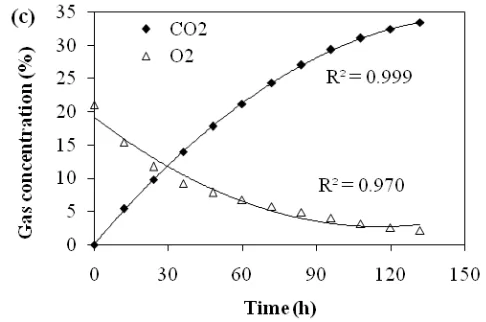
The progression of O2 and CO2 concentration as a function of time is shown in Figure 1. The O2 concentration was found to decrease with time at all the temperatures studied. On the other hand, CO2 concentration increased. The reduction in concentration of O2 and increase in concentration of CO2 may be consumption of available O2 and liberation of CO2 respectively by tomato for its respiratory reaction. As it is expected, the rate of O2 consumption and CO2 evolution was found to be low at 10 and 20°C compared to 30°C. However, the regression functions describe the experimental data for O2 and CO2 concentration were very well (R2 > 0.970). These results were in good agreement with findings reported by [15, 16, 18, 19]. Knowledge of the gas concentration is important for designing of ventilation or gas diffusion systems in controlled atmosphere storage and also selecting a type of storage system for particular commodity [28]. The results obtained for reduction in O2 and increase in CO2 concentrations were analyzed statistically. It was inferred that the reduction of O2 and evolution of CO2 concentration were significantly different at 5% level by temperature.
Figure 1: Progression of O2 and CO2 concentration in closed containers contains tomato at (a) 10°C (b) 20°C (c) 30°C (Each valve is the average of three replicates; all the
values are significantly different at 5%)
C. Respiration Rate of Tomato at Specified Temperature in Closed Containers
Figure 2 shows progression of respiration rate of tomato in closed container at different temperatures. Generally, temperature and modified atmosphere are recognized as significant factors that can affect the respiration activities of fresh produce. The same is confirmed for tomato. For instance, at 10ºC, the initial respiration rates recorded were about 52.459 and 60.079 mg kg-1 h-1 for RO2 and RCO2, respectively. When temperature rose to 30ºC, the values increased to 93.729 and 88.682 mg kg-1 h-1 for RO2 and RCO2, respectively. RO2 and RCO2 decreased with a decrease in the O2 and an increase in the CO2 concentrations in closed system. Therefore, both of low O2 and high CO2 atmospheres decreased the respiration of tomato. Large fluctuations in respiration rate were observed towards the end of experiment. The reasons may be the respiration rate is sensitive to changes in O2
However, R
concentration below about 8% [29].
83
Copyright © 2011-15. Vandana Publications. All Rights Reserved.surrounding temperature is beyond their optimum level [32].
Figure 2: Progression of respiration rate (RR) of tomato in closed container at specified temperatures (a) function of O2 (b) function of CO2
The respiration model parameters (K
concentration (n = 3, all the values are significantly different at 5% level)
D. Mathematical Modeling of Respiration Rate
1, K2 and K3) and correlation coefficient (R2) at different temperature are presented in Table 3. The regression described that the experimental data i.e. O2 concentration very well (R2 = 0.923 to 0.970) whereas CO2 concentration fair (R2 = 0.804 to 895) for tomato. The estimated values for K1 and K2 are showed positive and CO2 evolution showed a negative value for K3 [11, 13]. However, the negative value is quite close to zero that indicates the influence of CO2 concentration on respiration rate was negligible. Therefore, the respiration rate of tomato was considered mainly as a function of O2 concentration. The inhibition parameter K3, calculated as the rate of CO2 evolution, was inversely related to temperature, whereas, the one
calculated as the rate of O2
Such results are expected because the rate of CO consumption directly proportional to the temperature.
2 evolution during the respiration process is not same as the rate of O2 consumption. The parameter K3 was negligible in either case which nullifies the effect of changing CO2 concentration on the respiration rate. The small variations between them may be due to the nearing anaerobic conditions created inside the chambers and which must be prevented during storage. As the inhibition constant (K3) for CO2 concentration in Equation (6) tended to zero, the model was modified mainly as a function of O2 concentration. The modified model is given as follows:
84
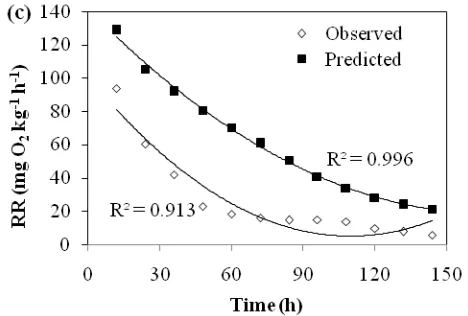
Copyright © 2011-15. Vandana Publications. All Rights Reserved.Figure 3: Predicted and observed respiration rate (RR) of tomato with respect to O2 concentration at (a) 10°C (b)
20°C (c) 30°C
E. Verification of Respiration Rate Model
The respiration rate predicted by the enzyme kinetics model (8) was verified with the experimental respiration rate at all storage temperatures to distinguish the relative variations between them. The experimental respiration rates of tomato were obtained by the closed system method in terms of O2 consumption and CO2 evolution using Equation (1) and (2) respectively. For comparision, the experimental respiration rates as a function of O2 concentration were taken into account since the predicted respiration rates are the function of O2 concentration. The predicted and observed respiration rates of tomato are shown in Figure 3.
The mean relative deviation moduli between predicted and experimental respiration rates of tomato at 10°C and 20°C were found to be 2.39% and 2.668% respectively for O2
IV.
CONCLUSION
consumption. This indicates that the predicted respiration rates for tomato were in reasonable agreement with the experimental respiration rates. The proposed model (8) provides an accurate and rapid prediction of respiration rate of tomatoes in controlled/modified atmospheres. Such model could be applicable for predicting respiration rate of other
commodities of similar respiratory behaviour. Similar findings of goodness of fit have been reported by [18, 19].
The O2 consumption and CO2 evalution rates were found to be rapid during the initial periods of storage thus the respiration rates were also found to decrese with storage time. The CO2 evalution rate was influenced by the O2 concentration prevailing inside the air-tight storage containers. Respiration rate was found to decrease with increasing CO2 and decreasing O2 concentration. Moreover, rate of respiration was found to be fast at 30°C whereas slow at 10 and 20°C. It indicates that the low temperature influenced the rate of respiration. In the enzyme kinetics model, the dependence of respiration rate on O2 and CO2 was found to follow the uncompetitive inhibition. The inhibition constant nullifies the effect of changing CO2 concentration on the respiration rate as the rate of CO2 evolution was inversely related to the temperature whereas rate of O2 consumption directly related to the temperature. Therefore, a new model was proposed as a function of O2 concentration in which the model parameters were correlated with storage temperature. The applicability of the model for the prediction of respiration rate was verified and there was a reasonable agreement (R2 = 0.997) between the predicted and experimental respiration rates at 10°C for O2 concentration.
NOMENCLATURE
[O2] = Oxygen concentration, % [CO2] = Carbon dioxide concentration, %
CO2 = Oxygen mass concentration, mg L-1
CCO2 = Carbon dioxide mass concentration, mg L-1
d[O2] = Change in concentration of oxygen with time
d[CO2] = Change in concentration of carbon dioxide with time
dt = Difference in time between two gas measurements, h
E = Mean relative deviation modulus, %
K1, K2, K3 = Constants (functions of the temperature of reaction)
Ki = Inhibition constant Km = Michaelis constant
Ma = Mean molecular mass of air, g mole-1
N = Number of respiration data points (in Eqn. 7)
85
Copyright © 2011-15. Vandana Publications. All Rights Reserved.P = Pressure of the gas (1 atm) R = Gas constant in the ideal gas equation, 0.08206 L atm mole-1 K-1
RO2 = Respiration rate, mg O2 kg-1 h-1 RCO2 = Respiration rate, mg CO2 kg-1 h-1
Rm = Maximum respiration rate, mg kg-1 h-1
Rexp = Experimental respiration rate, mg O2 kg-1 h-1
Rpre = Predicted respiration rate, mg O2 kg-1 h-1
S = Substrate concentration T = Temperature of the gas, K Vf = Free volume of the container, L v0 = Rate of reaction at time t = 0 Vm = Max. rate achieved by the system at maximum substrate concentrations
Wp = Weight of the stored product, kg
REFERENCES
[1] Agarwal S, Rao AV. 2000. Tomato lycopene and its role in human health and chronic diseases. Canadian Medical Association Journal, 163(6): 739-744.
[2] Sammi S, Masud T. 2007. Effect of different packaging systems on storage life and quality of tomato
(Lycopersicon esculentum var. Rio Grande) during different ripening stages. Internet Journal of Food Safety, 9: 37-44.
[3] Pila N, Gol NB, Ramanarao TV. 2010. Effect of post harvest treatments on physicochemical characteristics and shelf life of tomato (Lycopersicon esculentum Mill) fruits during storage. American-Eurasian Journal of Agriculture and Environmental Sciences, 9(5): 470-479.
[4] Kader AA, Zagory D, Kerbel EL. 1989. Modified atmosphere packaging of fruits and vegetables. Critical Review in Food Science and Nutrition, 28: 1–30.
[5] Kader AA. 2002. Postharvest technology of horticultural crops. University of California Davis, 39-47. [6] Jayas DS, Jeyamkondan S. 2002. Modified atmosphere storage of grains meats fruits and vegetables. Biosystems Engineering, 82(3): 235–251.
[7] Fonseca SC, Fernanda, AR, Oliveira, Brecht JK. 2002. Modeling respiration rate of fresh fruits and vegetables for modified atmosphere packages: a review. Journal of Food Engineering, 52: 99–119.
[8] Mahajan PV, Goswami TK. 2001. Enzyme kinetics based modeling of respiration rate for apple. Journal of Agricultural Engineering Research, 79(4): 399–406. [9] Yang CC, Chinnan MS. 1988. Modeling the effect of O2 and CO2
[10] Cameron AC, Boylan-Pett W, Lee J. 1989. Design of modified atmosphere packaging systems: modeling oxygen
concentrations within sealed packages of tomato fruits.
Journal of Food Science, 54(6): 1413–1415.
on respiration and quality of stored tomatoes.
Trans of ASAE, 30(3): 920–925.
[11] Lee DS, Haggar PE, Lee J, Yam KL. 1991. Model for fresh produce respiration in modified atmosphere based on principles of enzyme kinetics. Journal of Food Science,
56(6): 1580-1585.
[12] Talasila PC, Chau KV, Brecht JK. 1992. Effects of gas concentrations and temperature on O2 consumption of strawberries. Trans of ASAE, 35(1): 221–224.
[13] Song Y, Kim HK, Yam KL. 1992. Respiration rate of blueberry in modified atmosphere at various temperatures.
Journal of the American Society of Horticultural Sciences,
117(6): 925-929.
[14] Lee DS, Song Y, Yam KL. 1996. Application of an enzyme kinetics based respiration model to permeable system experiment of fresh produce. Journal of Food Engineering, 27: 297-310.
[15] Yaptenco KF, Kim JG, Lee HE. 2007. Respiration modeling of cherry tomato (cv. Coco) at different temperatures for modified atmosphere packaging applications. The Philippine Agriculture Sciences, 90(4): 272-282.
[16] Wang ZW, Duan HW, Hu CY. 2009. Modeling the respiration rate of guava (Psidium guajava L.) fruit using enzyme kinetics, chemical kinetics and artificial neural network. European Food Research Technology, 229: 495-503.
[17] Heydari A, Shayesteh K, Eghbalifam N, Bordbar H, Falahatrisheh S. 2010. Studies on the respiration rate of banana fruit based on enzyme kinetics. International Journal of Agriculture and Biology, 12: 145–149.
[18] Mangaraj S, Goswami TK. 2011a. Modeling of respiration rate of litchi fruit under aerobic conditions.
Food and Bioprocess Technology, 4: 272-281.
[19] Mangaraj S, Goswami TK. 2011b. Measurement and modeling of respiration rate of guava for modified atmosphere packaging. International Journal of Food Properties, 14: 609–628.
[20] Gautier H, Verdin VD, Benard C, Reich M, Buret M, Bourgaud F, et al. 2008. How does tomato quality (sugar, acid and nutritional quality) vary with ripening stage, temperature and irradiance? Journal of Agriculture and Food Chemistry, 56: 1241–1250.
[21] Helga A, Peter P, Bernhard B, Angelika K, Rolf K. 1999. Sensory analysis and instrumental measurements of short-term stored tomatoes (Lycopersicon esculentumMill). Postharvest Biology and Technology, 15: 323-334.
86
Copyright © 2011-15. Vandana Publications. All Rights Reserved.[24] Hagger PE, Lee DS, Yam KL. 1992. Application of an enzyme kinetic based respiration model to closed system experiments for fresh produce. Journal of Food Process Engineering, 15: 143-157.
[25] Ratti C, Raghavan GSV, Gariepy Y. 1996. Respiration rate model and modified atmosphere packaging of fresh cauliflowers. Journal of Food Engineering, 28: 297-306.
[26] Gong S, Corey K. 1994. Predicting steady-state oxygen concentrations in modified atmosphere packages of tomatoes. Journal of the Americal Society of Horticultural Sciences, 119(3): 546-550.
[27] Moneruzzaman KM, Hossain ABMS, Sani W, Saifuddin M, Alenazi M. 2009. Effect of harvesting and storage conditions on the post harvest quality of tomato (Lycopersicon esculentum Mill). Australian Journal of Crop Science, 3(2): 113-121.
[28] Ratti C, Rabie HR, Raghavan GSV. 1998. Modeling modified atmosphere storage of fresh cauliflower using
diffusion channels. Journal of Agricultural Engineering Research, 69: 343-350.
[29] Zagory D, Kader AA. 1988. Modified atmosphere packaging of fresh produce. Food Technology, 42(9): 70– 77.
[30] Iqbal T, Rodrigues FAS, Mahajan PV, Kerry JP. 2009. Mathematical modeling of the influence of temperature and gas composition on the respiration rate of shredded carrots. Journal of Food Engineering, 91: 325-332.
[31] Zhang D, Haang BY, Scoh KJ. 1993. Physiological and bio chemical changes of green ripe banana at relative high storage temperatures. Acta Horticulture, 343: 81–85. [32] Labibet D, Metzidakes I, Gerasophos D. 1995. Effect of storage temperature on the ripening response of banana grown in mild winter climate of Crete. Acta Horticulture,
![Table 1. Free volume of the container (Vfusing the method of water displacement [16]. The free ) was measured volume of container was calculated by difference in](https://thumb-us.123doks.com/thumbv2/123dok_us/9779625.1963244/3.612.52.291.404.550/table-container-vfusing-displacement-measured-container-calculated-difference.webp)