The Thirty-Third AAAI Conference on Artificial Intelligence (AAAI-19)
Towards Sentence-Level Brain Decoding with Distributed Representations
Jingyuan Sun,
1,2Shaonan Wang,
1,2Jiajun Zhang,
1,2Chengqing Zong
1,2,3 1National Laboratory of Pattern Recognition, CASIA, Beijing, China2University of Chinese Academy of Sciences, Beijing, China
3CAS Center for Excellence in Brain Science and Intelligence Technology, Beijing, China
{jingyuan.sun, shaonan.wang, jjzhang, cqzong}@nlpr.ia.ac.cn
Abstract
Decoding human brain activities based on linguistic represen-tations has been actively studied in recent years. However, most previous studies exclusively focus onword-level rep-resentations, and little is learned about decoding whole sen-tencesfrom brain activation patterns. This work is our effort to mend the gap. In this paper, we build decoders to asso-ciate brain activities with sentence stimulus via distributed representations, the currently dominant sentence representa-tion approach in natural language processing (NLP). We carry out a systematic evaluation, covering both widely-used base-lines and state-of-the-art sentence representation models. We demonstrate how well different types of sentence represen-tations decode the brain activation patterns and give empiri-cal explanations of the performance difference. Moreover, to explore how sentences are neurally represented in the brain, we further compare the sentence representation’s correspon-dence to different brain areas associated with high-level cog-nitive functions. We find the supervised structured represen-tation models most accurately probe the language atlas of hu-man brain. To the best of our knowledge, this work is the first comprehensive evaluation of distributed sentence representa-tions for brain decoding. We hope this work can contribute to decoding brain activities with NLP representation models, and understanding how linguistic items are neurally repre-sented.
Introduction
In the past decade, brain imaging technology has been de-veloped to reveal what a person is seeing, perceiving or attending to through analyzing his brain activity patterns (Tong and Pratte 2012). This approach, namely brain de-coding, might one day make it possible to read a person’s thoughts from noninvasive measurements of brain activa-tions. One important and promising aspect of brain decoding is in the form of language. Much has recently been learned about reconstructing simple linguistic items, such as words and phrases from brain activities measured by functional magnetic resonance imaging (fMRI) (Thirion et al. 2006; Wehbe et al. 2014). But only a few developments have been made in decoding whole sentences (Matsuo et al. 2016).
The key aspect of a sentence decoder is a computational mapping between the brain activities and the sentence
stim-Copyright c2019, Association for the Advancement of Artificial Intelligence (www.aaai.org). All rights reserved.
ulus. To build the decoder, it’s thus important to find numeri-cal representations of the sentence. Pioneering work (Wehbe et al. 2014) in brain imaging generally uses human-elicited features, which can’t fully express fine-gradient differences of sentence meanings. Human-elicited features are also lim-ited in scope to cover the large compositional space of nat-ural language (Nishida and Nishimoto 2017). We instead adopt distributed sentence representation (DSR) models, the currently dominant approach in NLP community. DSR mod-els roughly fall into two categories: unstructured and struc-tured models (Wang, Zhang, and Zong 2017). Unstrucstruc-tured models treat a sentence as a bag of words (Iyyer et al. 2015; Shen et al. 2018), while structured models explicitly catch the sentence structure (Kiros et al. 2015; Logeswaran and Lee 2018), such as word order. We don’t yet know which of the two is the better option for brain decoding. More specif-ically, will structured models more accurately decode the brain activities than unstructured models? If so, under what condition? Is the conclusion consistent with different decod-ing methods? We will answer these questions to benefit brain decoding from DSR models.
Except for sentence representations, low-dimensional representations of the brain activities are also necessary for brain decoding. The brain images measured by fMRI usu-ally contain hundreds of thousands of voxels, which must be reduced in case of overfitting. Inspired by Pereira et al. (2018), we train regression models to predict sentence rep-resentations from the brain images, and keep voxels most in-formative in the prediction. Other than direct dimensionality reduction, such selection method provides an extra bonus. Through the spatial distribution of the informative voxels on the brain, we can study the relations between the sentence representations and brain areas associated with high level cognitive functions. This may offer some insights for how sentences are represented in the human brain.
In this paper, we explore 9 DSRs, covering both unstruc-tured and strucunstruc-tured models, classical baselines and state-of-the-art methods, to represent the sentence stimulus1. We
then select informative voxels from fMRI images to repre-sent the brain activities. With these reprerepre-sentations at hand,
1
[a] Passage
Musical Instruments
Clarinet Accordion
1. A clarinet is a woodwind musical instrument… 2. It is a long black tube with a flare at the bottom 3. The player chooses notes by pressing keys and
holes. Piano
…
Topic Sentence
…
…
…
1. The piano is a popular musical instrument… 2. Pressing a piano key causes a felt-tipped
hammer...
3. The piano has an enormous note range.
1. An accordion is a portable musical instrument. 2. One keyboard is used for individual notes 3. Accordions produce sound with bellow that blow
air
[b]
Decoder
Brain image for sentence STi
(9 DSRs)
Decoder
Reduced image for sentence SEi.
Reduced image
Sentence representation
of STi
Decoded semantic vector
Sentence representations
co
rr
elate
Voxel selection
Training
Evaluation
SE1.
SEn
SEi.
…
…
Figure 1: [a] Training and evaluation of sentence-level brain decoders. The brain images are reduced by voxel selection. The decoders are trained to map the brain imaging data to match the distributed sentence representations. During evaluation, the decoders produce semantic vectors from unseen images to refer the corresponding sentence stimulus. [b] Example of sentence stimulus organized in topic–passage–sentence, taking the musical instrument topic as an instance
we can start the sentence-level brain decoding as shown in Fig.1(a). We use two decoding methods: similarity-based decoding and regression-based decoding. The decoder re-spectively learns to map the brain images to different sen-tence representations. The mapping is then evaluated on un-seen brain images to reveal corresponding sentence stimu-lus.
In the evaluation, we find:
(i) Simple unstructured representation models are capable of decoding coarser-grained difference of brain activa-tions. But they lose to the structured models in tasks of finer granularity.
(ii) Performance of representation models may fluctuate in a narrow range across different decoding methods. But one of the supervised structured models, InferSent, consistently outperforms other baselines in nearly all experiments.
(iii) The distributed sentence representations actively probe some of the functional networks of human brain. Sen-tence representations which better decode the brain ac-tivities are shown to have a higher correspondence with the voxels of the language cortex.
Findings of this paper not only demonstrate the weakness and advantages of different sentence representation mod-els in the brain decoding task. They offer a deeper insight of the connection between the two manifestations of men-tal meanings: the neural activation patterns and the extrinsic linguistic representations. We hope this could boost further research on using NLP representation models in analyzing brain activities.
Related Work
Brain Decoding
The past decade has witnessed considerable progress in the field of brain decoding. Early studies managed to re-cover simple verbal stimulus, including words (Mitchell et
al. 2008; Palatucci et al. 2009; Just et al. 2010; Pereira, Detre, and Botvinick 2011; Handjaras et al. 2016) and phrases (Wehbe et al. 2014; Fyshe 2015; Huth et al. 2016), from brain activation patterns measured by functional mag-netic resonance imaging (fMRI). Recent work has shown that sentences may also be decoded (Matsuo et al. 2016; Pereira et al. 2018). These results potentially support a brain-computer interface that could perform “brain reading” (Nishimoto et al. 2011).
In brain decoding, we need to build mapping between stimulus and corresponding brain activities. We call such mapping function a decoder. Two types of decoders are most widely used in brain imaging research: the similarity-based decoder (Anderson, Zinszer, and Raizada 2016) and regression-based decoder (Nishida and Nishimoto 2017; Bulat, Clark, and Shutova 2017). Similarity-based decoders re-represent a stimuli by its similarity with other stimu-lus. The brain activities are re-represented in the same way. The decoding is based on matching the similarity space. Regression-based decoder learns a parametric mapping from the brain activation patterns to the stimulus. The learned mapping then produces quantitative representations of un-seen brain activities for further decoding. In this paper, we adopt both the two types of decoders for a comprehensive evaluation. We give a detailed introduction of them in the Brain Decoding Methodssection.
Distributed Sentence Representations
Structured models can be further classified into unsu-pervised and suunsu-pervised methods. Unsuunsu-pervised methods (Kiros et al. 2015; Logeswaran and Lee 2018) generally encode a sentence to predict its contexts. So the produced representations catch the lexical co-occurrence patterns of the training corpora. While for supervised models, sentence representations are trained on various supervised tasks, such as natural language inference (NLI) and machine transla-tion (MT). The trained encoders integrate additransla-tional task-related semantic information. InferSent (Conneau et al. 2017) and GenSen (Subramanian et al. 2018), state-of-the-art distributed sentence representations, are both supervised structured methods.
Brain Imaging Data
We experiment with the fMRI neural activation data pub-lished by Pereira et al. (2018), acquired on a whole-body 3-Tesla Siemens Trio scanner with a 32-channel head coil. We use the brain images corresponding to sentence stimu-lus. These images are scanned from 5 participants (mean age 27.7, range 21-50), all of them are native English speakers. The details of experimental setup, materials and presentation scripts are available online2.
Sentence Stimulus
The sentences stimulus are organized in the hierarchy of topic–passage–sentence, as shown in Fig 1(b). In experi-ments, participants are presented a set of 168 passages, each consisting of 3-4 sentences about a particular concept. The passages cover 48 broad topics (e.g., professions, opera, nat-ural disasters, bone fractures, dreams, etc.) and provide basic information of the corresponding concept in a Wikipedia-style. All passages are presented sentence by sentence. Each sentence is presented for 4s followed by a 4s fixation gap. The entire set of 637 sentences in 168 passages is seen 3 times. The participants are asked to attentively read the sen-tences they are presented for scanning.
All subjects are scanned three times for every sentence stimulus. The scan is running consistently during the pres-ence of sentpres-ence stimulus. Then the acquired data series is corrected by slicing time and motion and concatenated to align the sentence. The fixation gap is used to separate the sentences and distinguish brain activities of language pro-cessing with other (noisy) brain activities.
Voxel Selection
The voxel selection method is inspired by Pereira et al. (2018). Formally, regression models are trained on each voxel and its 26 neighbors in 3D to predict each dimension of the sentence representations. The correlation between predicted values and the ground truth sentence representa-tions is then calculated. We take the mean correlation across all dimensions as a voxel’s informativeness score. The 5,000 voxels with highest scores are selected. With such method, we select voxels according to how they correspond with the sentence representation. Therefore, through the spatial dis-tribution of the selected voxels on the brain, we can gain
2
https://osf.io/crwz7/wiki/home/
some deeper insights of the relation between sentence repre-sentations and brain areas associated with different cognitive functions.
Sentence Representation Models
In this paper we evaluate 9 sentence representation models. Both simple and advanced unstructured models, supervised and unsupervised structured models are all included.
Unstructured Models
These models ignore the structure of a sentence, thus are generally easier to train than structured models.
Simple Polling Methods Averaging is almost the sim-plest way to generate a sentence representation. It returns the element-wise average over word embeddings in a sen-tence, which can be seen as an average pooling over the se-quence. Averaging takes semantic information from every single word, but it also dilutes the most salient features of the sentence. Considering that only a small number of words in a sentence contribute most to its meaning, we also adopt pooling as a representation model. It extracts the max-imum value along each dimension of the word embeddings, aggregating the most salient features of all dimensions in the sentence representation. Intuitively, features extracted by av-eraging and max-pooling catch complementary semantic in-formation of a sentence. So we concatenate the two extracted features as the third representation method, motivated by Shen et al (2018).
Advanced Pooling Methods Simple pooling methods en-joy minimal parameters but may only catch limited features of a sentence. Advanced pooling methods are still unstruc-tured but they integrate additional information. FastSent (Hill, Cho, and Korhonen 2016) sums word embeddings in a sentence as its representation to predict the surrounding sen-tences. SIF3(Arora, Liang, and Ma 2016) adapts the naive
averaging of word embeddings to weighted averaging. Both methods show improvements over simple pooling methods in downstream tasks. We also test FastSent and SIF in this paper.
Structured Models
Structured representation models are aware of the order and structure of a sentence. How words or phrases affect each other is modeled in the training process but somewhat sacri-ficing computational efficiency.
Unsupervised Methods Unsupervised structured models generally encode a target sentence to predict its contexts. One typical method is Skip-thought4 (Kiros et al. 2015). It trains an RNN based encoder-decoder model that re-constructs the contexts of an encoded sentence. Sentences with similar semantic and structure properties can thus be mapped to closer vectors in the representation space. Quick-Thought5 (Logeswaran and Lee 2018) is an advanced
ver-sion of skip-thought. It formulates the sentence predicting
3https://github.com/PrincetonML/SIF 4
https://github.com/ryankiros/skip-thoughts
5
as a classification task and achieves impressive accelera-tion of training speed over skip-thought. Quick-thought is also the state-of-art unsupervised structured model, deliver-ing impressive performance on downstream tasks.
Supervised Methods These methods learn sentence en-coders with supervised data of certain NLP tasks. InferSent6 (Conneau et al. 2017) is a state-of-the-art supervised model trained on the Stanford Natural Language Inference datasets. It is shown to consistently surpass unsupervised models, such as Skip-thought, in a series of downstream tasks. In-ferSent is trained on one type of supervised task, while an-other well-performing supervised model, GenSen7
(Subra-manian et al. 2018), is learned in a multi-task manner. The variant of GenSen we test is trained on machine translation and semantic parsing.
Brain Decoding Methods
After the sentence representations are built, the brain de-coder establishes an associative mapping between the rep-resentation and the imaging data. In this paper we use two brain decoding methods: similarity-based decoding and regression-based decoding.
Similarity-based Decoding
Similarity-based decoding is proposed by Anderson et al. (2016). The first step is to build the similarity-based repre-sentation of each sentence embedding and each brain image respectively. Formally, given a set ofnsentence representa-tions{S0, ..., Si, ..., Sn}, we calculate similarity-based rep-resentation ofSias
RSi = [corr(Si, S0), corr(Si, S1), ...., corr(Si, Sn)], (1)
where corr denotes Pearson’s correlation. The similarity-based representation of brain images{B0, ..., Bi, ...Bn}can be acquired by analogy. At test time, two of then similarity-based representations of sentences and their corresponding brain images are chosen for decoding at one time. They are represented by the similarity vectors,RSi, RSj for the two sentences andRBi, RBj for the corresponding brain im-ages. The decoding is scored a success ifcorr(RSi, RBi) + corr(RSj, RBj)> corr(RSi, RBj)+corr(RSj, RBi). This is actually a pairwise matching task, reflecting if the sen-tence representations match the brain activities in similarity relation.
Regression-based Decoding
Regression-based decoding operates by estimating a seman-tic vector directly from the voxels, with each dimension pre-dicted by a separate regression model. Let’s take Ridge Re-gression as an example to give a detailed explanation. For-mally, we are given the voxel matrixX ∈ RNE×NV and sentence representation matrixZ ∈ RNE×ND in the train-ing set, whereNEdenotes the number of examples,NV de-notes the number of voxels, andNDdenotes the number of
6
https://github.com/facebookresearch/InferSent
7
https://github.com/Maluuba/gensen
dimensions for sentence representation. The regression co-efficientsW andbare estimated to minimize
||W X+b−zi||22+λ||b||22 (2) for each columnziinZ, i.e., each dimension of the sentence vectors.λis the regularization parameter separately set for each dimension with cross-validation. Except for ridge re-gression, we also test with Lasso-regression and Multilayer Perceptron (MLP) to cover the most widely used regression models in brain decoding. How to evaluate the decoded se-mantic vectors will be detailed in the following section.
Results
Similarity Based Decoding
As depicted in the Brain Decoding Methodssection, simi-larity based decoding is tested on a pairwise matching task. The matching task includes three subtasks in progressively finer granularity, with training and testing sentences coming from:
(i) different topics (e.g., a sentence about a piano vs. a butterfly),
(ii) different passages from the same topic (e.g., a sentence about a dragonfly vs. a butterfly),
(iii) different sentences within the same passage (e.g., two sentences about a piano), for all possible pairs in every subtask.
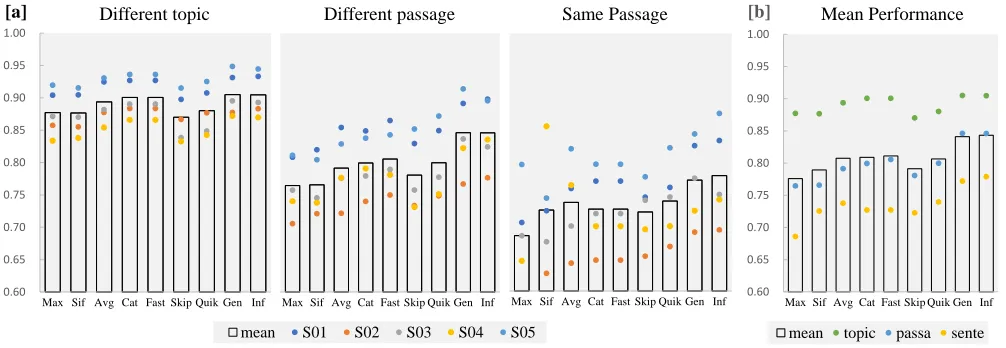
Fig.2 shows the matching accuracy of different sentence representations under the similarity based decoding. All the tested representations perform significantly above chance level in decoding the sentence stimulus from different top-ics. The performance is consistent across subjects. Averag-ing achieves satisfactory performance but doesn’t rank the top, even in the pooling based methods. Concatenating max-imum and average embeddings achieves minor but consis-tent improvements over simply averaging and max-pooling. SIF, though taking the form of weighted averaging, performs even worse than naive averaging in some cases.
The pooling-based methods perform almost on a par with the structured model in the first two sub-tasks. From Fig.2[b] we can see that averaging, concatenation and FastSent, the three unstructured models, perform even better than the two unsupervised structured models. However, the advantages of structured models become clear as the tasks getting tough. Especially in the third task of decoding sentences from the same passage, InferSent and GenSen exceed all other base-lines by an impressively large margin.
Regression Based Decoding
0.60 0.65 0.70 0.75 0.80 0.85 0.90 0.95 1.00
Max Sif Avg Cat Fast Skip Quik Gen Inf
Mean Performance
mean topic passa sente
m
ax avg fas qui inf
mean S01 S02 S03 S04 S05
0.60 0.65 0.70 0.75 0.80 0.85 0.90 0.95 1.00
Max Sif Avg Cat Fast Skip Quik Gen Inf
Different topic
Max Sif Avg Cat Fast Skip Quik Gen Inf
Different passage
Max Sif Avg Cat Fast Skip Quik Gen Inf
Same Passage [b]
[a]
Figure 2: Pairwise matching results for similarity based decoding. We report the results of three subtasks: matching sentences from (i) different topics, (ii) same topic but different passages and (iii) the same passage. We also illustrate the average per-formance across the three subtasks in the last figure. Each colored dot in the figures denotes the matching accuracy for an individual subject. And dots with the same color refer to a same subject across the subtasks, as depicted by the legend
0.73 0.75 0.78 0.80 0.83 0.85 0.88 0.90 0.93
Max Avg Cat Fast Skip Quik Gen Inf
mean S01 S02 S03 S04 S05
Ridge Lasso MLP
topic passa. sente. topic passa. sente. topic passa. sente.
Max 0.88 0.76 0.65 0.88 0.75 0.70 0.83 0.70 0.63
Avg 0.90 0.83 0.73 0.92 0.81 0.78 0.89 0.78 0.67
Cat 0.92 0.83 0.74 0.90 0.81 0.80 0.86 0.74 0.66
Sif 0.89 0.84 0.69 0.91 0.77 0.72 0.84 0.73 0.65
Fast 0.92 0.81 0.74 0.90 0.79 0.77 0.88 0.76 0.67
Skip 0.90 0.82 0.75 0.91 0.80 0.79 0.86 0.81 0.73
Quik 0.91 0.84 0.75 0.91 0.81 0.79 0.90 0.82 0.77
Gen 0.91 0.84 0.78 0.92 0.84 0.84 0.91 0.84 0.80
Inf 0.94 0.90 0.83 0.93 0.86 0.84 0.92 0.84 0.79
[a] [b]
Figure 3: Decoding performance under three regression models: Ridge regression, Lasso regression, and MLP. Table[a]: Av-erage matching accuracy of each tested sentence representation among all subjects. Figure[b]: Ranking accuracy of different sentence representations. Each colored dot in the figure denotes the performance on a certain subject
Pairwise Matching Task In Fig.3(a), we show the match-ing accuracy of different sentence representations with three regression models. We test with imaging data from every single subject and report the mean accuracy. Generally, rep-resentation models deliver consistent performance from the similarity based decoding to the current regression based de-coding.
Still, most unstructured models perform nearly as well as structured models in the first two subtasks. Avg and Cat prove strong baselines, fully comparable to the two advanced pooling models. However, the structured models work better in the third subtask, i.e. discriminating sentences from a same passage. Even skip-thought which doesn’t per-form very well in the first subtask overtakes Avg and Cat here. InferSent surpasses other baselines in nearly all sub-tasks with the three regression models.
0 20 40 60 80 100 120
4 6 8 10 12 14 16 18 20
0.8 0.82 0.84 0.86 0.88 0.9 0.92 0.94 0.96
8 9 10 11 12 13 14 15 16 17
avma sif skip infersent
[a] [b]
Figure 4: [a] The length distribution of sentences [b] The influence of sentence length to decoding performance. We choose one representative model for each class of methods to display.
the decoding performance for structured models. We don’t expect much of that since unsupervised structured models which encode word orders didn’t outperform unstructured ones significantly in the previous experiments. We do a se-mantically identical while syntactic plausible rearrangement of the word order and test the structured models. No signifi-cant difference is observed so we won’t display it.
Rank Evaluation In the rank evaluation, every decoded vector is correlated with all 637 sentence embeddings and then ranked by the correlation. The score is 1 if the correct sentence embedding ranks top, 0 if it ranks the bottom and in-between otherwise (Pereira et al. 2018). We use the mean ranking score across all decoded vectors as the final score.
Fig.3(b) shows the ranking accuracy. All the tested repre-sentation models consistently score above the chance level across the subjects. The three simple pooling embeddings give pretty similar results. Concatenated embedding ranks top in the three and max embedding outperforms the aver-age, but just with small margins. GenSen and InferSent sur-pass all the simple pooling methods with InferSent ranking the top. Skip-thought’s performance ranks the lowest among the structured models, virtually the same as the simple pool-ing models.
Analysis and Summary
We carry out extensive experiments. All representation models are compared under two decoding frameworks. In regression-based decoding particularly, we test with three different regression models. Throughout all the decoding tasks, we have some common findings to summarize.
In simple pooling based methods, the concatenation of av-eraging and max-pooling achieves improvements over the single methods. We owe the improvements to the additional information caught by maximum pooling, since averaging dilutes the most salient features of each word in a sen-tence. Concatenation fares well in both the two brain de-coding frameworks, and shows comparable performance to unsupervised structured models in coarse-grained decoding tasks. Given its low computational complexity, it might be considered as a competent alternative in brain semantic de-coding. As for the advanced pooling methods, FastSent per-forms similar with concatenation and slightly better than the
naive averaging. This may indicate the benefit of catching co-occurrence patterns of sentences in the representations.
M
ax Avg Fast Quik In
f
mean S01 S02 S03 S04 S05
0.2 0.25 0.3 0.35 0.4 0.45 0.5 0.55
0.6 Language Atlas
0 0.1 0.2 0.3 0.4 0.5
Max Sif Avg Cat Fast Skip Quik Gen Inf
Overall Distribution
language visual DMN MD
0.15 0.2 0.25 0.3 0.35 0.4
0.45 Visual Atlas
[a]
[b]
Figure 5: Distribution of informative voxels among brain at-lases.[a] Overall distribution [b] Distribution on language and visual atlas of informative voxels on language atlas se-lected by different sentence representations for every sub-ject. [b] Distribution of informative voxels on language abd visual atlas selected by different sentence representations for every subject.)
The structured models tend to perform better than un-structured models in fine-grained decoding tasks. InferSent, especially, delivers significant improvements over all other baselines in nearly every single experiment. Why? In our experiments, sentences from a same passage tend to use se-mantically related words to describe one single concept, as shown in Fig. 1(b). This means merely pooling on the the word embeddings is largely possible to produce similar sen-tence representations. That’s where the structured and other auxiliary semantic information come to rescue. But for sen-tences from different topics or different passages, words are less overlapping. Simply the word embeddings may provide enough semantic features for a distinguishable sentence rep-resentation.
Cognitive Insights
at-Language Atlas Visual Atlas DMN MD
topic. passa. sente. topic. passa. sente. topic. passa. sente. topic passa. sente.
Max 0.849 0.678 0.554 0.799 0.636 0.497 0.784 0.610 0.568 0.818 0.664 0.516
Avg 0.877 0.712 0.564 0.816 0.656 0.485 0.799 0.616 0.517 0.834 0.676 0.545
Cat 0.882 0.724 0.549 0.825 0.673 0.445 0.809 0.639 0.537 0.842 0.689 0.545
Sif 0.850 0.668 0.534 0.778 0.613 0.465 0.750 0.560 0.466 0.795 0.608 0.540
Fast 0.880 0.718 0.557 0.821 0.664 0.465 0.804 0.627 0.527 0.838 0.682 0.545
Skip 0.847 0.673 0.572 0.790 0.632 0.522 0.760 0.620 0.540 0.790 0.631 0.534
Quik 0.847 0.673 0.534 0.810 0.625 0.555 0.780 0.649 0.519 0.810 0.614 0.537
Gen 0.860 0.696 0.580 0.819 0.653 0.561 0.793 0.611 0.537 0.813 0.643 0.546
Inf 0.906 0.744 0.583 0.846 0.676 0.580 0.822 0.638 0.575 0.856 0.674 0.572
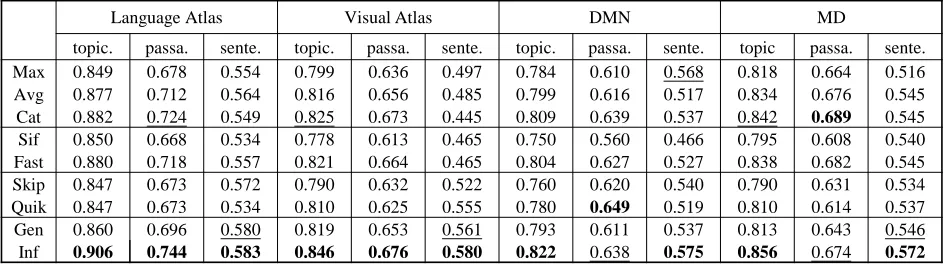
Figure 6: (Table 1) Matching accuracy of sentence representations with voxels constrained on specific brain areas
las (Duncan 2010)8 . We are particularly interested in the language atlas, since it stores the mappings between linguis-tic forms and meanings (Power et al. 2011).
In previous experiments, we select informative voxels based on how well they predict the sentence representations, without any spatial constraints over the brain. Nevertheless, voxels themselves belong to different brain areas with high-level cognitive functions. We show how the informative vox-els are distributed among these areas, which is actually prob-ing the functional brain areas with sentence representations. As depicted in Fig.5, the informative voxels are not evenly distributed among the atlases. Of all the voxels selected by different sentence representations, about 40% (in average) fall into the language atlas. InferSent, the supervised struc-tured model which consistently leads in previous decoding tasks, selects significantly more language atlas voxels than other methods. Further, most of informative voxels fall out-side of the visual atlas, indicating that the information de-coded is not primarily visual in nature.
To demonstrate how well different sentence representa-tions decode specific brain area, we further constrain the voxels to that area and re-train the decoders. We show the results in Table 1. The performances are generally consistent with previous experiments. InferSent and GenSen still rank the top. Using voxels in the language atlas leads to better decoding results than other areas. The results may provide some insights of the deeper relationship between the dis-tributed lexical representation and the mental representation of a sentence. InferSent and GenSen capture not only the sentence structure in the representations. The supervised set-tings allow them to further integrate task-oriented semantic information. For example, sentence representations trained in machine translation may catch the cross-lingual corre-spondence, trained in NLI better reflect the logic relations among words and phrases. That means these representations are not just statistical mappings of linguistic pattens, but an aggregation of the sentence properties from different points of view. Such supervised representations accurately decode the brain activities and actively probe the language cortices. We thus guess that brain representation of sentence may also
8
On average, there are respectively 16193, 12335, 16657 and 32351 voxels in the language atlas, visual atlas, DMN and MD.
be a bindings of multi-source semantic information, but not just a simple reflection of linguistic features.
Conclusion
In this paper, we fully explore different types of distributed representations for sentence-level brain decoding. We con-duct the evaluation with the two most widely used decod-ing methods and multiple tasks to qualify the finddecod-ings. Em-pirically, we show the cases where unstructured models can handle and where they fail to structured models, which pro-vides lessons for applying sentence representation models in future decoding work. We also find that the supervised struc-tured models, largely overlooked in previous work, are sur-prisingly effective in decoding. InferSent, specifically, con-sistently outperforms the other models in nearly all the tasks. This leads us to recommend supervised structured models to be considered in sentence level brain decoding.
To gain deeper insights of how sentences are neurally rep-resented, we further study the correlation between sentence representations and different brain functional areas. We first show that the informative voxels selected by different sen-tence representations have roughly consistent distribution patterns, even though the representations themselves might be acquired in very different ways. We are also surprised to find that, without any apriori location constraints, nearly half of the voxels selected by the supervised structured mod-els fall into the language atlas. This means that brain re-gions active in language processing also highly correspond to these representations. We thus suggest that the way su-pervised structured models encode a sentence may provide some insights on how human brains represent a sentence.
Acknowledgments
The research work descried in this paper has been supported by the Natural Science Foundation of China under Grant No. 61333018.
References
Arora, S.; Liang, Y.; and Ma, T. 2016. A simple but tough-to-beat baseline for sentence embeddings. InProceedings of the 2016 International Conference on Learning Representations (ICLR). Buckner, R. L.; Andrews-Hanna, J. R.; and Schacter, D. L. 2008. The brain’s default network. Annals of the New York Academy of Sciences1124(1):1–38.
Bulat, L.; Clark, S.; and Shutova, E. 2017. Speaking, seeing, un-derstanding: Correlating semantic models with conceptual repre-sentation in the brain. InProceedings of the 2017 Conference on Empirical Methods in Natural Language Processing, 1081–1091. Conneau, A.; Kiela, D.; Schwenk, H.; Barrault, L.; and Bordes, A. 2017. Supervised learning of universal sentence representations from natural language inference data. InProceedings of the 2017 conference on empirical methods in natural language processing (EMNLP).
Duncan, J. 2010. The multiple-demand (md) system of the pri-mate brain: mental programs for intelligent behaviour. Trends in cognitive sciences14(4):172–179.
Fedorenko, E.; Behr, M. K.; and Kanwisher, N. 2011. Functional specificity for high-level linguistic processing in the human brain.
Proceedings of the National Academy of Sciences201112937. Fyshe, A. 2015. Corpora and Cognition: The Semantic Composi-tion of Adjectives and Nouns in the Human Brain. Ph.D. Disserta-tion, Doctoral dissertaDisserta-tion, Air Force Research Laboratory. Handjaras, G.; Ricciardi, E.; Leo, A.; Lenci, A.; Cecchetti, L.; Cosottini, M.; Marotta, G.; and Pietrini, P. 2016. How concepts are encoded in the human brain: a modality independent, category-based cortical organization of semantic knowledge. Neuroimage
135:232–242.
Hill, F.; Cho, K.; and Korhonen, A. 2016. Learning distributed representations of sentences from unlabelled data. InProceedings of the Annual Conference of the North American Chapter of the As-sociation for Computational Linguistics: Human Language Tech-nologies (NAACL-HLT).
Huth, A. G.; de Heer, W. A.; Griffiths, T. L.; Theunissen, F. E.; and Gallant, J. L. 2016. Natural speech reveals the semantic maps that tile human cerebral cortex.Nature532(7600):453.
Iyyer, M.; Manjunatha, V.; Boyd-Graber, J.; and Daum´e III, H. 2015. Deep unordered composition rivals syntactic methods for text classification. InProceedings of the 53rd Annual Meeting of the Association for Computational Linguistics and the 7th Interna-tional Joint Conference on Natural Language Processing (Volume 1: Long Papers), volume 1, 1681–1691.
Just, M. A.; Cherkassky, V. L.; Aryal, S.; and Mitchell, T. M. 2010. A neurosemantic theory of concrete noun representation based on the underlying brain codes.PloS one5(1):e8622.
Kiros, R.; Zhu, Y.; Salakhutdinov, R. R.; Zemel, R.; Urtasun, R.; Torralba, A.; and Fidler, S. 2015. Skip-thought vectors. In Ad-vances in neural information processing systems, 3294–3302. Logeswaran, L., and Lee, H. 2018. An efficient frame-work for learning sentence representations. arXiv preprint arXiv:1803.02893.
Matsuo, E.; Kobayashi, I.; Nishimoto, S.; Nishida, S.; and Asoh, H. 2016. Generating natural language descriptions for semantic representations of human brain activity. InProceedings of the ACL 2016 Student Research Workshop, 22–29.
Mitchell, T. M.; Shinkareva, S. V.; Carlson, A.; Chang, K.-M.; Malave, V. L.; Mason, R. A.; and Just, M. A. 2008. Predicting human brain activity associated with the meanings of nouns. sci-ence320(5880):1191–1195.
Nishida, S., and Nishimoto, S. 2017. Decoding naturalistic experi-ences from human brain activity via distributed representations of words.NeuroImage.
Nishimoto, S.; Vu, A. T.; Naselaris, T.; Benjamini, Y.; Yu, B.; and Gallant, J. L. 2011. Reconstructing visual experiences from brain activity evoked by natural movies. Current Biology21(19):1641– 1646.
Palatucci, M.; Pomerleau, D.; Hinton, G. E.; and Mitchell, T. M. 2009. Zero-shot learning with semantic output codes. InAdvances in neural information processing systems, 1410–1418.
Pereira, F.; Lou, B.; Pritchett, B.; Ritter, S.; Gershman, S. J.; Kan-wisher, N.; Botvinick, M.; and Fedorenko, E. 2018. Toward a uni-versal decoder of linguistic meaning from brain activation.Nature communications9(1):963.
Pereira, F.; Detre, G.; and Botvinick, M. 2011. Generating text from functional brain images. Frontiers in human neuroscience
5:72.
Power, J. D.; Cohen, A. L.; Nelson, S. M.; Wig, G. S.; Barnes, K. A.; Church, J. A.; Vogel, A. C.; Laumann, T. O.; Miezin, F. M.; Schlaggar, B. L.; et al. 2011. Functional network organization of the human brain.Neuron72(4):665–678.
Shen, D.; Wang, G.; Wang, W.; Min, M. R.; Su, Q.; Zhang, Y.; Li, C.; Henao, R.; and Carin, L. 2018. Baseline needs more love: On simple word-embedding-based models and associated pooling mechanisms. In32nd
AAAI Conference on Artificial Intelligence (AAAI-18), 5964–5972.
Subramanian, S.; Trischler, A.; Bengio, Y.; and Pal, C. J. 2018. Learning general purpose distributed sentence representations via large scale multi-task learning. InProceedings of the 2018 Inter-national Conference on Learning Representations (ICLR). Thirion, B.; Duchesnay, E.; Hubbard, E.; Dubois, J.; Poline, J.-B.; Lebihan, D.; and Dehaene, S. 2006. Inverse retinotopy: inferring the visual content of images from brain activation patterns. Neu-roimage33(4):1104–1116.
Tong, F., and Pratte, M. S. 2012. Decoding patterns of human brain activity.Annual review of psychology63:483–509.
Wang, S.; Zhang, J.; and Zong, C. 2017. Learning sentence repre-sentation with guidance of human attention. InInternational Joint Conference on Artificial Intelligence (IJCAI-17), 4137–4143. Wang, S.; Zhang, J.; and Zong, C. 2018. Empirical exploring word-character relationship for chinese sentence representation. ACM Transactions on Asian and Low-Resource Language Information Processing (TALLIP)17(3):14.
Wehbe, L.; Murphy, B.; Talukdar, P.; Fyshe, A.; Ramdas, A.; and Mitchell, T. 2014. Simultaneously uncovering the patterns of brain regions involved in different story reading subprocesses. PloS one
![Figure 1: [a] Training and evaluation of sentence-level brain decoders. The brain images are reduced by voxel selection](https://thumb-us.123doks.com/thumbv2/123dok_us/9698723.1953017/2.612.59.550.58.208/figure-training-evaluation-sentence-decoders-images-reduced-selection.webp)
![Figure 4: [a] The length distribution of sentences [b] Theinfluence of sentence length to decoding performance](https://thumb-us.123doks.com/thumbv2/123dok_us/9698723.1953017/6.612.321.557.91.326/figure-length-distribution-sentences-theinuence-sentence-decoding-performance.webp)