243
Copyright © 2016. Vandana Publications. All Rights Reserved.
Volume-6, Issue-6, November-December 2016
International Journal of Engineering and Management Research
Page Number: 243-248
Operational Efficiency after Core Banking System- A Study of Four
Public Sector Banks in Mysuru City
Mrs. Geetha S1, Dr. C S Ramanarayanan2
1Research Scholar, Manasa Gangothri, University of Mysore, Mysore, Karnataka, INDIA
2Retired Principal, Professor of Commerce and Research Guide, University Evening College, Mysore, Karnataka, INDIA
ABSTRACT
Banking services have been predominantly popular in all the countries since time immemorial. The banking industry everywhere in the global economy has thrived because of deposit mobilization from the savings of people and channelization of such mobilized deposits for the strengthening of trade, industry and commerce. Core Banking System in Commercial Banks have been introduced with a view to get rid of the traditional time consuming tedious manual operations in commercial banks. The Narasimhan Committee Report on banking has suggested technology up gradation of banking services to reduce the stress on people and to improve the efficiency and accuracy in banking operations. The present study aims for finding out the opinion regarding the operational efficiency and evaluate the customer satisfaction after the introduction of Core Banking System.
Keywords-- Operational Efficiency, Customer
Satisfaction, Core Banking System
I.
INTRODUCTION
The impact of Information Technology is very high in the banking sector. Hence, modern technologies have been adopted from the beginning itself. The second half of the 20th century saw a technological revolution taking place in India. Banks started accepting main frame computers to automated ledger posting machines, Branch computerisation, inter-bank connectivity, bank connectivity and now Core Banking System which provide services like ATM banking, online banking and mobile banking which are the governing factors of the banking sector.
„Core Banking‟ is a general term used to describe the services provided by a group of net worked bank branches. A bank customer can access his funds and make transactions from any branch of the banks at Real time. Now, all banks use Core Banking Applications to support their operations where CORE stands for “Centralized Online Real Time Environment”. Today, a customer is not just a customer of a branch
where the person maintains an account, but is the customer of the bank.
II.
MEANING OF OPERATIONAL
EFFICIENCY
Operational Efficiency of any organization depends on the effective use of human resource and other resources for day to day operations. After computerisation of banking services all the branches of banks have been brought under a network and banking operations have systematically improved and uniformity in branch operations have been achieved. This has helped in the networking process of the banks to a very great extent. Further, the computerization of operations has reduced the time consumed for every operation and thereby has improved the efficiency of day-to-day working of the banks.
Operational efficiency at the branch level of a bank may be described as the quick, prompt and immediate attention to every customer need using the latest technology under Core Banking System. It is the interaction between the banker and the computer system which enables the Operational Efficiency. In other words, the latest computer system and skilled employee contribute effectively for Operational Efficiency. The resultant of Operational Efficiency is measured through customer satisfaction.
III.
REVIEW OF LITERATURE
Sidhu R.I.S. (2007), General Manager, Punjab
244
Copyright © 2016. Vandana Publications. All Rights Reserved.
Financial Messaging System (SFMS) and National Electronic Fund Transfer (NEFT). CBS has been implemented at all the branches of PNB. PNB has an enterprise wide area network which makes safer and faster communication possible through the implementation of CBS.
Sultan Singh, Komal M S (2009), in their article “Impact of ATM on customer satisfaction” researched about ATM facility provided by SBI, ICICI and HDFC Bank and the factors affecting the choice of ATM. ATMs are machines to provide electronic access to customers. The main functions of the ATMs are withdrawal of cash, balance enquiry and transfer of money from one account to another account. ATMs facilitate variety of banking transactions for customers.
Vikas Choudary and Suman Tandon (2010) in their paper “Performance evaluation of Public Sector Banks in India” analysed the financial performance of Public Sector Banks in India. Public Sector Banks form the major chunk of the total Banking industry, making it necessary to assess the performance of the Public Sector Banks. Public Sector Banks improve the allocation of resources by lending money to important areas of the economy. The Indian Banking Sector is mainly controlled by the government. It is vital that customer friendly policies be formulated to face the competition.
Seema Malik (2014), in her article entitled “Technological Innovations in Indian Banking Sector: Changed face of Banking” analyses technological innovations of the Indian Banking Sector. The Indian Banking Industry faced lot of challenges of changing needs and perceptions of customers. Banks are adapting the latest technology to provide best service to customers. After the implementation of Core Banking System, customers are able to operate banking transactions from any remote place of the world. Changing environment leads to more innovations in the varied field of service. Thus the study examines technological changes in the Indian Banking System. Choosing the right technology for right transaction is the most essential factor. Now, the number of services offered has increased with banks also trying to meet the expectations of the customers. Operational efficiency plays a major role for survival and growth.
IV.
OBJECTIVES OF THE STUDY
1. To analyse the nature and extent of Core Banking System and Operational Efficiency.
2. To assess the perception of Customers regarding Operational Efficiency after the introduction of Core Banking System
3. To evaluate the Customer Satisfaction based on demographic variables.
V.
SCOPE OF THE STUDY
The Present study was focused on Operational Efficiency and Customer Satisfaction after the introduction of Core Banking System of four Public
Sector Banks namely State Bank of India, State Bank of Mysore, Canara Bank and Punjab National Bank in Mysuru City. It covers the Operational Efficiency, Customer Satisfaction and Core Banking System. For the study 980 customers were considered across the Mysuru city using Stratified Random Sampling Technique.
VI.
HYPOTHESES OF THE STUDY
1. H0: “Customers do not perceive a positive relationship between the Operational Efficiency and implementation of Core Banking System
H1: “Customers perceive a positive relationship between the Operational Efficiency and implementation of Core Banking System
2. H0: Customers do not perceive a positive relationship between the Customer Satisfaction and implementation of Core Banking System.
H1: Customers perceive a positive relationship between the Customer Satisfaction and implementation of Core Banking System.
VII.
RESEARCH METHODOLOGY
The study will be conducted in Mysuru City of Karnataka. Four Banks of Mysuru City have been selected namely State Bank of India, State Bank of Mysore, Canara Bank and Punjab National Bank. The study was conducted in some of the branches of banks chosen of based on the number of customers business conducted by these- size and volume of transactions. The present study was bases on both primary data and secondary data. The primary data is collected through a questionnaire. The secondary data was collected through internet, books, journals and newspapers.
VIII. SAMPLE DESIGN, STATISTICAL
TOOLS AND TECHNIQUES
Research design for the study includes descriptive and inferential approach. The descriptive approach includes mean, standard deviation, frequency table and percentages and inferential approach includes Contingency Co-efficient, Anova, t test, F test and Scheffe‟s Post hoc test. It attempts a detailed analysis of Operational efficiency after the introduction of Core Banking System. A total sample of 980 Customers of the four banks was selected using Stratified Random Sampling Technique for the purpose to ascertain the Operational Efficiency and Customer Satisfaction. The following tables indicate the personal demography of the customers. The customers can be divided on the basis of Gender, Age, Academic Qualification, Occupation, Marital status, Income.
Table-1
245
Copyright © 2016. Vandana Publications. All Rights Reserved.
A total of 980 customers of the four Public Sector Banks were selected through Stratified Random Sampling Technique: 280 respondents were from State Bank of India, 440 from State Bank of Mysore, 170 from Canara Bank and the remaining 90 from Punjab National Bank, from branches in Mysuru city.
Gender wise comparison in Table 1 and Graph 1 reveal that 510(52%) are male respondents and 470(48%) female. Further, Contingency Co-efficient revealed a non-significant association between Gender and the banks (CC=0.032 and p=.796) indicating a similarity in the distribution of male and female respondents across banks.
Graph 1
Table 1 and Graph 2 show age groups and an analysis of the customers. A majority of the respondents, 390 (39.8%) to be precise are from the age group of 30-45 years followed by those below 30 years which is 284 (29%), 45 to 60 years consisting of 219 (22.3%) and 87 (8.9%) respondents are 60 and above. Contingency Co-efficient revealed a significant association between age groups and the banks (CC=.230 and P=.000) indicating a dissimilarity in the distribution of age group of the respondents across banks. We find that in Canara Bank none of them are from the age group of 60 years and above whereas 48.8%(83) of respondents in the same bank belong to the age group of 30-45 years , 40 (14.3%) of the respondents in State Bank of India were from the age group of 45 to 60 years where as 106(37.9%) of the same bank belong to below 30 years of age and 18(20%) of the respondents in Punjab National Bank belong to below 30 years where as 15(16.7%) of the respondents in the same bank belong to 60 years and above.
Graph 2
The table 1and graph 3 indicates the Academic Qualification Analysis of the customers. Of the majority of the respondents 346(35.3%) are graduates, 337 (34.4%) Post Graduates, 236 (24.1%) are from professional courses and 61(6.2%) have passed high school. Contingency Co-efficient revealed a significant association between the academic qualification and the banks (CC=.137 and p=.027) indicating a dissimilarity in the distribution of qualification across banks. For instance in Punjab National Bank 43.3% (39) of the respondents are graduates, where as only 10(11.1%) of respondents from the same bank had passed high school.
Graph 3
Table 2
Frequency and Response in Percent of the customers for Demographic Profile and results of test statistics
246
Copyright © 2016. Vandana Publications. All Rights Reserved.
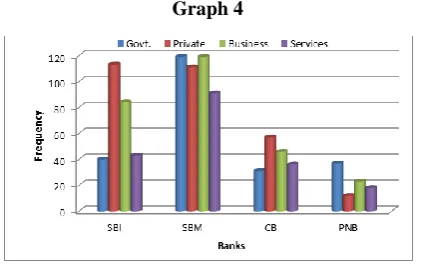
government employees 227 (23.2%) and 188(19.2%) who belong to the service sector and others. Contingency Co-efficient revealed a significant association between Occupation and the banks (CC=.226 and p=.000) indicating a dissimilarity in the distribution of occupational respondents across banks. We find that in Punjab National Bank 37(41.1%) of respondents are government employees where as 12(13.3%) of respondents in the same bank work for the private sector and 113(40.4%) of the respondents in State Bank of India work for the private sector while 31(18.2%) of the respondents are government employees.
Graph 4
Marital status wise comparison in table 2 and graph 5 reveals that 704(71.8%) of the respondents are married and 276(28.2%) unmarried. Further, Contingency Co-efficient revealed a significant association between marital status and the banks (CC=.133 and p= .000) indicating a dissimilarity in the distribution of married and unmarried respondents across banks. One finds 344(78.2%) of the respondents are married in State Bank of Mysore where as it was only 107(62.9%) in Canara Bank and 63(37.1%) of the respondents in Canara Bank and 96 (21.8%) of the respondents in State Bank of Mysore were unmarried respondents. Here it was found that a majority of customers in State Bank of Mysore are married where as majority of unmarried customers‟ bank with Canara Bank.
Graph 5
Income wise analysis in table 2 and graph 6 reveals that in the case of Public Sector Banks, the majority of the respondents 391(39.9%) are from the income group of Rs.100000 to Rs.300000 per annum (p.a.) followed by 368(37.6%) of the respondents Rs.300000 to Rs.500000p.a., 210(21.4%) of the
respondents Rs.500000 and above and 11(1.1%) of the respondents below Rs.100000. Contingency Coefficient revealed a significant association between income and the banks (CC=.367 and p=.000) indicating a dissimilarity in the distribution of income of the respondents across banks. The data shows 138(49.3%) of the respondents in State Bank of India belong to the group of Rs.100000- Rs.300000 where as only 155(35.2%) of the respondents in State Bank of Mysore belong to the same income group, 114(40.7%) of the respondents in State Bank of India are from the group of Rs.300000- Rs.500000 where as only 30(33.3%) of the respondents in Punjab National Bank belong to the same income group. 125(28.4%) of the respondents in State Bank of Mysore where as only 28(10%) of the respondents are from Rs.500000 and above income group.
Graph 6
IX.
TESTING OF HYPOTHESES
1) Hypothesis 1:
H1: Customers perceive a positive relationship between the Operational Efficiency and implementation of Core Banking System.
H0: Customers do not perceive a positive relationship between the Operational Efficiency and implementation of Core Banking System.
Table 3
Mean obtained and expected scores on Operational Efficiency of CBS and results of one sample t test
247
Copyright © 2016. Vandana Publications. All Rights Reserved.
hypothesis “Customers do not perceive a positive relationship between the Operational Efficiency and implementation of Core Banking System”, is rejected.
Table 4 shows the Significance of relationship between Banks and Overall Operational Efficiency of Core Banking System:
Graph 7
Here, the opinion of the four Public Sector Banks on inferences on Core Banking System was analysed. The respondents were asked to rate the Operational Efficiency ranging from 5 to 1, 5 extremely satisfied and 1 extremely dissatisfied.
A significant difference was observed between customers of different Public Sector Banks (F=14.363; P=.000) where the highest efficiency was found in Canara Bank. There was no difference found between the customers of Canara Bank and State Bank of India as expressed regarding overall efficiency of Core Banking Services. Linear Scheffe‟s Post hoc test (Alpha=.05) reveals no difference between the customers of Punjab National Bank and State Bank of India and expressed the least efficiency by State Bank of Mysore.
2) Hypothesis 2:
H1: Customers perceive a positive relationship
between the customer satisfaction and
implementation of Core Banking System.
H0: Customers do not perceive a positive relationship
between the customer satisfaction and
implementation of Core Banking System.
Table 5
Mean obtained and expected scores on Customer satisfaction after the introduction of CBS and results of
one sample t test
The average score obtained for Customer Satisfaction was 49.77 for 12 statements. The percentage efficiency as perceived by the respondents was 82.95%. The researcher had kept a standard of 70%
as criterion point of efficiency, which amounts to 42 scores. When one sample t test is applied, t value of 37.678 was found to be significant at .000 level, where we find that the obtained mean is higher than the expected mean. One can definitely conclude that there is significant improvement in the Customer Satisfaction after the introduction of Core Banking Services and thus the hypothesis “Customers do not perceive a positive relationship between the customer satisfaction and implementation of Core Banking System” is rejected.
Table 6
Showing the significance of relationship between Banks and Overall Customer Satisfaction after the introduction
of Core Banking System:
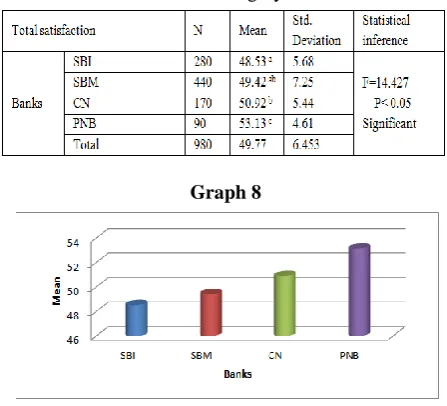
Graph 8
Here, the opinion of the respondents of the four Public Sector Banks on overall Customer Satisfaction on Core Banking System was analysed. The respondents were asked to rate Customer Satisfaction ranging from 5 to 1, 5 extremely satisfied and 1 extremely dissatisfied.
A significant difference was observed between customers of the different Public Sector Banks (F=14.427; P=.000) where we find that customers of Punjab National Bank expressed the highest overall customer satisfaction followed by Canara Bank. Linear Scheffe‟s Post hoc test (Alpha=.05) reveals no difference between the customers of Canara Bank and State Bank of Mysore and also State Bank of Mysore and State Bank of India followed by the least efficiency in State Bank of India.
X.
FINDING OF THE STUDY
1) The study revealed similarity in the awareness of Core Banking System in all the four Public Sector Banks under the Gender wise comparison.
248
Copyright © 2016. Vandana Publications. All Rights Reserved.
3) Educational qualifications influence Core Banking System usage. Graduates and Post graduates make use of Core Banking System better than SSLC passed customers.
4) The study revealed that the private sector employees make the best use of Core Banking System followed by business community and government employees and the others use Core Banking System to the minimal level. 5) The study found that Rs.100000 to Rs.300000 p.a. income level group make the best use of Core Banking System followed by Rs.300000 to Rs.500000 income group while those below Rs.100000 p.a. income group use this facility relatively in less frequency.
XI.
HYPOTHESES TESTING
FINDINGS
1) From the study it is found that there is a significant improvement in the Operational Efficiency of banks after the introduction of Core Banking System, customers endorse the improvement in operational efficiency.
2) From the hypothesis tested as per Linear Scheffe‟s post hoc test it was found that Canara Bank excelled in the Operational Efficiency. Similarly the test also proved that there is no difference in operational efficiency between Punjab National Bank and State Bank of India. Both of them recorded almost the same in the comparative study. State Bank of Mysore was ranked the least.
3) When the customer satisfaction after the introduction of Core Banking System was measured under the study, the customers of Punjab National Bank expressed the highest overall satisfaction followed by Canara Bank. Further, the study reveals that there is no difference between customers of Canara Bank and State Bank of Mysore regarding customer satisfaction and the customers of State Bank of India expressed least satisfaction.
XII.
CONCLUSION OF THE STUDY
The study on operational efficiency of a few selected Public Sector Banks found that there is a considerable improvement in operational efficiency through the hypothesis tested. The hypotheses were tested through a detailed questionnaire distributed to customers and employees. Customers and employees perceived a strong positive relationship between operational efficiency and implementation of Core Banking System; Customer satisfaction and implementation of Core Banking Services and technology usage. Also the study revealed a strong dependence of demographic characteristics concerning employees and customers on the overall operational efficiency of banks. Ultimately the study proved that there is a significant relationship between the operational efficiency and customer satisfaction after the introduction of Core Banking System.
REFERENCES
[1] Sidhu, R. I. (2007). Technology and Resultant
Innovations in Customer Service and
Products.TheJournal of Indian Institute of Banking and Finance , 40-41.
[2] Sulthan, Singh, & Komal. (2009). Impact of ATM on Customer Satisfaction. Business Intelligence Journal,2 (2).
[3] Vikas, Choudhary, Suman, & Tandan. (2010). Performance Eavluation of Public Sector Banks in India. Sri Krishna International Research and Educational Consortium, APJRBM , 1 (1).
[4] Seema, & Malik. (2014). Technological Innovations in Indian Banking Sector: Changed face of Banking. International Journal of advance research in Computer Science and Management Studies , 2 (6), 122-128. [5] www.statebankofindia.com