Available Online at www.ijpret.com
574
INTERNATIONAL JOURNAL OF PURE AND
APPLIED RESEARCH IN ENGINEERING AND
TECHNOLOGY
A PATH FOR HORIZING YOUR INNOVATIVE WORK
IMAGE SEGMENTATION USING WATERSHED TRANSFORMATION
MS. ANURADHA MUJUMDAR1, MS. VAISHALI NIRANJANE1, MS. PORNIMA NIRANJANE2
1. Electronics & Telecommunication department Y.C.C.E Nagpur, Nagpur University, India.
2. Information Technology Department, Babasaheb Naik College of Engg. Pusad Amaravati
University, India
Accepted Date: 15/02/2014 ; Published Date: 01/04/2014
\
Abstract: In this paper, we present a new approach for object boundary Extraction called
GVF on watershed. It is more robust to local minima because it finds the solution by searching the entire energy space. To reduce the complexity of the minimization process, the marker controlled watershed transformation is used. The watershed algorithm from mathematical morphology is powerful for segmentation. This leads to a new segmentation method integrating the strengths of watershed segmentation and energy based segmentation i.e. GVF snake..
Keywords: Gradient vector flow, Boundary extraction, marker controlled watershed algorithm, topographical distance, Brain MR Image Segmentation
Corresponding Author: MS. ANURADHA MUJUMDAR
Access Online On:
www.ijpret.com
How to Cite This Article:
Anuradha Majumdar, IJPRET, 2014; Volume 2 (8): 574-584
Available Online at www.ijpret.com
575 INTRODUCTION
The image segmentation process can be considered as one of the basic, yet very important, steps in digital image processing and computer vision applications. The extraction of objects from the background of a digital image has been a challenging task in the field of digital image processing. Segmentation involves partitioning an image into a set of homogeneous and meaningful regions so that the pixels in each partitioned region possess an identical set of properties or attributes.
Segmentation algorithms are based on different parameters of an image like gray-level, color, texture, depth or motion. In medical images, segmentation is mainly done based on the gray-level value of pixels, because the majority of medical images are gray-scale representations. The former method involves segmenting an image based on the similarity of intensity between pixels within a region, while the latter uses sudden changes in gray-level to indicate the discontinuity of a region.
The watershed segmentation algorithm is computationally simple but sensitive to noise and also it cannot extract concave tumor regions accurately. The active contour algorithm is able to extract concave regions in a watershed segmented the real brain MR image. The active contour algorithm is based on Gradient Vector Forces (GVF).
In this paper, a new mixed model for segmentation of brain tumors from the real brain MR images is proposed. In the proposed method, the gradient of the real brain MR image is computed first, and then this is given as input to marker controlled watershed segmentation. The output contours of the marker controlled watershed segmentation will be the initial contours for active algorithm to extract the tumor regions.
Pre processing
Important issues concerning fundamental aspects of image segmentation methods viz., initialization, convergence, ability to handle topological changes, stopping criteria and over segmentation must be taken into account. The procedure done before processing by correcting image from different errors is pre-processing. This has to be done before image enhancement.
Available Online at www.ijpret.com
576 Watershed Transform
The watershed transform is the basic segmentation tool in mathematical morphology. The watershed concept comes from the field of topography: In a topographic surface, the watersheds are the lines dividing two catchment basins. A gray-scale gradient image is considered as a topographic surface where the value of each pixel represents the elevation or altitude at that point. Thus, high-gradient image edges represent watersheds while low-gradient regions correspond to catchment basins. Watershed regions or catchment basins of the 'topographic' image are homogeneous meaning that the corresponding pixels are connected with a path of monotonically decreasing altitude. Each catchment basin is represented by the set of pixels that will drain to the same local minimum.
The advantage of the watershed transform is that it produces closed and adjacent contours including all image edges. Often the watershed produces a severe over segmentation, but the crucial point is that all important object boundaries are included, and the task is reduced to eliminating the undesired ones. Some solutions of the over-segmentation are:
1) Region Merging:
2) Marker-Controlled Watershed Segmentation
3) Multi-scale Hierarchical Segmentation
Out of which Marker –Controlled Watershed segmentation is used to avoid over segmentation problem.
A marker is a connected component belonging to an image. Internal markers associate with objects of interest, and external markers associate with the background. The criteria for an internal marker can for example be that it has to be surrounded by pixels with higher altitude. These markers are then made to be the only allowed minima in the watershed algorithm. The watershed lines created here are defined as external markers. The external markers efficiently partition the image into regions containing one single internal marker and some background. The problem is then reduced to partitioning each of these regions into two, which can be done by some simpler segmentation algorithm.
Available Online at www.ijpret.com
577 Segmentation using the watershed transforms works well if you can identify, or "mark," foreground objects and background locations.
Marker-controlled watershed segmentation follows this basic procedure:
1. Compute a segmentation function. This is an image whose dark regions are the objects you are trying to segment.
2. Compute foreground markers. These are connected blobs of pixels within each of the objects.
3. Compute background markers. These are pixels that are not part of any object.
4. Modify the segmentation function so that it only has minima at the foreground and background marker locations.
5. Compute the watershed transform of the modified segmentation function.
Gradient Vector Flow
Active contour is defined as an energy minimizing spline. Its energy depends on its shape and location within the image. A snake can be considered as a number of control points or snaxels that are linked together and free to deform under the constraining forces. The control points v(s) = [x(s), y(s)] are traditionally placed near the edges of interest because of the poor capture range of a snake. Snake deformation is carried by minimization of an energy function so that the contour will move from an initial position until the energy will stabilize at significant edges.
An energy function E(c) can be defined on the contour as
E(c) = E int +Eext
Where, E int and Eext denote the internal and external energies respectively. The internal energy function determines the regularity, i.e., smooth shape, of the contour. A common choice for the internal energy is a quadratic functional given by
E int =∫α |c’(s) |2 + β |c”(s)| ds
Available Online at www.ijpret.com
578 E ext =∫ Eimg (c(s)) ds
Eimg (x, y), denotes a scalar function defined on the image plane, so that local minimum of Eimg attracts the snakes to edges. Solving the problem of snakes is to find the contour that minimizes the total energy term E using Greedy algorithm with the given set of weights α and β. GVF snake has been defined as an external force to push the snake into objects Concavity. It is a 2D vector field V(s) = [u(s), v(s)], which minimizes the following energy functional
E =∫∫μ (ux2 +uy2 +vx2+vy2) + |Δf|2 |V -Δf|2 dx dy
where, u x , u y , v x , and, vy are the spatial derivatives of the field, μ is the regularization parameter, which should be set according to the amount of noise of the image and ∆ f is the gradient of the edge map which is defined as the negative external force i.e. f = -Eext . The behaviour of the GVF approach that is able to converge to boundary concavity can be explained from the Euler equations used to find the GVF field. These Euler equations are:
µ ∆2u – (u – f x) (fx2+ fy2)
µ ∆2v – (v – f x) (fx2+ fy2)
Where ∆2 is the Laplacian operator. Compared to the balloon force, the GVF approach is proven to converge relatively faster. This is caused by the external force employed by the GVF that make the capture range of the active contours bigger. The generation of GVF is iterative and computationally intensive.
Hybrid Model
It is a two-step snake algorithm whose energy functional is minimized by the dynamic programming method. It is more robust to local minima because it finds the solution by searching the entire energy space. The algorithm proposed in this paper belongs to the category of hybrid techniques, since it results from the integration of edge and region-based techniques through the morphological watershed transform. This algorithm delivers accurately localized and closed object contours while it requires a small number of input parameters (Markers and GVF parameters optimization).
Available Online at www.ijpret.com
579 the watershed detection algorithm, which produces an initial image tessellation into a large number of primitive regions.
Figure1. Flow diagram of the proposed segmentation algorithm
(hybrid model)
This initial over-segmentation is due to the high sensitivity of the watershed algorithm to the gradient image intensity variations, and, consequently, depends on the performance of the noise reduction algorithm. Over-segmentation is further reduced by markers, i.e., gradient magnitudes prior to the application of the watershed transform. The output of the watershed transform is the starting point of a bottom-up hierarchical merging approach.
Figure 1 shows steps carried out while the applied segmentation approach. In first step applied MRI image undergoes pre processing where it filtered to remove salt n pepper noise. In next step simple watershed is applied to get the edges of counter but this cause over segmentation.
The problem of over segmentation is avoided by applying marker controlled watershed transform which also gives the initial contour. Next it is given for minimum energy spline i.e.GVF snake. The last part combines the Watershed and GVF to segment tumour from brain
Input MRI Images
Pre-processing
Initial segmentation by watershed method
Watershed regions contour extraction
GVF Snake
Available Online at www.ijpret.com
580 MR image, i.e., coupling the smoothness of the edge map to the initial size of the GVF snake by automatic initialization of contour in order to preserve a limited number of suspect areas.
Advantages of Hybrid Model
It has the ability to automatically detect all image minima and to make the regions grow inside the respective zones, of influence; a property inherited from the watershed transform. It is having the ability to automatically stop the growing process whenever two users labelled regions get into contact. IT can easily change the image topology by using a simple merging mechanism, thus reducing over-segmentation. It is efficient in edge preserving smoothing guided by GVF. It has relatively low sensitiveness to noise corruption in an image.
Experimental Results
(a) (b)
Available Online at www.ijpret.com
581
(e) (f)
(g) (h)
Available Online at www.ijpret.com
582
(k) (l)
(m) (n)
(o) (p)
Available Online at www.ijpret.com
583
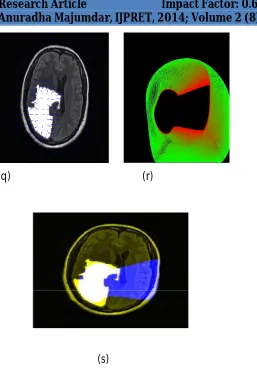
(q) (r)
(s)
Figure (2) -Segmentation using proposed hybrid model.
In this paper, hybrid segmentation model combined with GVF snake and marker controlled watershed is introduced to segment the brain tumour. Real MR images are used for the validation of the proposed framework. This method is tested with different images including noisy gray level images.
Available Online at www.ijpret.com
584 REFERENCES
1. D. Jayadevappa1, S. Srinivas Kumar2, and D. S. Murty, “A Hybrid Segmentation Model based on Watershed and Gradient Vector Flow for the Detection of Brain Tumour”, International Journal of Signal Processing, Image Processing and Pattern Recognition Vol. 2, No.3, September 2009.
2. T. Kapur, W. E. L. Grimson, W. M. Wells, and R. Kikinis, “Segmentation of Brain Tissue from Magnetic Resonance Images,” Medical Image Analysis, vol. 1, no. 2, 1996, pp. 109-127.
3. N.R Pal and S.K. Pal, "A Review on Image Segmentation Techniques," Pattern Recognition, vol. 26, 1993, pp.1277-1294.
4. D. L Pham, Chenyang XU and Jery L Prince, “Current methods in medical image segmentation,” Annual review of Biomedical engineering, vol. 2, no. 1, 2000, pp. 315-337.
5. F. Deravi and S.K. Pal, "Gray Level Thresholding Using Second-order Statistics", Pattern Recogn. Letters, vol. 1, 1983, pp.417-422.
6. B. Johnston, M. S. Atkins, B. Mackiewich, and M. Anderson, “Segmentation of Multiple Sclerosis Lesions in Intensity Corrected Multispectral MRI,” IEEE Transactions on Medical Imaging, April 1996, vol. 15, no. 2, pp. 154-169.
7. C. Lee, S. Hun, T.A. Ketter, and M. Unser, “Unsupervised connectivity-based thresholding segmentation of Mid-saggital brain MR Images,” Computer Biology Medicine, 1998, pp. 309-338.
8. G. Hillman, C. Chang and H. Ying, “Automatic system for brain MRI analysis using a novel combination of fuzzy rule-based and automatic clustering techniques,” Medical Imaging, SPIE, Feb 1995, pp. 16-25.
9. T. McInerney and D. Terzopoulos, “Deformable models in medical image analysis: a survey,” Medical Imaging Analysis, 1996, pp. 91-108.
10.F. Meyer, “Topographic distance and watershed lines,” Signal Processing, , July 1994, 38(1):113–125.
11.C. Xu, D. Pham, and J. Prince, “Image segmentation using deformable models,” SPIE handbook of Medical imaging. Medical image processing and analysis, editor: M. Sonka, J. Fitzpatrick, Vol. 2, chapter 3 June 2000, SPIE press.