Available Online At www.ijpret.com
INTERNATIONAL JOURNAL OF PURE AND
APPLIED RESEARCH IN ENGINEERING AND
APPLICATION OF ANN TO ANALYZE AND PREDICT IMPACT STRENGTH AND
HARDNESS OF SHIELDED METAL ARC WELDED JOINTS UNDER
OF EXTERNAL MAGNETIC FIELD
RUDRA PRATAP SINGH
1. Mechanical Engineering Department, I.E.T., G.L.A. University Mathura, (U.P.) 2. Mechanical Engineering Department, I.E.T., Lucknow, (U.P.)
3. Mechanical Engineering Department, Kumaon Engineering (Uttarakhand) Accepted Date: 16/01/2013 Publish Date: 01/02/2013 Keywords
Artificial Neural Network, Back Propagation, External Magnetic Field, Hidden Layer,
Input Process Parameters, Shielded Metal Arc Welding.
Corresponding Author Mr. Rudra Pratap Singh1
IJPRET-QR CODE
Available Online At www.ijpret.com
INTERNATIONAL JOURNAL OF PURE AND
APPLIED RESEARCH IN ENGINEERING AND
TECHNOLOGY
A PATH FOR HORIZING YOUR INNOVATIVE WORKAPPLICATION OF ANN TO ANALYZE AND PREDICT IMPACT STRENGTH AND
HARDNESS OF SHIELDED METAL ARC WELDED JOINTS UNDER
OF EXTERNAL MAGNETIC FIELD
RUDRA PRATAP SINGH1, RAMESH CHANDRA GUPTA SUBHASH CHANDRA SARKAR3
Mechanical Engineering Department, I.E.T., G.L.A. University Mathura, (U.P.) Engineering Department, I.E.T., Lucknow, (U.P.)
Mechanical Engineering Department, Kumaon Engineering
Abstract
Purpose The prediction of the optimal impact strength and hardness of weld simultaneously is an important aspect in any welding process. Therefore, the artificial neural networks (ANN) models that predict and control these properties
paper focuses on investigation of the development of the simple and accuracy interaction model for prediction of impact strength and hardness for butt joint in shielded metal arc welding (SMAW) process. Design/methodology/approach
conducted with a simple shielded metal arc welding machine by welding mild steel plates with four welding input process parameters to obtain impact strength and hardness of the weld bead. The analysis and prediction of impact strength and hardness propertie efficiently been done for identifying the significance of main and interaction effects of process parameters. Eighteen sets of experimental input
employed as the guide to achieve the trained ANN model. The prediction of the
given by the model was also carried out with the help of other seven experimental sets. Findings The prediction capability of ANN model is reliable. It was found that welding voltage, arc current, welding speed and external magnetic field all a
the weld. Practical implications The developed model should also cover a wide range of material thicknesses and be applicable for all types of welding processes and positions. Originality/value It has been realized that with the use
prediction of optimal impact strength and hardness becomes much simpler to even a novice user who has no prior knowledge of any welding process and optimization techniques.
INTERNATIONAL JOURNAL OF PURE AND
APPLIED RESEARCH IN ENGINEERING AND
A PATH FOR HORIZING YOUR INNOVATIVE WORK
APPLICATION OF ANN TO ANALYZE AND PREDICT IMPACT STRENGTH AND
HARDNESS OF SHIELDED METAL ARC WELDED JOINTS UNDER THE INFLUENCE
, RAMESH CHANDRA GUPTA2,
Mechanical Engineering Department, I.E.T., G.L.A. University Mathura, (U.P.)
College, Dwarahat,
The prediction of the optimal impact strength and hardness of weld simultaneously is an important aspect in any welding process. Therefore, the artificial neural networks (ANN) models that predict and control these properties are required to be developed. This paper focuses on investigation of the development of the simple and accuracy interaction model for prediction of impact strength and hardness for butt joint in shielded metal arc Design/methodology/approach The experiment has been onducted with a simple shielded metal arc welding machine by welding mild steel plates with four welding input process parameters to obtain impact strength and hardness of the weld bead. The analysis and prediction of impact strength and hardness properties has efficiently been done for identifying the significance of main and interaction effects of process parameters. Eighteen sets of experimental input-output variables have been employed as the guide to achieve the trained ANN model. The prediction of the properties given by the model was also carried out with the help of other seven experimental sets. The prediction capability of ANN model is reliable. It was found that welding voltage, arc current, welding speed and external magnetic field all affect the properties of The developed model should also cover a wide range of material thicknesses and be applicable for all types of welding processes and positions. It has been realized that with the use of the developed model, the prediction of optimal impact strength and hardness becomes much simpler to even a novice user who has no prior knowledge of any welding process and optimization techniques.
Available Online At www.ijpret.com
INTRODUCTION
Welding is the process used to join two or
more pieces of metal together by applying
thermal energy or pressure. It is a precise,
reliable, cost-effective method for joining
materials. This technique is widely used by
manufacturers to join metals and alloys. In
this way welding is essential to produce
most of usual objects, from big structures
such as bridges and ships to microelectronic
components. In comparison to other joining
methods, welded structures are stronger,
cheaper and lighter in weight. Welding adds
value in manufacturing process. Moreover,
welding is frequently used to repair fix
structures that were not originally welded,
increasing the life of this structures. In this
work Shielded Metal Arc Welding (SMAW)
was used to produce all welds for analysis.
SMAW is an arc welding process in which
coalescence of metals is produced by heat
from an electric arc that is maintained
between the tip of a covered electrode and
the surface of the base metal in the joint
being welded. SMAW is also called Manual
Metal Arc (MMA) welding since welding is
normally carried out by a welder manually
guiding a stick electrode. At first glance, a
normal stick electrode basically consists of a
metallic wire which is surrounded by a
coating. Within the electrode, there are
filler materials for the joint and intricate
compounds required to control the arc and
to create a protective slag and generate a
protective gas shroud that shields the weld
pool from the atmosphere. Shielded metal
arc welding is the most widely used arc
welding process. It employs the heat of the
arc to melt the base metal and the tip of a
consumable covered electrode. The
electrode and the work are part of an
electric circuit. This circuit begins with the
electric power source and includes the
welding cables, an electrode holder, a work
piece connection, the work piece
(weldment), and an arc welding electrode.
One of the two cables from the power
source is attached to the work. The other is
attached to the electrode holder. Welding
commences when an electric arc is struck
between the tip of the electrode and the
work. The intense heat of the arc melts the
tip of the electrode and the surface of the
work close to the arc. Tiny globules of
molten metal are rapidly formed on the tip
Available Online At www.ijpret.com
through the arc stream into the molten
weld pool1. In this manner, filler metal is
deposited as the electrode is progressively
consumed. The arc is moved over the work
at an appropriate arc length and travel
speed, melting and fusing a portion of the
base metal and continuously adding filler
metal. The temperature of arc is about
5000°C at its center and hence melting of
the base metal takes place almost
instantaneously upon arc initiation. The
process requires sufficient electric current
to melt both the electrode and a proper
amount of base metal. It also requires an
appropriate gap between the tip of the
electrode and the base metal or the molten
weld pool. These requirements are
necessary to set the stage for coalescence.
The sizes and types of electrodes for
shielded metal arc welding define the arc
voltage requirements (within the overall
range of 16 to 40 V and the amperage
requirements within the overall range of 20
to 550 A2. The mechanical properties of a
weld metal can be affected by the welding
parameters like welding current, arc
voltage, welding speed, plate thickness,
preheating and interpass temperatures etc.
Toughness or impact strength is a measure
of the amount of energy a material can
absorb before fracturing. It becomes of
engineering importance when the ability of
a material to withstand an impact load
without fracturing is considered. It is the
capability of the material in withstanding by
the suddenly applied loads in terms of
energy. Often measured with the Izod
impact strength test or Charpy impact test,
both of which measure the impact energy
required to fracture a sample. Impact
testing ascertains the fracture
characteristics of materials. It is used when
laboratory tensile test results cannot be
used to predict fracture behavior3. One of
the most common impact testing
techniques, Charpy method was used to
measure impact energy, or the toughness of
the metal in the present work. The V-notch
bar-shaped specimen was placed in the test
machine as a simply supported beam where
it was struck by a weighted pendulum
hammer that deformed cracked and
fractured the specimen at the notch. The
notch was located on tension side of
specimen during impact loading. The impact
Available Online At www.ijpret.com
measuring the amount of energy absorbed
in the fracture.
Hardness is the property of a material to
resist permanent indentation. Because
there are several methods of measuring
hardness, the hardness of a material is
always specified in terms of the particular
test that was used to measure this
property. Rockwell, Vickers, or Brinell are
some of the methods of testing. Of these
tests, Rockwell is the one most frequently
used. For the measuring the hardness of the
metals, that are softer, a metal ball is used
and the hardness is indicated by a Rockwell
“B” number. Hardness test was conducted
using the Rockwell testing machine. The
standard method was used in which the
test specimen was placed with the surface
on the anvil, and by slowly turning the hand
wheel; the specimen was raised until it
touched the indenter. The numbers were
read directly from the dial indicator and
converted to the Rockwell number.
Magnetic fields and electric currents in
conductors interact and some of this
interaction as it pertains to welding arcs is
detrimental and some is beneficial.
Magnetic field may be applied or induced
but interact with arc current to produce a
force that causes the arc to deflect. This
phenomenon is known as arc blow when it
becomes severe. Arc blow arises from two
basic conditions, (i) the change in direction
of current flow as it leaves the arc and
enters the work-piece to seek the ground
and (ii) the asymmetrical arrangement of
magnetic material around the arc as it is
easier for magnetic flux to pass through
certain materials (especially ferromagnetic
materials) than through air4. Magnetic field
can be applied to the welding arc in three
different modes. If the direction of the
magnetic field is parallel to the direction of
electrode travel it is considered to be a
parallel field. If the field is perpendicular to
the direction of electrode travel and
electrode axis it is referred to as a
transverse field. If the field is parallel to the
axis of electrode it is termed as longitudinal
or axial field5. According to the Fleming’s
left hand rule the arc under the influence of
parallel field will be deflected towards right
or left across the weld bead length
depending upon the direction of the parallel
field (forward or backward). If field strength
Available Online At www.ijpret.com
decreased but weld width will be increased.
In the present work the parallel external
magnetic field was produced by bar
magnets which were assembled on a lathe
machine.
A neural network is a computational
structure inspired by the study of biological
neural processing. There are many different
types of neural networks, from relatively
simple to very complex, just as there are
many theories on how biological neural
processing works6. Artificial neural
networks are the result of academic
investigations that use mathematical
formulations to model nervous system
operations. Neural networks represent a
meaningfully different approach to use
computers in the workplace, and have been
used to recognize patterns and
relationships indata7.
Experimentation
The mild steel plates of 6 mm thickness
were cut into the required dimension (150
mm×50 mm) by oxy-fuel cutting and
grinding. The initial joint configuration was
obtained by securing the plates in position
using tag welding. Single ‘V’ butt joint
configuration was used to fabricate the
joints using shielded metal arc welding
process. All the necessary cares were taken
to avoid the joint distortion and the joints
were made with applying clamping fixtures.
The specimens for testing were sectioned to
the required size from the joint comprising
weld metal, heat affected zone (HAZ) and
base metal regions and were polished using
different grades of emery papers. Final
polishing was done using the diamond
compound (1µm particle size) in the disc
polishing machine. The specimens were
etched with 5 ml hydrochloric acid, 1 g
picric acid and 100 ml methanol applied for
10–15 second. The welded joints were
sliced using power hacksaw and then
machined to the required dimensions
(55mm x 10mm) for impact test and (10mm
x 6mm) for hardness test8.
Impact test was conducted at room
temperature using pendulum type impact
testing machine with a maximum capacity
of 300 Joule (J) and least count of 2 J. The
amount of energy absorbed in fracture was
recorded and the absorbed energy was
defined as the impact toughness of the
Available Online At www.ijpret.com
on Rockwell (B scale) hardness testing
machine.
RESULTS
Impact Strength property
Charpy impact strength (toughness) values
of all the joints were evaluated and they
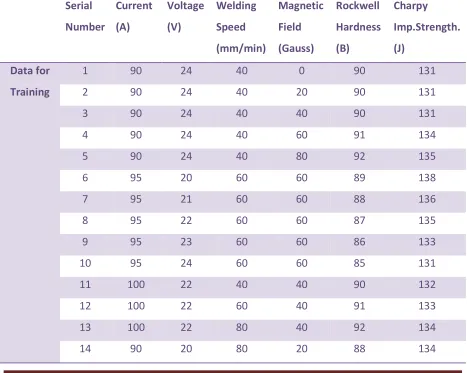
were presented in table 1. The magnetic
field had no effect on impact strength if it
was changed in between 0 and 40 gauss,
the impact strength remained constant at
131 J, and after this the impact strength
increased if magnetic field was increased
upto 80 gauss which was our investigation
range. If the magnetic field was increased
from 40 gauss to 60 gauss the impact
strength increased from 131 J to 134 J and if
it was increased from 60 gauss to 80 gauss
the impact strength increased from 134 J to
135 J. If the speed of welding was increased
from 40 mm/ min to 80 mm/min the impact
strength continuously increased. Increment
in voltage from 20 to 24V, decreased the
impact strength from 138 J to 131 J., if the
increment in current was from 90 A to 110
A, the impact strength of weld decreased
from 134 J to 127 J.
Hardness property
The hardness across the weld cross-section
was measured using a Rockwell hardness
testing machine, and the results were
displayed in table 1 9.
The hardness of weld metal (WM) region
was found greater than the HAZ region, but
lower than the base metal (BM) region,
irrespective of filler metals used. There was
no effect of magnetic field on hardness if
the strength of the field was less than 40
gauss and if it was increased from 40 gauss
to 80 gauss the hardness increased from 90
RHB to 92 RHB. If the speed of welding was
increased from 40 mm /min to 80 mm/ min
the hardness increased from 90 RHB to 92
RHB. If the voltage was increased from 20 V
to 24 V the hardness decreased from 89
RHB to 85 RHB. If the current was increased
from 90 V to 110 V, the hardness decreased
from 88 RHB to 80 RHB.
Prediction made by Artificial Neural
Network
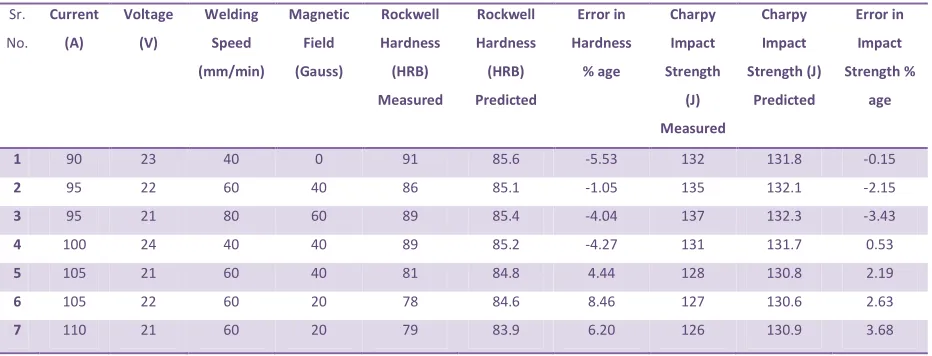
From the table 2, it is clear that the
prediction made by artificial neural network
is almost the real value. The maximum
positive and negative percentage errors in
prediction of Rockwell hardness are 8.46
Available Online At www.ijpret.com
the impact strength these values are 3.68
and 3.43 respectively. The other predictions
are in between the above ranges and hence
are very close to the practical values, which
indicate the super predicting capacity of the
artificial neural network model.
DISCUSSION
In this investigation, an attempt was made
to find out the best set of values of current,
voltage, speed of welding and external
magnetic field to produce the best quality
of weld in respect of hardness and impact
strength. Shielded metal arc welding is a
universally used process for joining several
metals. Generally in this process speed of
welding and feed rate of electrode both are
controlled manually but in the present work
the speed of welding was controlled with
the help of cross slide of a lathe machine
hence only feed rate of electrode was
controlled manually which ensures better
weld quality. In the present work external
magnetic field was utilized to distribute the
electrode metal and heat produced to
larger area of weld which improves several
mechanical properties of the weld. The
welding process is a very complicated
process in which no mathematical accurate
relationship among different parameters
can be developed10. In present work back
propagation artificial neural network was
used efficiently in which random weights
were assigned to co-relate different
parameters which were rectified during
several iterations of training. Finally the
improved weights were used for prediction
which provided the results very near to the
experimental values.
CONCLUSIONS
Based on the experimental work and the
neural network modeling the following
conclusions are drawn:
1. A strong joint of mild steel is found to
be produced in this work by using the
SMAW technique.
2. If amperage is increased, hardness and
impact strength of weld generally
decrease.
3. If voltage of the arc is increased
hardness and impact strength of weld
generally decrease.
4. If travel speed is increased hardness and
impact strength of weld generally
Available Online At www.ijpret.com
5. If magnetic field is increased hardness
and impact strength of weld, generally
increase.
6. Artificial neural networks based
approaches can be used successfully for
predicting the output parameters like
hardness of weld and impact strength of
weld as shown in table 2. However the
error is rather high as in some cases in
predicting hardness it is more than 8
percent. Increasing the number of
hidden layers and iterations can
minimize this error.
ACKNOWLEDGEMENT
We express our gratitude to the GLA
University Mathura, for giving us the
opportunity to work on the Research Paper
during our busy schedule of teaching work.
Our special thanks to Professor Girish
Kumar Srivastav, HOD (Department Of
Mechanical Engineering) for his invaluable
guidance throughout our work and
endeavor period has provided us with the
requisite motivation to complete our
Research paper successfully. We are also
grateful to our lab assistants Mr. Rajendra
Singh, Mr. Rakesh Singh, Mr. Khaim
Chandra Sharma and S. C Sharma Ji without
whom the work could not be completed.
Available Online At www.ijpret.com
Table 1 Data for Training and Prediction
Serial
Number
Current
(A)
Voltage
(V)
Welding
Speed
(mm/min)
Magnetic
Field
(Gauss)
Rockwell
Hardness
(B)
Charpy
Imp.Strength.
(J)
Data for
Training
1 90 24 40 0 90 131
2 90 24 40 20 90 131
3 90 24 40 40 90 131
4 90 24 40 60 91 134
5 90 24 40 80 92 135
6 95 20 60 60 89 138
7 95 21 60 60 88 136
8 95 22 60 60 87 135
9 95 23 60 60 86 133
10 95 24 60 60 85 131
11 100 22 40 40 90 132
12 100 22 60 40 91 133
13 100 22 80 40 92 134
14 90 20 80 20 88 134
Current
Voltage
Travel speed
Magnetic field
Impact Strength
Hardness I/P
Layer Hidden Layer Hidden Layer O/P Layer
Available Online At www.ijpret.com
15 95 20 80 20 86 132
16 100 20 80 20 84 130
17 105 20 80 20 82 129
18 110 20 80 20 80 127
Data for
Prediction
1 90 23 40 0 91 132
2 95 22 60 40 86 135
3 95 21 80 60 89 137
4 100 24 40 40 89 131
5 105 21 60 40 81 128
6 105 22 60 20 78 127
7 110 21 60 20 79 126
Table 2 Measured and Predicted Values with percentage Error
REFERENCES
1. Karalis DG, Papazoglou VJ, and Pantelis
DI, Mechanical Response of Thin SMAW Arc
Welded Structures: Experimental and
Numerical Investigation, Theoretical and
Applied Fracture Mechanics 51, Elsevier,
2009: 87-94.
2. Physics of Welding. Welding Handbook.
8th ed., 2006; 1: 50-54.
Sr. No.
Current (A)
Voltage (V)
Welding Speed
(mm/min)
Magnetic Field
(Gauss)
Rockwell Hardness
(HRB) Measured
Rockwell Hardness
(HRB) Predicted
Error in Hardness
% age
Charpy Impact
Strength (J) Measured
Charpy Impact
Strength (J) Predicted
Error in Impact
Strength % age
1 90 23 40 0 91 85.6 -5.53 132 131.8 -0.15
2 95 22 60 40 86 85.1 -1.05 135 132.1 -2.15
3 95 21 80 60 89 85.4 -4.04 137 132.3 -3.43
4 100 24 40 40 89 85.2 -4.27 131 131.7 0.53
5 105 21 60 40 81 84.8 4.44 128 130.8 2.19
6 105 22 60 20 78 84.6 8.46 127 130.6 2.63
Available Online At www.ijpret.com
3. Pak JH, Modeling of Impact Toughness of
Weld Metals, Master of Engineering Thesis,
Pohang University of Science and
Technology, Pohang, Korea, 2007: 67.
4. Robert W and Messler Jr. Principles of
Welding Processes, Physics, Chemistry and
Metallurgy, Wiley, VCH Verlag Gmbh and
Co. KgaA Weinheim, 2004: 365.
5. Khan IH, Welding Science and
Technology, New Age International (P)
Limited Publishers, 2007: 137.
6. Valluru R and Hayagriva R, C++ Neural
Networks and Fuzzy Logic, BPB Publications,
First Indian Edition, 1996: 18.
7. Razavi S and Ahmed H. International
Journal of the Physical Sciences Vol. 6(6), 18
March, 2011: 1325-1331.
8. Singh RP. Prediction of Weld Bead
Geometry in Shielded Metal Arc Welding
under External Magnetic Field using
Artificial Neural Networks, International
Journal of Manufacturing Technology and
Research, 2012; 8(1): 9-15.
9. Singh RP. Application of Artificial Neural
Network to Analyze and Predict the
Mechanical Properties of Shielded Metal
Arc Welded Joints under the Influence of
External Magnetic Field, International
Journal of Engineering Research &
Technology (IJERT), 2012: 8(1); 1-12.
10.American Welding Society. Welding
Hand Book, Welding Processes, Eighth