SOME COMMON DISEASES
Types Of Diseases
1. Contagious Diseases :- Those diseases that spread through contact. For example :
Ringworm.
1. Non Contagious Diseases :- Those diseases that do not spread through contact. For
How Diseases Spread?
1. Through food and water.
2. Through Spitting, Coughing & Sneezing.
3. Through Vectors.
Cholera
•
Cholera is a severe
diarrheal
disease
caused by the bacterium
Vibrio
cholerae
.
•
The toxin released by the bacteria
•
The toxin released by the bacteria
A perfectly healthy person can die of Cholera in 24 hours
The primary symptom of the disease
A young boy draws water from a river in Zimbabwe
is a massive diarrhea which lethally drains the
Cholera is ‘caused’ by foul water
When cases of cholera
were found to be clustered around a certain well
in 18th century London, in 18th century London, it first became evident that some substance in the water must be
responsible for the illness
A young boy draws water from a river
How Cholera vibrio infects the body
The cholera microorganisms are ingested by drinking contaminated water.
Several thousand microbes are necessary for the
are necessary for the disease to result.
SYMPTOMS
• Watery diarrhea - usually severe but painless • Vomiting
• Rice-water stools • Muscle cramps • Muscle cramps • Cold skin
• Sunken eyes • Thirst
Treatment Of Cholera
• Bed rest
• Tetracycline
• Sulphonamides • Electrolytes
• Electrolytes • Bed rest
Preventive Measures
Purchasing food
1. Do not buy food from unlicensed food premises or illegal
hawkers.
2.Pay attention to hygienic condition of shops and the holding
temperature of food.
3.Buy only those shellfish which are fresh, with intact shell and
• Tuberculosis is an air-bone disease that can spread
when someone coughs, sneezes, or when somebody literally talks. It usually affects the lungs but can be present anywhere in the body. Each year 2 billion people or one third the earths population dies from
TUBERCULOSIS
people or one third the earths population dies from tuberculosis.Tuberculosis can increase the infection if there is factors like poor air circulation or lack of
How Does Tuberculosis Develop?
• There are two possible ways
a person can become sick with TB disease:
• The first applies to a person
who may have had been infected with TB but is
• The other way it TB
can develop, happens much more quickly. Sometimes when a
person first breathes in the TB germs, the
infected with TB but is perfectly healthy. The person can get infected
again if they have a another disease such as HIV or
cancer or they may get infected if they use
drugs/alcohol.
the TB germs, the body is unable to
protect itself against the disease. The germs then develop into
SYMPTOMS
• feeling weak or sick all the time
• coughs that will not go away
• weight loss/loss of appetite • weight loss/loss of appetite
• fever/night sweats
• chest pain
Who Gets Tuberculosis?
Anyone can get tuberculosis. Some people are at higher risks than others. The people who have more of a
chance getting TB are:
• People who share same breathing space
• Poor people/homeless people
• Poor people/homeless people
• Prisoners
• Alcoholics or Drug users
• People with medical conditions (cancer, diabetes)
Is Tuberculosis Curable?
• Fifty years ago, there was no cure or drugs for
tuberculosis. If someone is given the wrong treatment, it would have been better if they weren’t given a treatment at all.
• Many countries use Bacillus Calmette-Guérin
(BCG) vaccine as part of their TB control
TYPHOID
• Typhoid fever, also known as typhoid, is a
common worldwide illness, transmitted by the ingestion of food or water contaminated with the feces of an infected person, which contain the bacterium salmonella typhi. The bacteria then perforate through the intestinal wall. The the bacterium salmonella typhi. The bacteria then perforate through the intestinal wall. The organism is a short bacillus that is motile due to its peritrichous flagella. The bacterium
SYMPTOMS
•
Light Fever that drops in the
morning.
•
Intestine bleeding
•
The patient feels weak, chilly and
•
The patient feels weak, chilly and
tired.
•
Headache
,
backache
,
diarrhea
,
TREATMENT
• Oral rehydration therapy (ORT).
• Antibiotics, such as ampicellin,
chloramphenicol, trimethoprim-chloramphenicol, trimethoprim-sulfamethoxazole, Amoxicillin and
PREVENTION
• Typhoid vaccine gives temporary protection. • Avoid contamined water.
• Good Hygiene.
• Boil drinking water • Boil drinking water
• Sterilize drinking water
• Neat and Clean environment.
• Keep flies away by the use of proper insect
COMMON COLD
Common Cold (also known as nasopharyngitis,
acute viral rhinopharyngitis, acute coryza, or a cold) is a viral disease of the upper respiratory
system. Common symptoms include a cough, sore throat, runny nose, and fever. There is currently
throat, runny nose, and fever. There is currently no known treatment that shortens the duration; however, symptoms usually resolve
SYMPTOMS
• Cough
TREATMENT
• Aspirin and acetaminophen can be found in
many cold remedies.
PREVENTION
• The best prevention is staying away from
people who are infected.
• Alcohol-based hand sanitizers provide very • Alcohol-based hand sanitizers provide very
little protection against upper respiratory infections, especially among children.
CHICKEN POX
• Chickenpox is a highly contagious illness that is common
in children, particularly those under age 12.
• It is caused by the varicella-zoster virus (VZV) also
known as human herpes virus 3 (HHV-3).
• Infections is characterized by a fever and itchy, red
spots usually appearing on the chest and stomach first, spots usually appearing on the chest and stomach first, then appearing in crops over the entire body.
• The red spots turn into small blisters that dry up and
Varicella (Chickenpox) View Table
Chickenpox on the hand. Notice the simultaneous occurrence of lesions in different stages of development.
Chickenpox in an infant. Notice the rose-colored macules,
Variola (Smallpox) View Table
Symptoms Of Chicken Pox
•A rash that usually begins on the body and face and
later often spreads to the scalp and limbs.
•The rash is often itchy.
•It begins as small red spots which develop into blisters
in a couple of hours.
•After one or two days, the blisters turn into scabs.
•After one or two days, the blisters turn into scabs.
•New blisters may appear after three to six days.
•The number of blisters differs greatly from one person
to another.
•The infected person may run a temperature.
•These symptoms are mild in young children.
•Chickenpox lasts 7 to 10 days in children and longer in
Treatments
• Most cases of chickenpox can be managed at home.
Chickenpox rash tends to be extremely itchy. Several
treatments can be used at home to help a child feel better.
• You can give cool-water baths every 3-4 hours, adding baking
soda to the water to calm itching.
• Trimming fingernails can help prevent infection from
scratching the blisters. If you have a small infant with scratching the blisters. If you have a small infant with
chickenpox, cover the child's hands with mittens to minimize scratching.
• Avoid any foods that are spicy, hot, or acidic (for instance,
orange juice).
• Keep children at home from school and daycare until all
Treating Chicken Pox with Folk
Medicine
valerian aloe vera garlic
lemon
ginger St. John’s Wort
calendula
lantana
Treating Chicken Pox with Scientific
Medicine
Tylenol
Claritin
Calamine Lotion
Poliomyelitis (Polio)
• Poliovirus
• Transmitted by ingestion
• Initial symptoms: Sore throat and nausea • Initial symptoms: Sore throat and nausea
• Virus slowly moves to the CNS
• Destruction of motor cells and paralysis occurs in <1% of
Can it cause paralyzes?
• Paralytic disease occurs 0.1% to 1% of those who
become infected with the polio virus.
• Paralysis of the respiratory muscles or from cardiac
arrest if the neurons in the medulla oblongata are destroyed.
destroyed.
• Patients have some or full recovery from paralysis
usually apparent with proximally 6 months
Treatment
• Bed rest with close monitoring of respiratory
and cardiovascular functioning is essential during the acute stage of poliomyelitis along with fever control and pain relievers for
with fever control and pain relievers for muscle spasms.
• Mechanical ventilation, respiratory therapy
Oral Polio Vaccine (OPV)
• Polio vaccine first appeared to be licensed in the
United States in 1955.
• Advantages:
• Ease to administration
• Ease to administration
• Good local mucosal immunity
• Disadvantage:
• Strict cold shipping & storage requirements
• Multiple doses are required to achieve high humeral
Vaccine (continuation)
• Babies are given 4 doses through out their infancy.
• Adolescents and adults should get vaccinated as
well. Adolescents younger than 18 should receive the routine four doses.
the routine four doses.
• You should get it if you travel outside places where
Leprosy
• Also called Hansen’s disease
• Caused by Mycobacterium leprae
• Acid-fast rod that grows best at 30°C.
• Grows in peripheral nerves and skin cells • Grows in peripheral nerves and skin cells
• Transmission requires prolonged contact with an
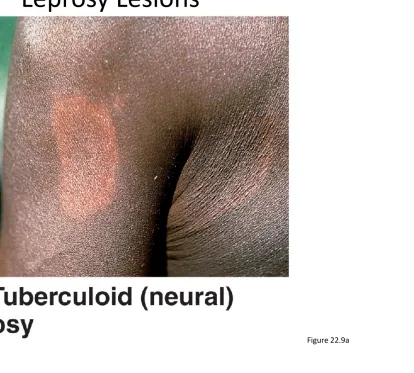
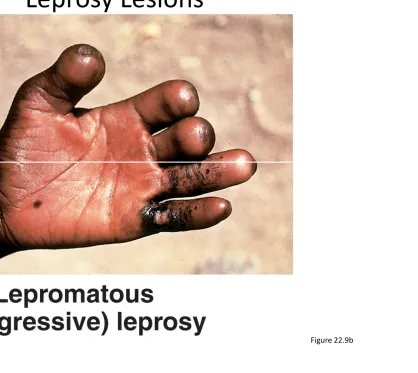
Leprosy Lesions
Leprosy Lesions
What is Leprosy?
• Leprosy is an infectious disease that attacks
the nervous system
• Leprosy is caused by a type of bacteria called
What can leprosy do to people?
• Leprosy attacks the cooler areas of the body
• Leprosy destroys neurons in these areas, taking feeling away
from them
• Leprosy also causes cartilage in those areas to get absorbed
back into the body, causing fingers, toes, ears and noses to back into the body, causing fingers, toes, ears and noses to disappear
• Leprosy also causes large bumps in the skin that do not feel
What are the types of leprosy?
• Lepromatous: damages respiration, eyes, and
skin
• Tuberculoid: affects nerves in fingers and toes,
and surrounding skin and surrounding skin
What are the signs and symptoms?
Large bumps on the skin that do not feel pain Large bumps on the skin that do not heal for
weeks or months Muscle weakness Muscle weakness
How can you avoid getting leprosy?
• To avoid Contracting leprosy, avoid close
Is there a cure?
• Yes! Leprosy is curable with MDT (multidrug
therapy)
• Treatments include taking Dapsone and
Rabies
• Caused by the
rabies virus
• Transmitted by
animal bite
• Furious rabies:
Animals are
• Furious rabies:
Animals are restless then highly excitable
• Paralytic rabies:
Animals seem unaware of surroundings
Symptoms of Rabies
• Abnormal Postures & Thoughts • Aggressiveness
• Confusion
• Difficulty in Speaking • Excessive Movements
• Extreme Sensitivity to bright lights, sounds, touch • Fatigue
• Fever • Fever
• Headache
• Increased Production of Saliva • Irritability
• Loss of Appetite
• Muscle Aches and Spasms • Nausea
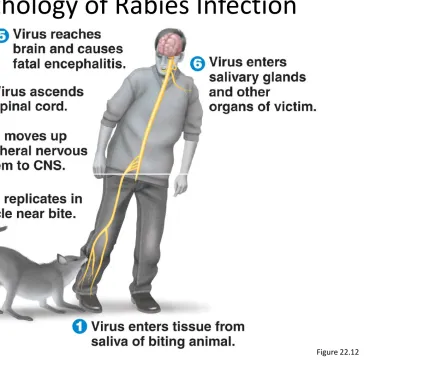
Pathology of Rabies Infection
Treatment Of Rabies
• Tetanus Injection: At the hospital the doctor will
first clean the wound thoroughly and make sure that your child's tetanus immunizations are
current.
• Wound care: The wounds should be cleaned with
mild soap and a virus-killing cleanser mild soap and a virus-killing cleanser
• Human Rabies Immune Globulin: A one-time
injection of human rabies immune globulin
Prevention
• Animals with rabies might be aggressive and
vicious, or tired and weak so don't approach stray animals.
• Don't let pets roam
• Remind kids that they should never touch or feed
stray cats or dogs wandering in the neighborhood stray cats or dogs wandering in the neighborhood or elsewhere.
• Report any stray animals to your local health
authorities or animal-control officer.
• Vaccinate your pet. Rabies vaccines are available
Malaria
Malaria is a mosquito-borne infectious disease caused by a
eukaryotic protist of the genus Plasmodium. It is
widespread in tropical and subtropical regions, including parts of the Americas (22 countries), Asia, and Africa. After a period of between two weeks and several months
a period of between two weeks and several months
(occasionally years) spent in the liver, the malaria parasites start to multiply within red blood cells, causing symptoms that include fever, and headache. In severe cases the
Some Symptoms
• Fever
• Chills
• Sweats
• Headache
• Body aches
• Body aches
• Vomiting
• Mild anemia
• Mild jaundice
• Larger-than-normal liver
• Quicker breather
• Low red blood cell count
Treatment and Prevention
• Different medicine is needed for different types of malaria. • Important to know where the malarial zones are as shown on
slide 13
• Important to know where malaria was picked up: malaria from Africa might be resistant to medicine that malaria from South America is not.
• Primaquine is the standard medicine for malaria in the liver • Chloroquine is medicine for malaria in blood.
• Some types of malaria are chloroquine resistant, so quinine is used.
• Use bug spray and mosquito nets to avoid being bitten. • Prophylaxis (prevention) and Malarone are used to reduce