Analyst Coverage and Earnings Management
Using Classification Shifting
Fang Zhao1 1
Girard School of Business, Merrimack College, North Andover, MA 01845, USA
Correspondence: Fang Zhao, Girard School of Business, Merrimack College, North Andover, MA 01845, USA.
Received: June 3, 2018 Accepted: June 20, 2018 Online Published: June 25, 201825
doi:10.5430/afr.v7n3p172 URL: https://doi.org/10.5430/afr.v7n3p172
Abstract
This study examines the association between analyst coverage and classification shifting. Prior studies on external monitoring factors and classification shifting provide mixed results: international studies (Haw, Ho, & Li, 2011; Behn, Gotti, Herrmann, & Kang, 2013) find that external monitoring factors mitigate classification shifting, while Abernathy, Beyer, and Rapley (2014) find that external monitoring factors promote classification shifting when accrual-based earnings management and real earnings management are constrained. Using a sample of firms in the United States, this study finds a positive association between classification shifting and an external monitoring factor: analyst coverage. This result suggests that when higher analyst coverage has a stronger monitoring role in earnings management, managers are more likely to use classification shifting. The implication of this study should be of interest to financial analysts.
Keywords: classification shifting, analyst coverage, earnings management
1. Introduction
Classification shifting involves managers’ misclassifying core expenses to special items to overstate core earnings (Note 1), with the bottom-line net income unaffected (McVay, 2006; Fan, Barua, Cready, & Thomas, 2010). Prior studies examine the relation between different external monitoring factors and classification shifting. Haw, Ho, and Li (2011) find that stronger legal institutions and Big 4 auditors mitigate classification shifting in East Asian countries. Another international study by Behn, Gotti, Herrmann, and Kang (2013) finds that higher financial analyst following mitigates classification shifting in the countries where the investor protection is weak. However, using the data of firms in the United States, Abernathy, Beyer, and Rapley (2014) find that classification shifting is more likely to be used when institutional ownership is higher. They also find that the likelihood of classification shifting is not associated with firms audited by Big N auditors. The overall results are mixed between the research using international data and the research using U.S. data. To further understand the relation between external monitoring factors and classification shifting, this study examines the association between financial analyst coverage and classification shifting using a sample of firms in the United States.
Corporate executives manage earnings using accruals to achieve their diverse reporting goals (Jones, 1991; Healy & Wahlen, 1999; Dechow & Skinner, 2000; Kothari, 2001). They also manage earnings through real activities, including reducing discretionary expenses (e.g., research and development, advertising, maintenance, and training expenses), over producing inventory to reduce costs of goods sold, selling long-term assets and other ways of structuring transactions (Roychowdhury, 2006; Xu, Taylor, & Dugan, 2007). Classification shifting is another form of earnings management, which involves shifting core expenses to special items to inflate core earnings. McVay (2006) and Fan et al. (2010) provide empirical evidence that managers misclassify core expenses to special items to overstate core earnings, with the bottom-line net income unaffected.
Financial analysts play an important role in corporate governance. They are able to detect corporate accounting frauds (Miller, 2006). Yu (2008) finds that when analyst coverage is higher, there is less earnings management evidenced by lower level of abnormal accruals, suggesting the effectiveness of financial analysts following the firm on managers’ accrual-based earnings management.
Cohen & Zarowin, 2010; Chi, Lisic, & Pevzner, 2011; Zang, 2012). Both accruals management and real earnings management are subject to future earnings implications. Accruals are subject to reversal in subsequent periods and real activities may have potential negative consequences on future cash flows. Compared with accrual-based and real earnings management, classification shifting is a relatively less costly way to manage earnings since it does not change the bottom-line income. Analysts may less likely to pay attention and scrutinize the reporting issues related to classification shifting since the bottom-line income numbers are not changed (Note 2). In this study, I examine whether managers are more likely to use classification shifting to manage earnings when there are more financial analysts following a firm (higher analyst coverage).
This study contributes to the stream of literature on the effects of external monitoring on earnings management activities. Prior studies on external monitoring factors and classification shifting provide mixed results: international studies (Haw et al., 2011; Behn et al., 2013) find external monitoring factors mitigate classification shifting, while Abernathy et al. (2014) find external monitoring factors promote classification shifting when accrual-based and real earnings management is constrained. This study examines this topic from the perspective of analysts’ monitoring effect in the United States.
In the next section, I review the related literature and develop the hypothesis. Section 3 describes the data, sample and descriptive statistics. Section 4 discusses the research design. Section 5 reports the empirical results. Section 6 concludes this study.
2. Literature Review and Hypothesis Development
2.1 Monitoring Role of Financial Analysts
Prior studies on agency theory (Jensen & Mecling, 1976; Fama, 1990) suggest that financial analysts play an important role in corporate governance. Analysts interact directly and indirectly with corporate managers of their covered firms. Healy and Palepu (2001) argue that analysts play monitoring roles through engaging in collecting private information and uncovering managers’ superior information. In a survey on a sample of Chief Financial Officers (CFOs), Graham, Harvey, and Rajgopal (2005) find that CFOs consider financial analysts and institutional investors as two most important groups in setting company’s stock price. Using a sample of firms subject to the SEC enforcement action, Miller (2006) suggests that analysts play an important role in detecting corporate accounting frauds. Dyck, Morce, and Zingales (2010) report similar evidence by analyzing a sample of corporate frauds taking place between 1996 and 2004.
In the context of earnings management, Yu (2008) finds a significant negative association between analyst coverage and abnormal accruals, suggesting that higher analyst coverage mitigates accrual-based earnings management. Using an international sample, Behn et al. (2013) finds that higher financial analyst following mitigates classification shifting in the countries where the investor protection is weak.
2.2 Earnings Management
2.2.1 Accrual-based Earnings Management, Real Earnings Management, Classification Shifting
A wide range of research provides evidence that corporate executives manage earnings using accruals to achieve their diverse reporting goals (Jones, 1991; Healy & Wahlen, 1999; Dechow & Skinner, 2000; and Kothari, 2001). A growing number of studies investigate whether corporate managers engage in real activity management to achieve earnings targets. Real activity management includes reducing discretionary expenses (e.g., research and development, advertising, maintenance, and training expenses), over producing inventory to reduce costs of goods sold, selling long-term assets and other ways of structuring transactions (Roychowdhury, 2006; Xu et al., 2007). In a survey study, Graham et al. (2005) report that CFOs engage in real activities manipulation to deliver earnings.
Classification shifting involves shifting core expenses to special items to inflate core earnings. Hwang (1994) provides anecdotal evidence of classification shifting – Borden, Inc. misclassified $192 million selling, general and administrative expenses as restructuring charges. McVay (2006) provides empirical evidence that managers misclassify core expenses to special items to overstate core earnings, with the bottom-line net income unaffected. Fan et al. (2010) use quarterly data and find that managers use classification shifting more in the fourth quarter than in interim quarters. Barua, Lin, & Sbaraglia (2010) document that managers also shift core expenses to discontinued operations. This study focuses on classification shifting using special items.
2.2.2 Substitutional Effects of Earnings Management Methods
management to real earnings management when their ability to manage accruals is constrained. Cohen et al. (2008) find that firms switch from accrual-based earnings management to real activity management after the passage of the Sarbanes-Oxley Act (SOX) because real activity management is less likely to draw auditor or regulatory scrutiny. In the same vein, Chi et al. (2011) provide evidence that firms are more likely to engage in real earnings management when audited by higher quality auditors since their ability to manipulate accruals is constrained. Badertscher (2011) examines a sample of overvalued firms and finds that during the period of overvaluation firms use accrual-based earnings management at the beginning and then move into real earnings management to sustain their overvalued equity as they run out of accruals management choices. Cohen and Zarowin (2010) find that around the time of seasoned equity offerings (SEOs), firms choose to engage in real earnings management based on their ability and costs to do accruals management. Zang (2012) provides further evidence that managers use the two earnings management tools as substitutes and the trade-off decision is based on their relative costs. Managers adjust the level of accruals management at the end of the year according to the realized level of real activities manipulation during the fiscal year.
In the context of classification shifting, Fan et al. (2010) find that firms engage in more classification shifting when their ability to manipulate accruals is constrained by auditor scrutiny in the fourth quarter. Abernathy et al. (2014) find that managers are more likely to use classification shifting when accrual-based and real earnings management are constrained by different factors such as poor financial condition, high institutional ownership, low industry market share (constrain real earnings management), low accounting system flexibility and the provision of a cash flow forecast (constrain accrual-based earnings management). They also find that firms audited by Big N auditors are not associated with the likelihood of classification shifting. My study follows this stream of research by examining the association between classification shifting and another monitoring factor: analyst coverage.
2.3 Hypothesis Development
Prior studies suggest that financial analysts serve as monitors on corporate managers and financial reporting system, and that their monitoring roles are effective in constraining accrual-based earnings management (Yu, 2008). Prior research also suggests that when accrual-based earning management is constrained, managers are likely to engage in alternative earnings management behavior like real earnings management (e.g., Cohen & Zarowin, 2010; Chi et al., 2011; Zang, 2012).
While accruals management and real earnings management are subject to future earnings implications because accruals are subject to reversal in subsequent periods and real activity managements may have potential negative consequences on future cash flows, classification shifting is a relatively less costly way to manage earnings since it does not change the bottom-line income. Managers are more likely to resort to classification shifting when other methods of earnings management are constrained by high levels of institutional ownership (Abernathy et al. 2014).
Analysts, like institutional investors, also play monitoring roles in managers’ self-serving behavior. Therefore, this study predicts that when firms followed by more financial analysts, managers are more likely to use classification shifting to manipulate earnings.
Formally, the hypothesis is stated as follows:
Hypothesis: Firms followed by more analysts use more classification shifting to manage earnings.
3. Data
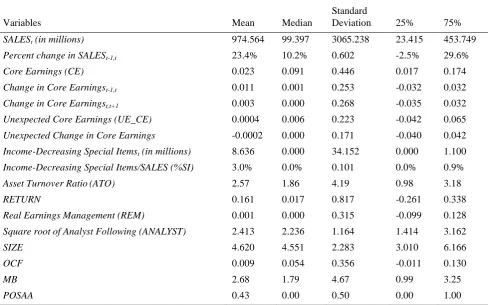
Table 1. Descriptive Statistics
Variables Mean Median
Standard
Deviation 25% 75%
SALESt (in millions) 974.564 99.397 3065.238 23.415 453.749
Percent change in SALESt-1,t 23.4% 10.2% 0.602 -2.5% 29.6%
Core Earnings (CE) 0.023 0.091 0.446 0.017 0.174
Change in Core Earningst-1,t 0.011 0.001 0.253 -0.032 0.032
Change in Core Earningst,t+1 0.003 0.000 0.268 -0.035 0.032
Unexpected Core Earnings (UE_CE) 0.0004 0.006 0.223 -0.042 0.065
Unexpected Change in Core Earnings -0.0002 0.000 0.171 -0.040 0.042
Income-Decreasing Special Itemst (in millions) 8.636 0.000 34.152 0.000 1.100
Income-Decreasing Special Items/SALES (%SI) 3.0% 0.0% 0.101 0.0% 0.9%
Asset Turnover Ratio(ATO) 2.57 1.86 4.19 0.98 3.18
RETURN 0.161 0.017 0.817 -0.261 0.338
Real Earnings Management (REM) 0.001 0.000 0.315 -0.099 0.128
Square root of Analyst Following (ANALYST) 2.413 2.236 1.164 1.414 3.162
SIZE 4.620 4.551 2.283 3.010 6.166
OCF 0.009 0.054 0.356 -0.011 0.130
MB 2.68 1.79 4.67 0.99 3.25
POSAA 0.43 0.00 0.50 0.00 1.00
Table 1 provides the descriptive statistics for the main variables, which are winsorized at 1 percent and 99 percent. The mean core earnings scaled by sales (CE) is 0.023. The mean income decreasing special items as a percentage of sales is 3%. The mean and median for the variables are comparable to McVay (2006).
4. Research Design
I use the McVay (2006) expectation model for core earnings as modified in Fan et al. (2010) to estimate unexpected core earnings (Note 4).
CEt = β0 + β1CEt-1 + β2ATOt + β3ACCRUALSt-1 + β4RETURNt + β5RETURNt-1
+ β6 ∆ SALESt + β7 NEG_∆ SALESt + ζt (1) The definitions of the variables in equation (1) are listed in the Appendix. Equation (1) is estimated by industry-year, excluding firm i from the estimation. The expected core earnings are calculated using the coefficients obtained from the industry-year regressions multiplied by the value of the variables in equation (1) for firm i. The unexpected core earnings (UE_CE) are calculated as the difference between actual core earnings and expected core earnings.
To test the hypothesis related to the association between analyst coverage and classification shifting, the following model is used.
UE_CEt = α0 + α1%SIt + π1ANALYST + π2ANALYST * %SIt + α2REMt + α3SIZE
+ α4OCF + α5MB + α6POSAA + YEARDUMMY + εt (2)
where ANALYST is the square root of the number of analysts following the firm. For robustness, I also use the natural logarithm of number of analysts, and the results are consistent. The hypothesis predicts that the propensity to use classification shifting is likely to increase with higher analyst coverage. A positive association between special items (%SI) and unexpected core earnings (UE_CE) indicates classification shifting (McVay, 2006). I expect that the relation between unexpected core earnings and special items will be more positive when analyst coverage is higher. Thus, the coefficient on the interaction term (ANALYST * %SI) in the models (π2) is predicted to be positive, indicating that higher analyst coverage is associated with more classification shifting.
Since my objective is to test whether analyst coverage affects the relation between unexpected core earnings and special items, I control for other two earnings management mechanisms: real earnings management and accruals management, which can affect unexpected core earnings. I include an indicator variable for positive abnormal accruals (POSAA) following Haw et al. (2011) and a measure of real earnings management (REM) used in prior studies (Note 5). The model also includes the year-specific fixed effects (YEARDUMMY).
5. Results
Equation (2) is used to test the hypothesis related to the association between analyst coverage and classification shifting.
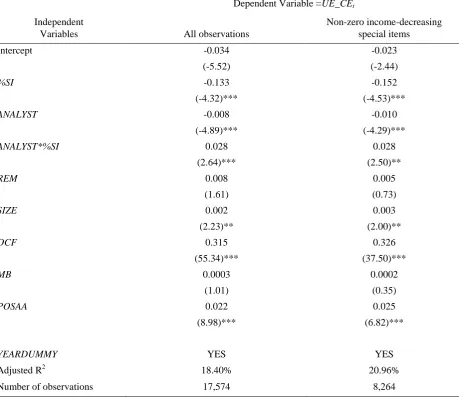
Table 2. Regression Results: Classification Shifting and Analyst Coverage
Dependent Variable =UE_CEt
Independent
Variables All observations
Non-zero income-decreasing special items
Intercept -0.034 -0.023
(-5.52) (-2.44)
%SI -0.133 -0.152
(-4.32)*** (-4.53)***
ANALYST -0.008 -0.010
(-4.89)*** (-4.29)***
ANALYST*%SI 0.028 0.028
(2.64)*** (2.50)**
REM 0.008 0.005
(1.61) (0.73)
SIZE 0.002 0.003
(2.23)** (2.00)**
OCF 0.315 0.326
(55.34)*** (37.50)***
MB 0.0003 0.0002
(1.01) (0.35)
POSAA 0.022 0.025
(8.98)*** (6.82)***
YEARDUMMY YES YES
Adjusted R2 18.40% 20.96%
Number of observations 17,574 8,264
Table 2 reports the regression results. *** and ** indicate that statistical significance is demonstrated at the .01 and .05 levels, respectively. Equation (2) is estimated by using all observations with available data (results presented in column 2) and by using a subsample with only non-zero income-decreasing special items (results presented in column 3).Consistent with Fan et al. (2010), the coefficient of %SI is negative and significant in both estimations, suggesting the dominance of performance effect (Note 6). I also include REM and POSAA variables to capture the effects of real earning management and accrual-based earnings management, which can potentially affect unexpected core earnings.
The variable of interest is the interaction term ANALYST*%SI. As predicted, the coefficients of ANALYST *%SI are positive and significant in both estimations, suggesting that firms with higher analyst coverage are more likely to use classification shifting. To standardize the number of analysts following, the variable used in the regression
is also used for robustness check, the results are consistent (Note 7). The adjusted R2 increases from 18.40% to 20.96% when the subsample includes firms that have more opportunities to engage in classification shifting.
6. Conclusion
In this study I examine the relation between analyst coverage and classification shifting. I find that higher level of analyst coverage is associated with more classification shifting. This result suggests that with a stronger monitoring role of financial analysts, managers are more likely to use classification shifting, which is less costly and less likely to be detected than other forms of earnings management.
This study contributes to the literature on the effects of external monitoring on earnings management activities. Prior studies on external monitoring factors and classification shifting provide mixed results: international studies (Haw et al., 2011; Behn et al., 2013) find negative associations between external monitoring factors and classification shifting, while Abernathy et al. (2014) find positive associations between external monitoring factors and classification shifting. This study examines this topic from the perspective of analysts’ monitoring effect in the United States and finds a positive association between analyst coverage and classification shifting.
The implication of this study should be of interest to financial analysts. While high analyst coverage can enhance external monitoring, improve overall corporate governance and constrain major mechanisms of earnings management, it may have an unintended consequence of promoting classification shifting, which is less likely to be detected.
Acknowledgements
I am grateful for the contributions of Abhijit Barua on an earlier version of this paper. I thank workshop participants at Florida International University, the Financial Management Association Annual Meeting, the American Accounting Association Southeast Region Meeting, the Midwest Finance Association Annual Meeting for their helpful comments on an earlier version of this paper.
References
Abernathy, J. L., Beyer, B., & Rapley, E. T. (2014). Earnings Management Constraints and Classification Shifting.
Journal of Business Finance & Accounting, 41(5) & (6), 600–626. https://doi.org/10.1111/jbfa.12076
Badertscher, B. (2011). Overvaluation and the choice of alternative earnings management mechanisms. The
Accounting Review, 86(5), 1491–1518. https://doi.org/10.2308/accr-10092
Barua, A., Lin, S., & Sbaraglia, A. M. (2010). Earnings Management Using Discontinued Operations. The
Accounting Review, 85(5), 1485–1509. https://doi.org/10.2308/accr.2010.85.5.1485
Behn, B. K., Gotti, G., Herrmann, D., & Kang, T. (2013). Classification Shifting in an International Setting: Investor Protection and Financial Analysts Monitoring. Journal of International Accounting Research, 12(2), 27-50. https://doi.org/10.2308/jiar-50439
Chi, W., Lisic, L. L., & Pevzner, M. (2011). Is enhanced audit quality associated with greater real earnings management? Accounting Horizons, 25(2), 315-335. https://doi.org/10.2308/acch-10025
Cohen, D., Dey, A., & Lys, T. (2008). Real and accrual-based earnings management in the pre- and
post-Sarbanes-Oxley periods. The Accounting Review, 83(3), 757-787.
https://doi.org/10.2308/accr.2008.83.3.757
Cohen, D., & Zarowin, P. (2010). Accrual-based and real earnings management activities around seasoned equity offerings. Journal of Accounting and Economics, 50(1), 2–19. https://doi.org/10.1016/j.jacceco.2010.01.002
Dechow, P., & Skinner, D. (2000). Earnings management: Reconciling the views of accounting academics, practitioners, and regulators. Accounting Horizons, 14(2), 235–250. https://doi.org/10.2308/acch.2000.14.2.235
Dyck, A., Morce, A., & Zingales, L. (2010). Who blows the whistle on corporate fraud. The Journal of Finance. LXV(6), 2213-2253. https://doi.org/10.1111/j.1540-6261.2010.01614.x
Fama, E. (1990). Contract costs and financing decisions. The Journal of Business, 63(1), S71–S91. https://doi.org/10.1086/296494
Fan, Y., Barua, A., Cready, W. M., & Thomas, W. B. (2010). Managing earnings using classification shifting: Evidence from quarterly special items. The Accounting Review, 85(4), 1303-1323. https://doi.org/10.2308/accr.2010.85.4.1303
of Accounting and Economics, 40(1-3), 3–73. https://doi.org/10.1016/j.jacceco.2005.01.002
Haw, I. M., Ho, S. S. M., & Li, A. Y. (2011). Corporate Governance and Earnings Management by Classification
Shifting. Contemporary Accounting Research, 28(2), 517-553.
https://doi.org/10.1111/j.1911-3846.2010.01059.x
Healy, P., & Palepu, K. (2001). Information asymmetry, corporate disclosure, and the capital markets: a review of the empirical disclosure literature. Journal of Accounting and Economics, 31, 405–440. https://doi.org/10.1016/S0165-4101(01)00018-0
Healy, P., & Wahlen, J. (1999). A review of the earnings management literature and its implications for standard setting. Accounting Horizons, 13(4), 365–383. https://doi.org/10.2308/acch.1999.13.4.365
Hwang, S. (1994). Borden to reverse, reclassify 40% of 1992 charge. Wall Street Journal (March 22).
Jensen, M., & Meckling, W. (1976). Theory of the firm: Managerial behavior, agency costs, and ownership structure.
Journal of Financial Economics, 3, 305–360. https://doi.org/10.1016/0304-405X(76)90026-X
Jones, J. (1991). Earnings management during import relief investigations. Journal of Accounting Research, 29(2), 193–228. https://doi.org/10.2307/2491047
Kothari., S. P. (2001). Capital markets research in accounting. Journal of Accounting and Economics, 31, 105-231. https://doi.org/10.1016/S0165-4101(01)00030-1
McVay. S. (2006). Earnings management using classification shifting: An examination of core earnings and special items. The Accounting Review, 81(3), 501-531. https://doi.org/10.2308/accr.2006.81.3.501
Miller, G. (2006). The press as a watchdog for accounting fraud. Journal of Accounting Research, 44(5), 1001–1033. https://doi.org/10.1111/j.1475-679X.2006.00224.x
Nelson, M. W., Elliott, J. A. & Tarpley, R. L. (2002). Evidence from auditors about managers’ and auditors’ earnings management decisions. The Accounting Review, 77(supplement), 175-202. https://doi.org/10.2308/accr.2002.77.s-1.175
Roychowdhury, S. (2006). Earnings management through real activities manipulation. Journal of Accounting and
Economics, 42(3), 335–370. https://doi.org/10.1016/j.jacceco.2006.01.002
Xu, R. Z., Taylor, G. K., & Dugan, M. T. (2007). Review of real earnings management literature. Journal of
Accounting Literature, 26, 195–228.
Yu, F. (2008). Analyst coverage and earnings management. Journal of Financial Economics, 88(2), 245-271. https://doi.org/10.1016/j.jfineco.2007.05.008
Notes
Note 1. Core earnings is defined as sales minus core expenses defined as costs of goods sold and selling, general and administrative expenses excluding depreciation, amortization and depletion.
Note 2. Survey findings in Nelson, Elliott, and Tarpley (2002) suggest that auditors are less likely to be scrutinized by external auditors, and less likely to require audit adjustments when firms’ bottom-line earnings numbers do not increase.
Note 3. The financial crisis years are excluded from the sample period.
Note 4. McVay (2006) uses current accruals in the expectation core earnings model, and Fan et al (2010) modified the model by substituting current accruals with current return. Current returns are used to control for current performance, and prior-period returns are included since market may detect deteriorating performance and decrease its expectations of core earnings before it is reported in the current period.
Note 5. REM may measure good performance, not necessarily real earnings management. Thus, I do not rule out the possibility that the change in unexpected core earnings is due to good performance rather than the results of manipulating real activities. I measure REM as follows:
REMt = - Equation (i) residual + Equation (ii) residual
(i) DISEXPt = β0 + β1(1/ATt-1) + β2 (Salest/ATt-1) + εt (ii) PRODt = β0 + β1(1/ATt-1)+ β2(Salest/ATt-1)+ β3(ΔSalest/ATt-1) + β4(ΔSalest-1/ATt-1) + εt
Note 6. McVay (2006) finds a positive association between unexpected core earnings and the magnitude of income-decreasing special items, which is interpreted as the evidence of classification shifting. However, she admits the possibility of inadequate controls may lead to such a positive association. More discussions on the concern relating to controlling performance in the expectation model are provided in Fan et al. (2010) and they modified the expectation model, which is followed in this paper.
Note 7. In the regression, the coefficient of the interaction term (log_analyst*%SI) is positive (0.044) and significant at 0.001 level for both samples.
Appendix
Variable Definitions
CE = core earnings, measured as: (sales – cost of goods sold – selling, general and administrative expenses) / sales;
ATO = asset turnover ratio, calculated as: sales / average net operating assets;
RETURNS= market-adjusted return;
∆𝑆𝐴𝐿𝐸𝑆 = percentage change in sales;
𝑁𝐸𝐺_∆𝑆𝐴𝐿𝐸𝑆 = 1 if the percentage change in sales is negative, 0 otherwise; ∆𝐴𝑇𝑂 = change in asset turnover ratio;
REMt = Equation (i) residual * (-1) + Equation (ii) residual
(i) DISEXPt= β0 + β1(1/ATt-1) + β2(Salest/ATt-1) + εt (ii) PRODt = β0 + β1(1/ATt-1) + β2(Salest/ATt-1) + β3(ΔSalest/ATt-1) + β4(ΔSalest-1/ATt-1) + εt
DISEXP = sum of advertising expenses, R&D expenses, and SG&A expenses.
PROD= sum of cost of goods sold and change in inventory in year t.
AT= total assets
ANALYST = analyst coverage, measured as the square root of number of analyst following firm i in year t