1
Implementing an IT Service Information Management Framework: the
case of COTEMAR
Teresa Lucio-Nietoa, Ricardo Colomo-Palaciosb, Pedro Soto-Acostac,∗,
Simona Popac, Antonio Amescua-Secob
a Instituto Tecnológico y de Estudios Superiores de Monterrey, Monterrey Campus, Ave. Eugenio Garza Sada, 2501, 64849 Monterrey, Nuevo Leon, Mexico
b Computer Science Department, Universidad Carlos III de Madrid, Av. Universidad, 30, 28911 Leganés, Madrid, Spain c Department of Management & Finance, University of Murcia, Campus de Espinardo, 30100 Espinardo, Murcia, Spain Abstract
It is evident that organizations are demanding more efficient information management technologies in order to offer high quality services for both internal and external clients. Firms pursue the implementation of processes aligned to their strategic and operational objectives and, to achieve these goals, they usually introduce various frameworks and approaches to information technology service management, such as Information Technology Infrastructure Library (ITIL) or Control Objectives for Information and Related Technologies (COBIT). However, once incorporated, it is essential to have mechanisms that guarantee performance efficiency. One of such mechanism is the Service Management Office (SMO). The case analysis presented here describes the lessons learned from its implementation in COTEMAR. The results provide useful insights for firms interested in integrating SMO within IT service management practices.
Keywords: Service Management Office, ITSM, IT Governance, Service Management Department.
Introduction
The increasing use of information management technologies within firms has resulted in IT usage-dependant organizations seeking to have increasingly efficient and innovative technological services and solutions. Organizations recognize that Information Technology (IT) services are strategic assets to support information and services management. However, the reality is often that these services are overlooked or not addressed at all, with the strategic importance they entail. Those which do attach importance to this issue, through the implementation of best practices or frameworks for IT services, such as
Information Technology Infrastructure Library (ITIL), have found that one of the key factors to guarantee success is having suitable processes, not only for the implementation but also for follow up and maintenance (Neničková, 2011). According to Kooper, Maes & Roos Lindgreen (2011), the foundations and the current application of IT governance suffers from serious limitations. This paper analyzes one of these limitations.
The literature points out the importance of implementing an IT service information management framework to support and monitor IT services performance (Cannon, 2011;
2
Roller, 2009). Service Management Office (SMO) is presented as a mechanism based on the ITIL framework for delivering quality IT services to users at both tactical and strategic levels. Indeed, the literature concludes that it is advisable to implement tools to monitor the fulfillment of IT service management objectives. SMO is an IT governance mechanism, which defines, monitors and audits processes that are in operation or in transition. SMO is responsible for guaranteeing compliance with the “end-to-end” service strategy, and it achieves this by designing a service that delivers business value through supervising the governance of processes, frameworks, methodologies and IT standards as well as their relation with the business (Cannon, 2011; Roller, 2009).
Company Background
COTEMAR is a Mexican company founded in 1979 with its headquarters in Monterrey (Nuevo Leon, Mexico). Although it has partners in Europe and the United States, 100% of the company’s operations are conducted in Ciudad del Carmen (Campeche, Mexico. Although Cotemar offers different services (maintenance and rehabilitation of platforms and process centers in offshore facilities; operations of semi- submersible platforms; integral food and lodging service; and support for vessels for specialized transportation services), the company’s main source of revenue comes from the construction and maintenance of offshore oil platforms and “flotels” (floating hotels). It has over 7,000 employees, serves over 1,100 users and has incomes of about 600 million USD a month.
In addition, the company has a joint venture with Dynamic Positioning Systems which provides special services, such as offshore maintenance. They own ships fitted with saturation diving equipment to perform inspection and rehabilitation work on sea-bottom process lines. The specialized services provided by the company include: hauler-type ships and barges for transportation of major structures that are required in petroleum exploitation; processing and transportation of petroleum and liquids extracted from the platforms; ships for transportation of bulk abrasive materials; fire fighting and hydrocarbon spill response.
Since its foundation, the company’s main client has been Petroleos Mexicanos (PEMEX), which is ranked among the five major oil companies in the world. COTEMAR provides
3
PEMEX with services related to development of offshore oil fields utilizing specialized ships. The construction and maintenance services performed for PEMEX include the maintenance and rehabilitation of platforms and Complexes (processing centers) in offshore facilities. The scope of this service allows works to be carried out ranging from prefabrication for mounting up to commissioning of service lines. The service is provided with the support of dynamically positioned semi-submersible platforms that are capable of moving swiftly from one complex to another.
The operational control is performed by mobile connection equipment for field information collection and is supported by technological systems developed for proper planning and timely delivery. The employees are specialists in design, construction and adaptation of works for the oil industry. The entire marine operation is conducted under strict control with regard to standards and ISO-ISM-ISPS system application management. The firm is certified under the ISO 9001:2000 and approved under the International Ship and Port-Facility Security standards for its business operations. Moreover, Cotemar’s ships hold the ISM (International Safety Management) certification for its safe sea activities. To meet its IT service needs, the company has over 170 servers (LAN, WAN, Spread Spectrum, Microwave and Satellite Communications…), over 20 service management software applications, SAP JDEdwards, and is a CISCO & Microsoft based company.
The Service Management Office (SMO) Project at COTEMAR
The complex, specialized and strategic services provided by COTEMAR to its main client (PEMEX) make IT service management a vital element for planning business activities and processes as well as for communication between internal users to guarantee quality and efficiency in the delivery of its services and products. More specifically, with regard to IT services, the personnel involved became aware of the fact that not everything was technology and they realized the importance of understanding the strategy, tactics and business processes. Thus, the IT area began to undergo a transformation from a technical support and operational area to a strategic area focused on quality and business services.
4
COTEMAR became aware that Service Management (SM), and mostly ITIL, were the best practices to be adopted to guarantee service and continuous improvement for its superintendence. Initially, they implemented Service Desk (SD), a solution which offers a single point of assistance for internal and external users, enabling the firm to improve its performance. Next, the consolidation of service management, initiated with the SD, required a strategy and an improvement stage, backed up by 11 Service Management (SM) processes and an evolutionary work period of nearly four years, which led to the implementation of the following IT service management: (1) Service Desk + Incident & Problem Management + Request fulfillment (2007 – 2008); (2) the basis for Configuration & Release & Change and SL Management (2008 – 2009); (3) Event and Access process (2010); (4) Knowledge management & Processes Maturing (2012).
COTEMAR’s department in charge of managing IT services was named IT Superintendence. IT services were of the insourcing type. However, there were some
outsourcing type areas - mostly regarding systems development. The department’s main objective was to take care of all system requirements and as such it had a strategic level within the organizational structure and was directly supervised by the CEO’s office.
Although the department had technical certifications, it had neither an IT area certification nor any framework for IT service management (ITSM). IT Personnel in the department had problems to provide an adequate follow-up on user service requests because of their workload and the ambiguity of their responsibilities and, as a consequence, response times were not adequate to meet their needs. There was no standard way of organizing and measuring their own resources in order to be able to solve users’ requirements.
COTEMAR like many other competing organizations became gradually aware of the need of redesigning its internal IT service processes in order to better organize and quantify if services are efficiently coordinated within the organization. Their first contact with ITIL was by consulting a basic reference book on the topic. They then understood that the above challenges could be faced through the adoption of a framework such as ITIL, which allows a set of processes to be carried out providing quality IT services. The main focus would be on the management of services’ lifecycle so that the organization would be able to align
5
efforts and entrepreneurial objectives, ensuring compliance with regulatory controls as well as client and employee satisfaction.
It is worth mentioning that the motivation for implementing ITIL was that they realize that basic IT services were not actually performing well. This finding motivated an internal analysis that uncovered the following issues regarding IT services: the focus was quite transactional; final service was more oriented towards operation; no methodology was applied; over 60% of the work was not planned; there was low reliability in service and operation and high dependency on technical support services in order to solve problems, although with low efficiency levels. They realized there was a shortfall in organization, follow up, communication and structure.
When COTEMAR decided to implement ITIL in 2008, they had different perceptions. They were looking for a software solution rather than a framework for IT services management. In addition, they did not believe in the value of certifications in this field. After knowing what ITIL could offer to the firm, they decided to go ahead with its implementation. Their vision was to integrate it as a part of the IT service management to generate value for their users, and IT personnel followed a training process.
Eventually, ITIL became a framework that allowed the Superintendence to measure its day-to-day activities and processes practically, so ensuring value generation for IT service and facilitating the achievement of organizational objectives. They began implementing incident management (IM), problem management (PM) and a service desk (SD). In 2009, the parts corresponding to configuration, versions and changes were implemented. However, only processes related to IM achieved level 3, the rest were still far from achieving the defined goals and, worse still, some processes such as continuous improvement (CSI) were even completely stopped. In 2010, Event management (EM), service level management (SLM) and access management (AM) processes were implemented, reaching a level 3 of maturity (Defined Level).
6
COTEMAR took some 4 years to implement and consolidate the service management strategy. They became aware of the importance of certifying all IT personnel in ITIL and other IT service management frameworks. So, starting in 2009, COTEMAR began an intensive program aimed at ensuring that its personnel would be certified not only at ITIL fundamentals levels, but also at practitioner level. They did this by process groups and achieved certification of personnel and decision makers up to intermediate level. In addition to ITIL certifications, COTEMAR handled other frameworks such as PMI, ISO9000 and SCRUM. Moreover, their processes were assessed by ISO/IEC2000 standard.
An analysis of various suppliers was conducted to select the support system (tool) for service management. However, the implementation of the selected tool turned out to be the most troublesome issue. They therefore had to change the supplier. They realized that they had focused on almost all elements during ITIL implementation but had overlooked the tool, and this proved to be their “Achilles’ heel”. To cope with this weakness, in 2010 they re-implemented IBM’s Tivoli tool (the 4th version in 6 years).
Process managers adapted to IT service management activities and terminology and an interaction was generated with the incident process. Thus, requirements began to be assigned and controlled; first and second level executives were organized in order to solve the various users’ requirements. Moreover, given the results in Service Desk operations, a restructuring of support levels was performed for both the first level and the troubleshooter within the SD.
With regard to ITIL processes, these were implemented under a methodological regime, undergoing the phases of analysis, design, implementation and operation, which included a post-implementation review. The processes implemented were incident management (IM), problem management (PM), a Service Desk (SD), which were followed by configuration, versions and changes management. Then, continuous improvement (CSI), event management (EM), service level management (SLM) and access management (AM) processes were introduced, although the last ones ceased to be executed on a daily basis.
7
Although ITIL is a framework that has proved to provide significant benefits for firms which have implemented it (Iden & Langeland, 2010), ITIL success does not come automatically. At COTEMAR, at the beginning of ITIL implementation, they thought it would be easy and that everyone would have known that their role were within the processes. However, they realized that it was a new way of working and that adaptations would be required. For this reason the book ITIL Service Strategy (Cannon, 2011), in chapter 6 entitled “Organizing for Service Strategy”, suggests the need of an office which
coordinates all of the processes and functions along their lifecycle. In this sense, one of the ITIL’s framework weaknesses is that it only describes what must be done for its implementation without providing a precise description of what to do after implementation (Mesquida, Mas, Amengual, & Calvo-Manzano, 2012). As a consequence, this is exactly what happened in COTEMAR after implementing ITIL. Thus, despite the benefits after implementing ITIL (request recording, follow up and control; distribution of operating activities; creation of two support levels, operating and strategic; clear identification of the operating aspects vs. strategic aspects; service improvement; going from a traditional to a strategic IT function; and new company initiatives were organized based on the learning achieved with ITIL), the company faced the fact that some of the implemented processes were deficient and had to deal with this challenge by backing up the processes appropriately using the Tivoli tool.
The company faced the challenges of identifying, maintaining and consolidating integrated processes which allowed the organization to deliver services that met the requirements of both the organization and their clients. However, several questions emerged regarding these issues: Who should maintain and assess the whole IT Service Management and its already implemented processes, thus ensuring order and efficiency, and how? The answer at COTEMAR was to create SMO as an IT governance framework. This framework ensures that IT policies and strategies are implemented and that the required processes are correctly followed, including a definition of roles and definitions, measurement and reporting the actions taken.
8
In spite of the evidence of the benefits of implementing a framework such as ITIL, the operating activities led to moving the already consolidated IT service management processes to a background position and leave behind the ones that were expected to be implemented or consolidated. They faced the challenge of defining an IT and Service Management (SM) governance mechanism. Such a mechanism was found in SMO, which allows formalizing and clarifying the design, implementation, surveillance, ownership and decision making about strategy, resources, processes and tools for SM, so ensuring service and value for its different users and clients.
The following objectives were sought in implementing SMO: (1) to establish standards for the design and implementation of processes and SM, as well as to validate and execute them in such a way that they are a part of COTEMAR’s organizational culture; (2) to maintain communication, both internally and externally, regarding results, services, improvements and key issues of SM; (3) to ensure that the personnel is always trained, with a standard level in everything related to SM; (4) to promote and execute continuous improvement of services, managers, tools, processes and the service model.
After the decision to implement SMO, an initial diagnosis was conducted in order to evaluate the current practices. The main issues to be solved were as follows: design, approving, implementing, closing and recording needed to be reviewed; communication with IT personnel was under the responsibility of each process manager and no formal communication and recording process existed; the plan for service improvement had been suspended due to the redefinition of the processes and the re-implementation of tools; and service improvements represented isolated efforts focused mainly on maintenance operations. Given these challenges, establishing SMO was considered as a means for monitoring and reporting (services, processes and projects) as well as a way of supporting decision making, audits, service and project compliance through a Service Improvement Plan.
9
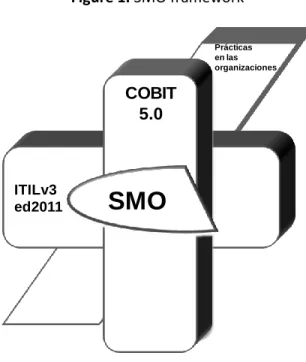
After completing the diagnosis, five steps were taken to implement SMO in COTEMAR. First, an initial session where all managers were asked what they expected from SMO. Second, a set of weaknesses in IT service management were obtained from the initial session. Third, the objectives and the initial definition of SMO and its mission were established. Fourth, standards for design, process implementation and SM were defined in such a way that they were part of COTEMAR’s organizational culture; (5) committees were set up at executive, tactic, operational and improvement levels. The proposed framework is presented in Figure 1.
Figure 1. SMO framework
Some of the major benefits obtained after SMO implementation were: (1) In contrast to books on ITIL, it is a framework that defines how to do; (2) it is a framework which permits decisions on what to implement according to the company’s needs, both in the short and medium term; (3) it is a practical framework with a methodological procedure; (4) it is a framework that enables selection of what is priority, that is, it is a flexible framework; (5) it enables internal processes related to IT services to be improved.
ITILv3 ed2011 COBIT 5.0 Prácticas en las organizaciones
SMO
10
Finally, although SMO represented a solution at COTEMAR for the areas of opportunity identified in IT service management, it is important to highlight that SMO did not participate in the IT service design strategy because it was still an office in the process of being consolidated. Thus, in the future, as acknowledge by COTEMAR’s management, the framework may include projects and final user services.
Lessons learned
IT service management has several recognized frameworks nowadays (Rozemeijer, 2007). ITIL is among the most widely used, but it is not without its weaknesses such as only describing what must be done in order to implement ITIL or only suggesting the creation of a service management office (Cannon, 2011). ITIL does not describe the mechanics or the methodology to create the service management or what to do after implementation. Merely having an ITIL certification does not guarantee its adequate adoption or execution (Pollard & Cater-Steel, 2009). This was apparent at COTEMAR in the early stages of ITIL implementation. For the ITIL framework to be successful in its operations and functioning a set of factors needs to be addressed (Neničková, 2011), one of which is the existence of a SMO.
Considering the above, the main lessons learned from the COTEMAR case are related to the implementation of SMO and they can be classified into the following three categories: people, processes and technology. These categories are considered as ITIL post-implementation success factors (Iden & Langeland, 2010; Neničková, 2011) as well as key elements to be considered in the design and operation of SMO (Roller, 2009). Today SMO is considered to be in its consolidation stage at COTEMAR.
- people
COTEMAR considers that one of its most important elements, and a success factor in the implementation of both ITIL and SMO, is people. Having adequate personnel located in the right processes is a key issue and it has been found to be a critical success factor in recent studies on IT service management and software development (Colomo-Palacios, Fernandes,
11
Soto-Acosta, & Sabbagh, 2011; Gama, Nunes da Silva, & Mira da Silva, 2011). With this in mind, the company is aware that the post-implementation of an IT service management framework must take into account the people involved. Thus, the company promoted characteristics such as: (1) leadership; (2) roles and responsibilities; (3) commitment and participation; and (4) knowledge and understanding (Neničková, 2011; Pollard & Cater-Steel, 2009).
The COTEMAR case shows that the implementation of SMO entailed the development of a set of activities that started with the implementation of a model relying on the leadership of the IT Chief (TIC Superintendent). A series of meetings through tactical and operating committees was also held to develop awareness about the importance of creating SMO and<of the participation of each person involved until all of them had a holistic vision of the project. In this task, the TIC Superintendent was assisted by personnel from technical support, communications, applications and infrastructure.
For the establishment of roles and responsibilities, they formed an executive committee which was responsible for: (a) SM processes tools, strategy, plans and projects; (b) defining the service strategy; (c) aligning and incorporating business changes into SM strategies. A tactical committee was also established with the following responsibilities: (a) defining plans and work programs according to the strategy defined for SM; (b) project execution and leadership; (c) change management; (d) improvement management; (e) communication management; (f) supplier performance. Furthermore, to supervise day-to-day operations, they established an improvement Committee responsible for: (a) process, service and project monitoring and compliance; (b) generating immediate actions to ensure compliance in operation; and (c) proposing improvements to services, processes and projects.
The knowledge and understanding part led COTEMAR to train and certify its personnel in IT service management. Thus, people involved with SMO were trained in techniques and methodologies to achieve efficient performance and gain knowledge about IT service management. As Pollard & Cartel Stell (2009) found, this is an essential success factor for the operation of an IT service framework. Since the main responsibility of COTEMAR’s
12
SMO was to ensure that SM practices and processes were integrated with all of the firm’s service areas, personnel participation was considered as fundamental. The integration of information from SM processes to services and projects, in the pursuit of service vision, has meant that COTEMAR ensures that the improvement agreements defined by the various roles involved in the service are carried out while, at the same time, guaranteeing compliance with the responsibilities identified in process validation.
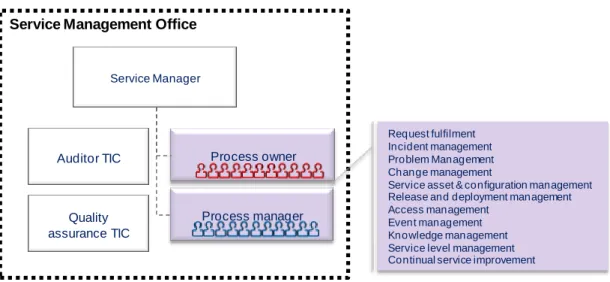
The involvement of all IT personnel in the processes meant that the action plan was carried out together with all process managers, who “compelled” IT personnel to define solution methods to meet their own and the organization’s goals. Thus, they established a record of the commitments made by the committees to ensure adequate processes monitoring from beginning to end. As a conclusion, the objective was that the personnel involved in SMO became “guards” who oversee that everyone involved in managing IT services complies with his/her process to guarantee better quality services. SMO’s organizational structure is illustrated in Figure 2.
Figure 2. SMO organizational structure
- processes
Since processes are a key success factor of IT service management, it must be taken into account that (1) adequate techniques and tools must be applied; (2) IT and the related
Service Management Office
Service Manager Auditor TIC Quality assurance TIC Process owner Process manager Request fulfilment Incident management Problem Management Change management
Service asset & configuration management Release and deployment management Access management
Event management Knowledge management Service level management Continual service improvement
13
business processes must be aligned; (3) Follow-up and assessment are required (Neničková, 2011; Pollard & Cater-Steel, 2009), and (4) a clear vision of the benefits of adequate process management must exist. Through SMO COTEMAR achieved the integration of tools which allowed it to align IT services with business processes, so enabling a better measurement of all its processes. One of the main tools used was IBM’s Tivoli.
Given the above, the firm has, through its SMO, been able to establish continuous improvement processes (CSI), so achieving efficiency in the internal communication process. In fact, all process managers were virtually forced to inform about their process status and prepare reports on how to proceed in order to increase the efficiency of the processes that depend on him / her. Thus, process managers ensured the suitable operation of the processes they were responsible for, and each manager worked towards increasing integration of his or her process within the whole network of processes. Hence, an awareness that all processes depend, in one way or another, on other processes (systemic focus) was built along the lines of Iden & Langenland (2010): “An IT service consists of a combination of persons, processes and technology… ITIL is a process-based framework, which implies that it is focused on the activities and functions of the whole organization both inside and outside the IT operations department”.
The priority of which processes were addressed through SMO depended on the established objectives so this was defined in the standard for design and implementation of services and communications. Once SMO was operating, and its processes had been defined, the outputs generated by its operations were audit reports, audit plans, monitoring reports, complete audit reports and action plans. The outputs regarding communications were: communication items on customer satisfaction and communication of reports, while the reports area received the following outputs: a plan of reports defined for each process and a report of operational results.
Finally, regarding decision-making, committees were established at three levels: executive, tactical and operational. Support from top IT management was ensured, something which is considered to be one of the key success factors when implementing IT service management frameworks (Neničková, 2011; Pollard & Cater-Steel, 2009).
14
- technology
Technology is held to be a success factors in the implementation and post-operation of IT service management frameworks (Pollard & Cater-Steel, 2009). SMO, which is a part of it, is no exception. Nowadays, organizations depend on IT for the execution of their processes. Thus, maturity is necessary for an organization’s systems and for its overall information architecture. Strong, mature technologies make it possible to have processes and services that are available when and as required by the end user. Maturity is especially vital when the processes that are utilized within a shared service model are interrelated in some way (Roller, 2009).
COTEMAR sees technology as a vital tool (a means rather than an end) to achieve leveling/speed in process execution; process improvements/roles; greater strength in the use of statistics to support continuous improvement. However, if not adequately integrated into the needs of IT process management, the tool may become more of a headache than a help. Although the main technological tool utilized for IT service management is Tivoli, one of the steps for consolidating SMO was stabilizing it. In the case of COTEMAR, technology is a means for achieving adequate operation of SMO as well as a way of managing the IT services provided to the different company areas. It can be concluded that the tool must reflect and support the work scheme.
Conclusion
The case analysis presented illustrates the implementation of SMO at COTEMAR as a means for formulating strategies and designing services that deliver business value. SMO also facilitates the governance of processes, frameworks, methodologies and IT standards. In this sense, several conclusions can be drawn from our study. The need for implementing SMO emerged at a time that the execution of the processes had become relaxed. It was a response to the lack of check points for follow up and auditing as well as the lack of an adequate methodology to make outputs evident.
15
The benefits that SMO brought to the firm came from: adjustments to the way of working (establishing committees), the tools used, the assessment methods; the promotion of continuous improvement, the efficiency of communication processes (communications and reports), information sharing efficiency, better follow up of processes through audits; the reinforcement of decision-making through committees. SMO became a critical tool for supporting re-standardization and evolution in order to generate business value. It also strengthened the design, operation and maintenance of SM. The implementation took into account three fundamental elements for the successful and efficient operation of the IT service management: people, processes and technology. The TIC Superintendent and the first level managers boost SMO consolidation and stabilization to instill into managers and the rest of IT personnel the organizational culture change that is needed in order to develop and maintain the service strategy.
The case analyzed reveals, as the main challenge in the implementation of an SMO, the management of change in the organizational culture. It is also worth noting the need for creating awareness of the importance of the interrelationships between IT service management processes, technology and people.
The authors consider that the findings presented in this case may be applicable not only to companies with the same characteristics as COTEMAR, but also to firms operating in other industries, since the SMO model proposed and analyzed was designed so that it could be tailored to the IT service management needs of any organization. SMO bases stem from frameworks and best practices such as ITIL and Control Objectives for Information and Related Technologies (COBIT). Thus, as suggested by Rozemeijer (2007): “Commonly, the available frameworks do not fit in as the pieces of a puzzle. It must be taken into consideration that they were created by different people, in different moments, in different places, in different ways, by different reasons, focusing on different phases of the lifecycle, functions, processes, results and aspects, with different degrees of granularity, precision, quality and consistency. Together, they constitute an integrated image that may act as an umbrella to help an organization successfully implement multiple frameworks”. This work fosters the inquiry and documentation of the lessons learned from companies that have
16
implemented SMO in various sectors as well as the assessment of its usefulness for IT service management prior to its implementation.
Acknowledgements
We thank Pedro Salguero, COTEMAR’s CIO, for his collaboration and support. We also thank Fundación Cajamurcia for the financial support provided.
References
Cannon, D. (2011). Chapter 6. Organizing for service strategy. ITIL Service Strategy (pp. 317-339). The
Stationery Office. ITIL Best Management Practice. Retrieved from http://www.best-management-practice.com/serviceStrategy2011_demo/content.aspx?page=sst_9&showNav=true&expandNav=false Colomo-Palacios, R., Fernandes, E., Soto-Acosta, P., & Sabbagh, M. (2011). Software product evolution for
Intellectual Capital Management: The case of Meta4 PeopleNet. International Journal of Information
Management, 31(4), 395-399. doi:10.1016/j.ijinfomgt.2011.04.001
Gama, N., Nunes da Silva, R., & Mira da Silva, M. (2011). Using People-CMM for Diminishing Resistance
to ITIL. Journal of Human Capital and Information Technology Professionals, 2(3), 29-43.
Iden, J., & Langeland, L. (2010). Setting the Stage for a Successful ITIL Adoption: A Delphi Study of IT
Experts in the Norwegian Armed Forces. Information Systems Management, 27(2), 103-112.
doi:10.1080/10580531003708378
Kooper, M., Maes, R., & Roos Lindgreen, E. E. (2011). On the governance of information: Introducing a new
concept of governance to support the management of information. International Journal of Information
Management, 31(3), 195–200.
Mesquida, A. L., Mas, A., Amengual, E., & Calvo-Manzano, J. A. (2012). IT Service Management Process
Improvement based on ISO/IEC 15504: A systematic review. Information and Software Technology,
54(3), 239-247. doi:10.1016/j.infsof.2011.11.002
Neničková, H. (2011). Critical success factors for ITIL best practices usage. Economics and Management,
(16), 839-845.
Pollard, C., & Cater-Steel, A. (2009). Justifications , Strategies , and Critical Success Factors in Successful
ITIL Implementations in U.S. and Australian Companies: An Exploratory Study. Information Systems
Management, 2(26), 164-165. doi:10.1080/10580530902797540
Roller, S. (2009). The Service Management Office. The Role of Integrated Governance and the ITIL V3.
Proactive.