Disconnected Operation in the Coda File System
James J. Kistler and M. Satyanarayanan
School of Computer Science
Carnegie Mellon University
Pittsburgh, PA 15213
How can we improve this state of affairs? Ideally, we
Abstract
would like to enjoy the benefits of a shared data repository, Disconnected operation is a mode of operation that enables
but be able to continue critical work when that repository is a client to continue accessing critical data during temporary
inaccessible. We call the latter mode of operation failures of a shared data repository. An important, though
not exclusive, application of disconnected operation is in disconnected operation, because it represents a temporary supporting portable computers. In this paper, we show that deviation from normal operation as a client of a shared disconnected operation is feasible, efficient and usable by
repository. describing its design and implementation in the Coda File
System. The central idea behind our work is that caching of
In this paper we show that disconnected operation in a file data, now widely used for performance, can also be
system is indeed feasible, efficient and usable. The central exploited to improve availability.
idea behind our work is that caching of data, now widely used to improve performance, can also be exploited to enhance availability. We have implemented disconnected
1. Introduction
operation in the Coda File System at Carnegie Mellon Every serious user of a distributed system has faced
University. situations where critical work has been impeded by a
remote failure. His frustration is particularly acute when
Our initial experience with Coda confirms the viability of his workstation is powerful enough to be used standalone,
disconnected operation. We have successfully operated but has been configured to be dependent on remote
disconnected for periods lasting four to five hours. For a resources. An important instance of such dependence is the
disconnection of this duration, the process of reconnecting use of data from a distributed file system.
and propagating changes typically takes about a minute. A local disk of 100MB has been adequate for us during these Placing data in a distributed file system simplifies
periods of disconnection. Trace-driven simulations collaboration between users, and allows them to delegate
indicate that a disk of about half that size should be the administration of that data. The growing popularity of
adequate for disconnections lasting a typical workday. distributed file systems such as NFS [15] and AFS [18]
attests to the compelling nature of these considerations. Unfortunately, the users of these systems have to accept the
2. Design Overview
fact that a remote failure at a critical juncture may seriously
Coda is designed for an environment consisting of a large inconvenience them.
1
collection of untrusted Unix clients and a much smaller number of trusted Unix file servers. The design is optimized for the access and sharing patterns typical of academic and research environments. It is specifically not
This work was supported by the Defense Advanced Research Projects Agency
(Avionics Lab, Wright Research and Development Center, Aeronautical Systems intended for applications that exhibit highly concurrent, Division (AFSC), U.S. Air Force, Wright-Patterson AFB, Ohio, 45433-6543 under
fine granularity data access.
Contract F33615-90-C-1465, ARPA Order No. 7597), National Science Foundation (PYI Award and Grant No. ECD 8907068), IBM Corporation (Faculty Development
Award, Graduate Fellowship, and Research Initiation Grant), Digital Equipment Each Coda client has a local disk and can communicate Corporation (External Research Project Grant), and Bellcore (Information
with the servers over a high bandwidth network. At certain
Networking Research Grant).
times, a client may be temporarily unable to communicate with some or all of the servers. This may be due to a server or network failure, or due to the detachment of a portable client from the network.
mahler vivaldi ravel x=12 x=12 x=12
x=12
flute harp x=12
mahler vivaldi ravel x=87 x=87 x=87
flute
harp x=87 x=87
viola x=87
mahler vivaldi ravel x=33 x=87 x=87
flute
harp x=87 x=33
x=33 viola
x=12
(a) (b) (c)
x=33 x=87 x=87
mahler vivaldi ravel
flute
harp x=87 x=45
x=33 x=45 x=87 x=87
mahler vivaldi ravel
flute
harp x=87 x=45
x=45 mahler vivaldi ravel
x=45 x=45 x=45
harp x=45 flute
x=45
viola x=45
(d) (e)
(f)
viola viola
viola
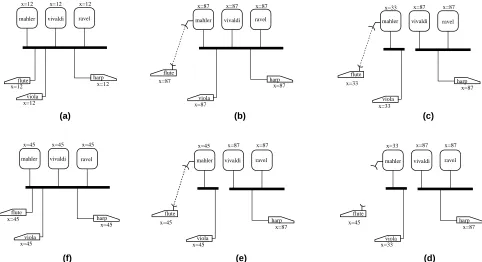
Three servers (mahler, vivaldi, and ravel) have replicas of the volume containing file x. This file is potentially of interest to users at three clients (flute, viola, and harp). Flute is capable of wireless communication (indicated by a dotted line) as well as regular network communication. Proceeding clockwise, the steps above show the value of x seen by each node as the connectivity of the system changes. Note that in step (d), flute is operating disconnected.
Figure 1: How Disconnected Operation Relates to Server Replication
Clients view Coda as a single, location-transparent shared cache. Since cache misses cannot be serviced or masked, Unix file system. The Coda namespace is mapped to they appear as failures to application programs and users. individual file servers at the granularity of subtrees called When disconnection ends, Venus propagates modifications volumes. At each client, a cache manager (Venus) and reverts to server replication. Figure 1 depicts a typical dynamically obtains and caches volume mappings. scenario involving transitions between server replication
and disconnected operation. Coda uses two distinct, but complementary, mechanisms to
achieve high availability. The first mechanism, server Earlier Coda papers [17, 18] have described server replication, allows volumes to have read-write replicas at replication in depth. In contrast, this paper restricts its more than one server. The set of replication sites for a attention to disconnected operation. We discuss server volume is its volume storage group (VSG). The subset of a replication only in those areas where its presence has VSG that is currently accessible is a client’s accessible significantly influenced our design for disconnected VSG (AVSG). The performance cost of server replication is operation.
kept low by caching on disks at clients and through the use of parallel access protocols. Venus uses a cache coherence
protocol based on callbacks [9] to guarantee that an open of
3. Design Rationale
a file yields its latest copy in the AVSG. This guarantee is At a high level, two factors influenced our strategy for high provided by servers notifying clients when their cached availability. First, we wanted to use conventional, off-the-copies are no longer valid, each notification being referred shelf hardware throughout our system. Second, we wished to as a "callback break." Modifications in Coda are to preserve transparency by seamlessly integrating the high propagated in parallel to all AVSG sites, and eventually to availability mechanisms of Coda into a normal Unix
missing VSG sites. environment.
clients and servers, and the need to strike a balance The use of portable machines also gave us another insight. between availability and consistency. We examine each of The fact that people are able to operate for extended these issues in the following sections. periods in isolation indicates that they are quite good at predicting their future file access needs. This, in turn, suggests that it is reasonable to seek user assistance in augmenting the cache management policy for disconnected
3.1. Scalability
operation. Successful distributed systems tend to grow in size. Our
experience with Coda’s ancestor, AFS, had impressed upon
Functionally, involuntary disconnections caused by failures us the need to prepare for growth a priori, rather than
are no different from voluntary disconnections caused by treating it as an afterthought [16]. We brought this
unplugging portable computers. Hence Coda provides a experience to bear upon Coda in two ways. First, we
single mechanism to cope with all disconnections. Of adopted certain mechanisms that enhance scalability.
course, there may be qualitative differences: user Second, we drew upon a set of general principles to guide
expectations as well as the extent of user cooperation are our design choices.
likely to be different in the two cases. An example of a mechanism we adopted for scalability is
callback-based cache coherence. Another such mechanism,
whole-file caching, offers the added advantage of a much 3.3. First vs Second Class Replication
simpler failure model: a cache miss can only occur on an If disconnected operation is feasible, why is server open, never on aread,write,seek, orclose. This, replication needed at all? The answer to this question in turn, substantially simplifies the implementation of depends critically on the very different assumptions made disconnected operation. A partial-file caching scheme such about clients and servers in Coda.
as that of AFS-4 [21], Echo [8] or MFS [1] would have
Clients are like appliances: they can be turned off at will complicated our implementation and made disconnected
and may be unattended for long periods of time. They have operation less transparent.
limited disk storage capacity, their software and hardware A scalability principle that has had considerable influence may be tampered with, and their owners may not be on our design is the placing of functionality on clients diligent about backing up the local disks. Servers are like rather than servers. Only if integrity or security would public utilities: they have much greater disk capacity, they have been compromised have we violated this principle. are physically secure, and they are carefully monitored and Another scalability principle we have adopted is the administered by professional staff.
avoidance of system-wide rapid change. Consequently, we
It is therefore appropriate to distinguish between first class have rejected strategies that require election or agreement
replicas on servers, and second class replicas (i.e., cache by large numbers of nodes. For example, we have avoided
copies) on clients. First class replicas are of higher quality: algorithms such as that used in Locus [22] that depend on
they are more persistent, widely known, secure, available, nodes achieving consensus on the current partition state of
complete and accurate. Second class replicas, in contrast, the network.
are inferior along all these dimensions. Only by periodic revalidation with respect to a first class replica can a second class replica be useful.
3.2. Portable Workstations
Powerful, lightweight and compact laptop computers are
The function of a cache coherence protocol is to combine commonplace today. It is instructive to observe how a
the performance and scalability advantages of a second person with data in a shared file system uses such a
class replica with the quality of a first class replica. When machine. Typically, he identifies files of interest and
disconnected, the quality of the second class replica may be downloads them from the shared file system into the local
degraded because the first class replica upon which it is name space for use while isolated. When he returns, he
contingent is inaccessible. The longer the duration of copies modified files back into the shared file system.
disconnection, the greater the potential for degradation. Such a user is effectively performing manual caching, with
Whereas server replication preserves the quality of data in write-back upon reconnection!
the face of failures, disconnected operation forsakes quality for availability. Hence server replication is important Early in the design of Coda we realized that disconnected
because it reduces the frequency and duration of operation could substantially simplify the use of portable
disconnected operation, which is properly viewed as a clients. Users would not have to use a different name space
measure of last resort. while isolated, nor would they have to manually propagate
changes upon reconnection. Thus portable machines are a
Server replication is expensive because it requires champion application for disconnected operation.
costs little. Whether to use server replication or not is thus the purpose of disconnected operation which is to provide a tradeoff between quality and cost. Coda does permit a high availability. Worse, updates already made while volume to have a sole server replica. Therefore, an disconnected have to be discarded.
installation can rely exclusively on disconnected operation
An optimistic approach has its own disadvantages. An if it so chooses.
update made at one disconnected client may conflict with an update at another disconnected or connected client. For optimistic replication to be viable, the system has to be
3.4. Optimistic vs Pessimistic Replica Control
more sophisticated. There needs to be machinery in the By definition, a network partition exists between a
system for detecting conflicts, for automating resolution disconnected second class replica and all its first class
when possible, and for confining damage and preserving associates. The choice between two families of replica
evidence for manual repair. Having to repair conflicts control strategies, pessimistic and optimistic [5], is
manually violates transparency, is an annoyance to users, therefore central to the design of disconnected operation.
and reduces the usability of the system. A pessimistic strategy avoids conflicting operations by
disallowing all partitioned writes or by restricting reads and
We chose optimistic replication because we felt that its writes to a single partition. An optimistic strategy provides
strengths and weaknesses better matched our design goals. much higher availability by permitting reads and writes
The dominant influence on our choice was the low degree everywhere, and deals with the attendant danger of
of write-sharing typical of Unix. This implied that an conflicts by detecting and resolving them after their
optimistic strategy was likely to lead to relatively few occurence.
conflicts. An optimistic strategy was also consistent with our overall goal of providing the highest possible A pessimistic approach towards disconnected operation
availability of data. would require a client to acquire shared or exclusive
control of a cached object prior to disconnection, and to
In principle, we could have chosen a pessimistic strategy retain such control until reconnection. Possession of
for server replication even after choosing an optimistic exclusive control by a disconnected client would preclude
strategy for disconnected operation. But that would have reading or writing at all other replicas. Possession of
reduced transparency, because a user would have faced the shared control would allow reading at other replicas, but
anomaly of being able to update data when disconnected, writes would still be forbidden everywhere.
but being unable to do so when connected to a subset of the servers. Further, many of the previous arguments in favor Acquiring control prior to voluntary disconnection is
of an optimistic strategy also apply to server replication. relatively simple. It is more difficult when disconnection is
involuntary, because the system may have to arbitrate
Using an optimistic strategy throughout presents a uniform among multiple requestors. Unfortunately, the information
model of the system from the user’s perspective. At any needed to make a wise decision is not readily available.
time, he is able to read the latest data in his accessible For example, the system cannot predict which requestors
universe and his updates are immediately visible to will actually use the object, when they will release control,
everyone else in that universe. His accessible universe is or what the relative costs of denying them access would be.
usually the entire set of servers and clients. When failures occur, his accessible universe shrinks to the set of servers Retaining control until reconnection is acceptable in the
he can contact, and the set of clients that they, in turn, can case of brief disconnections. But it is unacceptable in the
contact. In the limit, when he is operating disconnected, case of extended disconnections. A disconnected client
his accessible universe consists of just his machine. Upon with shared control of an object would force the rest of the
reconnection, his updates become visible throughout his system to defer all updates until it reconnected. With
now-enlarged accessible universe. exclusive control, it would even prevent other users from
making a copy of the object. Coercing the client to reconnect may not be feasible, since its whereabouts may
4. Detailed Design and Implementation
not be known. Thus, an entire user community could be at
In describing our implementation of disconnected the mercy of a single errant client for an unbounded
operation, we focus on the client since this is where much amount of time.
of the complexity lies. Section 4.1 describes the physical Placing a time bound on exclusive or shared control, as structure of a client, Section 4.2 introduces the major states done in the case of leases [7], avoids this problem but of Venus, and Sections 4.3 to 4.5 discuss these states in introduces others. Once a lease expires, a disconnected detail. A description of the server support needed for client loses the ability to access a cached object, even if no disconnected operation is contained in Section 4.5.
different volumes, depending on failure conditions in the
4.1. Client Structure
system. Because of the complexity of Venus, we made it a user
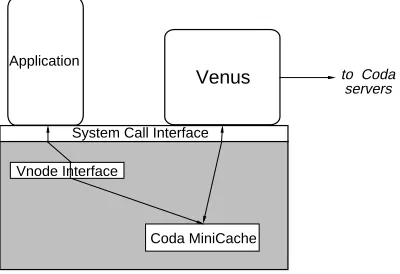
level process rather than part of the kernel. The latter approach may have yielded better performance, but would have been less portable and considerably more difficult to debug. Figure 2 illustrates the high-level structure of a Coda client.
Hoarding
Emulation Reintegration
disconnection
physical reconnection
logical reconnection
When disconnected, Venus is in the emulation state. It transits to reintegration upon successful reconnection to an AVSG member, and thence to hoarding, where it resumes connected operation.
Figure 3: Venus States and Transitions Coda MiniCache
Application
Venus
System Call Interface
Vnode Interface
to Coda servers
4.3. Hoarding
Figure 2: Structure of a Coda Client
The hoarding state is so named because a key responsibility of Venus in this state is to hoard useful data in anticipation Venus intercepts Unix file system calls via the widely-used
of disconnection. However, this is not its only Sun Vnode interface [10]. Since this interface imposes a
responsibility. Rather, Venus must manage its cache in a heavy performance overhead on user-level cache managers,
manner that balances the needs of connected and we use a tiny in-kernel MiniCache to filter out many
disconnected operation. For instance, a user may have kernel-Venus interactions. The MiniCache contains no
indicated that a certain set of files is critical but may support for remote access, disconnected operation or server
currently be using other files. To provide good replication; these functions are handled entirely by Venus.
performance, Venus must cache the latter files. But to be prepared for disconnection, it must also cache the former A system call on a Coda object is forwarded by the Vnode
set of files. interface to the MiniCache. If possible, the call is serviced
by the MiniCache and control is returned to the application.
Many factors complicate the implementation of hoarding: Otherwise, the MiniCache contacts Venus to service the
•File reference behavior, especially in the call. This, in turn, may involve contacting Coda servers.
distant future, cannot be predicted with Control returns from Venus via the MiniCache to the
certainty. application program, updating MiniCache state as a side
effect. MiniCache state changes may also be initiated by •Disconnections and reconnections are often unpredictable.
Venus on events such as callback breaks from Coda
servers. Measurements from our implementation confirm •
The true cost of a cache miss while that the MiniCache is critical for good performance [20]. disconnected is highly variable and hard to
quantify.
•Activity at other clients must be accounted for,
4.2. Venus States
so that the latest version of an object is in the Logically, Venus operates in one of three states: hoarding,
cache at disconnection. emulation, and reintegration. Figure 3 depicts these states
and the transitions between them. Venus is normally in the •Since cache space is finite, the availability of less critical objects may have to be sacrificed hoarding state, relying on server replication but always on
in favor of more critical objects. the alert for possible disconnection. Upon disconnection, it
enters the emulation state and remains there for the To address these concerns, we manage the cache using a duration of disconnection. Upon reconnection, Venus prioritized algorithm, and periodically reevaluate which enters the reintegration state, resynchronizes its cache with objects merit retention in the cache via a process known as its AVSG, and then reverts to the hoarding state. Since all hoard walking.
# Personal files # X11 files # Venus source files
a /coda/usr/jjk d+ # (from X11 maintainer) # (shared among Coda developers) a /coda/usr/jjk/papers 100:d+ a /usr/X11/bin/X a /coda/project/coda/src/venus 100:c+ a /coda/usr/jjk/papers/sosp 1000:d+ a /usr/X11/bin/Xvga a /coda/project/coda/include 100:c+
a /usr/X11/bin/mwm a /coda/project/coda/lib c+ # System files a /usr/X11/bin/startx
a /usr/bin 100:d+ a /usr/X11/bin/xclock
(c)
a /usr/etc 100:d+ a /usr/X11/bin/xinit a /usr/include 100:d+ a /usr/X11/bin/xterm
a /usr/lib 100:d+ a /usr/X11/include/X11/bitmaps c+ a /usr/local/gnu d+ a /usr/X11/lib/app-defaults d+ a /usr/local/rcs d+ a /usr/X11/lib/fonts/misc c+ a /usr/ucb d+ a /usr/X11/lib/system.mwmrc
(a) (b)
These are typical hoard profiles provided by a Coda user, an application maintainer, and a group of project developers. Each profile is interpreted separately by the HDB front-end program. The ’a’ at the beginning of a line indicates an add-entry command. Other commands are delete an entry, clear all entries, and list entries. The modifiers following some pathnames specify non-default priorities (the default is 10) and/or meta-expansion for the entry. Note that the pathnames beginning with ’/usr’ are actually symbolic links into ’/coda’.
Figure 4: Sample Hoard Profiles
4.3.1. Prioritized Cache Management To resolve the pathname of a cached object while
Venus combines implicit and explicit sources of disconnected, it is imperative that all the ancestors of the information in its priority-based cache management object also be cached. Venus must therefore ensure that a algorithm. The implicit information consists of recent cached directory is not purged before any of its reference history, as in traditional caching algorithms. descendants. This hierarchical cache management is not Explicit information takes the form of a per-workstation needed in traditional file caching schemes because cache hoard database (HDB), whose entries are pathnames misses during name translation can be serviced, albeit at a identifying objects of interest to the user at that performance cost. Venus performs hierarchical cache
workstation. management by assigning infinite priority to directories
with cached children. This automatically forces A simple front-end program allows a user to update the replacement to occur bottom-up.
HDB using command scripts called hoard profiles, such as those shown in Figure 4. Since hoard profiles are just files,
4.3.2. Hoard Walking it is simple for an application maintainer to provide a
We say that a cache is in equilibrium, signifying that it common profile for his users, or for users collaborating on
meets user expectations about availability, when no a project to maintain a common profile. A user can
uncached object has a higher priority than a cached object. customize his HDB by specifying different combinations of
Equilibrium may be disturbed as a result of normal activity. profiles or by executing front-end commands interactively.
For example, suppose an object, A, is brought into the To facilitate construction of hoard profiles, Venus can
cache on demand, replacing an object, B. Further suppose record all file references observed between a pair of start
that B is mentioned in the HDB, but A is not. Some time and stop events indicated by a user.
after activity on A ceases, its priority will decay below the hoard priority of B. The cache is no longer in equilibrium, To reduce the verbosity of hoard profiles and the effort
since the cached object A has lower priority than the needed to maintain them, Venus supports meta-expansion
uncached object B. of HDB entries. As shown in Figure 4, if the letter ’c’ (or
’d’) follows a pathname, the command also applies to
Venus periodically restores equilibrium by performing an immediate children (or all descendants). A ’+’ following
operation known as a hoard walk. A hoard walk occurs the ’c’ or ’d’ indicates that the command applies to all
every 10 minutes in our current implementation, but one future as well as present children or descendents. A hoard
may be explicitly requested by a user prior to voluntary entry may optionally indicate a hoard priority, with higher
disconnection. The walk occurs in two phases. First, the priorities indicating more critical objects.
name bindings of HDB entries are reevaluated to reflect update activity by other Coda clients. For example, new The current priority of a cached object is a function of its
children may have been created in a directory whose hoard priority as well as a metric representing recent usage.
pathname is specified with the ’+’ option in the HDB. The latter is updated continuously in response to new
Second, the priorities of all entries in the cache and HDB references, and serves to age the priority of objects no
are reevaluated, and objects fetched or evicted as needed to longer in the working set. Objects of the lowest priority
restore equilibrium. are chosen as victims when cache space has to be
4.4.1. Logging Hoard walks also address a problem arising from callback
During emulation, Venus records sufficient information to breaks. In traditional callback-based caching, data is
replay update activity when it reintegrates. It maintains refetched only on demand after a callback break. But in
this information in a per-volume log of mutating operations Coda, such a strategy may result in a critical object being
called a replay log. Each log entry contains a copy of the unavailable should a disconnection occur before the next
corresponding system call arguments as well as the version reference to it. Refetching immediately upon callback
state of all objects referenced by the call. break avoids this problem, but ignores a key characteristic
of Unix environments: once an object is modified, it is
Venus uses a number of optimizations to reduce the length likely to be modified many more times by the same user
of the replay log, resulting in a log size that is typically a within a short interval [14, 6]. An immediate refetch
few percent of cache size. A small log conserves disk policy would increase client-server traffic considerably,
space, a critical resource during periods of disconnection. thereby reducing scalability.
It also improves reintegration performance by reducing latency and server load.
Our strategy is a compromise that balances availability, consistency, and scalability. For files and symbolic links,
One important optimization to reduce log length pertains to Venus purges the object on callback break, and refetches it
write operations on files. Since Coda uses whole-file on demand or during the next hoard walk, whichever
caching, the close after an open of a file for
occurs earlier. If a disconnection were to occur before
modification installs a completely new copy of the file. refetching, the object would be unavailable. For
Rather than logging the open, close,and intervening directories, Venus does not purge on callback break, but
write operations individually, Venus logs a single marks the cache entry suspicious. A stale cache entry is
storerecord during the handling of aclose. thus available should a disconnection occur before the next
hoard walk or reference. The acceptability of stale
Another optimization consists of Venus discarding a directory data follows from its particular callback
previous store record for a file when a new one is semantics. A callback break on a directory typically means
appended to the log. This follows from the fact that a that an entry has been added to or deleted from the
storerenders all previous versions of a file superfluous. directory. It is often the case that other directory entries
The store record does not contain a copy of the file’s and the objects they name are unchanged. Therefore,
contents, but merely points to the copy in the cache. saving the stale copy and using it in the event of untimely
disconnection causes consistency to suffer only a little, but We are currently implementing two further optimizations increases availability considerably. to reduce the length of the replay log. The first generalizes
the optimization described in the previous paragraph such that any operation which overwrites the effect of earlier
4.4. Emulation operations may cancel the corresponding log records. An
In the emulation state, Venus performs many actions example would be the cancelling of a store by a
normally handled by servers. For example, Venus now subsequent unlink or truncate. The second
assumes full responsibility for access and semantic checks. optimization exploits knowledge of inverse operations to It is also responsible for generating temporary file cancel both the inverting and inverted log records. For identifiers (fids) for new objects, pending the assignment of example, armdirmay cancel its own log record as well permanent fids at reintegration. But although Venus is as that of the correspondingmkdir.
functioning as a pseudo-server, updates accepted by it have to be revalidated with respect to integrity and protection by
4.4.2. Persistence real servers. This follows from the Coda policy of trusting
A disconnected user must be able to restart his machine only servers, not clients. To minimize unpleasant delayed
after a shutdown and continue where he left off. In case of surprises for a disconnected user, it behooves Venus to be
a crash, the amount of data lost should be no greater than if as faithful as possible in its emulation.
the same failure occurred during connected operation. To provide these guarantees, Venus must keep its cache and Cache management during emulation is done with the same
related data structures in non-volatile storage. priority algorithm used during hoarding. Mutating
operations directly update the cache entries of the objects
Meta-data, consisting of cached directory and symbolic involved. Cache entries of deleted objects are freed
link contents, status blocks for cached objects of all types, immediately, but those of other modified objects assume
replay logs, and the HDB, is mapped into Venus’ address infinite priority so that they are not purged before
space as recoverable virtual memory (RVM).
reintegration. On a cache miss, the default behavior of
Transactional access to this memory is supported by the Venus is to return an error code. A user may optionally
RVM library [12] linked into Venus. The actual contents request Venus to block his processes until cache misses can
of cached files are not in RVM, but are stored as local Unix 4.5. Reintegration
files. Reintegration is a transitory state through which Venus
passes in changing roles from pseudo-server to cache The use of transactions to manipulate meta-data simplifies manager. In this state, Venus propagates changes made Venus’ job enormously. To maintain its invariants Venus during emulation, and updates its cache to reflect current need only ensure that each transaction takes meta-data from server state. Reintegration is performed a volume at a time, one consistent state to another. It need not be concerned with all update activity in the volume suspended until with crash recovery, since RVM handles this transparently. completion.
If we had chosen the obvious alternative of placing meta-data in local Unix files, we would have had to follow a
4.5.1. Replay Algorithm strict discipline of carefully timed synchronous writes and
The propagation of changes from client to AVSG is an ad-hoc recovery algorithm.
accomplished in two steps. In the first step, Venus obtains permanent fids for new objects and uses them to replace RVM supports local, non-nested transactions and allows
temporary fids in the replay log. This step is avoided in independent control over the basic transactional properties
many cases, since Venus obtains a small supply of of atomicity, permanence, and serializability. An
permanent fids in advance of need, while in the hoarding application can reduce commit latency by labelling the
state. In the second step, the replay log is shipped in commit as no-flush, thereby avoiding a synchronous write
parallel to the AVSG, and executed independently at each to disk. To ensure persistence of no-flush transactions, the
member. Each server performs the replay within a single application must explicitly flush RVM’s write-ahead log
transaction, which is aborted if any error is detected. from time to time. When used in this manner, RVM
provides bounded persistence, where the bound is the
The replay algorithm consists of four phases. In phase one period between log flushes.
the log is parsed, a transaction is begun, and all objects referenced in the log are locked. In phase two, each Venus exploits the capabilities of RVM to provide good
operation in the log is validated and then executed. The performance at a constant level of persistence. When
validation consists of conflict detection as well as integrity, hoarding, Venus initiates log flushes infrequently, since a
protection, and disk space checks. Except in the case of copy of the data is available on servers. Since servers are
store operations, execution during replay is identical to not accessible when emulating, Venus is more conservative
execution in connected mode. For a store, an empty and flushes the log more frequently. This lowers
shadow file is created and meta-data is updated to reference performance, but keeps the amount of data lost by a client
it, but the data transfer is deferred. Phase three consists crash within acceptable limits.
exclusively of performing these data transfers, a process known as back-fetching. The final phase commits the 4.4.3. Resource Exhaustion
transaction and releases all locks. It is possible for Venus to exhaust its non-volatile storage
during emulation. The two significant instances of this are If reintegrations succeeds, Venus frees the replay log and the file cache becoming filled with modified files, and the resets the priority of cached objects referenced by the log. RVM space allocated to replay logs becoming full. If reintegration fails, Venus writes out the replay log to a local replay file in a superset of the Unixtarformat. The Our current implementation is not very graceful in
log and all corresponding cache entries are then purged, so handling these situations. When the file cache is full, space
that subsequent references will cause refetch of the current can be freed by truncating or deleting modified files.
contents at the AVSG. A tool is provided which allows the When log space is full, no further mutations are allowed
user to inspect the contents of a replay file, compare it to until reintegration has been performed. Of course,
non-the state at non-the AVSG, and replay it selectively or in its mutating operations are always allowed.
entirety.
We plan to explore at least three alternatives to free up disk
Reintegration at finer granularity than a volume would space while emulating. One possibility is to compress file
reduce the latency perceived by clients, improve cache and RVM contents. Compression trades off
concurrency and load balancing at servers, and reduce user computation time for space, and recent work [2] has shown
effort during manual replay. To this end, we are revising it to be a promising tool for cache management. A second
our implementation to reintegrate at the granularity of possibility is to allow users to selectively back out updates
subsequences of dependent operations within a volume. made while disconnected. A third approach is to allow
Dependent subsequences can be identified using the portions of the file cache and RVM to be written out to precedence graph approach of Davidson [4]. In the revised removable media such as floppy disks.
4.5.2. Conflict Handling In the following sections we provide qualitative and Our use of optimistic replica control means that the quantitative answers to three important questions disconnected operations of one client may conflict with pertaining to disconnected operation. These are:
activity at servers or other disconnected clients. The only 1. How long does reintegration take? class of conflicts we are concerned with are write/write
2. How large a local disk does one need? conflicts. Read/write conflicts are not relevant to the Unix
file system model, since it has no notion of atomicity 3. How likely are conflicts? beyond the boundary of a single system call.
The check for conflicts relies on the fact that each replica 5.1. Duration of Reintegration
of an object is tagged with a storeid that uniquely identifies In our experience, typical disconnected sessions of editing the last update to it. During phase two of replay, a server and program development lasting a few hours require about compares the storeid of every object mentioned in a log a minute for reintegration. To characterize reintegration entry with the storeid of its own replica of the object. If the speed more precisely, we measured the reintegration times comparison indicates equality for all objects, the operation after disconnected execution of two well-defined tasks. is performed and the mutated objects are tagged with a new The first task is the Andrew benchmark [9], now widely
storeid specified in the log entry. used as a basis for comparing file system performance.
The second task is the compiling and linking of the current If a storeid comparison fails, the action taken depends on
version of Venus. Table 1 presents the reintegration times the operation being validated. In the case of astoreof a
for these tasks. file, the entire reintegration is aborted. But for directories,
a conflict is declared only if a newly created name collides The time for reintegration consists of three components: with an existing name, if an object updated at the client or the time to allocate permanent fids, the time for the replay the server has been deleted by the other, or if directory at the servers, and the time for the second phase of the attributes have been modified at the server and the client. update protocol used for server replication. The first This strategy of resolving partitioned directory updates is component will be zero for many disconnections, due to consistent with our strategy in server replication [11], and the preallocation of fids during hoarding. We expect the
was originally suggested by Locus [22]. time for the second component to fall, considerably in
many cases, as we incorporate the last of the replay log Our original design for disconnected operation called for
optimizations described in Section 4.4.1. The third preservation of replay files at servers rather than clients.
component can be avoided only if server replication is not This approach would also allow damage to be confined by
used. marking conflicting replicas inconsistent and forcing
manual repair, as is currently done in the case of server One can make some interesting secondary observations replication. We are awaiting more usage experience to from Table 1. First, the total time for reintegration is determine whether this is indeed the correct approach for roughly the same for the two tasks even though the Andrew
disconnected operation. benchmark has a much smaller elapsed time. This is
because the Andrew benchmark uses the file system more intensively. Second, reintegration for the Venus make
5. Status and Evaluation
takes longer, even though the number of entries in theToday, Coda runs on IBM RTs, Decstation 3100s and replay log is smaller. This is because much more file data 5000s, and 386-based laptops such as the Toshiba 5200. A is back-fetched in the third phase of the replay. Finally, small user community has been using Coda on a daily basis neither task involves any think time. As a result, their as its primary data repository since April 1990. All reintegration times are comparable to that after a much development work on Coda is done in Coda itself. As of longer, but more typical, disconnected session in our July 1991 there were nearly 350MB of triply-replicated environment.
data in Coda, with plans to expand to 2GB in the next few months.
5.2. Cache Size
A version of disconnected operation with minimal
A local disk capacity of 100MB on our clients has proved functionality was demonstrated in October 1990. A more
adequate for our initial sessions of disconnected operation. complete version was functional in January 1991, and is
To obtain a better understanding of the cache size now in regular use. We have successfully operated
requirements for disconnected operation, we analyzed file disconnected for periods lasting four to five hours. Our
reference traces from our environment. The traces were experience with the system has been quite positive, and we
obtained by instrumenting workstations to record are confident that the refinements under development will
Andrew Benchmark
Venus Make
Elapsed Time (seconds)
Reintegration Time (seconds)
Total AllocFid Replay COP2
Size of Replay Log
Records Bytes
Data Back-Fetched (Bytes)
223 65,010
193 65,919
1,141,315
2,990,120 288 (3)
3,271 (28)
43 (2) 4 (2) 29 (1) 10 (1)
52 (4) 1 (0) 40 (1) 10 (3)
This data was obtained with a Toshiba T5200/100 client (12MB memory, 100MB disk) reintegrating over an Ethernet with an IBM RT-APC server (12MB memory, 400MB disk). The values shown above are the means of three trials. Figures in parentheses are standard deviations.
Table 1: Time for Reintegration
Our analysis is based on simulations driven by these traces. We plan to extend our work on trace-driven simulations in Writing and validating a simulator that precisely models three ways. First, we will investigate cache size the complex caching behavior of Venus would be quite requirements for much longer periods of disconnection. difficult. To avoid this difficulty, we have modified Venus Second, we will be sampling a broader range of user to act as its own simulator. When running as a simulator, activity by obtaining traces from many more machines in Venus is driven by traces rather than requests from the our environment. Third, we will evaluate the effect of kernel. Code to communicate with the servers, as well hoarding by simulating traces together with hoard profiles code to perform physical I/O on the local file system are that have been specified ex ante by users.
stubbed out during simulation.
5.3. Likelihood of Conflicts
In our use of optimistic server replication in Coda for nearly a year, we have seen virtually no conflicts due to multiple users updating an object in different network partitions. While gratifying to us, this observation is subject to at least three criticisms. First, it is possible that our users are being cautious, knowing that they are dealing with an experimental system. Second, perhaps conflicts will become a problem only as the Coda user community grows larger. Third, perhaps extended voluntary disconnections will lead to many more conflicts.
Time (hours)
2 4 6 8 10 12
High-Water Mark (megabytes)
10 20 30 40 50
0
Max Avg Min
To obtain data on the likelihood of conflicts at larger scale,
This graph is based on a total of 10 traces from 5 active we instrumented the AFS servers in our environment.
Coda workstations. The curve labelled "Avg" These servers are used by over 400 computer science
corresponds to the values obtained by averaging the
faculty, staff and graduate students for research, program
high-water marks of all workstations. The curves
development, and education. Their usage profile includes a
labelled "Max" and "Min" plot the highest and lowest
values of the high-water marks across all workstations. significant amount of collaborative activity. Since Coda is Note that the high-water mark does not include space
descended from AFS and makes the same kind of usage
needed for paging, the HDB or replay logs.
assumptions, we can use this data to estimate how frequent Figure 5: High-Water Mark of Cache Usage conflicts would be if Coda were to replace AFS in our
environment. Figure 5 shows the high-water mark of cache usage as a
Every time a user modifies an AFS file or directory, we function of time. The actual disk size needed for
compare his identity with that of the user who made the disconnected operation has to be larger, since both the
previous mutation. We also note the time interval between explicit and implicit sources of hoarding information are
mutations. For a file, only theclose after anopen for imperfect. From our data it appears that a disk of
update is counted as a mutation; individual write 50-60MB should be adequate for operating disconnected
operations are not counted. For directories, all operations for a typical workday. Of course, user activity that is
that modify a directory are counted as mutations. drastically different from what was recorded in our traces
Type of Volume
Number of Volumes
Type of Object
Total
Mutations Same User
Total < 1min < 10 min < 1hr < 1 day < 1 wk
User 529 Files
3,287,135 99.87 %
108 Project
Directories 4,132,066 99.80 %
Files 4,437,311 99.66 % Directories 5,391,224 99.63 %
System 398 Files 5,526,700 99.17 % Directories 4,338,507 99.54 %
Different User
0.04 % 0.13 % 0.20 % 0.04 %
0.34 % 0.17 % 0.37 % 0.00 %
0.83 % 0.06 % 0.46 % 0.02 %
0.05 % 0.07 %
0.25 % 0.01 %
0.18 % 0.05 %
0.06 % 0.10 %
0.26 % 0.03 %
0.42 % 0.08 %
0.09 % 0.15 %
0.28 % 0.09 %
0.72 % 0.27 %
0.15 % 0.09 % 0.16 %
0.30 %
0.78 % 0.34 %
This data was obtained between June 1990 and May 1991 from the AFS servers in thecs.cmu.educell. The servers stored a total of about 12GB of data. The column entitled "Same User" gives the percentage of mutations in which the user performing the mutation was the same as the one performing the immediately preceding mutation on the same file or directory. The remaining mutations contribute to the column entitled "Different User".
Table 2: Sequential Write-Sharing in AFS
Table 2 presents our observations over a period of twelve By providing tools to link local and remote name spaces, months. The data is classified by volume type: user the Cedar file system [19] provided rudimentary support volumes containing private user data, project volumes used for disconnected operation. But since this was not its for collaborative work, and system volumes containing primary goal, Cedar did not provide support for hoarding, program binaries, libraries, header files and other similar transparent reintegration or conflict detection. Files were data. On average, a project volume has about 2600 files versioned and immutable, and a Cedar cache manager and 280 directories, and a system volume has about 1600 could substitute a cached version of a file on reference to files and 130 directories. User volumes tend to be smaller, an unqualified remote file whose server was inaccessible. averaging about 200 files and 18 directories, because users However, the implementors of Cedar observe that this often place much of their data in their project volumes. capability was not often exploited since remote files were
normally referenced by specific version number. Table 2 shows that over 99% of all modifications were by
the previous writer, and that the chances of two different Birrell and Schroeder pointed out the possibility of users modifying the same object less than a day apart is at "stashing" data for availability in an early discussion of the most 0.75%. We had expected to see the highest degree of Echo file system [13]. However, a more recent description write-sharing on project files or directories, and were of Echo [8] indicates that it uses stashing only for the surprised to see that it actually occurs on system files. We highest levels of the naming hierarchy.
conjecture that a significant fraction of this sharing arises
The FACE file system [3] uses stashing but does not from modifications to system files by operators, who
integrate it with caching. The lack of integration has at change shift periodically. If system files are excluded, the
least three negative consequences. First, it reduces absence of write-sharing is even more striking: more than
transparency because users and applications deal with two 99.5% of all mutations are by the previous writer, and the
different name spaces, with different consistency chances of two different users modifying the same object
properties. Second, utilization of local disk space is likely within a week are less than 0.4%! This data is highly
to be much worse. Third, recent usage information from encouraging from the point of view of optimistic
cache management is not available to manage the stash. replication. It suggests that conflicts would not be a
The available literature on FACE does not report on how serious problem if AFS were replaced by Coda in our
much the lack of integration detracted from the usability of environment.
the system.
An application-specific form of disconnected operation was
6. Related Work
implemented in the PCMAIL system at MIT [Lambert88]. Coda is unique in that it exploits caching for both
PCMAIL allowed clients to disconnect, manipulate performance and high availability while preserving a high
existing mail messages and generate new ones, and re-degree of transparency. We are aware of no other system,
synchronize with a central repository at reconnection. published or unpublished, that duplicates this key aspect of
Besides relying heavily on the semantics of mail, PCMAIL Coda.
re-synchronization as well as pre-registration of clients changes made while disconnected, and replay them upon
with servers. reconnection.
The use of optimistic replication in distributed file systems Implementing disconnected operation is not so simple. It was pioneered by Locus [22]. Since Locus used a peer-to- involves major modifications and careful attention to detail peer model rather than a client-server model, availability in many aspects of cache management. While hoarding, a was achieved solely through server replication. There was surprisingly large volume and variety of interrelated state no notion of caching, and hence of disconnected operation. has to be maintained. When emulating, the persistence and integrity of client data structures become critical. During Coda has benefited in a general sense from the large body reintegration, there are dynamic choices to be made about of work on transparency and performance in distributed file the granularity of reintegration.
systems. In particular, Coda owes much to AFS [18], from
which it inherits its model of trust and integrity, as well as Only in hindsight do we realize the extent to which its mechanisms and design philosophy for scalability. implementations of traditional caching schemes have been simplified by the guaranteed presence of a lifeline to a first-class replica. Purging and refetching on demand, a strategy often used to handle pathological situations in
7. Future Work
those implementations, is not viable when supporting Disconnected operation in Coda is a facility under active
disconnected operation. However, the obstacles to development. In earlier sections of this paper we described
realizing disconnected operation are not insurmountable. work in progress in the areas of log optimization,
Rather, the central message of this paper is that granularity of reintegration, and evaluation of hoarding.
disconnected operation is indeed feasible, efficient and Much additional work is also being done at lower levels of
usable. the system. In this section we consider two ways in which
the scope of our work may be broadened.
One way to view our work is to regard it as an extension of the idea of write-back caching. Whereas write-back An excellent opportunity exists in Coda for adding
caching has hitherto been used for performance, we have transactional support to Unix. Explicit transactions
shown that it can be extended to mask temporary failures become more desirable as systems scale to hundreds or
too. A broader view is that disconnected operation allows thousands of nodes, and the informal concurrency control
graceful transitions between states of autonomy and of Unix becomes less effective. Many of the mechanisms
interdependence in a distributed system. Under favorable supporting disconnected operation, such as operation
conditions, our approach provides all the benefits of remote logging, precedence graph maintenance, and conflict
data access; under unfavorable conditions, it provides checking would transfer directly to a transactional system
continued access to critical data. We are certain that using optimistic concurrency control. Although
disconnected operation will become increasingly important transactional file systems are not a new idea, no such
as distributed systems grow in scale, diversity and system with the scalability, availability, and performance
vulnerability. properties of Coda has been proposed or built.
A different opportunity exists in extending Coda to support
weakly-connected operation, in environments where
Acknowledgments
connectivity is intermittent or of low bandwidth. Such We wish to thank Lily Mummert for her invaluable assistance in collecting and postprocessing the file reference traces used in conditions are found in networks that rely on voice-grade
Section 5.2, and Dimitris Varotsis, who helped instrument the lines, or that use wireless technologies such as packet
AFS servers which yielded the measurements of Section 5.3. We radio. The ability to mask failures, as provided by also wish to express our appreciation to past and present disconnected operation, is of value even with weak contributors to the Coda project, especially Puneet Kumar, Hank connectivity. But techniques which exploit and adapt to Mashburn, Maria Okasaki, and David Steere.
the communication opportunities at hand are also needed. Such techniques may include more aggressive write-back
policies, compressed network transmission, partial file
References
transfer, and caching at intermediate levels.[1] Burrows, M.
Efficient Data Sharing.
PhD thesis, University of Cambridge, Computer
8. Conclusion
Laboratory, December, 1988.[2] Cate, V., Gross, T. [14] Ousterhout, J., Da Costa, H., Harrison, D., Kunze, J., Combining the Concepts of Compression and Caching for Kupfer, M., Thompson, J.
a Two-Level File System. A Trace-Driven Analysis of the 4.2BSD File System. In Proceedings of the 4th ACM Symposium on In Proceedings of the 10th ACM Symposium on Operating
Architectural Support for Programming Languages System Principles. December, 1985. and Operating Systems. April, 1991.
[15] Sandberg, R., Goldberg, D., Kleiman, S., Walsh, D., Lyon,
[3] Cova, L.L. B.
Resource Management in Federated Computing Design and Implementation of the Sun Network
Environments. Filesystem.
PhD thesis, Department of Computer Science, Princeton In Summer Usenix Conference Proceedings. 1985. University, October, 1990.
[16] Satyanarayanan, M.
[4] Davidson, S.B. On the Influence of Scale in a Distributed System.
Optimism and Consistency in Partitioned Distributed In Proceedings of the 10th International Conference on
Database Systems. Software Engineering. April, 1988.
ACM Transactions on Database Systems 9(3), September,
[17] Satyanarayanan, M., Kistler, J.J., Kumar, P., Okasaki, 1984.
M.E., Siegel, E.H., Steere, D.C.
[5] Davidson, S.B., Garcia-Molina, H., Skeen, D. Coda: A Highly Available File System for a Distributed Consistency in Partitioned Networks. Workstation Environment.
ACM Computing Surveys 17(3), September, 1985. IEEE Transactions on Computers 39(4), April, 1990.
[6] Floyd, R.A. [18] Satyanarayanan, M.
Transparency in Distributed File Systems. Scalable, Secure, and Highly Available Distributed File Technical Report TR 272, Department of Computer Access.
Science, University of Rochester, 1989. IEEE Computer 23(5), May, 1990.
[7] Gray, C.G., Cheriton, D.R. [19] Schroeder, M.D., Gifford, D.K., Needham, R.M. Leases: An Efficient Fault-Tolerant Mechanism for A Caching File System for a Programmer’s Workstation.
Distributed File Cache Consistency. In Proceedings of the 10th ACM Symposium on Operating In Proceedings of the 12th ACM Symposium on Operating System Principles. December, 1985.
System Principles. December, 1989.
[20] Steere, D.C., Kistler, J.J., Satyanarayanan, M.
[8] Hisgen, A., Birrell, A., Mann, T., Schroeder, M., Swart, G. Efficient User-Level Cache File Management on the Sun Availability and Consistency Tradeoffs in the Echo Vnode Interface.
Distributed File System. In Summer Usenix Conference Proceedings. June, 1990. In Proceedings of the Second Workshop on Workstation
[21] Decorum File System Operating Systems. September, 1989.
Transarc Corporation, 1990. [9] Howard, J.H., Kazar, M.L., Menees, S.G., Nichols, D.A.,
[22] Walker, B., Popek, G., English, R., Kline, C., Thiel, G. Satyanarayanan, M., Sidebotham, R.N., West, M.J.
The LOCUS Distributed Operating System. Scale and Performance in a Distributed File System.
In Proceedings of the 9th ACM Symposium on Operating
ACM Transactions on Computer Systems 6(1), February,
System Principles. October, 1983.
1988.
[10] Kleiman, S.R.
Vnodes: An Architecture for Multiple File System Types in Sun UNIX.
In Summer Usenix Conference Proceedings. 1986.
[11] Kumar, P., Satyanarayanan, M.
Log-Based Directory Resolution in the Coda File System.
Technical Report CMU-CS-91-164, School of Computer Science, Carnegie Mellon University, 1991.
[12] Mashburn, H., Satyanarayanan, M.
RVM: Recoverable Virtual Memory User Manual
School of Computer Science, Carnegie Mellon University, 1991.
[13] Needham, R.M., Herbert, A.J.
Report on the Third European SIGOPS Workshop: "Autonomy or Interdependence in Distributed Systems".