R E S E A R C H A R T I C L E
Open Access
A solid-phase extraction method using
Transcarpathian clinoptilolite for preconcentration
of trace amounts of terbium in water samples
Volodymyr O. Vasylechko
1,2*, Galyna V. Gryshchouk
1, Victor P. Zakordonskiy
1, Olga Vyviurska
1and Andriy V. Pashuk
3Abstract
Background:In spite of the fact that terbium is one of the rarest elements in the Earth’s crust, it is frequently used for the production of high technological materials. At the result, an effective combination of sample preparation procedure and detection method for terbium ions in different matrices is highly required. The solid-phase extraction procedure with natural Transcarpathian clinoptilolite thermally activated at 350 °C was used to preconcentrate trace amounts of terbium ions in aqueous solutions for a final spectrophotometric determination with arsenazo III.
Results:Thermogravimetric investigations confirmed the existence of relations between changes that appeared during dehydratation of calcined zeolite and its sorption affinity. Since the maximum of sorption capacity towards terbium was observed at pH 8.25, a borate buffer medium (2.5 · 10−4М) was used to maintain ionic force and solution acidity. Terbium was quantitatively removed from the solid-phase extraction column with a 1.0 M solution of sodium chloride (pH 2.5). The linearity of the proposed method was evaluated in the range of 2.5-200 ng · mL−1with detection limit 0.75 ng · mL−1.
Conclusions:Due to acceptable recoveries (93.3–102.0 %) and RSD values (6–7.1) from spiked tap water, the developed method can be successfully applied for the determination of trace amounts of terbium ions in the presence of major components of water.
Keywords:Preconcentration, Terbium, Solid-phase extraction, Clinoptilolite
Background
Terbium belongs to the rarest elements, participating with 1.1 · 10−4% in the composition of the Earth’s crust [1], and this is only 1.0 % among all lanthanides including yttrium. At the same time terbium compounds have been widely ap-plied for luminophores, magnetic and laser materials. Fur-thermore, this lanthanide was detected in sea and mineral waters [2] as well as in some wines at the microlevel. For example, the content of terbium and other rare earth ele-ments was used for authentication of Hungarian wines [3]. In general, the determination of microelements from real samples and wastewaters requires a proper sample prepar-ation procedure, including such steps as preconcentrprepar-ation,
separation and isolation from natural objects and process liquors. In this case, ion exchange and extrac-tion chromatography were found to be effective and fast for the separation of trace amounts of rare earth elements [4, 5]. At the same time, the solid-phase extraction (SPE) has also become quite popular sample preparation procedure for trace analysis [5–9], allows to reduce solvent consumption due to a simplified pro-cedure of the solvent removal. Furthermore, SPE could be easily combined with the selective and high sensitive methods of the analysis, e.g. atomic absorption spectros-copy [9, 10] and inductively coupled plasma spectrosspectros-copy [5–7]. A variety of sorbents such as modified high dis-persed silica [5, 11, 12], activated carbon [5, 13, 14], poly-urethane foams [15, 16], polymeric resins [9, 17], carbosilicon [18], synthetic zeolites [19] are commonly used for solid phase extraction. In recent years, the popu-larity of natural zeolites has increased for SPE applications [6, 10, 20–29], because of a number of advantages over * Correspondence:[email protected]
1
Faculty of Chemistry, Ivan Franko National University of Lviv, 6 Kyryla and Mefodiya St., 79005 Lviv, Ukraine
2
Department of Chemistry and Physics, Lviv Academy of Commerce, 9 Samchuka St., 79011 Lviv, Ukraine
Full list of author information is available at the end of the article
the other sorbents. For example, these natural alumino-silicate minerals contain pores and cavities with strictly defined size and shape, and it provides very effective concentration and separation of organic and inorganic compounds. In addition, zeolites have mechanical strength, good stability in aggressive medium and under thermal treatment, ability to sorb the trace amounts of analytes, high sorption capacity and selectivity, possibil-ity of easy modification and regeneration of the sor-bent, low cost and accessibility. The sorption properties of Transcarpathian clinoptilolite towards terbium ions were described in our previous work [30]. The aim of this study is to complete these investigations and to develop a simple sample preparation procedure for the spectrophoto-metric detection of trace amounts of terbium ions in aque-ous solutions.
Experimental
Reagents and apparatus
All used reagents were of analytical grade. Standard aque-ous solutions of terbium(III) nitrate (1.0 mg · mL−1) were prepared by dissolution of metallic terbium (99.9 % purity) in nitric acid (1:1). The following solutions were also used for the experiments: a 0.05 % solution of sulfarsazene in a 0.05 M borax solution, a 0.05 % aqueous solution of arsenazo III, a 1 % ascorbic acid solution, a formic buffer solution (60 mL of formic acid and 28 g of NaOH are dis-solved in 1.0 L of water), a 1 M sodium chloride solution, a 5 % sulphosalicylic acid solution, a 0.2 M EDTA solu-tion, a 0.1 M aqueous solutions of NaOH and Na2B4O7,
and a borate buffer solution with pH 8.25 (595 mL of 0.05 M Na2B4O7diluted to 1.0 L with 0.1 M HCl).
Clinoptilo-lite samples with 85–90 % of the main component content were taken from the deposit near the village Sokirnytsia in the Ukrainian Transcarpathian region. The specific sur-face area measured with water sorption was found to be 59 m2· g−1 [31]. The chemical composition of Transcar-pathian clinoptilolite is (in %): SiO2, 67.29; TiO2, 0.26;
Al2O3, 12.32; Fe2O3, 1.26; FeO, 0.25; MgO, 0.99; CaO,
3.01; Na2O, 0.66; K2O, 2.76; H2O, 10.90 [32]. The thermal
heating of Transcarpathian clinoptilolite was carried out for 2.5 h in the oven. The results of the X-ray analysis of the calcined Transcarpathian clinoptilolite were described in details in our previous study [33]. Spectrophotometric determination was performed on a HACH DR/4000 V spectrophotometer. X-ray fluorescence investigations were carried out on an Expert 3 L multi element rapid response analyzer (INAM, Ukraine) with semiconducting PIN-detector (AMPTEK, USA) on thermoelectric cooling. A low-power X-ray tube was operated at 45 kV (current 0.1 mA, output 4.5 W). In this case, 2 mL of the sample was placed into the cuvette, and Tb Lαline radiation was mea-sured for 285 s. The Paulik–Paulik–Erdey Q–1500D
(MOM, Hungary) system was employed for thermogravi-metric analysis.
Adsorption measurements
The sorption properties of clinoptilolite were studied under dynamic conditions using a peristaltic pump, and the procedure was described in details in our previous paper [34]. The metal solutions were passed through a sorption cartridge filled with 0.6 g of sorbent at a flow rate of 3 mL · min−1. A passing moment of terbium(III) ions (LDL, 100 ng · mL−1) was detected visually and/or spectrophotometrically at 540 nm with sulfarsazene as a chromogenic reagent, and additionally confirmed by X-ray fluorescence.
An acidified solution of sodium sulphate and mineral acids solutions were used for desorption of Tb(III) ions from clinoptilolite. In this case 15 mL of eluent was passed through the sorption cartridge at a flow rate of 1 mL · min−1. The obtained eluate was collected into a volumetric glass flask and made up to 25 mL using double-distilled water.Since selectivity of determination of Tb(III) ions with sulfarsazene was insufficient for the analysis of desorption filtrates, a content of Tb(III) ions was found spectrophotometrically with arsenazo III as a reagent [35, 36]. Interference of Fe(III), Al(III), Ca(II) and Mn(II) ions was eliminated by the addition of ascor-bic and sulphosalicylic acids, EDTA and Seignette salt to the system. The adsorption and desorption studies were carried out at a temperature of 20 ± 1 °C.
Method of spectrophotometric determination with arsenazo III
5 mL of an 1 % ascorbic acid solution, 4 mL of a 4 % sul-phosalicylic acid solution, 5 mL of a 0.2 M EDTA solution, 3 mL of a 5 % Seignette salt solution were mixed with 25 mL of the analysed solution (pH ~ 1). After 2 min, a mixture of 1 mL of a formic buffer solution (pH 3.5) and 4 mL of a 0.05 % arsenazo III solution was diluted with double-distilled water to approximately 40 mL and regu-lated to pH 2.6 ± 0.1 with a 0.1 M NaOH. The final volume of the solution was made up to 50 mL with double-distilled water, and the absorbance was measured specto-photometrically at 650 nm against the blank solution which contains all the reagents except for terbium(III) ions. The quantitative determination of terbium(III) ions was carried out in the final volume of the solution (in concen-tration range of 0.1–2μg · mL−1).
Thermogravimetric analysis
The analysis was performed under air conditions with the heating rate 10 °C · min−1from 50 to 900 °C with Al2O3as
drying oven or a muffle oven during 2.5 h and stored in a desiccator above a saturated solution of H2SO4.
Results and discussion
As can be seen from the Fig. 1, the sorption capacity of Transcarpathian clinoptilolite towards terbium(III) ions considerably depends on the pH of analyte solution and previous thermal treatment of the used zeolite. The most effective sorption was observed in the weak alkaline solu-tions (pH 8.25), where according to our previous studies [30], terbium(III) ions exist in three cation forms of Tb3+ (~25 %), TbOH2+ (~50 %) and Tb(OH)2+ (~25 %). In
order to maintain pH and improve the accuracy of the in-vestigations, a borate buffer was added to terbium solu-tion. Consequently, it was found that the same amounts of terbium(III) ions were concentrated from the solution adjusted to pH 8.25 with sodium hydroxide at once and from the solution which was firstly neutralized, then buff-ered to pH 8.25. Moreover, the use of the buffer solution provides a possibility to keep constant ionic strenght, and minimize the negative influence of different admixtures on the effectiveness of terbium preconcentration.
As to the thermal treatment of Transcarpathian clinop-tilolite, a minimum at 250 °C and a maximum at 350 °C of sorption capacity for terbium were observed over a nar-row temperature range (Fig. 1). These observations con-firmed the connection between zeolite structural changes
during dehydration processes and its sorption abilities [23–31, 33, 34, 37]. At the same time, only partial rehydra-tion of zeolite could be observed in distilled water, e.g. water content of Transcarpathian clinoptilolite was re-duced by 18 wt. % after thermal treatment at 500 °C. As a result, the sorption effectiveness of thermally activated zeolite towards trace element ions was not further dimin-ished in aqueous solutions.
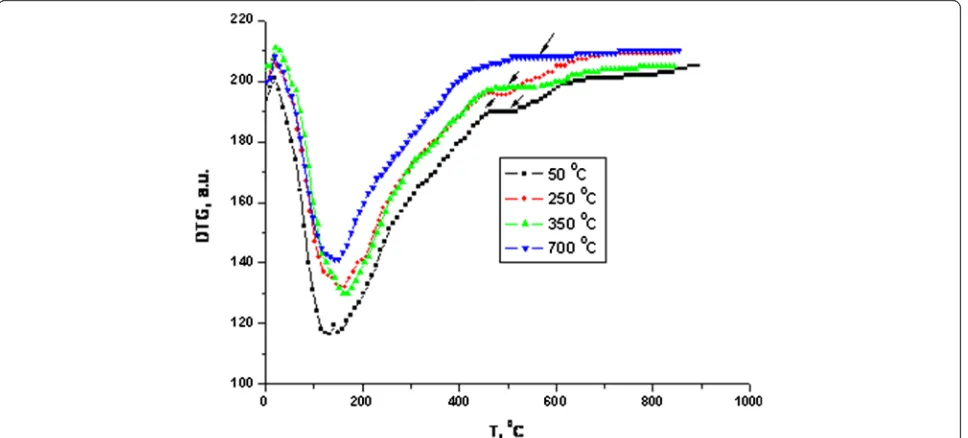
The results of our previous investigations [30] showed that efficiency of exchangeable cations and specific sur-face value of clinoptilolite change after thermal treat-ment of the sorbent. Similarly, specific surface area and sorption capacity of thermally treated clinoptilolite sam-ples depend on the pretreatment temperature. Conseq-ently, an additional thermogravimetric experiment was carried out to investigate the thermal desorption of water from the clinoptilolite surface. Figure 2 illustrates TG-and DTG-curves of natural clinoptilolite and clinop-tilolite thermally activated at 500 °C. It appears that TG-and DTG-curves have almost identical shapes. TG-curve entirely represents physical and chemical transformations of the sample during continuous heating. The observed plateau at 600–700 °Сhas an S-form which is typical for minerals. At the same time, TG-curve suggests the influ-ence of previous thermal treatment of the sorbent on its adsorption capacity for water. These results could be con-firmed by DTG-curves (Fig. 3) and data of the overall
water loss at 900 °C for Transcarpathian clinoptilolite heated at different temperatures (Table 1). For instance, the samples thermally activated at 200–250 °C were char-acterized with a minimum of water loss (6.1 %). Relatively high amounts of water loss (9.4–9.8 %) were received for the clinoptilolite previously calcined at the temperature range of 300–500 °C. In this case, the reverse dependence between water loss amounts and temperature of thermal treatment was received. Nevertheless, previous heating of the sample at 700 °C again caused a sharp decrease in clinoptilolite water loss.
Consequently, it could be proposed that, the temperature of the zeolite thermal pretreatment influences on a rate of adsorption equilibrium rather than on its sorption capacity of water at 200–250 °C. This suggestion could be confirmed
by the fact that weight losses were 9.9 % for the sorbent previously heated at 200 and 250 °C and then kept for 72 h in air with relative humidity of 70 %.
These effects appeared from decelerated process of re-hydration, since changes of clinoptilolite porous struc-ture were still reversible at 200–250 °C. On the contrast, an irreversible deep amorphization of Transcarpathian clinoptilolite occured at 700 °C [33]. In general, DTG-curve is a differential DTG-curve of the sample weight change and describes the dependence of the weight loss rate from the temperature. For the studied clinoptilolite sam-ples, DTG-curves were asymmetrical and some characteris-tic points were identified (Fig. 3). A broad DTG-maximum observed at low temperatures indicates the intensive ther-mal desorption of water. It should be noted that maximum rates of water loss were observed for all studied samples in the temperature range from 110 to 130 (140) °C, inde-pendently from previous thermal treatment conditions. Furthermore, this dissymmetry of the DTG-maximum could be caused by overlapping between a few quasiele-mentary maximums, which suggests at least two types of molecular water physically bonded to the clinoptilolite surface. In this temperature range, the water loss did not significantly varied with the temperature of the sorbent preparation (6.3–7.0 %), except for the sample calcinated at 700 °C (4.4 %). An isokinetic region (indicated by ar-rows on Fig. 3) was observed on DTG-curves at the temperature of 440–560 °C for all samples, apart from the sorbent previously heated at 700 °C.
Moreover, an undefined DTG-maximum was found for the clinoptilolite previously calcined at 250 °C. It is known that a deep dehydroxylation of silica occurs in this Fig. 2TG and DTG-curves of natural clinoptilolite (1, 1*) and clinoptilolite
heated at 500 °С(2, 2*)
temperature range [38], and practically all OH-groups ap-pear to be isolated at temperature over 400 °C. Conse-quently, the fully dehydroxylated surface is covered with oxygen atoms because of recombination of two hydroxyl groups and release of water molecules. This process de-mands reorganization of the surface atoms and also should be activated. Since surface dehydroxylation of the Transcarpathian clinoptilolite considerably diminishes the amount of surface OH-groups responsible for the sorption of trace elements ions, the terbium sorption effectiveness of clinoptilolite heated above 400 °C was significantly de-creased (Fig. 1).
It has been reported [39] that water molecules in the hy-drated zeolite could form the cyclic hexamers with oxygen atoms of the sorbent framework. Due to these hydrogen bonds, water molecules did not contain free OH-groups. Moreover, such cyclic hexamers prevent sorption of large cationic aqua and hydroxo complexes of metal ions. De-sorption of ligand water molecules caused a simultaneous destruction of hydrogen bonds and cyclic hexamers at the temperature above 200 °C. As a result, a number of free OH-groups considerably increased due to water molecules of the broken hexamer, which were still bonded to the zeolite framework. Since the surface OH-groups are mainly active sorption centers towards trace elements ions, a noticeable improvement of sorption properties of the clinoptilolite heated in the temperature range of 250–350 °C towards terbium ions (Fig. 1) was con-nected with the increased number of surface hydroxyl groups provided by water molecules and surface silanol (Si–OH) groups.
Permissible multiple contents (Сion/СTb(III)) of ions
common in waters and wastewaters, that do not change the maximum sorption capacity of clinoptilolite towards
terbium ions, are led in Table 2. Increasing of the admix-ture concentration beyond a define value leads to the reduction in sorption effectiveness of the zeolite.
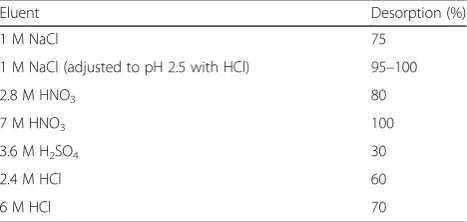
A 7 M solution of HNO3and a 1 M solution of NaCl
acidified with a hydrochloric acid to pH 2.5 were pre-ferred as desorbents for terbium(III) ions, because each of them provided almost full recovery of lanthanide (Table 3). As a result, the developed solid phase extraction procedure could be applied for the spectro-photometric determination of trace amounts of terbiu-m(III) ions in aqueous samples.
Sample preconcentration procedure
The sorbent was grounded in a ball mill to 0.20–0.31 mm size and washed with distilled water. After drying at room temperature, the clinoptilolite sample was heated in the oven at 350 °C for 2.5 h and then stored in a desiccator. 0.5–2 L water sample was acidified with nitric acid to a pH value approximately 1 and heated on a sand bath for 1 h. After the filtration through the dense paper filter, the pH of the water was adjusted to 7 with a sodium hydrox-ide solution, and then a borate buffer was added to main-tain pH 8.25. The final concentration of a borate buffer in the sample solution was 2.5 · 10−4М. The obtained solu-tion passed through SPE cartridge filled with 0.6 g of the prepared sorbent at a flow rate of 3 mL · min−1. After the loading of the sample, the cartridge was washed with 50 mL of double-distilled water at the same flow rate. Table 1Overall water loss at 900 °C for clinoptilolite samples
previously heated at different temperatures
Temperature of the thermal pretreatment, °C Water loss, %
Unheated form 10.4
50 10.4
100 10.0
200 6.1
200а 9.9
250 6.1
250а 9.9
300 9.8
350 9.7
500 9.4
700 6.6
аClinoptilolite samples heated at the same conditions but additionally kept for
72 h in air with relative humidity of 70 %
Table 2Tolerance limits of some ions for terbium(III) sorption from aqueous solution of Transcarpathian clinoptilolite (concentration of Tb(III)–1μg∙mL−1; pH 8.25)
Species Tolerance limit (Cion/CTb(III))
NH4 +
, NO3− 2000
Na+, K+ 1500
Zn2+, Ca2+ 50
Cl− 2500
Mg2+ 300
SO42− 1000
Table 3Desorption effectiveness of terbium(III) ions from clinoptilolitea
Eluent Desorption (%)
1 M NaCl 75
1 M NaCl (adjusted to pH 2.5 with HCl) 95–100
2.8 M HNO3 80
7 M HNO3 100
3.6 M H2SO4 30
2.4 M HCl 60
6 M HCl 70
a
Whereas, terbium(III) ions were desorbed with 15 mL of a 1 M sodium chloride solution acidified with a hydrochloric acid to pH 2.5 at a flow rate 1 mL · min−1. 5 mL of double-distilled water was added to the eluate, and the pH was ad-justed to 1 with hydrochloric acid. The obtained solution was made up to 25 mL volume with double-distilled water and thoroughly mixed. Terbium(III) content in the solu-tion was determined spectrophotometrically with arsenazo III as an indicator. This procedure is described in detail in the experimental part. Overall, the proposed method for determination of Tb(III) ions had a linearity range from 2.5 to 200 ng · mL−1. The detection limit was found to be 0.75 ng · mL−1, and this parameter was calculated using the following equation:
DL¼3Sb=m;
where Sb is a standard deviation of blank and m is a slope of the calibration curve. The sample preparation method was tested on a model solution with the com-position similar to natural water. As can be seen from Table 4, the components of waters do not have consider-able influence on the determination of trace amounts of terbium(III) ions. The analyte recoveries from spiked tap water were above 93 %.
Conclusions
A solid-phase extraction procedure was developed for spectrophotometric determination of trace amounts of ter-bium(III) ions in aqueous solution. Transcarpathian clinop-tilolite heated at 350 °C for 2.5 h was applied as a SPE sorbent. Maximum sorption ability towards terbium(III) ions was observed after thermal activation of the clinopti-lolite. The results of thermogravimetric investigations indi-cated a relationship between changes of zeolite structure during dehydration processes and its sorption abilities. It was shown that previous thermal treatment of clinopti-lolite has an influence on its sorption capacity and the overall water loss, which suggests only partial revers-ibility of zeolite rehydration. Due to this fact, thermally
activated samples of clinoptilolite maintain their sorp-tion abilities towards trace elements ions, especially ter-bium(III) ions, in aqueous solutions.
The same sorption values were obtained for terbiu-m(III) solutions with pH 8.25 regulated with either a borate buffer or sodium hydroxide. A buffer solution maintains a pH value, which permits to improve metro-logical characteristics of the measurements. Moreover, in this case the constant ionic strenght minimizes influence of other water components on the sorption process of Tb(III) ions. The developed method offers a possibility to concentrate trace amounts of terbium(III) ions in the presence of water components. Permissible multiple con-tents of competing ions for terbium(III) ions sorption were the following: 2500 (Cl−), 2000 (NH4+, NO3−), 1500
(Na+, K+), 1000 (SO42−), 300 (Mg2+), 50 (Ca2+, Zn2+). A 1.0
M sodium chloride solution acidified with hydrochloric acid to pH 2.5 was used for quantitative desorption of ter-bium(III) ions., An enrichment factor of 130 was obtained under the optimum conditions. A wide range of linearity (2.5–200 ng · mL−1) with detection limit of 0.75 ng. mL−1 was achieved. The developed procedure was applied for the determination of terbium(III) ions in techno-logical solutions, where recoveries and RSD values were 93.3–103.0 % and 1.6–7.1, respectively.
Competing interests
The authors declare that they have no competing interests.
Authors’contributions
VOV conceived of the ideas of the project, carried out SPE investigation and coordinated the project. VPZ was responsible for the thermogravimetric analysis, AVP performed X-ray fluorescence determination of terbium. OV defined the influence of borax solution on the effectiveness of the SPE extraction, and GVG determined the optimum SPE conditions fo terbium concentration. All authors contributed to the preparation of the manuscript, read and approved the final version.
Acknowledgement
This work was partially funded by the Ministry of Education and Science of Ukraine.
Author details 1
Faculty of Chemistry, Ivan Franko National University of Lviv, 6 Kyryla and Mefodiya St., 79005 Lviv, Ukraine.2Department of Chemistry and Physics, Lviv
Table 4Determination of terbium(III) ions in the synthetic water sample with the composition similar to natural surface waters after ions preconcentration with clinoptilolite (n= 3,P= 0.95)
Composition of synthetic solution, mg∙L−1
Volume of synthetic
solution, mL Enrichment factora
Concentration of Tb(III), ng∙mL−1
Recovery, % RSD, %
Added Found
Na+(20), K+(5), 600 40 100 97 ± 3.9 97 1.6
Mg2+(1), Ca2+(10), 600 40 50 51 ± 2.6 102 2.08
Fe3+(0.5), SO42−(5) 1050 70 10 9,8 ± 0.98 98 4.02
Cl−(20), HCO3−(50), 1950 130 5 4,7 ± 0.53 94 4.51
NH4 +
(1), Zn2+(0.005), NO3−(1) 1950 130 3 2,8 ± 0.49 93.3 7.1
1950 130 0 N.D.b
a
Enrichment factor = volume of sample/volume of eluent b
Academy of Commerce, 9 Samchuka St., 79011 Lviv, Ukraine.3Department of
Environmental Safety and Nature Protection, Lviv Polytechnic National University, 12 Bandera St., 79013 Lviv, Ukraine.
Received: 5 January 2015 Accepted: 10 July 2015
References
1. Emsley J. The elements 3-rd edition. Oxford: Clarendon Press; 1998. 2. Meshkova SB, Topilova ZM, Gerasimenko GI. Polymetyl-methacrylate as a
sorbent for effective recovery of lanthanides from solutions and highly sensitive luminescence determination of europium and terbium in waters. Zh Anal Khim. 1993;48(1):65–72.
3. Tatar E, Mihucz VG, Virag I, Racz L, Zaray G. Effect of four bentonite samples on the rare earth element concentrations of selected Hungarian wine samples. Microchem J. 2007;85:132–5.
4. Gschneidner KAJ, Eyring LR. Handbook on the Physics and Chemistry of Rare Earths. Moscow: Metallurgiya; 1982.
5. MacCarthy P, Klusman RW, Cowling SW, Rice JA. Water Analysis. Anal Chem. 1995;67:525–82.
6. Faghihian H, Kabiri-Tadi M. A novel solid-phase extraction method for separation and preconcentration of zirconium. Microchim Acta. 2010;168:147–52. 7. Kagaya S, Maeba E, Inoue Y, Kamichatani W, Kajiwara T, Yanai H, et al. A solid
phase extraction using a chelate resin immobilizing carboxymethylated pentaethylenehexamine for separation and preconcentration of trace elements in water samples. Talanta. 2009;79:146–52.
8. Yu JC, Jiang ZT, Liu HY, Yu J, Zhang L.β-Cyclodextrin epichlorohydrin copolymer as a solid-phase extraction adsorbent for aromatic compounds in water samples. Anal Chim Acta. 2003;477:93–101.
9. Ayata S, Kaynak I, Merdivan M. Solid phase extractive preconcentration of silver from aqueons samples. Environ Monit Assess. 2009;153:333–8. 10. Faghihian H, Hajishabani A, Dadfarnia S, Zamani H. Use of clinoptilolite loaded
with 1-(2-pyridylazo)-2-naphthol as a sorbent for preconcentration of Pb(II), Ni(II), Cd(II) and Cu(II) prior to their determination by flame atomic absorption spectroscopy. Intern J Environ Anal Chem. 2009;89(4):223–31.
11. Thabano JRE, Breadmore MC, Hutchinson JP, Johns C, Haddad PR. Silica nanoparticle-templated methacrylic acid monoliths for in-line solid-phase extraction-capillary electrophoresis of basic analytes. J Chromatogr A. 2009;1216:4933–40.
12. Zougagh M, Pavon JMC, de Torres AG. Chelating sorbents based on silica gel and their application in atomic spectrometry. Anal Bioanal Chem. 2005;381:1103–13.
13. Yusof AM, Rahman MM, Wood AKH. Adsorption of some toxic elements from water samples on modified activated carbon, and red soil using neutron activation analysis. J Radioanal Nucl Chem. 2007;271:191–7. 14. Daorattanachai P, Unob F, Imyim A. Multi-element preconcentration of
heavy metal 311 ions from aqueous solution by APDC impregnated activated carbon. Talanta. 2005;67:59–64.
15. Trohimenko A, Zaporozhets O. Stepwise extraction of coexistent iodine forms by the 314 polyurethane foam in water solutions. Visnyk Lviv Univ Ser Khim. 2012;53:185–91.
16. Dyachuk OA, Gubina TI, Melnikov GV. Adsorption preconcentration in the 316 luminescence determination of polycyclic aromatic hydrocarbons. Zh Anal Khim. 2009;64(1):7–11.
17. Tuzen M, Palar K, Soylak M. Enrichment/separation of cadmium (II) and lead (II) in environmental samples by solid phase extraction. J Hazard Mater. 2005;121:79–87.
18. Leboda R, Gierak A, Grochowicz P. On the application of carbosilicon adsorbents to analysis of organic pollutants. OchrŚrodow. 1987;2–3(32–33):61–4. 19. DePena YP, Lόpez W, Burguera JL, Burguera M, Gallignani M, Brunetto R,
et al. Synthetic Zeolites as sorbent material for on-line preconcentration of copper traces and its determination using flame atomic absorption spectrometry. Anal Chim Acta. 2000;403:249–58.
20. Budnyak TM, Yanovska ES, Tertykh VA, Voznyuk VI. Adsorption properties of composite sokirnitskiy clinoptilolite-polyaniline to anions of elements of the V-and VI- groups of the Periodic system of D.I. Mendeleev. Rep Natl Acad Sci Ukr. 2011;3:141–5.
21. Al-Degs YS, El-Sheikh AH, Al-Ghouti MA, Hemmateenejad B, Walker GM. Solid-phase extraction and simultaneous determination of trace amounts of sulphonated and azo sulphonated dyes using microemulsion-modified-zeolite and multivariate calibration. Talanta. 2008;75:904–15.
22. Chen X, Chen S, Lui J, Wang J. Isolation of hemoglobin from human blood using solid phase extraction with lanthanum (III) modified zeolite. Microchim Acta. 2009;165:217–22.
23. Vasylechko VO, Lebedynets LO, Gryshchouk GV, Kuz’ma YuB, Vasylechko LO, Zakordonskiy VP, (2001) in Book of Proceedings–Stud. Surf. Sci. Catal., V.135
“Zeolites and Mesoporous Materials at the Dawn of the 21ST Century”, Eds. Galarneau A, Renzo FDi, Fajula F, Vedrine J, Elsevier, Amsterdam, 8 p. (CD Version). 24. Vasylechko V, Gryshchouk G, Neroda I. Adsorption of Pb(II) on
Transcarpathian clinoptilolite. Visnyk Lviv Univ Ser Khim. 2009;50:177–87. 25. Vasylechko VO, Lebedynets LO, Gryshchouk GV, Leboda R,
Skubiszewska-Zięba J. On the utility of Transcarpathian clinoptylolite in the adsorption of chloroform from aqueous solutions. OchrŚrodow. 1998;3(70):27–30. 26. Vasylechko V, Gryshchouk G, Svidrak G, Korkuna O. Concentration of Sr(II) on
transcarpathian clinoptilolite. Visnyk Lviv Univ Ser Khim. 2012;53:174–84. 27. Vasylechko V, Gryshchouk G, Mel’nyk A, Kalychak Y. Pre-concentration and
determination of cerium using Transcarpathian clinoptilolite. Nauk Zapysky NaUKMA Khim Nauky Technol. 2011;118:10–6.
28. Vasylechko VO, Lebedynets LO, Gryshchouk GV, Leboda R, Skubiszewska-Zięba J. Investigations of usefulness of Transcarpathian zeolites in trace analysis of waters. Application of mordenite for the preconcentration of trace amounts of copper and cadmium. Chem Anal (Warsaw). 1999;44:1013–24.
29. Vasylechko V, Gryshchouk G, Suhnatsky M. Sorption of Zn(II) on Transcarpathian clinoptilolite. Visnyk Lviv Univ Ser Khim. 2011;52:148–58. 30. Vasylechko VO, Gryshchouk GV, Zakordonskiy VP, Patsay IO, Len’NV,
Vyviurska OA. Sorption of terbium on Transcarpathian clinoptilolite. Microporous Mesoporous Mater. 2013;167:155–61.
31. Vasylechko VO, Gryshchouk GV, Lebedynets LO, Kuz’ma YB, Vasylechko LO, Zakordonskiy VP. Adsorption of Copper on Transcarpathian clinoptilolite. Adsorpt Sci Technol. 1999;17(2):125–34.
32. Tarasevich YI, Polyakov VE, Penchev VZ, Kirov GN, Minchev KI, Polyakov IG, et al. Ion-exchange qualities and structural features of clinoptilolites of various deposits. Khim Technol Vody. 1991;13(2):132–40.
33. Vasylechko VO, Gryshchouk GV, Kuz’ma YB, Zakordonskiy VP, Vasylechko LO, Lebedynets LO, et al. Adsorption of cadmium on acid-modified
Transcarpathian clinoptilolite. Microporous Mesoporous Mater. 2003;60:183–96. 34. Vasylechko VO, Lebedynets LO, Gryshchouk GV, Kuz’ma YB, Vasylechko LO,
Bernats’ka TM. Adsorption of Copper on Transcarpathian Mordenite. Adsorpt SciTechnol. 1996;14(5):267–77.
35. Marczenko Z. Photometricheskoye opredeleniye elementov. Moscow: Mir; 1971.
36. Goryushina VG, Savvin SB, Romanova EV. Photometric determination of rare earths in ores with arsenazo III. Zh Anal Khim. 1963;18(11):1340–4. 37. Tsitsishvili GV, Andronikashvili TG, Kirov GN, Filizova LD. Prirodnye Tseolity.
Moscow: Mir; 1985.
38. Gregg SJ, Sigg KSW. Adsorpbtsia, udel’naya poverkhnost, poristost. Moscow: Mir; 1984.
39. Hunger J, Beta IA, Bohlig H, Lind C, Jobic H, Hunger B. Adsorption Structures of water in NaX Studied by DRIFT Spectroscopy and Neutron Powder Diffraction. J Phis Chem B. 2006;110:342–53.
Open access provides opportunities to our colleagues in other parts of the globe, by allowing
anyone to view the content free of charge.
Publish with
Chemistry
Central and every
scientist can read your work free of charge
W. Jeffery Hurst, The Hershey Company.
available free of charge to the entire scientific community peer reviewed and published immediately upon acceptance cited in PubMed and archived on PubMed Central yours you keep the copyright
Submit your manuscript here: