G U I D E L I N E
Open Access
Development process of a
consensus-driven CONSORT extension for randomised
trials using an adaptive design
Munyaradzi Dimairo
1*, Elizabeth Coates
1, Philip Pallmann
2, Susan Todd
3, Steven A. Julious
1, Thomas Jaki
4,
James Wason
5,14, Adrian P. Mander
5, Christopher J. Weir
6, Franz Koenig
7, Marc K. Walton
8, Katie Biggs
1,
Jon Nicholl
1, Toshimitsu Hamasaki
9, Michael A. Proschan
10, John A. Scott
11, Yuki Ando
12, Daniel Hind
1and Douglas G. Altman
13ˆ
Abstract
Background:Adequate reporting of adaptive designs (ADs) maximises their potential benefits in the conduct of clinical trials. Transparent reporting can help address some obstacles and concerns relating to the use of ADs. Currently, there are deficiencies in the reporting of AD trials. To overcome this, we have developed a consensus-driven extension to the CONSORT statement for randomised trials using an AD. This paper describes the processes and methods used to develop this extension rather than detailed explanation of the guideline.
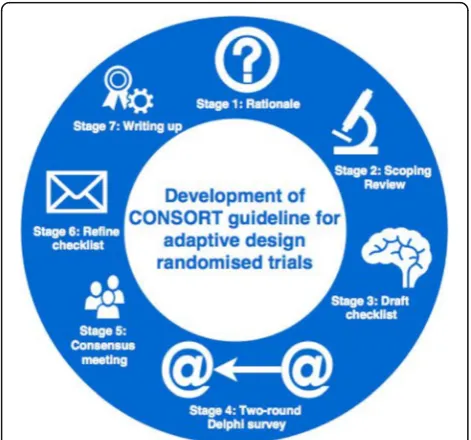
Methods:We developed the guideline in seven overlapping stages:
1) Building on prior research to inform the need for a guideline; 2) A scoping literature review to inform future stages;
3) Drafting the first checklist version involving an External Expert Panel;
4) A two-round Delphi process involving international, multidisciplinary, and cross-sector key stakeholders; 5) A consensus meeting to advise which reporting items to retain through voting, and to discuss the structure
of what to include in the supporting explanation and elaboration (E&E) document; 6) Refining and finalising the checklist; and
7) Writing-up and dissemination of the E&E document.
The CONSORT Executive Group oversaw the entire development process.
Results:Delphi survey response rates were 94/143 (66%), 114/156 (73%), and 79/143 (55%) in rounds 1, 2, and across both rounds, respectively. Twenty-seven delegates from Europe, the USA, and Asia attended the consensus meeting. The main checklist has seven new and nine modified items and six unchanged items with expanded E&E text to clarify further considerations for ADs. The abstract checklist has one new and one modified item together with an unchanged item with expanded E&E text. The E&E document will describe the scope of the guideline, the definition of an AD, and some types of ADs and trial adaptations and explain each reporting item in detail including case studies.
(Continued on next page)
* Correspondence:[email protected] ˆDeceased
1School of Health and Related Research, University of Sheffield, Regent Court, 30 Regent Street, Sheffield S1 4DA, UK
Full list of author information is available at the end of the article
(Continued from previous page)
Conclusions:We hope that making the development processes, methods, and all supporting information that aided decision-making transparent will enhance the acceptability and quick uptake of the guideline. This will also help other groups when developing similar CONSORT extensions. The guideline is applicable to all randomised trials with an AD and contains minimum reporting requirements.
Keywords:Adaptive design, Flexible design, CONSORT extension, Reporting guidance, Reporting guideline, Randomised controlled trial
Introduction
Clinical trials are expected to adhere to high ethical and scientific standards and answer research questions ro-bustly, as quickly as possible to benefit patients, and use no more research resources than necessary. The need to streamline the conduct of trials is a cross-sector (public and private sector) and regulatory priority [1–6]. Well-designed and properly conducted adaptive design (AD) trials can improve the efficiency of clinical trials and help achieve these objectives.
There is a growing interest in ADs across sectors to address the shortcomings of trials with a fixed design. Furthermore, there is considerable statistical methodo-logical literature on ADs [7, 8] and new methods con-tinue to be developed. Discussions on opportunities to use ADs across trial phases and advice on their robust design and conduct are growing [9–17]. Different types of ADs are increasingly used or at least considered at the design stage across sectors [18–25]. However, ADs have a number of issues and challenges. There is lack of practical knowledge of ADs, and some obstacles and concerns about some types of ADs are impeding their use [22,26–32]. Access to case studies of AD trials may help alleviate some of these problems [28, 33]. Conse-quently, authors have reviewed real-life AD case studies to build knowledge resources [18, 19, 34, 35]. Although these reviews found a number of AD case studies, espe-cially in oncology, many of these trials are inadequately reported and thus may not address some of the concerns about ADs [18,33,36]. Adequate reporting will improve the credibility and interpretability of ADs and increase their application [28,34].
The Consolidated Standards of Reporting Trials (CONSORT) framework has been instrumental in pro-moting transparent reporting of randomised trials. In-creased complexity of the trial design and conduct, as is common in AD trials, comes with additional transpar-ency and reporting demands. The CONSORT 2010 statement [37] includes the concept of changes to the trial design and methods after commencement without differentiating between planned adaptations and un-planned changes (item 3b) and interim stopping rules (item 7b). It does not, however, specifically address the
general reporting needs for randomised trials that use an AD. As noted above, reporting deficiencies of AD trials have been highlighted [18, 23, 33–35] and it has been suggested that there is a need for additional reporting considerations to address this [33–35, 38]. However, these papers lack a grounded methodological approach to developing comprehensive reporting guidance. Thus, the suggested piecemeal recommendations are likely to be incomplete and unlikely to be accepted to influence practice because they lack input from important stake-holders through a robust process. Therefore, this project aimed to address this limitation by using a recom-mended consensus-driven framework [39] to develop an official reporting guideline, Adaptive designs CONSORT Extension (ACE), for randomised trials that use ADs.
In the spirit of good reporting practice, this paper de-scribes the processes and methods that the ACE Steering Committee (SC) used to develop a consensus-driven ACE reporting guideline. We provide justification for the decisions made to arrive at the final checklist and explain the structure of the forthcoming ACE explan-ation and elaborexplan-ation (E&E) document. Box 1 lists the long-term objectives of the ACE project.
Methods
A favourable ethical approval for this study was granted by the Research Ethics Committee (REC) of the School of
Box 1 ACE project long-term goals
▪To enhance transparency and adequate reporting of randomised trials that use an AD
▪To improve the usefulness of randomised trial case studies that use an AD and bridge the gap in practical knowledge
▪To mitigate some concerns about AD methods and enhance the interpretability and the credibility of results from randomised trials that use an AD
▪To indirectly enhance robust design and conduct of randomised trials that use an AD
Health and Related Research (ScHARR) at the University of Sheffield (ref: 012041). The guideline development process adhered to a consensus-driven methodological framework for developing healthcare reporting guidelines recommended by the CONSORT Executive Group [39]. An a priori registered protocol accessible via the EQUA-TOR Network [40] guided the conduct of this research, and Fig.1summarises the development process.
Study management and group composition
A multidisciplinary SC of 19 members from industry and the public sector, including the CONSORT Executive Group representative (DA) and members of the MRC Network of Hubs for Trials Methodology Research (HTMR) Adaptive Designs Working Group (ADWG), led the guideline development process. The members were based in Europe, USA, and Asia. The professional experi-ence of members included methodology and conduct of AD trials, management and conduct of randomised trials, regulatory assessment and approval, reviewing research grant applications and decision-making on research fund-ing panels, systematic reviewfund-ing of evidence, and develop-ment of reporting guidelines. This composition was motivated by the need to capture diverse views of experts across sectors with multidisciplinary roles in trials re-search covering wide geographical locations.
A Study Management Group (SMG) comprised of thir-teen SC members oversaw the day-to-day project activities in consultation with the SC. For quality control, we sought the advice from an External Expert Panel of four members based in the USA, UK, and Australia—with practical and
methodological expertise in AD trials during the drafting process of the version of the checklist to be included in the Delphi surveys. Additional file 1 summarises the project activities undertaken throughout the development process.
Prior work to inform the need for a CONSORT extension
The findings from a National Institute for Health Research (NIHR) Doctoral Research Fellowship (DRF-2012-05-182) led by MD and supervised by SJ, ST, and JN informed the need for this research [33]. The idea was presented, dis-cussed, and contextualised at the 2016 annual workshop of the MRC HTMR ADWG attended by six members of the ACE SC (MD, TJ, PP, JW, AM, and CW). In summary, re-search prior to 2016 investigated obstacles and potential facilitators to the use of AD trials [22, 26, 28–32, 41] as well as deficiencies in their reporting [18,23,33,34]. Fur-ther research highlighted the overwhelming need for a tai-lored reporting guideline for AD trials with literature suggesting some reporting principles [26,28,33–35,38].
We approached the CONSORT Executive Group in 2016 informing them about our plans for the ACE guideline, and they agreed to oversee the development process. Before the research began, we further per-formed a scoping free text search on 10 October 2016 using the term ‘adaptive’ on the EQUATOR Network database [42], but we found no reporting guideline on ADs or related guideline under development.
Scoping literature review
The objectives of the scoping narrative review were to collate any concerns about AD trials or considerations that may influence their reporting, to identify any sug-gestions on how AD trials should be reported and to es-tablish definitions of technical terms. The aim was to guide the preliminary drafting of the reporting items and working definitions for the extension checklist. The re-view also helped us to create a list of authors who had published AD trials or methodology research as poten-tial participants for the Delphi surveys.
The literature search was not intended to be exhaustive but to provide a good foundation for the guidance devel-opment process. We searched the MEDLINE database via PubMed on 17 November 2016 for any articles about ran-domised AD trials written in English using this combin-ation of terms: ((“adaptive design”) OR (“adaptive clinical trial”) OR (“adaptive trial”) OR (“adaptive interim”) OR (“flexible design”)) AND (reporting OR recommendation* OR (“best practice”) OR (“good practice”) OR (“panel dis-cussion*”) OR guidance OR guideline* OR interpretation OR bias OR (“expert opinion”) OR (“expert panel”)). We retrieved 237 articles, from which we excluded 51: 33 were ineligible (irrelevant to the subject or about non-rando-mised studies), 16 inaccessible, one duplicate, and one had an English abstract but was written in Chinese. We Fig. 1Development process of the Adaptive designs Extension
narratively reviewed 186 eligible publications, and key ones are cited in relevant sections. We also reviewed some additional key documents that we were aware of but that were not retrieved by the search strategy, such as regula-tory reflection guidance [4–6]. We summarised the find-ings and drafted a preliminary checklist in preparation for our first face-to-face SC meeting.
Checklist drafting process
On 29 January 2017, the SC met in Sheffield for a full day to discuss the findings from the scoping review, agree upon a working definition of an AD trial, and to discuss the preliminary extension checklist in the context of the concerns about AD trials and what necessary changes should be made to the CONSORT 2010 checklist.
What do we consider an adaptive design trial?
We found several references that provide definitions of an AD and related technical terms [5,6,16,43–46]. Our review showed that what is considered an AD trial is in-consistently defined and often creates confusion [26, 41,
43]. However, there are three common themes in the definitions [5, 6, 16, 43, 46]: ‘use of accruing trial data’,
‘opportunity to make changes to aspects of the trial’, and
‘need to preserve trial validity and integrity’. After a lengthy discussion, the SC agreed to define an AD as:
A clinical trial design that offers pre-planned opportunities to use accumulating trial data to modify aspects of an ongoing trial while preserving the validity and integrity of that trial
Bypre-planned, we envisaged trial changes or adaptations are specified at the design stage or at least before any un-blinded review of the accumulating trial data, and they are documented in an auditable trial-related document such as the trial protocol. We acknowledged the existence of flexible statistical methods to cope with unplanned trial changes under specific conditions [7]. However, we strongly feel that pre-planning is one of the necessary conditions to preserve the integrity of the trial, a view shared with regulatory guid-ance [4–6]. Thus, this guideline is not meant for trials with unplanned changes only (no planned adaptations).
For the scope of this guideline, changes toaspects of an ongoing trialthat solely depend on external information ra-ther thanaccumulating trial dataare outside the scope of what we consider an AD trial. Furthermore, we specifically exclude the use of accruing trial data to make changes that relate only to the feasibility and process aspects of con-ducting a trial, which forms part of almost every trial. We refer to these changes as operational adaptations [47]. The types of ADs and trial aspects that can be modified are dis-cussed in the literature [3,9,11,15,16,24,41,48–53].
Byvalidity, we meant the ability to provide correct statis-tical inference to establish the effects of the study interven-tions and produce accurate estimates of the effects (such as point estimates and associated uncertainty) to give re-sults that are convincing to research consumers. Finally, the use of the word integrity pertains to minimisation of operational bias, maintenance of data confidentiality, and consistency in trial conduct for credibility, interpretability, and persuasiveness of trial results. Our definitions of terms relating to ADs are listed in Additional file2.
What are the concerns for adaptive design trials?
The review found some key publications that discussed why the reporting of AD trials requires special consider-ation and reporting suggestions or recommendconsider-ations for particular types of AD trials [23, 25, 33, 34, 38, 45, 51,
53–61]. ADs are not immune to potential biases and limitations despite their appealing nature and promising benefits [9,50,53].
Box 2 Themes that may influence reporting of ADs
1. The risk of introducing operational bias into the conduct of
the trial increases when interim data are reviewed. 2. Performing multiple hypotheses tests increases the risk of
making inappropriate or unjustified claims about the treatment effect if inappropriate statistical methods are used. This occurs
for example when conducting interim analyses; evaluating multiple patient subgroups, treatments, or endpoints; or a combination of these.
3. Not addressing planned adaptations and unplanned changes
may potentially invalidate results depending on their form, purpose, and the statistical methods used.
4. Biased estimates of the treatment effect may be produced if inappropriate statistical methods are used for analysis.
5. The risk of making undesirable trial adaptation decisions based on premature or inadequate interim data.
6. The type of adaptive design, form of trial adaptations, and interim adaptation decision rules used may influence the
acceptability of results, level of information to disclose, and the applicable statistical methods.
7. Unintended changes in patient characteristics or the estimand (what is to be estimated) before and after trial adaptation
may occur, making overall results difficult to interpret. 8. The need for more transparency to enable research
consumers to evaluate the appropriateness of the methods, sources of potential bias, and interpretability and trustworthiness
Box 2 summarises the concerns or considerations that influence the reporting of ADs into eight themes that may depend on the type of the AD and scope of the trial adaptations used. These themes explain why the report-ing of AD trials requires special consideration, and they influenced the development of the ACE guideline.
Drafting of the first extension checklist
The SC then discussed the preliminary extension checklist drafted during the scoping literature review focusing on what changes need to be made and the structure of the changes with justification. We classified items as ‘no changes proposed’,‘modifications proposed’, and‘new item suggested’. A report summarising the discussions is ac-cessible online (see download athttps://doi.org/10.15131/ shef.data.6139631). Following the first face-to-face meet-ing in Sheffield, the checklist was then redrafted and re-fined during an iterative process through subsequent face-to-face and teleconference meetings and email cor-respondence involving the SMG and the SC.
The External Expert Panel reviewed the draft checklist and working definitions of technical terms. We added two specific items on how to deal with overrunning partici-pants (12e) and multiple outcomes or multiple treatment comparions (12f), which were suggested by the panel (see download at https://doi.org/10.15131/shef.data.6198290). The panel also suggested a rewording of some items for clarification and identified specific aspects that should be addressed in the E&E document. In addition, inde-pendent experts were consulted to review the draft checklist to identify major problems with content and wording of items.
On 5 May 2017, the SC finalised the official first draft of the extension checklist with a total of 58 items. This list included 22 new items, 15 modified items, and 21 items unchanged from the CONSORT 2010 checklist. This draft checklist is accessible online (see download at
https://doi.org/10.15131/shef.data.6198290).
The sampling frame for the Delphi surveys
We aimed to engage key stakeholders across sectors and over wide geographical locations. We targeted those with AD-related experience including clinical trialists, clinical investigators, statisticians, trial methodologists, and health economists; those interested in using ADs; and consumers of research findings, decision makers, and policy-makers in clinical trials research including journal editors, system-atic reviewers, research funders, regulators, research ethi-cists, and patient representative groups.
We created a list of 468 authors of the AD-related publications (trials or methodology) from our review and known case studies [18,34]. This list contributed to the majority of the survey sampling frame. The details of organisations or professional groups we also approached
are accessible online (see download at https://doi.org/ 10.15131/shef.data.6291050). We used a wide range of platforms to reach out to key stakeholders of interest such as targeted mailing lists, social media, and personal communications (see Additional file3).
The Delphi process
The National Perinatal Epidemiology Unit (NPEU, Uni-versity of Oxford) built and hosted the online Delphi surveys and offered administrative support to maintain the anonymity of participants’responses. The SC includ-ing the lead investigator and study coordinator did not have access to any information that could link partici-pants to their responses during and after the survey.
Number of survey rounds
The objective of the Delphi process was to assess the stabil-ity of opinions that can be viewed as consistency in ratings of importance between rounds and not merely to reach consensus. We expected two survey rounds would suffice to reach stability in perceptions based on recent similar studies [62, 63]. However, the methodology permitted the SC the flexibility to undertake a third round if necessary based on the results and feedback received in round 2.
Scoring system
We used an importance rating scale of 0 to 9 adopted in related Delphi surveys [62–64]:‘not important’(score 1 to 3),‘important but not critical’(score 4 to 6),‘critically im-portant’ (score 7 to 9), and ‘do not know’ (unsure). We used the same scoring system across rounds and indicated whether items were new (N), modified (M), or remained unchanged (U) from the CONSORT 2010 checklist [65]. See Fig.2for a screenshot.
Delphi round 1
We registered stakeholders who were willing to take part with informed consent via a bespoke web-based platform. During registration, we obtained informed consent and gathered demographics and characteristics of participants such as geographical location, self-identified stakeholder group (clinical trials user, clinical trialist, or methodolo-gist), employment sector, years of experience in trials re-search, and AD-related research experience.
open-ended feedback such as any potentially overlooked modifications or clarity issues. We activated the round 1 survey on 31 May 2017 and gave participants approxi-mately 3 weeks to complete it.
Delphi round 2
Between rounds 1 and 2, we re-opened registration and extended recruitment to specifically target journal edi-tors using a similar process as described for round 1. All registered participants were eligible to complete round 2 unless they withdrew consent. In round 2, participants who completed the round 1 survey were presented with their own previous item rating scores and the distribu-tion of the item rating as displayed in Fig. 3 (including medians and interquartile ranges (IQRs) of all partici-pants (green) and their self-identified stakeholder group at registration (blue)). We did not display previous data for participants who only completed the round 2 survey. We asked participants to rate the importance of 38 new or modified items as compared to the CONSORT 2010 checklist. Item 21 (generalisability) from round 1 was unintentionally overlooked and not included in the
round 2 survey due to a technical error (see download at
https://doi.org/10.15131/shef.data.6198290). Items 14a (dates defining the periods of recruitment) and 14b (un-expected termination/why the trial ended or stopped) were modified for reasons stated in Additional file4. We asked participants to give open-ended feedback includ-ing any reasons for changinclud-ing their ratinclud-ings where applic-able. The survey also displayed unchanged items from the CONSORT 2010 checklist and asked participants to provide any additional feedback without rating these items. The main and abstract draft checklist used for round 2 are accessible online (see download at https:// doi.org/10.15131/shef.data.6198347). We launched the round 2 Delphi survey on 15 September 2017 and gave participants approximately 4 weeks to complete it.
Consensus decision-making criteria
We predefined consensus as receiving the support of at least 70% of responders rating an item as‘critically im-portant’for inclusion in the round 2 Delphi survey [40,
achieving at least 50% support of delegates voting to
‘keep’an item [40]. These criteria in consideration with the feedback gathered informed the SC in making the final decisions about reporting items to be included in the ACE guideline.
Analysis methods
We summarised the distribution of characteristics and demographics of registered participants and responders for each Delphi round. Item rating scores were descrip-tively analysed using the number of responders, the me-dian (IQR), and mean (standard deviation, SD). We explored whether the ratings of participants differed by specific characteristics of interest using clustered box-plots stratified by:
Self-selected key stakeholder group
(clinical trial user, clinical trialist, or methodologist);
Current employment sector (public sector or industry);
Self-reported regulatory assessment experience (yes or no); and
Primary role in clinical trials research as a statistician (yes or no).
We summarised the number and proportion of partici-pants who rated an item as‘not important’,‘important but not critical’, and‘critically important’, including the‘do not know’category. We analysed qualitative feedback gathered
during the Delphi surveys using a simple thematic analysis [67] to identify common comments and elucidate feed-back on suggested items (new or modified) as well as gather additional content suggestions for the checklist.
We assessed the stability and consistency of individual ratings of item importance across rounds using:
1) Percentage agreement as assessed by the proportion of responders whose ratings were the same in both rounds;
2) Weighted Cohen’s kappa with absolute error weights [68] with confidence intervals calculated using bootstrapping [69];
3) Bland-Altman plots [70] and histograms of changes in the scores between rounds.
Decision-making process
Feedback-based adaptation process
The SC reviewed the open-ended feedback received to inform the development process, such as modification of items for clarification and testing the wording of items. For instance, in round 1, we tested the preference of two additional versions of item 14c adaptation decisions (14d pre-planned adaptation decisions and 14e deviations from pre-planned adaptation decisions, see download at
https://doi.org/10.15131/shef.data.6198290). The word-ing of items and structurword-ing of the checklist evolved dur-ing the process.
Consensus meeting and onwards
The aim of the consensus meeting was to discuss the round 2 Delphi survey results; to make advisory deci-sions on items to retain in the guideline through voting, including reasons for supporting decisions; and to sug-gest reporting aspects that should be addressed in the supporting E&E document. We held a full day meeting on 8 November 2017 in London attended by 27 dele-gates from the UK, USA, Europe, and Asia. Deledele-gates from the public sector and industry included clinical in-vestigators, trial statisticians, journal editors, systematic reviewers, funding panel members, methodologists, and the CONSORT Executive Group representative. Profes-sor Deborah Ashby was the independent chair of the meeting. We took notes during the meeting and audio-recorded and transcribed the discussions to en-sure that the content was accurately captured. Following the discussion of each checklist item or group of check-list items, we asked delegates to anonymously vote about the inclusion of a specific item;‘keep’,‘drop’, and‘unsure or no opinion’. We also included the item-voting prefer-ences of a 28th delegate who was unable to attend in person but provided their ratings of checklist items re-motely and the project support administrator voted on their behalf. Twenty-six delegates voted, with EC and the independent chair excluded from voting to maintain the independence of the process.
Results
Response rates across rounds
In round 1, we registered 143 participants, 94 (65.7%) completed the survey. Of these 94, 86 (91.5%) rated all 58 items and the remaining 8 (8.5%) rated 45 items or fewer. We registered an additional 13 participants after round 1, bringing the total registered participants in round 2 to 156. The round 2 response rate was 114/156 (73.1%). Of these 114, 110 (96.5%) rated all 38 items and the remaining 4 (3.5%) rated 22 items or fewer.
Excluding 13 participants who were only registered after round 1, 79/143 (55.2%) completed both round 1 and 2 surveys. Of the 114 round 2 responders, 35 (30.7%) did not complete the round 1 survey.
Characteristics of registered participants and responders
Additional file5presents the demographics and character-istics of registered participants and responders (com-pleters of at least one reporting item in at least one round). Registered participants and responders were very similar across rounds. Responders in rounds 1 and 2 were based in 19 and 21 countries, respectively; the majority were from the UK, other European countries, and the USA. The majority of responders identified themselves as statisticians in their primary role in trials research; other prominent roles were clinical investigators and trial
methodologists. However, the secondary roles in trials re-search were more diverse. Some stakeholder groups in-cluding regulatory assessors, health economists, and research ethicists were underrepresented. Over two thirds of responders were from the public sector. Responders had diverse AD-related experience, and most identified themselves as clinical trialists or methodologists.
Delphi round 1
Perceptions of proposed items
Additional file 6 summarises the distribution of the re-sponders’ perceptions of the importance of reporting items. Detailed item descriptors are accessible online (see download at https://doi.org/10.15131/shef.data.6198290). Of the 22 new items, 11 (50.0%) and 17 (77.3%) were per-ceived as critical for inclusion by at least 70% and 50% of responders, respectively. Except for one modified item (15a—appropriate baseline data for comparability), which was rated as critical by only 62.9% of responders, the remaining 14 modified items were rated as critical by at least 70% of responders.
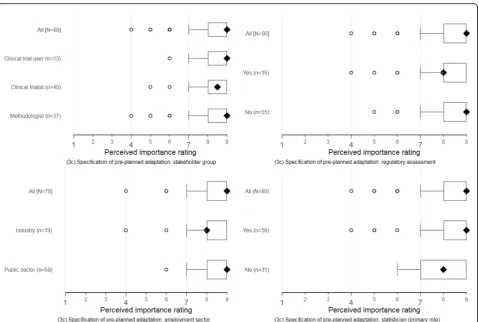
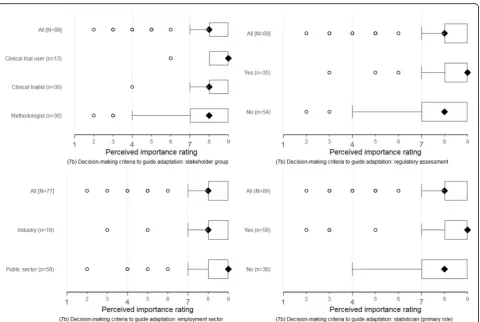
The perceptions of responders about the importance of suggested reporting items were broadly consistent across self-identified stakeholder groups, employment sectors, regulatory assessment experience, and statistical primary role. Figures4and5display these response pat-terns for two reporting items selected for illustration. The remaining clustered boxplots for the new or modi-fied items are accessible online (see download athttps:// doi.org/10.15131/shef.data.6139721.v1).
Open-ended feedback from participants and Steering Committee decisions
On 3 July 2017, the SC met face-to-face to discuss the round 1 Delphi survey results. The summary of the open-ended feedback we received is accessible online (see download at https://doi.org/10.15131/shef.data.6139631). Some responders highlighted that the guideline does not cover ADs used in non-randomised studies. However, we intentionally restricted the scope of the guideline to randomised trials to conform to the scope of CONSORT 2010 framework and to avoid additional complexities. We suggest a separate reporting guideline specific to non-randomised ADs commonly applied in phase 1 trials.
of various frequentist and Bayesian randomised trials that use an AD.
In general, the qualitative feedback acknowledged that the first checklist draft was comprehensive. However, some responders felt that there were too many items which may impede the use of ADs. The feasibility of reporting all aspects due to limited journal space was questioned although this should no longer be a barrier to complete reporting due to the availability of online re-positories. However, the SC deliberately included a large number of draft items at this stage of the Delphi survey to gather perceptions about their importance. The aim of the Delphi process and the subsequent consensus meeting was then to help the SC to decide on essential items to retain.
Some responders suggested the need to include as-pects of an estimand of interest, such as under item 2b (specific objectives and hypotheses). The SC ac-knowledge that the importance of estimands is grow-ing [71–73]. It was felt that estimands are applicable to every trial, and therefore, we recommended via the CONSORT Executive Group representative that such
a modification should be considered as a general amendment to the standard CONSORT 2010 when it is revised.
Based on the findings and feedback gathered, the SC made the following key decisions:
Open registration of new participants prior to round 2 specifically targeting journal editors to improve their participation;
Exclude the rating of unchanged items in round 2 to shorten completion time but include these items in the survey only to gather any qualitative feedback;
Terminate the Delphi survey after round 2 because the ratings suggested it was unlikely that additional valuable feedback would be gathered after this stage;
Submit an ethics amendment to increase the number of survey reminders sent out to non-responders to six and the completion period by 1 to 2 weeks in order to improve the response rate;
Provide general and itemised feedback to responders summarising their feedback and the SC’s response (what you said and what we did/will do);
Additional file 4 summarises some of the SC’s re-sponses to responders’qualitative feedback.
Delphi round 2
Additional file 7 presents the summary of item ratings of round 2 survey responders for new and modified items. See download athttps://doi.org/10.15131/shef.data.6198347, for the detailed description of items for the main and abstract draft checklists used in round 2.
Perceptions of proposed items
For the abstract checklist, 65.8% of responders rated a new item on ‘adaptation decisions made’ as critical for inclusion (Additional file 7). The remaining four modi-fied abstract items were rated as critical by at least 70% of responders. The overall distributions of ratings were relatively similar across these five abstract items.
For the main checklist items (Additional file 7), more than 70% of responders perceived 25/33 (75.2%) of the new or modified items as critical for inclusion, including 18/33 (54.5%) that were rated as critical by more than 90% of responders. Only 4/33 (12.1%) items received less than 50% votes for being critical: contribution to future research
(22b), simulation protocol and report (24d), data monitor-ing committee charter (24e), and statistical code (24f). However, these items were perceived as at least important by more than 80% of responders. The remaining four items were perceived as critical by between 60% and 68% of responders: dealing with overrun trial participants (12e), representativeness of patient population (15b), access to intentionally withheld information during trial conduct (24b), and access to the statistical analysis plan (24c).
As in round 1, the perceptions of responders about the importance of suggested reporting items were broadly consistent across self-identified stakeholder groups, em-ployment sectors, regulatory assessment experience, and statistical primary role. Clustered boxplots showing re-sponse patterns in item ratings are accessible online (see downloadhttps://doi.org/10.15131/shef.data.6139721.v1).
22b (contribution to future research) and 24e (data moni-toring committee charter) (Additional file9).
Open-ended feedback from participants
A summary of the open-ended feedback received in round 2 of the Delphi survey that was reviewed during the consensus meeting is accessible online (see down-load athttps://doi.org/10.15131/shef.data.6139631). Two responders queried whether it was important to iden-tify a trial as ‘adaptive’ in the title. We agreed on the importance of indexing an AD trial as adaptive. How-ever, due to the increasing number of guidelines, it is im-practical to mandate keywords in the title for every trial publication. Instead, we decided to recommend the inclu-sion of the word‘adaptive’in the trial abstract or at least as a keyword. This simplifies the search for AD trials in lit-erature databases. A new item 3c (specification of pre-planned adaptation) then captures the details about the AD used.
Consensus meeting discussions
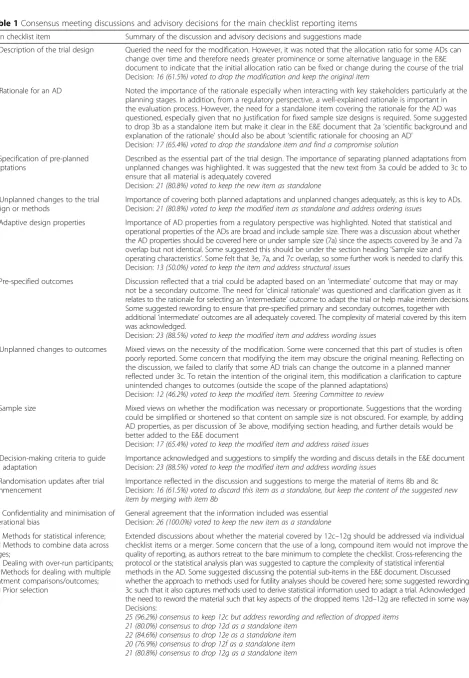
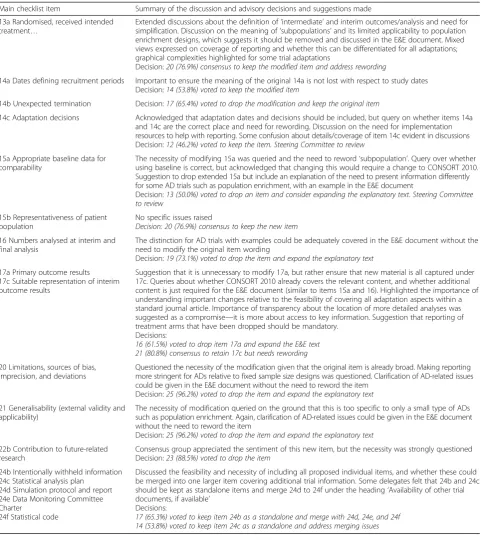
For the main checklist, Table 1 summarises the ACE Consensus Group discussions and advisory decisions made with suggestions of related issues to address. Delegates voted whether to keep or discard each item or whether they were unsure. There was a consensus (≥70% of votes) to include ten AD-specific items in the main checklist guideline, of which five were new and five modi-fied items. A further five items were favoured by at least 50% of delegates: AD properties (50.0%), sample size (65.6%), and 53.8% each for randomisation updates after trial commencement (8c), dates defining periods of re-cruitment (14a), and for the inclusion of the statistical analysis plan (24c). A suggestion was made to expand the explanatory text of the E&E document for six items to clarify additional requirements for some ADs without modifying the item: items 14b (unexpected termination/ why the trial ended or was stopped), 15 (appropriate base-line data for comparability), 16 (numbers analysed at in-terim and final analysis), 17a (primary outcome results), and 20 (limitations, sources of bias, imprecision and devi-ations) and 21 (generalisability) (Table1). It was apparent after the meeting that modified item 6b (unplanned changes to outcomes) and new item 14c (adaptation deci-sions) that were supported by 46.2% of votes for inclusion needed further discussions by the SC (Table1).
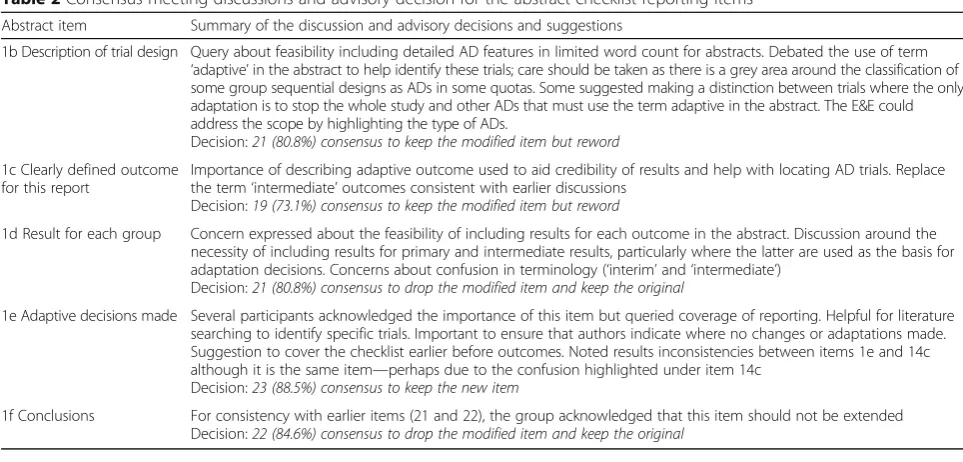
For the abstract (Table 2), there was an agreement to include two modified items (description of trial design and clearly defined outcome for this report) and one new item (adaptive decisions made). A recurrent discus-sion point was the need to minimise adding new items to the abstract unless they are essential due to word limits imposed by journals.
Finalisation of the checklist
On 1 February 2018, the SMG met to discuss advisory decisions and suggestions made at the consensus meet-ing. The group discussed each item reflecting on the consensus report and agreed on the items to retain and structural changes required in the guidance.
The advisory decisions and suggestions from the con-sensus meeting were taken on board. The rationale for an AD (item 3b, Table1) was dropped as a compromise but will be discussed in the E&E text under item 3c (pre--planned adaptations) and linked to the scientific back-ground and explanation of the rationale (item 2a). We merged items 3e (AD properties) and 7b (sample size) be-cause they are connected. As a result, we renamed the
‘sample size’ subheading to ‘sample size and operating characteristics’. The modified item 6b (unplanned changes to outcomes) with borderline results was included for clarification purpose. In addition, item 14c (adaptation de-cisions) was discussed as very important and also included for consistency with the abstract decisions. For items 24b to 24f (Table1), we decided to keep the statistical analysis plan (24c) as an important standalone item and merge to include other items (24b intentionally withheld informa-tion, 24d simulation protocol and report, 24e data moni-toring committee charter and 24f statistical code) for discussion in the E&E document for good practice.
For the abstract, we acknowledged the importance of including a clearly defined outcome used to inform adaptation if different from the primary outcome (1c Table 2). However, for parsimony reasons due to word limit imposed on abstracts, we dropped the modified item but will instead expand the E&E text discussing cir-cumstances when this information is desirable to be in-cluded in the abstract.
Following the meeting, the checklist was revised in-cluding rewording and reordering of some items (such as item 3c‘specification of pre-planned adaptation’to 3b
Table 1Consensus meeting discussions and advisory decisions for the main checklist reporting items
Main checklist item Summary of the discussion and advisory decisions and suggestions made
3a Description of the trial design Queried the need for the modification. However, it was noted that the allocation ratio for some ADs can change over time and therefore needs greater prominence or some alternative language in the E&E document to indicate that the initial allocation ratio can be fixed or change during the course of the trial Decision:16 (61.5%) voted to drop the modification and keep the original item
3b Rationale for an AD Noted the importance of the rationale especially when interacting with key stakeholders particularly at the planning stages. In addition, from a regulatory perspective, a well-explained rationale is important in the evaluation process. However, the need for a standalone item covering the rationale for the AD was questioned, especially given that no justification for fixed sample size designs is required. Some suggested to drop 3b as a standalone item but make it clear in the E&E document that 2a‘scientific background and explanation of the rationale’should also be about‘scientific rationale for choosing an AD’
Decision:17 (65.4%) voted to drop the standalone item and find a compromise solution
3c Specification of pre-planned adaptations
Described as the essential part of the trial design. The importance of separating planned adaptations from unplanned changes was highlighted. It was suggested that the new text from 3a could be added to 3c to ensure that all material is adequately covered
Decision:21 (80.8%) voted to keep the new item as standalone
3d Unplanned changes to the trial design or methods
Importance of covering both planned adaptations and unplanned changes adequately, as this is key to ADs. Decision:21 (80.8%) voted to keep the modified item as standalone and address ordering issues
3e Adaptive design properties Importance of AD properties from a regulatory perspective was highlighted. Noted that statistical and operational properties of the ADs are broad and include sample size. There was a discussion about whether the AD properties should be covered here or under sample size (7a) since the aspects covered by 3e and 7a overlap but not identical. Some suggested this should be under the section heading‘Sample size and operating characteristics’. Some felt that 3e, 7a, and 7c overlap, so some further work is needed to clarify this. Decision:13 (50.0%) voted to keep the item and address structural issues
6a Pre-specified outcomes Discussion reflected that a trial could be adapted based on an‘intermediate’outcome that may or may not be a secondary outcome. The need for‘clinical rationale’was questioned and clarification given as it relates to the rationale for selecting an‘intermediate’outcome to adapt the trial or help make interim decisions. Some suggested rewording to ensure that pre-specified primary and secondary outcomes, together with additional‘intermediate’outcomes are all adequately covered. The complexity of material covered by this item was acknowledged.
Decision:23 (88.5%) voted to keep the modified item and address wording issues
6b Unplanned changes to outcomes Mixed views on the necessity of the modification. Some were concerned that this part of studies is often poorly reported. Some concern that modifying the item may obscure the original meaning. Reflecting on the discussion, we failed to clarify that some AD trials can change the outcome in a planned manner reflected under 3c. To retain the intention of the original item, this modification a clarification to capture unintended changes to outcomes (outside the scope of the planned adaptations)
Decision:12 (46.2%) voted to keep the modified item. Steering Committee to review
7a Sample size Mixed views on whether the modification was necessary or proportionate. Suggestions that the wording could be simplified or shortened so that content on sample size is not obscured. For example, by adding AD properties, as per discussion of 3e above, modifying section heading, and further details would be better added to the E&E document
Decision:17 (65.4%) voted to keep the modified item and address raised issues
7b Decision-making criteria to guide trial adaptation
Importance acknowledged and suggestions to simplify the wording and discuss details in the E&E document Decision:23 (88.5%) voted to keep the modified item and address wording issues
8c Randomisation updates after trial commencement
Importance reflected in the discussion and suggestions to merge the material of items 8b and 8c Decision:16 (61.5%) voted to discard this item as a standalone, but keep the content of the suggested new item by merging with item 8b
11c Confidentiality and minimisation of operational bias
General agreement that the information included was essential Decision:26 (100.0%) voted to keep the new item as a standalone
12c Methods for statistical inference; 12d Methods to combine data across stages;
12e Dealing with over-run participants; 12f Methods for dealing with multiple treatment comparisons/outcomes; 12g Prior selection
Extended discussions about whether the material covered by 12c–12g should be addressed via individual checklist items or a merger. Some concern that the use of a long, compound item would not improve the quality of reporting, as authors retreat to the bare minimum to complete the checklist. Cross-referencing the protocol or the statistical analysis plan was suggested to capture the complexity of statistical inferential methods in the AD. Some suggested discussing the potential sub-items in the E&E document. Discussed whether the approach to methods used for futility analyses should be covered here; some suggested rewording 3c such that it also captures methods used to derive statistical information used to adapt a trial. Acknowledged the need to reword the material such that key aspects of the dropped items 12d–12g are reflected in some way Decisions:
25 (96.2%) consensus to keep 12c but address rewording and reflection of dropped items 21 (80.0%) consensus to drop 12d as a standalone item
Discussion
Main results or outputs
We have developed a consensus-driven extension to the CONSORT 2010 Statement for randomised trials using an AD to enhance transparency and adequate reporting. In the spirit of transparency, we have described in this paper the process for the development of the ACE
checklist and provided all supporting information that aided the decision-making process. We hope that our experiences can help others in the development of other guidelines or extensions.
The guideline aims to promote transparency and ad-equate reporting of randomised trials that use ADs and not to stifle design innovation or application of ADs.
Table 1Consensus meeting discussions and advisory decisions for the main checklist reporting items(Continued)
Main checklist item Summary of the discussion and advisory decisions and suggestions made
13a Randomised, received intended treatment…
Extended discussions about the definition of‘intermediate’and interim outcomes/analysis and need for simplification. Discussion on the meaning of‘subpopulations’and its limited applicability to population enrichment designs, which suggests it should be removed and discussed in the E&E document. Mixed views expressed on coverage of reporting and whether this can be differentiated for all adaptations; graphical complexities highlighted for some trial adaptations
Decision:20 (76.9%) consensus to keep the modified item and address rewording
14a Dates defining recruitment periods Important to ensure the meaning of the original 14a is not lost with respect to study dates Decision:14 (53.8%) voted to keep the modified item
14b Unexpected termination Decision:17 (65.4%) voted to drop the modification and keep the original item
14c Adaptation decisions Acknowledged that adaptation dates and decisions should be included, but query on whether items 14a and 14c are the correct place and need for rewording. Discussion on the need for implementation resources to help with reporting. Some confusion about details/coverage of item 14c evident in discussions Decision:12 (46.2%) voted to keep the item. Steering Committee to review
15a Appropriate baseline data for comparability
The necessity of modifying 15a was queried and the need to reword‘subpopulation’. Query over whether using baseline is correct, but acknowledged that changing this would require a change to CONSORT 2010. Suggestion to drop extended 15a but include an explanation of the need to present information differently for some AD trials such as population enrichment, with an example in the E&E document
Decision:13 (50.0%) voted to drop an item and consider expanding the explanatory text.Steering Committee to review
15b Representativeness of patient population
No specific issues raised
Decision: 20 (76.9%) consensus to keep the new item
16 Numbers analysed at interim and final analysis
The distinction for AD trials with examples could be adequately covered in the E&E document without the need to modify the original item wording
Decision:19 (73.1%) voted to drop the item and expand the explanatory text
17a Primary outcome results 17c Suitable representation of interim outcome results
Suggestion that it is unnecessary to modify 17a, but rather ensure that new material is all captured under 17c. Queries about whether CONSORT 2010 already covers the relevant content, and whether additional content is just required for the E&E document (similar to items 15a and 16). Highlighted the importance of understanding important changes relative to the feasibility of covering all adaptation aspects within a standard journal article. Importance of transparency about the location of more detailed analyses was suggested as a compromise—it is more about access to key information. Suggestion that reporting of treatment arms that have been dropped should be mandatory.
Decisions:
16 (61.5%) voted to drop item 17a and expand the E&E text 21 (80.8%) consensus to retain 17c but needs rewording
20 Limitations, sources of bias, imprecision, and deviations
Questioned the necessity of the modification given that the original item is already broad. Making reporting more stringent for ADs relative to fixed sample size designs was questioned. Clarification of AD-related issues could be given in the E&E document without the need to reword the item
Decision:25 (96.2%) voted to drop the item and expand the explanatory text
21 Generalisability (external validity and applicability)
The necessity of modification queried on the ground that this is too specific to only a small type of ADs such as population enrichment. Again, clarification of AD-related issues could be given in the E&E document without the need to reword the item
Decision:25 (96.2%) voted to drop the item and expand the explanatory text
22b Contribution to future-related research
Consensus group appreciated the sentiment of this new item, but the necessity was strongly questioned Decision:23 (88.5%) voted to drop the item
24b Intentionally withheld information 24c Statistical analysis plan
24d Simulation protocol and report 24e Data Monitoring Committee Charter
24f Statistical code
Discussed the feasibility and necessity of including all proposed individual items, and whether these could be merged into one larger item covering additional trial information. Some delegates felt that 24b and 24c should be kept as standalone items and merge 24d to 24f under the heading‘Availability of other trial documents, if available’
Decisions:
The ACE checklist provides the minimum requirements that we encourage researchers to report. It is good scien-tific practice to present additional information beyond this guideline if it helps the interpretation of AD trial re-sults. In principle, we are not advocating the inclusion of details of every trial aspect in a single journal publica-tion. We believe that the most important is the access to details relating to the identified reporting items. For ex-ample, researchers can cite other accessible sources of information such as the protocol, simulation protocol and report, a prior publication detailing study design and rationale, methodology publications, and supple-mentary materials. In addition, the publishing landscape is rapidly changing to meet the needs for more transpar-ency and adequate reporting.
During the development process, the SC came across a few reporting aspects that could be changed or added such as on estimands [71,72] and data transparency but decided not to do so. This is because we felt that changes to reporting aspects that apply to every trial should be managed via universal amendments to the CONSORT 2010 Statement. We did not want the ACE to selectively put additional hurdles on ADs on reporting aspects which would also apply for other fixed designs. We have communicated this decision to the CONSORT Executive Group through its SC representative.
The ACE reporting guideline is applicable to all rando-mised AD trials regardless of the statistical framework used to design and analyse the trials (frequentist, Bayesian, or both). The supporting E&E document to be accessed via the CONSORT [74] and EQUATOR Network [42] websites will explain the checklist items in detail with the aid of examples and discussion. The E&E document will
guide study publication authors in determining which minimum AD aspects warrant reporting and in what level of detail under different circumstances aided by examples. We hope this ACE reporting guideline will address some concerns about certain AD trials and, consequently, indir-ectly improve their design, conduct, and interpretability of results. We encourage researchers to use the guideline and journal editors and reviewers to enforce compliance as part of their publication policy. The usefulness of reporting guidelines can be maximised when there are ad-equate processes in place to enforce their compliance [75].
Main strengths
We used a consensus-driven Delphi methodology recom-mended when developing healthcare reporting guidelines [39]. We engaged with key stakeholders in trials research and potential end-users of the resultant ACE reporting guideline throughout the development process that in-volved participants from a wide range of scientific disci-plines, employment sectors, and nationalities with diverse AD-related experiences. Throughout the checklist drafting process, an External Expert Panel provided quality control assurances. Given the topic of the guideline, we adapted the development process in response to the feedback gath-ered. The CONSORT Executive Group through its repre-sentative (DA) oversaw the development process of the guideline throughout. This research developed a CON-SORT extension for AD randomised trials using this robust approach endorsed by the CONSORT Executive Group.
We recorded high response rates of 94 (66%), 114 (73%), and 79 (55%) in round 1, round 2, and across both rounds of the Delphi survey, respectively. The number of registered participants and responders is
Table 2Consensus meeting discussions and advisory decision for the abstract checklist reporting items
Abstract item Summary of the discussion and advisory decisions and suggestions
1b Description of trial design Query about feasibility including detailed AD features in limited word count for abstracts. Debated the use of term ‘adaptive’in the abstract to help identify these trials; care should be taken as there is a grey area around the classification of some group sequential designs as ADs in some quotas. Some suggested making a distinction between trials where the only adaptation is to stop the whole study and other ADs that must use the term adaptive in the abstract. The E&E could address the scope by highlighting the type of ADs.
Decision:21 (80.8%) consensus to keep the modified item but reword
1c Clearly defined outcome for this report
Importance of describing adaptive outcome used to aid credibility of results and help with locating AD trials. Replace the term‘intermediate’outcomes consistent with earlier discussions
Decision:19 (73.1%) consensus to keep the modified item but reword
1d Result for each group Concern expressed about the feasibility of including results for each outcome in the abstract. Discussion around the necessity of including results for primary and intermediate results, particularly where the latter are used as the basis for adaptation decisions. Concerns about confusion in terminology (‘interim’and‘intermediate’)
Decision:21 (80.8%) consensus to drop the modified item and keep the original
1e Adaptive decisions made Several participants acknowledged the importance of this item but queried coverage of reporting. Helpful for literature searching to identify specific trials. Important to ensure that authors indicate where no changes or adaptations made. Suggestion to cover the checklist earlier before outcomes. Noted results inconsistencies between items 1e and 14c although it is the same item—perhaps due to the confusion highlighted under item 14c
Decision:23 (88.5%) consensus to keep the new item
Table 3Finalised CONSORT extension for adaptive design randomised trials (only new and modified items and those with expanded E&E text)
Section/topic by item no
Standard CONSORT for abstracts and conference posters [84,85]
Abstract extension for adaptive design randomised trials
Title and abstract
Trial design Description of the trial design (for example, parallel, cluster, non-inferiority)
Description of the trial design (for example, parallel, cluster, non-inferiority); include the word‘adaptive’in the content or at least as a keyword
Outcome Clearly defined primary outcome for this report [expand E&E text for clarification]
Adaptation decisions made
Specify what trial adaptation decisions were made in light of the pre-planned decision-making criteria and observed accrued data
Section/topic by item no
Standard CONSORT 2010 checklist item [37,65] Main report extension for adaptive design randomised trials
Trial design
3b « pre-planned adaptive design features
Type of adaptive design used, with details of the pre-planned trial adaptations and the statistical information informing the adaptations
3c « 3b Important changes to methods after trial commencement (such as eligibility criteria), with reasons
Important changes to the design or methods after trial commencement (such as eligibility criteria) outside the scope of the pre-planned adaptive design features, with reasons
Outcomes
6a Completely defined pre-specified primary and secondary outcome measures, including how and when they were assessed
Completely define pre-specified primary and secondary outcome measures, including how and when they were assessed. Any other outcome measures used to inform pre-planned adaptations should be described with the rationale
6b Any changes to trial outcomes after the trial commenced, with reasons
Any unplanned changes to trial outcomes after the trial commenced, with reasons
Sample size and operating characteristics
7a How sample size was determined How sample size and operating characteristics were
determined
7b When applicable, explanation of any interim analyses and stopping guidelines
Pre-planned interim decision-making criteria to guide the trial adaptation process; whether decision-making criteria were binding or nonbinding; pre-planned and actual timing and frequency of interim data looks to inform trial adaptations
Sequence generation
8b Type of randomisation; details of any restriction (such as blocking and block size)
Type of randomisation; details of any restriction (such as blocking and block size); any changes to the allocation rule after trial adaptation decisions; any pre-planned allocation rule or algorithm to update randomisation with timing and frequency of updates
Blinding
11c Confidentiality and minimisation of operational bias
Measures to safeguard the confidentiality of interim information and minimise potential operational bias during the trial
Statistical methods
12a Statistical methods used to compare groups for primary and secondary outcomes
Statistical methods used to compare groups for primary and secondary outcomes, and any other outcomes used to make pre-planned adaptations
12b « Estimation and inference methods
For the implemented adaptive design features, statistical methods used to estimate treatment effects for key endpoints and to make inferences
Participant flow (a diagram is strongly recommended)
13a For each group, the numbers of participants who were randomly assigned, received intended treatment, and were analysed for the primary outcome
larger than other similar Delphi surveys [62,76,77]. The characteristics and demographics of registered partici-pants and responders were very similar across Delphi survey rounds. In addition, the number of registered participants and responders is larger than in most Del-phi surveys used to develop healthcare reporting guide-lines [78, 79] and comparable to the one of the latest guideline on pilot and feasibility studies [80, 81]. We also improved the participation of key end-users of the guideline (journal editors) in round 2 by reopening registration after round 1. Finally, we achieved a high degree of consensus that was consistent across Delphi survey rounds for the majority of the items. Additional supplementary materials are publicly accessible (Additional file10) including participants who took part (Additional file11).
Main limitations
Despite the highlighted strengths of this study, we also identified a number of limitations. First, over half of the survey participants were statisticians in their primary role in trials research and even though industry currently
contributes a huge proportion of ADs [18–20, 28, 82], over two thirds of participants were employed in the pub-lic sector. However, the secondary roles of participants in trials research were more diverse including clinical investi-gators and trial methodologists. Nonetheless, perceptions about the importance of items were broadly consistent re-gardless of the primary roles of the participants, and their self-identified stakeholder group, and employment sector.
Second, despite our broad engagement efforts, the num-ber of participants from some stakeholder groups was small such as health economists, regulatory assessors, and research ethicists. Research on obstacles to AD trials also reported poor uptake among these stakeholder groups [26,
28]. The implications for the guideline development are unclear. Paradoxically, although few participants identified themselves as regulatory assessors, about 43% stated that they had AD-related regulatory assessment experiences. This could include researchers with regulatory experiences as part of regulatory engagements or submissions of their trials, previous employees of regulatory agencies, or current regulatory assessors who did not want to identify themselves as employees of regulatory agencies during the
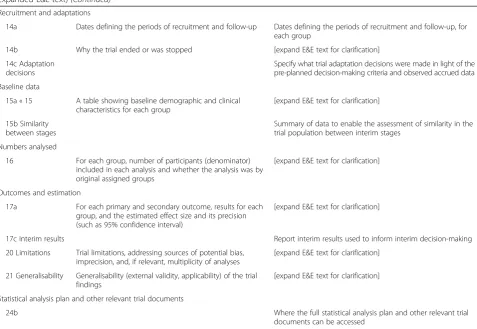
Table 3Finalised CONSORT extension for adaptive design randomised trials (only new and modified items and those with expanded E&E text)(Continued)
Recruitment and adaptations
14a Dates defining the periods of recruitment and follow-up Dates defining the periods of recruitment and follow-up, for each group
14b Why the trial ended or was stopped [expand E&E text for clarification]
14c Adaptation decisions
Specify what trial adaptation decisions were made in light of the pre-planned decision-making criteria and observed accrued data
Baseline data
15a « 15 A table showing baseline demographic and clinical characteristics for each group
[expand E&E text for clarification]
15b Similarity between stages
Summary of data to enable the assessment of similarity in the trial population between interim stages
Numbers analysed
16 For each group, number of participants (denominator) included in each analysis and whether the analysis was by original assigned groups
[expand E&E text for clarification]
Outcomes and estimation
17a For each primary and secondary outcome, results for each group, and the estimated effect size and its precision (such as 95% confidence interval)
[expand E&E text for clarification]
17c Interim results Report interim results used to inform interim decision-making
20 Limitations Trial limitations, addressing sources of potential bias, imprecision, and, if relevant, multiplicity of analyses
[expand E&E text for clarification]
21 Generalisability Generalisability (external validity, applicability) of the trial findings
[expand E&E text for clarification]
Statistical analysis plan and other relevant trial documents
24b Where the full statistical analysis plan and other relevant trial
documents can be accessed
surveys due to contractual issues. However, the percep-tions of responders were consistent regardless of the stated AD regulatory assessment experiences. It should also be noted that there was only a small number of regulatory as-sessors available for the sampling frame.
Finally, for practical purposes in line with the CONSORT 2010 statement, the ACE reporting guideline applies to randomised trials that use ADs. Hence, the guideline does not specifically address reporting aspects of non-randomised AD studies that are also applied in early phase trials. Nevertheless, the basic principles of the ACE reporting guideline may still be applicable to these interventional studies and are consistent with some researcher good practice propositions for writing early-phase AD study protocols [83]. We believe there is scope for a consensus-driven approach to develop a reporting guideline for non-randomised AD studies.
Conclusions
We have developed a consensus-driven CONSORT ex-tension for AD randomised trials. This paper transpar-ently describes how we reached the final ACE reporting checklist and the forthcoming E&E document and pro-vides all supporting information that aided the decision-making process. The process we described is not just applicable to ADs, and so we hope this will help researchers in the development of future guidelines or extensions to learn from our experiences. The ACE reporting guideline is applicable to all AD randomised trials and contains minimum reporting requirements with appropriate flexibility to be described in the E&E document. We hope the guideline will improve the reporting of AD randomised trials, enhance their inter-pretability and credibility of their results, improve their reproducibility, and indirectly facilitate their robust de-sign and conduct.
Additional files
Additional file 1:ACE project management activities. Summary of ACE project management related activities during the development process. (DOCX 21 kb)
Additional file 2:Definitions of technical terms relating to adaptive designs. List of adaptive designs technical terms and definitions agreed by the ACE Steering Committee. (DOCX 26 kb)
Additional file 3:Platforms used to reach out to key stakeholders for Delphi surveys. List of platforms used to reach out to key stakeholders for Delphi surveys. (DOCX 20 kb)
Additional file 4:Qualitative feedback from round 1 Delphi survey and our response. Qualitative feedback and Steering Committee responses. (DOCX 20 kb)
Additional file 5:Demographic and characteristics of registered participants and responders. Summaries of Delphi survey participants. (DOCX 23 kb)
Additional file 6:Round 1 summary of perceptions about the importance of reporting items. Summaries of round 1 perceptions about the importance of reporting items. (DOCX 28 kb)
Additional file 7:Round 2 summary of perceptions about the importance of reporting items. Summaries of round 2 perceptions about the importance of reporting items. (DOCX 29 kb)
Additional file 8:Measures of agreement in rating scores between Delphi rounds 1 and 2 survey. Summaries of measures of agreement in the rating of participants between rounds 1 and 2 of the Delphi surveys. (DOCX 24 kb)
Additional file 9:Distributions of the change in rating scores from round 1 and Bland-Altman plots. Bland-Altman plots and histograms showing the distribution of change in scores from round 1. (DOCX 1205 kb)
Additional file 10:Accessible supplementary material hosted within the University of Sheffield ORDA repository. Summary reports; draft checklists used in round 1 and 2 Delphi surveys; registration and Delphi survey rounds datasets; Figures (clustered boxplots) displaying responders’perceptions of reporting items stratified by key characteristics. (DOCX 22 kb)
Additional file 11:Registered participants for the Delphi surveys. List of participants who registered to take part in the Delphi surveys. This includes only those who did not opt out to be publicly acknowledged. (DOCX 19 kb)
Abbreviations
ACE:Adaptive designs CONSORT Extension; AD: Adaptive design;
ADMTP: Adaptive Designs and Multiple Testing Procedures; ADWG: Adaptive Designs Working Group; CONSORT: Consolidated Standards of Reporting Trials; CTU: Clinical Trials Unit; DIA: Drive Insights to Action; DRF: Doctoral Research Fellowship; E&E: Explanation and elaboration; HTMR: Hubs for Trials Methodology Research; IQR: Interquartile range; ISCB: International Society for Clinical Biostatistics; MRC: Medical Research Council; NIHR: National Institute for Health Research; PhRMA: Pharmaceutical Research and Manufacturers of America; PSI: Statisticians in the Pharmaceutical Industry; REC: Research Ethics Committee; SC: Steering Committee; ScHARR: School of Health and Related Research; SCT: Society for Clinical Trials; SD: Standard deviation; SMG: Study Management Group; UKCRC: United Kingdom Clinical Research Collaboration
Acknowledgements
The SC valued the administrative support provided by Sarah Gonzalez throughout the project and additional coordination. The authors acknowledged Sheffield Clinical Trials Research Unit for the support, particularly Mike Bradburn and Cindy Cooper for providing protected time to ensure progress of this project; Benjamin Allin and Anja Hollowell for the Delphi surveys’technical and administrative support; and Peter Bauer and Martin Posch for their helpful review feedback of the draft checklist.
ACE Steering Committee: Munyaradzi Dimairo, Elizabeth Coates, Philip Pallmann, Susan Todd, Steven A. Julious, Thomas Jaki, James Wason, Adrian P. Mander, Christopher J. Weir, Franz Koenig, Marc K. Walton, Katie Biggs, Jon Nicholl, Toshimitsu Hamasaki, Michael A. Proschan, John A. Scott, Yuki Ando, Daniel Hind, and Douglas G. Altman
ACE Study Management Group: Munyaradzi Dimairo, Elizabeth Coates, Philip Pallmann, Susan Todd, Steven A. Julious, Thomas Jaki, James Wason, Adrian Mander, Christopher J. Weir, Franz Koenig, Katie Biggs, Jon Nicholl, and Daniel Hind
The External Expert Panel
We would like to thank these members for their invaluable contributions in reviewing the checklist and working definitions of technical terms for the Delphi surveys: William Meurera, Yannis Jemiaib, Stephane Heritierc, and Christina Yapd.
aUniversity of Michigan, Taubman Center, USA b
Cytel, Cambridge, USA
cMonash University, Department of Epidemiology and Preventive Medicine,
School of Public Health and Preventive Medicine, Australia
dCancer Research UK Clinical Trials Unit, Institute of Cancer and Genomic
Sciences, University of Birmingham, Birmingham, UK
The ACE Consensus Group
We are very grateful to the participants who contributed to a very successful consensus meeting that influenced the decision-making process of the SC. All members including the SC signed off the final ACE checklist.
![Fig. 2 Snapshot of the online round 1 Delphi survey. [N] and [M] represent new and modified reporting items](https://thumb-us.123doks.com/thumbv2/123dok_us/8906594.1834380/6.595.56.539.84.445/snapshot-online-round-delphi-survey-represent-modified-reporting.webp)