VOLUME 36, ARTICLE 16, PAGES 501
−
524
PUBLISHED 8 FEBRUARY 2017
http://www.demographic-research.org/Volumes/Vol36/16/ DOI: 10.4054/DemRes.2017.36.16
Research Article
Division of housework and his and her view of
housework fairness:
A typology of Swedish couples
Leah Ruppanner
Eva Bernhardt
Maria Brandén
This publication is part of the Special Collection on “Finding Work-Life Balance: History, Determinants, and Consequences of New Bread-Winning Models in the Industrialized World,” organized by Guest Editors Trude Lappegård, Fran Goldscheider, and Eva Bernhardt.
© 2017 Leah Ruppanner, Eva Bernhardt & Maria Brandén.
This open-access work is published under the terms of the Creative Commons Attribution NonCommercial License 2.0 Germany, which permits use, reproduction & distribution in any medium for non-commercial purposes, provided the original author(s) and source are given credit.
1 Introduction 502
2 Typologies: The Swedish case 505
2.1 Explaining housework fairness: The distributive justice approach 505 2.2 Linking fairness to explain Swedish typologies 506
3 Data 507
3.1 Variables used in the typology 508
3.2 Independent variables 510
4 Analytical approach 511
4.1 Identifying clusters: A typology of households based on couple data from the 2009 YAPS survey
511
4.2 Sensitivity tests 513
4.3 Comparing the couple types: Evaluating the distributive justice perspective
514
5 Summary and tentative conclusions 517
References 520
Division of housework and his and her view of housework fairness:
A typology of Swedish couples
Leah Ruppanner1 Eva Bernhardt2 Maria Brandén3
Abstract
BACKGROUND
Housework studies have long documented a fairness paradox, whereby unequal divisions of housework are evaluated as fair. Gender equality, both at home and at work, is strongly normative in a highly egalitarian country like Sweden, but not always matched by an equally egalitarian situation in the family which are often viewed as fair.
OBJECTIVE
To explore the relationship between housework-sharing and perceived fairness of this division, using both partners’ reports, to identify how Swedish couples cluster across these measures and what individual characteristics predict cluster membership.
METHODS
Using the couple-level design of the 2009 wave of the Young Adult Panel Study (YAPS, n=1,026), we are able to advance the research field and evaluate housework experience within broader couple dynamics. Our approach is exploratory and develops a typology using latent class analysis.
RESULTS
We identify six latent groups, with distinct features. The modal Swedish-couple category comprises those who share housework equally and agree that this arrangement is fair (33% of the couples). Applying a distributive justice perspective, we find that childhood socialization, presence of children in the household, and the distribution of employment, education, income, and egalitarianism across couples are important predictors of cluster membership.
1
University of Melbourne, Australia. E-Mail:[email protected].
2
Stockholm University, Sweden.
CONCLUSIONS
We find that equal-sharing/fair couples are most common in the Swedish context, suggesting clear benefits from Sweden’s expansive gender policies. Yet, there seems to be a generational divide, whereby Swedish women who witnessed housework inequality in their parental home are increasingly dissatisfied when this inequality replicates in their own lives.
1. Introduction
Existing literature identifies a complex relationship between housework inequality and fairness in the Swedish context. Nordenmark and Nyman (2003) find perceptions of fairness are tied to each partner’s allocation of domestic, employment, and leisure time. Women’s greater domestic share is deemed ‘fair’ because women work fewer hours (even when working full-time) and thus have greater discretionary time for housework. Yet time trend data shows that Swedish men, not Swedish women, have increased discretionary time (leisure and sleep) net of their increased time spent on housework (when comparing 1990 to 2000) (Dribe and Stanfors 2009). As these trends in data indicate, Swedish women sacrifice leisure time to greater domestic time, even though their hours spent in paid work are lower. Despite this disparity, few women view these allocations as unfair. Swedish couples rarely share housework equally, yet only 30% of wives and 20% of husbands view this as ‘unfair’ (Ahrne and Roman 1997). Clearly, the housework paradox – unequal housework divisions viewed as fair – persists even in the highly egalitarian Swedish context. Even in light of this research, no study to date has taken a couple-level approach to investigate whether partners’ are consistent in their reports of housework fairness. This distinction is important, given that housework inequality is a predictor of relationship dissolution (Frisco and Williams 2003; Oláh and Gähler 2014; Ruppanner, Branden, and Turunen 2017).
We address these gaps by assessing how these relationships map onto Swedish women’s lived experiences. Existing research on housework and fairness focuses narrowly on individual-level reports (Dempsey 1999; Kluwer, Heesink, and Van De Vliert 1997; Perales, Baxter, and Tai 2015). However, household labor negotiations between partners are highly dynamic. The lack of couple-level data on these measures prohibits direct exploration, which is a major limitation in the field. Indeed, Smith and colleagues (1998) argue for a “reconceptualization of the problem (of housework inequality and fairness) into the properties of couples or marriages” (p. 325). Our research approach is exploratory and develops a typology using latent class analysis, yet it is important, given that little is known about whether previous findings from Swedish data (on persistent gender inequality and perceptions of fairness) capture all Swedish couples’ experiences or only those of certain types of Swedish couples (Ahrne and Roman 1997; Nordenmark and Nyman 2003).
family-responsive policy. Since 1978, parents have had the legal right to reduce their working hours (with a corresponding reduction in pay) up to 75% until the child reaches 8 years of age. This policy is not explicitly gendered, yet mothers take advantage of this right much more often than men (Larsson 2012). This means that many mothers are working long (30 plus) part-time hours, a characteristic distinct to the Swedish context. Women’s part-time work is coupled with a larger share of the housework, which may or may not be perceived as fair (Evertsson 2014). Existing research suggests that couples in these contexts will perceive their housework allocation as equitable (Ahrne and Roman 1997; Nordenmark and Nyman 2003). Despite this perception of fairness, cultural tensions remain, with young Swedish couples favoring an egalitarian division of domestic tasks and in a majority of cases aiming to apply this ideal in reality (Bernhardt, Noack, and Lyngstad 2008). Divorce is more common among young Swedish couples that do not equitably share housework, suggesting damaging tensions in housework bargaining (Oláh and Gähler 2014). For these reasons the need to understand cluster membership across a range of theoretically motivated measures is essential.
2. Typologies: The Swedish case
We expect our typologies of Swedish couples to be drawn along three dimensions: housework inequality, perceptions of fairness, and couples’ agreement over housework fairness. To assess these relationships we leverage the couple-level design of the YAPS to include inconsistencies in fairness reporting, expecting these to be most severe for those with unequal housework allocations. We draw heavily upon existing theory of housework fairness to explain our typology and to hypothesize which individual-level factors will explain group membership. We take each in turn.
2.1 Explaining housework fairness: The distributive justice approach
education to be less likely to justify an unequal division of housework as fair. Thus, we expect women’s resources, measured more comprehensively than gender role ideology alone, to explain our clusters.
The distributive justice perspective has received cross-national support, as housework allocation and gender-role expectations are shown to structure perceptions of unfairness (Baxter 2000; Perales, Baxter, and Tai 2015; Ruppanner 2010). However, these paradoxical findings – unequal divisions of housework perceived as fair – require additional investigation. Specifically, the question remains: are these relationships driven by single experiences or do they reflect broader groupings of individual traits? Thus, in this research we identify typologies of contention, with particular focus on women’s and men’s perceptions of housework inequality and on inconsistencies in couples’ reports of unfairness.
2.2 Linking fairness to explain Swedish typologies
We expect housework allocations and couples’ reports of fairness to form four broad typologies. We begin with equality in housework, as theory predicts that perceptions of fairness are tied to objective housework divisions (Thompson 1991). Judging by the explicit goals of Swedish gender equality policy, we expect the largest group to comprise couples who share housework equally and who agree on the fairness of this distribution (‘equitable/agree fair’). A wealth of previous research demonstrates the importance of housework equality in the case of Sweden (Ahrne and Roman 1997; Evertsson 2006, 2014; Evertsson and Nermo 2004, 2007; Fuwa 2004; Geist 2005; Hook 2006; Ruppanner 2010). Thus, we expect those who achieve housework equality to also report fairness, with consistency within couples. If Swedish gender egalitarianism is truly internalized by most Swedish couples, then this equitable/fair group should be the modal category, and we expect individually held gender role ideologies (justifications) and housework socialization (comparative referents) to be less predictive of group membership. Rather, we expect the equitable division of housework to be a normative Swedish experience, rather than being driven by egalitarians or traditionals.
(‘traditional/contested’ – she reports it is unfair to her). According to the distributive justice perspective, these Swedish clusters should be concentrated among women holding egalitarian gender role expectations and those working full-time. Whether men view this traditional arrangement as ‘fair’ should also hinge on men’s gender role ideology, with egalitarian men reporting perceptions of unfairness but traditional men viewing these allocations as more fair. These clusters may also capture those who grew up with traditional housework allocations, comparing their housework division to that of their parents, and validating it as fair. On the other hand, both partners may perceive these unequal housework divisions as fair (‘traditional/agree fair’). Here, again, we expect gender role ideology and childhood housework socialization to be important determining factors. Specifically, we expect those with traditional gender role expectations and a traditional childhood housework allocation to cluster in this group.
A third category is where the woman does more housework and both partners view this division as unfair to her. In these couples, perceptions of housework are judged accurately, consistently perceived as unfair within couples. The distributive justice perspective predicts that these couples will be more egalitarian in their gender-role attitudes. Women with higher relative earnings and education and those employed full-time will also be most likely to view inequitable housework divisions as unfair. In a final cluster, we have ‘norm-breaking’ Swedish couples. In these couples the man does the majority of the housework. As this is an emerging family form and is less common in other geographical contexts a theoretical explanation for these couples is absent, and is further complicated by the gendered dimension of this arrangement. On the one hand, the distributive justice perspective, which is gender neutral, predicts that unequal housework allocation will lead to perceptions of unfairness for both partners (‘norm-breaking/contested’ – both view it as unfair) (Thompson 1991). Alternatively, men’s larger share of housework may be a welcome reprieve from traditional housework arrangements and may thus be associated with perceptions of fairness, especially among Swedish women (‘norm-breaking/contested’ – she views it as fair but he views it as unfair to him). We investigate which cluster prevails, and expect gender-role expectations and women’s full-time employment to predict membership in this group.
3. Data
parents. In 2009 all the 3,547 respondents who participated in either of the previous waves (1999 and/or 2003) were again contacted to participate in a final wave of the survey. During the last survey wave (2009), respondents were asked to give their cohabiting or married partner an additional questionnaire. Out of the 1,528 respondents who were married or cohabiting at the time of the survey, 1,074, or 70%, had partners who participated in the 2009 survey. After excluding respondents in same sex relationships, 1,020 respondents remain for our analysis. We structure the data at the couple-level so that our analyses distinguish between the man and the woman in the couple, rather than between the respondent and the partner. All of our analyses use data from the 2009 wave.
We are interested in the interrelation between 1) the sharing of housework between partners, 2) the woman’s perception of how fair this division is, and 3) whether the two partners agree on the fairness of the housework division. By using Latent Class Analysis we examine how couples cluster based on these three characteristics; that is, their class membership (see the section on Analytical Approach below). Finally, we analyze how variables capturing comparative referents (measured by parents’ division of housework when the subject was growing up) and justifications (measured by gender ideology, education, earnings, and work status) predict class membership.
3.1 Variables used in the typology
The sharing of housework between the partners is measured as the man’s share of the couple’s total housework hours. In the distributive justice framework this sharing behavior constitutes the outcome. Housework is defined as the number of hours the woman and the man report a) buying groceries, cooking, and doing the dishes; b) doing laundry, ironing, and taking care of clothes; and c) cleaning and tidying up. This captures the core chores that are routine, essential for household functioning, and not easily delayed (Lee and Waite 2005). If self-reported information is missing, we use the information provided by the partner. If both self-reported and partner-reported information is missing, and there is only missing information for one of the three indicators, the missing value is replaced by the mean number of hours spent in that activity for individuals of the same sex. This modeling strategy is consistent with previous research (Evertsson 2014). We coded housework allocations into four groups based on the percentage of the total housework performed by the woman: 1) less than 25%, 2) 25%‒40%, 3) 40%‒55%, and 4) more than 55%. This allows us to differentiate between equal-sharing, traditional, and nontraditional couples’ housework divisions.
(a) I do much more than my fair share of the housework; (b) I do somewhat more than my fair share of the housework; (c) I do roughly my fair share of the housework; (d) I do somewhat less than my fair share of the housework; and (e) I do much less than my fair share of the housework.” We recoded the variable on a five-point scale to reflect gendered fairness ranging from a) the woman does much more than her fair share, to e) the man does much more than his fair share.
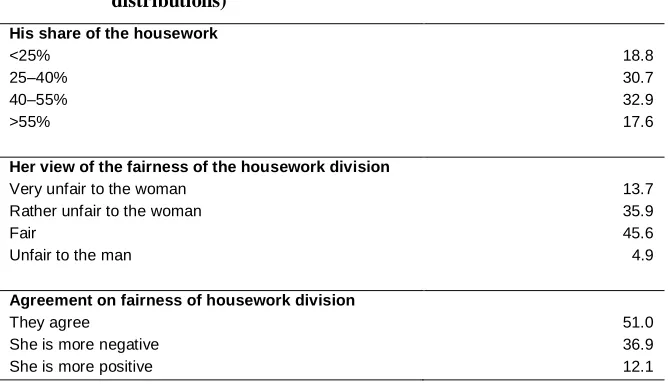
Agreement of fairness is measured by whether the two partners have given the same answer to the question regarding the fairness of the couple’s division of housework. The frequencies of these core variables are shown in Table 1.
Table 1: Descriptive statistics of variables used in the typology (percentage distributions)
His share of the housework
<25% 18.8
25‒40% 30.7
40‒55% 32.9
>55% 17.6
Her view of the fairness of the housework division
Very unfair to the woman 13.7
Rather unfair to the woman 35.9
Fair 45.6
Unfair to the man 4.9
Agreement on fairness of housework division
They agree 51.0
She is more negative 36.9
She is more positive 12.1
In roughly half of the couples there is a traditional division of housework, as his share of the housework is less than 40%. Close to 40% of the couples share more or less equally (40%‒60%), while the male partner does the major part of the housework (>60%) in about 12% of the cases.
3.2 Independent variables
Apart from outcomes (measured by actual sharing of housework), the two other core components of the distributive justice framework are comparative referents and justifications.
In the present study, comparative referents are captured by a variable measuring housework socialization, based on a survey question about the distribution of housework during the respondent’s and partner’s childhood and adolescence. It is included in the analyses as a dichotomous variable in order to capture egalitarian childhood housework arrangements (those in which both parents shared or the father did most, value=0), and traditional childhood housework arrangements (those in which the mother did most of the housework, value=1). In the analyses this variable is included as a separate variable for the man’s and the woman’s housework socialization.
Justifications are captured by gender ideology, work status, relative income, and educational achievement.
Gender ideology is measured by two questions measured on five-point Likert scales. “How much do you agree with the following statements? (a) the woman should take the main responsibility for housework; (b) the man should have the main breadwinner responsibility in the family.” The Likert scale goes from “(1) do not agree at all” to “(5) agree completely”. If an individual answered “do not agree at all” to both these statements, s/he is considered as having a strong gender-egalitarian ideology. In the analyses we include it as a four-category combined variable of whether the man and/or the woman has an egalitarian or non-egalitarian gender ideology, and contrast it where she is more egalitarian in her views than he is to the other categories. This measurement is consistent with previous Swedish data (Oláh and Gähler 2014).
Work status distinguishes between whether the man and the woman are 1) not working (not engaged in paid work), 2) working part-time, 3) working full-time, or 4) working more than full-time. Here we construct two dichotomous variables: 1) both work full-time or more, and 2) she works full-time or more but he does not. This allows us to compare couples where women’s full-time employment is equal to or exceeds men’s to couples where she works fewer hours than he does.
analyses as we are distinguishing between women and men in couples, rather than between respondents and partners. In the analyses we construct a dichotomous variable where the woman is more educated than the man, versus the others.
Finally, we control for the following demographic variables: the woman’s age (<30, 30‒33, 34‒37, 38+), the age difference between the partners (same age, he is more than two years older, she is more than two years older), partner status (cohabiting or married), and child status (childless, youngest child<3 years, youngest child>2 years). The percentage distributions of the independent variables are found in the Appendix.
4. Analytical approach
Initially we perform a latent class analysis to identify typologies of sharing behavior, the woman’s perception of fairness, and the two partners’ agreement on fairness. Latent class analysis identifies unobservable subgroups within a population, based on individuals’ values on two or more observed variables. These variables are assumed to jointly measure one underlying, or latent, construct. Most intuitively, latent class analysis can be thought of as a kind of factor analysis, but with discrete rather than continuous observed variables (Kitterød and Lappegård 2012). We use the Stata LCA Plugin, provided by Penn State University Methodology Center, (Collins and Lanza 2013) to estimate our models.
From the latent class analysis, each couple in our data is assigned to a certain class. Class membership is determined by the class that the couple has the highest probability of belonging to, based on the couple’s sharing behavior, the woman’s perception of fairness, and the partners’ agreement on the fairness. We then examine how variables such as housework socialization, gender ideology, work status, and educational achievement predict such class membership, using multinomial logistic regressions. This modeling strategy is two-fold, first allowing us to identify groups and second allowing us to identify sociodemographic and other characteristics within the assigned groups.
4.1 Identifying clusters: A typology of households based on couple data from the 2009 YAPS survey
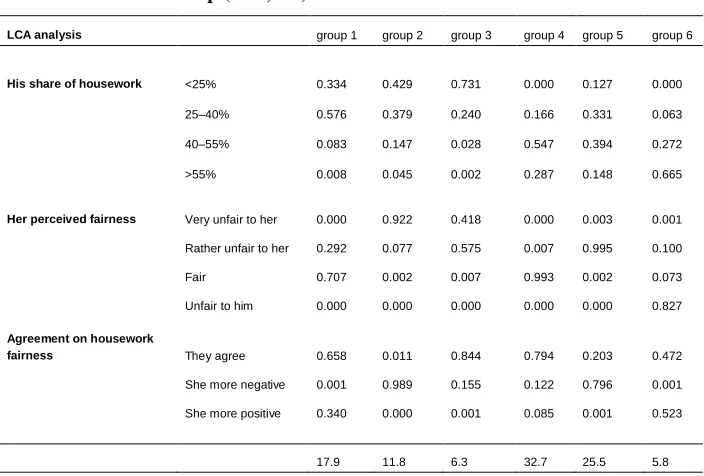
couples with equal sharing of housework and agreement that this distribution is fair (group 4; equal sharing ‒ fair), which constitutes one-third of the couples. Thus, our hypothesis that this category would be the largest group of Swedish couples, given Sweden’s long history of strong support for gender egalitarianism (Bernhardt, Noack, and Lyngstad 2008), is proven. As predicted, we found a second category where housework is shared more or less equally, but the woman views this division as unfair to her while the man thinks it is fair (group 5; semi-equitable/contested). This is a somewhat smaller group (25%) and captures inconsistencies in couples’ reporting of housework fairness.
Counter to expectations, we find those with traditional housework arrangements to form three clusters, not two. We predicted and find two clusters where traditional housework arrangements are either contested or not. The first comprises couples who report traditional housework that is highly contested by the woman (group 2; 12%). As many as 92% of the women in this group think that the division of housework is very unfair to them, while the man does not agree. We label this group traditional/contested. The second cluster is a traditional/contested group where the woman has a slightly less negative view of this housework division, even though as many as 73% of the male partners do less than 25% of the housework. However, unlike the previous group, the man agrees that this is unfair to the female partner (group 3; 6%; traditional/contested – both agree it is unfair to the woman). We also find a third cluster in which semi-traditional housework allocations are viewed as fair by both partners, or where the woman views it as fair but the male partner admits that she is doing more than her fair share (semi-traditional/contested – she views as fair and he agrees or views as unfair to her). This is a fairly large group (group 1; 18%), with men viewing the division as unfair in 34% of the couples. Previous research documents Swedish women’s tendency to view traditional divisions of housework as fair (Ahrne and Roman 1997; Nordenmark and Nyman 2003). Our research supports these findings, identifying a fairly large group of Swedish women who view traditional housework division as fair. However, our couple-level design illustrates inconsistency in couples’ reports, with some men viewing these allocations as unfair to the woman. What types of individuals comprise this group will be explored in our subsequent section, but our findings add nuance to the unequal housework-fairness paradox documented in previous research.
does all or almost all the housework. However, it could also be called ‘modern,’ as this might be a pioneer group with a housework division that is rarely observed, even in a gender-equal society such as Sweden.
Table 2: Item response probabilities for couples conditional on latent class membership (N=1,020)
LCA analysis group 1 group 2 group 3 group 4 group 5 group 6
His share of housework <25% 0.334 0.429 0.731 0.000 0.127 0.000
25‒40% 0.576 0.379 0.240 0.166 0.331 0.063
40‒55% 0.083 0.147 0.028 0.547 0.394 0.272
>55% 0.008 0.045 0.002 0.287 0.148 0.665
Her perceived fairness Very unfair to her 0.000 0.922 0.418 0.000 0.003 0.001
Rather unfair to her 0.292 0.077 0.575 0.007 0.995 0.100
Fair 0.707 0.002 0.007 0.993 0.002 0.073
Unfair to him 0.000 0.000 0.000 0.000 0.000 0.827
Agreement on housework
fairness They agree 0.658 0.011 0.844 0.794 0.203 0.472
She more negative 0.001 0.989 0.155 0.122 0.796 0.001
She more positive 0.340 0.000 0.001 0.085 0.001 0.523
17.9 11.8 6.3 32.7 25.5 5.8
4.2 Sensitivity tests
we employed a narrower estimation of housework-sharing. However, we note that our other five clusters are consistent across either modeling strategy. Thus, while our estimation of housework is theoretically relevant, it is not driving most of our groups’ membership, as the patterns are largely equivalent across models.
4.3 Comparing the couple types: Evaluating the distributive justice perspective
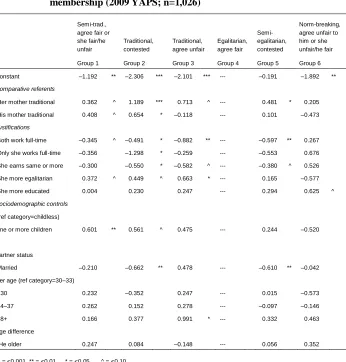
The next step in our analysis is to identify logistic regression coefficients for the independent variables that predict class membership. We present the results of the multinomial regression in Table 3. Our models use the modal category ‘equal sharing/agree fair’ couples as the reference category, allowing us to compare the predictors to this category. Groups 1 to 3 report traditional allocations of housework with different levels of fairness across couples. Based on the distributive justice perspective, we expect these couples to be traditional in their employment outcomes, gender role ideologies, and housework socialization. Group 1 has a semi-traditional division that she views as fair yet he views as unfair to her (contested). However, we find no support for the distributive justice perspective explaining this group membership. Rather, we find that respondents in this category are more likely to have a child in the home than equal sharing/fair couples (our comparison group). In fact, the presence of a child in the home is the only significant predictor (at the 5% level or less), suggesting that this group may be transitory, capturing the housework and fairness of parents of a young child (this may also be indicated by the weakly negative coefficient of the ‘both work full-time’ variable, at the 10% level) The time-specific nature of the added burden of a young child on women’s total domestic workload may explain why the woman views this (temporary) allocation as fair yet the man views it as unfair to her. This allocation may remain as children age, which may shift her perceptions to unfair. However, these questions require evaluation with couple-level longitudinal data.
counter to the predictions, these women do not view these allocations as fair, indicating that the distributive justice explanation that fewer resources will justify housework inequality as fair is not replicable among all Swedish couples. These couples are also more likely to have a child in the home but, unlike group 1, the women do not view their traditional allocation as fair, even though they are less likely to be employed full-time and have pay parity with their partners. They are also less likely to be married.
Table 3: Multinomial logistic regression results predicting cluster membership (2009 YAPS; n=1,026)
Semi-trad., agree fair or she fair/he unfair
Traditional, contested
Traditional, agree unfair
Egalitarian, agree fair
Semi-egalitarian, contested
Norm-breaking, agree unfair to him or she unfair/he fair
Group 1 Group 2 Group 3 Group 4 Group 5 Group 6
Constant ‒1.192 ** ‒2.306 *** ‒2.101 *** --- ‒0.191 ‒1.892 **
Comparative referents
Her mother traditional 0.362 ^ 1.189 *** 0.713 ^ --- 0.481 * 0.205
His mother traditional 0.408 ^ 0.654 * ‒0.118 --- 0.101 ‒0.473
Justifications
Both work full-time ‒0.345 ^ ‒0.491 * ‒0.882 ** --- ‒0.597 ** 0.267 Only she works full-time ‒0.356 ‒1.298 * ‒0.259 --- ‒0.553 0.676 She earns same or more ‒0.300 ‒0.550 * ‒0.582 ^ --- ‒0.380 ^ 0.526 She more egalitarian 0.372 ^ 0.449 ^ 0.663 * --- 0.165 ‒0.577
She more educated 0.004 0.230 0.247 --- 0.294 0.625 ^
Sociodemographic controls
(ref category=childless)
One or more children 0.601 ** 0.561 ^ 0.475 --- 0.244 ‒0.520
Partner status
Married ‒0.210 ‒0.662 ** 0.478 --- ‒0.610 ** ‒0.042
Her age (ref category=30‒33)
<30 0.232 ‒0.352 0.247 --- 0.015 ‒0.573
34‒37 0.262 0.152 0.278 --- ‒0.097 ‒0.146
38+ 0.166 0.377 0.991 * --- 0.332 0.463
Age difference
He older 0.247 0.084 ‒0.148 --- 0.056 0.352
Group 3 is our final couple-type with a traditional division of housework. In this group, both partners view their very traditional housework allocation as unfair to her. As with group 2, this group is more likely to include a woman socialized in a traditional household than the equal-sharing/fair group. And, consistent with the previous group, the women are more likely to view their traditional allocation as unfair. Couples in this group are less likely to be full-time dual earners, but the women are no less likely to be the only one working full-time (partner working part-time or less) than equal-sharing/fair couples. Women in these couples are more likely to have a more egalitarian gender role ideology than their partners than women in equal-sharing/fair couples. As the distributive justice perspective predicts, women having a more egalitarian gender role ideology will be less satisfied with a traditional housework allocation. Our results expand this theory by documenting that women that have a more egalitarian ideology also have husbands who view this inequality as unfair, suggesting a spillover effect within the couple. These couples also appear to be more likely to have a child in the home than equal sharing/fair couples, although the coefficient does not quite reach significance. That couples with children report more traditional housework allocations is documented in the literature and confirmed here in our study (Evertsson 2014; Gupta 1999; Offer and Schneider 2011; Sayer 2005). However, we show that the equity of these allocations is viewed differently by men and women based on the distribution of resources within the couple (groups 2 and 3). Whether these couples are transitory, evident only when children are young or permanent, requires additional longitudinal investigation. Our study highlights the importance of couples’ employment and economic and gender role expectations.
Finally, we explore those in ‘norm-breaking’ unions, in which the man does a larger share of the housework and both view this as unfair to him, or she unfair and he fair. These couples are more likely to have an educational imbalance (woman more educated than the man) than those in equal-sharing/fair couples. This may capture differences in educational resources, with women capitalizing on this inequality to bargain for men’s greater housework time. Alternatively, these may be couples in which the men are students in the process of completing their education, and thus have more discretionary time for housework. We do not find that these couples reflect differences in employment outcomes when compared to equal-sharing/fair couples, which limits support for our second explanation. However, there is some indication that the woman is more likely to earn the same or more than her partner (the coefficient is barely significant at the 10% level). Following these couples over time is beyond the scope of the current study but would illuminate the characteristics of this emerging norm-breaking couple.
5. Summary and tentative conclusions
Our exploratory study of the relationships between housework-sharing and perceived fairness regarding domestic tasks clearly demonstrates that these factors in combination reflect different types of couples rather than associations across these measures, and that variation in couples’ fairness reports form distinct clusters. We identified six latent groups, with distinct features. Consistent with expectations based on the strong societal support for egalitarianism in Sweden, we find the equal-sharing/fair group is the largest couple type, accounting for one-third of the couples in our sample. While this is not a numerical majority (50% or higher), this group is modal, suggesting that the Swedish gender equality policy of sharing housework equally has some positive influence on couples’ housework allocations. We find only one other group that reports semi-equal housework allocations that the woman views as unfair but the man views as fair (25%), and one with non-traditional housework allocations (he does more/both view as unfair) that is the smallest cluster in our sample (6%). We find that couples with traditional housework allocations account for 36% of our sample, yet cluster by differences in perceptions of fairness. Specifically, we find that those with semi-traditional housework allocations that she views as fair but he views as unfair are the second most common category among those with a traditional housework allocation (18%), followed by those with traditional divisions that she views as unfair but he views as fair (12%), and those with traditional divisions that both view as unfair (6%).
Existing studies, including those applying Swedish data, identify a fairness paradox where women’s greater housework contribution is evaluated as fair (Ahrne and Roman 1997; Baxter 2000; Nordenmark and Nyman 2003; Perales, Baxter, and Tai 2015; Ruppanner 2010). Applying couple-level data, we find a more complex relationship between housework inequality and both partners’ reports of fairness. First, we find no couple-cluster where both partners evaluate an unequal housework division as fair. Rather, we find that women view semi-traditional divisions as fair but their male partners report this as unfair to the woman, and women view traditional divisions as unfair to them yet men view these as fair. In this, our research satisfies the call for investigating housework dynamics at the couple-level (Smith, Gager, and Morgan 1998). Our research contributes to this literature by identifying deeper complexity through couple-level design.
We also find important individual-level predictors of group membership that strengthen existing theory and identify future areas for investigation. We apply the distributive justice perspective, which identifies ‘comparative referents’ and ‘justifications’ as important predictors of evaluations of fairness (Thompson 1991). We use our respondents’ housework socialization – comparing respondents who grew up with a traditional division of housework (mother did more) with those whose parents shared housework equally – to capture comparative referents. Surprisingly, we find that housework socialization is important for women’s evaluation of fairness. We find that women who grew up in traditional-housework homes are more likely to occupy a cluster where she views the housework as unfair, regardless of the actual division (traditional and semi-equitable). This suggests a generational divide, whereby Swedish women who witnessed housework inequality are increasingly dissatisfied when this inequality replicates in their own lives. This relatively young sample of Swedish women in the YAPS cohorts suggests a post-feminist legacy of housework contestation (Bernhardt, Noack, and Lyngstad 2008). We expand our estimation of justifications to include the distribution of employment and economic and educational resources within couples. We find that couples with traditional housework arrangements are less likely to be dual-earner full-time couples than our equal-sharing/fair couples. However, counter to previous research, women’s reduced labor force participation does not ‘justify’ this housework inequality, as women in these couples view their housework inequality as unfair (groups 2 and 3). In group 3 even the men evaluate this inequality as unfair. Thus, we do not find that imbalances in couples’ employment result in housework inequality.
with anything less than equal. Young Swedish adults are more likely to expect equal housework arrangements and are dissatisfied when this arrangement does not emerge (Bernhardt, Noack, and Lyngstad 2008; Kaufman, Bernhardt, and Goldscheider 2016). Further, housework inequality is identified as a clear source of relationship dissatisfaction and dissolution among Swedish couples, indicating that the stakes are high regarding this form of inequality (Olah and Gähler 2014; Ruppanner, Branden, and Turunen 2017). A second explanation is that these couples are transitory, capturing changes across the life course rather than being distinct long-term groupings. We find that couples with traditional housework allocations are more likely to have a child in the home than our equal-sharing/fair couples. Couples may share housework equally until children are born, and then all bets are off. Longitudinal research documents a traditionalization of domestic work upon the birth of a child (Baxter, Hewitt, and Haynes 2008; Gupta 1999). To combat this potent source of inequality, the Swedish government has legislated mandatory paternity leave to encourage men’s equal participation in domestic work during this critical transition. Our results are not longitudinal but do identify different couple clusters when children are present in the home, with diverging views within couples about the equity of such arrangements. It is possible that we are capturing couples at this distinct life-course juncture and that couples vary in their perceptions of the fairness of this allocation based on their childhood socialization and the gender distribution of resources within the partnership. Here our study identifies a fruitful direction for future research, to determine whether these couple-clusters are transitory or permanent. The latter would constitute a more problematic reality, as housework inequality contributes to relationship dissatisfaction and dissolution in the Swedish context (Olah and Gähler 2014; Ruppanner, Branden, and Turunen 2017). Following these couples over time would illuminate the broader consequences of these relationships, which highlights the importance of maintaining longitudinal couple-level datasets. Our results hint at these relationships, but without more robust empirical evaluation no clear conclusions can be drawn.
References
Ahrne, G. and Roman, C. (1997). Hemmet, barnen och makten: Förhandlingar om arbete och pengar i familjen. Stockholm: Arbetsmarknadsdepartementet (Statens offentliga utredningar 1997: 139).
Baxter, J. (2000). The joys and justice of housework. Sociology 34(4): 609‒631.
doi:10.1177/S0038038500000389.
Baxter, J., Hewitt, B., and Haynes, M. (2008). Life course transitions and housework: Marriage, parenthood, and time on housework.Journal of Marriage and Family70(2): 259‒272.doi:10.1111/j.1741-3737.2008.00479.x.
Bernhardt, M.E. (1988). The choice of part-time work among Swedish one-child mothers. European Journal of Population/Revue européenne de Démographie 4(2): 117‒144.
Bernhardt, E., Noack, T., and Lyngstad, T.H. (2008). Shared housework in Norway and Sweden: advancing the gender revolution. Journal of European Social Policy 18(3): 275‒288.doi:10.1177/0958928708091060.
Bernhardtz, L. (2014). Gapet mellan kvinnors och mäns arbetstid består [The gap between men and women regarding work hours remains]. Välfärd 3/2014. Statistics Sweden
Collins, L.M. and Lanza, S.T. (2013).Latent class and latent transition analysis: With applications in the social, behavioral, and health sciences. Vol. 718. New York: John Wiley.
Dribe, M. and Stanfors, M. (2009). Does parenthood strengthen a traditional household division of labor? Evidence from Sweden. Journal of Marriage and Family 71(1): 33‒45.doi:10.1111/j.1741-3737.2008.00578.x.
Dempsey, K.C. (1999). Attempting to explain women’s perceptions of the fairness of the division of housework. Journal of Family Studies 5(1): 3‒24. doi:10.5172/ jfs.5.1.3.
Evertsson, M. (2006). The reproduction of gender: Housework and attitudes towards gender equality in the home among Swedish boys and girls.The British Journal of Sociology 57(3): 415‒436.doi:10.1111/j.1468-4446.2006.00118.x.
Evertsson, M. and Nermo, M. (2004). Dependence within families and the division of labor: Comparing Sweden and the United States. Journal of Marriage and Family66(5): 1272‒1286. doi:10.1111/j.0022-2445.2004.00092.x.
Evertsson, M. and Nermo, M. (2007). Changing resources and the division of housework: A longitudinal study of Swedish couples. European Sociological Review 23(4): 455‒470.doi:10.1093/esr/jcm018.
Frisco, M.L. and Williams, K. (2003). Perceived housework equity, marital happiness, and divorce in dual-earner households. Journal of Family Issues 24(1): 51‒73.
doi:10.1177/0192513X02238520.
Fuwa, M. (2004). Macro-level gender inequality and the division of household labor in 22 countries.American Sociological Review 69(6): 751‒767.doi:10.1177/00031
2240406900601.
Geist, C. (2005). The welfare state and the home: Regime differences in the domestic division of labour.European Sociological Review 21(1): 23‒41.doi:10.1093/esr/ jci002.
Goldscheider, F., Bernhardt, E., and Lappegård, T. (2015) The gender revolution: A framework for understanding changing family and demographic behavior. Population and Development Review 41(2): 207‒239.doi:10.1111/j.1728-4457. 2015.00045.x.
Government Offices of Sweden (2016). Objective of gender equality policy [electronic resource]. Sweden: Government Offices of Sweden. www.government.se/ government-policy/gender-equality/goals-and-visions
Gupta, S. (1999). The effects of transitions in marital status on men’s performance of housework. Journal of Marriage and Family 61(3): 700‒711. doi:10.2307/353 571.
Hook, J.L. (2006). Care in context: Men’s unpaid work in 20 countries, 1965‒2003. American Sociological Review 71(4): 639‒660. doi:10.1177/000312240607 100406.
Kaufman, G., Bernhardt, E., and Goldscheider, F. (2016). Enduring egalitarianism? Family transitions and attitudes toward gender equality in Sweden. Journal of Family Issues.doi:10.1177/0192513X16632266.
Kitterød, R.H. and Lappegård, T. (2012). A typology of work-family arrangements among dual-earner couples in Norway.Family Relations 61(4): 671‒685.
Kluwer, E.S., Heesink, J.A., and Van De Vliert, E. (1997). The marital dynamics of conflict over the division of labor.Journal of Marriage and Family 59(3): 635‒
653.doi:10.2307/353951.
Larsson, J. (2012). Studier i tidsmässig välfärd, med fokus på tidsstrategier och tidspolitik för småbarnsföräldrar [Studies in Temporal Welfare - focusing on time strategies and time politics for families with small children]. Dissertation. Göteborgs universitet.
Lee, Y.S. and Waite, L.J. (2005). Husbands’ and wives’ time spent on housework: A comparison of measures. Journal of Marriage and Family 67(2): 328‒336.
doi:10.1111/j.0022-2445.2005.00119.x.
Nordenmark, M. and Nyman, C. (2003). Fair or unfair? Perceived fairness of household division of labour and gender equality among women and men the Swedish case. European Journal of Women’s Studies 10(2): 181‒209.doi:10.1177/135050680
3010002004.
Offer, S. and Schneider, B. (2011). Revisiting the gender gap in time-use patterns, multitasking and well-being among mothers and fathers in dual-earner families. American Sociological Review 76(6): 809‒833. doi:10.1177/0003122411425 170.
Oláh, L.S. and Gähler, M. (2014). Gender equality perceptions, division of paid and unpaid work, and partnership dissolution in Sweden. Social Forces 93(2): 571‒ 594. doi:10.1093/sf/sou066.
Perales, F., Baxter, J., and Tai, T.O. (2015). Gender, justice and work: A distributive approach to perceptions of housework fairness. Social Science Research 51: 51‒ 63. doi:10.1016/j.ssresearch.2014.12.010.
Ruppanner, L. (2010). Conflict and housework: Does country context matter?European Sociological Review 26(5): 557‒570. doi:10.1093/esr/jcp038.
Ruppanner, L., Branden, M., and Turunen, J. (2017).Does unequal housework lead to divorce? Evidence from Sweden.Sociology.doi:10.1177/0038038516674664.
Sayer, L.C. (2005). Gender, time and inequality: Trends in women’s and men’s paid work, unpaid work and free time.Social Forces84(1): 285‒303. doi:10.1353/ sof.2005.0126.
Appendix A: Frequencies of the background variables in the
regression analysis (percent)
Her age Age difference
<30 20.5 Same age 47.3
30‒33 30.8 He older 39.0
34‒37 25.4 She older 13.8
38+ 23.3
Union status Child status
Cohabiting 48.6 Childless 30.1
Married 51.4 One or more children 69.9
Her work hours His work hours
No work 23.4 No work 9.1
Part-time 22.8 Part-time 4.6
Full-time 46.6 Full-time 69.1
More than full-time 7.2 More than full-time 17.2
Relative income Combined education
Same 15.4 Both low 25.2
He more 69.9 Only he university 19.5
She more 14.7 Only she university 9.0
Both university 42.6
Combined gender ideology Combined housework socialization
Neither egalitarian 13.4 Both ‘she does most’ 63.6
Only he egalitarian 7.9 Woman ‘she does most’ 16.2
Only she egalitarian 24.1 Man ‘she does most’ 15.2