________________
*Corresponding author
Received December 14, 2015
1133
Available online at http://scik.org
J. Math. Comput. Sci. 6 (2016), No. 6, 1133-1144 ISSN: 1927-5307
CHAOS SYNCHRONIZATION USING BACKSTEPPING CONTROL METHOD
OF TWO SYSTEMS
AYUB KHAN1, NET RAM GARG2, GEETA JAIN2,*
1Department of Mathematics, Jamia Millia Islamia University, New Delhi, India 2Department of mathematics, Maharshi Dyanand University, Rohtak, India
Copyright © 2016 Khan, Garg and Jain. This is an open access article distributed under the Creative Commons Attribution License, which permits unrestricted use, distribution, and reproduction in any medium, provided the original work is properly cited.
Abstract. The paper Chaos synchronization using Backstepping control method of two systems studied the
performance of synchronization between master and slave system by using single controller. The advantage in many application is that only one controller is used no matter how much the dimensions are there in the system to be synchronized.
Keywords: chaos; synchronization; backstepping; numerical simulation.
2010 AMS Subject Classification: 34H10.
I. INTRODUCTION
has been studied and to control these chaotic systems the backstepping control schemes have been employed. In recent year this method has importance in hydraulic servo system [15], backstepping Decision and fractional derivative equation [14]. Among other applications recursive procedure has importance in to demonstrate to control a third-order phase-locked loops.With the design of the controller the backstepping method is effective to choice of lyapunov exponent. Through the transmission of the signal the trajectory of slave system approaches asymptotically to the trajectory of master system which is input system so that the error dynamics converges to zero. When several single oscillators are coupled together then a complicated system is obtained. For the study of these types of oscillators complex variables are used which are more convenient. Based on Lyapunov function for determination of the controllers the backsteeping technique is used and also for synchronize two identical chaotic system. In this paper, between two chaotic systems for achieving the global synchronization we design backstepping control method. This presentation is divided in sections: In Section II, formulation of the problem is introduced.in III. Design for chaos synchronization and methodology is presented. SectionIV, deals with numerical simulation results. Section V, presented finally the simulation results.
II. PROBLEM FORMULATION
Consider the system of the form
𝑥1̇ = 𝑓1 ( 𝑥1, 𝑥2 )
𝑥2̇ = 𝑓2 ( 𝑥1, 𝑥2, 𝑥3 )
𝑥𝑛̇ = 𝑓𝑛 ( 𝑥1, 𝑥2 , 𝑥3, … … . 𝑥𝑛) (1.1)
In the system (1.1) the function 𝑓1 is the linear function and the functions used ( 𝑓2……𝑓𝑛) are the nonlinear function . The input system (1.1) is considered as an master system.
Now consider the another system which is taken as output system as that is the slave system
𝑦1̇ = 𝑓1 ( 𝑦1, 𝑦2 )
𝑦2̇ = 𝑓2 ( 𝑦1, 𝑦2, 𝑦3 )
𝑦𝑛̇ = 𝑓𝑛 ( 𝑦1, 𝑦2 , 𝑦3, … … . 𝑦𝑛) +𝑢 (1.2)
System (1.2) is the output that is slave system of system (1.1) and 𝑢 is an controller by assuming the appropriate value of the controller between two system that is master and slave
For the two systems (1.1) and (1.2) considering the error dynamical system as
𝑒𝑖 = 𝑦𝑖− 𝑥𝑖 (1.3)
After subtracting (1.2) and (1.1) the error system becomes
𝑒1̇ = ℎ1 ( 𝑒1, 𝑒2 )
𝑒2̇ = ℎ2 ( 𝑒1, 𝑒2, 𝑒3, 𝑥1, 𝑥2, 𝑥3 )
𝑒𝑛̇ = ℎ𝑛 ( 𝑒1, 𝑒2 , 𝑒3, … … . 𝑒𝑛,𝑥1, 𝑥2 , 𝑥3, … … . 𝑥𝑛) +𝑢 (1.4)
the function ℎ1 is the linear function and the functions used ( ℎ2……ℎ𝑛) are the nonlinear function with inputs of system (1.1) that is (𝑥1, 𝑥2 , 𝑥3, … … . 𝑥𝑛). Now choosing of appropriate value of the controller 𝑢 is the problem so that drive and response system are synchronized and error vector becomes zero when time is increased. In this paper our objective is achieved by using backsteeping method.
Theorem 1(a):- LaSalle-Yoshizawa theorem Let 𝑥 = 0 be an equilibrium point of 𝑥̇ = 𝑓 (𝑥, 𝑢)
Let 𝑣(𝑥) be a continuous differentiable positive definite and radially unbounded function such that
𝑣 = 𝜕𝑣𝜕𝑥 𝑓(𝑥, 𝑡)≤ −𝑤(𝑥) ≤ 0
Where 𝑤 is a continuous function. Then all solution of 𝑥̇ = 𝑓 (𝑥, 𝑢) are globally uniformly bounded and satisfy lim
𝑡→∞𝑤(𝑥(𝑡)) = 0
III. Backstepping design for synchronization of two systems
In this section for chaos synchronization Backstepping method is designed which produces Reliable performance of the control method for chaos synchronization.
𝑥1̇ = ∝(𝑥2− 𝑥1)
𝑥2̇ =(𝛶−∝)𝑥1−𝑥1𝑥3 + 𝛶𝑥2
𝑥3̇ = −β𝑥3−δ𝑥4 +𝑥1𝑥2
𝑥4̇ = −𝑑𝑥4+ 𝑓𝑥3+ 𝑥1𝑥2 (1.5)
And the response system is:-
𝑦1=̇ ∝(𝑦2−𝑦1)
𝑦3=̇ 𝑦12− 𝑑𝑦3 (1.6)
𝑦4=̇ −𝑦1𝑦3−δ𝑦4+ 𝑢
Where 𝑢 is the controller . The given system has the error dynamics as
𝑒𝑖 = 𝑦𝑖 − 𝑥𝑖
𝑒1 = 𝑦1− 𝑥1
𝑒2 = 𝑦2− 𝑥2
𝑒3 = 𝑦3− 𝑥3
𝑒4 = 𝑦4− 𝑥4 (1.7) And the system
𝑒1̇ = 𝑦1̇ − 𝑥1̇
𝑒2̇ = 𝑦2̇ − 𝑥2̇
𝑒3̇ = 𝑦3̇ − 𝑥3̇
𝑒4̇ = 𝑦4̇ − 𝑥4̇ (1.8)
Thus
𝑒1̇ = −∝(𝑥2− 𝑥1)+ ∝(𝑦2−𝑦1)
𝑒1̇ =∝(𝑒2− 𝑒1)
𝑒2̇ = 𝑏𝑦1− 𝑐𝑦2−𝑦1𝑦3−(𝛶−∝)𝑥1 +𝑥1𝑥3− 𝛶𝑥2
𝑒2̇ = 𝑏𝑒1+ 𝑥1(𝑏 − 𝛶+∝)−𝑐𝑒2− 𝑥2(𝑐 + 𝛶) − 𝑒3(𝑒1+ 𝑥1)−𝑒1𝑥3
𝑒3̇ = 𝑦12− 𝑑𝑦3 +β𝑥3+δ𝑥4 −𝑥1𝑥2
𝑒3̇ = 𝑒12 +𝑥
12+ 2𝑒1𝑥1− 𝑑𝑒3+𝑥3(β−𝑑)+𝛿𝑥4− 𝑥1𝑥2
𝑒4̇ = −𝑦1𝑦3 −δ𝑦4+ 𝑢+𝑑𝑥4− 𝑓𝑥3− 𝑥1𝑥2
𝑒4̇ = − 𝑒3 (𝑒1 + 𝑥1 ) −𝑥3 (𝑒1+𝑓 +𝑥1 )− δ𝑒4− 𝑥4 (𝛿 − 𝑑 )+𝑢− 𝑥1𝑥2 (1.9)
System (1.9) exist an equilibrium (0,0,0,0) when there is no controller,then the synchronization problem of the drive (input)-response (output) system would be reduced to that of asymptotic stability of system (1.9). Thus, the main aim is to find a controller u such that system (1.9) is stabilized at the origin. The stability of system considered as :
𝑒1̇ =∝(𝑒2− 𝑒1)
And assuming that ∝(𝑒2− 𝑒1) as a virtual control function , for the virtual control ∝(𝑒2− 𝑒1) function designed an estimate stabilizing function ∝1 𝑒1.
𝑣1(𝑒1)=12(𝑒12)
The derivative is
𝑣1̇ (𝑒1) = 𝑒1̇ 𝑒1
For 𝑣1(𝑒1 ) to be negative definite, then, 𝑒1̇ = −𝑒1, so that
𝑣1̇ (𝑒1)= − 𝑒12 < 0
Thus. ∝1 (𝑒1) = −𝑒1 , when ∝(𝑒2− 𝑒1) is considered as a controller then function ∝1 𝑒1 is an estimate control function . Let us consider
𝑤2 = 𝑒2+ 𝑒1
𝑤2 = 𝑒2−∝1 (𝑒1 )
𝑒2 = 𝑤2− 𝑒1 (1.10) and consider the subspace (𝑒1, 𝑤2) given by
𝑒1̇ =∝(𝑒2− 𝑒1)
𝑒2̇ = 𝑏𝑒1+ 𝑥1(𝑏 − 𝛶+∝)−𝑐𝑒2− 𝑥2(𝑐 + 𝛶) − 𝑒3(𝑒1+ 𝑥1)−𝑒1𝑥3
𝑒2̇ = 𝑒1(𝑏 + 𝑐)+𝑥1 (𝑏 − 𝛶 + 𝛼)−𝑐𝑤2−𝑥2(𝑐 + 𝛶)−𝑒3(𝑒1+ 𝑥1) – 𝑒1𝑥3 (1.11)
As virtual controller in system is ∝(𝑒2− 𝑒1) and assume that when ∝(𝑒2− 𝑒1) = ∝1(𝑒1,𝑤2) system (1.11) is made asymptotically stable. Choose the Lyapunov function
𝑣2(𝑒1, 𝑤2)=𝑣1 (𝑒1) +12(𝑤22) (1.12)
for subspace above. The derivative of (1.12) is given by
𝑣2(̇𝑒1, 𝑤̇ 2̇)= 𝑣1̇ (𝑒1̇) +𝑤2𝑤2̇
𝑣2(̇𝑒1, 𝑤̇ 2̇)=−𝑒12− 𝑤22+ 𝑤2[𝑒1(𝑏 + 𝑐)+𝑥1 (𝑏 − 𝛶 + 𝛼)−𝑐𝑤2 −𝑥2(𝑐 + 𝛶)−𝑒3(𝑒1+ 𝑥1)
– 𝑒1𝑥3+∝(𝑒2− 𝑒1)]
If ∝1(𝑒1,𝑤2)= −[ 𝑒1(𝑏 + 𝑐)+𝑥1 (𝑏 − 𝛶 + 𝛼)−𝑐𝑤2 −𝑥2(𝑐 + 𝛶)−𝑒3(𝑒1+ 𝑥1) – 𝑒1𝑥3]
Then
∝(𝑒2− 𝑒1) = −[ 𝑒1(𝑏 + 𝑐)+𝑥1 (𝑏 − 𝛶 + 𝛼)−𝑐𝑤2−𝑥2(𝑐 + 𝛶)−𝑒3(𝑒1+ 𝑥1) – 𝑒1𝑥3]
And the subspace
𝑣2̇ (𝑒1, 𝑤2) = −𝑒12− 𝑤22 < 0 (1.13)
This is negative definite. Consider the error dynamics 𝑤3 as
𝑤3 = −∝2(𝑒1,𝑤2)+𝑒3
Now discuss the full dimension space (𝑒1, 𝑤2, 𝑤3)
𝑒1̇ =∝(𝑒2− 𝑒1)
𝑤2̇ = 𝑏𝑒1 + 𝑥1 (𝑏 − 𝛶 + 𝛼)−𝑐𝑤2−𝑥2(𝑐 + 𝛶)−𝑒3(𝑒1+ 𝑥1) – 𝑒1𝑥3
𝑤3̇ = 𝑒12+ 𝑥
12 +2𝑒1𝑥1− 𝑑𝑒3+ 𝑥3(β−𝑑)+δ𝑥4− 𝑥1𝑥2
𝑤3̇ = 𝑒12+ 𝑥12 +2𝑒1𝑥1− 𝑑𝑤3+ 𝑥3(β−𝑑)+δ𝑥4− 𝑥1𝑥2
𝑤4̇ =−𝑒3(𝑒1+ 𝑥1)−𝑥3(𝑒1+ 𝑓 + 𝑥1)−𝛿𝑒4− 𝑥4(δ−𝑑)+𝑢 − 𝑥1𝑥2
𝑤4̇ =−𝑒3(𝑒1+ 𝑥1)−𝑥3(𝑒1+ 𝑓 + 𝑥1)−𝛿𝑤4− 𝑥4(δ−𝑑)+𝑢 − 𝑥1𝑥2
Define the error dynamics 𝑤4as
𝑤4 = 𝑤4 −∝3 (𝑒1𝑤3)
𝑤4 = 𝑤4 − (−𝑤3)
𝑤4̇ =−𝑒3(𝑒1+ 𝑥1)−𝑥3(𝑒1+ 𝑓 + 𝑥1)−δ[𝑒12+ 𝑥12 +2𝑒1𝑥1− 𝑑𝑒3+ 𝑥3(β−𝑑)+δ𝑥4+𝑒3(𝑒1+
𝑥1)+𝑥3(𝑒1+ 𝑓 + 𝑥1)+𝛿𝑒4+ 𝑥4(δ−𝑑)−𝑢]− 𝑥4(δ−𝑑)+𝑢 − 𝑥1𝑥2
Choose a Lyapunov function
𝑣4(𝑒1, 𝑤3) = 𝑣3(𝑒1, 𝑤3) +12𝑤42
If
𝑢 = −(𝛿+1)1 [𝑒3(𝑒1+ 𝑥1)+𝑥3(𝑒1+ 𝑓 + 𝑥1)+ 𝛿[𝑒12+ 𝑥12 +2𝑒1𝑥1− 𝑑𝑒3+ 𝑥3(β−𝑑)+δ𝑥4+
𝑒3(𝑒1+ 𝑥1)+𝑥3(𝑒1+ 𝑓 + 𝑥1)+ 𝛿𝑒4+ δ𝑥4− d𝑥4]+ 𝑥4(δ−𝑑)+𝑥1𝑥2]
Then
𝑣4(𝑒1, 𝑤3) =−𝑒12− 𝑤32 − 𝑤42 < 0 (1.14)
Is a negative definite . and according to LaSalle-Yoshizawa theorem 1(a), the equilibrium (0,0,0,0) remains asymptotically stable and the error dynamics(𝑒1, 𝑒2, 𝑒3, 𝑒4) will converge to zero as t→ ∞. Thus, the two system are in the synchronized state.
IV. NUMERICAL RESULTS
The values of initials conditions 𝑥(0) = (0.1,0.1,0.1,0) and by choosing the values of
(𝛼, 𝛽, 𝛾, 𝛿, 𝑑, 𝑓, 𝑏, 𝑐) as (0.5,0,1,1,0.1,0.5,10) two equations (1.5) and (1.6) are solved by using
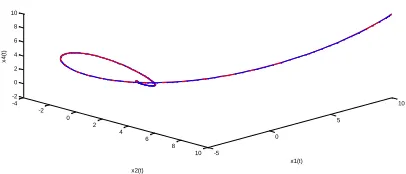
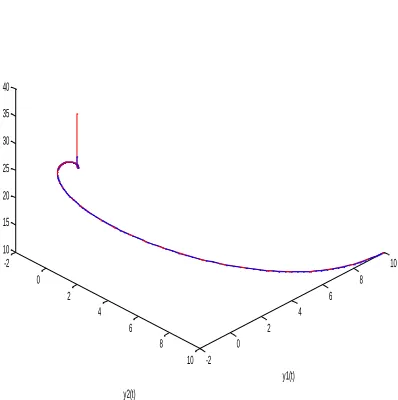
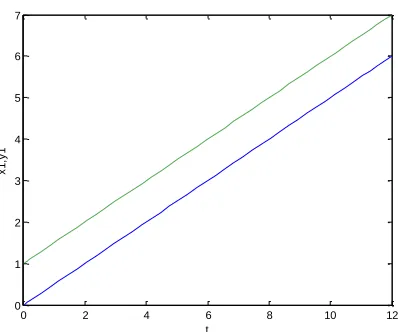
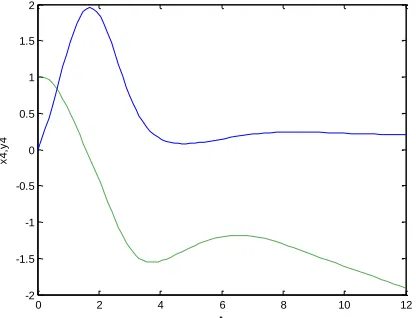
the MATLAB numerically . The error behaviour is shown by Fig 2(a) to 2(b) with time t, shows that the two system are synchronized as error system converges to zero . Between 𝑥𝑖 and 𝑦𝑖 where 𝑖 = 1,2, … .4 the time series of signals is shown by Fig3 (a) to 3(d) . For the system (1.5) and (1.6) the chaotic behaviour is shown by Fig 1.1(a) to 1.1(d) , by choosing the values of
Fig 1.1(a). Chaotic behaviour of master system between 𝑥1, 𝑥2, 𝑥3
Fig 1.1(b). Chaotic behaviour of master system between 𝑥1, 𝑥2, 𝑥4
Fig 1.1(d). Chaotic behaviour of slave system between 𝑦1, 𝑦2, 𝑦4
Fig. 2(a). Synchronization between 𝑒1and 𝑒2, 𝑒3 with time t -2
0 2
4 6
8 10 -2
0 2
4 6
8 10 10
15 20 25 30 35 40
y1(t) y2(t)
y
4
(
t
)
0 2 4 6 8 10 12
-0.2 0 0.2 0.4 0.6 0.8 1 1.2
t
e
1
,e
2
,e
Fig. 2(b ). Synchronization between 𝑒4 and time t
Fig. 3(a). Synchronization between 𝑥1and 𝑦1with time t
0 2 4 6 8 10 12
-0.05 0 0.05 0.1 0.15 0.2 0.25 0.3 0.35 0.4
t
e4
0 2 4 6 8 10 12
0 1 2 3 4 5 6 7
t
x
1
,y
Fig. 3(b). Synchronization between 𝑥2and 𝑦2 with time t
Fig. 3(c). Synchronization between 𝑥3and 𝑦3with time t
Fig. 3(d). Synchronization between 𝑥4and 𝑦4with time t
0 2 4 6 8 10 12
-0.2 0 0.2 0.4 0.6 0.8 1 1.2
t
x
2
,y
2
0 2 4 6 8 10 12
-9 -8 -7 -6 -5 -4 -3 -2 -1 0 1
t
x
3
,y
3
0 2 4 6 8 10 12
-2 -1.5 -1 -0.5 0 0.5 1 1.5 2
t
x
4
,y
V. CONCLUSION
Chaos synchronization of two systems is presented in this paper by using Backstepping control method. However, due to the effectiveness of the cost and density with one controller backstepping is effective. The advantage of this procedure is that there is only one controller no matter how much dimension are there in the system to be synchronized.
Conflict of Interests
The authors declare that there is no conflict of interests.
REFERENCES
[1] L. M. Pecora and T. L. Carrol, Synchronization in chaotic systems, Phys. Rev. Lett. 64 (8) (1990), 821. [2] L. M. Pecora and T. L. Carrol,’ Driving systems with chaotic signals’, Phys. Rev. A 44 (1991), 2374.
[3] Ayub khan:Prempal Singh :Study of chaos synchronization , Applied Mathematical Science, 4 (2010), no.16, 761-775.
[4] Ö. Morgül and E. Solak, Observer based synchronization of chaotic systems, Phys. Rev. E 54 (5) (1996), 4803. [5] U. E. Vincent, Synchronization of Rikitake chaotic attractor via active control, Phys. Lett. A, 343 (2005), 133–
138.
[6] Ayub khan:Net Ram Garg;Geeta Jain, New Fractional Order Hyper chaotic System and Generalized Projective Synchronization, ISBN 978-93-80544-10-6; pp-481-485
[7] Parlitz U., Junge L., Lauterborn W., Experimental observation of phase synchronization, Phys. Rev. E 54 (2) (1996), 2115.
[8] Tass P. A. at al., Detection of n:m phase locking from noisy data: Application to magneto Encephalography, Phys. Rev. Lett. 81 (15) (1998), 3291.
[9] Kapitaniak T. Controlling Chaos-Theoretical. Practical Methods in Non- linear Dynamics, Academic Press, London.1996
[10] Sebastian Sudheer K., and Sabir M, Hybrid Synchronization of hyperchaotic Lu system, Indian Academy of Sciences, 73 (2009), No.4, 781- 786.
[11] Qingying Miao, Yang Tang, Suojun Lu, Jian’an Fang, Synchronization Control between Two Different Chaotic Systems Synchronization Control between Two Different Chaotic Systems, www.atlantis-press.com/php/download_paper.php?id=1301.
[12] Nakata S., Mujata T., Ojima N., Yoshikawa K. Self-synchronization in coupled salt-water Oscillators, Physica D, 115 (1998), 313-320.
[14] Ayub khan:Net Ram Garg;Geeta Jain: Backstepping Design and Fractional Derivative Equationof chaotic system.,World Academy of Science, Engineering and Technology, InternationalJournal of Mathematical, Computational, Natural and Physical Engineering, 8 (2014), No 6.