USF Scholarship: a digital repository @ Gleeson Library |
Geschke Center
Doctor of Nursing Practice (DNP) Projects Theses, Dissertations, Capstones and Projects
Fall 12-12-2014
Transitional Care Services: A Nurse-Led Quality
Improvement Project
Debra Conroy-McCue
University of San Francisco, [email protected]
Follow this and additional works at:https://repository.usfca.edu/dnp Part of theOther Nursing Commons
This Project is brought to you for free and open access by the Theses, Dissertations, Capstones and Projects at USF Scholarship: a digital repository @ Gleeson Library | Geschke Center. It has been accepted for inclusion in Doctor of Nursing Practice (DNP) Projects by an authorized administrator of USF Scholarship: a digital repository @ Gleeson Library | Geschke Center. For more information, please [email protected].
Recommended Citation
Conroy-McCue, Debra, "Transitional Care Services: A Nurse-Led Quality Improvement Project" (2014).Doctor of Nursing Practice (DNP) Projects. 47.
Transitional Care Services:
A Nurse-Led Quality Improvement Project
Debra Conroy-McCue
Acknowledgments
I would like to thank the members of my advisory committee, Dr. Timothy S. Godfrey,
Gregory DeBourgh, and Dr. Anna Kwong. I am also grateful to the following individuals: Kathy
Grimley-Baker and Lisa Sabatini for our weekly study/”therapy” group and their support when I
said “I can’t do this”; my friends and family, who haven’t seen or talked to me much over the
past two years; my sons Michael and Eddy; my grandchildren Veda, Desmond, and Donovan,
whose Nana was always doing homework; and my husband Kevin, who always told me, “It will
be all right.” I would also like to extend a special thank you to my colleagues at St. Mary's
Section I
Abstract
With the implementation of the Patient Protection and Affordable Care Act of 2010
(PPACA) and a national requirement for health care providers and systems to deliver care that is
safe, outcome driven, and cost effective, Dignity Health (DH) as part of the hospital engagement
network (HEN) launched an initiative called the “No Harm” campaign to reduce all-cause
avoidable hospital readmissions. The project, led by a Doctorate of Nursing Practice (DNP)
student and readmission team, sought to achieve a 20% reduction in preventable readmissions by
December 2014. After having achieved initial success in implementing transitional care services
for patients with heart failure and subsequently decreasing rehospitalizations by 30%, the DNP
student and readmission team plan to expand evidence-based practices and interventions to all
high-risk patients admitted to St. Mary’s Medical Center, a DH member. Such practices will
include four key transitional care interventions: enhanced assessment of post-hospital needs,
effective teaching and facilitated coaching (learning), post-hospital care follow-up, and provision
of real-time handover to the next provider(s) to reduce avoidable rehospitalizations and improve
outcomes.
Table of Contents
Acknowledgments ... 2
Section I... 3
Abstract ... 3
Section II: Introduction ... 8
Background Knowledge ... 9
Local Problem ... 14
Intended Improvement ... 15
Review of the Evidence ... 17
Transitional care models ... 18
Promising practices ... 19
Enhanced assessment of post-hospital needs: Risk-assessment tools ... 23
Effective teaching and facilitated learning ... 26
Post-hospital care and follow-up ... 27
Provision of real-time handover to the next provider(s) ... 28
Conceptual and Theoretical Frameworks ... 28
Organizational quality improvement models ... 29
Lean approach to quality improvement... 30
Section III: Methods ... 31
Setting... 32
Planning the Intervention ... 34
Enhanced assessment of post-hospital needs: Risk assessment ... 34
Effective teaching and facilitated learning: Teach-back ... 36
Implementation and evaluation: Teach-back ... 36
Planning Next-Step Interventions ... 37
Post-hospital care and follow-up. Discharge ... 37
Provision of real-time handover to the next provider(s). Community ... 39
Walgreens ... 40
Cost-benefit analysis ... 40
Responsibility and communication plan ... 41
Implementation of Project ... 42
There’s No Place Like Home campaign ... 42
Walgreens bedside medication delivery and Well Transitions program ... 42
Planning the Study of the Intervention ... 43
Gap analysis ... 43
Discharge: There’s No Place Like Home campaign ... 44
Walgreens: Bedside medication delivery and Well Transitions program ... 44
Timeline ... 45
Methods of Evaluation ... 45
SWOT... 47
Budgetary return on investment plan ... 47
Analysis ... 48
Section IV: Results ... 48
Program Evaluation/Outcomes ... 48
Section V: Discussion ... 51
Relation to Other Evidence ... 52
Barriers to Implementation/Limitations... 53
Interpretation and Implications ... 54
Conclusions ... 55
References ... 57
Appendix A: Annual Report ... 72
Appendix B: Table of Evidence ... 75
Appendix C: IRB Exemption ... 81
Appendix D: Job Description Care Transition RN ... 82
Appendix E: DH Readmission Risk Assessment Tool ... 83
Appendix F: Risk for Readmission ... 86
Appendix G: Example of High-Volume Patient Teaching Handouts: Sepsis ... 87
Appendix H: Teach Back Online Module ... 88
Appendix I: Simulated Experience ... 95
Appendix J: "There's No Place Like Home" Flyer ... 99
Appendix K: Hospital Newsletter ... 100
Appendix L: Know Your Discharge Plan (Sign) ... 101
Appendix M: Improving Timeliness/Quality of Discharge ... 102
Appendix N: Discharge Performance ... 104
Appendix O: Bedside Meds and Well Transitions ... 105
Appendix P: Annual Budget ... 106
Appendix Q: Responsibility and Communication Matrix ... 107
Appendix S: Walgreens Rollout Training ...113
Appendix T: ARC Readmission Interview Tools ...114
Appendix U: Gap Analysis ...119
Appendix V: Walgreens Process ... 120
Appendix W: Gantt Chart ... 121
Appendix X: SWOT ... 122
Appendix Y: ROI Calculator ... 123
Appendix Z: Outcome Data Transitional Care Processes ... 124
Appendix AA: SMMC No Harm Campaign ... 126
Appendix BB: Transition Bundle Domains ... 127
Section II
Transitional Care Services:
A Nurse-Led Quality Improvement Project
More than a decade has passed since the Institute of Medicine published its landmark
reports, To Err Is Human: Building a Safer Health System (Kohn, Corrigan, & Donaldson, 2000)
and Crossing the Quality Chasm: A New Health System for the 21st Century (Institute of
Medicine, 2001), yet the quality of health care in the United States remains suboptimal and
fragmented. These shortcomings particularly affect chronically ill people who experience
frequent changes in health status accompanied by multiple transitions between settings and
providers (Naylor, Aiken, Kurtzman, Olds, & Hirschman, 2011; Dartmouth Atlas Project & Perry
Undem Research and Communication, 2013). Transitions, or “handovers,” are vulnerable
exchange points that contribute to unnecessarily high rates of health service use, health care
spending, and the exposure of chronically ill people to lapses in quality and safety (Anderson,
2004; Thorpe & Howard, 2006). Transitions have also been associated with increased rates of
potentially avoidable hospitalizations.
In 2012, Dignity Health (DH), as a member of the Hospital Engagement Network (HEN),
established by the Centers for Medicare and Medicaid Services (CMS), launched an initiative
called the “No Harm” campaign to address such vulnerabilities in transitional care. This
campaign chose as its goal a reduction in all-cause avoidable hospital readmissions. Under the
leadership of a Doctorate of Nursing Practice (DNP) student and a readmission team, the project
specifically aimed to implement evidence-based care-transition strategies for high-risk patients
admitted to St Mary’s Medical Center, a DH member, in order to reduce preventable
readmissions by 20%. A target of December 2014 was selected to meet the organizational “No
provides a description and analysis of all facets of the campaign as well as a discussion of
next-step interventions.
Background Knowledge
Traditional health care does not have dependable mechanisms for coordinating care
across settings; are all ensconced in “silos” that generally keep the focus within individual
venues (Coleman, Fox, & HMO Workgroup on Care Management, 2004). Lack of coordination
blurs the lines of responsibility for patients in the period between discharge from one location
and admission to another, leaving them confused about whom to contact for care, especially if
symptoms worsen (Coleman & Berenson, 2004; Snow et al., 2009). Gaps in coordination are not
surprising given the complexity of the U.S. health care system and the often remarkable number
of physicians caring for an individual patient (Bonner, Schneider, & Weissman, 2010). Medicare
beneficiaries see an average of two primary care physicians and five specialists during a
two-year period; patients with chronic conditions may see up to 16 physicians in one two-year (Pham,
Schrag, O’Malley, Wu, & Bach, 2007). Areas that need improvement include communication
between providers, patient education about medications and treatments, monitoring of
medication adherence and complications, follow-up of pending tests and procedures after
discharge, and outpatient follow-up soon after discharge (Forster, Murff, Peterson, Gandhi, &
Bates, 2003; Roy et al., 2005; Moore, McGinn, & Halm, 2007).
Jencks, Williams, and Coleman (2009) reported that approximately 20% of Medicare
beneficiaries discharged from hospitals were rehospitalized within 30 days, and nearly 13%
experienced three or more provider transfers. This movement of patients from hospitals to the
community and back again accounts for an estimated $17 billion in annual Medicare spending
(Medicare Payment Advisory Commission [MedPAC], 2007). A recent national report from the
(Dartmouth Atlas Project, 2013). Typical failures in transitions include ineffective patient and
caregiver education, discharge summaries that are incomplete or not communicated to the patient
or the next care setting provider, lack of follow-up with primary care providers, and poor patient
social support (Rutherford, Nielsen, Taylor, Bradke, & Coleman, 2012; Forster et al., 2003;
Moore et al., 2007). Innovative solutions, referred to as transitional care, have emerged to
interrupt this pattern. In addition, section 3026 of the Patient Protection and Affordable Care Act
(PPACA, 2010) established the Community Based Care Transitions program in which health
systems and community organizations receive funding to provide at least one transitional care
intervention to high-risk Medicare beneficiaries.
Transitional care is defined as a broad range of time-limited services designed to ensure
the coordination and continuity of health care. These services are intended to prevent poor
outcomes (including rehospitalizations among at-risk populations) and promote safe and timely
transfer of patients as they move from one level of care to another, among multiple providers and
across settings (Coleman & Boult, 2003; Naylor, 2011). In a systematic review, Naylor et al.
(2011) identified nine studies demonstrating positive effects of transitional care on readmissions.
All of the studies included multicomponent interventions that focused on comprehensive
discharge planning with timely continued follow-up. Effective interventions included
comprehensive discharge planning, home visits, coaching, disease management, self-care
education, support, and telehealth. In a national study, Bradley and colleagues (2012) found that
although hospitals were aware of evidence-based practices to reduce readmissions, on average
hospitals used 4.8 of 10 key practices and fewer than 3% of hospitals utilized all 10 practices. In
addition, relevant to nursing, Naylor et al. (2011) identified 18 randomized controlled trials
Leading national organizations such as the Institute of Healthcare Improvement
(IHI), the Agency for Healthcare Research and Quality (AHRQ), and the National Quality Forum
endorse transitional care models as preferred practices for high-risk patients. Moreover, the
California Quality Collaborative recommends the Care Transition Program (Coleman, 2003),
Project RED (Jack, 2013), Better Outcomes for Older Adults Through Safe Transitions
(BOOST), the Transitional Care Model (Naylor, 2011), and Transforming Care at the Bedside
(IHI & RWJ, 2003) as models with effective strategies that reduce readmissions.
Readmission rates are viewed as a measure of the quality of care delivered during
hospitalization, and reducing avoidable readmissions has become a national priority under the
Patient Protection and Affordable Care Act (2010) (PPACA). Furthermore, the Hospital Quality
Alliance, a consortium of payers, health care organizations, and regulators, includes readmission
rates for select inpatient conditions as measures of quality (Consumer Assessment of Healthcare
Providers and Systems, 2014). In addition, Medicare readmission rates are publicly reported by
the Hospital Compare website (http://www.medicare.gov/ hospitalcompare/search.html), and in
2012, the Centers for Medicare and Medicaid Services began reducing reimbursements to
hospitals with high readmission rates.
Although readmission rates in the United States have been high for many years, Jencks,
Williams, and Coleman brought this issue to the forefront with their landmark 2009 article.
Analyzing 2003–2004 claims data, they demonstrated that 19.6% of Medicare beneficiaries were
readmitted to the hospital within 30 days of discharge, and 34.0% were readmitted within 90
days. Medical and surgical patients were both affected, although medical patients had a higher
readmission rate (21.1% versus 15.6% among surgical patients at 30 days) and accounted for
77.1% of the rehospitalizations. The highest 30-day readmission rates were observed for patients
obstructive pulmonary disease (22.6%), and pneumonia (20.1%). During the past decade, risk-
adjusted 30-day readmission rates among Medicare beneficiaries have remained relatively
constant (Joynt & Jha, 2012).
Readmission rates have been documented in other populations as well. For example, in
Veterans Affairs hospitals, the 30-day all-cause readmission rate was 15.2% in 2009–2010
(Kaboli et al., 2012). In 2007, the 30-day readmission rate among non-elderly adults (ages 21–
64, excluding obstetric admissions) was 10.7% for patients with Medicaid and 6.3% for patients
with private insurance (Jiang & Wier, 2010). Despite some recent progress, improving care
transitions remains a national challenge. As the United States health system evolves from a
fee-for-service financial model to payment-for-value, it is especially important that health care
providers improve care for patients by optimizing care transitions (Gabow et al., 2012).
Starting in October 2012, more than 2,000 hospitals nationwide were penalized by the
Centers for Medicare and Medicaid Services (CMS) because patients were readmitted within 30
days after discharge (Hostetter & Klein, 2012). In the fiscal year FY 2012 final rule, CMS
defined a readmission as an admission to a hospital within 30 days of a discharge from the same
or another hospital (CMS, 2012a). The CMS levies penalties when patients are readmitted with
an index post-discharge diagnosis of pneumonia (PNA), acute myocardial infarction (AMI),
heart failure (HF), or any other cause within 30 days. In 2014, CMS added diagnoses of chronic
lung disease, elective knee, and hip replacements as additional conditions that are subject to
penalties for excess readmissions. The penalties, authorized by the PPACA, range from 0.1%-1%
of Medicare reimbursements. The maximum penalty increased to 2% of payments starting
October 2013, then to 3% in 2014. Approximately $280 million or 0.3% of the total amount
In May 2014, CMS issued new guidelines for assessing whether hospitals are in
compliance with the CMS Discharge Planning Conditions of Participation (COPs). Processes
such as actively engaging the patient/family/caregivers in discharge planning, providing
customized education using teach-back, arranging for post-hospital services, and developing a
discharge plan that can be realistically implemented are what should be delivered for all patients,
not only those at high risk of readmission.
There are many reasons to improve transitional care for all patients. First is the regulatory
compliance rationale: The 2013 CMS COPs make it clear that improved processes are required
for all patients. Since public payers typically make up a majority of safety-net hospitals' payer
mix, the efficient response to this requirement is to improve care systematically. Second is the
clinical quality rationale: Each patient, regardless of admission diagnosis, payer, or presence of
comorbidities/complexities, should have a safe and effective transition out of the hospital and
into the next care setting. Third is the clinical impact and clinical efficiency rationale: It is more
effective and efficient to improve standard care for all patients than to rely on incomplete and
time-intensive methods to identify a subset of patients for whom to improve these basic elements
of hospital-based care (Agency for Healthcare Research and Quality [AHRQ], 2014a).
In the past, the organization has addressed similar transitional care issues. It had an
established Gordon and Betty Moore grant-funded heart failure (HF) team comprised of two
registered nurses (a DNP student and a telemetry charge nurse). The team exceeded the grant
goal of reducing the 30-day all-cause rehospitalization rate for patients with HF by implementing
evidence-based transitional care interventions as described in the IHI’s How-to Guide: Improving
Transitions from the Hospital to Community Settings to Reduce Avoidable Rehospitalizations
(Rutherford et al., 2012). The goal was to reduce by 30% the readmission rate for patients with a
14%. In addition, the team decreased the readmission rate for the Medicare population, as
reported by Dignity Health, from a FY 2012 baseline rate of 22% to FY 2013 rate of 14%.
Finally, the team exceeded the goal for the 90-day rehospitalization rate. The goal was to reduce
the FY 2012 baseline rate of 33% to 29%, and the team achieved a FY 2013 rate of 24% for
patients with a primary diagnosis of heart failure (see Appendix A for final Moore grant report).
Local Problem
Dignity Health (DH) is a hospital engagement network (HEN) that has a contract with
two CMS-funded transition programs, Community-based Care Transitions Program (CCTP) and
the Partnerships for Patients Program (P4P). The goals of the HEN are to improve transitions of
Medicare beneficiaries from the inpatient hospital setting to other care settings, to improve
quality of care, to reduce avoidable readmissions for high-risk beneficiaries, and to document
measurable savings to the Medicare program. The DH system goal for the “No Harm” HEN
campaign is a 20% reduction in all-cause readmissions from a FY 2012 baseline rate of 7.33% to
a system goal FY 2014 rate of 5.86%. St. Mary’s Medical Center target rate for all-cause
readmissions is 5.86% for FY 2014 with a FY 2013 rate of 6.55%. Equally important, CMS
under the PPACA implemented the hospital value-based purchasing program (VBP) initiative in
which hospitals receive rewards based on the quality of care provided to Medicare patients, their
close adherence to best clinical practices, and their enhancement of the patients’ experiences of
care. The patient experience of care domain is scored by the results of the national Hospital
Consumer Assessment of Healthcare Providers and Systems (HCAHPS)survey. In 2013, three
care transition questions were added to the survey (CMS, 2013), signaling that these answers will
factor into the VBP equation.
In addition, St. Mary’s Medical Center is participating in the San Francisco Community-
Readmissions Reduction Program (CMS, 2012b). The Community-Based Care Transitions
Program (CCTP), created by Section 3026 of the PPACA, tests models for improving care
transitions from the hospital to other settings. The goals of the CCTP are to improve transitions
of beneficiaries from the inpatient hospital setting to other care settings, to improve quality of
care, to reduce readmissions for high-risk beneficiaries, and to document measurable savings to
the Medicare program. This free program is a benefit to Medicare patients living in San
Francisco.
Intended Improvement
The aim of the project was to implement evidence-based care-transition strategies for
high-risk patients admitted to St. Mary’s Medical Center in order to reduce preventable
readmissions by 20% by December 2014, thereby meeting the organizational “No Harm”
campaign goal of a FY 2014 all-cause readmission rate of 5.86%. These practices emphasize four
key areas: enhanced assessment of post-hospital needs, effective teaching and facilitated
coaching (learning), post-hospital care follow-up, and provision of real-time handover to the next
provider(s) to reduce avoidable rehospitalizations and improve outcomes. After a review of the
literature, the team decided to continue to utilize the IHI’s How-to Guide: Improving Transitions
from the Hospital to Community Settings to Reduce Avoidable Rehospitalizations (Rutherford et
al., 2012) as a roadmap for spreading interventions to high-risk patients. Furthermore, embedded
in the How-to Guide are various evidence-based practice transition models to be tested and
adapted by organizations to improve transitions from hospital to home or community.
The first step as outlined in the guide is to perform an enhanced assessment of
post-hospital needs. The involvement of the patient, family caregivers, and/or community providers as
full partners in assessing post-hospital needs is vital to a safe transition back into the community.
stakeholders (Rutherford et al., 2012). Without a thorough needs assessment and
cross-continuum communication, it is impossible to develop a customized discharge plan. Typical
system or process failures include identifying those at high risk, incomplete medication
reconciliation and polypharmacy that lacks a thorough assessment of functional ability, physical
and cognitive health status, and social concerns. Other gaps in the assessment include the failure
to facilitate self-care management, to address palliative care, and to attend to end-of-life issues
(Rutherford et al., 2012).
The second step is to provide effective education and facilitate learning through the use
of the teach-back method (Agency for Healthcare Research and Quality, 2001) throughout the
hospital stay to assess the patient’s understanding of discharge instructions and ability to perform
self-care. The teach-back method utilizes health literacy principles by using plain language,
limiting information to three to five key points, and being specific and concrete in teaching
patients what they need to do. Patients are asked to restate or teach back information that has
been presented to them. The technique allows the educator to check for gaps in understanding,
reinforce and tailor messages, engage in open dialogue (Iowa Health System Literacy
Collaborative, 2013), and provide closed- loop communication.
The third step is to ensure post-hospital care follow-up. An analysis by Medicare found
that 50% of patients readmitted within 30 days had no physician visit between discharge and
readmission (Kansagara et al., 2011). Scheduling a follow-up physician appointment prior to
discharge and implementing post-hospital follow-up phone calls and home health referrals have
demonstrated effectiveness in reducing readmissions and improving outcomes (Rutherford et al.,
2012).
The fourth strategy in reducing readmissions according to the IHI roadmap is to provide
post-hospital care plan that is patient-centered and includes a clear reconciled medication list. Next,
provider(s) should be identified, receive critical written information, and for high-risk patients
receive real-time verbal handover communication.
Review of the Evidence
A comprehensive literature review was conducted using the following keywords as
individual terms and in combination: hospital readmissions, readmission risk assessment, teach
back, and care transition models. Using PubMed, CINAHL Plus with full text, AHRQ evidence
reports, and Cochrane databases, as well as government health care and other websites, a number
of articles were retrieved. Publication date was initially limited to the last five years but
expanded to 15 years as key recommended evidenced-based models of transitional care were
published beyond five years.
Applying the Johns Hopkins Nursing Evidence-Based Practice Appraisal (JHNEBP)
summary tool (Newhouse, Dearholt, Poe, Pugh, & White, 2007), three RCT and three best
practice care transition models were selected, as evidenced by their quality and rigor, evaluated,
and summarized into a table (see Appendix B for evidence table). The quality of evidence was
graded using the JHNEBP quality-rating scientific-evidence appraisal scale: A = High quality, B
= Good quality, and C= Low quality. Articles were rated on strength of evidence using the
hierarchy of evidence in Melnyk and Fineout-Overholt (2011, p. 12). Finally, for the purpose of
this critical appraisal of the existing literature, articles have been summarized as they apply to
transitional care models, enhanced assessment of post-hospital needs, effective teaching and
facilitated learning, post-hospital care and follow-up, and provision of real-time handover to the
next provider(s) (Boutwell, Griffin, Hwu, & Shannon, 2011; Coleman, Parry, Chalmers, & Min,
Transitional care models. Evidence-based models include the Transitional Care Model
(TCM) (University of Pennsylvania, 2013), Care Transitions Intervention (CTI) (Coleman et al.,
2006), a Reengineered Hospital Discharge Program (Project Red) (Jack, 2013), Better Outcomes
by Optimizing Safe Transitions (BOOST) (Society of Hospital Medicine, 2014), State Action on
Avoidable Rehospitalizations (STAAR, 2014), and INTERACT (Florida Atlantic University,
2011). These models seek to improve patient outcomes and reduce avoidable rehospitalizations
with interventions aimed at care transitions. Selected for review are several of these
multicomponent transitional care interventions, tested in randomized controlled trials, followed
by a discussion of promising practices.
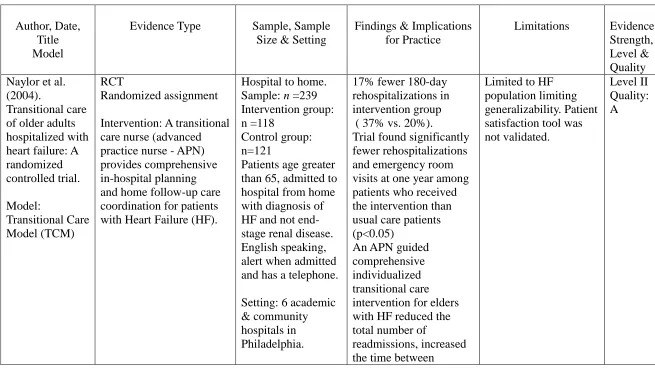
Naylor et al.’s (2004) Transitional Care Model (TCM) utilizes an advanced practice nurse
(APN) that meets with the patient and caregiver in the hospital, performs a structured needs
assessment, and provides comprehensive discharge planning which includes education and
coordination of post-discharge services. Post-discharge telephone follow-up includes
reinforcement of education, monitoring of symptoms and progress, and adjustment of the care
plan as needed. In an RCT, the TCM model reduced readmissions for heart failure patients. In
addition, a more intensive form of the TCM intervention that included APN home visits was also
effective in reducing rehospitalization among high-risk elderly patients (Naylor et al., 1999).
The Care Transitions Intervention (CTI), developed by Coleman et al. (2006), utilizes
a nurse transition coach that educates and empowers patients to better navigate their
own care. The nurse coach meets the patient in the hospital, visits the patient at home 48-72
hours after discharge, and performs three follow-up telephone calls. The CTI emphasizes four
“pillars”: medication self-management, a patient-owned health record, follow-up with a primary
care provider or specialist, and awareness of “red flags.” The intervention lowered 30- and 90-
study (Voss et al., 2011).
Project Reengineering Discharge (RED), developed by Jack and colleagues (2009),
addresses both the system and patient’s navigation of the discharge process through 12 mutually
reinforcing components. Interventions include patient education, scheduled follow-up
appointments prior to discharge, reconciliation of the medication list and discharge plan,
delivering discharge summaries to the next providers, and performing telephone follow-up.
When implemented in an urban university hospital by nurse discharge advocates, participants
randomized to the intervention group had a lower rate of 30-day hospital utilization (emergency
department visits and rehospitalizations) (Greenwald, Denham & Jack, 2007).
Promising practices. Three other promising interventions being tested are Project
BOOST (Better Outcomes by Optimizing Safe Transitions), the STAAR initiative (State Action
on Avoidable Rehospitalizations), and INTERACT (Interventions to Reduce Acute Care
Transfers) (Florida Atlantic University, 2011). These three interventions are important
approaches to improving transitions of care and/or reducing avoidable hospitalization. However,
further studies such as RCT’s, larger cohorts, or more rigorous outcome data are needed to
validate the approaches and to be able to generalize to larger populations (Boutwell et al., 2009).
Project BOOST (Better Outcomes by Optimizing Safe Transitions) is a national initiative
developed by the Society of Hospital Medicine to standardize and optimize the care of patients
discharged from hospital to home (Society of Hospital Medicine, 2014). The program includes
evidence-based clinical interventions that can be adopted by any hospital. The intervention goals
are as follows: identifying patients at high risk on admission, targeting risk-specific situations,
improving information flow between inpatient and outpatient providers, improving patient and
caregiver education by using the teach-back method, and achieving timely follow-up after
Preliminary results from pilot sites showed a 14% reduction in 30-day readmission rates in units
using BOOST compared with control units in the same hospital (Hansen et al., 2013).
The STAAR initiative (State Action on Avoidable Rehospitalizations) was launched
in 2009 by the IHI as a four-year community-level program with the goal of reducing avoidable
readmissions in the states of Massachusetts, Michigan, and Washington. Hospital teams focus on
improving assessment of needs after hospital discharge, teaching and learning real-time hand-off
communication, providing timely follow-up after hospital discharge, and forming
cross-continuum teams, both internally and externally. In an interim report, Boutwell et al. (2011)
recommended to policy makers, providers, leaders, and funders that any efforts to reduce
rehospitalizations must include three important strategies. First, organizations must go beyond
the hospital walls and partner with community-based providers. Second, state leaders who are
setting health care quality and cost improvements across multiple settings of care should
consider forming state-level multi-stakeholder entities, all with a common aim. Finally,
incentives and updated payment policies are needed to support the investments required to
deliver coordinated transitional care across settings (Boutwell et al., 2011).
A substantial proportion of patients cared for in the hospital require subsequent treatment
in either a skilled nursing or rehabilitation facility. Among patients >65 years of age, discharges
to post-acute care (PAC) facilities account for 28% of all hospital discharges (Kripalani,
Theobald, Anctil, & Vasilevskis, 2013). Among Medicare beneficiaries discharged to a PAC
facility in 2006, nearly 25% of patients were readmitted within 30 days at a cost of $4.34 billion
(Mor, Intrator, Feng, & Grabowski, 2010). Interventions to Reduce Acute Care Transfers
(INTERACT) is a quality-improvement initiative for skilled nursing facilities and nursing
homes, designed to facilitate early identification, evaluation, documentation, and communication
includes three key tools for providers: care paths, communication tools, and advanced care
planning tools. A six-month study in 25 nursing homes showed a 17% reduction in self-reported
hospital admissions with this program compared with the same period the previous year
(Ouslander et al., 2011).
Overall, the literature demonstrates that single interventions, i.e., patient education or
scheduling follow-up, are not likely to reduce readmissions or improve patient care. However,
the evidence suggests multifaceted, bundled interventions are likely necessary for substantial
improvements in readmission rates (Coleman, 2006; Hansen et al., 2011; Jack et al., 2009;
Naylor et al., 1999). Although the selected models differ in approach, they all bridge the hospital
and post-discharge periods with dedicated transitional care personnel, patient-centered discharge
instructions, and telephone follow-up. The models, however, do share certain features, such as
helpful tools for professionals, promotion of patient-centered care, reduced hospital
readmissions, and overall reduced health care costs. Additionally, the hospital-to-home models
all utilize discharge planning with written discharge instructions, medication information, and
patient education. While there are no comparative studies to demonstrate effectiveness of one
model over the other, organizations have used bundles of interventions and customized them
based on local workflow, resources, and culture (Kripalini et al., 2013). St. Mary’s Medical
Center’s evidence-based model is a combination of Project Red (Jack et al., 2009) for in-hospital
transitional care services and the Care Transition Model (Coleman et al., 2006) in association
with San Francisco Transitional Care Program (SFTCC) to address post-discharge follow-up
care.
Burke, Kripalani, Vasilevskis, and Schnipper (2013) propose a framework of 10 domains,
which they term the Ideal Transition in Care (see Appendix CC for framework). The domains
which the transition process approaches the ideal to move beyond regulatory penalties to
providing quality care. The domains act as structural supports of the “bridge” patients must cross
from one care environment to another during a care transition. It also implies that the more the
structural supports are missing, the less safe the “bridge” or transition is. Those domains that
take place prior to discharge are placed closer to the “hospital side” of the bridge; those that take
place after discharge are placed closer to the “community side” of the bridge; while those that
take place both prior to and after discharge are in the middle.
Hospital domains include discharge planning, complete communication of information,
medication safety, patient education to promote self-management, and enlistment of social and
community supports. The Advance Care Planning domain may begin in the hospital or outpatient
setting, and involves establishing goals of care and health care proxies, as well as engaging with
palliative care or hospice services, if appropriate. The community side domains include
coordinating care among team members to synchronize efforts across settings and providers,
monitoring and managing symptoms after discharge, and following up with outpatients’ post-
discharge providers.
In an updated systematic review, Burke, Guo, and Misky (2013) mapped care
interventions to the 10-component Ideal Transition in Care framework. They included 61
interventions, 42 of which have been studied in RCTs. The number of components included in
prior interventions ranged from 1 to 8, with an average of 3.5. The most common components
included were patient education (with an emphasis on promoting self-management), medication
safety, and coordination of care.
Just under half (47.5%) of interventions demonstrated a statistically significant reduction
in readmissions (Burke et al., 2013). Consistent with prior reviews, no single intervention
education and engaging social and community supports (p = 0.06 for each). The only significant
predictor of success in reducing readmissions was the number of domains included in the
intervention (p = 0.002). Others have also recently shown that the number of strategies employed
by hospitals is significantly associated with 30-day risk-standardized readmission rates (Bradley
et al., 2013). Although a number of risk-assessment tools are reported in the literature, there are
inconsistencies regarding which characteristics and/or variables are most predictive of patients
who are at risk for rehospitalization.
Enhanced assessment of post-hospital needs: Risk-assessment tools. Many risk
factors have been found to be associated with a heightened likelihood of readmission, including
patient-specific factors (Van Walraven et al., 2010), quality of in-hospital care (Lindenauer et al.,
2010; Ashton, Del Junco, Souchek, Wray, & Mansyur, 1997; Hansen, Williams, & Singer, 2011),
and the quality and adequacy of discharge planning and follow-up care (Jencks et al., 2009;
Marcantonio et al., 2010; Ghali et al., 2010).
In a systematic review of risk prediction models for hospital readmission, Kansagara and
colleagues (2011) found that readmission-risk prediction models, whether designed for
comparative or clinical purposes, perform poorly. The objective of the review was to summarize
validated readmission-risk prediction models, describe their performance, and assess their
suitability for clinical or administrative use. Characteristics of ideal models, according to the
authors, should include reliable data that are easily obtained and deployable in large populations;
they should also use variables clinically related to and validated in the target population and be
of good predictive value. Clinical applications of the model would provide relevant stratification
of readmission risk (high to low) and give information early enough during the hospitalization to
trigger a transitional care intervention, many of which involve discharge planning.
(Kansagara et al., 2011). The most common outcome used was 30-day readmission; only one
model specifically addressed preventable readmissions. Fourteen models that relied on
retrospective administrative data could be potentially used to risk-adjust readmission rates for
hospital comparison; of these, nine were tested in large U.S. populations and had poor
discriminative ability (c statistic range: 0.55-0.65). The c statistic is defined as the proportion of
times the model correctly discriminates a pair of high- and low-risk individuals. A c statistic of
0.50 indicates that the model performs no better than chance; a c statistic of 0.70 to 0.80
indicates modest or acceptable discriminative ability; and a c statistic of greater than 0.80
indicates good discriminative ability (Kansagara et al., 2011). Seven models could potentially be
used to identify high-risk patients for intervention early during a hospitalization (c statistic range:
0.56-0.72), and five could be used at hospital discharge (c statistic range: 0.68-0.83).
Most models were categorized into two groups: those that rely on retrospective or
real-time administrative data and those that use primary data, either survey or chart review in real
time or retrospectively (Kansagara et al., 2011). Factors such as inpatient care quality, patient
comorbidities, social supports, and post-discharge care have been investigated. However, the
authors found few models have examined social determinant variables, such as illness severity,
mental health and substance use, overall health and function, socioeconomic status, social
support, access to care, health literacy, numeracy, and self-management skills. They concluded
that in certain settings such risk-prediction models may prove beneficial, and as their use
becomes more widespread, efforts should be made to improve their performance. Strengths of
the systematic review include a comprehensive reproducible search strategy, defined inclusion
and exclusion criteria, and quality assessment of articles retrieved (University of Iowa Hospitals
& Clinics, 2010).
clinically actionable data that could be used to triage patients to different types of interventions.
For example, marginally housed patients, or those struggling with substance abuse, might require
unique discharge services. Relatively simple, practical models that use real-time clinically
actionable data, such as the Better Outcomes for Older Adults (BOOST) model, have been
created, but their performance has not yet been rigorously validated.
Given that numerous risk factors have been identified in the literature as being associated
with increased risk for adverse events after discharge, including unplanned readmissions, the
BOOST tool aims to “risk identify” rather than “risk stratify”; that is, the tool uses the 8Ps Risk
Assessment for determining if the patient has a risk factor and then targets interventions to
mitigate that risk. The 8Ps Risk Assessment is not intended to be a score, but a checklist of risks
that should be identified and addressed for all hospitalized patients. While many of these risk
factors have been described in the literature, the BOOST checklist provides sample definitions:
1. Problems with medications: Patients with polypharmacy — i.e., ≥7 routine medications
or who are on high-risk medications, including anticoagulants (e.g., warfarin, heparin,
Factor Xa, or thrombin inhibitors), antiplatelet agents in combination (e.g., aspirin and
clopidogrel), insulin, oral hypoglycemic agents, digoxin, and narcotics.
2. Psychological: Patients who screen positive for depression or who have a history of
depression. Providers may also choose to include anxiety and substance abuse in this
screening.
3. Principal diagnosis: Patients with a principal diagnosis or reason for hospitalization
related to cancer, stroke, diabetic complications, COPD, or heart failure.
4. Physical limitations: Patients with frailty, deconditioning, or other physical limitations
that impair or limit their ability to significantly participate in their own care (e.g., perform
care).
5. Poor health literacy: Patients who are unable to demonstrate adequate understanding of
their care plan as demonstrated by their inability to complete “teach-back” successfully.
6. Poor social support: The absence of a reliable caregiver to assist with the discharge
process and to assist with care after the patient is discharged. This P also captures the
concept of social isolation.
7. Prior hospitalization: Unplanned hospitalization in the six months prior to this
hospitalization.
8. Palliative care: When thinking about this patient, would the providers be surprised if the
patient died within a year? Does this patient have an advanced or progressive serious
illness? This risk factor would be triggered if answered no to the first or yes to the second
question.
Effective teaching and facilitated learning. The 2007 MedPAC Report notes that
patient adherence with discharge instructions affects the rate of rehospitalization. However, the
ability of patients to follow instructions provided at discharge is hindered by the complexities of
medical issues, jargon used in the health care setting, and the stress associated with
hospitalization. During the acute care hospitalization, only essential education is recommended
(Rutherford et al., 2012).
Research shows that one of the most effective ways to improve understanding of self-care
instructions while simultaneously addressing health literacy is the “teach-back” method
(Kripalani, Bengtzen, Henderson, & Jacobson, 2008; Kemp, Floyd, McCord-Duncan, & Lang,
2008; Schillinger et al., 2003; White, Garbez, Carroll, Brinker, & Howie-Esquivel, 2013). In the
randomized controlled study, Kripalani et al. demonstrated that teach-back was an effective
Schillinger et al., used the teach-back method as a means of “closing the loop” in communication
and found having patients teach back information helpful in assessing patients’ understanding of
instructions and improving outcomes.
In a prospective cohort study, White and colleagues (2013)used the teach-back method to
determine if hospitalized patients with heart failure, educated with the teach-back method,
retained self-care educational information and had lower readmissions. The authors concluded
that teach-back was an effective method to educate and assess learning, but it was not associated
with lower readmission rates in this cohort. In all of these studies, the authors suggested the use
of teach-back as a feasible and generalizable approach that could be adopted to other research
studies to help assess comprehension.
Teach-back requires patients to explain in their own words what they need to know or do
(Iowa Health Collaborative, 2013). The method utilizes clear communication principles by using
plain language, limiting information to three to five key points, and being specific and concrete
in teaching patients what they need to do. It creates an opportunity for the clinician to check for
understanding and, if necessary, re-teach the information (Iowa Health Collaborative, 2013).
Post-hospital care and follow-up. A high percentage of rehospitalizations occur in the
immediate days or weeks followingdischarge (Jencks et al., 2009; Rutherford et al., 2012). A
national Medicare analysis found 50% of patients who were rehospitalizedwithin 30 days had no
intervening physician visit between discharge and rehospitalization (Kansagara et al., 2011).
Intervening by scheduling a physician appointment prior to hospital discharge is a best practice
strategy (Jack et al., 2009; Naylor, 2004; Rutherford et al., 2012). Additional recommended
evidence-based interventions in post-hospital care include initiation of clinical and social
services as indicated from the assessment of post-hospital needs and the capabilities of patients
community resources.
Provision of real-time handover to the next provider(s). Patients and families are
better able to participate in next steps after hospitalization when they have clear, specific, easy-
to-read written discharge information, including a clear medication list (Jack et al., 2009; Naylor,
2004; Rutherford et al., 2012). Tools are available to assist in providing clear discharge
instructions (IHI , 2012, p. 109). Inadequate transfer of information (the handover) during care
transitions plays a significant role in the problems of quality and safety for patients, contributing
to duplication of tests and greater use of acute care services (Institute of Medicine, 2001;
Rutherford et al., 2012). All patients need complete and timely discharge summaries, preferably
at time of discharge, to be sent to and received by the next care providers prior to their scheduled
post-hospital office visit. Additionally, direct verbal communication is needed for those assessed
as high-risk. The telephone call can allow for dialogue about the patient’s clinical status as well
as opportunities for inquiry and clarification about the plan of care (Rutherford et al., 2012; Jack
et al., 2009).
Conceptual and Theoretical Frameworks
Several related theoretical and conceptual frameworks informed this project: Diffusion of
Innovation Theory (Rogers, 2003), Donabedian’s model (Donabedian, 1988), and the IHI
evidence-based model using the Plan Do Study Act (PDSA) model (Langley et al., 2009). These
frameworks work together in organizational change and transitional care because they encourage
new behaviors, as Rogers’ theory explains.
The key to adoption, according to Rogers’ (2003) theory, is for the person or system to
perceive the idea or behavior as new or innovative. When promoting change, leaders must
understand the characteristics of the five established adopter categories and the strategies used to
risk takers; they become the unit champions of new care transition strategies. Early adopters are
those who are in leadership roles and embrace change and are comfortable with new ideas. This
group supports the effort and celebrates each success. The early majority group consists of those
who need evidence that the innovation works before they are willing to adopt; they need the data.
Late adopters are skeptical and will only try something new after the majority has. They need
information on how many others have been successful. Finally, there are the laggards, who are
bound by tradition and don't adopt easily but may feel pressure from the other groups to do so.
Rogers (2003) similarly outlined five steps that people take when adapting to a new idea
or innovation: knowledge, persuasion, decision, implementation, and confirmation. To achieve
the aim of reducing readmissions and improving care, people from the frontline to the executive
organizational leadership need to perceive providing transitional care services as providing better
care, better patient experience, and lower costs (CMS, Partnership for Patients, 2014a).
The Donabedian Paradigm (Donabedian, 1966) of structure, process, and outcome has
been used in health care quality research. First, structures of health care are defined as the
physical and organizational aspects of care settings (e.g., facilities, equipment, personnel,
operational and financial processes supporting medical care, etc.). Second, the processes of
patient care rely on the structures to provide resources and mechanisms for participants to carry
out patient care activities. In addition, processes are performed in order to improve patient health
in terms of promoting recovery, functional restoration, survival, and “transition” from the
hospital to home or community (McDonald et al., 2007).
Organizational quality improvement models. The IHI quality improvement (IHI-QI)
approach is grounded in the work of Edward Deming. The model draws a fundamental
distinction between the system to be improved and the techniques and methods used to improve
applied to a health care system, and that under certain conditions and with belief, desired
predictable improvements can be achieved. Success requires the will, moral engagement, and
action to improve ideas for changes that can be tested, adapted, and implemented. In the
execution of changes, the theories and techniques translate into improvements. Deming terms
this idea as “Profound Knowledge” or the knowledge that builds will, generates ideas, and guides
execution (Scoville & Little, 2014). One of the core elements of IHI-QI is the Model for
Improvement, which poses three questions: 1) What are we trying to accomplish? 2) How will
we know a change is an improvement? and 3) What changes can we make that will result in
improvement? In Plan Do Study Act (PDSA) cycles, improvements can be achieved (Langley et
al., 2009).
St. Mary’s Medical Center also uses the PDSA performance improvement model in
conjunction with the IHI-QI model (Langley et al., 2009; Scoville & Little, 2014) to improve
organizational performance. A collaborative, multidisciplinary approach is fostered by creating a
culture focused on improvements in both individual performance and systematic organizational
planning. Processes are developed by multidisciplinary teams to meet key performance
objectives. Improvements are prioritized based on volume, risk level, problem areas, cost, and
dimensions of care, including patient safety. Reducing readmissions and improving care
transitions constitute a strategic performance improvement project in line with DH and St.
Mary’s Medical Center’s “No Harm” campaign.
Lean approach to quality improvement. In a 2014 IHI white paper, Scoville and Little
(2014) describe Lean “as an approach to quality improvement using the integrated principles,
methods, and tools that have developed from the Toyota Production System (TPS) to optimize
the performance and management of value-producing systems” (Scoville and Little, 2014, p. 5).
is tailored and delivered in response to need, the response is immediate, and work is done safely
and without waste. The term Lean acknowledges the drive to eliminate waste from the system,
and thus produce maximum value at minimum cost. When applied to health care, Lean is “an
organization's cultural commitment to applying the scientific method to designing,
performing, and continuously improving the work delivered by teams of people, leading to
measurably better value for patients and other stakeholders” (Toussaint & Berry, 2013, p. 75).
Lean is an operating system composed of six principles: attitude of continuous improvement,
value-creation, unity of purpose, respect for people who do the work, visual information
displays, and flexibility. Lean thinking promotes employee participation in process improvement,
so that the staff actually doing the work figures out ways to improve it. In this way improvement
becomes integrated into the daily functions of all staff. Lean is a cultural transformation that
changes how an organization works (Toussaint & Berry, 2013). St. Mary’s Medical Center’s
structure, process, quality improvement model, and Transformational Care (TC) and lean
thinking, leadership and change model allow for successful implementation of transitional care
services.
Section III
Methods
Through the ethical principles of beneficence, nurses act to provide care that ensures the
maximum benefit and least amount of harm to the patient. The advanced practice nurse (APN)
has a greater moral responsibility because of his/her expanded practice and leadership role
(Grace, 2009). Providing transitional care services through assessing patient needs, providing
education for self-care, and collaborating with other professionals to meet the needs of the
patient are ways in which this fulfills the nurse’s primary commitment to the patient in meeting
The aim of this project was to implement evidence-based care-transition strategies to
improve the quality of care for patients admitted to St. Mary’s Medical Center and decrease
readmissions. Improvement activities are changes that meet the requirements of a quality
improvement project, rather than a research project. There is no intention of using any data
obtained for research purposes. Approval as a quality improvement project was obtained from
USF (see Appendix C for IRB approval exemption). There are no identifiable ethical issues or
conflicts of interest noted for this project.
Setting
St. Mary’s Medical Center, a member of Dignity Health (DH), is an integrated non–profit
Catholic hospital located in San Francisco, California. The Sisters of Mercy opened St. Mary’s in
1857, and it was the first Catholic hospital on the Pacific coast of the United States. Today, it is a
vibrant 300-bed teaching community hospital that serves a culturally diverse population of
adults. The mission of the organization is to deliver high-quality, affordable health care services
in a compassionate environment that meets each patient’s physical, mental, and spiritual needs,
upholding the core values of dignity, justice, stewardship, collaboration, and excellence (Dignity
Health, 2014a). St. Mary’s medical services include emergency, cardiology, orthopedics, acute
rehabilitation, comprehensive cancer care, and bariatric surgery.
In 2013, there were 6,152 discharges and 395 readmissions with an equivalent
readmission rate of 6.42% (Dignity Health, 2014b). The California Office of Statewide Health
Planning & Development (2014) reported organizational demographic characteristics as 62%
over the age of 50 and non-Hispanic (85%). The top three payer sources are Medicare (54%),
private coverage (28.4%), and Medi-Cal (11.8%). The principal diagnosis groups are
22% to a skilled nursing facility or long-term care facility. The remaining 4% leave against
medical advice or are transferred to another acute hospital or expire.
The medical center staff includes over 500 physicians, of which 12 are hospitalists (S.
Kim, personal communication, April 10, 2014, Hospitalist, St. Mary’s Medical Center). There
are 400 registered nurses, 16 case managers, and four medical social workers. The combined
average daily census on the two focused medical surgical units is 50, with an average of 15
discharges daily (D.Thakkar, personal communication, June 30, 2014, Director Transformational
Care, St. Mary’s Medical Center).
In 2010, Dignity Health introduced the Transformational Care (TC) model of leadership
and organizational change. This type of leadership framework demonstrates elements of both
loose coupling and tight coupling. Loose coupling is exhibited though TC teams in which
participants are capable of semiautonomous actions and frontline staff are encouraged to lead the
team. These voluntary multidisciplinary teams create continuous process flow to bring problems
to the surface, find solutions to quality issues within organizational systems, and focus on
process, learning, and action. TC teams display characteristics of tight coupling as they are stable
accountable partnerships (Nelson, Batalden, & Godfrey, 2007).
The primary objective of the TC model is to improve the quality of care delivered while
optimizing patient flow and financial sustainability (Dignity Health, 2010). A second objective is
to provide teams with new tools in lean thinking to inform their daily work and guide
performance improvement activities. The final objective of TC is to develop the organizational
infrastructure and capabilities such that the hospitals can sustain improvements.
Successful organizational change achieved by TC teams included moving patients
post-percutaneous coronary intervention (PCI) to the telemetry unit as opposed to the intensive care
decreased 30-day readmission rates for HF patients by 20%. The DNP student led the
Readmission TC team and joined the Hospitalist/Resident Realignment TC team in March 2014.
Planning the Intervention
For the purposes of this project, knowledge acquisition was established when the DNP
student was able to demonstrate to the organizational leadership the effectiveness of
evidence-based care transitions strategies with the HF population in reducing readmissions and identified
similar gaps in care transitions for other patient populations admitted to the organization. The
success of the grant-funded HF Team project convinced the leadership to expand the scope and
role of the team. The team decided to continue to use the IHI How-to Guide (Rutherford et al.,
2012) as the overall roadmap for change. Embedded in the document are the previously
described evidence-based Care Transition models and other evidence-based strategies. The four
transition interventions planned are as follows: enhanced assessment of post-hospital needs,
effective teaching and facilitated learning, post-hospital care and follow-up, and provision of
real-time handover to the next provider(s). The implementation began in February 2014 with the
newly established Care Transition RN role (CTN) (see Appendix D for Care Transition RN job
description) and a multidisciplinary team composed of physicians, nurses, and the directors of
transformational care and case management.
Enhanced assessment of post-hospital needs: Risk assessment. To identify patients at
risk for readmission, DH in March 2013 implemented a new tool embedded in the Adult
Admission Form. The tool was adapted from eQHealth Solutions, the Quality Improvement
Organization (QIO) for Louisiana, under contract 500-99-LA02 with the Centers for Medicare
and Medicaid Services (CMS) (see Appendix E for DH Readmission Risk Tool).
The DH readmission-risk scoring consists of 15 questions, including evidence-based
health literacy, and functional and cognitive capabilities on five separate sections of the Adult
Admission History Form. A yes response for any of the questions assigns 1 point to the patient’s
readmission-risk score. The tally of the score stratifies patients as low, moderate, or high risk for
readmission. Patient-specific interventions follow scoring, depending on the area of readmission
risk—for example, polypharmacy, medication management, and multiple hospital admissions or
emergency department visits. An electronic alert is sent to the case manager (CM) for all high-
and moderate-risk patients, and the results are shared with the team at the daily plan-of-care
huddles.
Implementation and evaluation: Risk assessment. The DNP student collaborated with
the medical-surgical nursing staff and provided instruction on the use of the risk-assessment tool,
performed random audits for completion of the tool on admission, and assessed data entered for
accuracy. Analysis (N = 50) revealed the tool was completed 100% of the time; but in half of
those reviewed, there were inaccurate patient assessments, particularly in the areas of
polypharmacy, end-stage disease, recent hospitalizations or ED visits, and health literacy. After
two months of monitoring, nursing staff were reeducated one-on-one on how to complete the
readmission-risk tool accurately (see Appendix F for Nursing Staff Re-education Risk
Assessment). Even when the tool was completed accurately, the DH tool performed poorly. All
results were reported internally to leadership and externally to the DH Readmissions
collaborative.
In the Fall of 2013, the team’s lead hospitalist developed a modified BOOST
risk-assessment tool to be utilized by hospitalists. An internal study and a test of change were
performed. Using retrospective chart reviews of 107 readmitted patients, two physicians scored
patients using the modified BOOST tool. Outcomes revealed the modified BOOST score was
leadership, although to date no action has been taken to potentially change the readmission-risk
tool. However, with the reinforced education of nursing staff and continued monitoring, more
patients are assessed as moderate or high risk, and the care team is implementing appropriate
interventions.
Effective teaching and facilitated learning: Teach-back. St. Mary’s nurses were
familiar with the teach-back technique, but as revealed in a nurse focus group conducted in the
summer of 2013, it was evident a refresh was needed. Staff also requested additional
patient-education materials that were teacher and learner friendly. The DNP student in collaboration with
bedside nurses developed key educational topic handouts for St. Mary’s Medical Center’s
high-volume clinical conditions (IHI, 2012 , p. 101) (see Appendix G for Example of Handouts:
Sepsis).
Implementation and evaluation: Teach-back. In the fall of 2013, the DNP student
developed and delivered an online module titled Teach Back (see Appendix H for Teach Back
online module). In addition, a live simulated teach-back session was facilitated at the annual
mandatory Nursing Skills Day over a four-day period (see Appendix I for Teach Back simulated
experience). A total of 419 nurses viewed the online module and participated in the simulated
experience. Evaluative feedback reported by the nurse educator indicated a positive learning
experience. Comments by nurses included the following: “I learned how to ask open-ended
questions, I learned to be more responsive to what the patient needs to know and Teach Back was
fun, I liked the debriefing” (P. Willems, personal communication, November 3, 2013, Nurse
Educator, St. Mary’s Medical Center). Following the educational sessions, the DNP student
performed observations of nurses and patients/families performing teach-back. Of the 40 random
The focus for the expanded phase of care transitions implementation strategies was to
lead practice change by improving the discharge process and improving community partnerships.
Confirmation has been accomplished in two of the four steps as described by Rutherford et al.
(2013). Assessment of post-hospital needs has been demonstrated by the fact that the risk
assessment is completed by the RN 100% of the time on admission. Accuracy has also been
demonstrated as more patients are now assessed as moderate-to-high risk for readmission.
Teach-back, focusing on diagnosis, warning signs or “red flags,” patient actions, medication use and
side effects, follow-up appointments, and ongoing health maintenance, has become the standard
method of patient education. Nursing staff have incorporated all of these strategies into their
daily practice as evidenced by direct observations and the DNP student asking patients upon
discharge.
Planning Next-Step Interventions
The areas of focus in the next phase of providing transitional care services to those
admitted to the organization are improving the discharge process with a goal of a safe, timely
discharge and improved handover communication and follow-up through community
partnerships. Using the IHI Model for Improvement, the IHI How-to Guide, Project Red, and
Donabedian’s framework, the team developed an aim, determined measurements, and discussed
what changes could be made that would result in an improvement. The DNP studentprovided
leadership for improving the discharge process through the following means: launch of the
“There’s No Place Like Home” campaign, collaboration in revising the depart or discharge
instructions to allow for real-time handover, consultative interprofessional teamwork to provide
timely discharge summaries to next providers, and the establishment of community partnerships
with Kindred Healthcare and Walgreens.
and Resident Realignment Team in developing the aim, which was that 75% of the patients on 7
west and 8 west will be discharged by noon (DBN). The team engaged in brainstorming sessions
to discuss the structure and processes needed to achieve the aim. Accountable key stakeholders
in the process were identified as physicians, nursing leaders, bedside nurses, case managers, Care
Transition Nurse (CTN), patients, and families. Discharge rounds began in April 2014. These
15-minute huddles attended by hospitalists, case managers, charge nurses, and CTN were devised to
identify anticipated next-day discharges. Physicians in attendance stated the discharge diagnosis,
any pending needs, and/or barriers to DBN.
In July 2014, bedside and charge nurse volunteers from each unit and each shift joined in
the effort as champions of the new organizational discharge process, “There’s No Place Like
Home” campaign. Leads from each discipline also volunteered. Weekly team meetings were
conducted to develop a process, and a launch date was selected (see Appendix J for “There’s No
Place Like Home” process flyer). Communication of the planned process was accomplished by
formal and informal presentations, flyers, organizational newsletter articles (see Appendix K for
newsletter article), and daily unit huddles with bedside nurses. A Know Your Discharge Plan sign
was posted in each patient room, and discharge was discussed daily with the patient and family
by physicians, case managers, nurses, and CTN (see Appendix L for Know Your Discharge Plan
sign). The anticipated date of discharge was written on the care board in the patient’s room by
the physician.
Simultaneously, the lead hospitalist revised the discharge summary template, educated
physicians in its use, and performed audits of compliance. The new expectation was that
physician-telephone handover to the next provider(s) was to be the standard care (see Appendix