Watermarking based Content Security and Multimedia
Indexing in Digital Libraries
Dr. M. Madhavi Latha1 G. Kesavan pillai2 K. Anitha Sheela1
1
Department of Electronics and communication Engineering JNT University, Hyderabad, Andhra Pradesh, India {[email protected], [email protected]}
2
Synoro Technologies Limited Hyderabad, Andhra Pradesh, India
Abstract:Encryption, digital signature and digital watermarking are the key techniques used in content protection and security applications. Latest technology to prevent the digital content from piracy and preserve the ownership information is to watermark the digital content. Watermarking the digital content with origin information or intended recipient identification secures content from electronic data theft. In digital libraries enormous collection of data is available in the form of multimedia (image, video, graphics and audio) and needs to be abstracted to provide the end users for easy access to the digital library. The multimedia contents are indexed by origin, date and time of content creation, key words and titles. In this paper, watermarking based content protection (authentication) and digital index creation for multimedia information has been proposed. In order to support the users for efficient use of available channel bandwidth, high quality videos and universal supported formats, digital libraries are supported with real time applications like video streaming, compression, and transcoding. The compute intensive operations of the video processing applications make a big challenge to the existing systems, so hardware solutions for the above problems are also presented to improve the digital video library performance.
1 Introduction
Digital libraries play an essential role in today’s information world. The digital data in library is created by scanning, printing, and recording the scientific and historic information [9]. Integration of digital libraries and the Internet makes easy accessing of electronic content. However it provides easy to pirate the copyright material. Digital library services should protect the digital data owners, users and library itself in order to avoid misuse of library contents. Most of the current security systems are based on encryption techniques. Since digital library contains very large volume of data in nature, delivering such data to users with encryption method results the key management process very difficult. So it is necessary to find alternate way of protecting digital content. The emerging privacy mechanism, watermarking the digital data for secured digital library management (retrieval and distribution) is presented in this paper. In order to provide the services to the user’s digital library should have the catalogue, searching and retrieving of digital data.
2 Digital library
creation, publication details, key words, abstracts etc. The challenges in digital libraries are:
1. Process of catalogue creation and indexing the multimedia data is highly human intense and time-consuming process because of the availability of large volume of visual information.
2. Protection of digital data (content security) from electronic data theft (piracy and false ownership claims etc).
3. Searching of data from huge collections, abstraction and transportation to the user upon request.
This paper addresses the above challenges based on watermarking technology. FPGA based hardware co-processing for video acceleration that result in real time abstraction and transportation.
Figure 1. Basic levels of Digital library process
3 Watermarking and Content Authentication
Digital watermarking is a communication method in which the author information known as watermark (author name, date, time, logo, fingerprint etc.) is embedded directly or imperceptibly into the digital data (called original data or host data may be images, videos, graphics and audio) to make the watermarked data.
Watermark is classified into fragile or robust watermarks. The fragile watermark is used for detecting smallest changes of the content, while robust watermarks are specially constructed to with stand spectrum of
Digital Library
Internet Content Create Content Store
Content Security Content Indexing
Content Search Content Transport
attacks. Depending upon its perceptual visibility to human visual system (HVS), watermark is split into two categories: visible watermark and invisible watermarks. The watermark is inserted either in the raw data or in compressed data [3] formats, visibly and or invisibly. One major advantage of such digital watermarking is to authenticate the ownership of the digital content. The watermark in the digital music, image and video archives also shows the origin of the digital content.
3.1 Visible and Invisible Watermarking
3.2 Watermarking domains
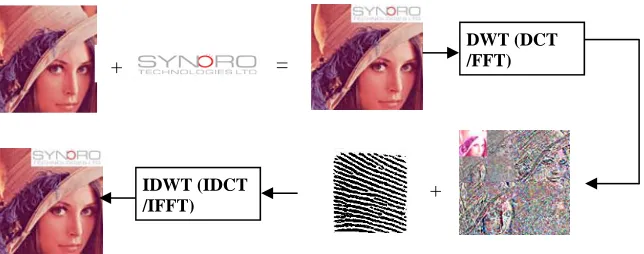
Watermarking of raw or compressed data is done in spatial or frequency domain. Spatial domain watermarking involves modification of pixels according to watermark involves less compute intense operations. Blocks prior to DWT are spatial watermarking in figure 2 For example LSB modification, pixel translations are obtained by modifying the pixel in the spatial domain that is less robust against general image processing attacks.
Figure 2. Spatial and Frequency domain watermarking
Frequency domain watermarking transforms the spatial information into frequency coefficients and then modifies the coefficients according to watermark, involves high compute intense operations. DCT, FFT, DWT are few transforms for transforming spatial information into frequency coefficients and they are highly robust against image processing attacks. Frequency domain watermarking is shown in Figure 2. The watermarking of these multimedia data in the digital library is explained in [3]. Using only invisible watermarks one can maintain the visible quality due to HVS property. The invisible watermark maybe owner name, organization logo, date and time of content creation, fingerprint of the author, title and keywords.
4 Multimedia finger printing and Indexing
Fingerprinting is the mechanism in which the watermarked content contains the intended recipient’s identification information in order to trace back the source of illegal distribution [6]. Such a situation arises when the same content is delivered to multiple users and restricts the users from
DWT (DCT /FFT)
IDWT (IDCT /IFFT)
+
+ =
redistribution. Watermarking algorithms are so designed such that watermark is introduced while playing back the multimedia content makes it robust against various attacks. Algorithm for finger printing is selected, it withstands collusion (statistical averaging) attacks, and such an attack is possible when a group of user posses the same content with the different watermark embedded into it. Once the end user (client) accesses the digital library, the client’s information like IP address and login identification has been used to watermark the materials delivered to the clients. By incorporating the mobile agent in the client’s copy, one can easily track the illegal copies in the Internet. Hence to identify and monitor the redistribution of client’s copy, the watermark inserted into the client’s copy should be unobservable to the client/recipient. Only the computational methods with watermark keys are able to retrieve the watermarks. However the watermark inserted allows the authorized user to show and view or insert in own works with copyrighted information in the client created material. Once the digital content is able to available in the Internet for public access, any one who accesses the Internet can view, copy, illegally distribute and claim of ownership. By watermarking the digital content the author allows every one to view except that he/she is the owner of the content and any usage of such digital material is supported to have copyright information with owner. Different watermarking algorithms have different technical requirement and their selection depends on robustness for various attacks, type of multimedia data to be embedded, amount of data (payload) that the host should carry and the format of watermark. Algorithms selected should with stand simple library processing attacks include scanning, printing, compression, and transcoding. Most of the watermarking algorithms modify the pixel values either directly or indirectly. Such pixel modifications are not tolerable in case of medical and satellite images in the library. Such images requires special watermarking techniques [10] in which watermark is modified into a noise like pattern and then embedded into the host image.
date, content etc. Libraries should have the capability to index the multimedia information during content creation and storage level.
For searching and indexing the multimedia content in libraries Wavelet based image indexing and searching (WBIIS) has been used [7]. The DWT described in [7] uses Daubechies wavelet, resulting in various sub bands. The low frequency sub band is the low level approximation (object) of the original image and high frequency sub band are the fine details (texture and color variations) of the image. Before watermark embedding in the multimedia content, the features of the watermark (author name, date, keywords and abstracts) are extracted and stored along with the watermarked content. Whenever the user requests the multimedia content, compute the vector features of the requested content are computed with the features available in the data base (watermark features) and best matched results are displayed in the descending order. During the first pass there is less likely the image requested features match the features stored in the database. Such cases are avoided using refined search by modifying the features of the requested content. In this cases user is in query and search loop and refinement extends to multiple passes to obtain the best result.
5 Hardware solution to real time video acceleration
of few Gigabytes and is difficult to handle by library server in real time. Hence compression becomes important in digital libraries. The raw video file available in the library need to be supplied to the end user in compressed form, which is playing back in the user’s computer. The file delivered to users must be of standard format with proper header to be recognized by the software available in the end user’s computer. If the video file formats in the digital library is other than that suitable for streaming video (example .rm and .ram) there is a need of trans-coding video to required formats.
The above three video processes involves high compute intense operations and may not be suitable to do in real time using PC’s. The efficiency of library server comes down if it handles number of streaming process concurrently is large. The quality of service provided by digital library is useful only when forward progression providing continuity of information is maintained, to make video file sense to the end user. Video streaming must be played in the correct order with little or no packet loss and with smooth, continuous timing or else essential information will be missing. Library server performance is improved by using dedicated hardware acceleration of above processes.
the fingerprinting of video to be delivered with client information as a invisible watermark. It also includes the mobile agents in the deliverable content.
App1 video encoding
App2 video compression
App3 video transcoding
. . .
App N Scene detection
Figure 3. FPGA co-processor in library server
Main function of video retrieval includes visual summaries of the video, video abstraction (low resolution thumbnail version of the video), key scene identification, scene translation and detection, video storyboard creation. By making configurable file of the above processes and then including those in the library sever for request based configuration switching. Such application switching makes the library search, browsing and retrieving process much easy. Implementation of content based video retrieval process in hardware makes the searching and retrieval of video becomes easy and hence the quality of service to the users.
6 Experimental Results
For implementation of digital multimedia watermarking we are using wavelet transform based watermark embedding techniques [3]. In order for watermark embedding and extraction to be near loss less we use 5/3 integer-to-integer wavelets. Only up to 2nd level of wavelet decomposition is performed. Gray level finger print (in Figure 2) is used as an invisible watermark. Synoro organization logo (in Figure 2) has been used as a visible watermark. Digital Image watermarking discussed in sections 3.0 and 4.0 above has been implemented using C running on Pentium IV 2.8GHz processor. PC based systems cannot handle full D1 frame size of
Library server
…… FPGA co-processor
Create and storage request
App 1 App 2 App N
PAL composite video format, which is of 720 x 576 pixels. Therefore dedicated hardware for video processing applications is required. Here FPGA based hardware video acceleration is implemented using Celoxica’s RC 203 development board. Celoxica design suite DK4.1 uses software based system design in which program for video watermarking is written in handel-c. The handel-c code is synthesized and targeted Xilinx FPGA Virtex II 2V3000-4 FG676. Real time watermarking running on FPGA utilizes 82 % of the slices with Block RAM utilization of 89 % (1360 KB for invisible watermark x 192 KB for visible watermark / 1728 KB total size). Hardware so designed is capable of producing throughput around 125 fps operating at 66 MHz. Video data available from the camera is in the raw format. The raw data is transformed into wavelet domain, watermarked and then displayed in the monitor. Tested attacks include Row deletion, Column deletion, Scaling, Compressing, Cropping, Rotation, Ambiguity, Noise addition, LSB modification, Blurring, Sharpening, Frame interchanging, Frame dropping, Aspect ratio modifications, Shearing, Combinational attacks, Sampling, Median filtering, Warping. In order to claim the ownership, watermark existence in the digital data is to be proved in the court of law. In such situations watermark extraction techniques are so designed to extract the watermark even after severely attacked conditions. Therefore security of digital contents exists mostly in watermark extraction techniques rather than robust watermark embedding algorithms. Algorithm presented in [12] has been implemented in C and used for watermark extraction. The watermark extracted from attacks like scaling rotation and compression is more than 50 % perceptually similar to Original watermark.
7 Conclusion
References
[1] John R. Smith, (January 99), Digital Video Libraries and the Internet, IEEE communications magazine, volume 37, No 1. pp 1-18.
[2] Fred Mintzer, Jeffrey Lotspiech, Norishige Morimoto, (December 1997), Safeguarding Digital library contents and users, Digital library magazine.
[3] P.W. Chan and Michael R Lyu (January 2002) A new scheme for robust blind digital video watermarking: approach, evaluation and experimentation, fall 2002 project.
[4] Christoph Busch, Wolfgang funk, Stephen Nolthusen, (January 1999), Digital watermarking from concepts to Real time video appliocation, IEEE computer graphics and Applications, ISSN 0272-1715.
[5] www.watermarkingworld.com
[6] Gwenael Doerr, Jean-Luc Duglay, (March 2003), A guide Tour of video watermarking, Signal Processing: Image Communications, volume 18,ISSN 0923 – 5965.
[7] [7] James Z. Wang, Gio Wiederhold, Oscar Firschein and Sha Xin Wei, (1998), Content-Based Image Indexing and Searching Using Daubechies' Wavelets, International Journal on Digital Libraries, volume 1, pp 311-328.
[8] Kishore Andra, Chaitali Chakrabarti, Tinku Acharya, (April 2002), A VLSI Architecture for Lifting-Based Forward and Inverse Wavelet Transform, IEEE Transactions on signal Processing, volume 50, No. 4, pp 966-977.
[9] [9] www.ibm.com
[10] [10] Hah-lin sieh, Lung-ao Hsu, I-Ju Tsai, (Dec 2005), A copy right protection scheme for color images using secret sharing and wavelet transform, Transaction engineering computing an Technology, volume 10, ISSN 1305-5313.
Array Architecture, 10th International Workshop on Field Programmable Logic and Applications.
[12] [12] Kesavan Pillai, (Jan 2005), A New Watermark Extraction