The University of San Francisco
USF Scholarship: a digital repository @ Gleeson Library |
Geschke Center
Master's Theses
Theses, Dissertations, Capstones and Projects
9-15-2000
Government Contracting and the Unionization of
San Francisco's Social Service Nonprofits
Jeanne Bell Peters
University of San FranciscoFollow this and additional works at:
https://repository.usfca.edu/thes
This Thesis is brought to you for free and open access by the Theses, Dissertations, Capstones and Projects at USF Scholarship: a digital repository @ Gleeson Library | Geschke Center. It has been accepted for inclusion in Master's Theses by an authorized administrator of USF Scholarship: a digital
Recommended Citation
Peters, Jeanne Bell, "Government Contracting and the Unionization of San Francisco's Social Service Nonprofits" (2000).Master's Theses. 1145.
The author of this thesis has agreed to make available
to the University community and the public a copy of this dissertation project.
Unauthorized reproduction of any portion of this dissertation is prohibited.
The quality of this reproduction is
contingent upon the quality of the original copy submitted
.
University of San Francisco Gleeson Library/Geschke Center
2130 Fulton Street
Government Contracting and the Unionization
of San Francisco's Social Service Nonprofits
A THESIS SUBMITTED
by
Jeanne Bell ,Peters
In Partial Fulfillment of the Requirements
for the Degree of
Master of
Nonprofit Administration
The University of San Francisco
Government Contracting and the Unionization of San
Francisco's Social Service Nonprofits
This Thesis written by
Jeanne Bell~Peters
~. ...
This Thesis written under the guidelines of the Faculty Advisory Committee, and approved by all of its members, has been accepted in partial fulfillment of the requirements for the degree of:
Master of Nonprofit Administration
at the
University of San Francisco
Research Committee:
Date
Date
TABLE OF CONTENTS
Abstract . . . i v
Vita Auctoris . . . v
Acknowledgements . . . vi
List of Tables . . . vii
List of Appendices . . . viii
Chapter One: Introduction . . . 1
Chapter Two: Review of Related Literature . . . 11
Chapter Three: Methodology . . . 30
Chapter Four: Results . . . 40
Chapter Five: Summary and Conclusions . . . 59
References . . . 69
Appendix A . . . 7 2
ABSTRACT
This study established baseline data about union activity
among San Francisco's nonprofit social service agencies. It
examined associations between agency staff size, annual
budget size, reliance upon government funding, and the
experience of union activity. It further sought to assess
executive directors' opinions about factors motivating
employees to organize, as well as their opinions about the
viability of unionization in the nonprofit sector.
The data demonstrate a strong, positive association between
agency staff size, annual budget size, reliance upon
government funding, and the experience of union activity.
Executive directors of nonprofit social service agencies in
this study believe that wages are the most important factor
for employees seeking union representation. These managers
do not believe that unionization is an appropriate response
to employees' grievances and would generally not support
organizing drives in their own agencies. While these
executive directors view labor organizing as a significant
challenge to the nonprofit sector, they tend to believe that
nonprofit organizations can ultimately function and thrive
Name:
Date of Birth:
High School:
Graduated:
Baccalaureate Degree:
Graduated:
College:
VITA AUCTORIS
Jeanne Bell Peters
October 7, 1969
Lick-Wilmerding High School San Francisco, California
1987
Bachelor of Arts Degree
1992
ACKNOWLEDGMENTS
I wish to thank Charlene Clemens, Vaughn Welty, Andrea
Martin, and Jan Masaoka for their support of my graduate
work and completion of this thesis. They each have played an
invaluable role in my development as a nonprofit
professional for which I am extremely grateful.
My sincere gratitude to Steven Hirschfeld, Dr. Edward
Rimer, Dr. Carol Silverman, and Dr. Michael O'Neill who
guided me through this process.
To my wonderful parents Norine Bell and Jim Bell, to
Diantha Bell, Pat Bell, and especially my husband, Neil, so
Table 1
Table 2
Table 3
Table 4
Table 5
Table 6
Table 7
LIST OF TABLES
Size of Paid Staffs among Participating Agencies
Size of Annual Budgets among Participating Agencies
Cross-tabulation of Staff Size and Union Activity
Cross-tabulation of Annual Budget Size and Union Activity
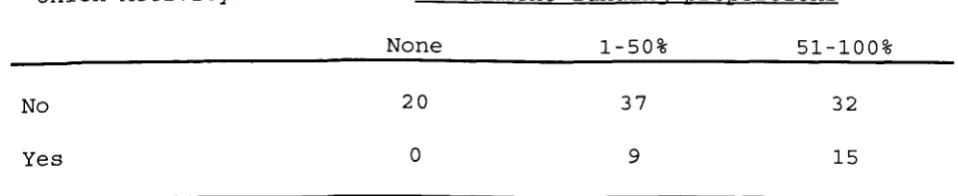
Cross-tabulation of Government Funding and Union Activity
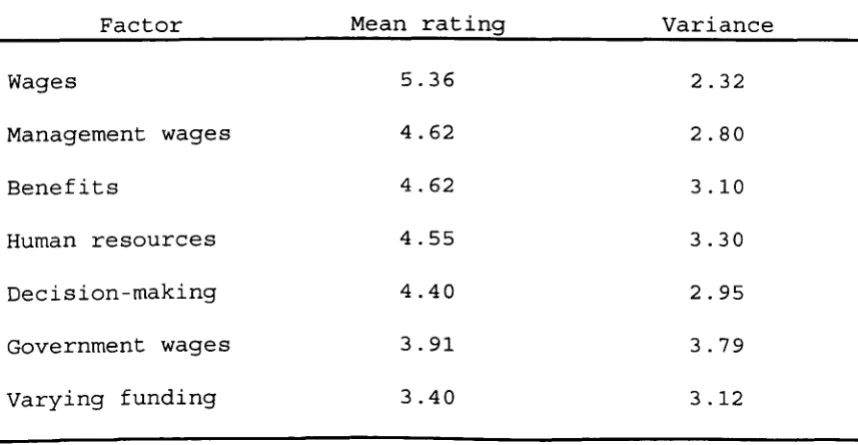
Executive Directors' Opinions of the Factors Motivating Staff to Unionize
Appendix A
Appendix B
LIST OF APPENDICES
Executive Directors' Responses to Question 16
CHAPTER ONE: INTRODUCTION
Background
Government funding of nonprofit social service
organizations has grown considerably ~n recent decades; it
is now their most significant source of financial support
(O'Neill, 1989; Lipsky
&
Smith, 1989-90). In evaluating thisgrowth, scholars and practitioners have identified a host of
associated benefits and risks for nonprofit agencies and the
sector as a whole. Benefits include the growth of the
sector, the increased availability of services and programs
not previously offered by the government, and higher revenue
for nonprofits. The identified risks tend to focus on the
potential dominance of government in the public/private
contracting relationship.
For instance, some are concerned that social service
nonprofits are changing their missions and goals to fit
government standards and to maintain their eligibility for
government dollars. Scholars have termed this "goal
displacementn (Gibelman, 1996; Lipsky
&
Smith, 1989-90)Some argue that contracting has led to the bureaucratization
of nonprofits' procedures and management style (Fabricant
&
Burghardt, 1992; Gibelman, 1996; Lipsky
&
Smith, 1989-90).And consistently, "resource dependence,n or the significant
is identified as a reality for many social service
nonprofits and a potential threat. Most scholars agree that
whatever the challenges for nonprofit social service
agencies associated with contracting, government contracts
are likely to continue as their principle funding mechanism
(Kramer, 1994).
Today, the increase in labor organizing among social
service nonprofits may be seen as a further outgrowth of
this " blurring" of the lines between the public and
nonprofit sectors (Gibelman, 1996; Pynes, 1997). The public
sector has been a key stronghold for unions in the United
States in recent decades as the labor movement has incurred
substantial losses in the manufacturing and blue collar work
force (Kearney, 1992). John Sweeney, President of AFL-CIO
wrote in 1996 about the decline of the labor movement:
" From our peak in the mid-1950s, when we represented 35
percent of the workforce, unions declined to 28 percent in
the mid-1970s- and now we number only 15 percent of the
entire workforce and a mere 11 percent in private industry"
(p. 39). It is typically unions that already serve large
numbers of public sector workers that are approaching
private nonprofits. Pynes (1997) posits that unionization
will continue to grow in the nonprofit sector in large part
because of its similarity to, and interdependent
A number of factors are at play in the nonprofit
unionization movement. From a union perspective, i t is
logical to follow the money and jobs that are created and
maintained through contracts with nonprofits. A recent study
by the Center for Labor Research and Education at U.C.
Berkeley found that in San Francisco, for instance,
nonprofits received 41.7 percent of all contract dollars
spent in FY 1994-95 (Walker et al., 1997, p. 6). Indeed, it
has been established that government contracts accelerate
the budgetary and personnel growth of voluntary agencies
(Lipsky
&
Smith, 1989-90; Stone, 1996). At the same time, asprotectors of public sector jobs, unions may pursue
nonprofit unionization as a way to counter the tide of
privatization by increasing nonprofit wages. For the tens of
thousands of public sector workers that unions represent,
contracting is a form of privatization which may lead to job
insecurity (DeHoog, 1984; Sweeney, 1996).
Like privatization, managed care is a cost containment
practice that has some providers in the health and social
services fields deeply concerned. Pynes (1997) and others
view managed care as an impetus for public and nonprofit
sector professionals and paraprofessionals to organize. In
this case, non-monetary issues are often in the
forefront-issues that pertain to the quality of physical and mental
There are also various personal and organizational
reasons that social service providers are seeking union
representation. Existing research suggests both monetary and
non-monetary motivations for them to organize. Some
researchers argue that management changes in response to the
aforementioned issues (contracting, privatization, and
managed care) are negatively impacting direct service
providers• job satisfaction (Fabricant
&
Burghardt, 1992)Some see a logic in social service organizing based upon the
early unionizing of social workers in the 1930s as well as
the tendency of social service providers to share labor's
historic commitment to advocacy and social action (Karger,
1989) .
On the other hand, there has been only minimal research
about the nonprofit management perspective on unionization.
Do nonprofit social service managers view unionization
differently than corporate or public sector managers do? We
don't yet understand nonprofit managerial views of
unionization and its potential impact on the nonprofit
sector. There is considerable debate about why social
service providers unionize, and further, whether i t is
appropriate for them to do so given the nature of their
work. Issues of professionalism and the impact of strikes by
social service workers are of particular concern to
Statement of the Problem
There is very limited research on the unionization of
nonprofit agencies. Pynes (1997) suggests that this is
partly due to the relative newness of their option to
organize. The National Labor Relations Board (NLRB) began
considering voluntary agencies as potential bargaining units
in 1976 (Pynes, 1997, p. 356). Whatever influences they may
experience from their multiple constituencies, public and
otherwise, nonprofit agencies should be studied
categorically to gain understanding of their unique position
vis-a-vis unionization.
At this preliminary stage in our understanding of the
issue, a two-pronged question presents itself. Why are
unions approaching nonprofit social service agencies? And,
why are nonprofit service providers seeking union
representation? Much of the related literature suggests that
government contracting is part of the answer to both
questions. It may be that nonprofits are attractive to
unions because of their financial relationship with the
widely unionized public sector; and in turn, that unions are
attractive to service providers at least in part because of
the monetary, managerial, and programmatic implications of
that same public/private partnership.
No published research that the author is aware of has
subjects of an inquiry about unionization. In addition to
establishing the scope and any discernible patterns in the
union activity among the organizations they lead, this study
asks them to characterize, from their personal perspectives,
the motivations of staff and union organizers, and the
opportunities and challenges that unionization presents the
sector. Moreover, while there is considerable literature
addressing the ways that government contracting has changed
the roles and functions of nonprofit managers and boards
(Heimovicks, 1993; Stone, 1996), there is none that
specifically establishes whether nonprofit managers are
prepared for the significant change that unionization
represents.
In sum, the problem is to begin the work of
establishing some baseline data about the frequency of union
activity among nonprofit social service organizations, and
to understand any patterns therein- especially those that
may relate to public/private partnerships. Further, the
research is concerned with management's preparation for, and
opinions of, labor organizing in the sector.
Normative Definitions of Relevant Variables
This study focuses on social services. Margaret
Gibelman (1996) defines these as " services oriented to
individuals, families, specific groups or communities"
(p.26). She further quotes research by Wellford and
Gallagher in which they describe social services as " those
which assist in the growth and development of individuals
and families" (p. 27). DeHoog (1996) argues that " social
services" is a broad category including " hard" and
" soft" services ranging from transportation to family
counseling respectively (p. 15). The organizations included
in this research fall along DeHoog's continuum, and as
Gibelman suggests, in some way address an individual or
group problem.
This study is concerned with public/private contracting
relationships. In Contracting Out for Human Services, DeHoog
(1984) writes:
The general term contracting out refers to the practice
of having public services (those which any given
government unit has decided to provide for its
citizens) supplied either by other governmental
jurisdictions or by private (profit or nonprofit)
organizations instead of delivering the service through
a government unit's own personnel (p. 3).
Within that definition, the study addresses the
contracting relationships of private nonprofits and any
governmental unit at any level: city, state, or federal.
This definition is synonymous with what some scholars refer
Research Questions
The related literature and a small number of scholarly
research studies focused solely on social service nonprofit
unionization inform the following research questions:
• What is the scope of union activity among social
service nonprofits?
• Is there a tendency for organizational similarities
among agencies experiencing union activity?
• Is there a relationship in the social services
between receiving government contracts and
experiencing union activity?
• Is there a relationship in the social services
between receiving government contracts and an
executive director's perception of staff and union
motivations for union organizing?
• Is there a relationship in the social services
between receiving government contracts and an
executive director's degree of preparation for labor
drives in currently nonunionized organizations?
• What are executive directors' opinions of the impact
of unionization on nonprofit human service
organizations? Do those opinions differ among
executive directors of unionized and nonunionized
Importance of the Study
The relationship between government and social service
nonprofits is a primary focus of researchers of the
voluntary sector. O'Neill (1989) terms it the " classic
policy issue for social service nonprofits" (p. 108). As
that relationship has become more complex and increasingly
characterized by profound interdependence, scholars and
practitioners have attached a variety of meanings to it
while anticipating advantages and disadvantages for both
consumers and service providers. It is important to
investigate whether unionization, a thriving staple in the
public sector for many years now, is a further result of the
increasing interdependence between the two sectors.
On a practical level, unionization may pose challenges
for nonprofit managers. It is unclear how they respond to it
and what impact it has on their roles and functions as
directors of nonprofit social service agencies. Over the
last 20 years, executive directors have had to acquire a
skill set previously never imagined in their roles. Their
functions now typically include service contract
negotiation, quantifiable outcomes measurement, and complex
financial accounting. Unionization will demand yet another
knowledge base. Researchers, practitioners, and educators in
need to have a clear understanding of this impact if
CHAPTER TWO: REVIEW OF RELATED LITERATURE
The literature review examines the potential for
viewing the emerging trend of labor organizing among
nonprofit social service organizations in the specific
context of the prevalence of public/private partnerships. To
that end, research and theory that identify aspects of the
contracting relationship that present organizational
challenges which may be associated with employee job
satisfaction, and therefore unionization, are first
discussed. The review then addresses literature concerned
with labor organizing in the social services and like
fields. Herein, the issues of the appropriateness of social
service worker organizing, striking, and employee and labor
union motivation are considered.
The Organizational Risks Associated with
Government Contracting
Kramer (1994) writes that the predominance of service
contracting has " meant that nonprofit organizations
function more often as a substitute for government rather
than in their traditional roles as an alternative, a
supplement, or a complement" (p.34). According to the
from the nonprofit that directly affect its workplace
environment:
The transaction costs to nonprofit organizations who
serve as vendors of public services can be grouped into
four clusters: various time constraints such as
'annualization' and multiple, conflicting deadlines
that contribute to uncertainty and other job pressures;
underfunding and cash flow delays; reporting, red tape,
paperwork, and other accountability requirements; and
undesired restrictions on staffing, client eligibility,
and service methods. (p.41)
Each of these implications of service contracting
potentially causes conflict for, and between, managers and
direct service providers. Kramer maintains that the
complexity of multiple contracting relationships " is one of
the major factors militating against coherence, continuity,
coordination, and planning, which are the basic elements of
a more rational service delivery system." (p. 46)
Specifically, Kramer identifies increased size and
scope of services, as well as bureaucratization, as trends
that have emerged among nonprofits along with contracting.
However, he cautions that the extent of their association is
not known. Kramer notes that larger organizations relying on
government contracts tend to decentralize into a variety of
separate programs each responding to a specific contract or
organizations is centralization, which allows them to
withstand the administrative, or indirect, costs of being a
contractor.
Kramer cautions against mythologizing the old days when
nonprofits were supposedly more informal, reminding the
reader that many nonprofits came into existence in direct
response to government funding. Still, he writes that " the
policy environment poses a serious challenge to many
nonprofit organizations: how can they avoid becoming just
another public agent and a substitute for government? How
can they preserve their traditional roles as alternatives,
supplementing and complementing public services" (p. 54)?
In "Contracting Out for Social Services: Boom or Bust
for the Voluntary Sector?" Gibelman (1996) also raises a
series of concerns about the potential impact of contracting
on both nonprofit managers and service providers. She names
" long-term overload and burnout of staff, loss of valuable
staff and disruption of operations" as possible
repercussions of the schedules and procedures associated
with the contract funding process (p. 34). A variety of
funding sources can mean multiple accountability
requirements for staff, which means more paperwork. Gibelman
argues that the added staff requirements associated with
contracting " raise the possibility of creating new
'mini-bureaucrats' rather than eliminating bureaucracy" (p. 35)
could negatively impact social service providers' job
satisfaction.
Lipsky and Smith (1989-90) claim that the blurring of
the lines between the government and nonprofit sectors has
made the latter less attractive to social service workers.
They believe that many older nonprofit agencies have " lost
the edge that set them apart from public organizatiqns and
other nonprofit agenciesn due to reliance on contracting (p.
117). And, they ask, "Why should a social worker continue
to work for a nonprofit agency when she can increase her
salary by 20 percent working for another type of
organizationn (p. 117)? The authors argue that employee
loyalty to social service nonprofits is detrimentally
impacted by nonprofits taking on public sector
characteristics. Nonprofit management has always been able
to counter the disincentive of working for lower salaries by
distinguishing the quality of nonprofit work from that in
any other sector. The loss of that distinction could be an
impetus for union organizing as lower salaries seem less
justified to nonprofit workers.
Melissa Middelton Stone's (1996) case study of a
nonprofit's transformation from the 1950s to the 1990s
highlights the significant influence of government
contracting. She recalls Alford's (1992) concept of
"orbits,n or what she names "institutional logics." During
" democratic" because it responds solely to its members,
volunteers, and clients. But as it takes on more and more
government contracting, the nonprofit inevitably takes on
the logic of the "state" as well. Stone concludes:
The point here is that CARC became embedded in a
contracting system that rewarded managerial
sophistication. Becoming a significant contractor
within this system, however, also produced tension
within CARC concerning its ability to continue client
advocacy efforts, the central founding purpose of the
organization (p. 83).
Struggling with organizational goal definition can be a
source of conflict for direct service providers especially
because their work is the daily enactment of that mission.
In The Welfare State Crisis and the Transformation of Social
Service Work, Fabricant and Burghardt (1992) delineate
changes for social service workers resulting from
public/private partnership. Based on in-depth investigations
of three nonprofit social service agencies, the authors cite
a more routinized work day, a greater emphasis on numbers of
clients seen, ethical dilemmas, increased paperwork, less
creativity in service development, and staff turnover as
negative ramifications of government contracting. The
authors maintain that these ramifications are leading to " a
deepening crisis" of a less qualified labor pool. Workers'
have cumulatively resulted in substantial labor flight" (p.
179)
DeHoog (1984) writes of a different sort of risk
associated with contracting, namely, raising the ire of
public sector unions. She notes that a number of
municipalities throughout the country have been slowed in
their efforts to contract out by union opposition. " When
governments decide to switch from public employees to
private firms, union leaders accuse the offending agency of
union-busting and putting public employees on
welfare" (p.14). Pynes (1997) goes further, arguing that
professional employees in both the public and nonprofit
sectors seek unionization in response to the impact
privatization, of which contracting is a part, has on the
delivery of social services (p. 358).
To summarize, scholars have identified a number of
characteristics and results of the contracting relationship
that can be seen as risks for social service nonprofits in a
unionizing environment. These risks include
bureaucratization, staff burn-out and turnover, a loss of
distinction between work in the public and nonprofit
Considering the Appropriateness· of Unionization
in the Social Services
Piazza and Frost (1993) question whether union
membership is an appropriate response for nonprofit
employees. They are concerned with the implications for the
professionalism of nonprofit counselors particularly. " The
dual role of professional counselor and union member may
place the mental health counselor in a conflict of
interest" (p. 193). The authors worry that when mental
health counselors are combined with nonprofessional staff in
a bargaining unit, "decisions . may be guided by
collective interest rather than by client welfare or
professional ethical standards" (p. 194).
Piazza and Frost also suggest that the image of
professional counselors may be tarnished by union
membership:
Because mental health professionals are usually not
part of management, they risk losing their professional
identity by aligning themselves with labor . Mental
health professionals would be wise to note the loss of
prestige and professional stature experienced by
teachers and nurses once they began to unionize (p.
195) .
Hush (1969) shares the concerns of Piazza and Frost. He
notes that social service workers tend to be sympathetic to
the theory behind organized labor, but he questions whether
that theory is applicable in the environment of social
service. " Problems arise . . when a philosophical,
humanitarian view of workers' rights, which evolved from the
needs of employees paid by the hour in an industrial, profit
making enterprise, is applied to the collective bargaining
process involving salaried personnel in a nonprofit
community service enterprise . ." (p.210). Hush maintains
that once the " adversary relationship" is established
through unionization, " i t is never fully absent" (p.211)
Finally he notes the shift in authority within a unionized
nonprofit away from the board of directors to the ratified
union contract (p. 212).
In contrast, Karger (1989) calls the idea that social
workers are somehow different from other workers,
" exceptionalism." This exceptionalism implies that tasks
performed by social workers are vastly more important than
those performed by other workers- especially
nonprofessionals (p. 8). He maintains that the notion of
social work as unique has kept salaries in the field lower
than in other professions. Karger refutes exceptionalism,
concluding, " for most social workers, the appellation of
'worker' is more of a reality than the preceding
'social"' (p. 9).
Milton Tambor (1973; 1988; 1995) identifies a host of
reasons that unionization is appropriate in the social
service field. First, he views organizing as a way for
direct service providers to impact policy and procedure in
their organizations. " In many agencies, negotiating wages,
hours, and working conditions, logically leads to the use of
collective bargaining to effect changes in administrative
policies and improve client services" (1973, p. 44). Access
to decision-making power is critical for Tambor; he notes
that " in some instances, negotiations provide the initial
opportunity for employees and board members to meet each
other" (1973, p. 43).
Tambor also views social service work and unionization
as philosophically compatible. " As trade unionists, social
workers can find expression for their political commitment
and values within their unions" (1988, p.95). He argues that
unions share providers' interest in the causes of social
work clients. "Social workers can use their labor
organization's resources to improve client services and join
in progressive coalitions with the neighborhood and
community groups" (1988, p.95).
Finally, Tambor sees collective bargaining, either
voluntarily in nonunionized social service settings, or
among unionized agencies, as a necessary weapon against
employment at will. He notes that while most nonprofits have
personnel practices that delineate a grievance process, " in
nearly every case, the process is limited to internal
impartial third-party hearing" (1995, p. 48). He uses four
case studies to illustrate the potential for nonprofits to
terminate employees without just cause. In three of the four
instances, unions successfully appealed terminations and
employees were reinstated.
Alexander, Lichtenberg, and Brunn (1980) found that
overall social workers themselves do not view unionization
as inappropriate for their field, but they do narrowly
define their relationship with organized labor. The
researchers surveyed 84 union members with masters degrees
in social work in a major urban community. Only 38 percent
of the respondents perceived any conflict between their
roles as professionals and as union members. But fewer than
25 percent of the respondents looked favorably upon
slowdowns, sick-outs, and strikes. The authors conclude:
" The respondents overall strongly favor the most moderate
of union tactics- arbitration- and strongly disapprove of
the more forceful and traditional tactics" (p. 222). Because
she anticipates the growth of nonprofit unionism, Pynes
(1997) assumes a pragmatic stance on the appropriateness of
organizing:
Whether or not one believes that nonprofit employees
should be able to organize and collectively bargain
over wages, hours, and working conditions is
irrelevant. Nonprofit administrators must become
relations as well as understand the reasons why many
nonprofit employees become union members (p. 356).
Social Service Workers and Strikes
The disapproval of striking that Alexander et al.
(1980) found among MSW respondents speaks to the ambivalence
many providers and managers feel about the notion of work
stoppage when vulnerable clients are dependent upon the
services in question. Reamer (1988) writes that " social
workers have always struggled to reconcile their principal
concern about clients' welfare and their right (or need,
perhaps) to strike" (p. 136). He articulates the argument
against striking: " It would be unconscionable for social
workers to betray the poor, mentally ill, infirm, abused,
and neglected in order to advance their own interests" (p.
136) . Reamer provides the other side of that argument as
well. "The presumption of altruism invites managers to take
advantage of social workers' benevolent instincts. To
counter such temptations, social workers must retain the
right to strike . . " (p. 136) .
Fisher (1987) examines the ethical considerations of
striking social workers. She writes about a 1984 strike in
New York City that involved more than 50 agencies and
included all of the social work staff in hospitals and
striking social workers heckled clients and their families
who crossed the picket line; many strikers did not alert
their clients to the pending work stoppage; and neither the
union nor the striking workers addressed the continuation of
care for clients anytime during the 47-day strike (p. 253)
Fisher argues that social service workers in unions
should be concerned with their own job security when they
consider striking. In the case of the strike in question,
managers cut back on social work staff after surviving
without many of them for seven weeks, she notes. Moreover,
Fisher maintains that it is " time for the profession to
develop a position that places patient care services as a
priority" and that " standards of professional behavior
conflict with union membership requirements" (p. 254)
In their discussion of unionized mental health
counselors, Piazza and Frost (1993) also advocate placing
clients' well-being in the forefront. "The client, whose
welfare is the highest priority, seems to have the least to
gain and the most to lose in the unionization process.
Clients risk disruption of services" (p. 198).
McConnell's (1982) case study of a Canadian youth
residential program that experienced a labor strike suggests
possible implications of disrupted services in a nonprofit
social service organization. The author makes the argument
that in work with vulnerable populations, replacement
because social service work is based to a significant extent
upon ongoing relationships between service providers and
clients. In the case of this residential home for children,
~ control, credibility, and influence" were extremely
difficult for replacement staff to establish. McConnell
concludes: ~Preparation for the strike underestimated the
effects of abruptly terminating existing relationships.
Experienced child care staff members did not realize the
extent to which their professional effectiveness was related
to their personal impact on the children" (p. 514).
The Motivations to Unionize
The absence of a substantial body of literature on the
motivations of social service workers in the nonprofit
setting to unionize necessitates some inclusion of relevant
public sector studies in this review. The organizing of
public sector social service workers is viewed as
potentially relevant because nonprofit workers are often
joining the same unions as government employees doing
similar work.
In ~ The Experience of Unionizing for Circuit Court
Psychologists in Chicago: Teamsters Local 743," psychologist
Catherine Wilson (1997) writes that issues of caseload and
management style, along with salary, were paramount in the
proposed nontraditional items for consideration in the
contract negotiation process: shared control by staff and
management over use of staff training funds; a requirement
that supervisors be experienced in the work of their
supervisees; and a weighting system for assigning caseloads
to prevent an excessive number of difficult cases going to
any one psychologist (p. 432). Wilson concludes that the
experience " has shown that through union organizing,
individuals can make a significant impact on their work
conditions and the quality of services they offer the
public" (p. 434).
Another psychologist, and union member of AFSCME Local
3758 in the District of Columbia, Stephen Fitzgerald (1997)
argues that unionization is an effective way for direct
service providers to gain access to policy makers and
decision makers. "As a union president, I have the
credibility to speak with city leaders and others in order
to express the views of our psychologist members. I am on
the invitation list for many functions that I would
otherwise be excluded from" (p. 436). As a union, these
psychologists have also collectively addressed client
welfare issues such as library closings and the termination
of an employment training program for their clients.
Petty and Odewahn's (1982) research of public sector
workers in a human service agency suggest that non-monetary
study of 169 people employed as social workers and
assistance payments technicians " indicates that attitudes
toward factors like the nature of one's work, the goals of
the agency, and the agency's strategies for obtaining its
objectives may be the best predictors of union membership in
human service agencies" (p. 58). The authors hypothesize
that the level of professionalism among these workers
explains their greater emphasis on issues other than salary.
" One implication of the results of the present study is
that employees in human service agencies may seek union
membership in pursuit of increasing the level of intrinsic
satisfaction with their work" (p. 59).
Hovenkamp's (1994) research with unionized and
nonunionized librarians also suggests a valuing of the
intrinsic aspects of job satisfaction. She asked respondents
questions pertaining to three areas of job satisfaction:
"bread and butter," which refers to salary and benefits;
"professional growth," which refers to challenge and career
development; and " work environment," which refers to the
quality of the people and facilities at their place of work.
Hovenkamp found that the existence of a union had no
significant relation to how workers valued each of the three
elements. However, within the unionized group she found that
commitment to union membership was positively associated
with valuing professional growth. Arriving at a conclusion
Because of their educational training and nature of
work, issues of intrinsic value may be as important for
professional workers as those of extrinsic value. The
present research moreover showed that those members who
expressed the strongest ties to the union also tended
to place higher values on professional issues" (p.
991) .
Scott, Seers, and Culpepper (1996) researched the
success of union elections in the nonhospital health care
industry. Nonprofits such as home health care agencies and
nursing homes were represented in the study. Previous
research established that in hospitals, professional groups
were the most likely to have election victories. The
findings of Scott et al. confirm that professionals in
nonhospital health fields, including nonprofits, also have a
higher probability of union election victory. Again, this
speaks to professional concerns motivating nonprofit
organizing in service settings.
Tambor (1988) writes that social worker unions
(representing public and nonprofit employees) are concerned
with pay equity and job protection as well as less
traditional issues. He lists possible professional
development contract items including " tuition
reimbursement, sabbatical and educational leaves, conference
time and costs, payment for professional dues and
regard to agency policy, Tambor suggests that employees may
seek to address workload issues and staff participation in
decision making through unionization (p.93).
Pynes (1997) argues that nonprofit managers' strategic
attention to human resources issues is required to address
the motivations to organize. She draws upon a 1990 work by
Pfeffer and Davis-Blake, ~ Unions and Job Satisfaction: An
Alternate View," which identifies four human resource
challenges that may foster union activity. These challenging
situations are: when staff feel a lack of autonomy, when
they experience poor supervision, when there is too much
interpersonal conflict in the workplace, and when management
makes substantial new work demands on staff (p. 368). Pynes
suggests that nonprofits need to change their tendency to
" administer personnel in an ad hoc manner, making i t up as
they go along" (p. 368). " Whether or not workers join
unions depends on their perceptions of the work environment
and their desire to influence employment conditions.
Organizations that provide employees with the opportunity to
participate in the decision-making process are less likely
to be the targets of unionization" (p. 368).
~ A House Divided: How Nonprofits Experience Union
Drives," a qualitative study by Masaoka, Peters, and
Richardson (1998), supports Pynes' assessment. The authors
identify four ~ areas of argument" in the unionization
strategies (especially human resources), wages and benefits,
and the political and racial context of the labor drive.
They write, " For pro-union staff, a desire for greater
involvement with agency decisibn-making was the most
frequently articulated reason for their pro-union stand" (p.
14). The study further suggests that the perceived
mismanagement of human resource issues is also a major
motivational factor for staff organizing. Although wages and
benefits were discussed by the study's participants,
nonbread-and-butter issues appeared to provoke the most
passionate responses among pro-union staff.
Masaoka et al. (1998) also include the voices of union
organizers in their study providing insight into the unions'
motivations to organize. Organizers speak openly of the
relationship between government contracting and nonprofit
unionization. As one study participant said, " [Nonprofit
organizing] is to balance out the discrepancy between public
and nonprofit. A two-tier system is evolving. The only way
to stop that is to organize both tiers." Another nonprofit
organizer explained how the union evaluates interest from
nonprofit workers: "When workers call us up, our first
question is, 'How big are you?' and then, 'Where does the
money come from?' Then we ask if other workers are in
agreement." While these comments suggest a clear agenda on
the part of unions organizing nonprofit workers, i t is not
agenda, at least initially. In fact, very few workers who
participated in the study referenced government contracting
as explicitly as the union staff did.
Conclusion
Reviewed together, the literature addressing the
potential impact of government contracting on nonprofit
social service staff, and that addressing the motivations of
social service employees and labor organizers to unionize,
suggest the possibility for overlap in the way we consider
the two issues. If employment factors such as burnout, goal
conflict, and professional development are linked with a
contracting environment and with the motivation for social
service employees to unionize, then further research that
looks at the issues concurrently is warranted. Moreover, if,
as Pynes (1997) and the participants in the study by Masaoka
et al. (1998) suggest, unions are targeting nonprofits
because of that same public/private partnership, then
establishing nonprofit management's awareness of, and
perspectives on, labor's focused attention is equally
CHAPTER THREE: METHODOLOGY
Respondents
Surveys inquiring about the level of union activity and
management's knowledge and perception of organized labor
drives among social service nonprofits were sent by US mail
to 329 executive directors in San Francisco during March,
1999. The sample was culled from an 890-record active
mailing list called BRAIN, or Bay Region Agency Information
Network. The list is maintained by HELPLINK, an information
and referral program of the Northern California Council for
the Community, Inc. BRAIN is a regional database of health
and human service organizations serving San Francisco County
that includes executive directors' names and brief
descriptions of agencies' services. Because the present
study addressed nonprofit social service agencies
exclusively, the researcher excluded 561 organizations:
government agencies, educational institutions, and other
organizations that did not fit this study's definition of
"social service."
Research Design
The survey was a four-page, 16-question instrument. It
research. The cover letter appeared on the Support Center
for Nonprofit Management's (subsequently renamed,
CompassPoint Nonprofit Services) letterhead due to the
researcher's collaboration with that local technical
assistance organization on other projects related to
unionization. A postage-paid envelope was included for
returning the survey.
Because agency names were not solicited on the survey
instrument, a handwritten number was placed on each survey
before it was mailed for the purposes of tracking returns.
This allowed the researcher to follow up with those agencies
that did not respond. One hundred and one completed surveys
were returned during the allotted timeframe, with six
surveys returned undeliverable.
On April 15, 1999, three weeks after the initial
survey distribution period, a reminder postcard was sent to
agencies that had not responded to the initial mailing
asking that they return the survey and offering contact
information should they have misplaced it. Twelve more
surveys were received, bringing the total to 113, or 35% of
the targeted population.
The relatively low return rate is not unexpected and
may be attributed to several factors. First, the data
collected suggested great variety in the levels of awareness
of the issue among agencies. While some have had union
circles where the issue is currently being debated, others
have had no reason to encounter the topic and may not have
believed it relevant enough to warrant their efforts.
Secondly, the topic is a controversial one among those who
are aware of it. The fact that several respondents tore the
identifying number assigned to their surveys off the
document before returning it despite assurances that a
participant list would never be shared publicly, speaks to
the anxiety level of some managers. In a time of active
recruitment by labor organizers, the notion of sharing
budget and staffing information as well as opinions about
unionization may have seemed too risky for some executive
directors. Finally, the nature of the questions generally,
from degree of reliance on varying funding sources, to the
knowledge base of one's board of directors, simply may have
gone beyond what some executive directors were inclined to
share.
Procedures
The researcher developed the survey questions. A
pretest of the survey to check for clarity and effectiveness
in capturing data was conducted with five San Francisco
executive directors and management consultants. Collected
analysis. Analysis, drafting of findings, and revisions took
place between August, 1999 and August, 2000.
Instrumentation
The survey instrument contained three types of
questions: organizational characteristics, assessment of
union activity, and subjective questions about the
respondent's knowledge of, preparation for, and opinions
about nonprofit unionization.
Organizational characteristics, questions 1 through 4,
included: the size of the agency,s annual operating budget
given in ranges; the size of the agency,s paid staff given
in ranges; the ratio of master,s-degreed/licensed staff to
bachelor1s-degreed or less; and the source of the agency,s
funding. For the last question, respondents were asked to
put a budget percentage next to each funding source type
(fee for service; individual, foundation, and corporate;
city and other government; and other) adding up to 100
percent. These responses were used to explore patterns among
unionized organizations based on these characteristics.
Questions 5 through 8 assessed the level of union
activity, if any, at the responding organizations. The
options allowed the author to capture the various stages of
this emerging movement among single and multi-program
agencies experiencing union activity. Some large nonprofits
are only partially unionized, some agencies are negotiating
their first contract, and some have been unionized for many
years.
Questions 8 through 11 addressed the likelihood of
future organizing and the level of preparedness of executive
directors and their boards of directors for that
possibility. Respondents were asked to rate their knowledge
of nonprofit union issues and that of their boards of
directors on a Likert-style scale. Directors of nonunionized
agencies were also asked if they were having conversations
about unionization with their staffs. In question 9,
respondents from nonunionized agencies were asked to rate
the likelihood that their organization would experience a
labor drive within the next two years on a Likert-style
scale.
Question 12 addressed the existing or potential
motivations for employees to organize. Executive directors
were asked to rate how important they believed each of six
factors were, or would be. These factors included wages, pay
equity, decision making power, and quality of supervision.
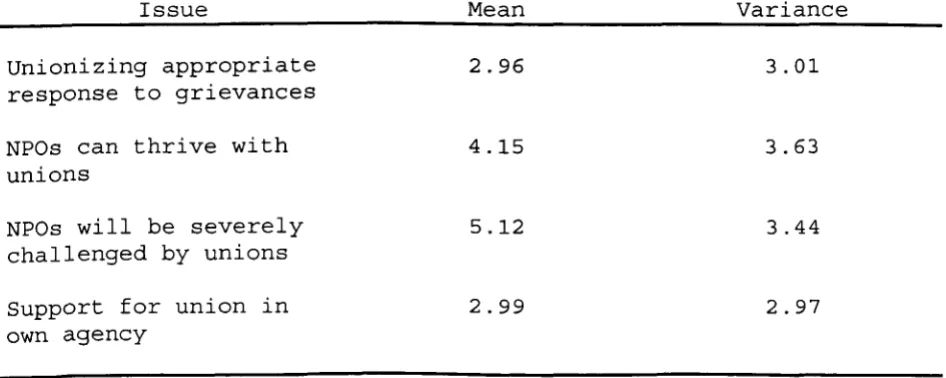
Question 13 asked executive directors to agree or
disagree on a Likert-style scale with six statements
pertaining to nonprofit unionization. This question gathered
the opinions of executive directors about the
union motivation, and the future impact of organizing on the
social services.
The last structured question, number 15, reflected the
researcher's aforementioned partnership with the Support
Center for Nonprofit Management (now CompassPoint Nonprofit
Services), asking executive directors what kinds of
technical assistance would help them address current or
potential union activity at their sites.
Finally, in question 16, respondents were encouraged to
write additional thoughts or concerns about the issue. These
were reviewed to complement and reinforce the collected
data, and appear unedited in Appendix A.
Operational Definitions of Relevant Variables
To examine any relationship between the government's
contracting out to nonprofits for human services and
unionization activity, the extent of each organization's
public funding was determined. The following nominal
categories captured reliance upon various funding sources:
fee-for-service; individual, foundation, and corporate
contributions and grants; public contracts with the city,
state, or federal government; and, other. These all
represent standard funding language in the nonprofit sector.
Other factors considered were each agency's overall
Budget meant a total annual operating budget. Staff size
referred to the number of paid part-time and full-time staff
that an agency employed. Master's/licensed referred to those
staff who have a master's degree and/or a license to provide
specific social services such as counseling or therapy.
Subjective questions used non-technical language to
determine executive directors' knowledge base regarding
unionization, their level of preparedness for future
organizing, and the respondents' opinions of the impact of
unionization on the nonprofit social services sector.
Treatment of Data
First, to provide a snapshot of the level of union
activity among San Francisco's social service nonprofits,
percentages of responses were computed for social service
nonprofits experiencing union activity and those already
unionized. A primary inquiry of the research was whether or
not the higher the percentage of public money a social
service nonprofit received, the higher the likelihood that
it had experienced union activity or been unionized. For
this purpose, categories suggesting any level of union
activity were collapsed. Cross-tabulation of union activity
and government funding data established the level of
association. Pearson's chi-square was utilized to test
Union activity data was compared with each of the three
additional organizational characteristics being considered
(budget size, staff size, and degree level) using
cross-tabs. Pearson's chi-square tested significance. This
established which, if any, of the factors had the strongest
association with union activity at social service
organizations in San Francisco.
The remaining responses allowed the researcher to
capture the extent to which executive directors are
discussing potential unionization with their staffs, their
perceptions of employee concerns that could lead to union
organizing, and their personal beliefs about the potential
impact of a unionized nonprofit workforce. These responses
were discussed with percentages and measures of central
tendency including ~ and variance.
Finally, any relevant narrative comments were quoted
anonymously from the surveys to capture the opinions and
concerns of executive directors in their own language,
enriching the quantitative analysis.
Limitations of the Study
There were three primary limitations to this research.
First, the research instrument did not ask nonprofit
employees themselves why they are, or are not, seeking union
management perspective. Questions regarding staff motivation
for union organizing were included, but the fact that
executive directors were making the assessment allows for a
management bias. However, regardless of accuracy, what
executive directors believe to be the motivations for labor
organizing will have a significant impact on their response
to the issue.
A related limitation stemmed from having executive
directors as respondents. It is possible that some executive
directors were unaware of pre-election union activity at
their agencies. Employees may have been meeting with union
representatives off-site or in secret; or, some executive
directors may have preferred to conceal pre-election
activity hoping it was insignificant and would not lead to
anything. Also, there was the political and highly sensitive
nature of the subject matter; to what extent this factor
influenced the survey responses of nonprofit executive
directors is unknown. This could be especially true for
those agencies that rely significantly upon city contracts
for survival. Overall, relying upon executive directors1
assessment may have led to under-reporting of current and
potential union activity among social service nonprofits.
Finally, this study focused on San Francisco
exclusively. Because of the city1s history of supporting
unions and its significant reliance upon nonprofit
results may not be generalizable to other communities. While
other major cities such as New York and Los Angeles are
currently experiencing similar labor movements, this study
reflects the economic and political environment of San
CHAPTER FOUR: RESULTS
Basic agency descriptors such as staff and operating
budget size were considered as potentially associated with
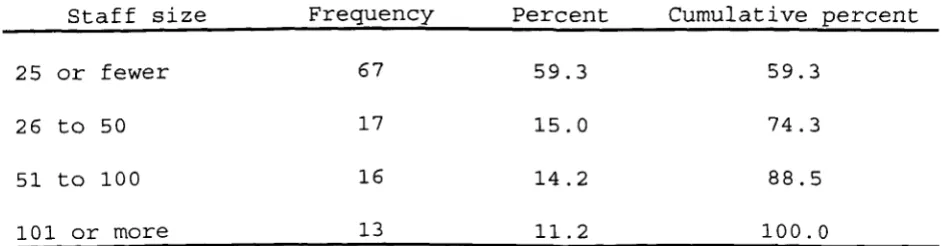
the likelihood of union activity. The majority of the social
service nonprofits in the study had small staffs. Fifty-nine
percent had staffs of fewer than 25 people, while just 11.5
percent had staffs of more than 100 people. The extent of
professional staff (defined as having a Master's degree
and/or professional license) was limited. For 65% of
responding organizations, advanced degree holders make up of
less than 25% of the staff.
Table 1
Size of Paid Staffs among Participating Agencies
Staff size Frequency Percent Cumulative percent
25 or fewer 67 59.3 59.3
26 to 50 17 15.0 74.3
51 to 100 16 14.2 88.5
101 or more 13 11.2 100.0
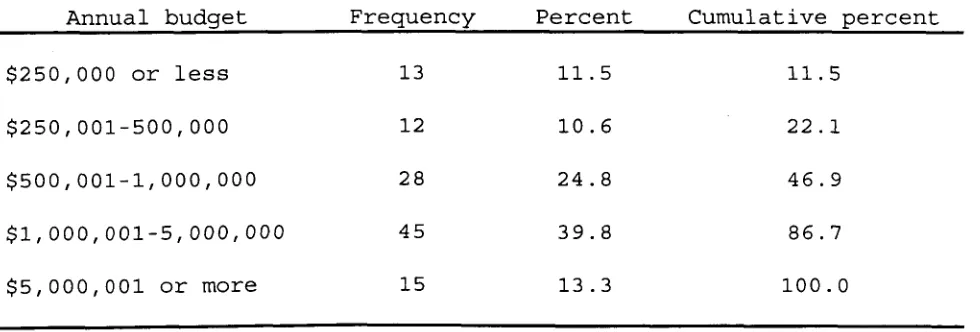
The annual budgets of most participating agencies were
substantial. Forty percent of the respondent agencies had
annual budgets in the $1,000,001 to $5,000,000 range, and
65% of respondents' budgets were between $500,001 and
$5,000,000.
Table 2
Size of Annual Budgets Among Participating Agencies
Annual budget Frequency Percent Cumulative
$250,000 or less 13 11.5 11.5
$250,001-500,000 12 10.6 22.1
$500,001-1,000,000 28 24.8 46.9
$1,000,001-5,000,000 45 39.8 86.7
percent
$5,000,001 or more 15 13.3 100.0
N=113
Scope of Union Activity
Of the 113 reporting agencies, 24, or 21%, had
experienced union activity; 15 were completely or partially
unionized; 4 were experiencing a unionization attempt; and 5
had rejected a union. That unionization was present to such
This is a topic just now drawing focused attention from
nonprofit scholars, the media, and practitioners.
Moreover, 40% of executive directors of nonunionized
agencies believed that there was some likelihood of labor
organizing at their site within the next two years. There
were 91 valid responses to the question regarding perceived
likelihood of future unionization. Sixty percent of the
executive directors believed that a unionization attempt
within their agencies was not likely at all. Of the 40% who
did believe that unionization was a possibility, 31% thought
it was somewhat likely, 7% thought i t was likely, and 2%
thought i t was very likely.
In addition to this baseline data, any relationship
between the aforementioned organizational characteristics of
staff and budget size and the experience of union activity
among the responding organizations was explored. The
variables of staff size and budget size were each
cross-tabulated with union activity. For this purpose, union
activity data collected from survey questions 6 and 7 were
collapsed: any organization that was unionized, going
through an organizing drive, or that had rejected a
unionization attempt was considered to have experienced
The Pearson's chi square yielded valid significance
levels of less than 0.05 in each case. Agency size was
recoded into three groups: staffs of 25 or fewer, 26 to 50,
and 51 or larger. Cross-tabulation of this recoded variable
and union activity found that 50% of cases experiencing
union activity had a staff size of greater than 50 people,
while just 19% of cases not experiencing union activity were
as large. In this case, one cell, or 16.7%, had an expected
value of less than 5. This falls within the acceptable range
(20% of cases or fewer) thus eliminating " small sample
size" as a reason to accept the null hypothesis. Pearson's
chi square established a significance of 0.001, and the null
hypothesis was rejected.
Table 3
Cross-tabulation of Staff Size and Union Activity
Union activity 25 or fewer 26-50 51 or more
No
Yes
Pearson chi-square 0.001 N==113
61 11
6 6
Also significant was the association between annual 17
12
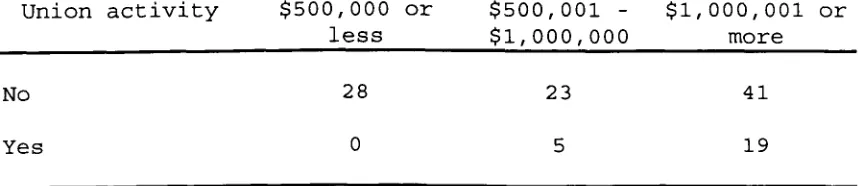
recoded into three categories: $500,000 or less, $500,001 to
$1,000,000, and $1,000,001 and above. Cross-tabulation of
these variables found that none of the agencies that had
experienced union activity fell into the smallest budget
category of $500,000 or less; whereas 28% of those
organizations with no union activity had annual budgets of
less than $500,000. Moreover, 79% of agencies that had
experienced union activity were in the largest budget size
category, compared with 46% of those organizations with no
union activity. Pearson's chi square established a
significance of 0.004, and the null hypothesis was rejected.
Table 4
Cross-tabulation of Annual Budget Size and Union Activity
Union activity
No
Yes
$500,000 or less
28
0
Pearson chi-square 0.004 N=113
$500,001 -$1,000,000
23
5
$1,000,001 or more
41
19
These associations are in line with expectations. It is
logical that labor unions would be more likely to organize